


Guide overview
What changes your EOR currency cost?
Check the agreed rate and any separate fees.
EOR currency costs can be included in the exchange rate, charged separately, or both. Match the same payment in both currencies, calculate the implied rate and compare it with the agreed rate-setting method. For scale, 1% on US$10,000 converted is US$100; an unexplained rate difference still needs reconciliation.
Rate source
Ask for the benchmark
Record the source against which conversion will be checked.
Fixing time
Agree the timestamp
Identify when the provider sets the exchange rate.
Separate fees
Check both charge routes
Distinguish an embedded rate markup from a separate fee.
Invoice review
Reconcile the conversion
Check each invoice against the agreed method and funding amount.
Check before acting
Treat an unstated percentage as unknown. Get the source, fixing time and separate charges in writing.
What to record in the worksheet
Scope
FX input · Value · Meaning / evidence
Evidence and follow-up
Calculate the conversion cost on one invoice
At a benchmark of 100 local units per USD, 100,000 local units come to USD 1,000. Suppose the EOR invoices USD 1,030 for the conversion and USD 10 for the transfer. You pay USD 1,040 in total. Of that, USD 10 is an identifiable fee. The other USD 30 is a 3% difference from the benchmark. Check that your agreement uses that rate and fixing time before treating the difference as a markup.
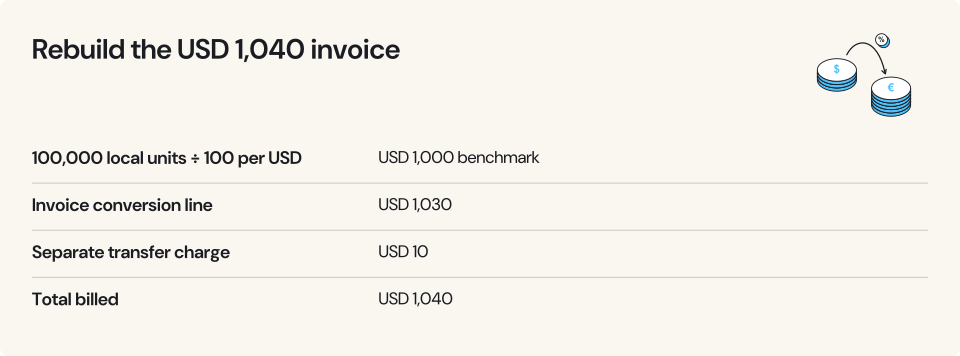
What to record for the calculation
Use one payment and one quotation direction throughout. Separate an identifiable fee from a difference that still needs an explanation.
| Input | What to record | Check |
|---|---|---|
Input
Amount to be paid locally
|
What to record
Payroll or other agreed amount in the destination currency.
|
Check
Exclude unrelated invoice lines.
|
Input
Amount funded
|
What to record
Matching amount in the invoice or funding currency.
|
Check
Separate transfer fees and other adjustments.
|
Input
Implied exchange rate
|
What to record
Funding amount ÷ destination-currency amount.
|
Check
Label the units, such as USD per EUR.
|
Input
Contractual comparison rate
|
What to record
Agreed benchmark, fixing time and any forward-rate method.
|
Check
Use the same direction and the agreed transaction basis.
|
Input
Unexplained difference
|
What to record
Funding minus the comparable amount at the agreed rate.
|
Check
Reconcile timing, stated spread and separate fees before calling it an overcharge.
|
Input
Recurring budget effect
|
What to record
Verified charge × the relevant number of payments.
|
Check
Do not annualize an unusual payment as if it were normal.
|
For a purely illustrative $10,000 amount converted every month, each 1 percentage point costs $100 a month or $1,200 a year.
Hypothetical monthly charges in USD. One common scale, starting at $0; percentages are examples, not provider quotes.
Calculated as the amount converted multiplied by the assumed percentage. Actual charges depend on the currency route and the agreed rate method.
Which amounts and currencies are being converted?
When you fund the EOR in one currency and it pays employees in another, who converts the money? The provider may bill a conversion fee, build a markup into the rate, or do both. Ask it to show which of those charges applies to your payment.
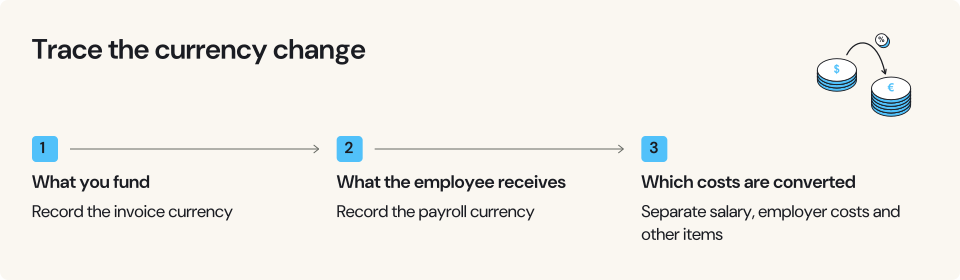
Unlike the service fee, a percentage conversion charge depends on the amount converted, which may include salary, employer contributions, benefits or other payments. Do not assume every invoice line is converted. Our hidden-fees guide explains how to separate service charges, employment costs and funding requirements.
Check the rate source, fixing time and separate fees
Record the invoice currency, payroll currency and funding route. If you fund in the payroll currency, the provider may not need to convert that payment, though your bank or payment provider may still charge you.
Find out when the provider fixes the rate. It could be the day it invoices you, the day your funds arrive, settlement or another time specified in the agreement. Ask whether it uses a spot, forward or billing-period rate and whether it can adjust that rate later. These details tell you which calculation to reproduce when the invoice arrives.
When a reference rate is a useful comparison
A mid-market rate generally sits between the quoted buying and selling rates. It is useful for comparison, but you may not be able to trade at it. Different sources, fixing times and transaction arrangements can also produce different rates.
The European Central Bank normally updates its euro reference rates around 16:00 CET on working days, except TARGET closing days. It publishes them for information and discourages their use for transactions. Compare the same currency pair in the same direction at the relevant date or fixing time. If your contract specifies a forward rate or a different benchmark, ask the provider to show you the calculation using that method.
Compare providers’ published EOR FX policies
Published FX policies range from zero markup to a conversion or FX processing fee, and for several providers the pages we checked on 24 September 2026 give no percentage. Treat a missing percentage as unknown rather than zero, and ask each provider for the terms that apply to your currency pair and funding route.
Our provider ratings show the order in which we recommend providers overall. They are not scores for an individual fee, contract term, certification or country. “Not rated” means we have not published a rating.
Pricing & terms
Published FX policy or terms to confirm
Publishes zero FX margin across currency pairings. Confirm the agreed reference rate and invoicing terms.
Published EOR service price
From EUR 560 per employee/month; monthly terms. Confirm the country quote.
Our rating
Not rated
![]()
Reviewed by Martynas Pupkevicius · Fact-checked by Michael Ennis
★★★★★4.5
Pricing & terms
EOR fee from
USD 699
USD 699 on monthly billing; annual seats are priced by quote, prepaid and non-refundable, with seat reuse permitted.
Published FX policy or terms to confirm
Charges a conversion fee when you pay in a currency other than the contract currency. The cited pages give no standard percentage.
Our rating
4.5/5
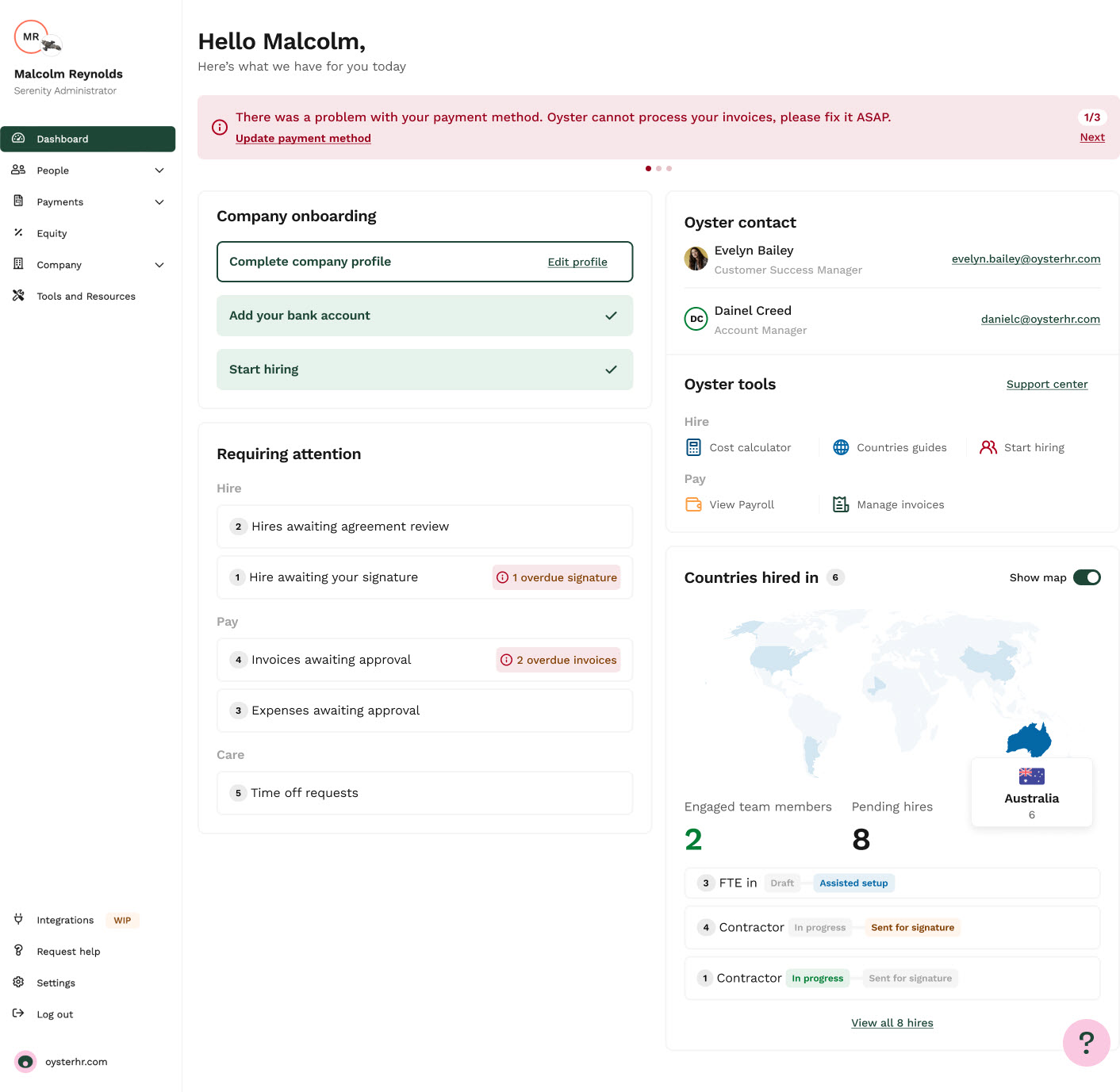
Oyster dashboard
Enlarge screenshot
![]()
Reviewed by Martynas Pupkevicius · Fact-checked by Michael Ennis
Opens oysterhr.com

★★★★★4.0
Pricing & terms
EOR fee from
USD 579
The standard fee is USD 579 per employee per month. Eligible companies headquartered outside Canada may pay USD 399 on EOR fees billed through 31 December 2026; USD 579 applies from 1 January 2027. Country and employment-type exceptions apply.
Published FX policy or terms to confirm
The cited page gives no EOR FX percentage, and the wording “no hidden markups” does not mean the EOR FX charge is zero.
Our rating
4.0/5
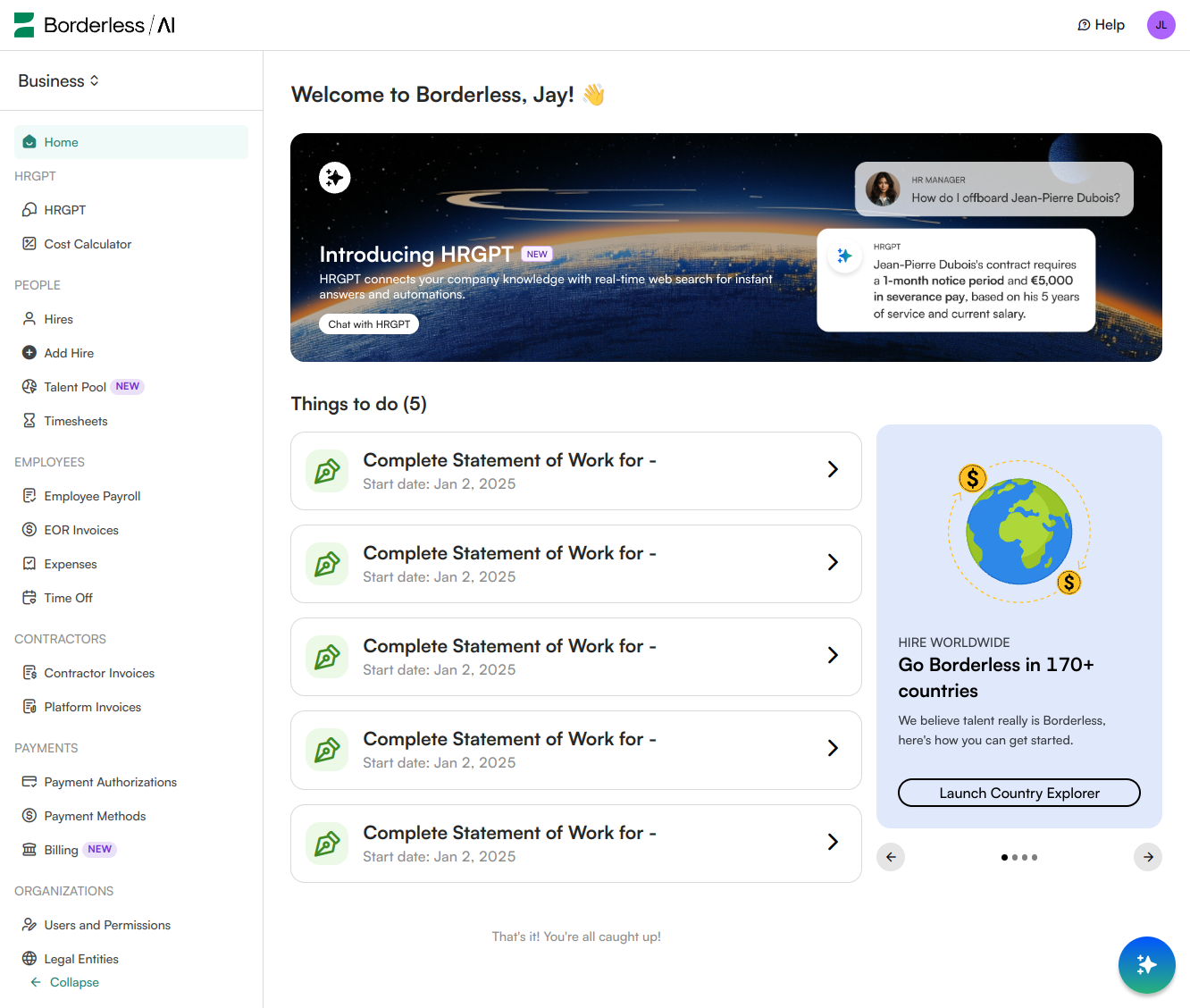
Borderless AI dashboard
Enlarge screenshot
![]()
Reviewed by Martynas Pupkevicius · Fact-checked by Michael Ennis
Opens hireborderless.com
★★★★★4.7
Pricing & terms
EOR fee
From USD 599
Per employee per month; month-to-month pricing available; mandatory Employer Liability Cost is additional
Published FX policy or terms to confirm
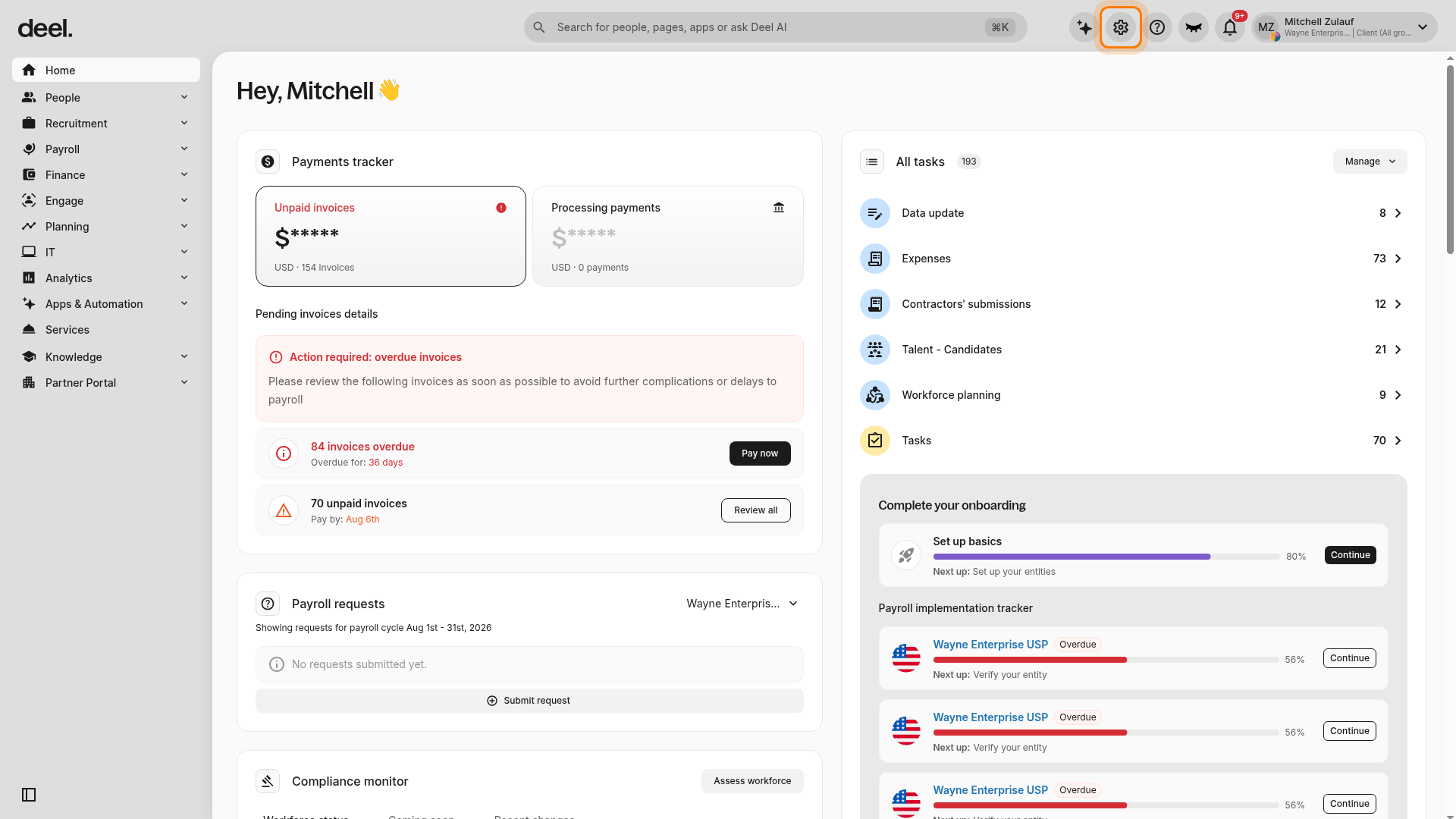
Uses forward rates when you fund an invoice in another currency, and funding in the invoice currency avoids that conversion. Payment-method fees are separate, and the policy gives no universal spread.
Our rating
4.7/5
Deel dashboard
Enlarge screenshot
![]()
Reviewed by Martynas Pupkevicius · Fact-checked by Michael Ennis
Opens deel.com

★★★★★4.1
Pricing & terms
EOR fee from
$499
Core costs $499 per employee per month with monthly billing, or $459 per employee per month billed annually. Confirm the dollar currency, country adjustments, implementation charges and mandatory add-ons.
Published FX policy or terms to confirm
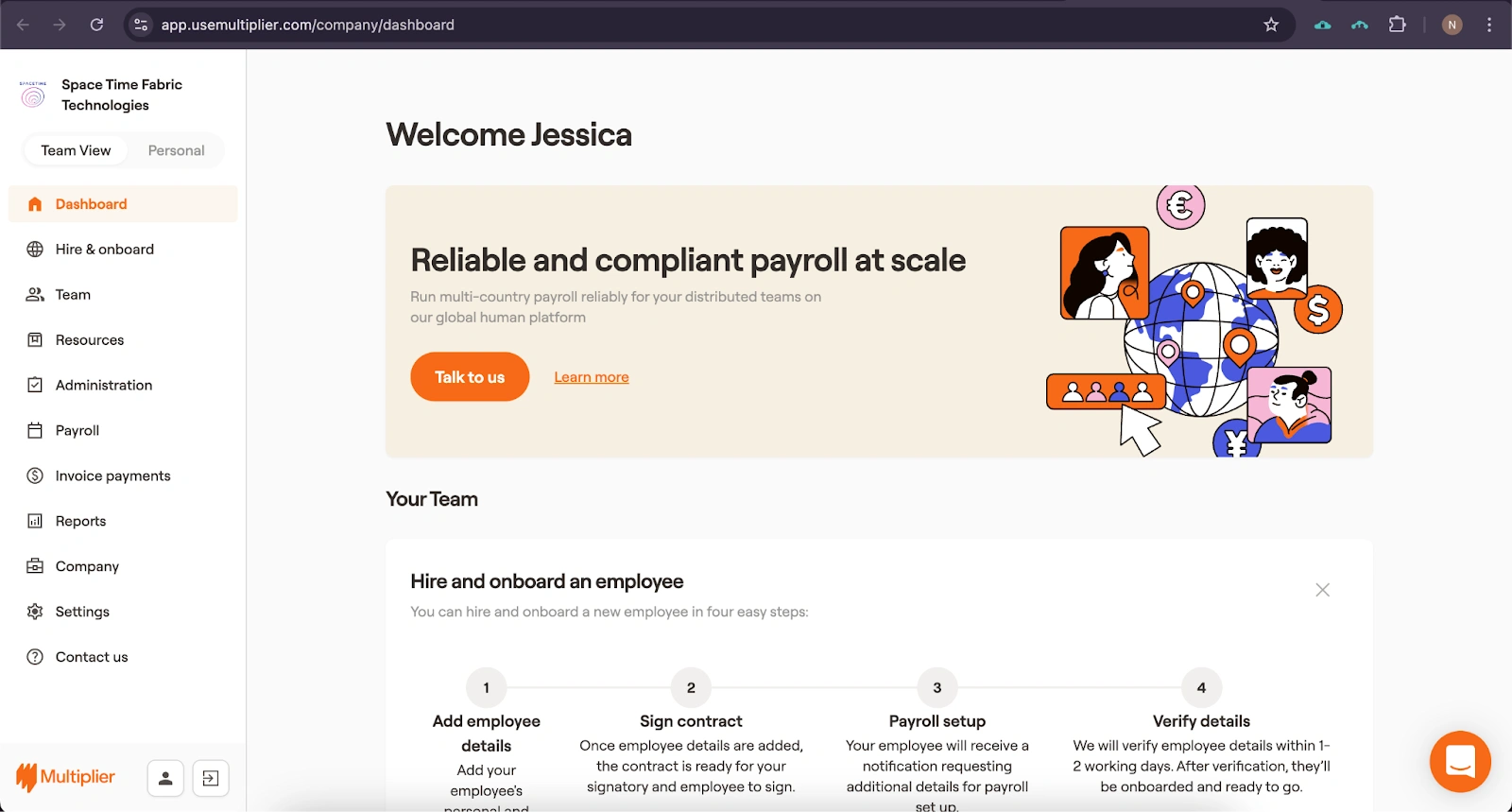
Its FAQ says it uses the prevailing mid-market rate without a markup. Its general terms say Multiplier determines the exchange rate before invoicing, so confirm the reference rate and fixing time.
Our rating
4.1/5
Multiplier dashboard
Enlarge screenshot
![]()
Reviewed by Martynas Pupkevicius · Fact-checked by Michael Ennis
Opens usemultiplier.com

★★★★★4.9
Pricing & terms
EOR fee
from USD 499
Global from USD 499; Select from USD 199 for eligible countries and salary ranges, per employee per month. Confirm country rate and commitment.
Published FX policy or terms to confirm
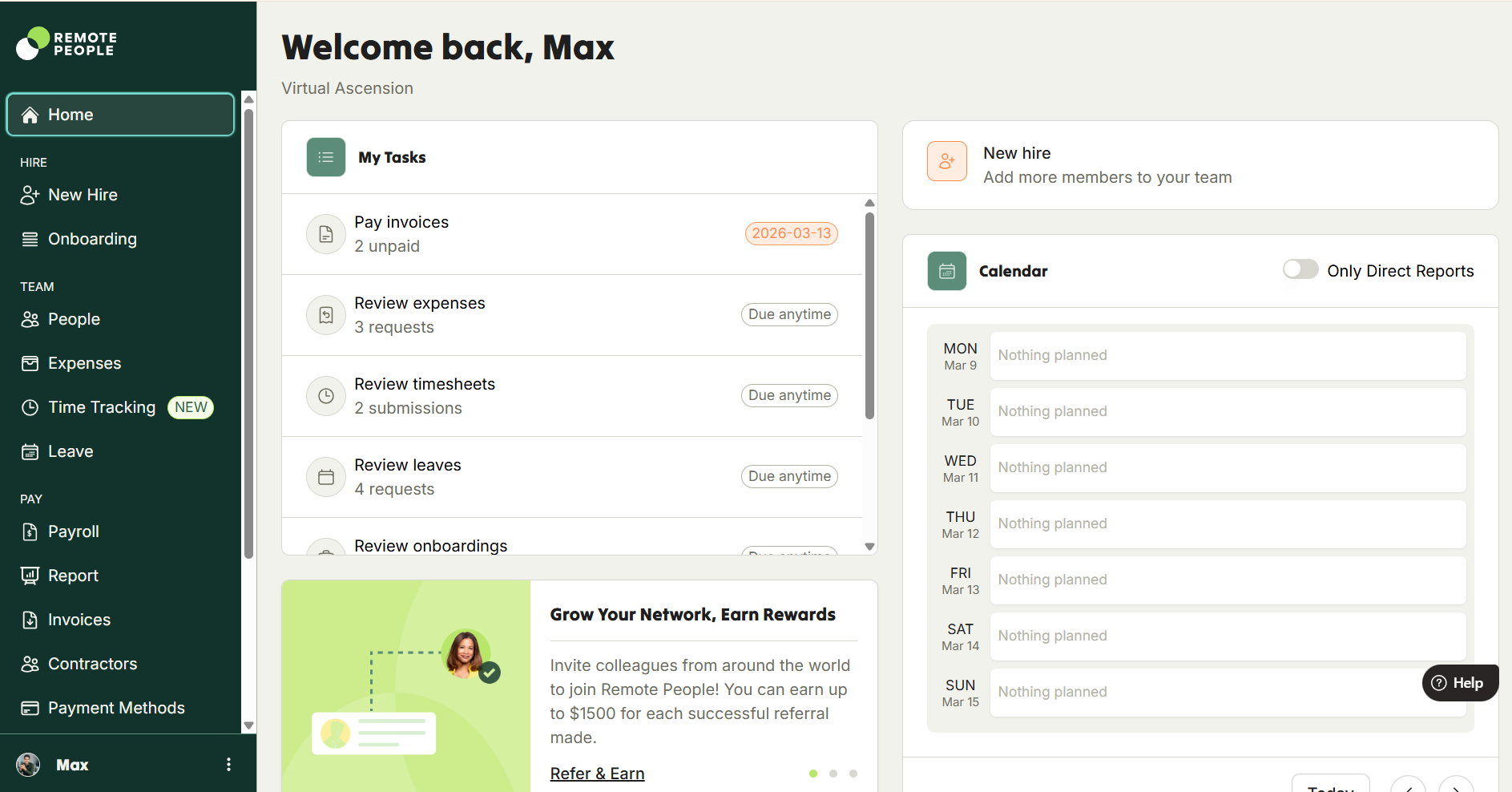
Use the applicable agreement for the conversion basis and any separate charges.
Our rating
4.9/5
RemotePeople dashboard
Enlarge screenshot
![]()
Reviewed by Martynas Pupkevicius · Fact-checked by Michael Ennis
Opens remotepeople.com

★★★★★0.5
Pricing & terms
EOR fee
From USD 199
Per employee per month; no annual contract or minimum headcount advertised. Country requirements may affect the quote.
Published FX policy or terms to confirm
⚠ Trustpilot warning: rating suspended for a breach of its guidelines; fake reviews removed (8 Nov 2026).
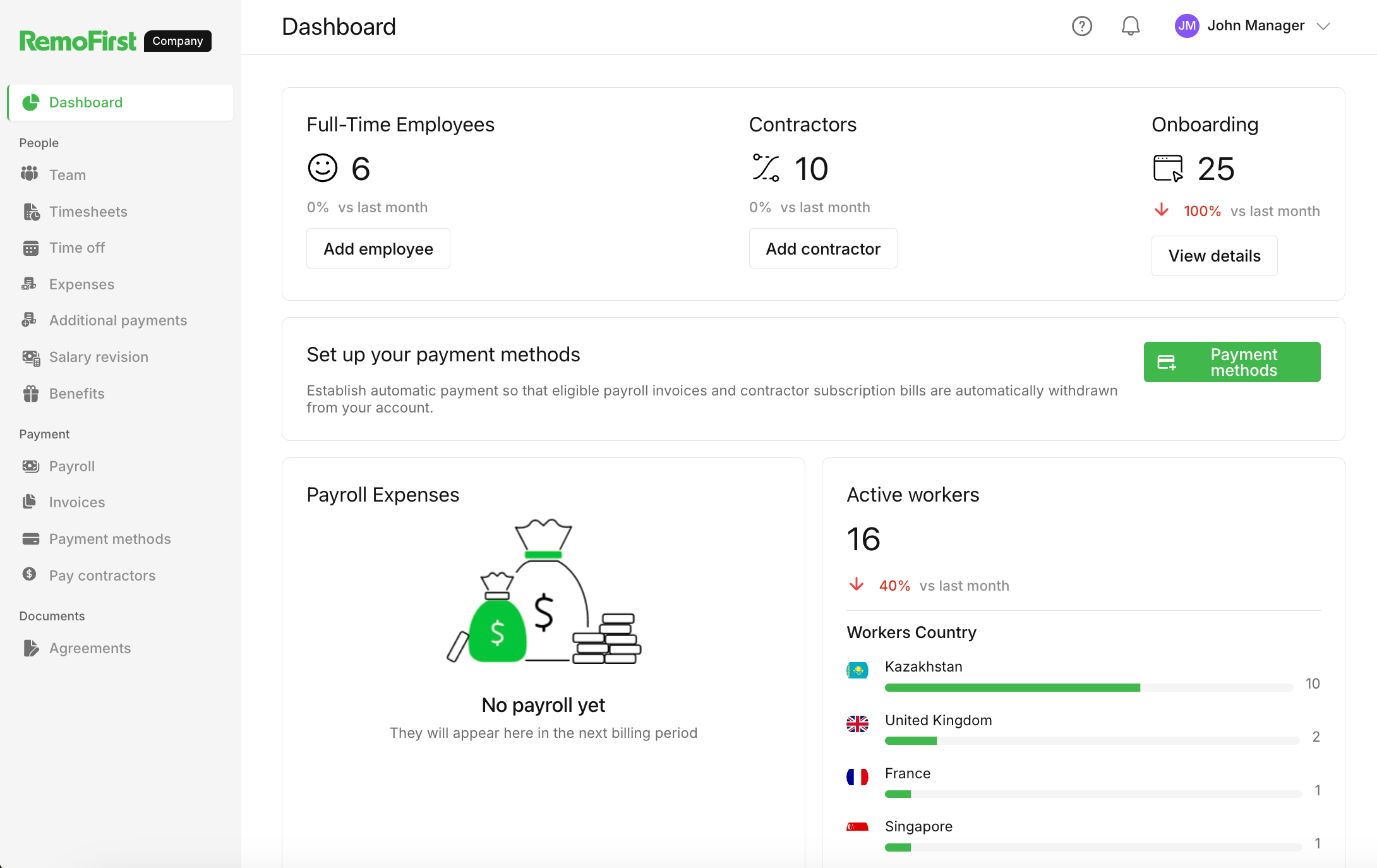
The cited page gives no standard EOR FX percentage. Confirm the rate-setting method and charges.
Our rating
0.5/5
RemoFirst dashboard
Enlarge screenshot
![]()
Reviewed by Martynas Pupkevicius · Fact-checked by Michael Ennis
Opens remofirst.com

★★★★★4.1
Pricing & terms
EOR fee
From USD 499
Per employee per month; the country quote sets the billing commitment.
Published FX policy or terms to confirm
Its policy describes a market-based reference rate plus an FX processing fee. EOR rates include hedging components and may vary by country, and the policy gives no single percentage.
Our rating
4.1/5
Papaya Global dashboard
Enlarge screenshot

![]()
Reviewed by Martynas Pupkevicius · Fact-checked by Michael Ennis
Opens papayaglobal.com

★★★★★4.5
Pricing & terms
EOR fee
From USD 499
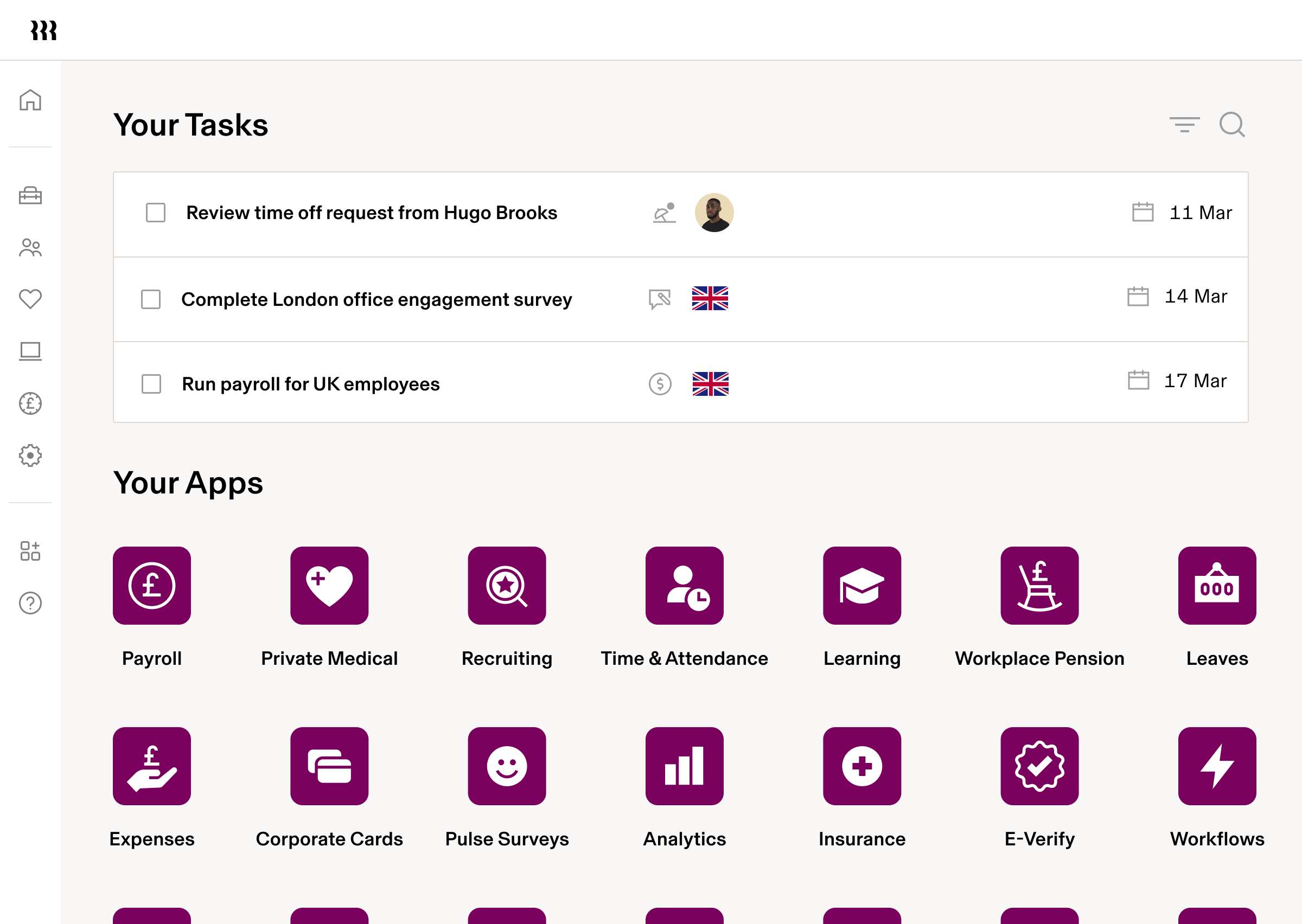
Per employee per month, plus the required Rippling Platform from $8 per employee per month and a monthly base fee.
Published FX policy or terms to confirm
The cited pages give no standard EOR FX percentage. Request the applicable currency and fee schedule.
Our rating
4.5/5
Rippling dashboard
Enlarge screenshot
![]()
Reviewed by Martynas Pupkevicius · Fact-checked by Michael Ennis
Opens rippling.com

★★★★★4.2
Pricing & terms
EOR fee from
USD 599
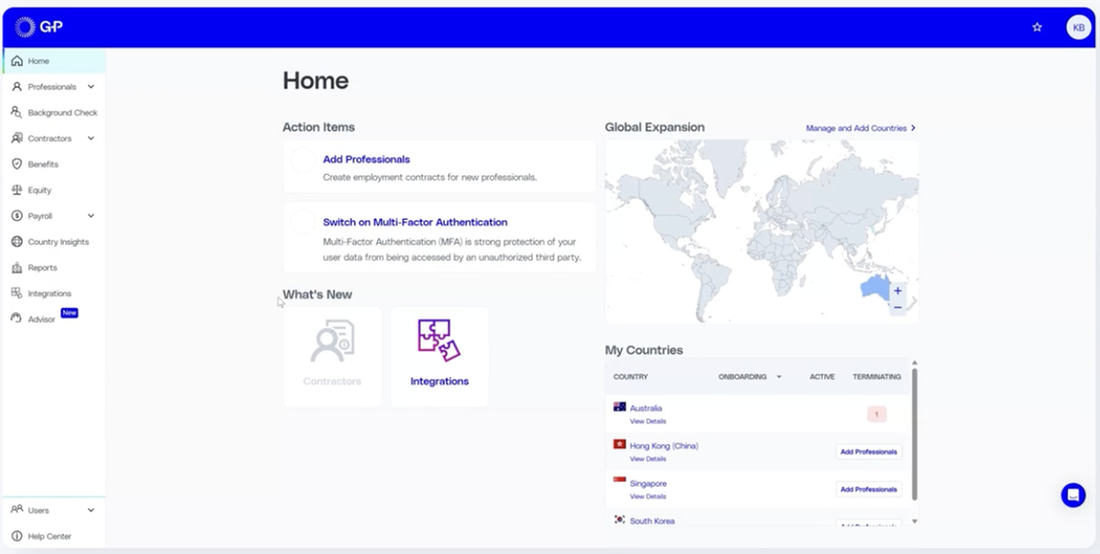
Starts at USD 599 per employee per month, with no minimum EOR hire duration advertised. Confirm the commercial terms.
Published FX policy or terms to confirm
The cited page gives no standard EOR FX percentage. Confirm conversion and payment terms in the proposal.
Our rating
4.2/5
G-P dashboard
Enlarge screenshot
![]()
Reviewed by Martynas Pupkevicius · Fact-checked by Michael Ennis
Opens globalization-partners.com

★★★★★4.2
Pricing & terms
EOR fee from
$399
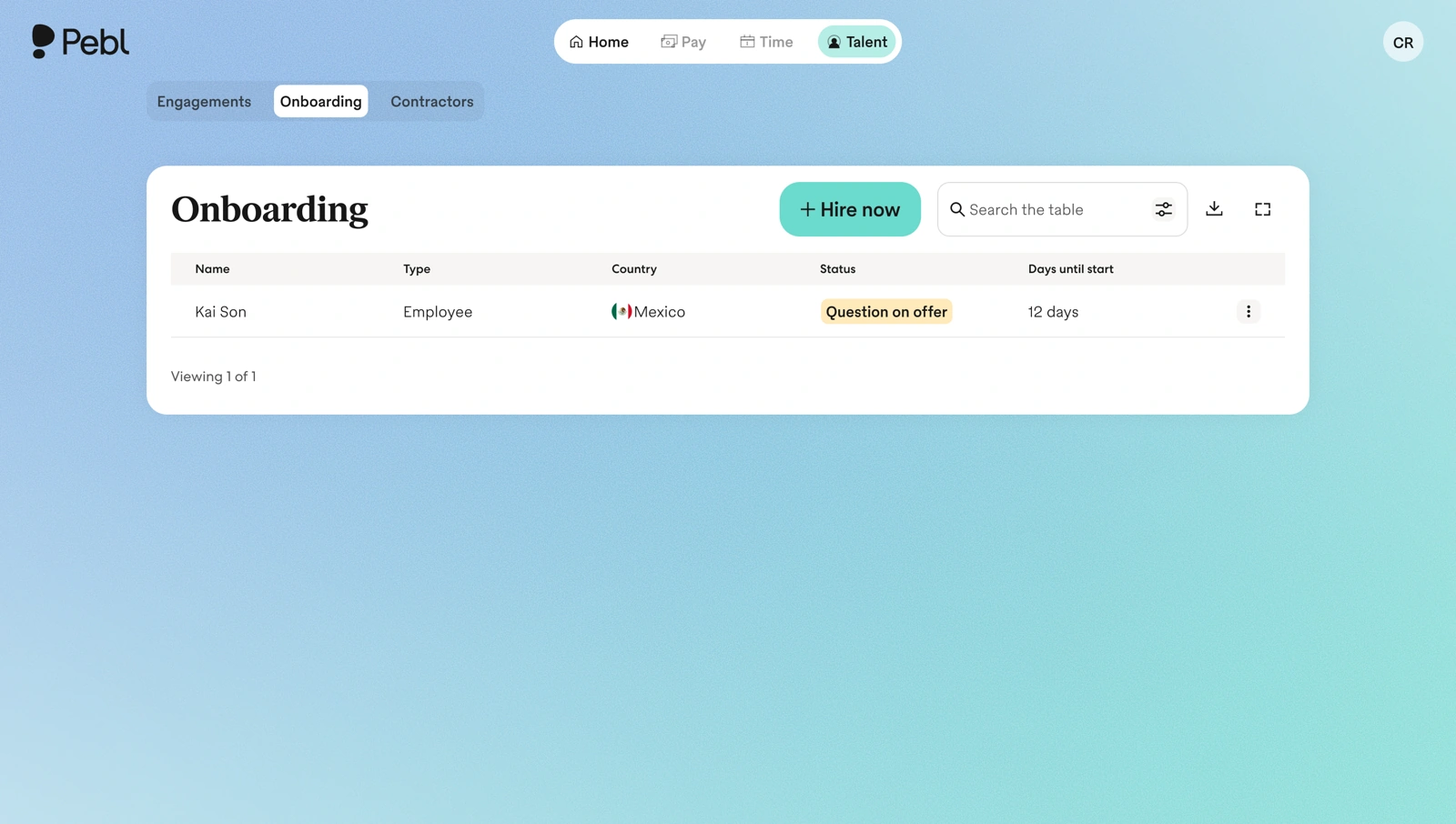
The advertised fee is $399 per employee per month. Confirm the country price, dollar currency, billing commitment, offer duration and renewal price in the quote.
Published FX policy or terms to confirm
The cited page gives no standard EOR FX percentage. Confirm the currency pair, rate source, fixing time and charges.
Our rating
4.2/5
Pebl onboarding
Enlarge screenshot
![]()
Reviewed by Martynas Pupkevicius · Fact-checked by Michael Ennis
Opens hellopebl.com
Fig. 1 · Official sources checked on 24 and 30 September 2026; Teamed’s price and FX policy rechecked on 15 October 2026; Rippling and Papaya Global prices on 8 November 2026. Service fees and stated billing terms for the reviewed providers were rechecked on 1 November 2026; Teamed’s EUR 560 starting fee, monthly terms and zero-FX-markup claim were also rechecked on 1 November 2026. USD is used only where established; confirm the dollar currency for Multiplier and Pebl. FX-policy dates remain unchanged. Policies are summarized from each provider’s published sources. Service fees exclude salary, statutory employer costs and other quoted charges.
Compare providers on the same currencies, funding amount and rate-setting method, and do not assume that a lower service fee means a higher FX cost.
Estimate the annual cost of an agreed FX charge
Suppose the EOR charges 2% to convert a monthly salary of $5,000. That costs $100. If it also converts $1,250 in employer costs, an illustrative 25% allowance, you pay 2% on $6,250 and the charge comes to $125.
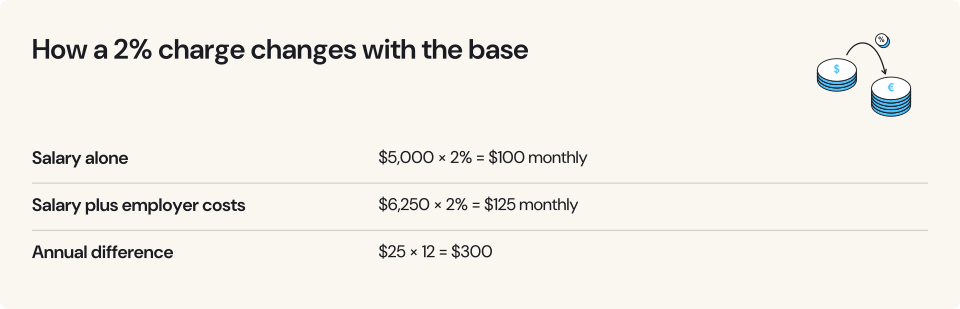
On the same assumptions, a 2% charge matches a $199 monthly service fee once converted funding reaches $9,950 a month, which corresponds to a $95,520 annual salary. At 3%, the charge reaches $199 at a $63,680 salary.
Figures are calculated on unrounded monthly funding and rounded to the nearest dollar, and bold values exceed an assumed $199 monthly service fee.
| Assumed annual salary | Assumed converted amount/month | Hypothetical 1% | Hypothetical 2% | Hypothetical 3% |
|---|---|---|---|---|
Assumed annual salary
$60,000
|
Assumed converted amount/month
$6,250
|
Hypothetical 1%
$63
|
Hypothetical 2%
$125
|
Hypothetical 3%
$188
|
Assumed annual salary
$80,000
|
Assumed converted amount/month
$8,333
|
Hypothetical 1%
$83
|
Hypothetical 2%
$167
|
Hypothetical 3%
$250
|
Assumed annual salary
$100,000
|
Assumed converted amount/month
$10,417
|
Hypothetical 1%
$104
|
Hypothetical 2%
$208
|
Hypothetical 3%
$313
|
Assumed annual salary
$120,000
|
Assumed converted amount/month
$12,500
|
Hypothetical 1%
$125
|
Hypothetical 2%
$250
|
Hypothetical 3%
$375
|
Fig. 2 · Hypothetical monthly conversion charges on salary plus an assumed 25% employer-cost allowance. Salary, employer costs and service fees are additional.
For the example’s $10,416.67 in monthly funding, one provider charges a $400 service fee and 0.7% for conversion. That comes to about $473. The other charges $199 for the service and 3% for conversion, or about $512 in total. These are hypothetical service and conversion charges only. Add employment funding and any other charges separately.
Scaling the model to ten $60,000 salaries gives $750,000 converted annually: $15,000 at 2% or $22,500 at 3%. The EOR cost calculator can help you structure a budget, but take current rates and employment costs from written quotes.
What zero FX markup and zero transfer fees cover
A provider promising “zero transfer fees” might still convert payroll at a rate that includes a margin. If it promises “zero FX markup,” ask which rate it uses and whether your bank will charge separately. Get the currency pair, funding route, billing plan, fixing time and exclusions in the order form so you can check the promise against a payment you actually make.
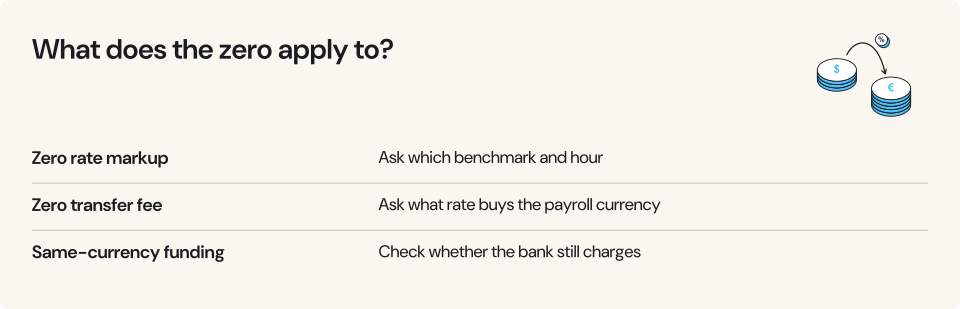
Contractor payouts, EOR payroll and same-currency funding may use different terms, so check which product and payment route a policy covers. Record the policy date and recheck it when your plan, currency or provider arrangement changes. Do not carry an old assumed FX percentage into a new contract.
Check an EOR invoice in four steps
Start with an invoice, the matching payroll record and the contract’s currency terms. You may also need the provider’s rate calculation and fixing time.
Run the check on several payments using the agreed fixing date for each. If the provider hasn’t shown the local amount, rate or calculation, request an itemized reconciliation. A difference between months could come from market movements, a different funding route, timing or a change in fees. Ask the provider to identify which changed.
Agree auditable currency terms before signing
Put the currency terms in the agreement or an incorporated schedule. A provider may agree to a cap, a different funding route or more detailed reporting. Weigh anything agreed against the rest of the commercial terms.
Agree these four terms: 1) The rate source (a benchmark that suits the transaction), quotation direction and fixing date or time. 2) Any spread, conversion fee and separate transfer charges, including how a cap would be calculated. 3) The amounts and rate information shown on each invoice or reconciliation. 4) How questions, corrections and credits are handled, including deadlines.
Keep currency costs, service charges and employment liabilities separate when you compare quotes for the same hire. For the other terms to compare, see how to read an EOR pricing sheet.
A currency-terms request you can reuse
“Please use our payroll amount to show how you would calculate the invoice. Which currencies would you use, in which direction, and when would you fix the rate? Identify the rate source, the amount converted, any spread and any separate payment fee. How would you treat a refund or correction? Please point us to the contract clause and show how we could reconcile the final invoice.” Keep the reply with the quote.
Download the EOR FX reconciliation worksheet
Use the same currency direction, amount and contractual conversion date for the invoice and benchmark. Keep the conversion amount separate from a disclosed transfer fee. The model uses local units per billing-currency unit and calculates the billing-currency difference and percentage.
| The working record | Fields to complete |
|---|---|
The working record
Scope
|
Fields to complete
FX input · Value · Meaning / evidence
|
EOR currency conversion FAQs
Is FX markup the same as a wire or transfer fee?
What is a fair FX markup for an EOR?
Can I pay my EOR in the employee's currency and skip the markup?
How can I check the conversion cost on an invoice?
Does FX markup apply to the EOR management fee itself?
Sources and policy check dates
The sources behind this guide, grouped by topic. Dates show when we last checked a page. Prices and terms change, so confirm them in your quote.
Exchange-rate reference
1 sourceEuropean Union · European Central Bank (ECB)
Euro foreign exchange reference rates
Informational rates that support a benchmark comparison, not a claim that a transaction could have executed at that rate.
Provider pricing and FX policies
11 sourcesBorderless AI
Checked 24 Sep 2026
Deel
Checked 24 Sep 2026
G‑P
Checked 24 Sep 2026
Multiplier
General Terms section 3.4 converts into the billing currency “using an exchange rate determined by Multiplier prior to invoicing”. Checked 24 Sep 2026
Oyster
Checked 24 Sep 2026
Papaya Global
PricingExchange-rate policyEOR cost guide
EOR from $499 per employee per month on the pricing page (rechecked 8 Nov 2026). The country quote must establish the billing commitment and determines additional charges. Other pages checked 24 Sep 2026.
Pebl
Checked 24 Sep 2026
RemoFirst
Checked 24 Sep 2026
RemotePeople
Global and Select pricing and eligibility. Checked 1 Nov 2026
Rippling
EOR pricingPricingRippling vs. Deel comparison
EOR from USD 499 per employee per month; plans start at $8 per employee per month plus a monthly base fee (checked 8 Nov 2026). The Rippling vs. Deel comparison gives EOR pricing “starting at $499 per employee, per month” (checked Sep 2026).
Teamed
Price and FX policy rechecked 15 Oct 2026, when the pricing page displayed an EOR starting fee in EUR, and again on 1 Nov 2026.
Our research
1 sourceThe Best EOR
The calculations in this guide are hypothetical illustrations, separate from historical tests or claims elsewhere on the site.
The model uses explicitly assumed rates, employment-cost allowances and funding amounts; replace them with the terms and amounts for your hire. Provider policies, plan availability and currency arrangements can change, so retain the quote and policy version that apply to your agreement.
If you spot a changed price or a conflicting source, send it through the contact page and we’ll review it.
This guide is for general information only and does not provide legal, tax, accounting, or financial advice. For advice about your business, consult a qualified professional familiar with the rules where you hire. Read our research methodology to learn how we assess sources.