TheBestEOR

Best Employer of Record in Argentina

Written by Martynas PupkeviciusFact-checked by Michael Ennis
Picture of Martynas Pupkevicius
Martynas Pupkevicius

EOR Advisor and Remote Work Editor

Our top employer of record in Argentina for 2026 is RemotePeople, from USD 499 per employee a month, ahead of Deel and Rippling.

We tested all 10 providers with paid client accounts, real quotes and a live hire run through payroll. Argentine employers pay the aguinaldo bonus in June and December, each instalment worth 50% of the highest monthly pay in that half year.

Flag of Argentina

Hiring in Argentina at a glance

Currency
ARS
Argentine peso
Pay cycle
Monthly
Daily or hourly staff paid weekly or every 2 weeks
Working hours
8 h a day
Or 48 a week, shorter for night and hazardous work
Annual leave
14 to 35 days
Calendar days, rising with length of service
Extra pay
Aguinaldo
Paid June and December, 50% of top monthly pay each
Employer costs
Social security
Plus health coverage and workplace injury insurance
Before you hire:
Confirm the union agreement, the employee’s recognized service and the salary payment currency.

Country hiring overview · Argentina

Hiring in Argentina, at a glance.

Compare the employer, the full cost and the start date.

For Argentina, I’d first establish who will employ the person and which responsibilities stay with your business. An EOR can provide local employment and payroll administration while your team directs the work. Ask how the proposed arrangement applies to the role.

Choose a hiring solution

Need a local employer?

Compare an EOR arrangement for your role before opening your own entity.

Already have a local employer?

Compare payroll and HR support against adding an EOR.

EOR service fee

Fees vary by provider.

Your quote should state the currency, fee per employee, minimum charge and billing commitment.

Onboarding

Paperwork affects the start date.

The contract, right-to-work checks, registrations and payroll deadlines all affect when employment can begin.

Employment costs

Include the 13th salary.

The employment budget includes salary, the SAC 13th salary, employer contributions and ART insurance. The provider should show each amount in the calculation.

Annual leave

Leave increases with service.

The general Labour Contract Law minimum is 14–35 calendar days, depending on length of service. Eligibility rules and different employment regimes can change what applies.

Check before choosing

Get the employer’s name, applicable collective agreement, salary and invoice currencies, deposit terms and first-payroll funding deadline in writing.

What your quote should include

Employment costs and service fees

1
Gross salary and agreed pay schedule
2
Salary, SAC, employer contributions and ART insurance
3
EOR fee: currency, per-employee billing, minimums and commitment
4
Setup, foreign exchange, extras and exit costs

Deposits and payroll funding

1
Amount and payment deadline
2
Whether funds are refundable or credited to payroll
3
Release conditions and refund timing
Show these separately from recurring expenses.

Key takeaways for hiring in Argentina

The registered employer does not absorb every client liability

Article 29 retains specified joint liability for the user company during the period the worker serves it. Request a written allocation of responsibilities and evidence of payroll compliance alongside the employer’s registration details.

Prepare for the December FAL contribution

FAL contributions begin with the December 2026 reporting period. The employer’s registration determines the rate, and the contribution appears in the social-security declaration alongside the applicable contribution offset. That distinction matters when reconciling the EOR invoice: the FAL line is not automatically an additional percentage on top of all existing employer contributions.

A severance fund is not an immediate refund

The FAL account belongs to the employer and is pooled across its workforce. It requires at least 12 complete, consecutive contribution periods before funds become available. An EOR’s customer agreement must separately explain any allocation or credit to the client; an early dismissal cannot be budgeted on the assumption that this fund will cover it.

Compare contribution bases before percentages

ARCA’s ARS 7,003.68 deduction reduces the relevant social-security contribution base. It is not a blanket exemption from every payroll charge. Request the calculation for each line, including separate health and ART amounts, so two identical headline rates do not conceal different taxable-base assumptions.

Give the immigration adviser the actual route

The contracted-worker residence procedure requires specific employer and employment evidence. Use it when that is the candidate’s route, rather than treating every foreign national as a new 23A applicant. Existing residence and nationality-based options should be assessed before adding sponsorship fees or promising a start date.

Quick verdict

What is the best EOR in Argentina?

My top three: Deel, RemotePeople and Rippling.

For a hire in Argentina, I’d shortlist RemotePeople first. It offers recruitment and EOR through one provider, with a dedicated account manager on both EOR plans, and its EOR Global plan starts at USD 499 per employee per month, or USD 199 on EOR Select where the hire qualifies. Deel, from USD 599 plus a mandatory Employer Liability Cost, fits when Argentina is one part of a wider employee and contractor programme. Rippling, from USD 499 plus its required platform, fits a team that already runs HR or IT on Rippling.

I compare the local employer, the employee’s pay terms and the provider’s currency rules together for an Argentine hire. The signing entity, employer charges, deposit and payroll-funding schedule all belong beside the service fee. Paying an invoice in dollars does not by itself fix the cost of a peso payroll.

1
Deel logo

4.7/5

Deel

Paying employees and contractors on one platform

Starting fee
$599

per employee / month

Countries
130+
where you can hire

Plus a mandatory Employer Liability Cost.

Deposit
1–1.5 months

of gross salary

Deposit refund
Within 60 days

of offboarding

Why consider it

EOR, contractor management and payroll for your own entities.

Month-to-month EOR service pricing available.

Check the fit

Ask for the country-specific Employer Liability Cost in your quote; it is mandatory.

Before signing: Confirm the Employer Liability Cost amount, benefit costs and any additional products. Monthly service terms do not remove employment notice, severance or other exit obligations.

The EOR pricing page lists 130+ countries. Broader platform coverage figures may include other services.

Legal employer in Argentina
– Confirm in your contract

Employing entity
Own Argentine entity
Deel describes a Deel-owned entity in Argentina with in-house legal and payroll staff

Local office
Confirm in your quote

Visit Deel ↗

2
Editorial pick
RemotePeople logo

4.9/5

RemotePeople

Hiring in new markets with local HR support

Starting fee
$499

per employee / month

Countries
150+
where you can hire

EOR Select from $199 for eligible hires.

Deposit
1 month

of gross salary

Deposit refund
Within 5 days

of the final payment

Why consider it

Recruitment and EOR services through one provider.

Dedicated account manager in both EOR plans.

Check the fit

Recruitment is separately priced.

Before signing: Confirm quote currency, billing commitment, deposits, funding deadlines and refund terms. EOR Select eligibility depends on the hiring country and employee salary.

Both EOR plans list local contracts, payroll and tax administration, and statutory benefits administration. Salary, employer contributions and benefit costs are separate.

Legal employer in Argentina
✓ Own entity

Employing entity
Own S.R.L., Buenos Aires
CUIT 20-25421878-3

Local office
Av. Corrientes 222, piso 2, of. 201, Ciudad Autónoma de Buenos Aires

Visit RemotePeople ↗

3
Rippling logo

4.5/5

Rippling

Setting up payroll, laptops and app access for new hires

Starting fee
$499

per employee / month

Countries
115
where you can hire

Plus the Rippling Platform, from $8 per employee / month.

Deposit
Per quote

based on gross salary

Deposit refund
Per contract

set in your agreement

Why consider it

EOR, payroll, HR records and benefits administration in one platform.

Shared workflows and reporting for domestic and international teams.

Check the fit

Ask for an itemised quote showing the required platform and each HR or IT module.

A paid Rippling Platform subscription is required on top of the EOR fee, from $8 per employee per month plus a monthly base fee. Rippling EOR starts at $499 per employee per month. Other HR and IT products are priced separately.

Rippling’s EOR page lists 115 countries. Confirm your hiring country and legal employer.

Legal employer in Argentina
– Confirm in your contract

Employing entity
Confirm in your contract
Ask Rippling to name the employer and say whether it is owned or a partner

Local office
Confirm in your quote

Visit Rippling ↗

No provider pays for a position on this page; some outbound links pay a referral fee. See the funding model and methodology.

Provider comparison

All 10 EOR providers for Argentina, side by side

June 2026 list fees are per employee per month.

Ask for the legal employer’s name and registration details.

I use the actual employee’s requirements to compare the legal employer, complete country quote, support, payroll milestones and any immigration needs. See the global EOR ranking for broader comparisons. For a wider shortlist, browse EOR providers for Argentina.

Provider

Best For

Starting feeDepositOnboarding
1 Deel logo Deel 4.7/5 Rating Paying employees and contractors on one platform Starting fee: $599 USD / monthDeposit: 1–1.5 monthsOnboarding: 15 days

My take

Deel combines EOR employment and contractor management in one platform.

Its global EOR fee starts at USD 599 per employee per month, with month-to-month billing available. Salary, employer contributions, benefits and the mandatory Employer Liability Cost are additional. The liability charge varies by country.

Argentine payroll invoices are in pesos. Deel’s service fee remains in US dollars until you select a payment currency; the exchange rate and payment charges affect the amount due. Moving a contractor onto EOR requires a new employment quote and employee onboarding. Contractor management is a separate service, starting at USD 49 per contractor per month.

When this provider fits

I’d shortlist Deel if you need employee and contractor administration in the same platform. The services have separate contracts and fees.

Ask before signing

Show the December FAL contribution and offset in the payroll reconciliation, plus the contract terms for exchange-rate changes.

Deposit

1–1.5 months

Entity model

Owned entity

First year, one hire

$7,188 in service fees

Reviewed by Martynas PupkeviciusFact-checked by Michael Ennis

Starting fee

$599

Month-to-month billing. Mandatory Employer Liability Cost is charged separately.

Against the 10 starting fees

$199 lowest$699 highest
2 RemotePeople logo RemotePeople 4.9/5 Rating Hiring in new markets with local HR support Starting fee: $499 USD / monthDeposit: 1 monthOnboarding: ~12 days

My take

Both RemotePeople EOR plans include employment contracts, payroll and tax administration, statutory benefits administration, a dedicated account manager and ongoing employment support.

EOR Global starts at USD 499 per employee per month. EOR Select starts at USD 199 for eligible countries and employee salary ranges. Salary, employer contributions and benefits are separate; the proposal sets the applicable plan, billing commitment, deposit and payroll funding terms.

When this provider fits

I’d consider RemotePeople if the named contact will coordinate the applicable collective agreement, registration and first payroll for your hire. Compare alternatives on the same reporting and benefit requirements.

Ask before signing

Which contact owns a collective-agreement pay change, and what payroll evidence will you provide?

Deposit

1 month

Entity model

Own entities in core markets

First year, one hire

$5,988 in service fees

Reviewed by Martynas PupkeviciusFact-checked by Michael Ennis

Starting fee

$499

EOR Global. EOR Select starts at $199 where the country and employee salary qualify.

Against the 10 starting fees

$199 lowest$699 highest
3 Rippling logo Rippling 4.5/5 Rating Setting up payroll, laptops and app access for new hires Starting fee: $499 USD / monthDeposit: Per quoteOnboarding: Start date agreed for each hire

My take

EOR employees share HR records and workforce reporting with the rest of the organisation. App access and device management are separate products.

Rippling EOR starts at USD 499 per employee per month, plus the required Rippling Platform from USD 8 per employee per month plus a monthly base fee. Billing commitment and optional HR or IT modules are quote-specific.

When this provider fits

Rippling would make my shortlist if the existing HR and IT setup saves meaningful administration and the Argentina payroll demonstration meets your needs. Another arrangement may fit if most modules would go unused.

Ask before signing

Can the demo show a salary adjustment, SAC accrual and local payroll funding in the same employee record?

Deposit

Per quote

Entity model

Own entities and local partners

First year, one hire

$5,988 in EOR fees

Reviewed by Martynas PupkeviciusFact-checked by Michael Ennis

Starting fee

$499

Plus the required Rippling Platform, from $8 per employee per month and a monthly base fee. Confirm the billing terms and selected products.

Against the 10 starting fees

$199 lowest$699 highest
4 Oyster logo Oyster 4.5/5 Rating Using one onboarding process for hires across countries Starting fee: $699 USD / monthDeposit: ~1 monthOnboarding: 10–14 days

My take

Oyster provides a hiring-cost calculator and separately priced benefits and HR advice. People Partner advice costs USD 300 per hour.

Oyster’s month-to-month EOR rate is USD 699 per employee per month. Annual seats are quoted separately. Standard annual billing is prepaid and non-refundable; quarterly or semiannual payment is available at a higher seat price. A seat can be reused for a replacement hire. Salary, employer costs, deposits and optional services are additional.

Deposit

~1 month

Entity model

Own entities and vetted partners

First year, one hire

$8,388 in service fees

Reviewed by Martynas PupkeviciusFact-checked by Michael Ennis

Starting fee

$699

Monthly billing. Annual seats are quoted separately, prepaid and non-refundable.

Against the 10 starting fees

$199 lowest$699 highest
5 Pebl logo Pebl 4.2/5 Rating Hiring people who need visa or relocation support Starting fee: $399 USD / monthDeposit: Per quoteOnboarding: 8–12 days

My take

Pebl, formerly Velocity Global, offers payroll and benefits administration together with employment support.

Immigration support and supplementary benefits are available as additional services.

Pebl lists an EOR fee of $399 per employee per month, but the general price does not specify the dollar currency or billing commitment. The country proposal determines availability, any offer period and renewal terms; salary, employer costs and additional services are separate.

Deposit

Per quote

Entity model

Affiliates and local partners

First year, one hire

$4,788 in service fees

Reviewed by Martynas PupkeviciusFact-checked by Michael Ennis

Starting fee

$399

Confirm the country price and billing commitment.

Against the 10 starting fees

$199 lowest$699 highest
6 G-P logo G-P 4.2/5 Rating Hiring abroad while keeping your existing HR system Starting fee: $599 USD / monthDeposit: 1–2.5 monthsOnboarding: Start date agreed for each hire

My take

G-P offers optional visa support, background checks and equity payroll management alongside its employment service. Additional services have their own eligibility and charges.

G-P’s global EOR fee starts at USD 599 per employee per month, with a tailored country proposal. There is no minimum duration for an EOR hire; the client’s billing, cancellation and employee exit terms remain separate contract terms.

Deposit

1–2.5 months

Entity model

100+ own entities, plus partners

First year, one hire

$7,188 in service fees

Reviewed by Martynas PupkeviciusFact-checked by Michael Ennis

Starting fee

$599

Confirm the included services and billing terms in your country quote.

Against the 10 starting fees

$199 lowest$699 highest
7 Papaya Global logo Papaya Global 4.1/5 Rating Comparing payroll costs across countries in one report Starting fee: $499 USD / monthDeposit: 1–2 monthsOnboarding: 10–12 days

My take

Papaya provides an account manager who coordinates payroll, legal, finance and benefits specialists. Employees can also raise tickets through its worker app or WhatsApp.

Papaya’s EOR service starts at USD 499 per employee per month. The country quote must identify the billing commitment and any additional services. Salary and employer costs are separate.

Deposit

1–2 months

Entity model

Partner model; confirm employer

First year, one hire

$5,988 in service fees

Reviewed by Martynas PupkeviciusFact-checked by Michael Ennis

Starting fee

$499

The country quote sets the billing terms. Payroll-only processing is priced separately.

Against the 10 starting fees

$199 lowest$699 highest
8 Multiplier logo Multiplier 4.1/5 Rating Managing payroll, leave and expenses in one place Starting fee: $459 USD / monthDeposit: 1+ monthsOnboarding: 7–10 days

My take

Multiplier Core starts at $499 per employee per month on monthly contracts, or $459 per employee per month billed annually.

The dollar currency is not specified. Country variations and compliance add-ons affect the quote. Growth adds integrations, custom reports and open API access. Implementation fees may apply, although the FAQ says setup is free; the quote must resolve that charge.

When this provider fits

With Multiplier, I’d compare the monthly and annual proposals for the period you plan to hire, including cancellation and remaining service fees. Select the plan on the complete cost, not the monthly-looking annual rate.

Ask before signing

Which commitment, refund and notice terms apply to the exact Core plan in this proposal?

Deposit

1+ months

Entity model

Own entities and partners

First year, one hire

$5,508 in service fees

Reviewed by Martynas PupkeviciusFact-checked by Michael Ennis

Starting fee

$459

Core plan billed annually, or $499 per month on monthly billing. Confirm the dollar currency.

Against the 10 starting fees

$199 lowest$699 highest
9 Borderless AI logo Borderless AI 4.0/5 Rating Getting 24/7 help with overseas payroll and HR Starting fee: $579 USD / monthDeposit: 1.5–3 monthsOnboarding: 10–14 days

My take

A refundable deposit is due before onboarding. Borderless AI’s standard calculation is 1.5 months of gross salary plus employer costs, benefits and platform fees for ACH or three months for wire and other methods, with country variations.

Balances unpaid for 15 days, or more than two late payments during the term, can raise the deposit to six months. Refunds follow account closure and settlement of outstanding balances.

Borderless AI’s standard fee is USD 579 per employee per month. Eligible companies headquartered outside Canada can pay USD 399 on fees billed through 31 December 2026; USD 579 applies from 1 January 2027, including promotional customers. Some countries and employment types are priced separately. Salary and employer costs are additional.

When this provider fits

I’d consider Borderless AI if the confirmed cash timing helps your budget and the documented Argentina service meets the role’s requirements.

Ask before signing

Does the Argentina order require a deposit or salary prefunding, in which currency and on what dates?

Deposit

1.5–3 months

Entity model

Own entities

First year, one hire

$6,948 in service fees

Reviewed by Martynas PupkeviciusFact-checked by Michael Ennis

Starting fee

$579

Eligible companies headquartered outside Canada can pay $399 on fees billed through 31 December 2026.

Against the 10 starting fees

$199 lowest$699 highest
10 RemoFirst logo RemoFirst ⚠ Trustpilot warning 0.5/5 Rating Making a first overseas hire on a tight budget Starting fee: $199 USD / monthDeposit: About 1 monthOnboarding: 10–12 days

My take

We moved RemoFirst to last place on 8 November 2026: Trustpilot has suspended its rating for a breach of its guidelines and removed fake reviews.

RemoFirst says it works exclusively with vetted in-country partners. Here, that means a local partner company, not RemoFirst, would normally employ your hire, and payroll changes, questions and exits pass through both companies, which can slow answers. US$199 is RemoFirst’s starting fee and varies by country, so get this country’s quote before you compare. RemoFirst’s free contractor tier covers administration, including contract management and identity checks. Contractor payments cost USD 25 per contractor in months when a payment is processed; payment-provider and transfer fees may also apply.

RemoFirst’s global EOR fee starts at USD 199 per employee per month, with no minimum contract term or employee count. The country fee, deposit, payroll funding and add-ons depend on the proposal. Salary and employer costs are additional.

Deposit

About 1 month

Entity model

Partners, not own entities

First year, one hire

$2,388 in service fees

Reviewed by Martynas PupkeviciusFact-checked by Michael Ennis

Starting fee

$199

RemoFirst advertises no minimum contract term or employee count. Confirm any country-specific charges.

Against the 10 starting fees
$199 lowest$699 highest

Pricing note (26 September 2026). Confirm billing terms, deposits, the employing entity, immigration fees and start dates, then recalculate the budget using your quote.

Choosing a provider in Argentina

For a foreign hire who needs a 23A visa, confirm the sponsoring entity holds the RENURE registration first. Ask the provider to itemise employer contributions and aguinaldo in its quote. Use the EOR cost calculator to compare the quoted recurring amounts in USD.

Local Argentine alternatives (researched, unranked): several domestic firms run payroll outsourcing for companies that already hold an Argentine entity. DDAS, a Buenos Aires consultancy (Av. Callao 1014, CABA), has 17 years of liquidacion de sueldos work for multinationals, mid-size companies and SMEs across Argentina and Latin America. Arizmendi, which claims 75 years in Latin American HR on its own site, covers the full payroll cycle, from filings with government agencies, banks and unions to digital salary receipts, with operations in Argentina, Chile, Paraguay, Peru and Uruguay. Estudio Lutenberg, a Buenos Aires accounting firm founded in 2009, handles liquidacion de sueldos end to end, including payslips, F.931 social-security filings and income-tax calculations.

Get your EOR discount

Get up to 30% off eligible EOR service fees. Your quote confirms the discount and terms.

Why this order

Why the order changes for Argentina

Two factors move every provider on this list.

The EOR’s legal employer matters because its registration determines the FAL contribution rate and its account holds the pooled reserve. The fund does not remove the employer’s dismissal obligations.

Funding terms also vary. Borderless AI requires a deposit based on gross salary plus employer costs and fees, generally 1.5 months for ACH payments or three months for wire payments, with country variations. Invoice currency, exchange rates and funding dates remain separate parts of the cost comparison.

Employment framework

Employment and payroll in Argentina

Plan for both aguinaldo payments during the year.

The Argentine employer handles an LCT employment contract, payroll contributions and the aguinaldo payment calendar. The 2026 labour reform also changes severance calculations and introduces a dated funding requirement.

Check how the 2026 reform affects the hire

Law 27,802, published on 6 March 2026, changed the statutory severance calculation. Article 245 retains one month of salary for each year of service or fraction exceeding three months after probation, but excludes non-monthly payments such as the aguinaldo and non-monthly bonuses from the calculation base. That amendment’s statutory commencement was 6 March; it does not share the FAL fund’s delayed start.

The Fondo de Asistencia Laboral (FAL) begins on 1 December 2026. Contributions are 1% of the relevant pension-contribution pay base for covered employers outside the qualifying smaller-employer category, and 2.5% for qualifying SMEs and nonprofit entities. The fund now requires at least 12 complete, consecutive contribution periods before it can be used.

What the December FAL invoice should show

ARCA’s General Resolution 5907/2026, amended by Resolution 5915/2026, sets the declaration and payment rules. For the December 2026 period, the legal employer must declare its private- or public-sector status and enter the identifier for its FAL account before the first contribution. The employer’s recorded classification determines the applicable rate; the client’s own global headcount does not answer that question.

Ask for a sample reconciliation that starts with the contribution base, shows the FAL amount, and identifies the matching reduction in the specified social-security components where applicable. The rules limit that offset to the contributions calculated. This makes a useful control when reviewing an invoice labelled “new statutory cost”.

Then separate monthly funding from eventual severance recovery. The amended decree requires at least 12 complete, consecutive contribution periods, and the account is pooled at employer level. The customer agreement should explain what evidence supports any allocation or credit when your employee leaves. The fund does not make the underlying dismissal obligation disappear, so the exit calculation still needs to account for it.

Employment contract and responsibilities

The named Argentine entity signs the registered contract under the Ley de Contrato de Trabajo (LCT, Law 20,744). Request its registration details and confirm responsibility for payroll filings, obra social health cover, the ART policy and LCT severance obligations. You direct the day-to-day work.

Payroll and statutory payments

Registration and cover

The EOR handles the applicable tax and ANSES social-security registrations, enrols the worker in an obra social health fund and arranges the mandatory ART workers-compensation policy.

Gross-to-net pay

Monthly payroll withholds the 17 percent employee social-security share and any income tax, then pays net salary. Employer contributions are 24 or 26.4 percent, plus the ART premium.

Salary and aguinaldo dates

Monthly salaries must be paid within four working days of the end of the pay period. The SAC aguinaldo, or 13th salary, is accrued and paid in two instalments by 30 June and 18 December.

From offer to first payroll

1

Agree the offer and check eligibility

Confirm salary, the intended start date and candidate details, including the CUIL. For a foreign hire, identify the immigration route, sponsor-registration requirements and application process.

2

Complete the employment file

The EOR prepares the LCT contract, collects bank details, handles the applicable registrations, enrols the obra social and arranges the ART policy.

3

Confirm readiness and payment dates

The start date depends on any required immigration permission. Confirm the salary, contribution and aguinaldo calendar. You manage the work and approve timesheets or expenses where relevant.

Employer cost

Statutory employer contributions in Argentina

The employer’s sector and size can affect contributions.

All figures as of June 2026, sourced from PwC Worldwide Tax Summaries and AFIP. The combined social-security load is 24 percent for most companies and 26.4 percent for larger services and trade firms, before the variable ART premium and the EOR fee.

Fig. 2 · Where the ~24–26.4% goes: employer contributions as a share of gross

Contribution Employer rate Basis / notes Agency
Contribution
SIPA (pension)
Employee also pays 11%
Employer rate
~10.77–12.35%
Basis / notes
No salary cap on employer side
Agency
ANSES / AFIP
Contribution
INSSJP / PAMI
Retiree health fund
Employer rate
~1.5–1.62%
Basis / notes
Part of the consolidated employer rate
Agency
INSSJP
Contribution
Obra social (healthcare)
Employee also pays 3%
Employer rate
6%
Basis / notes
Funds the employee's health plan
Agency
Obra social / AFIP
Contribution
Family allowances + employment fund
Asignaciones familiares + FNE
Employer rate
~5.33–6.67%
Basis / notes
Combined into the 24% / 26.4% total
Agency
ANSES / AFIP
Contribution
ART (workers' comp)
Mandatory under Law 24,557
Employer rate
Variable, no statutory rate
Basis / notes
Set by the ART insurer on risk + claims
Agency
ART insurer / SRT

Fig. 3 · Mandatory employer contributions in Argentina, 2026 rates

The 24 percent rate applies to most employers; 26.4 percent applies to larger companies whose main activity is services or commerce above the SME revenue thresholds. ARCA provides an ARS 7,003.68 deduction from the applicable social-security contribution base per worker. The ART premium is quoted separately by the insurer and varies with the activity’s risk and the employer’s claims history; no statutory rate exists. Argentine ART brokers quote office and professional-services work at 2 to 3 percent of payroll, which is why the cost model below budgets 3 percent, the top of that band; ask the EOR for the actual premium on its policy. The employee side totals 17 percent (11 percent pension, 3 percent healthcare, 3 percent social services), subject to a contribution cap that the government adjusts; it stood at ARS 4,414,652.38 as of 1 June 2026. From the December 2026 period, FAL contributions are 2.5 percent of the relevant pension-contribution pay base for qualifying SMEs and nonprofit entities, and 1 percent for other covered private employers. An offset applies against specified social-security contributions, capped at those contributions; it is not a blanket guarantee that every employer’s total cost stays unchanged. The EOR fee sits on top of all of this.

Working time & leave

Working hours, overtime and statutory leave

Paid annual leave increases with seniority.

The Ley de Contrato de Trabajo sets a 48-hour week and tiers paid annual leave by seniority. Overtime carries a statutory premium, and the aguinaldo and ART cover sit alongside the leave entitlements.

Hours and overtime

Standard week 48 hours
Standard day 8–9 hours
Overtime (weekday) 1.5× hourly
Overtime (Saturday after 1 pm, Sunday and public holidays) 2.0×
Public holidays/yr ~16–19

Fig. 4 · Hours and overtime under the LCT · overtime on Saturday after 1 pm, Sundays and public holidays carries a 100% surcharge

The 48-hour week breaks into a standard 8 to 9 hour day. Weekday overtime is paid at 1.5 times the hourly rate; Article 201 provides a 100% overtime surcharge for Saturday after 1 pm, Sundays and public holidays; night work has separate working-time rules and is not automatically double pay under that provision. Argentina gazettes roughly 16 to 19 public holidays a year, and the government regularly adds movable “puente” bridge holidays, so the annual count shifts year to year.

Statutory leave

Annual leave
by tenure
14 / 21 / 28 / 35 days
Maternity 90 days
Paternity 2 days
Marriage 10 days
Bereavement 3 days

Fig. 5 · Statutory leave in Argentina · annual leave scales with seniority, from 14 to 35 calendar days

Paid annual leave (vacaciones) scales with seniority: 14 calendar days up to 5 years, 21 days for 5 to 10 years, 28 days for 10 to 20 years, and 35 days beyond 20 years, taken after at least six months of service. Maternity leave is 90 days, normally split 45 days before and 45 days after the birth, with two 30-minute nursing breaks a day for the first year. The aguinaldo (SAC), a mandatory 13th salary, is paid in two installments and is covered in the payroll section below.

Ending employment

Probation, notice and severance in Argentina

Check which payments enter the severance calculation.

Notice scales with tenure, and dismissal without just cause carries a statutory seniority indemnity. The Ley 27802 reform keeps the one-month-per-year formula but changed the base and added the FAL fund, so the EOR documents the cause and calculates against the current rules.

Stage / tenure Notice (preaviso) Severance basis (dismissal without cause)
Stage / tenure
Probation (up to 6 months)
Notice (preaviso)
No employer notice during probation from 6 March 2026
Severance basis (dismissal without cause)
None during the período de prueba
Stage / tenure
Up to 5 years
Notice (preaviso)
1 month
Severance basis (dismissal without cause)
1 month's best regular pay per year of service
Stage / tenure
Over 5 years
Notice (preaviso)
2 months
Severance basis (dismissal without cause)
1 month's best regular pay per year of service

Fig. 6 · Notice and severance by tenure · one month’s best regular pay per year of service after probation

The probation period (período de prueba) is six months, extendable by collective agreement to eight months in companies with 6 to 100 employees and a year in companies with up to 5 workers; from 6 March 2026, the employer is not required to give notice when ending employment during probation, and no seniority indemnity is payable. After probation, dismissal without just cause requires the seniority indemnity under article 245 of the LCT: one month of the best normal and habitual monthly remuneration for each year of service or fraction over three months, never less than one month, capped at three times the applicable collective-agreement average wage. Argentina has no at-will employment; dismissal without cause requires payment of the indemnity, and a contested cause can go to the labor courts. Unworked notice is paid in lieu (preaviso integrado).

Dismissal without cause, 3-year employee on ARS 2,800,000/month
Best monthly remuneration = ARS 2,800,000 (~USD 1,936)
Seniority indemnity (art. 245)
1 month per year × 3 years = ARS 2,800,000 × 3 (base now excludes the aguinaldo under Ley 27802)
ARS 8,400,000
Notice in lieu (preaviso)
1 month (under 5 years) = ARS 2,800,000
ARS 2,800,000
Accrued aguinaldo + unused leave
Proportional SAC + pending vacaciones, illustrative
ARS 1,500,000
Indicative exit cost
Before any negotiated settlement; ~USD 8,780 at ARS 1,446/USD
ARS 12,700,000

Fig. 7 · Dismissal without cause after 3 years · illustrative pesos at ARS 1,446/USD

Figures are illustrative in pesos at a representative mid-level engineer salary; the seniority cap of three times the collective-agreement average can reduce the indemnity for higher earners, and the FAL fund starts on 1 December 2026 under the amended Decreto 408/2026. Its minimum 12-period contribution waiting rule means funding the reserve does not make it available for an immediate dismissal. Peso amounts move quickly with inflation, so price the exact figure at the time of any exit. The termination across jurisdictions guide puts this article 245 formula next to every other market on the site.

Payroll & tax

Payroll cycle, the aguinaldo and income tax in Argentina

The aguinaldo is paid in two instalments.

Payroll and withholding are monthly, the aguinaldo is paid in two mandatory installments, and pay is in pesos throughout. The EOR files the Ganancias withholding and the ARCA contribution declarations and pays the SAC on its statutory dates. Every statutory amount moves with the peso.

A monthly salary and the SAC need separate lines in the annual budget. Argentina’s Labour Contract Law sets the monthly pay period and payment deadline; it also governs the supplementary annual salary. The employee’s salary account, the payroll funding date and the tax remittance calendar are different parts of that process.

For the quote, show the annual gross salary, how SAC accrues and when each instalment will be funded, the applicable collective-agreement adjustments and the employee’s deductions. Keep the local-payroll amounts separate from the USD service fee and identify the FX rate and markup on each funding request.

The employment contract

Contract requirements and bonus norms

Record the pay period and any collective agreement.

The employment agreement should identify the role, wages, pay period, working hours and start date, together with any applicable collective agreement. The employer registers the worker with ARCA; amended Article 52 treats that registration as sufficient for all purposes. An EOR arrangement does not eliminate client liability: Article 29 provides for joint liability of the user company for labor and social-security obligations arising during the worker’s service to it.

Open-ended contracts are the default. A fixed-term contract needs a written duration and a justification based on the work or activity. Successive fixed terms that do not meet that condition become an open-ended contract, and the employer bears the burden of proving that a fixed term is valid. Using an EOR does not change those requirements.

The aguinaldo is payable in two installments, as explained above. A collective agreement may require additional payments or allowances. The bonus terms should distinguish guaranteed amounts from performance conditions. Its contribution and severance treatment depends on the payment: the statutory Article 245 base excludes non-monthly payments, including the aguinaldo and bonuses that are not paid monthly.

Division of responsibility

What the EOR handles, and what stays with you

Check who registers the hire and who directs the work.

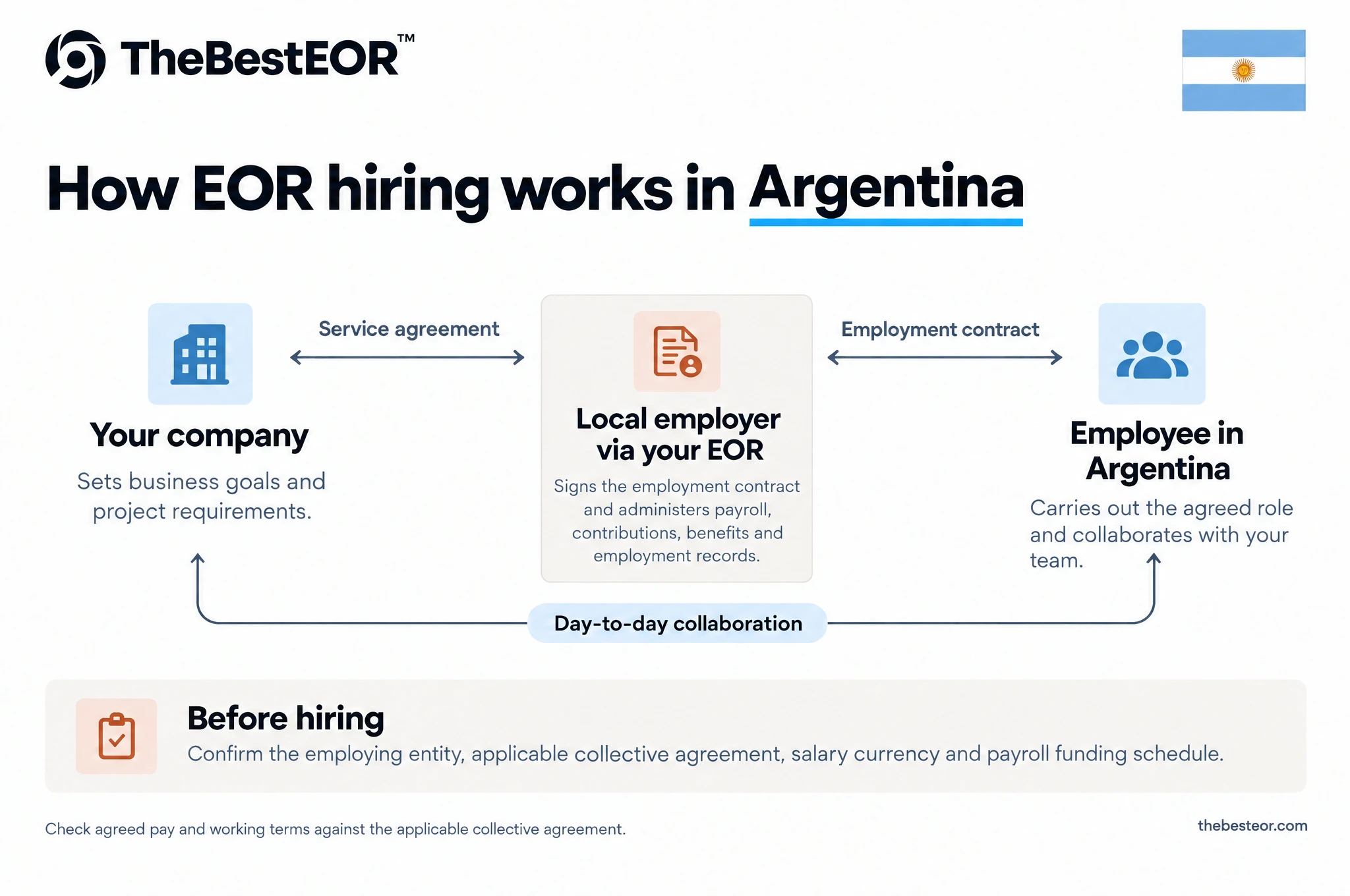
Employer of record in Argentina diagram showing the service agreement, employment contract, and day-to-day collaboration between your company and the employee.
Employer of record in Argentina: how your company, the local employer and the employee work together. Select the image to enlarge.

The EOR handles

1
The Argentine employer handles its employment and filing duties; client liability depends on the actual arrangement, including the applicable joint-liability rules.
2
ARCA and ANSES registration and monthly social-security remittance
3
Income-tax withholding and obra social enrolment
4
The mandatory ART workers-compensation policy under Law 24,557
5
The SAC aguinaldo, accrued and paid in two installments
6
The registered LCT contract in Spanish and the correct CCT
7
Compliant offboarding, notice and the severance calculation under Ley 27802

You keep

1
Direction of the daily work: tasks, deliverables and priorities
2
Pay above the CCT floor: salary, bonuses and any dollar-linked structure
3
The hiring call and the dismissal call; the EOR executes the preaviso you trigger
4
Performance management, with the paper trail a dismissal dispute would demand
5
Laptops and tooling, unless you buy the provider’s device provisioning
6
The commercial relationship and the IP assignment wording in the contract

Classification needs its own review. Engaging an Argentine worker as a monotributista independent contractor when they work fixed hours under your direction can lead the courts to deem them an employee, which exposes you to unpaid SIPA and obra social, back income tax, unpaid aguinaldo and severance accruals, and penalties for unregistered employment. An employment arrangement that meets local requirements can change how the worker is engaged from then on. It does not settle earlier classification liabilities, and the staffing model and any immigration route require their own assessment. The misclassification guide covers the tests Argentine courts apply.

Separate employment registration from client protection

An employment contract identifies the employer. Article 29 also addresses the company using the worker’s services. Have the proposal describe the actual relationship among the client, the registered employer and the employee, with the applicable duties mapped to that arrangement.

For an outsourced payroll or staffing relationship, a useful evidence file includes the named employer, the worker’s registration, contribution receipts, payroll records and relevant ART cover. Decide who provides these records and how exceptions are escalated before the first invoice.

Apply the same approach when changing providers: establish the legal transfer method and any earlier liabilities separately from the new contract.

Work permits

Work visas and the 23A employment permit

Is the sponsoring employer registered with RENURE?

Argentina sponsors foreign workers through employment-based temporary residence, and the petition depends on one registration: the sponsoring entity must be enrolled in RENURE before Migraciones will act on it.

Route Who it fits Duration Sponsor requirement
Route
Visa 23A (employment contract)
Who it fits
Salaried hire with a local contract
Duration
Up to 1 year, renewable
Sponsor requirement
RENURE-enrolled employer
Route
Visa 23E (intra-company transfer)
Who it fits
Transfer from a foreign branch
Duration
Up to 1 year, renewable
Sponsor requirement
RENURE-enrolled employer
Route
MERCOSUR residence
Who it fits
Nationals of MERCOSUR member states
Duration
Temporary, then permanent
Sponsor requirement
None; nationality-based

Fig. 8 · Work-visa routes into Argentina · employer-sponsored routes require a RENURE-enrolled sponsor

Most foreign employees work under a temporary residence based on employment, tied to work authorization through the Direccion Nacional de Migraciones. The common route is the 23A employment visa for a salaried role, or the 23E for an intra-company transfer; both run up to a year and are renewable and require a formal labor contract with the sponsor.

For most Argentine hires the permit question does not arise: nationals and permanent residents need no permit, and nationals of MERCOSUR states have a simplified residence path. Where a 23A or 23E is needed, no start date is safe until Migraciones grants the residence, so confirm the sponsoring entity’s RENURE status before you promise one.

Salary benchmarks

Indicative salary ranges

Compare gross monthly pay using a dated exchange rate.

Monthly gross shown in USD first, because Argentine professional pay is increasingly dollar-linked and the peso moves fast; the peso column is at roughly ARS 1,446 to the dollar (June 2026) and should be re-priced before any offer. Ranges are 2026 market data from SalaryExpert, Glassdoor and remote-hiring benchmarks; use the midpoint as a starting offer, not a ceiling.

Check current pay data for the role and location before you make an offer.

Role USD/month (approx) ARS/month (approx)
Role
Software engineer
USD/month (approx)
$1,500–2,800
ARS/month (approx)
ARS 2,170,000–4,050,000
Role
Senior software engineer
USD/month (approx)
$2,500–4,400
ARS/month (approx)
ARS 3,615,000–6,360,000
Role
Product manager
USD/month (approx)
$2,200–4,000
ARS/month (approx)
ARS 3,180,000–5,780,000
Role
Accountant
USD/month (approx)
$1,100–2,000
ARS/month (approx)
ARS 1,590,000–2,890,000
Role
Customer support
USD/month (approx)
$700–1,300
ARS/month (approx)
ARS 1,010,000–1,880,000
Role
Sales manager
USD/month (approx)
$1,800–3,500
ARS/month (approx)
ARS 2,600,000–5,060,000
Role
HR manager
USD/month (approx)
$1,600–3,000
ARS/month (approx)
ARS 2,310,000–4,340,000
Role
Designer
USD/month (approx)
$1,200–2,400
ARS/month (approx)
ARS 1,735,000–3,470,000

Fig. 9 · Monthly salary benchmarks, 2026 · USD first; peso column at roughly ARS 1,446/USD, June 2026

Pay concentrates in Buenos Aires (CABA and Gran Buenos Aires), and senior candidates increasingly expect offers quoted directly in dollars to protect real pay against inflation. Treat the peso column as indicative only; in a 33-percent-inflation economy it will be stale within a quarter, so confirm the current salary and exchange rate before making an offer. Once you have a provider quote, use the EOR cost calculator to total its recurring costs in USD.

Fully-loaded cost

What an Argentine engineer costs per month

Start with a gross monthly salary of ARS 2.75 million.

The June 2026 conversion gives about USD 1,900 for ARS 2,750,000. The example compares an assumed $199 fee with higher fees. For a different salary, estimate employer payroll costs in Argentina.

Software engineer, Buenos Aires Gross base: ~USD 1,900 / ARS 2,750,000/month
Gross salary USD 1,900
Employer social security (24%)
SIPA + INSSJP + obra social + family allowances + FNE
USD 456
ART workers' comp (modeled at 3%)
Variable premium set by the ART insurer; 3% is the top of the 2–3% band brokers quote for office roles, and the actual policy quote replaces it
USD 57
Aguinaldo accrual (~8.33%)
13th salary, accrued monthly across the year
USD 158
EOR fee, cheapest
RemoFirst from $199
⚠ Trustpilot warning: rating suspended for a breach of its guidelines; fake reviews removed
USD 199
Monthly total, cheapest fee
Annual ≈ USD 33,240
USD 2,770

Fig. 10 · Fully-loaded monthly cost, mid-level engineer · at an illustrative USD 199 monthly service fee; higher service-fee scenarios in the footnote

Statutory employer cost (social security plus ART plus the accrued aguinaldo) is about USD 671, roughly 35 percent on top of gross once the 13th salary is spread across the year. At the illustration’s exchange rate, these hypothetical USD monthly service fees change the modelled total: a hypothetical $599 service fee produces about USD 3,170/month (≈ USD 38,040/year), and a USD 699 service fee lands at about USD 3,270/month (≈ USD 39,240/year). For larger services and trade firms the social-security rate is 26.4 percent rather than 24 percent, which adds about USD 46 a month on this salary. Both the salary and the fee here are dollar-figures for stability; the peso equivalents move with inflation and FX, so obtain a dated country quote and confirm the exchange rate before committing.

EOR vs your own entity

EOR or your own sociedad: compare costs

Factor EOR Your own SRL / SA
Factor
Setup cost
EOR
None
Your own SRL / SA
Incorporation + notarial + initial registrations
Factor
Time to first hire
EOR
5–14 days (local national)
Your own SRL / SA
After IGJ/registry, ARCA, ANSES, ART and bank setup
Factor
Per-employee cost
EOR
$199–699/employee/mo fee + statutory
Your own SRL / SA
Statutory only, plus shared overhead
Factor
Ongoing admin
EOR
Provider runs payroll & filings
Your own SRL / SA
Local accountant, monthly ARCA filings, your own payroll
Factor
Compliance liability
EOR
Employer duties sit with the EOR; applicable client liability can remain.
Your own SRL / SA
On you and your local directors
Factor
FX exposure
EOR
Provider funds peso payroll
Your own SRL / SA
You manage peso funding and currency controls

Fig. 11 · Illustrative EOR-versus-entity comparison; the crossover depends on the fee plan, local operating costs and hiring duration.

Your own sociedad also has to exist before anyone is hired: company registry, ARCA, ANSES, an ART insurer and a bank account all come first, and once running it carries a local accountant, monthly social-security filings, payroll and the peso-funding and currency-control burden regardless of headcount.

Use current EOR and entity-administration quotes, including accounting, monthly filings and peso funding, to calculate the applicable break-even with the EOR vs entity break-even guide. A common path is to hire the first few through an EOR, then stand up a sociedad and transfer staff once the team passes the break-even and you have committed to Argentina long-term, which the EOR-to-entity migration guide walks through.

FAQ

EOR in Argentina: common questions

What is the best EOR in Argentina?

RemotePeople is our top pick for Argentina in 2026 (4.9/5), followed by Deel (4.7/5) and Rippling (4.5/5). We opened paid accounts with all 10 providers on this page, priced real hires and ran payroll.

RemotePeople offers recruitment and EOR through one provider, with a dedicated account manager on both EOR plans. Its EOR Global plan starts at USD 499 per employee per month, and EOR Select at USD 199 where the hire qualifies. Deel starts at USD 599 plus a mandatory Employer Liability Cost; Rippling starts at USD 499 plus its required platform subscription.

How does an employer of record work in Argentina?

An employer of record in Argentina becomes the worker’s legal employer through a local employing entity, while your company directs the day-to-day work. The EOR handles the tax and ANSES social-security registrations, enrols the worker in an obra social health fund and arranges the mandatory ART workers’ compensation policy. Monthly payroll withholds the 17% employee social-security share and income tax; the EOR pays the 24% or 26.4% employer contributions plus the ART premium, and the aguinaldo (13th salary) in two instalments.

How fast can an EOR onboard an employee in Argentina?

Estimated onboarding times for Argentina range from 7 to 15 days across the providers we tested that give an estimate. By provider: Multiplier 7–10 days, Pebl 8–12 days, Papaya Global 10–12 days, Oyster 10–14 days, RemotePeople about 12 days and Deel from 15 days.

Confirm the proposed employer’s contracting, registration, KYC and payroll requirements and agree a first-payroll cutoff. For a foreign hire, confirm the eligible 23A visa and temporary-residence route and let the required Migraciones approvals determine the start date.

How much does an EOR cost in Argentina per month?

Published service fees for Argentina run from USD 199 to USD 699 per employee per month across the 10 providers we tested: RemoFirst from USD 199; RemotePeople Global from USD 499, or Select from USD 199 only where country and salary qualify; Deel from USD 599 plus mandatory Employer Liability Cost; G-P from USD 599; Oyster USD 699 on monthly billing, with annual seats quoted separately. Multiplier Core advertises $499 monthly or $459 per month billed annually; Pebl advertises $399, with currency and commitment to confirm. Rippling starts at USD 499 plus its required platform from USD 8 per employee, and Papaya Global at USD 499. Borderless AI is USD 579 standard, with an eligible USD 399 promotion on fees billed through 31 December 2026. All amounts are per employee/month; salary and employment costs are separate. 

On top of the fee you pay the employee’s gross salary plus employer social contributions of 24 percent for most companies, or 26.4 percent for larger services and trade firms, before ART workers-compensation insurance.

What employer contributions are mandatory in Argentina?

Employer social security totals 24 percent of gross for most companies and 26.4 percent for larger services and commerce firms, covering SIPA pension, the INSSJP/PAMI retiree fund, obra social healthcare at 6 percent, family allowances and the national employment fund. On top sits ART workers-compensation insurance, a variable premium the insurer sets against the activity’s risk and claims history. There is no salary cap on employer contributions.

What is the SAC or aguinaldo in Argentina?

The Sueldo Anual Complementario (SAC), commonly called the aguinaldo, is a mandatory 13th salary paid in two installments. Each installment equals 50 percent of the highest monthly salary earned in the relevant half-year, paid by 30 June and by 18 December. It is statutory under the Ley de Contrato de Trabajo, not a discretionary bonus, so the EOR budgets and pays it automatically.

How does the 2026 Ley 27802 labor reform change hiring in Argentina?
Ley 27802, the Modernizacion Laboral law published on 6 March 2026, keeps the one-month-per-year severance formula but narrows the calculation base to regular monthly pay, excluding the aguinaldo and one-off bonuses. It creates the Fondo de Asistencia Laboral (FAL), an employer-funded severance buffer at 1 percent of payroll for large companies and 2.5 percent for SMEs, with a minimum waiting period of 12 complete, consecutive contribution periods. Decreto 408/2026, as amended by Decreto 1228/2026, defers the FAL’s start to 1 December 2026. This delay applies to the fund; the Article 245 amendment has a statutory commencement date of 6 March 2026. The probation-dismissal notice change already took effect on 6 March 2026. Law 27,555 on telework is repealed from 1 January 2027.
 
How much notice and severance applies when terminating in Argentina?
From 6 March 2026, employer dismissal during probation requires no statutory notice. After probation, employer notice is one month for service up to five years and two months beyond five years; unworked notice is generally paid in lieu. Severance for dismissal without cause is one month of the best regular monthly remuneration per year of service or fraction over three months, with a minimum of one month and a cap of three times the applicable collective-agreement average. The aguinaldo is now excluded from the base under Ley 27802.
What currency and payroll cycle does Argentina use, and how is FX handled?

The cost illustration uses Argentine pesos (ARS) for local salary and a USD service fee. State the actual contractual salary currency and the invoice currency separately.

For monthly paid workers, Article 126 sets a calendar-month pay period and Article 128 allows payment within four working days after that period. Hourly or daily-paid workers have different weekly or fortnightly periods. Agree the payroll cutoff, funding date, exchange-rate source and timestamp, FX markup and who bears exchange movements in the quote.

Can an EOR sponsor a work visa in Argentina?
Yes. Any company registered in Argentina and enrolled in RENURE, the national registry of entities that petition for foreign workers, can sponsor a 23A employment visa and temporary residence through Migraciones. Identify the proposed legal employer and confirm its RENURE registration, the employee’s eligible route and each party’s application responsibilities before committing a start date.
Can I convert an Argentine contractor to an EOR employee?
Yes, an EOR can employ a worker who previously invoiced as a monotributista, but the new employment contract does not by itself settle liabilities from the earlier arrangement. The review needs to cover how the person actually worked, any unpaid employment obligations, the new contract and registration, and whether prior service will be recognized. Onboarding time depends on the provider’s assessment and required documents.
Do I need a local entity to hire one person in Argentina?
No. An EOR employs the worker on its Argentine entity, so you hire without incorporating a sociedad. Running your own SRL or SA means incorporation plus ARCA, ANSES and ART registrations before the first legal payroll, then ongoing accounting, payroll and statutory-filing overhead for as long as it exists. Set that and the peso-funding work against the $199-to-$699 monthly fees and the break-even depends on complete current quotes and implementation costs rather than a universal headcount.
 
Is ART workers-compensation insurance mandatory in Argentina?
Yes. Every employer must cover staff with an Aseguradora de Riesgos del Trabajo (ART) under Law 24,557, which pays for workplace injury, occupational illness and rehabilitation. The premium is a variable percentage of payroll set by the ART insurer on the activity’s risk and the employer’s claims history; no fixed statutory rate exists. An EOR holds the ART policy on its own entity and bundles the cost into your invoice.

Sources and as-of dates

Article references

Argentina legislates payroll in statutes, so each figure below cites its law or the agency that collects it. Peso amounts are June 2026 snapshots and age fast.

Hiring facts Checked 2 Oct 2026

Hiring facts

Checked 2 October 2026
Eligibility, local and collective rules apply. EOR fees extra.

Ley de Contrato de Trabajo (Law 20,744) 5 sources

Annual-leave tiers of 14/21/28/35 calendar days, notice periods and the Article 245 seniority indemnity are covered by the LCT. Monthly or fortnightly wages must be paid within four working days after the pay period; weekly wages within three. The general 48-hour weekly limit comes from Law 11,544, subject to its exceptions. As amended.

Ley 27802 (Modernizacion Laboral) 6 sources

Published 6 March 2026. Law 27,802 excludes the aguinaldo from the Article 245 severance base and creates the FAL with statutory contributions of 1% for large companies and 2.5% for qualifying SMEs. Decreto 408/2026, as amended by Decreto 1228/2026, starts the FAL regime on 1 December 2026 with a minimum 12-period contribution waiting rule. The Article 245 amendment has a separate statutory commencement date of 6 March 2026. Employer dismissal notice during probation was removed from 6 March 2026. Repeal of the Telework Law and specified sector statutes is scheduled for 1 January 2027.

Employer social-security contributions 3 sources

As of June 2026, the combined headline rates are 24% or 26.4%: social-security contributions of 18% or 20.4%, plus 6% obra social. The higher social-security rate applies to qualifying services and commerce employers above the MiPyME sales thresholds. ARS 7,003.68 per worker per month is a deduction from the social-security contribution base. Separate ART costs and applicable special rules affect total cost.

Employee social security 4 sources

Standard employee contributions total 17%: 11% SIPA pension, 3% INSSJP/PAMI and 3% obra social, subject to the applicable bases and exceptions. ANSES Resolution 139/2026, Article 3, sets the June 2026 monthly pension contribution-base ceiling at ARS 4,414,652.38. This is a historical June figure, not a current-month ceiling.

Obra social 4 sources

Obra social: employer 6%, employee 3%, subject to applicable statutory and collective-agreement rules. ART: Law 24,557 requires work-risk coverage; employers must affiliate with an ART unless they qualify for authorized self-insurance. The premium is employer-specific, and the SRT provides a contribution-rate lookup and supervises ARTs.

SAC / aguinaldo 1 source

SAC / aguinaldo is paid in two installments, each generally 50% of the highest monthly remuneration earned in the relevant half-year, due 30 June and 18 December under LCT Article 122. The December installment uses an estimate with any difference reconciled in December pay.

Período de prueba 2 sources

The standard probation period is six months. A collective agreement may extend it to eight months for employers with 6–100 workers or one year for employers with up to five workers. Under LCT Article 231(b), as amended by Law 27,802 from 6 March 2026, an employer does not owe dismissal notice during probation.

Income tax (Impuesto a las Ganancias) 2 sources

Resident individual income tax uses progressive rates on taxable net income after applicable deductions, with a 35% top marginal band. ARCA publishes the Article 94 scales for each applicable period; the linked table covers January–June 2026.

Work permits 3 sources

Law 25,871 Article 23(a) covers temporary residence for contracted migrant workers. Article 23(e) covers scientific/specialist personnel and qualifying company transferees. The relevant Migraciones procedures require the sponsoring employer or requesting entity to be registered with RENURE; an approved entry permit is followed by the consular visa process where applicable.

FX and inflation 2 sources

INDEC reports May 2026 annual CPI inflation of 33.2%. The approximately ARS 1,446 per USD 1 conversion for 9 June 2026 is a historical assumption: the exchange-rate series and buy/sell basis were not specified. Use a dated quotation for the relevant transaction.

Salary benchmarks 2 sources

Levels.fyi provides Argentina software-engineer annual total compensation in pesos, with base, stock and bonus components. The ARS1,446-per-USD conversion is illustrative; use a dated exchange rate and a comparable local-payroll offer.

Provider pricing, entity model and onboarding 10 sources

Sources checked in October 2026 Checked 19 Oct 2026

Argentina consolidated Labour Contract Law — Articles 29, 52, 105 and 201: user-company liability, ARCA registration, salary currency and overtime. Checked 19 October 2026.

Decree 408/2026, as amended by Decree 1228/2026 — Articles 3, 15, 24 and 27: pooled employer account, minimum 12-period contribution waiting rule, contribution offset and 1 December 2026 commencement. These FAL provisions checked 4 November 2026.

ARCA employer contributions and base deductions — 18%/20.4% social-security rates and the ARS 7,003.68 deduction from the relevant contribution base, before separately scoped health/insurance items. Checked 19 October 2026.

ARCA General Resolution 5907/2026, as amended by Resolution 5915/2026 — Employer classification, ID FAL, contribution offsets and reporting from the December 2026 period. These FAL provisions checked 4 November 2026.

Migraciones contracted-worker residence — Employer-registration and employment evidence for this specific residence procedure. Checked 19 October 2026.

The country guides cover other markets. For this hire, browse EOR providers for Argentina and use the EOR cost calculator to compare the recurring amounts in your proposals in USD.

This guide is for general information only and does not provide legal, tax, accounting, or financial advice. For advice about your business, consult a qualified professional familiar with the rules where you hire. The research methodology explains how TheBestEOR assesses sources.