


Guide overview
An EOR RFP, at a glance.
Ask the same questions and require comparable evidence.
Use this EOR RFP to give every supplier the same country-specific hiring brief and request comparable written answers. The 47 questions cover employment authority, finances, security, costs, payroll, support, contracts and exit. Download the response register first, then adapt the mandatory requirements and review method to your program.
Hiring brief
Make it country-specific
Send each shortlisted provider the same requirements.
Required evidence
Request written answers
Treat missing information as unresolved.
Mandatory requirements
Identify the requirements
Agree which requirements must be met before scoring the rest.
Scoring and pilot
Document the decision
Use the stated scoring method and confirm terms before a live hire.
Check before acting
Record the evidence behind each answer, and confirm pilot terms and employee start requirements before proceeding.
What to record in the worksheet
Scope
Question · Supplier response · Evidence / version
Evidence and follow-up
Country exception · Reviewer · Acceptance condition · Status · Follow-up date
Choose the checklist for your review
If you already have two quotes and need to know whether the prices cover the same things, start with the 11 pricing questions. Use the full RFP when the decision also depends on written commitments about employment, security, payroll and exit.
For the full review, jump to the 47-question template and response workbook, then use the explanations when assessing answers. The workbook records supplier responses, evidence, country exceptions and review status.
1. How to run an EOR RFP
A full RFP makes sense when the hiring program is large enough to warrant it, procurement needs a selection record, or you’re replacing a provider and need comparable written terms. For a smaller review, the FAQ explains how to select questions. A paid pilot covering a complete payroll cycle can help you check how the promised service works in practice.
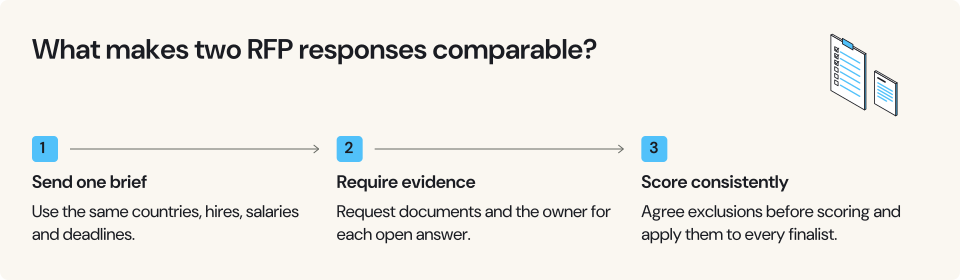
Use the comparison of employer of record companies to identify suppliers to invite. Four to six vendors and ten business days for replies are starting points you can adjust. Give each finalist the same 47 questions and a deadline for filling gaps. Have your legal reviewer identify which promises belong in the signed agreement and make sure they appear there.
Decide what your team will accept before reading the example answers. You might need a named manager, a particular report, service credits or delivery at no charge within 30 days. Another buyer might accept different terms. Record who can approve an alternative and why it meets the need. Procurement cannot waive a mandatory legal or payroll requirement.
Turn each RFP answer into an approval decision
Use this review sheet alongside the 47 questions. A clear answer is useful only when the evidence covers the country, service and contract you will actually buy.
| Decision | Evidence to attach | Before approval |
|---|---|---|
Decision
Can this entity employ the hire?
|
Evidence to attach
Employing company name; applicable licence and country agreement.
|
Before approval
Check the exact activity and assignment restrictions.
|
Decision
Is the cost comparable?
|
Evidence to attach
Quote with salary, statutory costs, fee, extras and refundable cash requirements separated.
|
Before approval
Resolve missing prices; an unknown amount is not zero.
|
Decision
Who fixes a failure?
|
Evidence to attach
Relevant liability, indemnity and escalation clauses.
|
Before approval
Check exclusions, caps and whether local-partner failures are covered.
|
Decision
Is employee data protected?
|
Evidence to attach
Data-flow map, role-specific terms and current assurance scope.
|
Before approval
Resolve uncovered recipients, transfers and incident responsibilities.
|
Decision
Can the service work in practice?
|
Evidence to attach
Dated onboarding plan and a paid-pilot agreement.
|
Before approval
Use agreed country milestones and a complete payroll cycle.
|
Decision
Can we leave safely?
|
Evidence to attach
Notice, records export, deposit return and employee-transition terms.
|
Before approval
Separate ending the vendor contract from changing the legal employer.
|
Use the checklist alongside your legal review. Keep any non-negotiable requirement outside the weighted score and record who approved each remaining exception.
Set the role, country and service scope.
Resolve critical gaps in the responses.
Complete the necessary agreements before any live hire.
Evaluate the service against agreed evidence and criteria.
Confirm any changed scope and terms before expansion.
Suggested procurement workflow. Country law and negotiated terms determine the requirements.
After resolving mandatory requirements, score the applicable answers. As an optional starting point, use the six factors in our methodology: compliance 25%, true cost 20%, coverage 15%, onboarding 15%, support 15%, and switching 10%. The 6-factor framework guide explains the broader framework. For this checklist, map compliance to Q1–6, Q8–10, Q14–26 and Q41–44; true cost to Q27–34; coverage to Q7 and Q11–13; onboarding to Q35; support to Q36–40; and switching to Q45–47. For each factor, divide points earned by twice its applicable question count and multiply by its percentage weight. Add the six results for a score out of 100.
Agree which questions don’t apply before scoring and give every finalist the same treatment. Leave those questions out of the calculation. If an entire factor is outside scope, agree new weights totaling 100% for the remaining factors. Missing evidence for a mandatory legal or payroll requirement leaves that requirement unresolved.
- Scoring. Give every answer a 2, 1, or 0.
- 2 → specific and verifiable: numbers, dates, documents attached
- 1 → answered, but vague enough to need a follow-up
- 0 → deflected, “let's discuss on a call”, or unanswered
- Requirements every provider must meet. Decide before scoring which legal, operational and commercial requirements are essential for your program. An unanswered liability, deposit or exit question remains unresolved until the agreed deadline. Record verified failures and accepted exceptions separately; a strong weighted score cannot offset a failed mandatory gate.
If you want help running the procurement process, see our EOR RFP support service. Request the deliverables, responsibilities, fees, timetable and any provider-related commercial arrangements in writing before commissioning the work.
2. Corporate and financial stability (questions 1–6)
An EOR is the legal employer of your team, and some providers also hold a deposit. Oyster normally requires about one month of each hire’s gross salary plus employer costs and fees, and Papaya Global charges a refundable deposit. If the provider becomes insolvent, employment continuity and deposit recovery depend on the local insolvency process, the employing entity and the contract.
Good answer: founding year, registered entity names, and any rebrands, listed without prompting.
Good answer: audited statements or a letter from a named auditor. “We’re well funded” gives no figures.
Good answer: a dated headcount and its three largest countries, so you can see whether your main country is core business or an experiment.
Good answer: a plain ownership summary and an assignment clause that keeps your terms intact through a change of control.
Good answer: certificates naming the carrier and per-claim limits for professional indemnity and employer liability. “We’re fully covered” is not enough.
Good answer: a dated list, plus the migration plan they ran for the clients affected.
3. Entity model and coverage (questions 7–13)
An EOR either owns the legal entity in your country or works through a local partner. Deel’s public product page describes owned entities and payroll infrastructure in 130+ countries, checked 15 October 2026. With any provider, verify the actual employer for your country. Either model can work if the contract sets out the chain of liability, and our guide to owned entities vs partner networks covers the trade-offs.
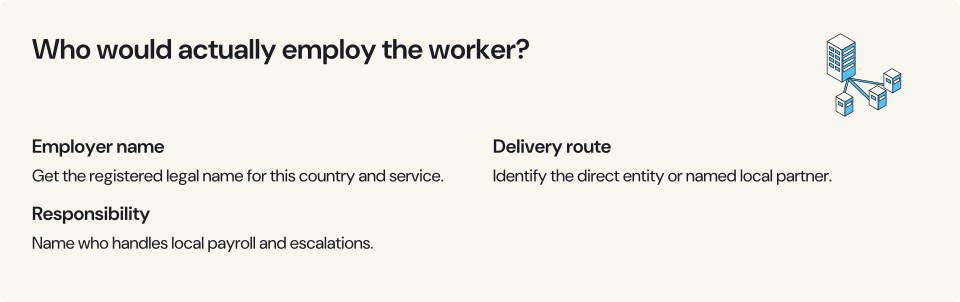
Good answer: a country-by-country table marked “owned” or naming the partner. A refusal to name partners scores 0.
Good answer: “we are, contractually,” with the clause number from their MSA. A verbal reassurance scores 1 at best.
Good answer: license numbers and the issuing authority, plus their process for Germany’s 18-month assignment cap.
Good answer: a written plan covering entity transfer, direct hiring, or supported migration, including who pays for what.
Good answer: yes or no per country, with processing times. A clear “no” now is better than a surprise in month three.
Good answer: a documented partner-sourcing process, a stated number of weeks, and the same liability terms as their owned-entity countries.
Good answer: jurisdiction-specific caps stated plainly, with a conversion plan for each, starting with Germany’s 18 months.
Germany’s default assignment cap follows the employee and client across lenders. Where the AÜG applies, §1(1b) generally limits an assignment to 18 months and aggregates previous assignments if the breaks are no more than three months. Specified collective-agreement arrangements can change the limit. Verify the applicable rule and plan any transition before the applicable assignment limit.
4. Compliance and certifications (questions 14–21)
Ask which entity, service and period each certificate or report covers, then compare that scope with the evidence your risk policy requires. Our guide to SOC 2, ISO 27001 and GDPR evidence explains what you can verify with each document.
Good answer: ISO/IEC 27001:2022 with the EOR platform in scope. Under the IAF accredited-certification transition, 2013-edition certificates had to expire or be withdrawn by October 31, 2025.
Good answer: the full report with the observation window stated and exceptions visible. A Type I or summary letter does not provide the same operating-period evidence.
Good answer: named in-house counsel or a named local firm per country, plus a 2025 or 2026 law change they implemented and its go-live date.
Good answer: a per-country test and a written risk memo you can show an auditor. “Our platform handles it” scores 0.
Good answer: they know that enforcement resumed on January 1, 2025, and that the penalty soft landing was partially extended into 2026 while back-assessments can still reach back to January 2025. They can also name what they changed for Dutch engagements.
Good answer: they run the defense as the legal employer, with the cost split and the indemnity boundary quoted from their MSA.
Good answer: a country-specific implementation plan for the law transposing Directive (EU) 2023/970. Article 5 requires applicants to receive initial pay or range information in time for informed negotiation; it does not require it in both every advertisement and contract. Article 9 sets first reports by June 7, 2027 for employers with 150–249 and 250+ workers, on different recurring schedules. Check the national rules and who is the reporting employer.
Good answer: a direct yes or no with specifics. Treat an evasive answer as unresolved and ask for evidence.
5. Data and security (questions 22–26)
Follow one employee’s information through the service. Who receives the passport, home address, salary and bank details? In some countries the EOR also handles tax and health records. Identify each party’s controller or processor role for the activity it performs, then check that the safeguards and contract terms fit that role.
Good answer: named cloud provider and regions, plus a contractual residency option. “We use AWS” does not name a location.
Good answer: a role-by-role data map, Article 28 terms where processing is on your behalf, and a valid transfer basis for each restricted transfer. Use the relevant SCC module only where SCCs are the chosen mechanism.
Good answer: a dated, published list and contractual advance notice with a right to object.
Good answer: a test inside the last 12 months, the firm named, and critical findings remediated with dates.
Good answer: candid disclosure and a documented notification process: processors notify controllers without undue delay. The controller’s regulator-notification duty has a separate, conditional 72-hour limit.
6. Pricing, fees, and FX (questions 27–34)
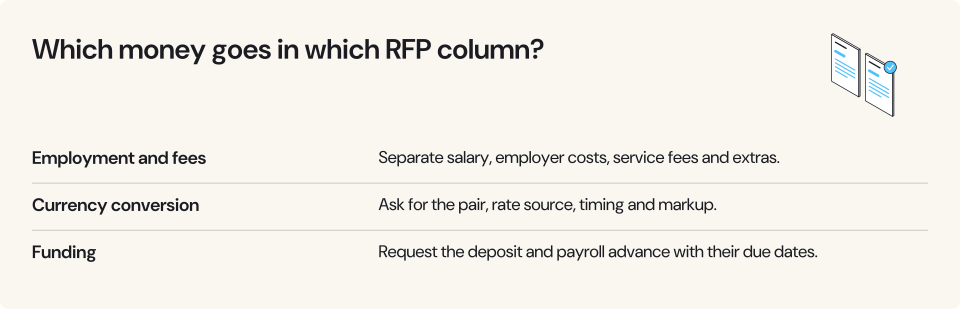
Compare the service fee, conversion charges, other service charges, and employment costs in each proposal, and track refundable deposits and payroll pre-funding separately from recurring charges. The hidden fees guide works through a hypothetical example: a $599 service fee plus $213 in assumed charges and financing costs comes to an $812 subtotal, which excludes salary, statutory employer costs, and benefits premiums. Build your own estimate with the EOR cost calculator and your quoted terms.
| Cost line | Input to collect | Evidence to request |
|---|---|---|
Cost line
Platform fee
|
Input to collect
Currency, billing period and commitment
|
Evidence to request
RemotePeople: Global from USD 499, Select from USD 199 for selected countries and qualifying salary ranges, per employee/month. RemoFirst from USD 199; Oyster USD 699 on monthly billing, with annual seats priced by quote, prepaid and non-refundable; G‑P from USD 599. Confirm country scope, salary and employer costs, billing commitment and funding terms in each quote.
|
Cost line
Security deposit
|
Input to collect
Amount, calculation base, deductions and return trigger
|
Evidence to request
Confirm RemotePeople Global or Select deposit terms in the country quote. Deel’s standard deposit is 1–1.5 months of gross salary; obtain each other provider’s actual deposit terms in the applicable agreement.
|
Cost line
Payroll pre-funding
|
Input to collect
Funding amount, currency and due date
|
Evidence to request
Request the funding calendar, reconciliation method and treatment of unused funds
|
Cost line
FX markup
|
Input to collect
Quote-specific
|
Evidence to request
Ask for the rate source, the fixing time, and all charges. A published service fee, such as Pebl’s, does not tell you the FX percentage. Do not treat an unknown rate as zero.
|
Cost line
Exit / offboarding fee
|
Input to collect
Itemized service fees and employment liabilities
|
Evidence to request
Deel does not publish its exit fee; Pebl states that it charges no setup or offboarding service fees (checked 23 September 2026); obtain the applicable offboarding terms for every other quote. Statutory termination liabilities are separate.
|
Cost line
Supplemental benefits markup
|
Input to collect
Premium and administration charge
|
Evidence to request
Ask for itemized pricing and compare equivalent policy cover
|
Fig. 1 · Quote-input checklist · provider service fees and billing conditions checked 1 November 2026 · Deel deposit checked 30 September 2026 · RemotePeople deposit terms by quote · Pebl setup/offboarding policy checked 23 September 2026
Good answer: a per-country rate card with exclusions itemized. The selected published service-fee examples in Fig.1 are starting points, not a complete market range or total hiring cost. Use the current country quote and keep deposits separate from expense.
Good answer: each line priced in the order form.
Good answer: the amount, currency and calculation base, including any salary, contribution or service-fee components, the return window in days, and what can be deducted from it.
Good answer: a named benchmark and a written cap. For scale, a hypothetical 3% charge on a $100,000 conversion adds $3,000. Use your own conversion amounts and agreed terms. The FX markup guide explains the test.
Good answer: a list of accepted invoice currencies per country. Ask for the currencies and payment routes your actual hiring plan needs.
Good answer: at cost, itemized on every payroll cycle, with the government rate referenced so finance can recompute it.
Good answer: a disclosed premium and administration charge, whether a percentage or a fixed amount. Compare equivalent cover before judging a bundled price or an “at cost” claim.
Good answer: whether prepaid seats are refundable mid-term and a fixed price per off-cycle run.
7. Onboarding and support SLAs (questions 35–40)
Before selection, have each provider document its support scope, measurements, exclusions and remedies.
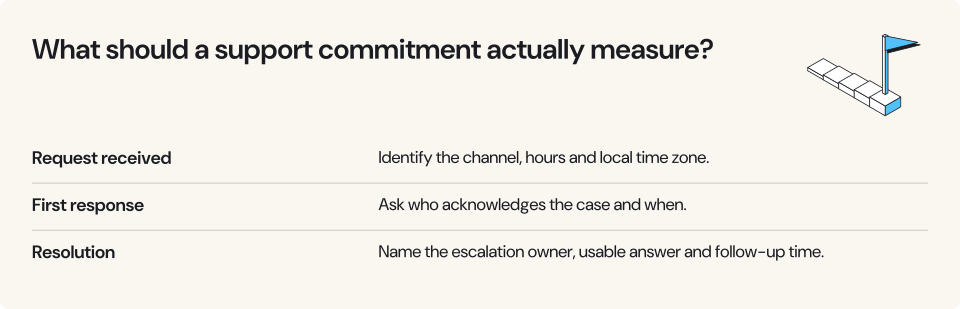
Good answer: per-country medians with the measurement period stated. Ask what was measured, which hires were excluded and whether the quoted country is represented.
Good answer: a dedicated account manager with a backup contact, and a clear line where AI chat ends and humans begin.
Good answer: response times in hours, measured and reported monthly, with service credits attached to misses.
Good answer: coverage windows that overlap your hiring map, and employee-facing support in the employee’s language.
Good answer: a direct channel with its own SLA, so your HR team does not end up forwarding employee questions.
Good answer: a named list (Workday, BambooHR, NetSuite, QuickBooks, Xero) with “native” and “CSV” correctly separated.
8. IP, contracts, and exit (questions 41–47)
Read these questions alongside the 9 contract clauses that matter most before you sign anything.
IP and contracts (questions 41–44)
Good answer: a documented transfer route for each country and IP right, including statutory vesting or claiming and any required onward assignments.
Good answer: complete templates upfront, with invention, confidentiality, and post-termination clauses visible. A summary sheet scores 1.
Good answer: indemnity for legal-employer failures, with a numeric cap in the MSA and carve-outs for misclassification claims. Compare the cap and exclusions with your modeled exposure; a one-month-fee cap may leave substantial loss uncovered.
Good answer: yes, after local counsel review, with any unenforceable clause flagged rather than silently accepted.
Exit and portability (questions 45–47)
Get the service notice period, minimum commitment, exit fees and employee-transfer conditions for the country and product you’re buying. A general description of Deel’s service, for example, won’t settle the terms of your order. Ending the service agreement and ending or transferring someone’s employment are separate steps. Use the 90-day switching plan to work out when each can happen.
Good answer: the actual notice, commitment, exit charges and employment-transition conditions, with all agreed prices in writing. Compare them with your required transition window.
Good answer: transition assistance and employee-continuity letters written into the contract, with named cooperation timelines.
Good answer: complete payroll, contract, and leave records in machine-readable format within 30 days, at no charge.
What a reviewed answer looks like
Suppose a supplier names “Local Employer Ltd” as the employer for your hiring country. The name appears in version 3 of the draft agreement, the country schedule and a dated registry extract. Legal can record that evidence now. Keep the answer open until the same name appears in the signed documents.
9. The full 47-question checklist
Paste the table below into your RFP document, keep the numbering so that answers stay comparable, and require vendors to answer in order.
| # | Question | Group |
|---|---|---|
#
1
|
Question
Years operating and all legal names
|
Group
Stability
|
#
2
|
Question
Profitability; audited financials under NDA
|
Group
Stability
|
#
3
|
Question
EOR headcount under management and top three countries
|
Group
Stability
|
#
4
|
Question
Ownership and change-of-control protection
|
Group
Stability
|
#
5
|
Question
Insurance certificates with carriers and limits
|
Group
Stability
|
#
6
|
Question
Layoffs or country exits in the last 24 months
|
Group
Stability
|
#
7
|
Question
Owned entity vs partner, per target country
|
Group
Coverage
|
#
8
|
Question
Liability when a local partner fails
|
Group
Coverage
|
#
9
|
Question
Local licenses held (e.g. Germany's AÜG)
|
Group
Coverage
|
#
10
|
Question
Plan if a country restricts EOR mid-engagement
|
Group
Coverage
|
#
11
|
Question
Visa and work-permit sponsorship per country
|
Group
Coverage
|
#
12
|
Question
Process and timeline for adding a new country
|
Group
Coverage
|
#
13
|
Question
Maximum legal EOR tenure per country
|
Group
Coverage
|
#
14
|
Question
ISO 27001:2022 certificate and Statement of Applicability
|
Group
Compliance
|
#
15
|
Question
SOC 2 Type II report with exceptions, under NDA
|
Group
Compliance
|
#
16
|
Question
Who maintains local contracts; speed of statutory updates
|
Group
Compliance
|
#
17
|
Question
Written misclassification risk assessments
|
Group
Compliance
|
#
18
|
Question
Handling of Dutch DBA enforcement, 2025–26
|
Group
Compliance
|
#
19
|
Question
Process and liability split on employee claims
|
Group
Compliance
|
#
20
|
Question
EU Pay Transparency Directive support
|
Group
Compliance
|
#
21
|
Question
Regulator fines or investigations, last five years
|
Group
Compliance
|
#
22
|
Question
Hosting locations and EU data-residency option
|
Group
Security
|
#
23
|
Question
GDPR Article 28 DPA and transfer mechanisms
|
Group
Security
|
#
24
|
Question
Sub-processor list and change notification
|
Group
Security
|
#
25
|
Question
Last penetration test: date, firm, findings
|
Group
Security
|
#
26
|
Question
Incident history and client notification record
|
Group
Security
|
#
27
|
Question
All-in per-country fee and its exclusions
|
Group
Pricing & FX
|
#
28
|
Question
Every setup, offboarding, and admin fee in writing
|
Group
Pricing & FX
|
#
29
|
Question
Deposits and pre-funding: amounts and return timelines
|
Group
Pricing & FX
|
#
30
|
Question
FX benchmark and written markup cap
|
Group
Pricing & FX
|
#
31
|
Question
Local-currency invoicing options
|
Group
Pricing & FX
|
#
32
|
Question
Statutory cost pass-through, itemized and checkable
|
Group
Pricing & FX
|
#
33
|
Question
Markup on supplemental benefits plans
|
Group
Pricing & FX
|
#
34
|
Question
Annual-commitment terms and off-cycle run pricing
|
Group
Pricing & FX
|
#
35
|
Question
Measured offer-to-day-one median, per country
|
Group
Support
|
#
36
|
Question
Named account manager vs pooled queue vs bot
|
Group
Support
|
#
37
|
Question
First-response and resolution SLAs with credits
|
Group
Support
|
#
38
|
Question
Support time zones and languages, both sides
|
Group
Support
|
#
39
|
Question
Direct support channel for employees
|
Group
Support
|
#
40
|
Question
Native HRIS and accounting integrations vs CSV exports
|
Group
Support
|
#
41
|
Question
Locally effective IP assignment chain
|
Group
IP & contracts
|
#
42
|
Question
Local contract templates shared before MSA signature
|
Group
IP & contracts
|
#
43
|
Question
Indemnity scope and liability cap
|
Group
IP & contracts
|
#
44
|
Question
Custom protective clauses where local law allows
|
Group
IP & contracts
|
#
45
|
Question
Notice period, exit fees, offboarding charges
|
Group
Exit
|
#
46
|
Question
Transfer support and tenure preservation
|
Group
Exit
|
#
47
|
Question
Exit data: scope, format, timeline
|
Group
Exit
|
Fig. 2 · The full 47-question RFP checklist · questions 1–47 in eight groups
Download the 47-question response workbook
Keep the supplier’s original answer with its supporting document and any country exception. Give each material issue to a named reviewer. Record what that person needs to see before closing it, then attach the evidence or revised contract when it arrives.
| The working record | Fields to complete |
|---|---|
The working record
Scope
|
Fields to complete
Question · Supplier response · Evidence / version
|
The working record
Evidence and follow-up
|
Fields to complete
Country exception · Reviewer · Acceptance condition · Status · Follow-up date
|
10. Frequently asked questions
How many vendors should receive an EOR RFP?
How long does an EOR RFP take end to end?
Do small teams need all 47 questions?
Should all 47 RFP questions be weighted equally?
Can we use an EOR vendor's free RFP template instead?
11. Sources
The sources behind this guide, grouped by topic. Dates show when we last checked a page. Prices and terms change, so confirm them in your quote.
Employment, data and IP law
8 sourcesEuropean Union · EUR-Lex
Pay Transparency Directive (EU) 2023/970
Articles 5, 9 and 34 are used in the proposal checklist, checked 3 Oct 2026.
European Union · EUR-Lex
Regulation (EU) 2016/679 (GDPR)
Article 28 processor contracts and the Article 33 72-hour breach notification. Both articles are used in the proposal checklist, checked 3 Oct 2026.
European Union · EDPB
Guidelines 07/2020 on controller and processor roles
Used in the proposal checklist. Checked 3 Oct 2026
European Union · European Commission
Standard Contractual Clauses for international data transfers
Germany · Federal Ministry of Justice
Temporary Employment Act (AÜG), full text
Section 1 is used in the proposal checklist, checked 3 Oct 2026.
Netherlands · Business.gov.nl
False self-employment and DBA enforcement
Published by the Netherlands Enterprise Agency.
United States · Data Privacy Framework program
EU-US DPF certification search
The transfer mechanism for US-bound data.
United States · Supreme Court (Justia)
Stanford v. Roche, 563 U.S. 776 (2011)
A US assignment dispute.
Security standards and legal commentary
5 sourcesInternational · ISO
ISO/IEC 27001 information security standard
2022 edition. Certificates to the 2013 edition were retired on 31 Oct 2025.
LRQA
ISO/IEC 27001:2022 transition deadline
2013-edition certificates expired or were withdrawn on 31 Oct 2025.
AICPA & CIMA
System and Organization Controls (SOC) suite
Type I vs Type II attestations and restricted-use reports.
Germany · Haufe
The AÜG 18-month assignment cap and its reset rule
The cap resets after a break of more than three months.
Netherlands · L&E Global
Dutch soft-landing enforcement moratorium partially extended into 2026
Back-assessments reach to January 2025.
Provider pricing, deposits and terms
7 sourcesDeel
Employer of Record pageDeposit calculationsOwned-entities blog post
Owns entities and payroll engine in 130+ countries (checked Sep 2026); the blog post, last updated Sep 2025, gave 100+. Standard deposit of 1 to 1.5 times total monthly charges (deposit terms checked 30 Sep 2026).
G‑P
EOR from USD 599 per employee per month. No minimum EOR hire duration is advertised, which does not establish every commercial cancellation term. Checked 1 Nov 2026
Oyster
PricingWhy a deposit is required
EOR at USD 699 per employee per month on monthly billing; annual seats are priced by quote, prepaid and non-refundable, with seat reuse permitted (checked 1 Nov 2026). The deposit is about one month of the hire’s total cost of services (checked 30 Sep 2026).
Papaya Global
Provider-published terms. Obtain the applicable deposit amount and conditions in the country agreement. Checked 15 Oct 2026
Pebl
Published policy of no setup or offboarding service fees. Checked 23 Sep 2026
RemoFirst
EOR from USD 199 per employee per month, with no annual contract or headcount minimum advertised. Local employment costs and optional services are separate. Checked 1 Nov 2026
RemotePeople
Global from USD 499 per employee per month; Select from USD 199 in selected countries and qualifying employee salary ranges. USD confirmed with the publisher on 16 Oct 2026. Confirm the country quote, commitment and deposit terms. Checked 1 Nov 2026
Our research
4 sourcesThe Best EOR
How we rate EOR providers.
The Best EOR
Historical pricing, deposit and exit examples, on a June 2026 basis.
The Best EOR
Used to review the FX row and the hypothetical-model wording. Checked 24 Sep 2026
The Best EOR
Used to review the FX row and the hypothetical-model wording. Checked 24 Sep 2026
Provider service fees and billing conditions were rechecked on 1 November 2026. Request current deposit and commitment terms in the country quote.
If you spot a changed price or a conflicting source, send it through the contact page and we’ll review it.
This guide is for general information only and does not provide legal, tax, accounting, or financial advice. For advice about your business, consult a qualified professional familiar with the rules where you hire. Read our research methodology to learn how we assess sources.