TheBestEOR

Best Employer of Record in Italy

Written by Martynas PupkeviciusFact-checked by Michael Ennis
Picture of Martynas Pupkevicius
Martynas Pupkevicius

EOR Advisor and Remote Work Editor

Our top employer of record in Italy for 2026 is RemotePeople, from USD 499 per employee a month, ahead of Deel and Rippling.

We tested all 10 providers with paid client accounts, real quotes and a live hire run through payroll. Italian pay terms follow an industry agreement that decides the 13th and any 14th salary payment, and employers also build up TFR deferred pay.

Flag of Italy

Hiring in Italy at a glance

Currency
EUR
Euro
Pay cycle
Per contract
Contract and industry agreement set the payday
Working hours
40 hours
Weekly, an agreement may set a shorter week
Annual leave
4 weeks
Minimum, an industry agreement may give more
Extra pay
13th salary
14th in some sectors, per industry agreement
Employer costs
Social insurance
Plus accident cover and TFR deferred pay
Before you hire:
Confirm the industry agreement, job grade, extra salary payments and how TFR and pension are funded.

Country hiring overview · Italy

Hiring in Italy, at a glance.

Use the collective agreement to compare like for like.

For an Italian hire, I’d ask which CCNL collective agreement and job classification the provider proposes. Use those terms to compare salary payments, contributions, benefits and employment accruals across the providers on your shortlist.

Choose a hiring solution

Need a local employer?

Compare an EOR arrangement for your role before opening your own entity.

Already have a local employer?

Compare payroll and HR support against adding an EOR.

EOR service fee

Fees vary by provider.

Your quote should state the currency, fee per employee, minimum charge and billing commitment.

Onboarding

Paperwork affects the start date.

The contract, right-to-work checks, registrations and payroll deadlines all affect when employment can begin.

Employment costs

Include TFR in the budget.

The quote should show INPS social security, INAIL work-injury insurance and TFR severance amounts separately. Check that it also accounts for all salary payments required by the contract.

Annual leave

The minimum is four weeks.

Statutory annual leave is at least 4 weeks. The applicable collective agreement (CCNL) or employment contract may give the employee a larger allowance.

Check before choosing

Confirm the CCNL, classification, salary instalments, TFR treatment, notice terms and employing entity in the proposal.

What your quote should include

Employment costs and service fees

1
Gross salary and agreed pay schedule
2
INPS, INAIL, TFR and contractual salary payments
3
EOR fee: currency, per-employee billing, minimums and commitment
4
Setup, foreign exchange, extras and exit costs

Deposits and payroll funding

1
Amount and payment deadline
2
Whether funds are refundable or credited to payroll
3
Release conditions and refund timing
Show these separately from recurring expenses.

Key takeaways for hiring in Italy

Check the employment structure even for an Italian citizen.

If the arrangement is labour supply under somministrazione, the authorised agency, client responsibilities and equal-treatment rules still matter. Start with those facts, then compare the fee.

Get an annual pay number before comparing invoices.

Under the Confcommercio example, salary includes a Christmas thirteenth instalment and a July fourteenth. A €3,000 ordinary monthly salary therefore gives €42,000 across fourteen payments. If €42,000 is already the annual offer, do not add those instalments again.

TFR can require current cash payments.

TFR is accrued remuneration, but it is not always money held by the employer until exit. The worker’s pension destination and the employing company’s Treasury Fund position affect where the cash goes. Ask for the destination and remittance schedule separately from the accrual calculation.

A first private-sector hire needs the July 2026 pension check.

INPS describes automatic supplementary-pension enrolment for covered first private-sector hires from 1 July 2026, with a 60-day choice window. Ask which onboarding process applies to this worker; do not reuse an older six-month explanation without checking the new rules.

Your one hire does not determine the EOR’s fund obligation.

The 2026 Treasury Fund rules consider the employing company’s workforce history and preserve some earlier obligations. A client with one employee can still use an employer that must remit TFR. The quote should explain that employer’s position.

Quick verdict

What is the best EOR in Italy?

My top three: RemotePeople, Deel and Rippling.

For a hire in Italy, I’d shortlist RemotePeople first. It offers recruitment and EOR through one provider, with a dedicated account manager on both EOR plans. Its EOR Global plan starts at USD 499 per employee per month, or USD 199 on EOR Select where the hire qualifies. Deel, from USD 599 plus a mandatory Employer Liability Cost, fits when Italy is one part of a wider employee and contractor programme. Rippling, from USD 499 plus its required platform, fits a team that already runs HR or IT on Rippling.

Two things decide an Italian hire: which provider maps your employee to the correct CCNL and administers TFR and the tredicesima without error, and what the fee is.

1
Editorial pick
RemotePeople logo

4.9/5

RemotePeople

Hiring in new markets with local HR support

Starting fee
$499

per employee / month

Countries
150+
where you can hire

EOR Select from $199 for eligible hires.

Deposit
1 month

of gross salary

Deposit refund
Within 5 days

of the final payment

Why consider it

Recruitment and EOR services through one provider.

Dedicated account manager in both EOR plans.

Check the fit

Recruitment is separately priced.

Before signing: Confirm quote currency, billing commitment, deposits, funding deadlines and refund terms. EOR Select eligibility depends on the hiring country and employee salary.

Both EOR plans list local contracts, payroll and tax administration, and statutory benefits administration. Salary, employer contributions and benefit costs are separate.

Visit RemotePeople ↗

2
Deel logo

4.7/5

Deel

Paying employees and contractors on one platform

Starting fee
$599

per employee / month

Countries
130+
where you can hire

Plus a mandatory Employer Liability Cost.

Deposit
1–1.5 months

of gross salary

Deposit refund
Within 60 days

of offboarding

Why consider it

EOR, contractor management and payroll for your own entities.

Month-to-month EOR service pricing available.

Check the fit

The country-specific Employer Liability Cost is mandatory.

Before signing: Confirm the Employer Liability Cost amount, benefit costs and any additional products. Monthly service terms do not remove employment notice, severance or other exit obligations.

The EOR pricing page lists 130+ countries. Broader platform coverage figures may include other services.

Visit Deel ↗

3
Rippling logo

4.5/5

Rippling

Setting up payroll, laptops and app access for new hires

Starting fee
$499

per employee / month

Countries
115
where you can hire

Plus the Rippling Platform, from $8 per employee / month.

Deposit
Per quote

based on gross salary

Deposit refund
Per contract

set in your agreement

Why consider it

EOR, payroll, HR records and benefits administration in one platform.

Shared workflows and reporting for domestic and international teams.

Check the fit

Ask for an itemised quote showing the required platform and each HR or IT module.

A paid Rippling Platform subscription is required on top of the EOR fee, from $8 per employee per month plus a monthly base fee. Rippling EOR starts at $499 per employee per month. Other HR and IT products are priced separately.

Rippling’s EOR page lists 115 countries. Confirm your hiring country and legal employer.

Visit Rippling ↗

No provider pays for a position on this page; some outbound links pay a referral fee. See the funding model and methodology.

Entity, permit filing and fee

All 10 EOR providers for Italy, side by side

Which Italian employer can apply for the nulla osta?

For an EU-citizen hire, the fee column decides; for a non-EU hire, the entity column does, because only the company that employs the worker can file the nulla osta with the Sportello Unico. Fees shown are June 2026 list, per employee per month; estimated onboarding times are the providers’ published service levels.

Italy keeps the overall order. The deciding factor here is correct CCNL selection and clean TFR and tredicesima administration, not the work-permit sponsorship that reorders Asian and Gulf markets: an EU or EEA citizen needs no permit, and every Italian citizen is one. Their worldwide positions are listed in the overall ranking of employer of record providers. For a wider shortlist, browse EOR providers for Italy.

Provider

Best For

Starting feeDepositOnboarding
1 RemotePeople logo RemotePeople 4.9/5 Rating Hiring in new markets with local HR support Starting fee: $499 USD / monthDeposit: 1 monthOnboarding: 7–10 days

My take

I’d compare RemotePeople’s two plans against your eligibility and budget.

Both include employment contracts, payroll and tax administration, statutory benefits administration, a dedicated account manager and ongoing employment support.

EOR Global starts at USD 499 per employee per month. EOR Select starts at USD 199 for eligible countries and employee salary ranges. Salary, employer contributions and benefits are separate; the proposal sets the applicable plan, billing commitment, deposit and payroll funding terms.

When this provider fits

RemotePeople is worth comparing when you want one contact coordinating the Italian offer. Ask for an annual pay schedule showing the CCNL grade, each salary instalment and the TFR destination. The useful outcome is a package that the candidate and finance team can both understand.

Ask before signing

Can you reconcile the annual offer to ordinary payslips, additional instalments, TFR and employer charges?

Deposit

1 month

Entity model

Own entities in core markets

First year, one hire

$5,988 in service fees

Reviewed by Martynas PupkeviciusFact-checked by Michael Ennis

Starting fee

$499

EOR Global. EOR Select starts at $199 where the country and employee salary qualify.

Against the 10 starting fees

$199 lowest$699 highest
2 Deel logo Deel 4.7/5 Rating Paying employees and contractors on one platform Starting fee: $599 USD / monthDeposit: 1–1.5 monthsOnboarding: 3–5 days

My take

I’d consider Deel when you need EOR employment and contractor management in one system.

Contractor management starts at USD 49 per contractor per month and is separate from the EOR service, so I’d compare those two budgets separately.

Deel’s global EOR service starts at USD 599 per employee per month, with month-to-month pricing available. Mandatory Employer Liability Cost is charged separately and varies by country. Salary, employer contributions, benefits and any additional services sit outside the starting service fee.

Deposit

1–1.5 months

Entity model

Own entities and partners

First year, one hire

$7,188 in service fees

Reviewed by Martynas PupkeviciusFact-checked by Michael Ennis

Starting fee

$599

Month-to-month billing. Mandatory Employer Liability Cost is charged separately.

Against the 10 starting fees

$199 lowest$699 highest
3 Rippling logo Rippling 4.5/5 Rating Setting up payroll, laptops and app access for new hires Starting fee: $499 USD / monthDeposit: Per quoteOnboarding: 3–5 days

My take

I’d look at Rippling when you want EOR employees to share HR records and workforce reporting with the rest of the organisation.

App access and device management are separate products, so I’d keep those costs distinct in the comparison.

Rippling EOR starts at USD 499 per employee per month, plus the required Rippling Platform from USD 8 per employee per month plus a monthly base fee. Billing commitment and optional HR or IT modules are quote-specific.

Deposit

Per quote

Entity model

Own entities and local partners

First year, one hire

$5,988 in EOR fees

Reviewed by Martynas PupkeviciusFact-checked by Michael Ennis

Starting fee

$499

Plus the required Rippling Platform, from $8 per employee per month and a monthly base fee. Confirm the billing terms and selected products.

Against the 10 starting fees

$199 lowest$699 highest
4 Oyster logo Oyster 4.5/5 Rating Using one onboarding process for hires across countries Starting fee: $699 USD / monthDeposit: ~1 monthOnboarding: 7–12 days

My take

Oyster’s automated Global Hiring workflow is one feature I’d consider for Italy: it supports Team Member onboarding, automated agreements and electronic signature.

I’d budget separately for People Partner advice, which costs USD 300 per hour.

Oyster’s month-to-month EOR rate is USD 699 per employee per month. Annual seats are quoted separately. Standard annual billing is prepaid and non-refundable; quarterly or semiannual payment is available at a higher seat price. A seat can be reused for a replacement hire. Salary, employer costs, deposits and optional services are additional.

Deposit

~1 month

Entity model

Own entities and vetted partners

First year, one hire

$8,388 in service fees

Reviewed by Martynas PupkeviciusFact-checked by Michael Ennis

Starting fee

$699

Monthly billing. Annual seats are quoted separately, prepaid and non-refundable.

Against the 10 starting fees

$199 lowest$699 highest
5 Pebl logo Pebl 4.2/5 Rating Hiring people who need visa or relocation support Starting fee: $399 USD / monthDeposit: Per quoteOnboarding: 7–10 days

My take

If your plans include an Italian entity, I’d examine Pebl’s restriction before going further.

At onboarding in Italy, its EOR terms require that neither the client nor its affiliates is locally incorporated, owns or controls a local entity, or plans to establish, acquire or reorganise as one. Later changes must be reported promptly in writing to Pebl, which will work with the client to resolve the resulting issues.

Pebl lists an EOR fee of $399 per employee per month, but the general price does not specify the dollar currency or billing commitment. The country proposal determines availability, any offer period and renewal terms; salary, employer costs and additional services are separate.

Deposit

Per quote

Entity model

Affiliates and local partners

First year, one hire

$4,788 in service fees

Reviewed by Martynas PupkeviciusFact-checked by Michael Ennis

Starting fee

$399

Confirm the country price and billing commitment.

Against the 10 starting fees

$199 lowest$699 highest
6 G-P logo G-P 4.2/5 Rating Hiring abroad while keeping your existing HR system Starting fee: $599 USD / monthDeposit: 1–2.5 monthsOnboarding: 3–5 days

My take

G-P would make my shortlist if you also need visa support, background checks or equity payroll management.

These are optional services alongside its employment service, with their own eligibility and charges.

G-P’s global EOR fee starts at USD 599 per employee per month, with a tailored country proposal. There is no minimum duration for an EOR hire; the client’s billing, cancellation and employee exit terms remain separate contract terms.

Deposit

1–2.5 months

Entity model

100+ own entities, plus partners

First year, one hire

$7,188 in service fees

Reviewed by Martynas PupkeviciusFact-checked by Michael Ennis

Starting fee

$599

Confirm the included services and billing terms in your country quote.

Against the 10 starting fees

$199 lowest$699 highest
7 Papaya Global logo Papaya Global 4.1/5 Rating Comparing payroll costs across countries in one report Starting fee: $499 USD / monthDeposit: 1–2 monthsOnboarding: 7–10 days

My take

Papaya’s support arrangement is one reason I’d include it in a payroll shortlist: an account manager coordinates payroll, legal, finance and benefits specialists.

Employees can also raise tickets through its worker app or WhatsApp.

Papaya’s EOR service starts at USD 499 per employee per month. The country quote must identify the billing commitment and any additional services. Salary and employer costs are separate.

When this provider fits

Papaya is relevant when finance needs Italian payroll reported alongside other countries. Use the proposal to test the December and, where applicable, July payment peaks and the separation of TFR accrual from remittance.

Ask before signing

Can the consolidated report distinguish Italian salary instalments, TFR accrual, fund remittances and service fees?

Deposit

1–2 months

Entity model

Partner + payroll engine

First year, one hire

$5,988 in service fees

Reviewed by Martynas PupkeviciusFact-checked by Michael Ennis

Starting fee

$499

The country quote sets the billing terms. Payroll-only processing is priced separately.

Against the 10 starting fees

$199 lowest$699 highest
8 Multiplier logo Multiplier 4.1/5 Rating Managing payroll, leave and expenses in one place Starting fee: $459 USD / monthDeposit: 1+ monthsOnboarding: 7–10 days

My take

With Multiplier, I’d choose the plan before comparing fees. Core starts at $499 per employee per month on monthly contracts, or $459 per employee per month billed annually.

The dollar currency is not specified. Country variations and compliance add-ons affect the quote. Growth adds integrations, custom reports and open API access. Implementation fees may apply, although the FAQ says setup is free; I’d have the quote resolve that charge.

Deposit

1+ months

Entity model

Own entities and partners

First year, one hire

$5,508 in service fees

Reviewed by Martynas PupkeviciusFact-checked by Michael Ennis

Starting fee

$459

Core plan billed annually, or $499 per month on monthly billing. Confirm the dollar currency.

Against the 10 starting fees

$199 lowest$699 highest
9 Borderless AI logo Borderless AI 4.0/5 Rating Getting 24/7 help with overseas payroll and HR Starting fee: $579 USD / monthDeposit: 1.5–3 monthsOnboarding: 7–12 days

My take

Before shortlisting Borderless AI, I’d budget for the refundable deposit due before onboarding.

Its standard calculation is 1.5 months of gross salary plus employer costs, benefits and platform fees for ACH or three months for wire and other methods, with country variations. Balances unpaid for 15 days, or more than two late payments during the term, can raise the deposit to six months. Refunds follow account closure and settlement of outstanding balances.

Borderless AI’s standard fee is USD 579 per employee per month. Eligible companies headquartered outside Canada can pay USD 399 on fees billed through 31 December 2026; USD 579 applies from 1 January 2027, including promotional customers. Some countries and employment types are priced separately. Salary and employer costs are additional.

When this provider fits

Borderless AI is worth assessing when assisted onboarding would help a small team, provided the Italian proposal identifies the employer and the person responsible for CCNL and payroll review.

Ask before signing

Who approves the Italian CCNL grade and TFR setup, and what local review is included in the fee?

Deposit

1.5–3 months

Entity model

Own entities

First year, one hire

$6,948 in service fees

Reviewed by Martynas PupkeviciusFact-checked by Michael Ennis

Starting fee

$579

Eligible companies headquartered outside Canada can pay $399 on fees billed through 31 December 2026.

Against the 10 starting fees

$199 lowest$699 highest
10 RemoFirst logo RemoFirst ⚠ Trustpilot warning 0.5/5 Rating Making a first overseas hire on a tight budget Starting fee: $199 USD / monthDeposit: About 1 monthOnboarding: 7–12 days

My take

We moved RemoFirst to last place on 8 November 2026: Trustpilot has suspended its rating for a breach of its guidelines and removed fake reviews.

RemoFirst says it works exclusively with vetted in-country partners. Here, that means a local partner company, not RemoFirst, would normally employ your hire, and payroll changes, questions and exits pass through both companies, which can slow answers. US$199 is RemoFirst’s starting fee and varies by country, so get this country’s quote before you compare. I’d separate RemoFirst’s contractor offer from its EOR price when reviewing a mixed workforce. The free contractor tier covers administration, including contract management and identity checks. Contractor payments cost USD 25 per contractor in months when a payment is processed; payment-provider and transfer fees may also apply.

RemoFirst’s global EOR fee starts at USD 199 per employee per month, with no minimum contract term or employee count. The country fee, deposit, payroll funding and add-ons depend on the proposal. Salary and employer costs are additional.

Deposit

About 1 month

Entity model

Partners, not own entities

First year, one hire

$2,388 in service fees

Reviewed by Martynas PupkeviciusFact-checked by Michael Ennis

Starting fee

$199

RemoFirst advertises no minimum contract term or employee count. Confirm any country-specific charges.

Against the 10 starting fees
$199 lowest$699 highest

Entity ownership is as each provider states it.

Comparison as of 6 October 2026.

Local Italian alternatives (researched, unranked): several Italy-based payroll and labour-administration firms also place or process staff, including consulenti del lavoro practices and staff-leasing agencies (somministrazione) such as Adecco Italia and Gi Group, plus domestic payroll bureaux like Zucchetti-based providers. I leave them unranked: Adecco Italia and Gi Group place staff under somministrazione, a different legal instrument from EOR employment, and the consulente del lavoro practices and Zucchetti-based bureaux are payroll specialists first. Compare each alternative’s documented coverage and Italian service scope with the work you need. An Italy-only employer with no expansion plans may still find a domestic consulente del lavoro sufficient.

Get your EOR discount

Get up to 30% off eligible EOR service fees. Your quote confirms the discount and terms.

How I compare

How I compare these providers for Italy

Italy’s comparison focuses on CCNL support.

Request a start-date and payroll plan for the actual hire.

Here it barely does. What decides an Italian payroll is mapping the employee to the correct CNEL-registered agreement, then administering TFR, the tredicesima and the monthly INPS and IRPEF remittances without error.

Employment framework

Employment and payroll in Italy

Job classification affects pay, leave and notice.

The applicable CCNL and job classification determine much of an Italian employment package. They feed into pay, leave, notice and additional salary payments alongside the employer’s INPS and INAIL duties.

Confirm the CCNL and classification

Ask the provider to identify the applicable CCNL and role level before the package is finalised. The classification affects the minimum wage, leave and ROL entitlements, notice periods and whether a fourteenth month is owed.

Employment contract and collective agreement

The named Italian entity signs a contract of subordinate employment (lavoro subordinato) under the Civil Code and applicable national collective agreement. Request its name and registration details. You direct the work; the EOR handles the employment relationship, INPS and INAIL records and filings.

Italy has no single labour code fixing pay and conditions. Sector agreements registered with CNEL, including CCNL Metalmeccanici and CCNL Commercio, set binding terms by level. The EOR’s classification therefore carries through to the payslip.

How the Italian employment structure affects your responsibilities

Where the proposed service is somministrazione, an authorised agency employs the worker and supplies the assignment to the client. The client directs the work, while the agency retains employer functions such as disciplinary authority. Ask the provider to identify the actual legal structure and relevant authorisation; “EOR” is only a service label.

Workers in this arrangement are entitled to conditions overall no less favourable than comparable client employees doing equivalent work. The client also has responsibilities, including joint liability for wages and social contributions and workplace-protection duties. Those points affect the information you must give the provider about the role and workplace.

For a new Italian operation, request a written explanation of how the proposed assignment satisfies the applicable rules, including any relevant limits or exceptions. This is equally necessary for an Italian or other EU worker.

Payroll, contributions and annual payments

Insurance registrations

The EOR handles INPS registration for pension and unemployment cover and INAIL registration for work-injury insurance.

Monthly pay and reporting

It calculates gross-to-net pay, withholding the employee’s INPS share, about 9 to 10 percent, and IRPEF income tax. It remits employer INPS and INAIL contributions, files monthly Uniemens declarations and accounts for the TFR severance accrual.

Additional salaries and tax certificate

The tredicesima is paid with December salary; the quattordicesima is paid in June or July where the CCNL requires it. The EOR also issues the annual Certificazione Unica (CU) used for the employee’s tax return.

From offer to first payroll

1

Agree the package and assess permission

Confirm salary, the CCNL level and a proposed start date. For a non-EU hire, establish the applicable nulla osta, Decreto Flussi or EU Blue Card process and the employer’s eligibility.

2

Complete the employment file

The EOR checks the codice fiscale, prepares the Italian contract and handles INPS and INAIL records. Agree required documents and approvals.

3

Confirm the start and payroll dates

Keep the immigration timetable separate. Agree the intended start, salary date, first-payroll cutoff, contribution and IRPEF schedule, and applicable additional salary payments.

Employer cost

Statutory employer contributions in Italy

Budget for TFR accrual alongside social insurance.

The table sets out each mandatory contribution at its 2026 rate, the base it is charged on, and whether INPS or INAIL takes the payment. The combined social-security load is about 29 to 32 percent of gross for most office roles, and TFR adds roughly another 7.4 percent that you accrue rather than remit.

Contribution Employer rate Base / cap Agency
Contribution
INPS social security
IVS pension + NASpI unemployment + sickness, maternity, wage-guarantee funds
Employer rate
~29–32% (varies by sector & size)
Base / cap
Pension base capped at EUR 122,295 (post-1996 enrolees, 2026 cap)
Agency
INPS
Contribution
INAIL work-injury insurance
Premium set by occupational risk class
Employer rate
~0.4%+ (risk-rated)
Base / cap
On gross wages, rate by tariff class
Agency
INAIL
Contribution
Employee INPS share
Withheld from gross, shown for context
Employer rate
~9–10% (employee-paid)
Base / cap
Same base as employer
Agency
INPS
Contribution
TFR severance accrual
Annual gross ÷ 13.5, revalued 1.5% + 75% ISTAT
Employer rate
Accrual based on eligible remuneration; payment destination and timing depend on pension allocation and the employer’s Treasury Fund obligations
Base / cap
On full gross; paid out on exit
Agency
Employer / INPS TFR fund

Fig. 2 · Mandatory employer contributions in Italy, 2026 rates

Take a EUR 3,000 gross monthly salary in an office role: employer INPS at about 30 percent is roughly EUR 900, INAIL at about 0.4 percent is roughly EUR 12, and TFR accrual at gross divided by 13.5 is about EUR 222, so the all-in monthly cost before the EOR fee is around EUR 4,134. The exact INPS percentage moves with sector, company size and the employee’s qualification (apprenticeships and certain southern-Italy hires carry reduced rates). Treasury Fund obligations depend on the employer’s workforce history and applicable 2026 rules. INPS Circular 12 preserves existing and first-year cases and adds a preceding-year average test of 60 workers for the relevant 2026–2027 growth cases.

Where the TFR accrual goes during employment

The cost calculation and the cash destination are separate. Depending on the worker’s pension choice and the employer’s position, TFR may be retained under the ordinary rules, paid to a supplementary pension arrangement or remitted to the INPS Treasury Fund. Ask the provider to show the accrual, any current remittance and the balance represented on its records.

INPS Circular 12 explains new size tests for employers growing after their first year: a preceding-year average of at least 60 workers is relevant for 2026–2027. The circular also preserves first-year and existing-obligation rules. A simple statement that every employer with 50 staff follows one rule is incomplete; the employing company’s history matters.

For covered first private-sector hires from 1 July 2026, the new automatic supplementary-pension process also requires attention to the worker’s 60-day choice window. Put responsibility for the communication and payroll reconciliation into the onboarding plan. If you later move the employee to your own company, obtain a reconciliation of accrued and remitted amounts before agreeing the handover.

Working time & leave

Working hours, overtime and statutory leave

The collective agreement may add leave or time off.

Legislative Decree 66/2003 sets the frame: a 40-hour week, a 48-hour average ceiling, at least four weeks of leave. The applicable CCNL layers on the rest, commonly 26 days of leave plus ROL hour-reduction permits.

Hours and overtime

Standard week 40 hours
Max average week 48 hrs (over 4 months)
Overtime (typical CCNL) +15% to +50%
Night / Sunday CCNL premium
Public holidays/yr ~11–12 + patron saint

Fig. 3 · Hours and overtime under Legislative Decree 66/2003 · overtime and night premiums are set by the applicable CCNL, not a single statute

The 40-hour week and the 48-hour average ceiling (including overtime, measured over a reference period) come from Legislative Decree 66/2003. Overtime rates and night and Sunday premiums are set by the applicable CCNL rather than a single statute. Italy gazettes about 11 national public holidays plus the local patron-saint day, so a Milan hire and a Rome hire observe a slightly different holiday set.

Statutory leave

Annual leave
4 weeks minimum
26 days (typical)
ROL permits
hour-reduction, by CCNL
~32 hrs/yr
Maternity 5 months (80% pay)
Paternity 10 days
Sick leave INPS + CCNL top-up

Fig. 4 · Statutory leave entitlements · four weeks is the statutory floor; most CCNLs set 26 days plus ROL permits

Statutory paid annual leave is at least four weeks under Legislative Decree 66/2003; most CCNLs set 26 working days on a six-day basis. At least two weeks must be taken in the year they accrue, and the remaining two within 18 months of year-end. Compulsory maternity leave is five months at 80 percent of pay funded by INPS, with CCNL top-ups common; mandatory paternity leave is 10 days. Sick leave is paid partly by INPS and topped up by the employer under the CCNL.

Ending employment

Probation, notice and severance in Italy

Notice scales by CCNL level and seniority, TFR is always paid on exit, and dismissal needs giusta causa or giustificato motivo. Italy has no at-will employment, so the EOR documents the basis before any exit.

Employee level Probation, plan on Employer notice, plan on
Employee level
Operai / lower clerical
Probation, plan on
up to ~2 months
Employer notice, plan on
~15–30 days
Employee level
Impiegati (white-collar, mid level)
Probation, plan on
up to ~3 months
Employer notice, plan on
~30–60 days
Employee level
Quadri (middle managers)
Probation, plan on
up to ~6 months
Employer notice, plan on
~60–90 days
Employee level
Dirigenti (executives)
Probation, plan on
up to 6 months
Employer notice, plan on
6–12 months

Fig. 5 · Probation and employer notice by CCNL level · planning bands; the live table of the applicable CCNL replaces them the day you sign

No statute writes these day-counts: notice and probation come out of the tables of the CCNL named in the contract, rise with level and seniority, and move with each renewal. I’d use the bands above to plan a white-collar exit, and the live table of the applicable agreement replaces them the day you sign. Italy has no at-will employment: a dismissal without giusta causa (serious misconduct) or giustificato motivo (a justified objective or subjective reason) can be challenged before the labour tribunal. Employees hired before the 2015 Jobs Act reform retain stronger reinstatement rights under Article 18.

Exit of a 3-year impiegato on EUR 3,000/month Monthly gross EUR 3,000 · 14 payments/yr
Notice in lieu
Modeled at 2 months' gross; the CCNL table in force sets the real day-count
EUR 6,000
TFR accrued (3 years)
Annual gross EUR 42,000 (14 payments) ÷ 13.5 = EUR 3,111/yr × 3, with revaluation
~EUR 9,600
Pro-rata 13th/14th + unused leave
Accrued tredicesima/quattordicesima portion + ~6 days leave
~EUR 2,400
Indicative exit cost
Before any settlement for a contested dismissal
~EUR 18,000

Fig. 6 · Exit of a 3-year impiegato on EUR 3,000/month · notice in lieu, before any settlement for a contested dismissal

TFR is statutory deferred pay you have been accruing all along, payable however the contract ends, including resignation. The notice figure assumes payment in lieu rather than worked notice. If the employee challenges the dismissal as unfair under the Jobs Act, the tribunal adds an award it sets at its own discretion within the 6-to-36-month statutory band (Constitutional Court 194/2018), which for this EUR 3,000-a-month hire means anywhere from EUR 18,000 to EUR 108,000 on top.

Payroll & tax

Payroll cycle and income tax in Italy

Allow for the 13th salary in the payroll calendar.

Monthly payroll, monthly IRPEF withholding, euro throughout, with the tredicesima as a built-in extra period. The EOR runs the Uniemens, F24 and Certificazione Unica schedule for you.

An Italian annual salary needs to be read alongside the applicable CCNL. The agreement and job classification affect the pay package, while the payslip separates gross remuneration, employee social contributions and income-tax withholding to arrive at net pay. Employer contributions are an additional cost, not an employee deduction.

Show the agreed annual gross pay and its number of instalments in the offer. Ask the provider to reconcile ordinary monthly salary, any additional instalment due under the CCNL, employer contributions and TFR accrual, then identify which items are accrued monthly and when cash is paid. Do not compare a 12-payment salary with a 13- or 14-payment offer using the monthly figure alone.

The employment contract

Contract requirements, CCNL and 13th-month norms

Spell out the 13th salary in the employment offer.

The contract of employment is written in Italian, names the applicable CCNL and the employee’s level within it, and states the gross salary, working hours, place of work, probation period and notice terms. Under the transparency rules implementing EU Directive 2019/1152, the employer must give the employee the core particulars of the relationship in writing at the outset. The CCNL reference imports the entire collective agreement (minimum pay tables, leave, ROL, overtime premiums, notice, and any fourteenth month) into the contract, so naming the right one matters more than any other clause.

Fixed-term contracts (contratto a tempo determinato) are permitted but tightly regulated. The Decreto Dignità framework caps most fixed terms at 24 months including renewals, requires a stated legal justification (causale) beyond an initial period, and limits the number of renewals; a fixed-term contract that breaches these rules converts to open-ended by operation of law. For permanent roles it issues a standard open-ended contract (tempo indeterminato).

The thirteenth month is effectively mandatory: nearly every CCNL requires the tredicesima, paid with the December salary and equal to about one month of pay, and it is not a discretionary bonus you can withhold. Where the CCNL also provides a quattordicesima, that fourteenth month is equally owed. Both are ordinary wage for tax and contribution purposes, so INPS, IRPEF and TFR all apply to them.

Division of responsibility

What the EOR handles, and what stays with you

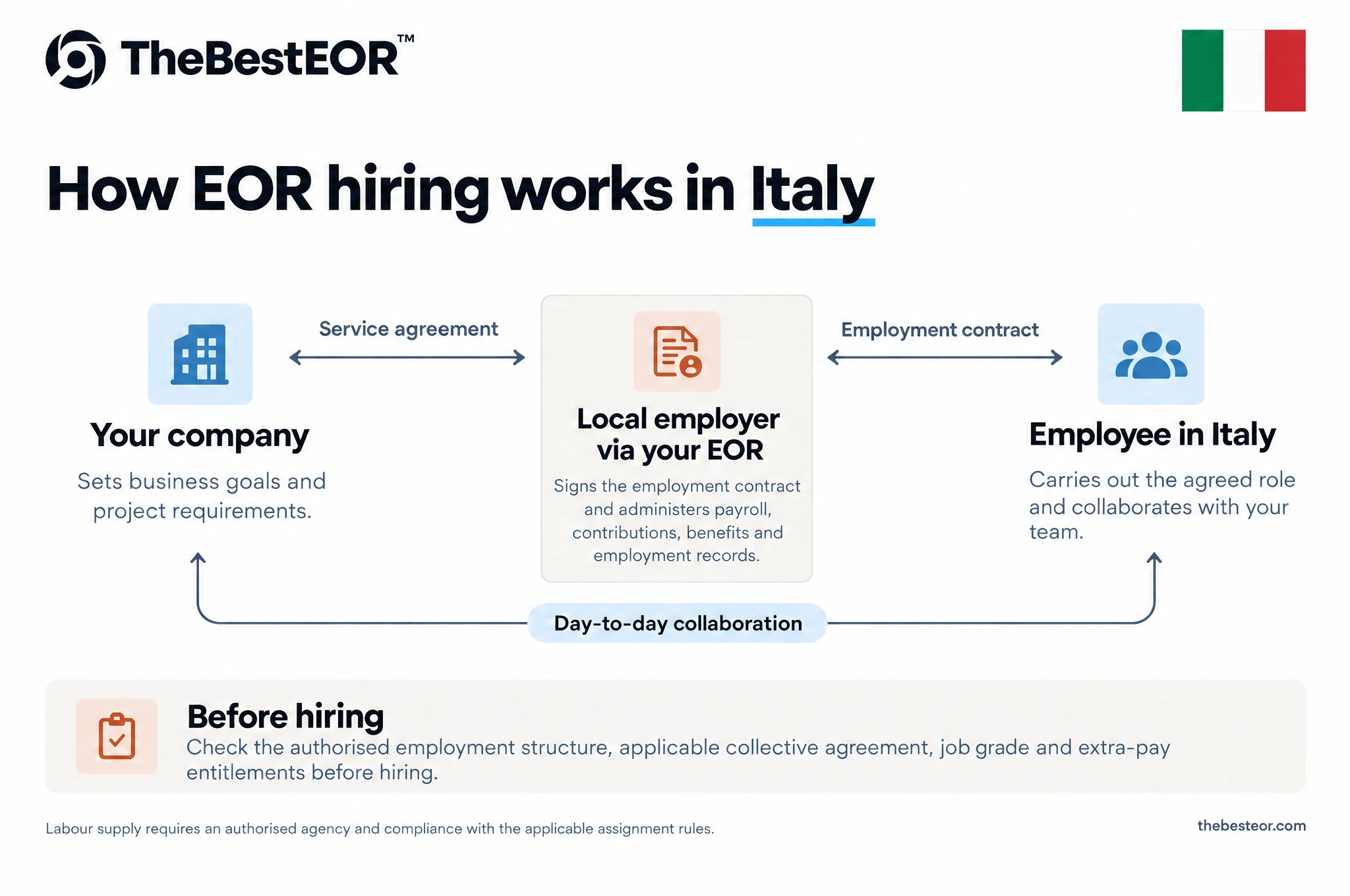
You direct the work. The EOR handles Italian payroll.

Employer of record in Italy diagram showing the service agreement, employment contract, and day-to-day collaboration between your company and the employee.
Employer of record in Italy: how your company, the local employer and the employee work together. Select the image to enlarge.

The EOR handles

1
The lavoro subordinato contract, held on its Italian entity along with the statutory liability that follows it
2
Choosing and applying the correct CCNL and level
3
INPS and INAIL registration and the monthly Uniemens and F24 filings
4
IRPEF withholding as sostituto d’imposta, and the annual Certificazione Unica
5
TFR under Article 2120: the accrual, the annual revaluation, the payout at exit
6
The tredicesima, and the quattordicesima where the CCNL requires it
7
The contract, drafted in Italian and naming the CCNL, plus statutory leave administration
8
Nulla osta filing for a non-EU hire where it holds an Italian entity
9
Compliant offboarding, notice and the documented dismissal case

You keep

1
What the person actually works on, day to day
2
Salary, bonus and anything you pay above the CCNL floor
3
The decision to hire and the decision to dismiss; the EOR executes both
4
Performance management, and the giustificato motivo file if it ever comes to that
5
Devices and tooling: your purchase and your policy, with provisioning available from some providers
6
The commercial relationship, and confirming the contract’s IP assignment matches your standard terms

Subordinazione is the test all of this guards against. An Italian court that finds a partita IVA or co.co.co. contractor working set hours under your direction can reclassify them as a subordinate employee, which exposes you to unpaid INPS, accrued TFR, back IRPEF and penalties. An employment arrangement that meets local requirements can change how the worker is engaged from then on. It does not settle earlier classification liabilities. The misclassification guide covers the tests Italian courts apply.

Work permits

Work permits and the nulla osta (2026)

Check the quota route and EU Blue Card eligibility.

Route Who it fits Salary floor (2026) Quota Notes
Route
EU / EEA citizen
Who it fits
Any EU/EEA/Swiss national
Salary floor (2026)
None (CCNL minimum)
Quota
None
Notes
No permit; register residence if staying
Route
EU Blue Card
Who it fits
Graduate / highly qualified non-EU
Salary floor (2026)
Applicable CCNL pay and latest relevant ISTAT average annual earnings; check current threshold
Quota
Quota-free
Notes
Apply any time; degree or equivalent + job offer
Route
Nulla osta (Decreto Flussi)
Who it fits
Other subordinate non-EU roles
Salary floor (2026)
Per CCNL for the role
Quota
164,850 entries in 2026, click-day
Notes
Quota set by decree; file the day the window opens

Fig. 7 · Work permits and 2026 salary floors · the EU Blue Card sits outside the quota; the Decreto Flussi allows 164,850 entries in 2026

For a non-EU hire the employer’s Italian entity files the nulla osta al lavoro with the local Sportello Unico per l’Immigrazione, after which the worker obtains the entry visa and then the permesso di soggiorno. Most non-EU subordinate hires fall under the annual Decreto Flussi quota, processed first-come on designated click days. The 2026–2028 planning decree, published in the Gazzetta Ufficiale on 15 October 2025, sets 497,550 entries across the three years, 164,850 of them for 2026. The EC portal’s EUR 33,500 figure is for 2024, not 2026; confirm the current figure at filing.

For an EU-citizen hire, which includes every Italian national, none of this applies and every provider on the list works.

Salary benchmarks

Indicative salary ranges

Compare Milan offers on the same annual salary basis.

Annual gross in euro with a monthly equivalent. Ranges are 2026 market data from Glassdoor and Levels.fyi for the Milan market. Match a proposed offer to the candidate’s role and seniority, and confirm how the annual package treats tredicesima.

Check current pay data for the role and location before you make an offer.

Role Gross EUR/year EUR/month (approx)
Role
Software engineer
Gross EUR/year
€30,000–52,000
EUR/month (approx)
€2,850
Role
Senior software engineer
Gross EUR/year
€42,000–66,000
EUR/month (approx)
€4,190
Role
Product manager
Gross EUR/year
€37,000–78,000
EUR/month (approx)
€3,615
Role
Accountant
Gross EUR/year
€28,000–45,000
EUR/month (approx)
€2,615
Role
Customer support
Gross EUR/year
€24,000–34,000
EUR/month (approx)
€2,155
Role
Sales manager
Gross EUR/year
€40,000–75,000
EUR/month (approx)
€4,000
Role
HR manager
Gross EUR/year
€40,000–70,000
EUR/month (approx)
€3,845
Role
Designer
Gross EUR/year
€28,000–48,000
EUR/month (approx)
€2,770

Fig. 8 · What roles cost in Italy, 2026 · annual gross for the Milan market, tredicesima already inside the annual figures

Salaries cluster in Milan and the north (Lombardy, Emilia-Romagna, Veneto); Rome runs broadly similar for senior roles, while the south and smaller cities run roughly 10 to 20 percent below Milan for the same job. Monthly figures divide annual gross by 13 to reflect the tredicesima as a standard extra period; under a 14-payment CCNL divide by 14 instead. For a non-EU hire, check the actual offer against the current EU Blue Card salary test and applicable CCNL; the EUR 33,500 figure is historical.

Ordinary-month cost illustration

What an Italian engineer costs per month

Start with an engineer on €3,000 gross per month.

For a different salary, estimate employer payroll costs in Italy.

Software engineer, Milan Gross base: EUR 3,000/month
Gross salary EUR 3,000

Employer INPS (~30%)

IVS pension, NASpI, sickness, maternity, wage-guarantee funds
EUR 900

INAIL (~0.4%)

Risk-rated work-injury premium
EUR 12

TFR accrual

Gross ÷ 13.5, set aside for severance
EUR 222

EOR fee, cheapest

RemoFirst from $199 ≈ EUR 184
⚠ Trustpilot warning: rating suspended for a breach of its guidelines; fake reviews removed
EUR 184

Ordinary-month illustration, lowest listed fee

Annual cost depends on the CCNL salary instalments and related employer costs
EUR 4,318

Fig. 9 · Ordinary-month illustration for a Milan software engineer · displayed employer-cost components plus TFR, using an illustrative USD 199 monthly service fee; reconcile the CCNL and additional salary instalments for an annual budget

Statutory employer cost plus TFR is about EUR 1,134, roughly 38 percent on top of gross when the deferred TFR accrual is counted. Using the illustration’s exchange-rate assumption, a hypothetical USD 699 monthly service fee (approximately EUR 646) gives EUR 4,780/month before unmodelled charges. This is a scenario, not a provider quote. Compare the complete proposal and reconcile the statutory components and any additional salary instalments.

EOR vs your own entity

EOR or your own S.r.l.: compare costs

Price the notary, accountant and payroll adviser.

Incorporating an S.r.l. adds setup and recurring administration: a notary to open it, a commercialista and a consulente del lavoro to keep it filing. Compare those quotes with the full EOR proposal over the same hiring period.

Factor EOR Your own S.r.l.
Factor
Setup cost
EOR
None
Your own S.r.l.
Notary deed, registration and paid-in capital
Factor
Time to first hire
EOR
3–14 days
Your own S.r.l.
Notary, then Registro Imprese, INPS/INAIL positions and VAT, before anyone is hired
Factor
Per-employee cost
EOR
$199–699/employee/mo fee + statutory
Your own S.r.l.
Statutory only, plus shared overhead
Factor
Ongoing admin
EOR
Provider runs payroll & filings
Your own S.r.l.
Commercialista, consulente del lavoro, your own Uniemens & F24
Factor
Compliance liability
EOR
Employer obligations sit with the named employer; client duties and potential joint liability depend on the arrangement
Your own S.r.l.
On you and your amministratore

Fig. 10 · EOR vs your own S.r.l. · the break-even guide works with a five-to-eight-employee band

Annualising an illustrative $199 monthly starting service fee gives about EUR 2,200 using the example’s exchange rate. That is only the service-fee component of the premium over employing through your own entity. An S.r.l. costs you in retainers rather than fees: the commercialista for the accounts, the consulente del lavoro for payroll, the annual filings and VAT compliance, every one of them billing at one employee and still billing at twelve, with compliance liability landing on your amministratore.

No single crossover number holds once you have a real commercialista quote; the EOR vs entity break-even guide provides a framework. The break-even depends on complete current quotes, including setup, administration, funding, benefits, FX and exit costs. A common path is to hire the first few through an EOR, then stand up an S.r.l. and transfer staff once the team passes the break-even and you have committed to Italy long-term. Ask early how each employee’s accrued TFR will move, because that is the detail an EOR-to-entity migration has to handle cleanly.

FAQ

EOR in Italy: common questions

How do TFR and the 13th salary affect the budget?

Which EOR should I choose for hiring in Italy?

RemotePeople is our top pick for Italy in 2026 (4.9/5), followed by Deel (4.7/5) and Rippling (4.5/5). We opened paid accounts with all 10 providers on this page, priced real hires and ran payroll.

RemotePeople offers recruitment and EOR through one provider, with a dedicated account manager on both EOR plans. RemotePeople’s EOR Global plan starts at USD 499 per employee per month, and EOR Select at USD 199 where the hire qualifies. Deel starts at USD 599 plus a mandatory Employer Liability Cost; Rippling starts at USD 499 plus its required platform subscription.

I’d start with this Italy EOR comparison, then ask your shortlist to confirm the legal employer and any local delivery partner, the applicable CCNL and job level, and a written total-cost quote.

Compare the same salary, benefits and start date, including employer contributions, TFR accrual, additional salary instalments, deposits, FX and exit charges. Check who answers Italian payroll and employment questions, the onboarding steps, and the fit with your existing HR systems. Choose the provider that can evidence a suitable Italian employment arrangement and support your needs; the lowest advertised service fee alone does not establish the lowest total cost.

How does an employer of record work in Italy?

An employer of record in Italy becomes the worker’s legal employer through a local employing entity, while your company directs the day-to-day work. The EOR registers the employee with INPS for pension and unemployment cover and with INAIL for work-injury insurance, withholds the employee INPS share and IRPEF income tax, files the monthly Uniemens declarations and accrues the TFR severance fund. It pays the tredicesima with December salary.

How fast can an EOR onboard an employee in Italy?

Estimated onboarding times for Italy range from 3 to 12 days across the providers we tested. By provider: Deel 3–5 days, Rippling 3–5 days, G-P 3–5 days, RemotePeople 7–10 days and Oyster 7–12 days.

Agree the start date only after the provider has reviewed the role, the relevant CCNL, the proposed pay and the employment arrangement. Ask for the contract and payroll-registration milestones and the first salary date. Immigration approval, if required, needs its own timetable.

How much does an EOR cost in Italy per month?

Published service fees for Italy run from USD 199 to USD 699 per employee per month across the 10 providers we tested: RemoFirst from USD 199; RemotePeople Global from USD 499, or Select from USD 199 only where country and salary qualify; Deel from USD 599 plus mandatory Employer Liability Cost; G-P from USD 599; Oyster USD 699 on monthly billing, with annual seats quoted separately. Multiplier Core advertises $499 monthly or $459 per month billed annually; Pebl advertises $399, with currency and commitment to confirm. Rippling starts at USD 499 plus its required platform from USD 8 per employee, and Papaya Global at USD 499. Borderless AI is USD 579 standard, with an eligible USD 399 promotion on fees billed through 31 December 2026. All amounts are per employee/month; salary and employment costs are separate. 

On top of the fee you pay the gross salary plus employer social security of roughly 29 to 32 percent through INPS and INAIL, and you accrue TFR severance at about one month of pay per year.

What employer contributions are mandatory in Italy?

INPS social security at roughly 29 to 32 percent of gross for most office roles, covering the IVS pension fund, unemployment (NASpI), sickness, maternity and the wage-guarantee funds, plus INAIL work-injury insurance from about 0.4 percent depending on risk class. The pension base is capped at EUR 122,295 in 2026 for workers first registered after 1996. On top of that, the employer accrues TFR severance at annual gross divided by 13.5.

What is TFR and how much does it cost the employer in Italy?

TFR (trattamento di fine rapporto) is statutory deferred severance under Article 2120 of the Civil Code. The employer sets aside the annual gross salary divided by 13.5, which is about 7.4 percent of pay or roughly one month per year, and the accrued sum is revalued each year by 1.5 percent plus 75 percent of ISTAT inflation. It is paid out when employment ends for any reason, including resignation, so budget it as a real cost from day one.

Is the 13th and 14th month salary mandatory in Italy?

The 13th month, the tredicesima, is mandatory under nearly every CCNL and is paid with the December salary. A 14th month, the quattordicesima, is required only where the applicable CCNL provides for it, which the commerce and tourism agreements commonly do, paid in June or July. At a fixed ordinary monthly amount, fourteen payments total 16.67% more than twelve payments. If the offer is an annual gross amount already including all instalments, changing the payment schedule does not add salary.

What notice and severance applies when terminating in Italy?

Notice comes out of the applicable CCNL’s tables and scales with the employee’s level and seniority; no statute supplies the day-count, so read the current table before fixing an exit date. TFR is always paid on top, whatever the reason for leaving. Dismissal needs giusta causa or giustificato motivo; an unfair dismissal under the Jobs Act regime for post-March-2015 hires is compensated with an award the tribunal sets at its discretion between 6 and 36 months of pay, per Constitutional Court judgment 194/2018.

What is the income tax and payroll cycle in Italy?

Income tax is IRPEF, withheld monthly by the employer. From 1 January 2026 the brackets are 23 percent up to EUR 28,000, 33 percent from EUR 28,001 to 50,000, and 43 percent above EUR 50,000, plus a regional surcharge of 1.23 to 3.33 percent and a municipal surcharge up to 0.9 percent. Payroll runs monthly, usually paid around the 27th, in euro, with the tredicesima added in December.

Can an EOR sponsor a work permit in Italy?

For an EU or EEA citizen no permit is needed, so any provider on the list can hire them. For a non-EU hire the employer’s Italian entity files the nulla osta with the Sportello Unico per l’Immigrazione, either under the annual Decreto Flussi quota or, for graduate roles, the quota-free EU Blue Card, which requires the applicable CCNL pay and latest relevant ISTAT average gross annual earnings measure; verify the current threshold at filing.

Does Italy have a minimum wage?

Italy does not have one statutory minimum hourly wage covering all workers. Pay floors depend on the relevant collective agreement (CCNL) and the role’s classification, alongside the constitutional requirement for proportionate and sufficient remuneration.

Ask the provider to identify the CCNL and grade used for the offer, then show the annual gross pay and any additional salary instalments required by that agreement.

Can I convert an Italian contractor to an EOR employee?

Yes, if the provider can confirm the employment arrangement is legal and compliant for the role. Review how the contractor has actually been working before agreeing the move: Italian rules can apply employee protections to certain ongoing, mainly personal collaborations organised by the client.

Moving to employment changes the future arrangement; it does not automatically erase liabilities from the earlier relationship. Article 54 of Legislative Decree 81/2015 provides a separate, conditional stabilisation procedure for qualifying cases. Ask an Italian labour adviser to assess the past arrangement and any available remedy; do not assume an EOR conversion qualifies. See the Labour Ministry’s guidance and the contractor misclassification guide.

Sources and as-of dates

Article references

The statutory numbers above come from Article 2120 for TFR, Decreto Legislativo 66/2003 for hours and leave, the 2026 Budget Law for the IRPEF cut and the CCNL tables for pay floors. Provider facts come from TheBestEOR’s 2026 review files. Rates as of June 2026.

Hiring facts Checked 2 Oct 2026

Hiring facts

Checked 2 October 2026
Eligibility, local and collective rules apply. EOR fees extra.

INPS contribution rates and cap 3 sources

INPS contribution rates depend on the employer’s sector, size and legal form, the worker’s classification and the insurance schemes involved. Obtain a payroll-specific calculation rather than treating approximate employer and employee percentages as statutory rates. The 2026 annual pension contribution-base ceiling is EUR 122,295 for workers first insured from 1 January 1996 who have no earlier contribution history.

INAIL work-injury insurance 2 sources

INAIL work-injury insurance is risk-rated. The premium depends on the insured payroll and the applicable occupational tariff, with adjustments for claims experience and prevention measures. A rate of about 0.4% should not be used as a universal minimum or a quote for a particular employer.

TFR severance 2 sources

Article 2120 of the Civil Code governs TFR. The annual accrual is based on eligible annual remuneration divided by 13.5. The accumulated balance from earlier years is revalued annually by a fixed 1.5% plus 75% of the increase in the ISTAT consumer-price index for worker and employee households; the current year’s accrual is excluded from that revaluation. The applicable CCNL and payroll rules determine the remuneration included.

Tredicesima / quattordicesima 1 source

Check the applicable CCNL for entitlement to additional salary instalments and their payment dates. For example, the Confcommercio Terziario agreement provides a 13th salary instalment at Christmas and a 14th on 1 July. Other collective agreements can have different entitlements, accrual rules and payment dates.

Working time and leave 5 sources

Legislative Decree 66/2003 sets a normal 40-hour working week, an average ceiling of 48 hours including overtime, and at least four weeks of paid annual leave, subject to its scope and permitted exceptions. Collective agreements can set shorter normal hours and govern overtime premiums. Additional paid time off, including ROL, depends on the applicable CCNL.

Termination 5 sources

Notice periods depend on the applicable CCNL, level and length of service. The dismissal remedy also depends on the hiring regime, employer size and the reason a dismissal is unlawful. For relevant dismissals under Legislative Decree 23/2015, the ordinary compensation range for employers above the statutory size thresholds is 6–36 months of the remuneration used to calculate TFR; judgment 194/2018 requires consideration of the individual circumstances. Reinstatement remains available in specified cases under both the Jobs Act and Article 18 regimes. Earlier hiring does not automatically guarantee reinstatement, and later hiring does not rule it out.

IRPEF income tax 3 sources

For 2026, national IRPEF rates are 23% on taxable income up to EUR 28,000, 33% on the portion above EUR 28,000 and up to EUR 50,000, and 43% above EUR 50,000. The 2026 Budget Law reduced the second rate from 35% with effect from 1 January 2026. Regional and municipal additions vary by location, taxable income and available exemptions; use the Ministry of Finance’s applicable-year schedules for the employee’s tax residence.

Minimum wage 3 sources

Italy has no national statutory minimum wage in Eurostat’s 2026 reporting. Applicable CCNLs specify sectoral minimum pay by classification. As a historical example, the Federmeccanica D1 monthly minimum from June 2025 was EUR 1,742.03, not about EUR 1,900. That historical amount must not be used as a current 2026 pay-table figure; check the applicable agreement and effective date for each hire.

Work permits 5 sources

Ordinary quota-based recruitment uses a nulla osta application through the Sportello Unico immigration service; the current Decreto Flussi program sets annual allocations within 2026–2028. The EU Blue Card is a separate route outside those quotas. Its salary must meet both the applicable CCNL requirement and the latest relevant ISTAT average gross annual earnings measure. The European Commission’s EUR 33,500 figure is explicitly for 2024, not 2026. The portal lists no reduced salary exception, but eligibility should be checked against the current Italian rules.

Salary benchmarks 3 sources

Glassdoor and Levels.fyi can provide indicative Milan salary comparisons. Compare gross annual base salary separately from bonuses, equity and total compensation. Convert annual base pay to 13 or 14 salary instalments only where the applicable contract uses that schedule; do not add an extra instalment to an annual figure that already includes it.

Provider pricing, entity model and onboarding 10 sources

Sources checked in October 2026 Checked 19 Oct 2026

Ministry of Labour: somministrazione — Authorised agency structure, client direction, equal treatment and joint wage/contribution liability. Checked 19 October 2026.

INPS Circular 12 of 5 February 2026 — 2026 Treasury Fund changes, employer-size history, preserved new-company rules and monthly remittance. Checked 19 October 2026.

INPS: July 2026 pension and TFR changes — First private-sector hires from 1 July 2026: automatic supplementary-pension enrolment and 60-day choice window. Checked 19 October 2026.

FILCAMS-CGIL: Confcommercio Terziario agreement — Agreement-party summary of Christmas thirteenth and July fourteenth instalments; six-day leave counting. Checked 19 October 2026.

Confirm the applicable collective agreement before comparing proposals. The country guides cover other markets. For this hire, browse EOR providers for Italy and use the EOR cost calculator to compare the recurring amounts in your proposals in USD.

This guide is for general information only and does not provide legal, tax, accounting, or financial advice. For advice about your business, consult a qualified professional familiar with the rules where you hire. The research methodology explains how TheBestEOR assesses sources.