TheBestEOR

Best Employer of Record in Egypt

Written by Martynas PupkeviciusFact-checked by Michael Ennis
Picture of Martynas Pupkevicius
Martynas Pupkevicius

EOR Advisor and Remote Work Editor

Our top employer of record in Egypt for 2026 is RemotePeople, from USD 499 per employee a month, ahead of Deel and G-P.

We tested all 10 providers with paid client accounts, real quotes and a live hire run through payroll. Egyptian employers pay social insurance contributions on the employee’s insured earnings, which depend on the pay elements included and the current earnings limits.

Flag of Egypt

Hiring in Egypt at a glance

Currency
EGP
Egyptian pound
Pay cycle
Monthly
Salaried staff, others generally weekly unless agreed
Working hours
8 h a day
And 48 a week, excluding meal and rest breaks
Annual leave
21 days
Minimum from the 2nd year, 1st year based on 15 days
Extra pay
Per contract
Or by practice, profit sharing if legally required
Employer costs
Social insurance
On insured earnings, check pay elements and limits
Before you hire:
Confirm leave under the 2025 Labour Law and which pay elements count as insured earnings.

Country hiring overview · Egypt

Hiring in Egypt, at a glance.

Compare the employment terms and the currency assumptions.

For an Egyptian hire, I’d ask for the named employer and the employment rules applied to the role, with the local salary separated from the provider invoice. Currency conversion and any immigration work need resolving before I’d rely on a proposed start date.

Choose a hiring solution

Need a local employer?

Compare an EOR arrangement for your role before opening your own entity.

Already have a local employer?

Compare payroll and HR support against adding an EOR.

EOR service fee

Fees vary by provider.

Your quote should state the currency, fee per employee, minimum charge and billing commitment.

Onboarding

Paperwork affects the start date.

The contract, right-to-work checks, registrations and payroll deadlines all affect when employment can begin.

Employment costs

Check the insurable wage.

Ask which insurable wage the provider uses to calculate employer contributions. The quote should show those contributions and agreed benefits separately from the employee’s salary.

Annual leave

Age and service affect leave.

Under Egypt’s Labour Law, annual leave depends on the employee’s length of service, age and employment category. Ask the EOR to state the allowance in the contract.

Check before choosing

Confirm the applicable 2025 labour-law provisions, leave allowance, insurable wage, EGP salary, invoice currency and any permit requirements.

What your quote should include

Employment costs and service fees

1
Gross salary and agreed pay schedule
2
Insurable wage, contributions and agreed benefits
3
EOR fee: currency, per-employee billing, minimums and commitment
4
Setup, foreign exchange, extras and exit costs

Deposits and payroll funding

1
Amount and payment deadline
2
Whether funds are refundable or credited to payroll
3
Release conditions and refund timing
Show these separately from recurring expenses.

Key takeaways for hiring in Egypt

Record remote employment terms

Keep remote employment terms explicit: the 2025 law recognizes new work patterns and requires a clear written relationship, including an electronic contract where applicable.

Confirm NOSI registration

Ask for confirmation of the NOSI registration, not only a payslip. The official joining procedure calls for Form 1 within two weeks of the employee joining.

Use the actual insured wage

For 2026, the monthly insured-wage band runs from EGP 2,700 to EGP 16,700. Do not report every employee at the lower bound.

Separate salary and invoice currency

Keep the salary promise separate from the invoice conversion. A fixed EGP salary and a USD-linked salary create different budgets even if the provider charges the same fee.

Compare the same cost assumptions

Compare total invoices using one stated exchange-rate assumption. In an EGP 49/USD scenario, a $599 fee equals EGP 29,351; the resulting salary-plus-contribution-plus-fee subtotal is EGP 72,482.25.

Quick verdict

What is the best EOR in Egypt?

1
Editorial pick
RemotePeople logo

4.9/5

RemotePeople

Hiring in new markets with local HR support

Starting fee
$499

per employee / month

Countries
150+
where you can hire

EOR Select from $199 for eligible hires.

Deposit
1 month

of gross salary

Deposit refund
Within 5 days

of the final payment

Why consider it

Recruitment and EOR services through one provider.

Dedicated account manager in both EOR plans.

Check the fit

Recruitment is separately priced.

Before signing: Confirm quote currency, billing commitment, deposits, funding deadlines and refund terms. EOR Select eligibility depends on the hiring country and employee salary.

Both EOR plans list local contracts, payroll and tax administration, and statutory benefits administration. Salary, employer contributions and benefit costs are separate.

Visit RemotePeople ↗

2
Deel logo

4.7/5

Deel

Paying employees and contractors on one platform

Starting fee
$599

per employee / month

Countries
130+
where you can hire

Plus a mandatory Employer Liability Cost.

Deposit
1–1.5 months

of gross salary

Deposit refund
Within 60 days

of offboarding

Why consider it

EOR, contractor management and payroll for your own entities.

Month-to-month EOR service pricing available.

Check the fit

The country-specific Employer Liability Cost is mandatory.

Before signing: Confirm the Employer Liability Cost amount, benefit costs and any additional products. Monthly service terms do not remove employment notice, severance or other exit obligations.

The EOR pricing page lists 130+ countries. Broader platform coverage figures may include other services.

Visit Deel ↗

3
G-P logo

4.2/5

G-P

Hiring abroad while keeping your existing HR system

Starting fee
$599

per employee / month

Countries
180+
where you can hire

Volume pricing is quoted for larger teams.

Deposit
1–2.5 months

of gross salary plus employer costs

Deposit refund
Per contract

agree a return date before signing

Why consider it

One flat starting fee in every listed country, with volume pricing for larger teams.

Right-to-work checks and local contracts are built into onboarding.

Check the fit

Partner entities employ hires in some countries, alongside G-P’s 100+ owned entities.

Before signing: Refund timing is set per contract, so agree a deposit return date. The deposit depends on a credit check.

At $599 a month, the first year for one hire is $7,188 in service fees. Salary, employer costs and the refundable deposit come on top.

Visit G-P ↗

No provider pays for a position on this page; some outbound links pay a referral fee. See the funding model and methodology.

Fees, entities, FX

All 10 EOR providers for Egypt, side by side

Fees are in dollars. Salaries are paid in Egyptian pounds.

Fees are 2026 list prices per employee per month, billed in dollars against a salary paid in pounds. Onboarding times are for an Egyptian national or a foreigner who already holds a permit; a new work permit adds one to three months through the Ministry of Labour.

With nearly the whole field on partner entities, I focus on fees, exchange-rate transparency and permit experience in the Egypt comparison. The same ten providers are compared side by side in the global EOR ranking. For a wider shortlist, browse EOR providers for Egypt.

Provider

Best For

Starting feeDepositOnboarding
1 RemotePeople logo RemotePeople 4.9/5 Rating Hiring in new markets with local HR support Starting fee: $499 USD / monthDeposit: 1 monthOnboarding: 5–8 days

My take

Both RemotePeople EOR plans include employment contracts, payroll and tax administration, statutory benefits administration, a dedicated account manager and ongoing employment support.

EOR Global starts at USD 499 per employee per month. EOR Select starts at USD 199 for eligible countries and employee salary ranges. Salary, employer contributions and benefits are separate; the proposal sets the applicable plan, billing commitment, deposit and payroll funding terms.

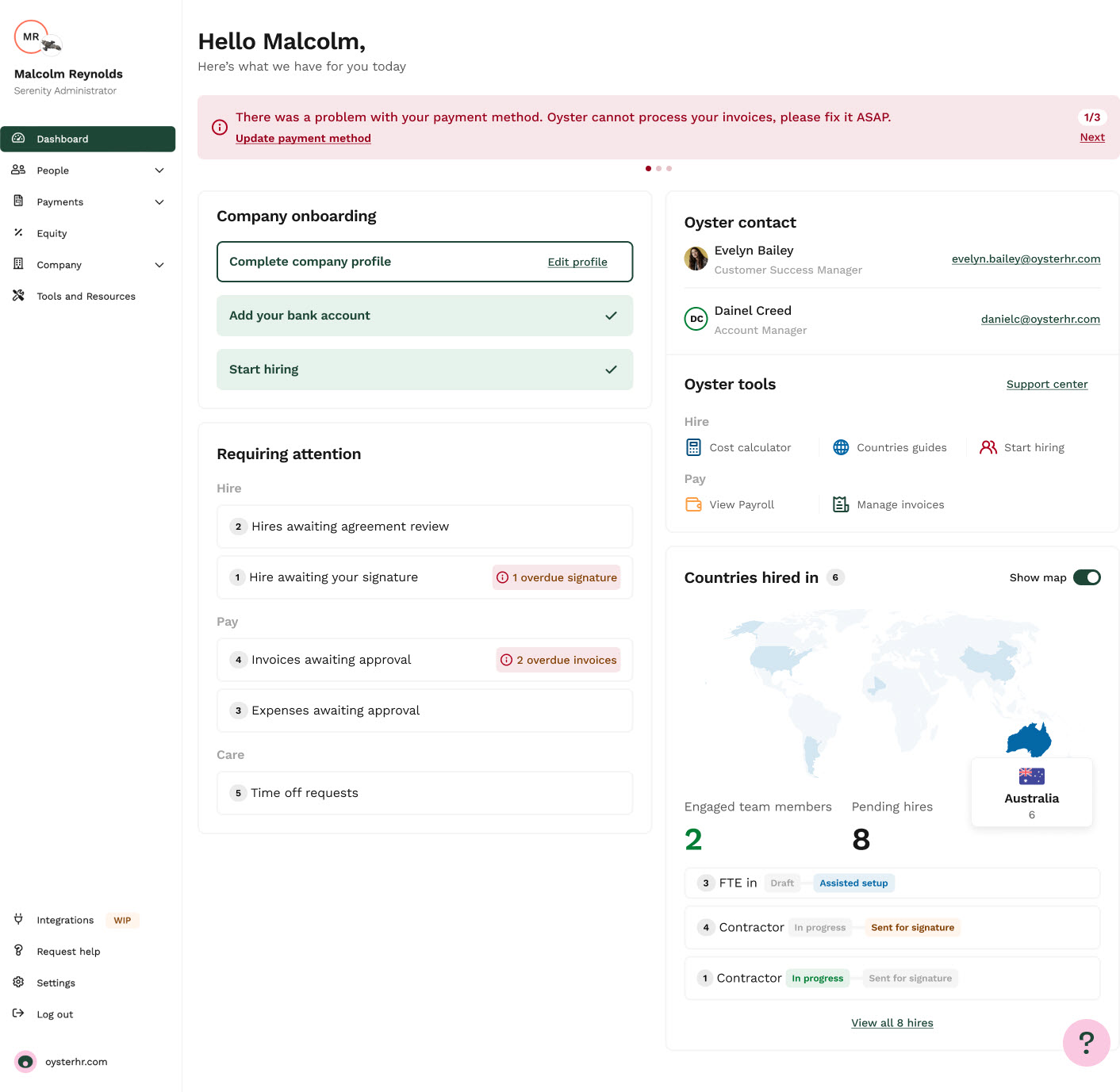
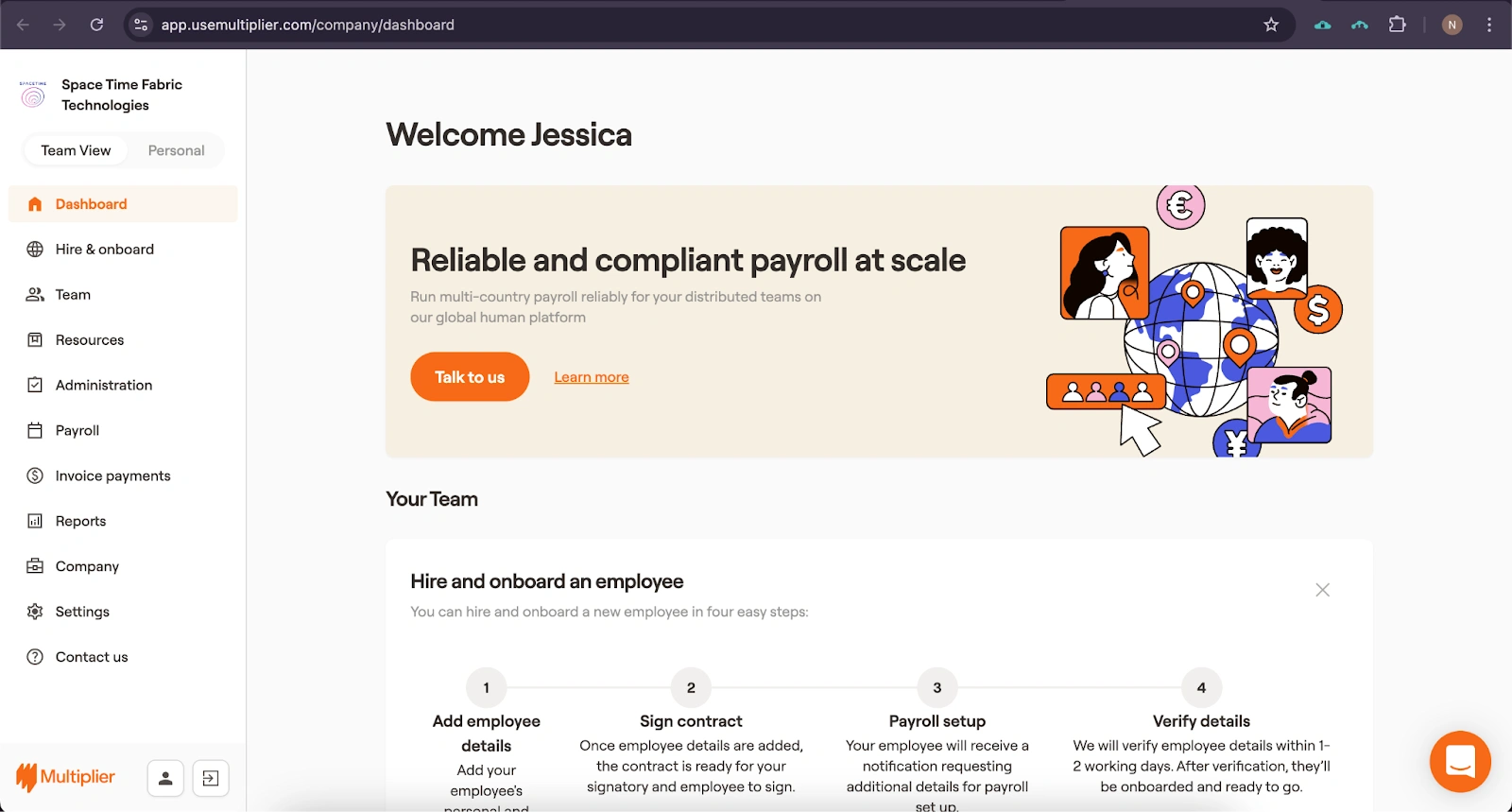
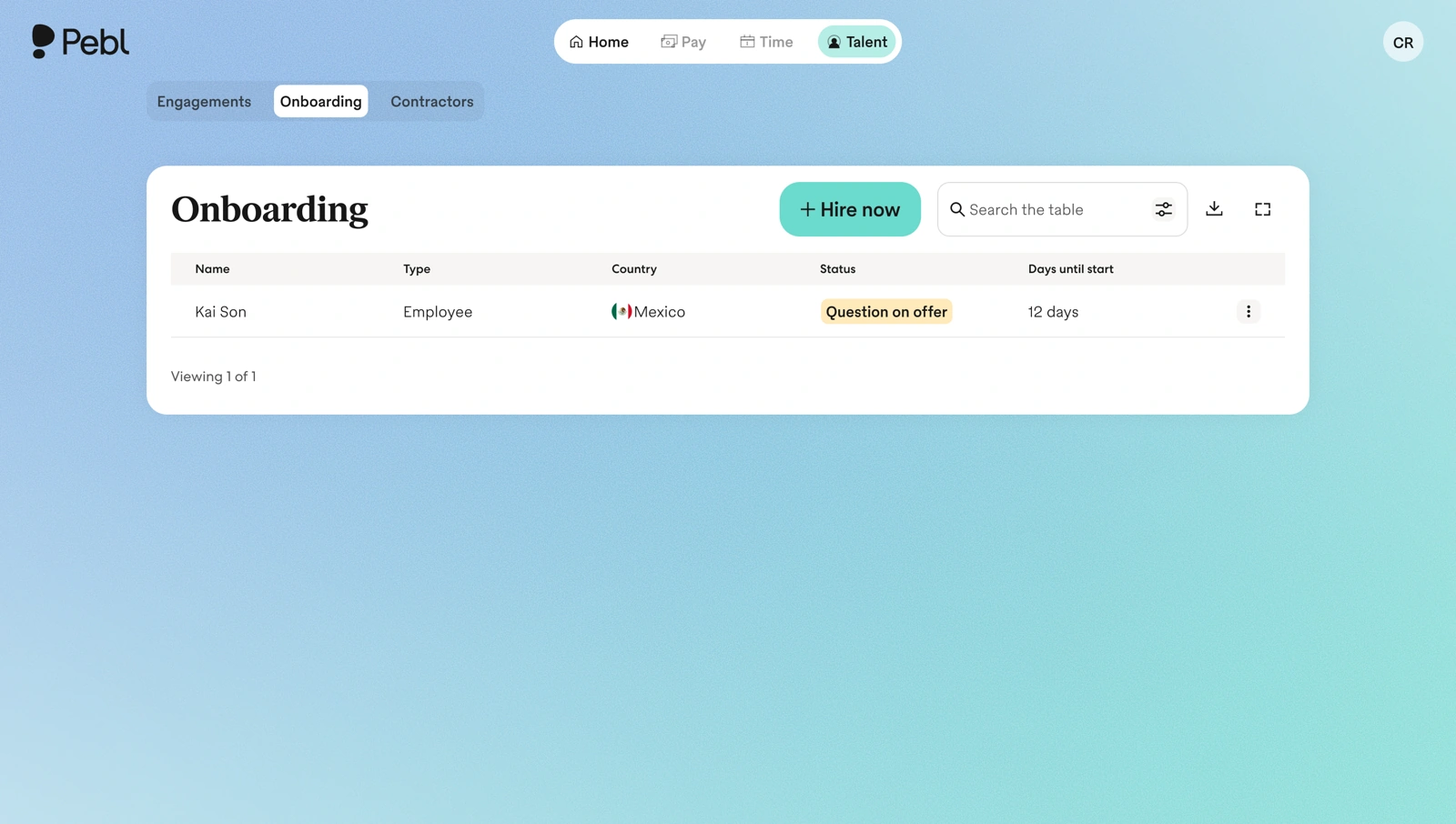
Fit check for RemotePeople, Multiplier, Pebl and RemoFirst

For a straightforward Egyptian hire, I’d compare these proposals using the same gross salary, insured wage, medical cover and invoice currency. I’d choose on the total cost, a clear exchange-rate policy and support that fits your team. A lower service fee is less useful if funding charges or salary adjustments remain unspecified.

Deposit

1 month

Entity model

Own entities in core markets

First year, one hire

$5,988 in service fees

Reviewed by Martynas PupkeviciusFact-checked by Michael Ennis

Starting fee

$499

EOR Global. EOR Select starts at $199 where the country and employee salary qualify.

Against the 10 starting fees

$199 lowest$699 highest
2 Deel logo Deel 4.7/5 Rating Paying employees and contractors on one platform Starting fee: $599 USD / monthDeposit: 1–1.5 monthsOnboarding: 2–5 days

My take

Deel offers contractor management from USD 49 per contractor per month.

Moving a contractor into EOR employment requires a new quote, review and employee onboarding, including a contractor release agreement.

Deel’s global EOR service starts at USD 599 per employee per month, with month-to-month pricing available. Mandatory Employer Liability Cost is charged separately and varies by country. Salary, employer contributions, benefits and any additional services sit outside the starting service fee.

Fit check for Deel and Rippling

The platform is most useful when it carries the agreed job into a complete Egyptian employment file. For a contractor conversion or remote employee, ask who records the new terms, confirms the insurance registration and gives the worker the local contract. I’d look elsewhere if the software demonstration leaves those responsibilities unclear.

Deposit

1–1.5 months

Entity model

Own entities and partners

First year, one hire

$7,188 in service fees

Reviewed by Martynas PupkeviciusFact-checked by Michael Ennis

Starting fee

$599

Month-to-month billing. Mandatory Employer Liability Cost is charged separately.

Against the 10 starting fees

$199 lowest$699 highest
3 G-P logo G-P 4.2/5 Rating Hiring abroad while keeping your existing HR system Starting fee: $599 USD / monthDeposit: 1–2.5 monthsOnboarding: 5–10 days

My take

G-P offers optional visa support, background checks and equity payroll management alongside its employment service. Additional services have their own eligibility and charges.

G-P’s global EOR fee starts at USD 599 per employee per month, with a tailored country proposal. There is no minimum duration for an EOR hire; the client’s billing, cancellation and employee exit terms remain separate contract terms.

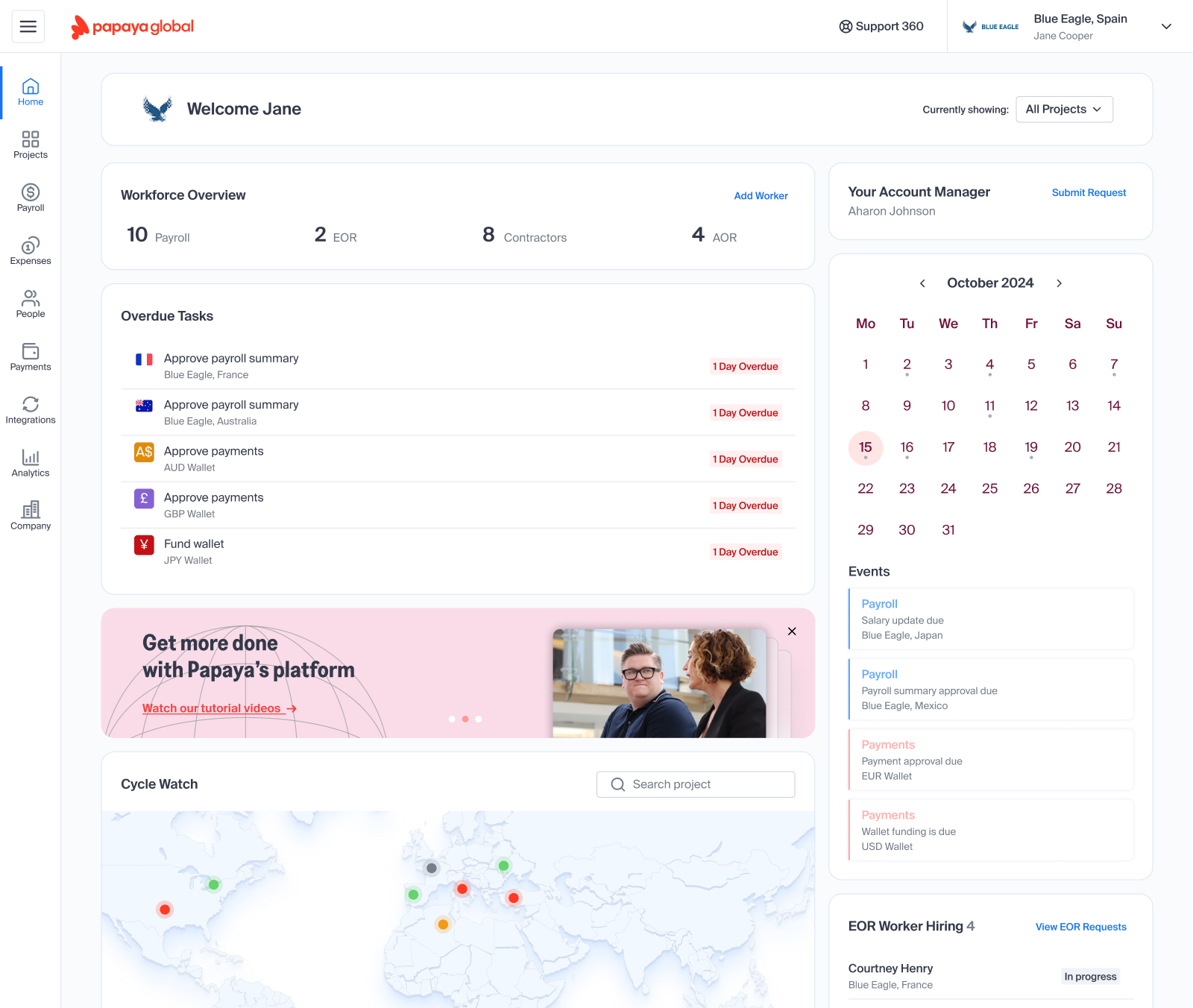
Fit check for G-P, Oyster, Papaya Global and Borderless AI

Ask for a sample Egyptian payroll explanation covering the agreed salary, insured wage, deductions and invoice conversion. I’d choose on whether the employee-facing explanation and finance reporting fit your needs. For a foreign hire, make approval of the actual employment and permit route a separate condition; a polished report cannot show that the candidate can start.

Deposit

1–2.5 months

Entity model

100+ own entities, plus partners

First year, one hire

$7,188 in service fees

Reviewed by Martynas PupkeviciusFact-checked by Michael Ennis

Starting fee

$599

Confirm the included services and billing terms in your country quote.

Against the 10 starting fees

$199 lowest$699 highest
4 Rippling logo Rippling 4.5/5 Rating Setting up payroll, laptops and app access for new hires Starting fee: $499 USD / monthDeposit: Per quoteOnboarding: 2–5 days

My take

EOR employees share HR records and workforce reporting with the rest of the organisation. App access and device management are separate products.

Rippling EOR starts at USD 499 per employee per month, plus the required Rippling Platform from USD 8 per employee per month plus a monthly base fee. Billing commitment and optional HR or IT modules are quote-specific.

Deposit

Per quote

Entity model

Own entities and local partners

First year, one hire

$5,988 in EOR fees

Reviewed by Martynas PupkeviciusFact-checked by Michael Ennis

Starting fee

$499

Plus the required Rippling Platform, from $8 per employee per month and a monthly base fee. Confirm the billing terms and selected products.

Against the 10 starting fees

$199 lowest$699 highest
5 Oyster logo Oyster 4.5/5 Rating Using one onboarding process for hires across countries Starting fee: $699 USD / monthDeposit: ~1 monthOnboarding: 10–14 days

My take

Oyster provides a hiring-cost calculator and separately priced benefits and HR advice. People Partner advice costs USD 300 per hour.

Oyster’s month-to-month EOR rate is USD 699 per employee per month. Annual seats are quoted separately. Standard annual billing is prepaid and non-refundable; quarterly or semiannual payment is available at a higher seat price. A seat can be reused for a replacement hire. Salary, employer costs, deposits and optional services are additional.

Deposit

~1 month

Entity model

Own entities and vetted partners

First year, one hire

$8,388 in service fees

Reviewed by Martynas PupkeviciusFact-checked by Michael Ennis

Starting fee

$699

Monthly billing. Annual seats are quoted separately, prepaid and non-refundable.

Against the 10 starting fees

$199 lowest$699 highest
6 Multiplier logo Multiplier 4.1/5 Rating Managing payroll, leave and expenses in one place Starting fee: $459 USD / monthDeposit: 1+ monthsOnboarding: 7–10 days

My take

Multiplier Core starts at $499 per employee per month on monthly contracts, or $459 per employee per month billed annually.

The dollar currency is not specified. Country variations and compliance add-ons affect the quote. Growth adds integrations, custom reports and open API access. Implementation fees may apply, although the FAQ says setup is free; the quote must resolve that charge.

Deposit

1+ months

Entity model

Own entities and partners

First year, one hire

$5,508 in service fees

Reviewed by Martynas PupkeviciusFact-checked by Michael Ennis

Starting fee

$459

Core plan billed annually, or $499 per month on monthly billing. Confirm the dollar currency.

Against the 10 starting fees

$199 lowest$699 highest
7 Pebl logo Pebl 4.2/5 Rating Hiring people who need visa or relocation support Starting fee: $399 USD / monthDeposit: Per quoteOnboarding: 7–10 days

My take

Pebl, formerly Velocity Global, offers payroll and benefits administration together with employment support.

Immigration support and supplementary benefits are available as additional services.

Pebl lists an EOR fee of $399 per employee per month, but the general price does not specify the dollar currency or billing commitment. The country proposal determines availability, any offer period and renewal terms; salary, employer costs and additional services are separate.

Deposit

Per quote

Entity model

Affiliates and local partners

First year, one hire

$4,788 in service fees

Reviewed by Martynas PupkeviciusFact-checked by Michael Ennis

Starting fee

$399

Confirm the country price and billing commitment.

Against the 10 starting fees

$199 lowest$699 highest
8 Papaya Global logo Papaya Global 4.1/5 Rating Comparing payroll costs across countries in one report Starting fee: $499 USD / monthDeposit: 1–2 monthsOnboarding: 7–10 days

My take

Papaya provides an account manager who coordinates payroll, legal, finance and benefits specialists. Employees can also raise tickets through its worker app or WhatsApp.

Papaya’s EOR service starts at USD 499 per employee per month. The country quote must identify the billing commitment and any additional services. Salary and employer costs are separate.

Deposit

1–2 months

Entity model

Partner model; confirm employer

First year, one hire

$5,988 in service fees

Reviewed by Martynas PupkeviciusFact-checked by Michael Ennis

Starting fee

$499

The country quote sets the billing terms. Payroll-only processing is priced separately.

Against the 10 starting fees

$199 lowest$699 highest
9 Borderless AI logo Borderless AI 4.0/5 Rating Getting 24/7 help with overseas payroll and HR Starting fee: $579 USD / monthDeposit: 1.5–3 monthsOnboarding: 7–12 days

My take

A refundable deposit is due before onboarding. Borderless AI’s standard calculation is 1.5 months of gross salary plus employer costs, benefits and platform fees for ACH or three months for wire and other methods, with country variations.

Balances unpaid for 15 days, or more than two late payments during the term, can raise the deposit to six months. Refunds follow account closure and settlement of outstanding balances.

Borderless AI’s standard fee is USD 579 per employee per month. Eligible companies headquartered outside Canada can pay USD 399 on fees billed through 31 December 2026; USD 579 applies from 1 January 2027, including promotional customers. Some countries and employment types are priced separately. Salary and employer costs are additional.

Deposit

1.5–3 months

Entity model

Own entities

First year, one hire

$6,948 in service fees

Reviewed by Martynas PupkeviciusFact-checked by Michael Ennis

Starting fee

$579

Eligible companies headquartered outside Canada can pay $399 on fees billed through 31 December 2026.

Against the 10 starting fees

$199 lowest$699 highest
10 RemoFirst logo RemoFirst ⚠ Trustpilot warning 0.5/5 Rating Making a first overseas hire on a tight budget Starting fee: $199 USD / monthDeposit: About 1 monthOnboarding: 5–9 days

My take

We moved RemoFirst to last place on 8 November 2026: Trustpilot has suspended its rating for a breach of its guidelines and removed fake reviews.

RemoFirst says it works exclusively with vetted in-country partners. Here, that means a local partner company, not RemoFirst, would normally employ your hire, and payroll changes, questions and exits pass through both companies, which can slow answers. US$199 is RemoFirst’s starting fee and varies by country, so get this country’s quote before you compare. RemoFirst’s free contractor tier covers administration, including contract management and identity checks. Contractor payments cost USD 25 per contractor in months when a payment is processed; payment-provider and transfer fees may also apply.

RemoFirst’s global EOR fee starts at USD 199 per employee per month, with no minimum contract term or employee count. The country fee, deposit, payroll funding and add-ons depend on the proposal. Salary and employer costs are additional.

Deposit

About 1 month

Entity model

Partners, not own entities

First year, one hire

$2,388 in service fees

Reviewed by Martynas PupkeviciusFact-checked by Michael Ennis

Starting fee

$199

RemoFirst advertises no minimum contract term or employee count. Confirm any country-specific charges.

Against the 10 starting fees
$199 lowest$699 highest

Entity ownership is as each provider states it.

Comparison update (6 October 2026).

Which top pick · Egypt

The Egypt shortlist splits by situation. Hiring an Egyptian national and watching cost: RemotePeople Global starts at $499 and Select at $199 per employee/month where country and employee salary qualify; confirm the selected plan, Egypt service scope and funding terms in writing. Converting Egyptian contractors you already pay in dollars: compare Deel’s contractor and employee products, including the conversion process and all relevant fees. Running Egypt inside a large audited program: ask G-P and Papaya for the local delivery team, reporting, escalation support and full price. Hiring a foreign national into Egypt: make the proposed legal employer, permit experience and employee-specific eligibility the first questions to every provider. Ask for a written quote covering the salary, benefits and services you need. Enter its recurring costs in USD in the EOR cost calculator to compare proposals.

Get your EOR discount

Get up to 30% off eligible EOR service fees. Your quote confirms the discount and terms.

How I compare

How I compare these providers for Egypt

I’d compare how each provider handles currency changes.

The Egypt order rewards what this market stresses: fee discipline, FX handling and procedural experience.

An Egypt shortlist needs to resolve the actual employing arrangement, the employee’s payroll package and the exit procedure. The order shown above is the site’s editorial ranking.

Before a recommendation rests on local compliance or speed, it needs the named employer, the applicable legal basis, the employee-specific contract and a documented start plan.

Employment framework

Employment and payroll in Egypt

Agree how a dollar benchmark converts to Egyptian pounds.

The Egyptian employer handles the local employment contract, social-insurance record and monthly withholding. If salary is benchmarked in dollars, the agreement also needs a clear policy for the amount paid in Egyptian pounds.

Confirm foreign-worker eligibility and support

For a foreign hire, confirm the named employer’s eligibility to apply for a Ministry of Labour work permit. Ask how the applicable foreign-worker quota and any local-recruitment requirements affect the role.

Obtain the provider’s current application requirements, expected processing range and renewal responsibilities. Keep the immigration timetable separate from ordinary payroll onboarding.

Employment contract and legal employer

The EOR’s Egyptian entity or local partner signs the employment contract. Confirm the named employer and its registrations.

The Labour Law passed in 2025 replaced the previous labour code and changed procedures for contracts, termination and leave. Employment is not at will.

The contract is written in Arabic, or bilingually with Arabic controlling. You direct the work; the employer holds the contract, social-insurance registration and the statutory liability attached to both.

Monthly payroll and social insurance

Check the insurance record behind the payroll invoice

The onboarding file should lead to an identifiable insurance registration. NOSI’s private-sector joining procedure calls for Form 1 within two weeks of joining, with supporting employment and identity records. The process checks for an existing insurance number and gives a number to someone not previously registered. Ask the EOR what confirmation it supplies and who corrects any mismatch.

The wage recorded also matters. From 1 January 2026, NOSI sets the monthly limits at EGP 2,700 and EGP 16,700 and stresses reporting actual insured wages. Have the provider reconcile the employment package, the insurable components and the recorded amount. Keep that explanation with the quote so later increases and corrections can be traced.

Tax and insurance deductions

The EOR calculates gross pay in pounds, withholds progressive income tax for the Tax Authority, deducts the employee’s 11 percent social-insurance share and adds the employer’s 18.75 percent share. The insurance amounts are remitted against the insurable wage, whose bands are reset each January.

Payslip and other entitlements

The employee receives a payslip showing withholding. Payroll also accounts for applicable statutory pay increases, leave accrual and contractual allowances.

Salary currency

Salary is paid in Egyptian pounds. If it is benchmarked in dollars, agree how and when the EGP amount will be reset.

From offer to first payroll

1

Agree the package and currency policy

Confirm salary, allowances, statutory pay adjustments and the proposed start date. Set any dollar-to-EGP review policy at this stage.

2

Complete the employment file

The EOR prepares the Arabic or bilingual contract and handles social-insurance registration. Agree required documents and any immigration approvals.

3

Confirm readiness and first payroll

Agree the permitted start date, first-payroll cutoff and responsibility for withholding and contributions. Keep required immigration approval separate from ordinary payroll setup.

Employer cost

Statutory employer contributions in Egypt

Egypt’s insurable wage band resets each January.

One system carries the statutory load: social insurance under the 2019 law, at 18.75 percent for the employer on the insurable wage, a banded figure that resets each January.

Fig. 2 · Where the 18.75% goes: employer contributions as a share of the insurable wage, within the annual bands
Contribution Employer rate Cap / basis Agency
Contribution
Social insurance, total
Employee also pays 11%, withheld by the employer
Employer rate
18.75%
Cap / basis
Insurable wage, between min and max bands reset each January
Agency
NOSI
Contribution
  Pension, disability & death
Employer rate
12%
Cap / basis
Part of the 18.75% above
Agency
NOSI
Contribution
  Sickness (health insurance)
Employer rate
3.25%
Cap / basis
Part of the 18.75% above
Agency
NOSI
Contribution
  Work injury
Employer rate
1.5%
Cap / basis
Part of the 18.75% above
Agency
NOSI
Contribution
  Unemployment
Employer rate
1%
Cap / basis
Part of the 18.75% above
Agency
NOSI
Contribution
  End-of-service
Employer rate
1%
Cap / basis
Part of the 18.75% above
Agency
NOSI

Fig. 3 · Mandatory employer contributions in Egypt · rates under the 2019 Social Insurance and Pensions Law

The central figure is the insurable wage. Contributions are not charged on full gross salary but on a figure bounded by a statutory minimum and maximum, and the 2019 Social Insurance and Pensions Law schedules both bands to rise each January, so the cash cost of the 18.75 percent moves annually even when the rate does not. For salaries above the ceiling the employer contribution stops growing: a well-paid engineer and a very well-paid engineer generate the same monthly contribution, on the order of a few thousand pounds at 2026 bands. That makes Egypt’s statutory employer load light relative to headline European rates, and it means the EOR fee, billed in dollars, is often the largest employment cost you control after the salary itself.

Working time & leave

Working hours, overtime and statutory leave

Annual leave increases with tenure and age.

Egyptian labour law works to an 8-hour day and a 48-hour week, with paid overtime premiums and annual leave that rises with tenure and age.

Hours and pay

Standard day 8 hours
Standard week 48 hours max
Overtime, daytime wage + 35%
Overtime, night wage + 70%
Weekly rest Min 1 day (usually Friday)
Public holidays/yr ~13–14 days

Fig. 4 · Hours and overtime in Egypt · 8-hour day, 48-hour week, premium overtime rates

The working week runs Sunday to Thursday in most offices, with Friday the anchor of the weekend and many employers adding Saturday. Overtime carries a statutory premium over the normal wage, higher at night, and work on the weekly rest day or a public holiday is compensated at a higher rate again or with substitute rest. Public holidays cluster around the two Eids, Coptic Christmas, Sinai Liberation Day, Revolution anniversaries and Armed Forces Day, with exact observance set year by year.

Statutory leave

Annual leave
by tenure / age
15 first year / 21 thereafter / 30 qualifying service or age
Sick leave Paid via social insurance, tiered
Maternity 4 months (new law)
Pilgrimage leave 1 month, once, after 5 yrs
Casual leave Up to 6 days/yr, deducted from annual

Fig. 5 · Statutory annual leave in Egypt · 15 days in the first year, 21 from the second, and 30 after ten years’ service or for workers over 50; additional entitlements apply to specified groups.

Annual leave is 15 days in the first year and 21 days from the second, rising to 30 after ten years of service or for workers over 50; specified groups have additional entitlements. Sick pay runs through the social-insurance system at a percentage of the insured wage, in tiers that step up with duration, on a medical certificate. Maternity leave runs four months under the new Labour Law, up from the 90 days of the old code, and working mothers gain nursing breaks on return. A one-month paid pilgrimage leave is available once in a career after five years’ service.

Ending employment

Probation, notice and termination in Egypt

Check written notice for an indefinite contract.

Egypt has no at-will employment. For an indefinite contract, Article 156 of Labour Law No. 14 of 2025 requires three months’ written notice, regardless of service length. A longer notice period may be agreed. The employer still needs a legally sufficient reason for dismissal.

Stage / contract Notice Exposure on exit
Stage / contract
Probation (max 3 months)
Notice
Contract terms apply
Exposure on exit
Minimal if ended within probation
Stage / contract
Indefinite contract, any length of service
Notice
3 months written
Exposure on exit
Accrued leave + any contractual items
Stage / contract
Longer agreed notice for an indefinite contract
Notice
Longer agreed period applies
Exposure on exit
Statutory notice cannot be reduced by agreement
Stage / contract
Dismissal found unjustified
Notice
Notice rights remain separate
Exposure on exit
Compensation from 2 months' pay per year of service
Stage / contract
Fixed term, runs its course
Notice
Apply the relevant fixed-term expiry or termination rules
Exposure on exit
Check accrued rights and Article 154; expiry and employer termination require separate assessment

Fig. 6 · Indefinite-contract notice under Law No. 14 of 2025, Articles 156–165 · three months in writing; longer agreed notice may apply. Fixed-term expiry follows separate rules.

Two features distinguish the Egyptian exit from its Gulf neighbours. There is no statutory end-of-service gratuity accruing month by month; the social-insurance pension plays that role. Fixed-term expiry and employer termination need separate assessment, including accrued rights and Article 154, and notice and contractual items remain relevant. The employer must be able to justify the dismissal and document the process. Labour bodies hear disputes, and compensation for an unjustified dismissal starts at two months’ full pay per year of service. Probation is capped at three months and cannot be repeated with the same employer, so the low-risk exit window is short and worth using deliberately.

Illustrative indefinite-contract exit after 4 years
Assumed wage basis: EGP 30,000/month
Full unserved notice: wage payment
3 months × EGP 30,000; no longer agreed notice
EGP 90,000
Accrued unused leave
Assume 10 days outstanding × (EGP 30,000 / 30)
EGP 10,000
Unjustified-dismissal exposure
If there are no legal grounds for dismissal: from 2 months × 4 years = 8 months × EGP 30,000
EGP 240,000
Selected amounts only
Notice + assumed leave: EGP 100,000; adding minimum unjustified-dismissal compensation: EGP 340,000
EGP 100,000 / 340,000+

Fig. 7 · Selected exit-payment illustration, not a total settlement quote. Assumes all three notice months are unserved, no longer agreed notice, EGP 30,000 as the applicable monthly wage basis, and 10 payable leave days using the stated 30-day divisor. Employer contributions, other accrued or contractual amounts and legal costs are excluded.

In this illustration, three months of unserved notice produces EGP 90,000 in wage payments. Adding the assumed EGP 10,000 leave payment gives a selected subtotal of EGP 100,000. If the indefinite-contract dismissal is unlawful, Article 165 provides compensation of at least two months’ wages per year of service: EGP 240,000 for four years on this assumed wage basis. Adding that minimum gives EGP 340,000.

Article 164 also preserves service credit and the employer’s related obligations for the unserved notice period. Confirm the wage basis, outstanding entitlements, longer agreed notice and the required termination procedure with the employing entity before acting. The termination across jurisdictions guide provides a broader comparison.

Payroll & tax

Payroll cycle, income tax and the FX question

Agree which exchange rate payroll will use.

Payroll runs monthly. The employer withholds salary income tax at progressive rates that climb by bracket to 27.5 percent at the top band, remits it to the Egyptian Tax Authority, deducts the employee’s 11 percent social-insurance share on the insurable wage, and adds its own 18.75 percent. Bracket thresholds have been adjusted repeatedly through the inflation years, so the exact bands are a moving target an EOR tracks for you; the top-rate figure has held while the thresholds shift. A 13th-month salary is not statutory. An annual raise is statutory, which is unusual globally: Egyptian law mandates a periodic yearly increment, historically set as a percentage of the wage, and the new Labour Law carries the obligation forward tied to the insured wage.

The pound is where Egyptian payroll differs most from a textbook market. The EGP has been through repeated step-devaluations and a move toward a more flexible exchange rate, losing most of its dollar value across the past few years, and that history sits inside every compensation conversation. Professional candidates increasingly benchmark salaries in dollars even when the contract must pay in pounds; employers respond with more frequent reviews, FX-linked adjustment clauses or simply higher headroom. This is routine for a provider who works the market daily, and it is a fair test question for any EOR you shortlist: how is the payroll conversion rate set, when does it reset, and what does the provider charge on the spread.

Mechanically, your invoice arrives in dollars: salary converted at the provider’s rate, the 18.75 percent employer contribution, the fee, and any benefits. The employee receives pounds in an Egyptian bank account with tax and social insurance already withheld and a payslip to show it. Where a candidate asks for split or offshore payment to hold dollars, treat it as a compliance question first: salary for Egyptian employment belongs on the Egyptian payroll, and a good EOR will say so.

The contract

The employment contract, the annual raise and the new Labour Law

Check the Arabic contract and the statutory raise.

What the Arabic contract must contain, what changed with the 2025 law, and the statutory raise that surprises most foreign employers.

Article 89 of Labour Law 14/2025 requires a written Arabic employment contract in four copies. It identifies the start date, parties and workplace, employee details, work, agreed pay, payment method and date, and agreed benefits. A foreign-language version may accompany it, but the Arabic version controls an interpretation difference.

Article 12 provides an annual increment of at least 3% of the insured wage when due, normally after a year from appointment or the previous increment. A business claiming economic difficulty must take the reduction or exemption question to the National Council for Wages; it is not an automatic employer waiver. Show the increment basis and review date in the budget, and check any better contractual entitlement.

Put the remote arrangement into the employment file

Egypt’s 2025 law recognizes remote, part-time, flexible and shared work. These arrangements retain employment protections. The relationship must be clear in a written paper or electronic contract.

For a remote hire, make the agreed workplace, working pattern, supervision and equipment arrangements usable in practice. Ask how a location change or revised schedule reaches the local employer’s records. This prevents your manager and the EOR from administering different versions of the same job.

Division of responsibility

What the EOR handles, and what stays with you

Which employer is on the social insurance record?

Identify the employer on the social-insurance file and agree who handles contributions, tax withholding and work permits.

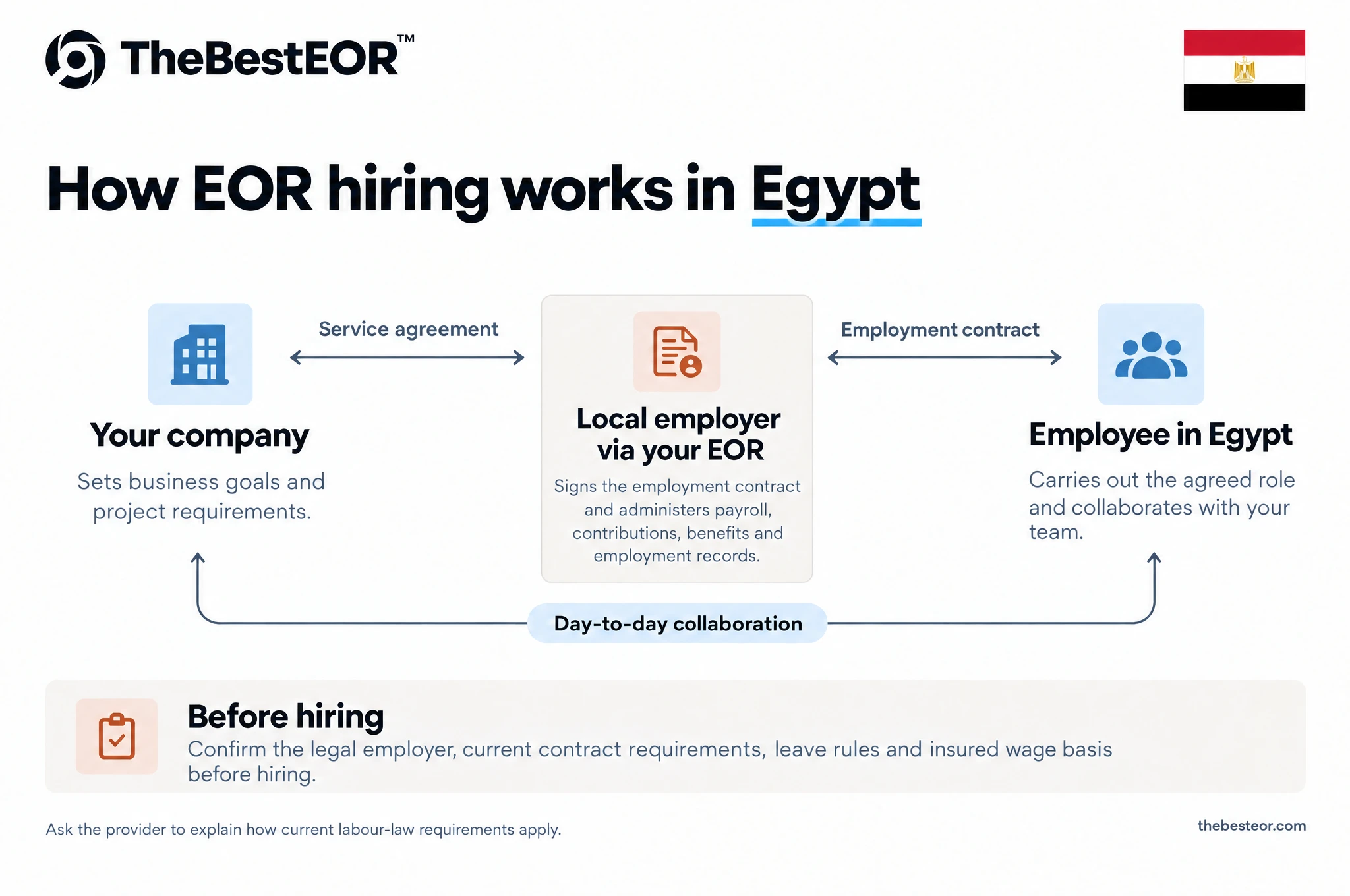
Employer of record in Egypt diagram showing the service agreement, employment contract, and day-to-day collaboration between your company and the employee.
Employer of record in Egypt: how your company, the local employer and the employee work together. Select the image to enlarge.

The EOR handles

1
Social-insurance registration and monthly remittance of both shares
2
Monthly income-tax withholding for the Egyptian Tax Authority
3
The Arabic (or bilingual) employment contract on the current legal template
4
The statutory annual raise, leave accrual and holiday calendar
5
Work-permit filing and renewals for a foreign hire, within the entity’s quota
6
Payslips, EGP salary payment and the FX conversion from your dollar invoice
7
Ending employment on legal grounds, giving notice and paying accrued entitlements

You keep

1
Direction of the day’s work: priorities, deliverables, reporting line
2
The package: salary, allowances, any bonus above the statutory raise
3
The hire and fire decisions themselves
4
Performance management (an Egyptian dismissal needs a documented legal ground, and that record is yours to build)
5
What kit ships to the hire; device provisioning is a paid add-on at some EORs
6
The commercial contract with the EOR, including the IP terms it must write into the employment contract

Classification and work permission need separate reviews. A contractor who works fixed hours under your direction can be found an employee, with back social insurance and penalties following the finding; and a foreign worker without a Ministry of Labour permit exposes both sides. An employment arrangement that meets local requirements can change how the worker is engaged from then on. It does not settle earlier classification liabilities, and the staffing model and any immigration route require their own assessment. The misclassification guide covers the tests that decide these cases.

Work permits

Work permits and hiring foreign nationals in Egypt

The permit names the Egyptian employer.

Permits run through the Ministry of Labour, attach to a named Egyptian employer, and live inside a quota that generally caps expatriate headcount relative to local staff.

Status Who it is for Timeline Notes
Status
Egyptian national
Who it is for
Citizen hire
Timeline
Days
Notes
No permit; contract + social-insurance registration only
Status
Work permit, new
Who it is for
Foreign hire, full-time role
Timeline
Commonly 1–3 months
Notes
Filed by the employing entity with the Ministry of Labour
Status
Work permit, renewal
Who it is for
Foreign hire already permitted
Timeline
Shorter than a new file
Notes
Permits typically issued a year at a time
Status
Quota position
Who it is for
Every employing entity
Timeline
Standing constraint
Notes
Expat share of establishment headcount generally capped, the classic 10% frame

Fig. 8 · Permit paths for hiring in Egypt · the permit attaches to the employing entity, so under an EOR the quota and the file both sit with the EOR’s entity or partner

Three practical rules govern a foreign hire. The permit is employer-specific, so the EOR’s Egyptian entity or partner is the applicant and the permit does not travel if you later switch providers. Under the quota, expatriate staff at an establishment are generally capped at a small share of the local workforce, so an entity already carrying foreign hires may lack headroom, and quota position should be your first question to any provider before a foreign hire. And the file needs a rationale, typically that the role requires expertise not readily available locally, with supporting documents that take time to legalise.

For remote-first companies the cleaner path is usually Egypt’s deep local talent pool, which needs no permit at all. The permit machinery matters mainly when relocating a known employee into Egypt, and for that case you are buying the provider’s in-country experience.

Salary planning

How to benchmark pay

Compare local quotes for the same city and seniority.

The sources currently cited do not support verified salary bands for these roles. Compare current data for the same role, city and seniority, then confirm the package with local recruiters or your EOR. Use the checks below to make those quotes comparable.

Check current pay data for the role and location before you make an offer.

Role Scope to match Package to compare
Role
Software engineer
Scope to match
Stack and experience
Package to compare
Base pay, bonus and benefits
Role
Senior software engineer
Scope to match
Technical leadership
Package to compare
On-call duties, equity and bonus
Role
Product manager
Scope to match
Product and team scope
Package to compare
Base pay and variable pay
Role
Accountant
Scope to match
Qualifications and remit
Package to compare
Month-end workload and benefits
Role
Customer support
Scope to match
Languages and shifts
Package to compare
Shift pay and allowances
Role
Sales manager
Scope to match
Territory and targets
Package to compare
Base pay, commission and quota
Role
HR manager
Scope to match
Headcount and remit
Package to compare
Base pay, bonus and benefits
Role
Designer
Scope to match
Discipline and portfolio
Package to compare
Base pay, equipment and benefits

Fig. 9 · Questions to align Egyptian salary quotes by role

For each quote, record the city, seniority, duties, gross base pay, variable pay and benefits. Keep EOR fees and employer costs separate from salary, and record the exchange rate and date used for any currency conversion. Agree how and when compensation will be reviewed before making the offer.

Fully-loaded cost

What an Egyptian software engineer costs per month

Start with an engineer on EGP 40,000 gross a month.

For a different salary, estimate employer payroll costs in Egypt.

Software engineer, Cairo
Gross base: EGP 40,000/month
Gross salary EGP 40,000

Employer social insurance (18.75% of insurable wage)

Illustrative ordinary covered private-sector employee: 18.75% × EGP 16,700 ceiling = EGP 3,131.25
EGP 3,131.25

EOR fee, cheapest

Illustrative $199 fee at EGP 49/USD; confirm the Egypt quote
EGP 9,751

Illustrative monthly subtotal

Annual EGP 634,587; excludes additional benefits, deposits and other charges
EGP 52,882.25

Fig. 10 · Fully-loaded monthly cost of an EGP 40,000 engineer · the social-insurance cap keeps the statutory line small; the EOR fee is the swing cost

Because contributions stop at the insurable-wage ceiling, the statutory line is roughly EGP 3,000 whether the engineer earns EGP 40,000 or EGP 90,000. That leaves the EOR fee as the biggest controllable line: at the same illustrative EGP 49/USD rate, a $599 fee is EGP 29,351 and the salary-plus-EGP 3,131.25-contribution-plus-fee subtotal is EGP 72,482.25 before excluded costs, with the fee now costing nearly ten times the statutory contributions. At an illustrative $699 monthly service fee, the fee becomes a substantial part of the total budget. Few markets punish fee inattention this visibly, which is why price weighs so heavily in the ranking above.
EOR vs your own entity

EOR or your own Egyptian entity: compare costs

Factor EOR Your own Egyptian entity (GAFI)
Factor
Setup cost
EOR
None
Your own Egyptian entity (GAFI)
Incorporation, legalised documents, capital deposit; modest by global standards but lawyer-led
Factor
Time to first hire
EOR
Days (local hire)
Your own Egyptian entity (GAFI)
1–3 months (GAFI, tax, social-insurance and bank registrations)
Factor
Per-employee cost
EOR
$199–699/employee/mo fee + contributions
Your own Egyptian entity (GAFI)
Contributions only, plus shared overhead
Factor
Ongoing admin
EOR
Provider runs payroll, withholding, filings
Your own Egyptian entity (GAFI)
Your own accountant, monthly tax and insurance filings, audits
Factor
FX and funding
EOR
One dollar invoice, provider converts
Your own Egyptian entity (GAFI)
You fund an EGP account and manage conversion and any repatriation
Factor
Compliance liability
EOR
On the EOR
Your own Egyptian entity (GAFI)
On you and your local managers

Fig. 11 · EOR against your own GAFI-registered entity · a per-employee fee versus fixed overhead and standing filings

An illustrative USD 199 monthly service fee is USD 2,388 per employee/year. This is the service-fee component, not the complete cost difference from employing through your own entity. An Egyptian entity’s incorporation cost is modest by international standards; the barrier is everything after: monthly tax and social-insurance filings, local accounting and audit, a resident-manager question to solve, the statutory raise and labour-law compliance to track through a reform period, and the practical work of funding pounds and getting profits back out, a channel that tightened badly in the hard-currency squeezes of recent years. That overhead is broadly fixed, so it thins per head as the team grows.

Annualise the selected service fee for the hires you expect to keep, then compare it with the Egyptian company setup, payroll/social-insurance administration and legal support. Count setup costs over the same hiring horizon and include payroll, benefits, transition and exit charges on both sides. A higher service-fee plan moves the financial crossover earlier; lower recurring entity overhead or a longer hiring horizon can do the same. Short hiring duration, setup costs and the need for local administration can move it later. The legal suitability of each arrangement remains a separate question.

FAQ

EOR in Egypt: common questions

How do wage bands and permits affect hiring costs?

Permit timelines, the 18.75 percent, the insurable-wage bands and the two-months-per-year exposure: what buyers ask before hiring in Egypt.

What is the best EOR in Egypt?

RemotePeople is our top pick for Egypt in 2026 (4.9/5), followed by Deel (4.7/5) and G-P (4.2/5). We opened paid accounts with all 10 providers on this page, priced real hires and ran payroll.

RemotePeople offers recruitment and EOR through one provider, with a dedicated account manager on both EOR plans. RemotePeople’s EOR Global plan starts at USD 499 per employee per month, and EOR Select at USD 199 where the hire qualifies. Deel starts at USD 599 plus a mandatory Employer Liability Cost; G-P starts at USD 599 per employee per month.

How does an employer of record work in Egypt?

An employer of record in Egypt becomes the worker’s legal employer through a local employing entity, while your company directs the day-to-day work. The EOR registers the employee for social insurance and remits both shares monthly, withholds income tax for the Egyptian Tax Authority, issues the Arabic or bilingual contract on the current legal template and files work permits for a foreign hire within its entity’s quota.

How fast can an EOR onboard an employee in Egypt?

Estimated onboarding times for Egypt range from 2 to 14 days across the providers we tested. By provider: Deel 2–5 days, Rippling 2–5 days, RemotePeople 5–8 days, G-P 5–10 days and Oyster 10–14 days.

For a foreign hire the work permit comes first: the employing entity applies to the Ministry of Labour, approval commonly takes one to three months, and the quota that generally caps foreign staff relative to Egyptian staff has to hold at the sponsoring entity.

How much does an EOR cost in Egypt per month?

Published service fees for Egypt run from USD 199 to USD 699 per employee per month across the 10 providers we tested: RemoFirst from USD 199; RemotePeople Global from USD 499, or Select from USD 199 only where country and salary qualify; Deel from USD 599 plus mandatory Employer Liability Cost; G-P from USD 599; Oyster USD 699 on monthly billing, with annual seats quoted separately. Multiplier Core advertises $499 monthly or $459 per month billed annually; Pebl advertises $399, with currency and commitment to confirm. Rippling starts at USD 499 plus its required platform from USD 8 per employee, and Papaya Global at USD 499. Borderless AI is USD 579 standard, with an eligible USD 399 promotion on fees billed through 31 December 2026. All amounts are per employee/month; salary and employment costs are separate. 

On top of the fee you pay the employee’s gross salary plus the employer social-insurance share of 18.75 percent, charged on the insurable wage rather than the full salary: the insurable wage sits between a minimum and a maximum band that reset each January, so for well-paid roles the cash contribution stops growing at the ceiling.

What employer contributions are mandatory in Egypt?

One system carries them all: social insurance under the 2019 Social Insurance and Pensions Law. The employer share totals 18.75 percent of the insurable wage, split across pension, sickness, work-injury, unemployment and end-of-service cover, and the employee contributes 11 percent, which the employer withholds. Both shares are calculated on the insurable wage, a figure bounded by minimum and maximum bands that the authorities reset each January, not on full gross salary.

Social insurance is the main payroll contribution. Other employer charges can apply, including the training-fund contribution for establishments covered by Article 21; ask whether these are included in the quote. Egypt does not use the same general monthly gratuity model as the Gulf, but applicable exit rights must still be assessed.

Can an EOR sponsor a work permit for a foreign employee in Egypt?

Yes, through its employing entity. Work permits are issued by the Ministry of Labour to a named Egyptian employer, so the EOR’s local entity or partner files the application, and approval commonly takes one to three months with permits typically issued a year at a time and renewed. Two constraints shape feasibility: foreign nationals are generally capped at a small share of an establishment’s workforce, the classic ten percent frame, and the file usually needs a case for why an Egyptian candidate cannot fill the role. Confirm the sponsoring entity’s quota headroom before committing to a foreign hire.

What is the minimum wage in Egypt in 2026?

There is a national minimum wage for the private sector, set by the National Council for Wages and revised repeatedly through the inflation years: it was raised to EGP 7,000 a month in 2025, and the council reviews the level periodically rather than on a fixed schedule. Most roles hired through an EOR price far above the floor, so in practice the figure matters less than the statutory annual raise, which Egyptian law mandates and which the EOR builds into the payroll.

How much notice and severance applies when terminating in Egypt?

An indefinite contract requires three months’ written notice under Article 156 of Labour Law No. 14 of 2025, regardless of service length. A longer period may be agreed; the statutory period cannot be reduced by agreement. Termination still requires a legally sufficient reason. If the employer ends the contract without serving all notice, Article 164 requires wages for the unserved period and preserves related service and employer obligations.

For an unlawful indefinite-contract dismissal, Article 165 provides compensation of at least two months’ wages per year of service, without removing other legal entitlements. Accrued leave and any additional contractual amounts must also be checked. These indefinite-contract notice rules are distinct from the rules for fixed-term expiry.

What currency and payroll cycle does Egypt use?

The Egyptian pound (EGP), which floats and has been through repeated devaluations, so a salary agreed in dollars costs a moving amount of pounds each month. Payroll runs monthly: the employer withholds progressive income tax that reaches 27.5 percent at the top band, deducts the 11 percent employee social-insurance share, and remits both. A 13th-month salary is not statutory; an annual raise is. EOR fees are billed in dollars while salaries pay out in pounds, so ask each provider how it sets and updates its exchange rate.

Can I convert an Egyptian contractor to an EOR employee?

It converts cleanly, and in Egypt there are usually two reasons to do it. Misclassification is the first: a contractor who works fixed hours under your direction can be found an employee, with back social insurance and penalties following. Currency is the second: many Egyptian contractors invoice foreign clients in dollars, and conversion moves the person onto a compliant EGP employment contract with social insurance and income-tax withholding, while the EOR helps structure the package around the FX reality. The EOR signs the local contract, registers the hire with the social-insurance authority and runs payroll from the next monthly cycle.

Sources and as-of dates

Article references

The indefinite-contract notice rule and related example were checked against Law No. 14 of 2025 on 23 September 2026. Other figures retain their stated source periods, including the existing August 2026 baseline.

Hiring facts Checked 2 Oct 2026

Hiring facts

Checked 2 October 2026
Eligibility, local and collective rules apply. EOR fees extra.

Egyptian labour law 8 sources

Labour Law No. 14 of 2025 replaced the 2003 code. It requires written Arabic contracts and limits probation to 3 months, once per employer. Normal working time is capped at 8 hours a day or 48 a week, excluding breaks, with statutory exceptions. Annual leave is 15 days in the first year, 21 from the second, and 30 after 10 years of service or for workers over 50; some groups receive more. Paid maternity leave is 4 months, subject to statutory conditions. Indefinite contracts require 3 months’ written notice and a legally sufficient reason for termination. The notice provisions, checked on 23 September 2026, are in Articles 156–164 of the official Gazette text : longer agreed notice is allowed, and an employer must pay for missing notice with related obligations.

Unjustified dismissal 1 source

For an employer’s unlawful termination of an indefinite contract, Article 165 of Law No. 14 of 2025 provides compensation of at least two months’ wages per year of service, separate from other legal entitlements. The earlier reference was checked on 23 September 2026.

Social insurance 6 sources

For private-sector employees covered by the ordinary branches of Law No. 148 of 2019, the listed contributions total 18.75% for the employer and 11% for the employee. The employer components are pension 12%, sickness 3.25%, work injury 1.5%, unemployment 1% and end-of-service 1%. Applicable health coverage, occupational categories and exemptions can change the calculation. NOSI set the monthly insurable-wage limits at EGP 2,700 and EGP 16,700 from 1 January 2026 and stresses reporting actual insured wages.

Income tax 4 sources

Salary tax is calculated and withheld through payroll under the progressive income-tax schedule. Law No. 7 of 2024 sets a top marginal rate of 27.5% on annual taxable income above EGP 1.2 million; the lower-band relief available also depends on total annual income. Use the applicable statutory table and payroll rules rather than treating the top rate as a flat charge.

Minimum wage 1 source

The National Council for Wages raised the private-sector minimum to EGP 7,000 a month from 1 March 2025. Later announcements for government employees should not be applied automatically to private-sector payroll.

Work permits 3 sources

Foreign nationals generally need a Ministry of Labour work permit and residence permission for employment. Quotas and exceptions depend on the employer’s legal regime: GAFI describes a 10% foreign-worker limit for investment projects, potentially rising to 20% when qualified local workers are unavailable. Confirm processing time, permit validity and renewal requirements for the particular application.

Currency 2 sources

The Egyptian pound (EGP) operates under a flexible exchange-rate regime. Dollar figures here use an illustrative EGP 49 per USD conversion for 2026. Refresh conversions using a dated exchange-rate observation before budgeting.

Salary benchmarks 1 source

PayScale’s Egypt software-engineer dataset separates annual base salary and total pay; its 190-profile sample was updated on 3 July 2026. It does not establish market ranges for all the roles listed above. Use dated, role-specific evidence alongside current local quotes before setting an offer.

Provider pricing, entity model and onboarding 10 sources

October 2026 sources Checked 19 Oct 2026

Egyptian Tax Authority — official Gazette, Labour Law 14/2025 — Labour Law Articles 21, 94, 96–99 and 154; implementing rules and the specific employment circumstances remain relevant. Checked 19 October 2026.

NOSI — registering a new private-sector employee — Form 1 within two weeks, supporting documents, existing insurance-number check and employer copy. Checked 19 October 2026.

NOSI — insured-wage limits from January 2026 — EGP 2,700 minimum and EGP 16,700 maximum monthly insured wage from 1 January 2026; reporting actual insured wages. Checked 19 October 2026.

The country guides cover other markets. For this hire, browse EOR providers for Egypt and use the EOR cost calculator to compare the recurring amounts in your proposals in USD.

This guide is for general information only and does not provide legal, tax, accounting, or financial advice. For advice about your business, consult a qualified professional familiar with the rules where you hire. The research methodology explains how TheBestEOR assesses sources.