TheBestEOR

Best Employer of Record in India

Written by Martynas PupkeviciusFact-checked by Michael Ennis
Picture of Martynas Pupkevicius
Martynas Pupkevicius

EOR Advisor and Remote Work Editor

Our top employer of record in India for 2026 is RemotePeople, from USD 499 per employee a month, ahead of Deel and Multiplier.

We tested all 10 providers with paid client accounts, real quotes and a live hire run through payroll. In India, hours and leave rules depend on the employee’s state, and employers pay retirement fund contributions plus gratuity when eligible staff leave.

Flag of India

Hiring in India at a glance

Currency
INR
Indian rupee
Pay cycle
By the 7th
Of the following month for monthly pay
Working hours
By state
Also varies by industry and role
Annual leave
By state
Also depends on job and workplace
Extra pay
Annual bonus
Statutory for some staff, check the wage threshold
Employer costs
Retirement fund
Plus health and social insurance, gratuity
Before you hire:
Confirm the work state and which salary parts count for employer contributions and gratuity.

Country hiring overview · India

Hiring in India, at a glance.

Use the work location and role to define the quote.

For an Indian hire, I’d first establish the state, work location, role and employing establishment before comparing providers. Ask which employment rules and payroll registrations apply, and have the provider separate contributions, benefits and the service fee.

Choose a hiring solution

Need a local employer?

Compare an EOR arrangement for your role before opening your own entity.

Already have a local employer?

Compare payroll and HR support against adding an EOR.

EOR service fee

Fees vary by provider.

Your quote should state the currency, fee per employee, minimum charge and billing commitment.

Onboarding

Paperwork affects the start date.

The contract, right-to-work checks, registrations and payroll deadlines all affect when employment can begin.

Employment costs

Check which contributions apply.

Ask whether EPF and ESI contributions apply to the employee. The quote should also show gratuity provisions and any state-level charges for the proposed hire.

Annual leave

Leave depends on the state and role.

Annual leave depends on the employee’s work location and employment category. For example, the Karnataka Shops Act sets earned leave for covered employees in Karnataka. Ask the EOR which rules apply to the role.

Check before choosing

Confirm the applicable central/state rules, leave policy, contribution eligibility and bases, gratuity treatment and payroll reporting.

What your quote should include

Employment costs and service fees

1
Gross salary and agreed pay schedule
2
Applicable EPF/ESI, gratuity and state-level items
3
EOR fee: currency, per-employee billing, minimums and commitment
4
Setup, foreign exchange, extras and exit costs

Deposits and payroll funding

1
Amount and payment deadline
2
Whether funds are refundable or credited to payroll
3
Release conditions and refund timing
Show these separately from recurring expenses.

Key takeaways for hiring in India

The statutory wage base can exceed basic pay

The Labour Codes’ wage calculation can add back excluded components when the relevant exclusions exceed half the defined remuneration. The result is not simply “basic pay” or a blanket percentage of CTC. Ask for a component-by-component calculation before comparing contribution and gratuity estimates.

A one-year service deal is not automatically fixed-term employment

The Ministry distinguishes direct fixed-term employment from contract labour supplied by a contractor. Identify the employment contract and arrangement before applying the special gratuity qualifying condition.

Use the current contribution ceiling and actual membership

The published EPF/EPS ceiling increased to Rs25,000 in September 2026. Membership, wage definition and any higher contribution commitment still need to match the employee.

Retrenchment costs and the re-skilling fund

For a covered retrenchment, budget for notice and compensation. The Industrial Relations Code also provides for the workers’ re-skilling fund. A retrenchment estimate should identify the worker and establishment category before deciding which notice, permission and payment rules apply.

Quick verdict

What is the best EOR in India?

I’d confirm who employs the hire and who sponsors a visa.

I’ve brought these providers together from the global shortlist in the country-specific order for India. I’d start with the employee’s right to work, the proposed legal employer and the full country quote. For a foreign-national hire, confirm the eligible visa route, sponsoring organization and responsibilities before comparing providers.

1
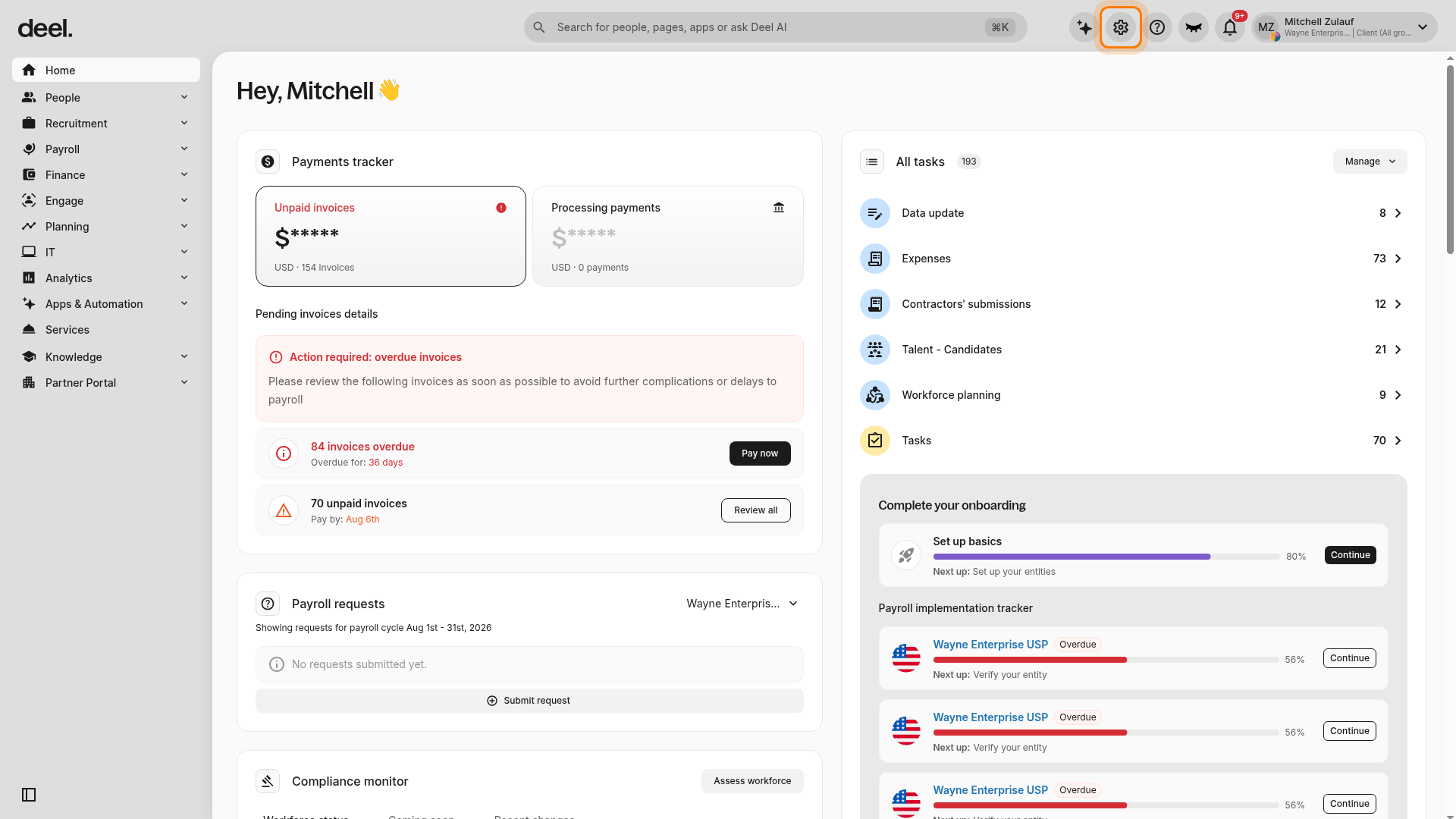
Deel logo

4.7/5

Deel

Paying employees and contractors on one platform

Starting fee
$599

per employee / month

Countries
130+
where you can hire

Plus a mandatory Employer Liability Cost.

Deposit
1–1.5 months

of gross salary

Deposit refund
Within 60 days

of offboarding

Why consider it

EOR, contractor management and payroll for your own entities.

Month-to-month EOR service pricing available.

Check the fit

The Employer Liability Cost is set country by country.

Before signing: Confirm the Employer Liability Cost amount, benefit costs and any additional products. Monthly service terms do not remove employment notice, severance or other exit obligations.

The EOR pricing page lists 130+ countries. Broader platform coverage figures may include other services.

Visit Deel ↗

2
Editorial pick
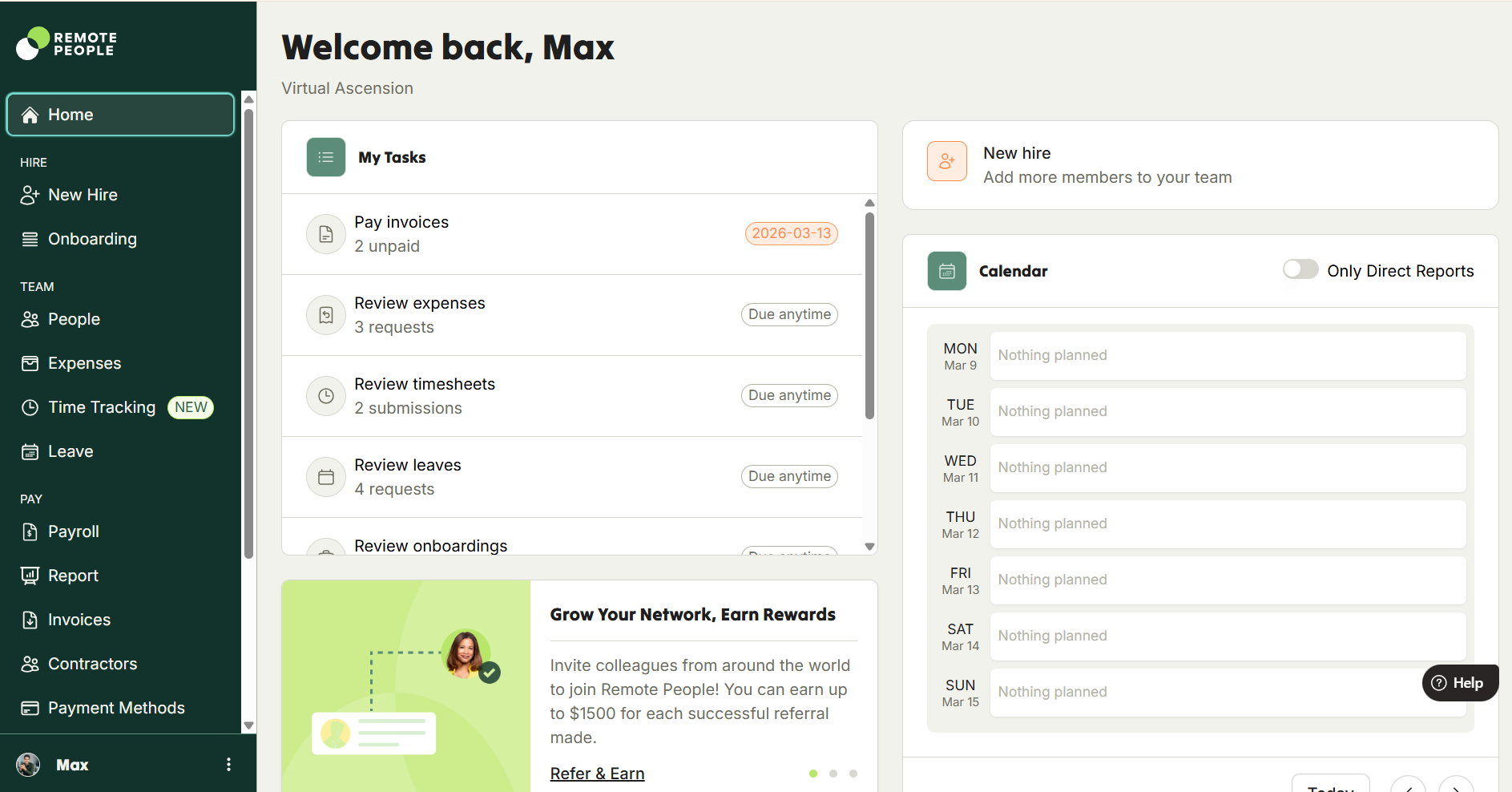
RemotePeople logo

4.9/5

RemotePeople

Hiring in new markets with local HR support

Starting fee
$499

per employee / month

Countries
150+
where you can hire

EOR Select from $199 for eligible hires.

Deposit
1 month

of gross salary

Deposit refund
Within 5 days

of the final payment

Why consider it

Recruitment and EOR services through one provider.

Dedicated account manager in both EOR plans.

Check the fit

Recruitment is separately priced.

Before signing: Confirm quote currency, billing commitment, deposits, funding deadlines and refund terms. EOR Select eligibility depends on the hiring country and employee salary.

Both EOR plans list local contracts, payroll and tax administration, and statutory benefits administration. Salary, employer contributions and benefit costs are separate.

Visit RemotePeople ↗

3
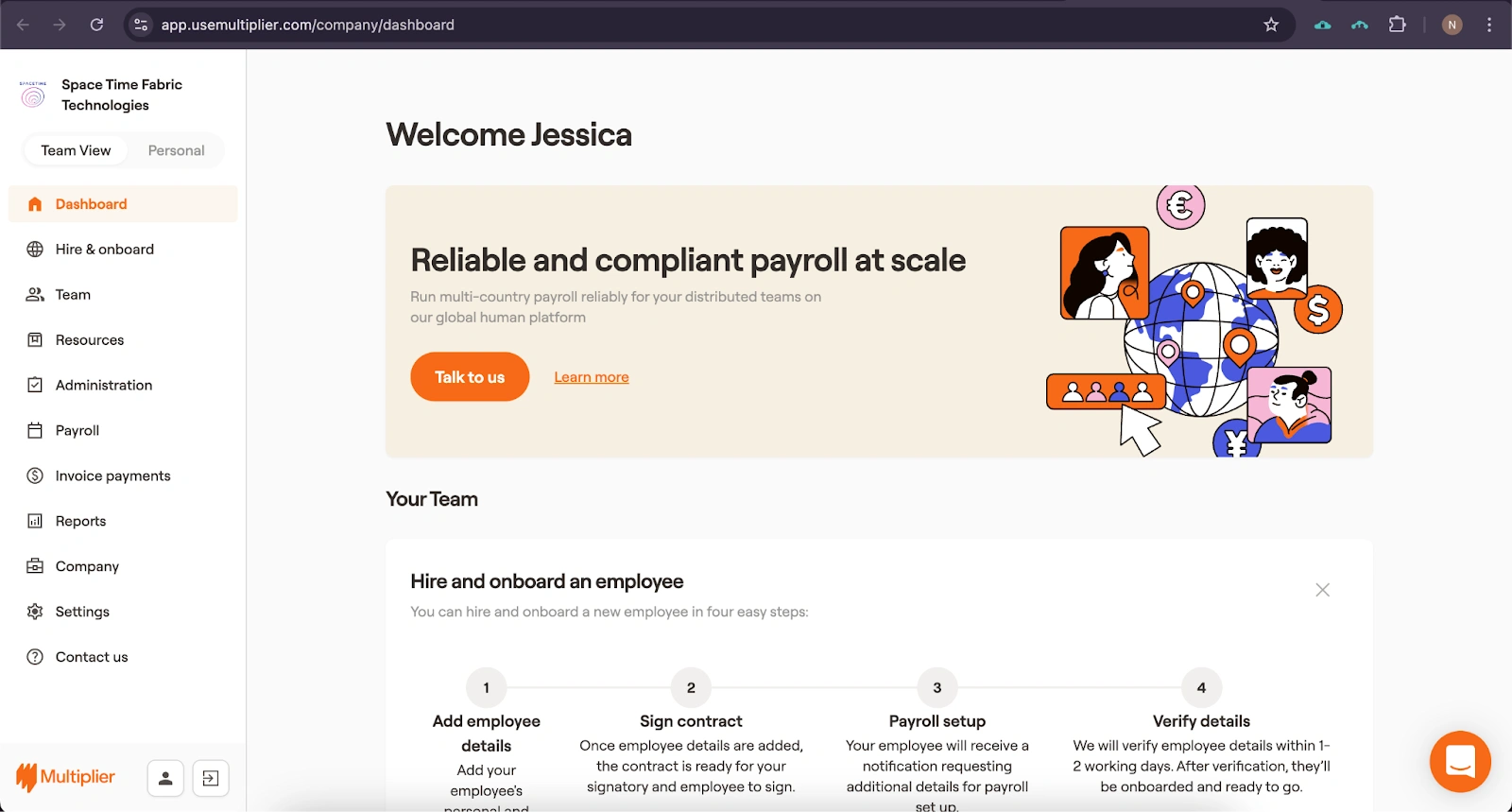
Multiplier logo

4.1/5

Multiplier

Managing payroll, leave and expenses in one place

Starting fee
$459

per employee / month

Countries
150+
where you can hire

Billed annually. $499 billed monthly.

Deposit
1+ months

of gross salary plus contributions

Deposit refund
Within 60 days

of the last working day

Why consider it

A set monthly payroll calendar, with salaries paid at month-end.

SOC 2 Type II audited every year and ISO 27001:2022 certified.

Check the fit

Integrations and API access need the Growth plan.

Before signing: An implementation fee can apply on some plans, so get setup confirmed as free in your quote. Confirm the employing entity for each country in your contract.

At $459 a month billed annually, the first year for one hire is $5,508 in service fees. Salary, employer costs and the refundable deposit come on top.

Visit Multiplier ↗

No provider pays for a position on this page; some outbound links pay a referral fee. See the funding model and methodology.

Legal employer, immigration scope and full cost

All 10 EOR providers for India, side by side

Compare quotes for the same salary and benefits.

Compare complete India proposals for the same employee, salary, benefits and service scope. Statutory rules apply to the worker and arrangement; benefits, deposits, extras and billing terms can change the amount due. The listed fees are indicative advertised starting prices per employee per month in USD, subject to plan and billing conditions.

Compare the actual employee’s eligibility, employing entity, full quote, support and payroll milestones. See the global EOR ranking for broader comparisons. For a wider shortlist, browse EOR providers for India.

Provider

Best For

Starting feeDepositOnboarding
1 Deel logo Deel 4.7/5 Rating Paying employees and contractors on one platform Starting fee: $599 USD / monthDeposit: 1–1.5 monthsOnboarding: Start date agreed per hire

My take

Deel makes my shortlist when you want EOR payroll and benefits administration alongside separate contractor and HR products.

EOR starts at USD 599 per employee per month, with month-to-month billing available. I’d budget beyond that fee: mandatory Employer Liability Cost is an additional charge based on gross salary, with rates varying by country. Salary, statutory employer costs and benefit premiums are also separate.

Contractor management starts at USD 49 per active contract per month. It is a separate service from EOR employment; currency conversion, payment-method charges and any required deposit also affect the amount funded.

When this provider fits

Deel is worth comparing when its broader payroll and contractor tools fit the way your team already hires. RemotePeople is worth comparing when you want recruitment and employment support within one provider relationship.

Deposit

1–1.5 months

Entity model

Owned entity

First year, one hire

$7,188 in service fees

Reviewed by Martynas PupkeviciusFact-checked by Michael Ennis

Starting fee

$599

Month-to-month billing. Mandatory Employer Liability Cost is charged separately.

Against the 10 starting fees

$199 lowest$699 highest
2 RemotePeople logo RemotePeople 4.9/5 Rating Hiring in new markets with local HR support Starting fee: $499 USD / monthDeposit: 1 monthOnboarding: 1–2 weeks

My take

I’d consider RemotePeople if a dedicated account manager is part of the support you want.

The service includes local employment contracts, payroll and tax administration, and statutory-benefits administration. I’d price recruitment separately, as it is a separate service.

EOR Global starts at USD 499 per employee per month. EOR Select starts at USD 199 for eligible countries and employee salary ranges. Salary, employer contributions, benefit costs and agreed extras are additional. The country quote determines eligibility, the final fee, billing commitment and payroll funding.

Deposit

1 month

Entity model

Own entities in core markets

First year, one hire

$5,988 in service fees

Reviewed by Martynas PupkeviciusFact-checked by Michael Ennis

Starting fee

$499

EOR Global. EOR Select starts at $199 where the country and employee salary qualify.

Against the 10 starting fees

$199 lowest$699 highest
3 Multiplier logo Multiplier 4.1/5 Rating Managing payroll, leave and expenses in one place Starting fee: $459 USD / monthDeposit: 1+ monthsOnboarding: Start date agreed per hire

My take

I’d start with Multiplier Core if you need employment administration, payroll, leave and standard workforce reporting.

Core starts at $499 per employee per month on monthly billing or $459 per month billed annually. For integrations, custom reports and open APIs, I’d compare the Growth plan. The quote needs to identify the dollar currency and chosen plan.

Country variations and mandatory add-ons affect the total. Implementation fees may apply, although the FAQ says setup is free; the quote must resolve that charge. Salary, employer costs and benefit premiums are additional.

When this provider fits

I’d compare Multiplier and Pebl using the same Indian salary structure and employment term. A lower-looking proposal is not a saving if it uses a different wage base or omits a gratuity provision included by the other provider.

Deposit

1+ months

Entity model

Own entities and partners

First year, one hire

$5,508 in service fees

Reviewed by Martynas PupkeviciusFact-checked by Michael Ennis

Starting fee

$459

Core plan billed annually, or $499 per month on monthly billing. Confirm the dollar currency.

Against the 10 starting fees

$199 lowest$699 highest
4 Rippling logo Rippling 4.5/5 Rating Setting up payroll, laptops and app access for new hires Starting fee: $499 USD / monthDeposit: Per quoteOnboarding: Start date agreed per hire

My take

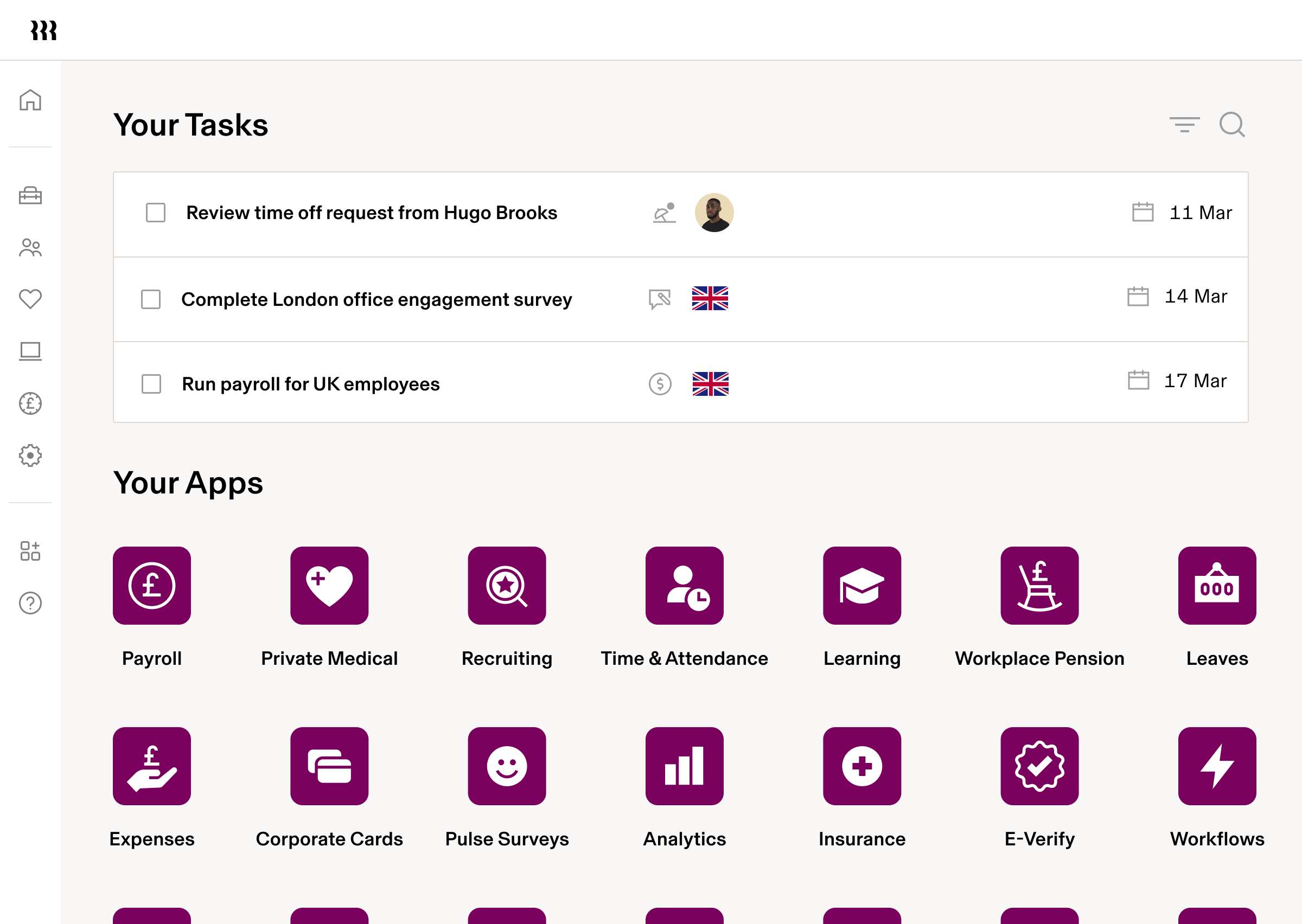
I’d consider Rippling when shared employee data across HR, IT and finance would help your workflows and reporting.

It connects EOR employment with those products, but device management and app access are separate products within the wider system.

Rippling EOR starts at USD 499 per employee per month, and the required Rippling Platform adds from USD 8 per employee per month plus a monthly base fee. The quote needs to show any selected HR, IT or finance products and the billing commitment. Salary, employer costs, benefits, deposits and payroll funding are additional to the software and service fees.

Deposit

Per quote

Entity model

Own entities and local partners

First year, one hire

$5,988 in EOR fees

Reviewed by Martynas PupkeviciusFact-checked by Michael Ennis

Starting fee

$499

Plus the required Rippling Platform, from $8 per employee per month and a monthly base fee. Confirm the billing terms and selected products.

Against the 10 starting fees

$199 lowest$699 highest
5 Oyster logo Oyster 4.5/5 Rating Using one onboarding process for hires across countries Starting fee: $699 USD / monthDeposit: ~1 monthOnboarding: Start date agreed per hire

My take

I’d look at Oyster for payroll, expense and time-off administration, reporting, and onboarding and offboarding support.

Benefits packages are optional add-ons. At USD 699 per employee per month on monthly billing, I’d compare the included support carefully against the other quotes.

Annual seats are priced by headcount and location and are non-refundable, but can be reused for replacement hires. Annual prepayment gives the lowest fee; higher-priced quarterly or semiannual payment options are available. Salary, employer costs and benefit premiums are additional, and a refundable deposit is required. Optional People Partner project work costs USD 300 per hour.

Deposit

~1 month

Entity model

Own entities and vetted partners

First year, one hire

$8,388 in service fees

Reviewed by Martynas PupkeviciusFact-checked by Michael Ennis

Starting fee

$699

Monthly billing. Annual seats are quoted separately, prepaid and non-refundable.

Against the 10 starting fees

$199 lowest$699 highest
6 Pebl logo Pebl 4.2/5 Rating Hiring people who need visa or relocation support Starting fee: $399 USD / monthDeposit: Per quoteOnboarding: Start date agreed per hire

My take

I’d look at Pebl, formerly Velocity Global, when you want hiring, payroll, employee changes, reporting and offboarding in one platform.

EOR starts at $399 per employee per month. Before using that figure in a budget, I’d have the country quote identify the dollar currency and billing commitment. Salary, employer costs, benefits and additional services are separate.

A deposit is required before onboarding. Its amount can change with salary, seniority or payment history, and it is returned after the final invoice and outstanding balances are paid. Early exit can make the remaining committed-term service fees payable, subject to the agreement’s termination exceptions. Any discounted offer needs an end date and renewal price.

Deposit

Per quote

Entity model

Affiliates and local partners

First year, one hire

$4,788 in service fees

Reviewed by Martynas PupkeviciusFact-checked by Michael Ennis

Starting fee

$399

Confirm the country price and billing commitment.

Against the 10 starting fees

$199 lowest$699 highest
7 G-P logo G-P 4.2/5 Rating Hiring abroad while keeping your existing HR system Starting fee: $599 USD / monthDeposit: 1–2.5 monthsOnboarding: Start date agreed per hire

My take

G-P would be on my shortlist when benefits, reporting and custom API integrations matter alongside EOR employment administration.

EOR starts at USD 599 per employee per month, with volume discounts by quote. I’d keep salary, employer costs, benefit premiums and additional services separate in the budget.

There is no minimum contract length for EOR hires. The proposal still sets the commercial billing and cancellation terms, along with the cost of any integration or implementation work.

Deposit

1–2.5 months

Entity model

100+ own entities, plus partners

First year, one hire

$7,188 in service fees

Reviewed by Martynas PupkeviciusFact-checked by Michael Ennis

Starting fee

$599

Confirm the included services and billing terms in your country quote.

Against the 10 starting fees

$199 lowest$699 highest
8 Papaya Global logo Papaya Global 4.1/5 Rating Comparing payroll costs across countries in one report Starting fee: $499 USD / monthDeposit: 1–2 monthsOnboarding: Start date agreed per hire

My take

Papaya interests me when payroll and payments need to work together across EOR employees and your own entities.

It brings those employees, own-entity payroll and workforce payments into one platform, with consolidated reporting and payroll approval tools. That connection is what I’d focus on in the evaluation.

Papaya’s EOR service starts at USD 499 per employee per month. The country quote must identify the billing commitment and any additional services. Salary and employer costs are separate.

When this provider fits

Papaya is more relevant when the main problem is consolidating payroll from existing employers and countries. Rippling is more relevant when the Indian employee needs the HR and IT workflows you already run.

Deposit

1–2 months

Entity model

Partner model; confirm employer

First year, one hire

$5,988 in service fees

Reviewed by Martynas PupkeviciusFact-checked by Michael Ennis

Starting fee

$499

The country quote sets the billing terms. Payroll-only processing is priced separately.

Against the 10 starting fees

$199 lowest$699 highest
9 Borderless AI logo Borderless AI 4.0/5 Rating Getting 24/7 help with overseas payroll and HR Starting fee: $579 USD / monthDeposit: 1.5–3 monthsOnboarding: Start date agreed per hire

My take

I’d compare Borderless AI using both its current offer and the fee after it ends.

The standard EOR fee is USD 579 per employee per month. Eligible companies headquartered outside Canada may qualify for USD 399 on fees billed through 31 December 2026. USD 579 applies from 1 January 2027, including promotional customers; country and employment-type exceptions apply. Salary, employer costs and benefits are additional.

A refundable deposit is required before the employee starts. The schedule is 1.5 months of gross salary plus employer costs, benefits and platform fees with ACH or three months by wire and other methods, with country variations. The base includes salary, employer contributions, benefits and platform fees. Late-payment issues can raise it to six months. Deposits are released after the relevant obligations are settled.

Deposit

1.5–3 months

Entity model

Own entities

First year, one hire

$6,948 in service fees

Reviewed by Martynas PupkeviciusFact-checked by Michael Ennis

Starting fee

$579

Eligible companies headquartered outside Canada can pay $399 on fees billed through 31 December 2026.

Against the 10 starting fees

$199 lowest$699 highest
10 RemoFirst logo RemoFirst ⚠ Trustpilot warning 0.5/5 Rating Making a first overseas hire on a tight budget Starting fee: $199 USD / monthDeposit: About 1 monthOnboarding: Start date agreed per hire

My take

We moved RemoFirst to last place on 8 November 2026: Trustpilot has suspended its rating for a breach of its guidelines and removed fake reviews.

RemoFirst says it works exclusively with vetted in-country partners. Here, that means a local partner company, not RemoFirst, would normally employ your hire, and payroll changes, questions and exits pass through both companies, which can slow answers. US$199 is RemoFirst’s starting fee and varies by country, so get this country’s quote before you compare. RemoFirst’s lack of a minimum contract term or headcount makes it worth considering for a small team. I’d compare its dedicated customer success manager and EOR employment service from USD 199 per employee per month against the support you need. The fee can vary with country requirements. Salary, employer costs, benefits, deposits and optional services are separate.

Contractor management is free for onboarding, identity checks, contract storage and expenses. Contractor payments cost USD 25 per contractor in months when a payment is processed; payment-provider and transfer fees may also apply. These contractor services are separate from EOR employment.

Deposit

About 1 month

Entity model

Partners, not own entities

First year, one hire

$2,388 in service fees

Reviewed by Martynas PupkeviciusFact-checked by Michael Ennis

Starting fee

$199

RemoFirst advertises no minimum contract term or employee count. Confirm any country-specific charges.

Against the 10 starting fees
$199 lowest$699 highest

Entity ownership is as each provider states it.

The quoted fees are indicative listed starting prices; confirm current country pricing, deposits and complete scope.

RemotePeople’s India EOR page describes an owned registered entity. Oyster’s hiring guidance explains direct and partner models and says the employment agreement identifies the entity. Checked 6 October 2026.

Which top pick · India

I’d start with the employee and role. For a foreign national, confirm eligibility and ask the proposed legal employer to explain the Employment Visa route and responsibilities before committing. For an employee with the required right to work, compare equivalent country quotes, support and exit terms. Agree the start date, documents and first-payroll cutoff with every shortlisted provider.

Local Indian alternatives (researched, unranked): several India-focused firms also provide EOR or local payroll outsourcing, including Wisemonk, Asanify and Husys on the domestic EOR side, and HR-software players such as greytHR, Keka and RazorpayX Payroll for in-house payroll once you hold your own entity. The six sit outside the ranked ten. A domestic provider can be enough for an India-only employer with no plans beyond one state, provided it tracks the state-by-state Labour Code rules rollout as closely as the nationals do.

Get your EOR discount

Get up to 30% off eligible EOR service fees. Your quote confirms the discount and terms.

Employment framework

Employment and payroll in India

State, workplace and worker category affect payroll.

Indian employment and payroll duties depend on the worker, establishment and state. The company signing the employment contract and any organisation sponsoring a visa may have different roles.

Identify the employer and any visa sponsor

For a foreign-national hire, identify both the legal employer and any eligible sponsoring organisation, and confirm the Employment Visa route for the actual role and person.

The Ministry of Home Affairs explains that a sponsoring Indian organisation need not necessarily be the legal employer. Confirm the arrangement with the relevant Indian mission and qualified immigration support before work starts.

Legal employer and contract

The proposed Indian employer signs the contract and administers the duties applicable to the worker, establishment and state. It may be provider-owned or a local partner.

Name the employer in the agreement and confirm its registrations, responsibilities and the provider’s accountability. You retain day-to-day direction of the work.

Payroll and statutory benefits

Contributions and withholding

The proposal should explain applicable EPF, ESIC, income-tax withholding and state professional tax, including wage thresholds and exceptions.

Leave, bonus and gratuity

Confirm the treatment applicable to the employee.

Administration and corrections

Agree who registers the employee, makes contributions, files returns and handles questions or corrections.

Onboarding milestones

1

Agree the package and identify the route

Confirm salary structure, identity records and bank details. Identify any immigration requirements and the responsible employer or sponsor.

2

Prepare the employment setup

Complete contract signing, applicable registrations and payroll cutoffs. Include required immigration approvals and any FRRO/FRO registration in the plan.

3

Date the start and first salary separately

Contract signing, permission to work and first salary payment are separate milestones. Obtain a date for each; an advertised onboarding estimate may not include the first salary payment.

Employer cost

Statutory employer contributions in India

Check which wages count toward each contribution.

Employer contributions depend on coverage and the statutory wage base. The EPF/EPS contribution ceiling increased to Rs25,000 on 17 September 2026. ESI, gratuity, insurance and establishment charges require separate calculations; a single percentage of gross does not fit every hire.

Contribution Employer rate Cap / basis Authority
Contribution
EPF – Provident Fund
Employee also pays 12%
Employer rate
Balance of employer contribution after applicable EPS allocation
Cap / basis
Applicable statutory wage base; Rs25,000 contribution ceiling from 17 September 2026, subject to scheme rules
Authority
EPFO
Contribution
EPS – Pension Scheme
Part of the employer 12%
Employer rate
8.33%
Cap / basis
Ordinary maximum Rs2,083/month on the Rs25,000 ceiling, where EPS applies
Authority
EPFO
Contribution
EDLI insurance
Employer rate
0.5%
Cap / basis
Applicable EDLI wage base and current scheme ceiling; confirm the assessed amount
Authority
EPFO
Contribution
EPF admin charge
Employer rate
0.5%
Cap / basis
Scheme assessment base; establishment-level minimum charges apply
Authority
EPFO
Contribution
ESIC – State Insurance
Employee also pays 0.75%
Employer rate
3.25%
Cap / basis
Coverage wage ceiling Rs21,000, or Rs25,000 for persons with disabilities; statutory wage definition and exemptions apply
Authority
ESIC
Contribution
Gratuity accrual
Usually after 5 years; statutory exceptions apply
Employer rate
~4.81%
Cap / basis
15/26 × last-drawn statutory monthly wages per qualifying year; applicable cap and better terms apply
Authority
Code on Social Security, section 53
Contribution
Professional tax
State levy, employer deducts
Employer rate
Fixed (e.g. Rs200/mo)
Cap / basis
Varies by state; not levied in all states
Authority
State government

Fig. 2 · Mandatory employer contributions in India, 2026 rates and monthly ceilings

For an illustrative full-month employee with Rs50,000 gross and an assumed Rs25,000 statutory wage base, a standard employer EPF/EPS contribution capped at Rs25,000 is Rs3,000 at 12%. An illustrative gratuity reserve using Rs25,000 × 15 ÷ 26 ÷ 12 is Rs1,201.92 a month. Together these two items are Rs4,201.92, or about 8.4% of gross, before EDLI, administrative charges, any ESI, bonus, benefits or EOR fee. Confirm scheme membership, the actual statutory wage base, any higher contribution commitment and the establishment’s charges before budgeting.

Working time & leave

Working hours, overtime and statutory leave

Leave rules can differ in Karnataka and Maharashtra.

Ministry guidance sets an eight-hour working day for covered workers under the OSH Code. Identify the worker category, establishment and applicable state rules before setting hours and overtime. Leave also depends on the governing rules; entitlements can differ between Karnataka and Maharashtra.

Hours and overtime

Standard week 48 hours
Standard day 8 hours for workers covered by the OSH Code; applicable exceptions matter
Overtime rate 2.0× ordinary
Weekly rest 1 day
Public holidays/yr ~3 national + state

Fig. 3 · Working time in India · For workers covered by the OSH Code, the Ministry describes eight hours a day and 48 hours a week, with overtime at twice normal wages. Check worker coverage and applicable state rules.

Overtime is paid at twice the ordinary rate under the Factories Act and most state Shops Acts for covered employees. India gazettes three national holidays (Republic Day, Independence Day, Gandhi Jayanti) and each state and employer adds a list of festival and restricted holidays on top, so the paid-holiday calendar differs by state and by the religions observed.

Statutory leave (varies by state)

Earned leave
Karnataka / Maharashtra
1 per 20 days worked, with statutory qualifying conditions
Casual leave Karnataka: shared 12-day bank / Maharashtra: 8 casual days
Sick leave Karnataka: shared 12-day bank / Maharashtra: no separate bank in section 18
Maternity (federal) 26 weeks
Paternity (private) None statutory

Fig. 4 · Statutory leave in India · varies by state; Karnataka and Maharashtra figures shown

Karnataka section 15 provides adult earned leave at one day per 20 days worked, plus up to 12 days for sickness, accident or other reasonable cause; these are not three separate 12-day allowances. Maharashtra section 18 provides eight casual days and earned leave at one day per 20 days worked after a 240-day qualifying year, with a 45-day accumulation limit; that section creates no separate sick-leave bank. Under section 60 of the Code on Social Security, maternity benefit is normally up to 26 weeks, reduced to 12 where the woman already has two or more surviving children, with an 80-day work condition in the preceding 12 months. ESI maternity eligibility follows its own conditions.

Ending employment

Probation, notice and severance in India

Check the contract and any retrenchment compensation.

Notice scales with seniority and contract, and retrenchment of a workman carries statutory compensation under the Industrial Disputes Act. India is not an at-will jurisdiction, so the EOR documents the basis for any exit.

Mechanism Notice Compensation / conditions
Mechanism
Covered worker retrenchment after one year
Notice
One month or pay in lieu, subject to the special regime
Compensation / conditions
15 days’ average pay per completed year and any part exceeding six months; Industrial Relations Code section 70
Mechanism
Covered factories, mines and plantations at the section 77 threshold
Notice
Three months or pay in lieu and prior government permission
Compensation / conditions
Normally 300 workers, or a higher notified threshold; sections 77 and 79
Mechanism
Other termination / managerial roles
Notice
Check applicable law, contract and termination ground
Compensation / conditions
No universal 30-day rule for every employee
Mechanism
Gratuity
Notice
Separate entitlement
Compensation / conditions
Statutory monthly wages × 15 ÷ 26 per qualifying year; general five-year condition with exceptions

Fig. 5 · Notice and severance by mechanism · retrenchment pays 15 days’ average pay per completed year under ID Act s.25-F

Under the Industrial Relations Code, a covered worker with at least one year of continuous service generally receives one month’s notice or pay in lieu and the applicable retrenchment compensation. Covered factories, mines and plantations generally employing at least 300 workers, or a higher notified threshold, fall under a special prior-permission regime; this is not a universal rule for every workplace. There is no at-will employment: a dismissal without valid cause can be challenged before a labour court or tribunal, which can order reinstatement or back wages, so the EOR builds the documented case before any exit. Probation is typically three to six months, but a confirmed or even probationary employee still cannot be dismissed arbitrarily.

Retrenchment of a 3-year employee on Rs1,00,000/month Average daily pay = Rs1,00,000 / 30 = Rs3,333
Notice (statutory)
30 days, paid in lieu = one month gross
Rs1,00,000
Retrenchment compensation
15 days/yr × 3 yrs = 45 days × Rs3,333 (ID Act s.25-F)
Rs1,50,000
Gratuity
Not payable: under 5 years of service, so it has not vested
Rs0
Accrued unused earned leave
Assume 12 days outstanding × Rs3,333
Rs40,000
Indicative exit cost
Before any ex-gratia settlement
Rs2,90,000

Fig. 6 · Retrenchment after 3 years at Rs1,00,000/month · before any negotiated ex-gratia sum

This exit illustration assumes a covered worker, a qualifying retrenchment and no gratuity exception. Five years is the general gratuity qualifying period, but fixed-term expiry, death and disablement can follow different rules. The Industrial Relations Code’s retrenchment formula and the Code on Social Security’s gratuity formula have different wage definitions and service rules; calculate each separately. Contractual enhancements and negotiated payments are additional.

Payroll & tax

Payroll cycle and income tax in India

Check tax withholding and contribution dates separately.

Monthly payroll in rupees, with contribution and withholding deadlines checked separately. Salary TDS is normally due by the seventh of the following month, with March deductions generally due by 30 April. Form 138 replaces Form 24Q under the new Act from 1 April 2026.

Salary withholding uses section 192 of the Income-tax Act, 1961 for the earlier period and section 392 of the Income-tax Act, 2025 from 1 April 2026. Quarterly Form 24Q is replaced by Form 138 under the new Act. Non-government salary TDS is normally due by the seventh of the following month; March deductions are generally due by 30 April.

For FY 2025–26 (AY 2026–27), the new regime has a nil slab to Rs4,00,000, a rebate of up to Rs60,000 for eligible resident individuals with total income up to Rs12,00,000, and a salary standard deduction of up to Rs75,000. Special-rate income can affect the rebate. Apply the rules for the actual tax year and employee.

Professional tax is state-specific. Karnataka’s ordinary deduction for eligible employees at or above its salary threshold is Rs200 a month except February, when it is Rs300. All four Labour Codes took effect on 21 November 2025 and the Central Rules were notified on 8 May 2026; state-rule status must be checked for the relevant state and Code.

The employment contract

Contract requirements and bonus norms

Which bonus rules apply to this employee?

The contract of service, called an appointment letter in Indian practice, is normally written in English. It must set out the role, salary structure broken into basic, dearness allowance, house rent allowance and other components, the wage period, working hours, leave, notice and the place of work, because the salary split drives EPF, ESIC, gratuity and bonus calculations. The EOR issues a compliant appointment letter and the supporting policy documents the relevant state Shops Act requires.

How the 50% wage rule affects the quote

A salary split can change the presentation of an offer without producing the intended statutory saving. The wage definition includes specified components and adds back the excess where the relevant exclusions exceed 50% of defined remuneration.

The Ministry’s March 2026 clarification also distinguishes employer PF/pension and statutory bonus from gratuity, ESI and other retirement benefits in this calculation. Do not place every item from a CTC sheet into the same allowance bucket.

Ask the provider to reconcile three figures in the proposal: the employee’s gross cash pay, the remuneration used for the wage test, and the resulting contribution or benefit base. The Bengaluru illustration assumes Rs54,000 in statutory wages; the proposal should establish whether that assumption fits this employee. This makes competing quotes comparable without promising that a different salary label will reduce liability.

Fixed-term employment is permitted and was formally recognised across sectors by central rules, with the important condition that a fixed-term employee must get the same wages, hours and statutory benefits as a permanent employee doing the same work, and under section 53 of the Code on Social Security 2020, in force since 21 November 2025, gratuity accrues to fixed-term staff pro rata even under five years. A fixed-term contract that is repeatedly renewed for genuinely permanent work risks being treated as permanent employment. The EOR uses a fixed term only where the work is genuinely time-bound and issues an open-ended appointment letter for permanent roles.

Separate the employment term from the EOR service term

A twelve-month agreement with an EOR describes your purchase of a service. Whether the individual has qualifying fixed-term employment or is contract labour depends on the arrangement being used. The Ministry’s March 2026 FAQ distinguishes direct fixed-term employees from contract labour and states a one-year service condition for the former’s gratuity eligibility.

Before relying on that exception to the general five-year condition, identify the legal employer, read the individual employment term and ask which category applies to the actual engagement. The answer should explain how an expiry, renewal or early exit would be treated. A monthly gratuity reserve is only a budgeting provision.

Have the provider show the qualifying rule and the wage calculation separately. That prevents a lower-looking reserve or a short service agreement from hiding an employment liability that is assessed under different conditions.

Chapter IV of the Code on Wages, 2019 governs statutory bonus: the minimum is generally 8⅓% of the applicable calculation wages, with a maximum of 20%, subject to eligibility, surplus and statutory exceptions. At least 30 working days in the accounting year are required. The usual payment deadline is eight months after year-end, with statutory extension and dispute provisions. Rs21,000 was the eligibility ceiling under the amended Payment of Bonus Act; current eligibility and calculation ceilings must be checked against the appropriate government’s notifications.

Division of responsibility

What the EOR handles, and what stays with you

Who directs the work in practice matters.

Control over the work and integration into the business can matter when a labour forum identifies the employer.

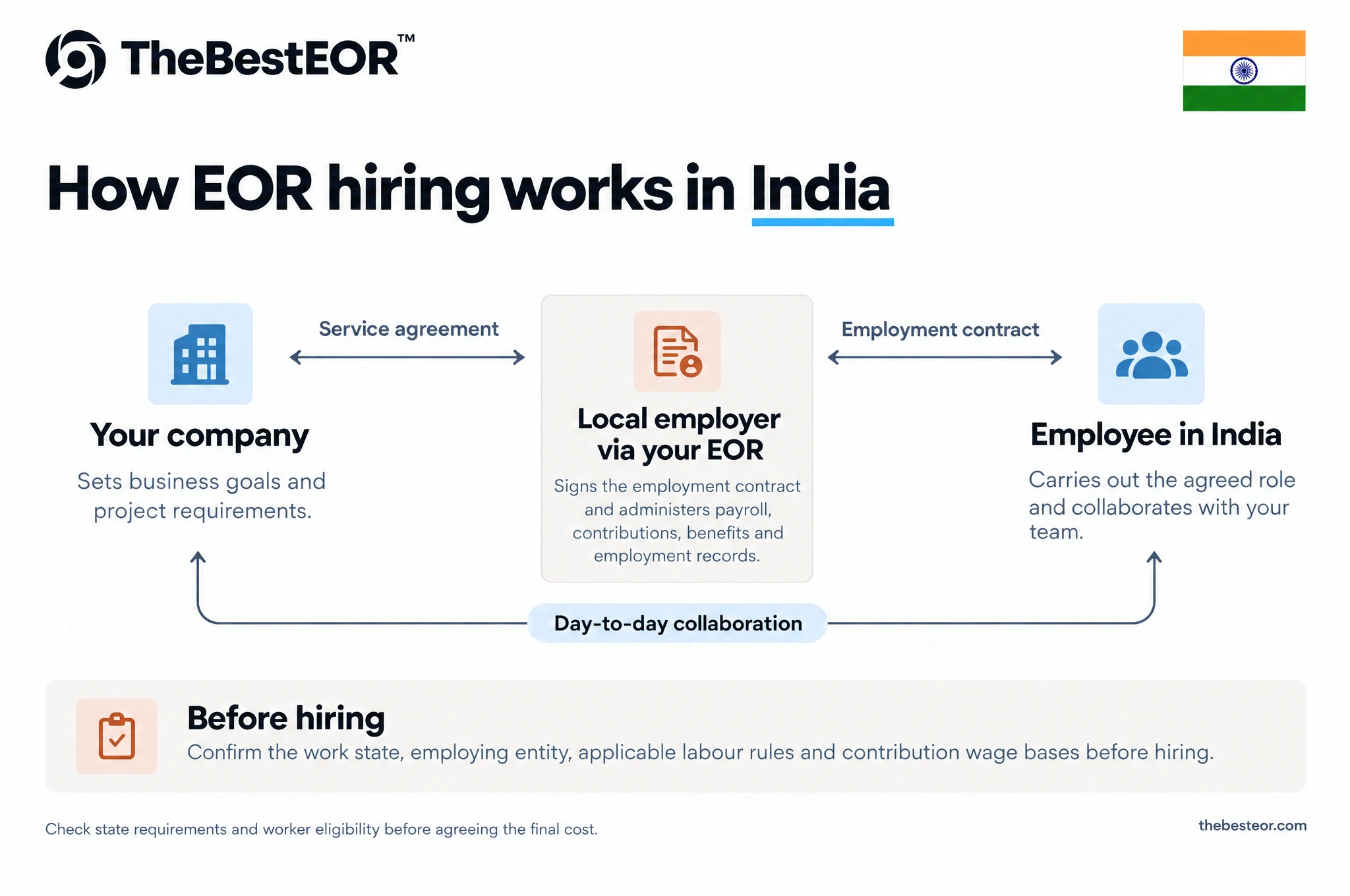
Employer of record in India diagram showing the service agreement, employment contract, and day-to-day collaboration between your company and the employee.
Employer of record in India: how your company, the local employer and the employee work together. Select the image to enlarge.

The EOR handles

1
The named Indian legal employer and its applicable statutory responsibilities
2
Applicable EPF, EPS and ESIC registration, calculation and remittance
3
Income-tax withholding, current salary-TDS returns and employee tax documentation
4
Professional-tax enrolment and deduction where required by the state
5
Applicable statutory bonus and gratuity treatment
6
The employment contract, relevant policies, leave administration and payslip
7
Any separately agreed immigration support, with the eligible route and sponsoring organization identified
8
Notice, documentation and other legal requirements for ending this worker’s employment

You keep

1
What the work is and how it gets done, day to day
2
Every pay decision: the gross, the basic-to-allowance split that drives EPF and gratuity, any bonus above the statutory one
3
Deciding who gets hired and when someone goes
4
Performance management, and the evidence behind any exit
5
Laptops and tooling, bought on your budget (some EORs sell device provisioning)
6
The commercial relationship, and the IP assignment terms the appointment letter must carry for you

Worker classification depends on the actual relationship, not just the contract title. Engaging someone as a consultant while directing employee-like work can create liabilities for unpaid employment contributions, benefits and penalties. EOR employment can address a contractor-versus-employee issue by formally employing the worker. Confirm how the worker may be employed and which obligations apply. The misclassification guide explains questions to discuss with qualified advisers.

Work permits

Employment Visa salary threshold and process

Check the visa salary condition and any exception.

For a foreign-national hire, establish the permitted immigration route for the person and role, including any Employment Visa salary condition, exceptions and sponsoring organization. Indian citizens do not need an Employment Visa; other statuses require their own right-to-work assessment.

Item Requirement (2026) Detail
Item
Salary threshold
Requirement (2026)
Rs16,25,000/year
Detail
Rupee threshold; salary and relevant perquisites, subject to category rules
Item
Who sponsors
Requirement (2026)
The employing entity
Detail
Eligible sponsoring organization; confirm the arrangement
Item
Validity
Requirement (2026)
1 year or contract term
Detail
Extendable up to 5 years
Item
Processing
Requirement (2026)
Confirm with the relevant Indian mission
Detail
Applied for from outside India at a mission
Item
On arrival
Requirement (2026)
Confirm visa duration and registration conditions
Detail
Registration with the Foreigners Regional Registration Office

Fig. 7 · Employment Visa requirements, 2026 · usual salary condition: more than Rs16,25,000 a year; category exceptions apply

The usual Employment Visa salary condition is more than Rs16,25,000 per year, subject to category-specific exceptions. Applications require the correct employment documents and an eligible sponsoring arrangement. Confirm the role, nationality, application location, validity and processing requirements with the relevant Indian mission. Employment visas exceeding 180 days generally require FRRO/FRO registration within 14 days of arrival; the cited consular guidance does not require registration for visas of 180 days or less.

The MHA employment-visa FAQ distinguishes the sponsoring organization from the legal employer. Ask the provider to identify both parties where they differ, explain eligibility and allocate immigration responsibilities in writing.

Salary benchmarks

Indicative salary ranges

Compare monthly gross pay with annual cost to company.

Monthly gross in rupees with a USD equivalent at roughly Rs95 to the dollar. Ranges are 2026 market data from Glassdoor, PayScale and 6figr; use the midpoint as a starting offer, not a ceiling. Salaries are quoted monthly; Indian offers are usually expressed as annual CTC.

These ranges are indicative. Check current pay data for the role and location before you make an offer.

Role Gross Rs/month USD/month (approx)
Role
Software engineer
Gross Rs/month
Rs66,000–1,70,000
USD/month (approx)
$695–1,790
Role
Senior software engineer
Gross Rs/month
Rs1,65,000–3,30,000
USD/month (approx)
$1,740–3,475
Role
Product manager
Gross Rs/month
Rs1,75,000–3,30,000
USD/month (approx)
$1,840–3,475
Role
Accountant (CA)
Gross Rs/month
Rs67,000–1,22,000
USD/month (approx)
$705–1,285
Role
Customer support
Gross Rs/month
Rs25,000–50,000
USD/month (approx)
$265–525
Role
Sales manager
Gross Rs/month
Rs57,000–1,56,000
USD/month (approx)
$600–1,640
Role
HR manager
Gross Rs/month
Rs83,000–2,00,000
USD/month (approx)
$875–2,105
Role
UX designer
Gross Rs/month
Rs32,000–71,000
USD/month (approx)
$335–750

Fig. 8 · Role salary benchmarks for India, 2026 · market ranges from Glassdoor, PayScale and 6figr

Pay clusters in Bengaluru, the National Capital Region (Gurugram, Noida), Hyderabad, Pune and Mumbai; Tier-2 cities such as Jaipur, Indore and Coimbatore run roughly 20 to 35 percent below the metros for the same role. Note that a senior engineer at Rs2,30,000 a month, about Rs27,60,000 a year, clears the Rs16,25,000 Employment Visa salary floor comfortably, which only matters if the hire is a foreign national; for an Indian citizen the threshold is irrelevant.
Selected monthly costs

What an Indian engineer really costs per month

Start with an engineer on ₹1,08,000 gross a month.

The $199, $499 and $699 fees are assumptions applied to the same salary and contribution lines. For a different salary, estimate employer payroll costs in India.

Illustrative full-month employee, Bengaluru Gross Rs1,08,000; assumed statutory monthly wages Rs54,000
Gross salary Rs1,08,000
Employer EPF/EPS
Assumes standard 12% contribution capped on Rs25,000; confirm membership and contribution rules
Rs3,000
Illustrative gratuity reserve
Rs54,000 × 15 ÷ 26 ÷ 12; actual qualifying entitlement calculated at exit
Rs2,596.15
Assumed EOR fee
$199 × illustrative Rs95/USD; confirm actual quote
Rs18,905
Monthly subtotal
Annualised Rs15,90,013.80; excludes items below
Rs1,32,501.15
Additional amounts to confirm
EDLI, establishment administration charges, any ESI, statutory bonus, benefits, deposits, tax and FX charges
Quote separately

Fig. 9 · Illustrated monthly subtotal, software engineer in Bengaluru · selected statutory and provision lines total Rs5,596.15, about 5.18% of the assumed Rs1,08,000 gross salary, illustrative USD 199 monthly service fee

With the assumptions above, gross salary, the capped employer EPF/EPS contribution, an illustrative gratuity reserve and a $199 fee total Rs1,32,501.15 a month. At the same illustrative Rs95/USD rate, a $499 fee gives Rs1,61,001.15 and a $699 fee Rs1,80,001.15. These subtotals exclude applicable EDLI, establishment administration charges, any ESI, statutory bonus, benefits, deposits, tax and FX charges. The annualised subtotal simply multiplies the monthly illustration by 12.

EOR vs your own entity

EOR or your own Pvt Ltd: compare costs

Compare fees over the planned hiring period.

Factor EOR Your own Pvt Ltd
Factor
Setup cost
EOR
None
Your own Pvt Ltd
~Rs7,000–25,000 to register + secretarial
Factor
Time to first hire
EOR
Confirm employee-specific milestones
Your own Pvt Ltd
2–3 weeks (MCA, PAN/TAN, EPF/ESIC/PT registration, bank)
Factor
Per-employee cost
EOR
$199–699/employee/mo fee + statutory
Your own Pvt Ltd
Statutory only, plus shared overhead
Factor
Ongoing admin
EOR
Provider runs payroll & filings
Your own Pvt Ltd
Company secretary, statutory audit, ROC, your own payroll & TDS
Factor
Compliance liability
EOR
On the EOR
Your own Pvt Ltd
On you and your directors

Fig. 10 · Illustrative EOR-versus-entity comparison; the crossover depends on the fee plan, local operating costs and hiring duration.

Keep the EOR and an illustrative USD 199 monthly service fee costs you about Rs2,26,800 a year per employee beyond the statutory contributions you would pay either way. A Pvt Ltd is cheap to incorporate, but mandatory annual statutory audit, a company secretary, ROC filings and in-house payroll add roughly Rs3,00,000 to Rs6,00,000 a year in fixed overhead regardless of headcount, plus director compliance liability under the Companies Act.

Annualise the selected service fee for the hires you expect to keep, then compare it with private limited company setup, accounting, state-level compliance and payroll over the same hiring period. Include transition and exit charges on both sides. The financial crossover depends on the written EOR quote, actual entity overhead and hiring duration; legal suitability remains a separate question. Use the EOR vs entity break-even guide to structure the comparison. If you later establish a Pvt Ltd, plan how to transfer staff before committing to a change.

FAQ

EOR in India: common questions

Check pension, insurance and gratuity for this hire.

Check the Rs25,000 EPF/EPS contribution ceiling effective 17 September 2026, ESI coverage, state rules, visa eligibility and the correct gratuity qualifying period for your employee.

What is the best EOR in India?

RemotePeople is our top pick for India in 2026 (4.9/5), followed by Deel (4.7/5) and Multiplier (4.1/5). We opened paid accounts with all 10 providers on this page, priced real hires and ran payroll.

RemotePeople offers recruitment and EOR through one provider, with a dedicated account manager on both EOR plans. Its EOR Global plan starts at USD 499 per employee per month, and EOR Select at USD 199 where the hire qualifies. Deel starts at USD 599 plus a mandatory Employer Liability Cost; Multiplier Core starts at $499 per employee per month on monthly billing, or $459 billed annually.

How does an employer of record work in India?

An employer of record in India becomes the worker’s legal employer through a local employing entity, while your company directs the day-to-day work. The EOR handles EPF, EPS and ESIC registration and remittance where they apply, withholds income tax (TDS) and files the returns, deducts professional tax where the state requires it, and applies the statutory bonus and gratuity rules.

How fast can an EOR onboard an employee in India?
Ask for an employee-specific start date and first-payroll date. Document collection, contract approval, right-to-work checks, immigration approvals where needed, applicable registrations and payroll cutoffs affect timing.
How much does an EOR cost in India per month?
Published service fees for India run from USD 199 to USD 699 per employee per month across the 10 providers we tested: RemoFirst from USD 199; RemotePeople Global from USD 499, or Select from USD 199 only where country and salary qualify; Deel from USD 599 plus mandatory Employer Liability Cost; G-P from USD 599; Oyster USD 699 on monthly billing, with annual seats quoted separately. Multiplier Core advertises $499 monthly or $459 per month billed annually; Pebl advertises $399, with currency and commitment to confirm. Rippling starts at USD 499 plus its required platform from USD 8 per employee, and Papaya Global at USD 499. Borderless AI is USD 579 standard, with an eligible USD 399 promotion on fees billed through 31 December 2026. All amounts are per employee/month; salary and employment costs are separate. See Provider fees. On top of the fee you pay the employee’s gross salary plus the applicable employer contributions, gratuity provision and agreed benefits. Calculate each on its own wage base; professional tax is generally an employee deduction governed by the relevant state.
What employer contributions are mandatory in India?

EPFO’s standard contribution schedule is 12% each for employer and employee, with specified 10% exceptions. The employer’s EPS allocation is 8.33% where applicable; its EPF allocation is the remainder. The contribution wage ceiling rose from Rs15,000 to Rs25,000 on 17 September 2026, and the maximum ordinary EPS contribution rose to Rs2,083. EDLI is 0.5% and EPF administration 0.5%, subject to scheme rules and establishment-level minimum charges. Apply the statutory wage definition and current scheme ceilings, rather than assuming basic+DA alone or a universal 3.67% EPF allocation.

Employer ESI contribution is 3.25% and employee contribution 0.75%, subject to applicable exemptions. ESIC’s coverage guidance gives a monthly wage ceiling of Rs21,000, or Rs25,000 for persons with disabilities. The Ministry’s March 2026 clarification applies the Code on Social Security wage definition from 21 November 2025; the ceiling should not be described simply as gross pay. The January 2017 date relates to the coverage ceiling, not the present contribution rates.

Can an EOR sponsor an Employment Visa in India?

Confirm an eligible sponsoring arrangement for the actual person and role, and identify the legal employer separately where necessary. The usual Employment Visa salary condition is more than Rs16,25,000 per year, subject to category exceptions. Employment visas exceeding 180 days generally require FRRO/FRO registration within 14 days of arrival; the cited consular guidance does not require it for visas of 180 days or less. Agree documents and timing with the provider and relevant Indian mission.

What is gratuity and when is it owed in India?

Gratuity is now governed by the Code on Social Security, 2020. For monthly paid employees, section 53 uses last-drawn statutory monthly wages ÷ 26 × 15 for each completed service year, including a part-year exceeding six months. Five years’ continuous service is the general qualifying rule, with exceptions including death, disablement and expiry of fixed-term employment; the Ministry specifies one year under the contract for fixed-term employees. Payment is due within 30 days. The Rs20,00,000 ceiling was notified in 2018; better contractual terms and any later applicable notification must also be considered.

What currency and payroll cycle does India use?

Payroll is in Indian rupees (INR). Confirm the contractual payday and applicable wage-payment rules. EPF and ESI follow their contribution calendars; non-government salary TDS is normally due by the seventh of the following month, with March deductions generally due by 30 April. Form 138 replaces Form 24Q under the new Act from 1 April 2026. Any Rs95/USD conversion in this guide is illustrative.

How much notice and severance applies when terminating in India?

Under section 70 of the Industrial Relations Code, 2020, a covered worker with at least one year’s continuous service generally requires one month’s retrenchment notice or pay in lieu, plus 15 days’ average pay per completed year and any part exceeding six months. Sections 77 and 79 impose prior government permission and three months’ notice or pay in lieu for covered factories, mines and plantations with at least 300 workers, or a higher notified threshold. These are retrenchment rules, not a universal notice rule for every employee termination.

Is there a 13th-month salary or statutory bonus in India?

Chapter IV of the Code on Wages, 2019 governs statutory bonus: the minimum is generally 8⅓% of the applicable calculation wages, with a maximum of 20%, subject to eligibility, surplus and statutory exceptions. At least 30 working days in the accounting year are required. The usual payment deadline is eight months after year-end, with statutory extension and dispute provisions. Rs21,000 was the eligibility ceiling under the amended Payment of Bonus Act; current eligibility and calculation ceilings must be checked against the appropriate government’s notifications. The bonus is not necessarily 8.33%–20% of the employee’s full annual salary.

Can I convert an Indian contractor to an EOR employee?

Converting a contractor to EOR employment can formalize future employment, subject to the worker’s eligibility and the legal requirements for that arrangement. It does not erase any past misclassification liability. Agree the employing entity, employment contract, applicable benefits and payroll start date, and review the earlier engagement where needed. The contractor misclassification guide explains issues to discuss with qualified advisers.

Do I need a private limited company to hire one person in India?

No. The agreed EOR structure employs the worker through a named Indian legal employer, so you can hire without incorporating your own Pvt Ltd. Setting up your own company costs roughly Rs7,000 to Rs25,000 to register but adds mandatory annual audit, ROC filings and in-house payroll.

Annualise the selected service fee for the hires you expect to keep, then compare it with the private limited company setup, accounting, state-level compliance and payroll. Count setup costs over the same hiring horizon and include payroll, benefits, transition and exit charges on both sides. A higher service-fee plan moves the financial crossover earlier; lower recurring entity overhead or a longer hiring horizon can do the same. Short hiring duration, setup costs and the need for local administration can move it later. The legal suitability of each arrangement remains a separate question.

Does leave vary by state in India?

Leave entitlements depend on the applicable law and worker category. Karnataka section 15 provides adult earned leave at one day per 20 days worked, plus up to 12 days for sickness, accident or other reasonable cause; it does not create three separate 12-day allowances. Maharashtra section 18 provides eight casual days and earned leave at one day per 20 worked after a 240-day qualifying year, with a 45-day accumulation limit; that section does not create a separate sick-leave bank. Where the OSH Code applies, the Ministry states eight hours per day and 48 per week, with overtime at twice normal wages; more favourable state benefits remain relevant.

Sources and as-of dates

Article references

Sources below retain their individual effective and checked dates. Later amendments are identified alongside the relevant claim.

Hiring facts Checked 2 Oct 2026

Hiring facts

Checked 2 October 2026
Eligibility, local and collective rules apply. EOR fees extra.

EPF, EPS and EDLI contributions (2026 schemes) 5 sources

EPFO’s standard contribution schedule is 12% each for employer and employee, with specified 10% exceptions. The employer’s EPS allocation is 8.33% where applicable; its EPF allocation is the remainder. The contribution wage ceiling rose from Rs15,000 to Rs25,000 on 17 September 2026, and the maximum ordinary EPS contribution rose to Rs2,083. EDLI is 0.5% and EPF administration 0.5%, subject to scheme rules and establishment-level minimum charges. Apply the statutory wage definition and current scheme ceilings, rather than assuming basic+DA alone or a universal 3.67% EPF allocation.

Employees' State Insurance Act 1948 3 sources

Employer ESI contribution is 3.25% and employee contribution 0.75%, subject to applicable exemptions. ESIC’s coverage guidance gives a monthly wage ceiling of Rs21,000, or Rs25,000 for persons with disabilities. The Ministry’s March 2026 clarification applies the Code on Social Security wage definition from 21 November 2025; the ceiling should not be described simply as gross pay. The January 2017 date relates to the coverage ceiling, not the present contribution rates.

Payment of Gratuity Act 1972 4 sources

Gratuity is now governed by the Code on Social Security, 2020. For monthly paid employees, section 53 uses last-drawn statutory monthly wages ÷ 26 × 15 for each completed service year, including a part-year exceeding six months. Five years’ continuous service is the general qualifying rule, with exceptions including death, disablement and expiry of fixed-term employment; the Ministry specifies one year under the contract for fixed-term employees. Payment is due within 30 days. The Rs20,00,000 ceiling was notified in 2018; better contractual terms and any later applicable notification must also be considered.

Maternity Benefit Act 1961 (amended 2017) 3 sources

Section 60 of the Code on Social Security, 2020 provides up to 26 weeks’ maternity benefit, reduced to 12 weeks where the woman already has two or more surviving children. The qualifying rule is at least 80 days’ work in the 12 months before the expected delivery. ESI maternity eligibility follows its own contribution conditions. The Ministry’s 2020 statement said it had no plan for a private-sector paternity-leave system; check current employer policy and any applicable sector or state provisions separately.

Industrial Disputes Act 1947 3 sources

Under section 70 of the Industrial Relations Code, 2020, a covered worker with at least one year’s continuous service generally requires one month’s retrenchment notice or pay in lieu, plus 15 days’ average pay per completed year and any part exceeding six months. Sections 77 and 79 impose prior government permission and three months’ notice or pay in lieu for covered factories, mines and plantations with at least 300 workers, or a higher notified threshold. These are retrenchment rules, not a universal notice rule for every employee termination.

Payment of Bonus Act 1965 3 sources

Chapter IV of the Code on Wages, 2019 governs statutory bonus: the minimum is generally 8⅓% of the applicable calculation wages, with a maximum of 20%, subject to eligibility, surplus and statutory exceptions. At least 30 working days in the accounting year are required. The usual payment deadline is eight months after year-end, with statutory extension and dispute provisions. Rs21,000 was the eligibility ceiling under the amended Payment of Bonus Act; current eligibility and calculation ceilings must be checked against the appropriate government’s notifications. The bonus is not necessarily 8.33%–20% of the employee’s full annual salary.

Labour Codes 4 sources

The four Labour Codes, including the Code on Wages, 2019, took effect on 21 November 2025. Section 53 of the Code on Social Security provides pro-rata gratuity for fixed-term employment, with the Ministry clarifying a one-year contractual-service requirement. The Central Rules were notified on 8 May 2026. State-rule status must be checked separately for the relevant state and Code; the earlier claim that Karnataka, Maharashtra, Gujarat, Haryana and Madhya Pradesh had all completed notification by March 2026 is not substantiated here.

Shops and Establishments Acts (state) 4 sources

Leave entitlements depend on the applicable law and worker category. Karnataka section 15 provides adult earned leave at one day per 20 days worked, plus up to 12 days for sickness, accident or other reasonable cause; it does not create three separate 12-day allowances. Maharashtra section 18 provides eight casual days and earned leave at one day per 20 worked after a 240-day qualifying year, with a 45-day accumulation limit; that section does not create a separate sick-leave bank. Where the OSH Code applies, the Ministry states eight hours per day and 48 per week, with overtime at twice normal wages; more favourable state benefits remain relevant.

Income Tax Act, Section 192 (TDS) 4 sources

For FY 2025–26 (AY 2026–27), the new regime has a nil slab to Rs4,00,000, a rebate of up to Rs60,000 for eligible resident individuals with total income up to Rs12,00,000, and a salary standard deduction of up to Rs75,000. Special-rate income can affect the rebate. Non-government salary TDS is normally deposited by the seventh of the following month, with March deductions generally due by 30 April. Salary withholding is under section 192 of the 1961 Act for the earlier period and section 392 of the Income-tax Act, 2025 from 1 April 2026. Quarterly Form 24Q is replaced by Form 138 under the new Act.

Employment Visa salary threshold 2 sources

The usual Employment Visa salary condition is more than Rs16,25,000 per year, subject to category-specific exceptions. It is a rupee threshold; the old USD25,000 comparison should not be treated as a current exchange-rate equivalent. Employment visas exceeding 180 days generally require registration with the relevant FRRO/FRO within 14 days of arrival; the cited consular guidance says registration is not required for visas valid for 180 days or less.

Company incorporation 2 sources

Company incorporation uses SPICe+ on MCA V3. The Rs7,000–25,000 all-in cost and 7–14 working-day timeframe are estimates, not a published MCA tariff or guaranteed approval period. MCA’s incorporation FAQs explain that fees depend on authorised capital, with state-specific stamp duty and separate applicable charges. Request an itemised quote and an expected timeline for the company’s actual structure and documents.

Professional tax 2 sources

Professional tax is a state levy and coverage varies by state. In Karnataka, the salary threshold is Rs25,000 per month, subject to exemptions. The normal deduction is Rs200 per month except February, when it is Rs300, giving Rs2,500 over a full year for an employee liable throughout.

Salary benchmarks 2 sources

The guide’s salary benchmarks are attributed to Glassdoor, PayScale and 6figr India data for 2026. Treat them as indicative estimates: role, city, seniority, sample date and base-versus-total-pay definitions affect comparisons. The linked Glassdoor and PayScale software-engineer datasets illustrate those distinctions. The conversion uses an illustrative rate of approximately Rs95 = USD1.

Provider pricing, entity model and onboarding 10 sources

The displayed amounts are indicative listed starting fees, with plan and billing conditions where known; they are not complete current country quotes. Confirm the current country fee, benefits, deposits, extras, legal employer and onboarding terms directly, and compare equivalent service proposals.

Sources for the October 2026 additions 4 sources

Ministry of Labour — Labour Codes FAQ — Wage add-back principle, statutory components, gratuity exceptions and applicable worker distinctions. Accessed 19 October 2026.

Ministry of Labour — additional FAQs, 16 March 2026 — Wage component clarification; direct fixed-term employment versus contract labour; one-year FTE condition; 8-hour guidance and more favourable state benefits. Accessed 19 October 2026.

Ministry of Labour — employer compliance handbook — Industrial Relations Code retrenchment, 300-worker special regime, re-skilling contribution and wage payment deadlines. Accessed 19 October 2026.

PIB / EPFO — September 2026 contribution ceiling — Published increase of EPF/EPS contribution wage ceiling to Rs25,000; eligibility remains scheme-specific. Accessed 19 October 2026.

The country guides cover other markets. For this hire, browse EOR providers for India and use the EOR cost calculator to compare the recurring amounts in your proposals in USD.

This guide is for general information only and does not provide legal, tax, accounting, or financial advice. For advice about your business, consult a qualified professional familiar with the rules where you hire. The research methodology explains how TheBestEOR assesses sources.