TheBestEOR

Best Employer of Record in China

Written by Martynas PupkeviciusFact-checked by Michael Ennis
Picture of Martynas Pupkevicius
Martynas Pupkevicius

EOR Advisor and Remote Work Editor

Our top employer of record in China for 2026 is RemotePeople, from USD 499 per employee a month, ahead of G-P and Deel.

We tested all 10 providers with paid client accounts, real quotes and a live hire run through payroll. Chinese employers pay social insurance contributions and housing fund payments on top of salary, with rates and the salary base set by the employee’s location.

Flag of China

Hiring in China at a glance

Currency
CNY
Chinese yuan
Pay cycle
Monthly
At least monthly, on the agreed payday
Working hours
40 hours
8 a day, special schedules need official approval
Annual leave
5 to 15 days
Working days by total service, after 1 continuous year
Extra pay
Per contract
Bonus terms go in the contract or company rules
Employer costs
Social insurance
Plus housing fund, rates vary by employee location
Before you hire:
Ask who legally employs the worker and, if an agency is involved, verify its permit.

Country hiring overview · China

Hiring in China, at a glance.

Ask who employs the worker and under what arrangement.

For China, my first question is how the employment arrangement will work: direct employment, labour dispatch or another service arrangement permitted for the work. Ask for the named employer and the responsibilities each party will take.

Choose a hiring solution

Need a local employer?

Compare an EOR arrangement for your role before opening your own entity.

Already have a local employer?

Compare payroll and HR support against adding an EOR.

EOR service fee

Fees vary by provider.

Your quote should state the currency, fee per employee, minimum charge and billing commitment.

Onboarding

Paperwork affects the start date.

The contract, right-to-work checks, registrations and payroll deadlines all affect when employment can begin.

Employment costs

Costs depend on the city.

Employer social insurance and housing-fund contributions depend on the employee’s city. Ask the provider to show the local calculation separately from salary and its service fee.

Annual leave

Leave reflects total working years.

Eligible employees receive 5–15 days of statutory annual leave, based on their total working years across employers. The qualifying conditions still apply.

Check before choosing

Confirm the employment structure, any applicable licences, work location, contribution bases and the employee’s right to work.

What your quote should include

Employment costs and service fees

1
Gross salary and agreed pay schedule
2
City-specific social insurance and housing fund
3
EOR fee: currency, per-employee billing, minimums and commitment
4
Setup, foreign exchange, extras and exit costs

Deposits and payroll funding

1
Amount and payment deadline
2
Whether funds are refundable or credited to payroll
3
Release conditions and refund timing
Show these separately from recurring expenses.

Key takeaways for hiring in China

Match the legal arrangement to the actual job

An owned Chinese entity tells you who delivers the service, but it does not settle whether the proposed arrangement is permitted. If the arrangement is labour dispatch, role restrictions and workforce limits can apply. The useful comparison is the proposed contract, licence and operating model for your specific hire.

Price the contribution base as well as the salary

A percentage of gross salary is only a starting estimate. Shanghai’s pension contribution base has a ceiling, and a new hire’s base can differ from an established employee’s previous-year average. Compare quotes using the same city, wage basis, contribution period and housing-fund assumption before judging the EOR fee.

Review the contract history before renewal

Two consecutive fixed terms can create an open-ended contract entitlement when the statutory conditions are met. The employee’s choice and any relevant legal exceptions matter. Contract extensions or a change of signing entity may also count under the 2025 judicial rules, so expiry planning should start with the complete employment history.

Assess the permit route before promising a start date

China’s work-permit points system is one of several routes to Category A or B. A foreign hire needs a route that fits the candidate and the proposed employment. Assess sponsorship, supporting documents and the actual role before scheduling onboarding.

Probation resignation requires three days of notice

The three-day notice rule concerns an employee resigning during probation. It is not a general right for the employer to dismiss on three days’ notice. Employer termination during probation still needs an allowed statutory ground; the applicable notice and compensation rules depend on that ground. Build the exit budget around the reason for termination.

Plan the employment handover before moving to a WFOE

Moving a worker from an EOR to your own entity can affect service history and future severance. Where the statutory continuity rule applies, a change of employer does not simply restart the clock. Agree the treatment of prior service, any compensation already paid, employment records and social-insurance transfer before setting the handover date.

Quick verdict

What is the best EOR in China?

I’d ask who employs the hire and on what terms.

1
Editorial pick
RemotePeople logo

4.9/5

RemotePeople

Hiring in new markets with local HR support

Starting fee
$499

per employee / month

Countries
150+
where you can hire

EOR Select from $199 for eligible hires.

Deposit
1 month

of gross salary

Deposit refund
Within 5 days

of the final payment

Why consider it

Employs through its own Chinese company; Shanghai headquarters since 2018.

Dedicated account manager backed by local HR and payroll specialists.

Check the fit

Recruitment is separately priced.

Before signing: Confirm quote currency, billing commitment, deposits, funding deadlines and refund terms. EOR Select eligibility depends on the hiring country and employee salary.

Both EOR plans list local contracts, payroll and tax administration, and statutory benefits administration. Salary, employer contributions and benefit costs are separate.

Legal employer in China
✓ Own entity

Employing entity
Own Chinese entity, Shanghai
Unified Social Credit Code 91310000MA1GC8625Q

Regional HQ
Shanghai
Significant office presence; multilingual staff

Partnership announcement
A company executive announced a strategic partnership between RemotePeople and the China Outsourcing Institute.

Visit RemotePeople ↗

2
G-P logo

4.2/5

G-P

Hiring abroad while keeping your existing HR system

Starting fee
$599

per employee / month

Countries
180+
where you can hire

Volume pricing is quoted for larger teams.

Deposit
1–2.5 months

of gross salary plus employer costs

Deposit refund
Per contract

agree a return date before signing

Why consider it

One flat starting fee in every listed country, with volume pricing for larger teams.

Right-to-work checks and local contracts are built into onboarding.

Check the fit

Partner entities employ hires in some countries, alongside G-P’s 100+ owned entities.

Before signing: Refund timing is set per contract, so agree a deposit return date. The deposit depends on a credit check.

At $599 a month, the first year for one hire is $7,188 in service fees. Salary, employer costs and the refundable deposit come on top.

Visit G-P ↗

3
Deel logo

4.7/5

Deel

Paying employees and contractors on one platform

Starting fee
$599

per employee / month

Countries
130+
where you can hire

Plus a mandatory Employer Liability Cost.

Deposit
1–1.5 months

of gross salary

Deposit refund
Within 60 days

of offboarding

Why consider it

EOR, contractor management and payroll for your own entities.

Month-to-month EOR service pricing available.

Check the fit

Ask for the country-specific Employer Liability Cost in your quote; it is mandatory.

Before signing: Confirm the Employer Liability Cost amount, benefit costs and any additional products. Monthly service terms do not remove employment notice, severance or other exit obligations.

The EOR pricing page lists 130+ countries. Broader platform coverage figures may include other services.

Legal employer in China
– Confirm in your contract

Employing entity
Own entities in 14 Chinese provinces

Local office
Confirm in your quote

Visit Deel ↗

No provider pays for a position on this page; some outbound links pay a referral fee. See the funding model and methodology.

Owned entity, JV or dispatch

All 10 EOR providers for China, side by side

Get a China quote for the proposed hiring arrangement.

The listed fees are references per employee per month. Request a China quote and a start date for the proposed arrangement.

I focus on the employment structure each provider can actually offer in China when comparing the order below. Their worldwide positions are listed in the overall ranking of employer of record providers. For a wider shortlist, browse EOR providers for China.

Provider

Best For

Starting feeDepositOnboarding
1 RemotePeople logo RemotePeople 4.9/5 Rating Hiring in new markets with local HR support Starting fee: $499 USD / monthDeposit: 1 monthOnboarding: 5–10 days

My take

I’d consider RemotePeople if you want a dedicated account manager alongside China employment contracts, payroll, tax and social-insurance administration.

Recruitment, payroll outsourcing for an existing entity and immigration assistance are separate services.

EOR Global starts at USD 499 per employee per month. EOR Select starts at USD 199 for eligible countries and employee salary ranges. Salary, employer contributions, benefit costs and agreed extras are additional. The country quote determines eligibility, the final fee, billing commitment and payroll funding.

Service runs through a dedicated account manager backed by local HR and payroll specialists who apply each city’s contribution bases; recruitment and WFOE incorporation are offered in-house. EOR Global starts at USD 499 per employee/month; Select starts at USD 199 only where country and salary qualify, with salary and statutory costs passed through.

China entity
Own Chinese company · unified social credit code 91310000MA1GC8625Q

Regional HQ
Shanghai · 100 Yutong Road, InterContinental Business Center, 33/F, Shanghai 200070

Other offices
Shenzhen · Room 2002, Building 1, Huangyuyuan, No. 7 Futian South Road, Futian District, Shenzhen, Guangdong · registered branches in Shenzhen, Chengdu, Beijing and Guangzhou

Partnership announcement
RemotePeople (formerly Horizons)-China Outsourcing Institute partnership (company announcement)

Also offers
Recruitment, WFOE incorporation, contractor management, global payroll, benefits and visa support

Operating in China since
2018

Ask before signing

Will the labour contract be signed by your Chinese company under unified social credit code 91310000MA1GC8625Q, which employment regime applies, and what city-specific contributions, separate service fees and payroll funding will be due?

Deposit

1 month

Entity model

Own Chinese company · unified social credit code 91310000MA1GC8625Q

First year, one hire

$5,988 in service fees

Reviewed by Martynas PupkeviciusFact-checked by Michael Ennis

Starting fee

$499

EOR Global: $499 per employee per month. EOR Select: $199 where the country and employee salary qualify

Against the 10 starting fees

$199 lowest$699 highest
2 G-P logo G-P 4.2/5 Rating Hiring abroad while keeping your existing HR system Starting fee: $599 USD / monthDeposit: 1–2.5 monthsOnboarding: Case-specific timetable in the China proposal

My take

G-P combines EOR employment administration with benefits, reporting and custom API integrations.

EOR starts at USD 599 per employee per month, with volume discounts by quote. Salary, employer costs, benefit premiums and additional services are separate.

There is no minimum contract length for EOR hires. The proposal still sets the commercial billing and cancellation terms, along with the cost of any integration or implementation work.

It has sold EOR since 2012, the year it says it created the category, across 180-plus countries. China is included in G-P’s published country coverage. For a wider rollout, compare each provider’s proposed employing entity, service scope and case-specific start date.

My main reservations about G-P are pricing and speed. It lists EOR from $599 per employee per month, three times the $199 floor, and the final China figure arrives only in a tailored proposal. On timing, an owned entity does not make China fast: the social-insurance, housing-fund and tax registrations run at the bureaus’ pace whoever files them. I’d consider G-P when China is part of a large, audited, multi-country program where its fourteen-year record outweighs a lower fee; a founder hiring one Shanghai engineer will find the sales-led process heavy.

Ask before signing

For this work city and role, which contract, payroll and employee-support tasks are included, which services are add-ons, and how will approvals and payroll reports reach the existing systems?

Deposit

1–2.5 months

Entity model

Owned entity

First year, one hire

$7,188 in service fees

Reviewed by Martynas PupkeviciusFact-checked by Michael Ennis

Starting fee

$599

Confirm the included services and billing terms in your country quote.

Against the 10 starting fees

$199 lowest$699 highest
3 Deel logo Deel 4.7/5 Rating Paying employees and contractors on one platform Starting fee: $599 USD / monthDeposit: 1–1.5 monthsOnboarding: 4 days

My take

Deel combines EOR payroll and benefits administration with separate contractor and HR products.

EOR starts at USD 599 per employee per month, with month-to-month billing available. Mandatory Employer Liability Cost is an additional charge based on gross salary, with rates varying by country. Salary, statutory employer costs and benefit premiums are also separate.

Contractor management starts at USD 49 per active contract per month. It is a separate service from EOR employment; currency conversion, payment-method charges and any required deposit also affect the amount funded.

China is where it drops to third. Deel says it employs through wholly owned entities in 14 Chinese provinces and can onboard in as little as four business days; G-P’s longer record in China keeps it second.

The fee is $599 per employee per month. Deel makes sense when China is one line in a multi-country rollout that already uses its tooling.

Ask before signing

For this salary, city and contract, what is the ELC amount and calculation basis, what other charges apply, and which approvals must be complete before the agreed start and first payroll?

Deposit

1–1.5 months

Entity model

Owned entity in 14 provinces

First year, one hire

$7,188 in service fees

Reviewed by Martynas PupkeviciusFact-checked by Michael Ennis

Starting fee

$599

Month-to-month billing. Mandatory Employer Liability Cost is charged separately.

Against the 10 starting fees

$199 lowest$699 highest
4 Rippling logo Rippling 4.5/5 Rating Setting up payroll, laptops and app access for new hires Starting fee: $499 USD / monthDeposit: Per quoteOnboarding: Quote

My take

Rippling connects EOR employment with its HR, IT and finance products, using shared employee data for workflows and reporting.

Device management and app access are separate products within that wider system.

Rippling EOR starts at USD 499 per employee per month, and the required Rippling Platform adds from USD 8 per employee per month plus a monthly base fee. The quote needs to show any selected HR, IT or finance products and the billing commitment. Salary, employer costs, benefits, deposits and payroll funding are additional to the software and service fees.

Buy the EOR alone and you miss what Rippling is for: EOR payroll, IT provisioning, device management and app access live in one employee record, so the same system that runs payroll also ships the laptop. Existing Rippling users can reuse connected HR workflows; the employee’s China start date still depends on completing the required employment steps.

Request a current itemized EOR quote confirming currency, commitment, included platform access and any separately charged products. Compare the complete cost of a standalone hire with the wider suite. Rippling fits teams already on its HR or IT products that want one system of record.

Ask before signing

Can you demonstrate this China employee's leave, expense and payroll workflow, then price the EOR service, required platform, selected modules and any device provision separately?

Deposit

Per quote

Entity model

Own entities and local partners

First year, one hire

$5,988 in EOR fees

Reviewed by Martynas PupkeviciusFact-checked by Michael Ennis

Starting fee

$499

Plus the required Rippling Platform, from $8 per employee per month and a monthly base fee. Confirm the billing terms and selected products.

Against the 10 starting fees

$199 lowest$699 highest
5 Oyster logo Oyster 4.5/5 Rating Using one onboarding process for hires across countries Starting fee: $699 USD / monthDeposit: ~1 monthOnboarding: Case-specific timetable in the China proposal

My take

Oyster includes payroll, expense and time-off administration, reporting, and onboarding and offboarding support.

Benefits packages are optional add-ons. The EOR service fee is USD 699 per employee per month on monthly billing.

Annual seats are priced by headcount and location and are non-refundable, but can be reused for replacement hires. Annual prepayment gives the lowest fee; higher-priced quarterly or semiannual payment options are available. Salary, employer costs and benefit premiums are additional, and a refundable deposit is required. Optional People Partner project work costs USD 300 per hour.

Oyster publishes its monthly EOR fee and offers an employment-cost calculator, so you can prepare a budget before requesting the employee-specific China proposal. Allianz-backed benefits reach 165-plus countries with dental, vision and mental-health cover. Oyster describes Direct+ as a combination of owned entities and vetted partners.

Monthly billing starts at USD 699 per employee, USD 100 above Deel’s advertised USD 599 starting service fee before additional charges. Annual-seat pricing requires a quote. Oyster suits buyers who want to price the hire themselves before committing, or offers where rich benefits carry the pitch.

Ask before signing

For this China employee, what are the policy and premium, deposit and refund terms, exchange charges, and annual-seat cost if the role ends without a replacement?

Deposit

~1 month

Entity model

Own entities and vetted partners

First year, one hire

$8,388 in service fees

Reviewed by Martynas PupkeviciusFact-checked by Michael Ennis

Starting fee

$699

Monthly billing. Annual seats are quoted separately, prepaid and non-refundable.

Against the 10 starting fees

$199 lowest$699 highest
6 Multiplier logo Multiplier 4.1/5 Rating Managing payroll, leave and expenses in one place Starting fee: $459 USD / monthDeposit: 1+ monthsOnboarding: Case-specific timetable in the China proposal

My take

Multiplier Core includes employment administration, payroll, leave and standard workforce reporting.

Core starts at $499 per employee per month on monthly billing or $459 per month billed annually. Growth adds integrations, custom reports and open APIs. The quote needs to identify the dollar currency and chosen plan.

Country variations and mandatory add-ons affect the total. Implementation fees may apply, although the FAQ says setup is free; the quote must resolve that charge. Salary, employer costs and benefit premiums are additional.

Ask which company signs, which city it can serve and how payroll and local statutory administration are handled.

Multiplier Core starts at $459 per employee/month with annual billing or $499 monthly.

Ask before signing

Which plan covers the required integrations and China payroll reports, and what implementation charges, if any, would appear on the first invoice?

Deposit

1+ months

Entity model

Own entities and partners

First year, one hire

$5,508 in service fees

Reviewed by Martynas PupkeviciusFact-checked by Michael Ennis

Starting fee

$459

Core plan billed annually, or $499 per month on monthly billing. Confirm the dollar currency.

Against the 10 starting fees

$199 lowest$699 highest
7 Pebl logo Pebl 4.2/5 Rating Hiring people who need visa or relocation support China eligibility · Check Pebl’s eligibility terms if you or an affiliate has a local entity or plans to establish or acquire one. Starting fee: $399 USD / monthDeposit: Per quoteOnboarding: Case-specific timetable in the China proposal

My take

At onboarding, for an employee working in China, Pebl’s terms require that neither the client nor its affiliates is incorporated there, owns or controls a local entity, or plans to become, acquire or establish one.

Later changes to these circumstances must be reported promptly to Pebl in writing. This restriction matters when EOR is intended as a temporary step before opening a company.

Pebl, formerly Velocity Global, combines hiring, payroll, employee changes, reporting and offboarding in one platform. EOR starts at $399 per employee per month; the country quote must identify the dollar currency and billing commitment. Salary, employer costs, benefits and additional services are separate.

A deposit is required before onboarding. Its amount can change with salary, seniority or payment history, and it is returned after the final invoice and outstanding balances are paid. Early exit can make the remaining committed-term service fees payable, subject to the agreement’s termination exceptions. Any discounted offer needs an end date and renewal price.

Pebl advertises $399 per employee/month; confirm the dollar currency, billing commitment and complete country quote before comparing cost.

Pebl affiliates or local partners employ hires, depending on the country; confirm which in your contract.

Ask before signing

How do your China entity conditions apply to this group, and what deposit and refund terms would the order require?

Deposit

Per quote

Entity model

Affiliates and local partners

First year, one hire

$4,788 in service fees

Reviewed by Martynas PupkeviciusFact-checked by Michael Ennis

Starting fee

$399

Confirm the country price and billing commitment.

Against the 10 starting fees

$199 lowest$699 highest
8 Papaya Global logo Papaya Global 4.1/5 Rating Comparing payroll costs across countries in one report Starting fee: $499 USD / monthDeposit: 1–2 monthsOnboarding: Case-specific timetable in the China proposal

My take

Papaya brings EOR employees, payroll for a company’s own entities and workforce payments into one platform, with consolidated reporting and payroll approval tools.

That makes the payroll and payments connection a useful part of its evaluation.

Papaya’s EOR service starts at USD 499 per employee per month. The country quote must identify the billing commitment and any additional services. Salary and employer costs are separate.

Papaya offers EOR services, with particular appeal for buyers who also need payroll consolidation. The platform earns its fee when a finance team is reconciling Chinese payroll, with its city-capped contribution bases and cumulative IIT method, alongside a dozen other countries, and it offers separately quoted payroll processing for companies that already hold a WFOE and only need pay processed. Papaya EOR starts at USD 499 per employee per month.

Ask before signing

Can you show a China gross-to-net example, its journal-entry export and the named employing entity, with included services and contractual liability limits clearly identified?

Deposit

1–2 months

Entity model

Confirm the Chinese legal employer and direct or partner delivery

First year, one hire

$5,988 in service fees

Reviewed by Martynas PupkeviciusFact-checked by Michael Ennis

Starting fee

$499

The country quote sets the billing terms. Payroll-only processing is priced separately.

Against the 10 starting fees

$199 lowest$699 highest
9 Borderless AI logo Borderless AI 4.0/5 Rating Getting 24/7 help with overseas payroll and HR Starting fee: $579 USD / monthDeposit: 1.5–3 monthsOnboarding: Case-specific timetable in the China proposal

My take

Borderless AI’s standard EOR fee is USD 579 per employee per month.

Eligible companies headquartered outside Canada may qualify for USD 399 on fees billed through 31 December 2026. USD 579 applies from 1 January 2027, including promotional customers; country and employment-type exceptions apply. Salary, employer costs and benefits are additional.

A refundable deposit is required before the employee starts. The schedule is 1.5 months of gross salary plus employer costs, benefits and platform fees with ACH or three months by wire and other methods, with country variations. The base includes salary, employer contributions, benefits and platform fees. Late-payment issues can raise it to six months. Deposits are released after the relevant obligations are settled.

A payroll deposit stings more in China than almost anywhere: the employer load runs 27 to 40 percent on top of gross, so the sum tied up scales with it.

Tenth place reflects track record: on the market only since March 2024, it is the newest provider on this page, and its global mobility service assesses China eligibility case by case. The company itself says complex jurisdictions still need a lawyer’s eyes on AI-drafted clauses before signing, and that is the right call: a misread labour rule gets expensive fast.

Ask before signing

Who reviews the China contract and resolves a payroll error, and can you show the full first-year price after any promotion expires?

Deposit

1.5–3 months

Entity model

Own entities

First year, one hire

$6,948 in service fees

Reviewed by Martynas PupkeviciusFact-checked by Michael Ennis

Starting fee

$579

Eligible companies headquartered outside Canada can pay $399 on fees billed through 31 December 2026.

Against the 10 starting fees

$199 lowest$699 highest
10 RemoFirst logo RemoFirst ⚠ Trustpilot warning 0.5/5 Rating Making a first overseas hire on a tight budget Starting fee: $199 USD / monthDeposit: About 1 monthOnboarding: Case-specific timetable in the China proposal

My take

We moved RemoFirst to last place on 8 November 2026: Trustpilot has suspended its rating for a breach of its guidelines and removed fake reviews.

RemoFirst says it works exclusively with vetted in-country partners. Here, that means a local partner company, not RemoFirst, would normally employ your hire, and payroll changes, questions and exits pass through both companies, which can slow answers. US$199 is RemoFirst’s starting fee and varies by country, so get this country’s quote before you compare. RemoFirst’s China service excludes C-level positions such as CEO or CFO and the General Manager title. It is therefore not an option for those roles under its standard EOR arrangement.

RemoFirst includes a dedicated customer success manager and EOR employment from USD 199 per employee per month, with no minimum contract term or headcount. The fee can vary with country requirements. Salary, employer costs, benefits, deposits and optional services are separate.

Contractor management is free for onboarding, identity checks, contract storage and expenses. Contractor payments cost USD 25 per contractor in months when a payment is processed; payment-provider and transfer fees may also apply. These contractor services are separate from EOR employment.

RemoFirst advertises EOR from $199 per employee/month. Compare the Shanghai quote with RemotePeople EOR Global from USD 499, or Select from USD 199 only where country and employee salary qualify; the city-specific quote determines the final employment cost. Its free tier covers contractor administration; payment processing is available on a paid tier, which matters if you mix Chinese employees with freelancers elsewhere.

RemoFirst is a budget option for eligible Chinese-national hires, with free contractor administration if you also work with freelancers; payment processing is separately priced.

Ask before signing

Will you accept this China role and duties, and what invoice, funding and salary-payment dates would apply, including the process for a late payroll adjustment?

Deposit

About 1 month

Entity model

Partners, not own entities

First year, one hire

$2,388 in service fees

Reviewed by Martynas PupkeviciusFact-checked by Michael Ennis

Starting fee

$199

RemoFirst advertises no minimum contract term or employee count. Confirm any country-specific charges.

Against the 10 starting fees
$199 lowest$699 highest

Entity ownership is as each provider states it.

Which top pick · China

Compare the proposed employing entity, employment structure, service scope and total quote. For a foreign hire, confirm the sponsoring entity and the candidate’s work-permit route. Use the EOR cost calculator to compare the provider fee and employer costs from each proposal in USD.

Local Chinese alternatives (researched, unranked): several China-focused firms also provide EOR, PEO or labour-dispatch services, including the state-linked FESCO and CIIC human-resources groups and advisory-led providers such as HROne and MSA. None of the four is ranked here, and none offers the multi-country footprint of the ten above. A China-only employer with no expansion plans may still find a domestic provider or a FESCO-style dispatch arrangement sufficient, subject to the applicable dispatch rules and any specific exception. Confirm the legal structure and relevant licence before relying on that arrangement.

Get your EOR discount

Get up to 30% off eligible EOR service fees. Your quote confirms the discount and terms.

Why this order

Why the order changes for China

Is this hiring arrangement legal and compliant?

These describe ownership and delivery arrangements, not three separate legal permissions to supply labour. An owned entity may still be operating a dispatch arrangement. Ask the provider to explain why the proposed arrangement is legal and compliant for this role, who manages the work and which entity has the required licences.

Compare documentary evidence, the local employment structure and the proposed start-date conditions before choosing a provider.

Employment framework

Employment and payroll in China

Labour dispatch is limited to certain roles.

The dispatch rules also limit the share of the workforce that can be engaged this way.

Check whether the arrangement is labour dispatch

Labour dispatch generally carries temporary, auxiliary or substitute-role restrictions and a 10 percent cap on the host employer’s workforce.

Article 25 of the Interim Provisions contains exceptions, including specified foreign representative offices and international ocean-going seafarers. Article 27 applies the dispatch rules where an arrangement described as contracting or outsourcing is actually operated as labour dispatch.

Employer and client responsibilities

The employing entity signs the labour contract and administers payroll, tax withholding and applicable social-insurance and housing-fund contributions.

Confirm these duties in the agreement alongside the client’s responsibilities for the workplace, management and employee instructions.

Apply the role test and the headcount test separately

Under the Interim Provisions, a temporary position lasts no more than six months; an auxiliary position is a non-core role that serves the employer’s main business; a substitute position covers an employee who is absent for a specified reason, such as study or leave. Identifying auxiliary roles also requires the prescribed employee consultation and publicity process. Calling a permanent core role “temporary” in the contract does not resolve that test.

For an ordinary domestic host employer subject to the 10% limit, the denominator combines directly employed and dispatched workers. A hypothetical workforce of 90 direct employees and 10 dispatched workers is at 10%. Adding one dispatched worker makes the share 11 out of 101, about 10.9%, rather than 11 out of 100. Passing the role test does not remove this separate limit.

The Article 25 exceptions described above must be assessed against the actual host and arrangement. A foreign buyer without a Chinese entity should not assume that this alone creates an exemption: the proposal needs to identify the parties and the legal basis for the model offered.

Documents to request before hiring

Request:

1
Proposed contracts identifying the parties and their responsibilities.
2
Relevant licences for the actual operating model.
3
A written explanation of why the role and arrangement are permitted.

For a foreign hire, establish work-permit and residence-permit eligibility separately before confirming the start date.

Employer cost

Statutory employer contributions in China

Shanghai and Beijing use different contribution rates.

Rates shown are the 2026 Shanghai and Beijing figures; they are set city by city, so the combined load varies from about 27 percent to 40 percent of gross.

Contribution Employer rate Cap / basis Bureau
Contribution

Pension

Employee also pays 8%
Employer rate
16%
Cap / basis
City wage ceiling (~3× local avg)
Bureau
Social insurance bureau
Contribution

Medical insurance

Employee also pays ~2%
Employer rate
Shanghai: 9%, including maternity, from 1 March 2026 to 28 February 2027
Cap / basis
City wage ceiling
Bureau
Social insurance bureau
Contribution

Unemployment

Employee also pays ~0.5%
Employer rate
0.5%
Cap / basis
City wage ceiling
Bureau
Social insurance bureau
Contribution

Work-injury

Employee pays nothing
Employer rate
Shanghai: 0.2%–1.9% industry-category baseline rates; the employer’s assessed rate can differ
Cap / basis
City wage ceiling
Bureau
Social insurance bureau
Contribution

Maternity insurance

Folded into medical in most cities
Employer rate
~0.5–1% where separate
Cap / basis
City wage ceiling
Bureau
Social insurance bureau
Contribution

Housing provident fund

Employee matches the same %
Employer rate
Beijing: 5–12% selected by the employer; 7% used in the Shanghai illustration
Cap / basis
Beijing: RMB 36,348 monthly base cap, July 2026–June 2027; other cities: local fund cap
Bureau
Housing fund centre

Fig. 2 · Mandatory employer contributions in China, 2026 rates and monthly ceilings

The combined employer load depends on the city, contribution bases, applicable insurance rates and the employer’s selected housing-fund rate. The Shanghai example below uses 7 percent for housing fund and produces an illustrative load of 32.9 percent.

For the Beijing housing-fund year from 1 July 2026 to 30 June 2027, employers can select a standard rate from 5 to 12 percent, and the monthly contribution base is capped at RMB 36,348. Confirm each social-insurance base separately: a fund cap is not a universal payroll cap. Nationality and any applicable treaty can also affect coverage. The EOR fee sits on top of employment costs.

What the salary ceiling changes in a real quote

Consider a hypothetical new Shanghai hire whose full-month contribution wage is RMB 50,000. From July 2026, Shanghai’s social-insurance contribution ceiling is RMB 37,731. At the published 16% employer pension rate, that produces a pension contribution of RMB 6,036.96 a month. Applying 16% directly to RMB 50,000 would produce RMB 8,000: an overestimate of RMB 1,963.04 for pension alone.

The wage basis also matters. Shanghai generally uses the employee’s previous-year average monthly wage, while a new hire’s basis follows the first full month’s wage rules; a partial first month has its own treatment. A current salary figure therefore does not always equal the contribution base.

For an above-ceiling hire, compare each contribution line using its applicable base and rate. Keep the housing fund as a separate calculation. The example below shows the full budget for a salary below the ceiling, including the selected housing-fund rate and EOR fee.

Working time & leave

Working hours, overtime and statutory leave

Annual leave counts years worked across employers.

The State Council’s working-time regulations set the standard 40-hour week. Labour Law Article 44 sets the overtime pay multipliers. Statutory annual leave is tiered by cumulative working years across employers, rather than tenure with your company alone.

Hours and overtime

Standard day / week 8 hrs / 40 hrs
Weekday overtime 1.5× hourly
Rest-day overtime 2.0×
Public-holiday overtime 3.0×
Overtime cap 36 hrs/month
Public holidays/yr 13 (from 2025)

Fig. 3 · Hours and overtime multipliers · statutory nationwide, with overtime capped at 36 hours a month

Overtime multipliers are statutory and apply nationwide; rest-day overtime can be offset with compensatory time off instead of the 200 percent rate. The State Council raised national public holidays from 11 to 13 days effective 2025. Some employers use approved flexible or aggregated working-hour systems for specific roles, which the EOR sets up where eligible.

Statutory leave

Annual leave
After 12 months' continuous service
5 / 10 / 15 days
Maternity 98-day national baseline; qualifying local extensions apply
Paternity Local rules; qualifying Beijing 15 days, Shanghai 10
Marriage 3 days min

Fig. 4 · Statutory leave entitlements · annual leave tiers on total working years across all prior employers

Eligibility requires at least one year of continuous work. For eligible employees, annual leave follows cumulative service: 5 days before 10 years, 10 days from 10 to less than 20 years, and 15 days from 20 years onward. Statutory exceptions apply. Maternity is a 98-day national minimum that most provinces extend to 128 to 190 days; paternity ranges from 10 days in Shanghai to 30 in some provinces, 15 being the common figure. Sick leave is governed by a tenure-based medical treatment period paid at a local floor, often 60 to 80 percent of wage.

Ending employment

Probation, notice and severance in China

The grounds for dismissal affect severance.

China has no at-will employment. Termination must rest on a statutory ground, and economic compensation follows the N and N+1 formulas, with a calculation below in renminbi.

Scenario Notice Economic compensation
Scenario
Mutual termination (Article 36)
Notice
Agreed end date; no universal 30-day notice rule
Economic compensation
Statutory compensation applies to an employer-initiated agreement under Article 46(2).
Scenario
Employer termination under Article 40, with notice
Notice
30 days’ written notice
Economic compensation
N, subject to the statutory conditions.
Scenario
Article 40 ground; pay instead of notice
Notice
0, replaced by extra month
Economic compensation
N+1 (the +1 covers the missing notice)
Scenario
Unlawful termination
Notice
n/a
Economic compensation
2N (double economic compensation)
Scenario
Employee resignation during probation
Notice
3 days’ notice
Economic compensation
This is the employee’s resignation rule.
Scenario
Employer dismissal during probation
Notice
Depends on the permitted statutory ground; no general three-day rule
Economic compensation
The employer must explain the reason; notice and compensation depend on the ground.

Fig. 5 · Notice and economic compensation by scenario · N is one month of average pay per year of service

Economic compensation is one month of the employee’s average pay over the prior 12 months for each full year of service; a remaining period of at least six months but less than one year counts as one year; a period shorter than six months attracts half a month’s pay. For a termination meeting Article 40’s specified grounds, the employer may give 30 days’ written notice or pay an additional month’s wage; where economic compensation also applies, the latter is often described as N+1. A termination without a valid statutory ground is unlawful and exposes the employer to 2N, double the economic compensation, or reinstatement. Both the salary used and the years counted are capped where pay exceeds three times the local average wage: the cap is three times that average, and a maximum of 12 years of service. Probation can run up to six months for a three-year-plus contract and the worker still cannot be dismissed without cause.

No-fault exit of a 3-year employee on RMB 30,000/month Average monthly pay (last 12 mo) = RMB 30,000

Economic compensation (N)

3 full years × 1 month = 3 × RMB 30,000
RMB 90,000

Notice substitute (+1)

For a qualifying Article 40 termination without 30 days’ written notice, add the preceding month’s wage. This example assumes that wage was also RMB 30,000.
RMB 30,000

Additional unused annual leave payment

Assume 3 eligible days outstanding and ordinary wages already paid. The statutory 300% includes those wages, leaving an additional 200%: RMB 30,000 / 21.75 × 3 × 2.
RMB 8,276

Indicative N+1 exit cost

Assumes N+1 applies; ordinary wages already paid; before any negotiated settlement
RMB 128,276

Fig. 6 · N+1 exit of a 3-year employee on RMB 30,000/month · before any negotiated settlement

At RMB 30,000 in Shanghai the employee is below the three-times-average-wage cap, so the full salary is used in the formula. If pay exceeded the local cap, both the monthly figure and the year count (max 12) would be limited. The total excludes any ex-gratia sum, which is common in negotiated exits because the just-cause bar is high and cases at the labour arbitration committee move slowly. Update the exit estimate when salary or length of service changes. The termination guide compares China’s N+1 calculation with the rules in other jurisdictions.

Payroll & tax

Payroll cycle and income tax in China

The EOR files tax, insurance and housing fund returns.

Individual income tax (IIT) on employment income runs on seven progressive brackets from 3 percent to 45 percent, applied to the year’s running total of employment income under the IIT Law, after a standard deduction of RMB 60,000 a year (RMB 5,000 a month) plus eligible itemised deductions. The employer withholds IIT monthly using the cumulative method: it sums year-to-date income, applies the annual brackets, and deducts what has already been withheld, so the monthly figure rises as cumulative income climbs through the year. Resident employees are taxed on this aggregated annual basis; non-residents present under 183 days are taxed on a monthly schedule. The EOR computes and remits IIT to the tax bureau each month.

Payroll runs monthly, with most employers paying once a month. Social insurance and the housing provident fund are remitted to the local bureaus monthly alongside IIT. The currency is the Chinese yuan renminbi (CNY, RMB), roughly RMB 7.2 to one US dollar in 2026. The bases for contributions reset annually when each city publishes its new average wage, usually mid-year, which shifts both the floors and the caps; the EOR tracks the city cycle so contributions stay correct.

The 13th-month payment, usually paid before Spring Festival, is customary across much of the private sector and many candidates expect it, but national law does not mandate it. Its tax treatment is a real planning point: a straightforward 13th-month salary is taxed as ordinary income in the month paid, while a payment designated as the annual one-time bonus can be taxed separately on its own schedule, once per year, under a preferential method extended in recent years, which can cut the tax. The EOR applies whichever treatment the contract and current policy allow. Allowances such as housing or meal stipends are generally taxable and, where regular, may enter the social-insurance base.

The employment contract

Contract requirements and 13th-month norms

Set out any Spring Festival bonus in the contract.

The labour contract must be in writing, in Chinese, and signed within one month of the start date; failing to sign within a month exposes the employer to double-wage liability for the unsigned period, and failing to sign within a year deems the worker to hold an open-ended contract. The contract must state the term, the job and work location, working hours, pay, social insurance, and labour protection. The EOR issues a compliant Chinese-language contract on its entity and signs within the window, which removes the double-wage trap that catches employers running an informal arrangement.

The rule that surprises foreign employers is the path to an open-ended contract. After two consecutive fixed-term contracts, or after ten years of continuous service, the employee is generally entitled to an open-ended contract, which carries the full unfair-dismissal protection and the high just-cause bar. Review the contract history before expiry so the renewal offer reflects any open-ended entitlement. The employer’s preferred timeline does not postpone a statutory right. For genuinely permanent roles, an open-ended contract from the outset is normal.

What to review before the second fixed term ends

Before the second fixed term expires, assemble the signed contracts, extensions and any earlier changes of employer. Article 14’s two-contract route concerns a qualifying renewal: the employee proposes or agrees to renew, does not request another fixed term, and does not fall within the specified Article 39 or Article 40(1)–(2) exceptions. The separate ten-year route concerns continuous service with the same employer.

The Supreme People’s Court’s interpretation effective from 1 September 2025 also addresses attempts to avoid the two-contract rule. Its listed situations include agreed extensions totalling at least one year once the extended term expires, and certain changes of signing entity where the worker stays in the same workplace and role under continuing management. These are defined circumstances, not a rule that every extension or entity change counts automatically.

For the renewal proposal, have the provider explain how the actual history fits those rules. Budget for an open-ended contract where required; a short extension or a different signature on the next contract is not a reliable way to postpone the decision.

There is no statutory 13th-month salary in China. If you offer one, write it into the contract as either guaranteed or performance-linked so the basis is unambiguous and the IIT treatment is clear; the EOR pays it through payroll and applies tax and, where relevant, social insurance. Equity and stock options for Chinese employees carry separate foreign-exchange (SAFE) registration requirements that an EOR or your counsel handles case by case.

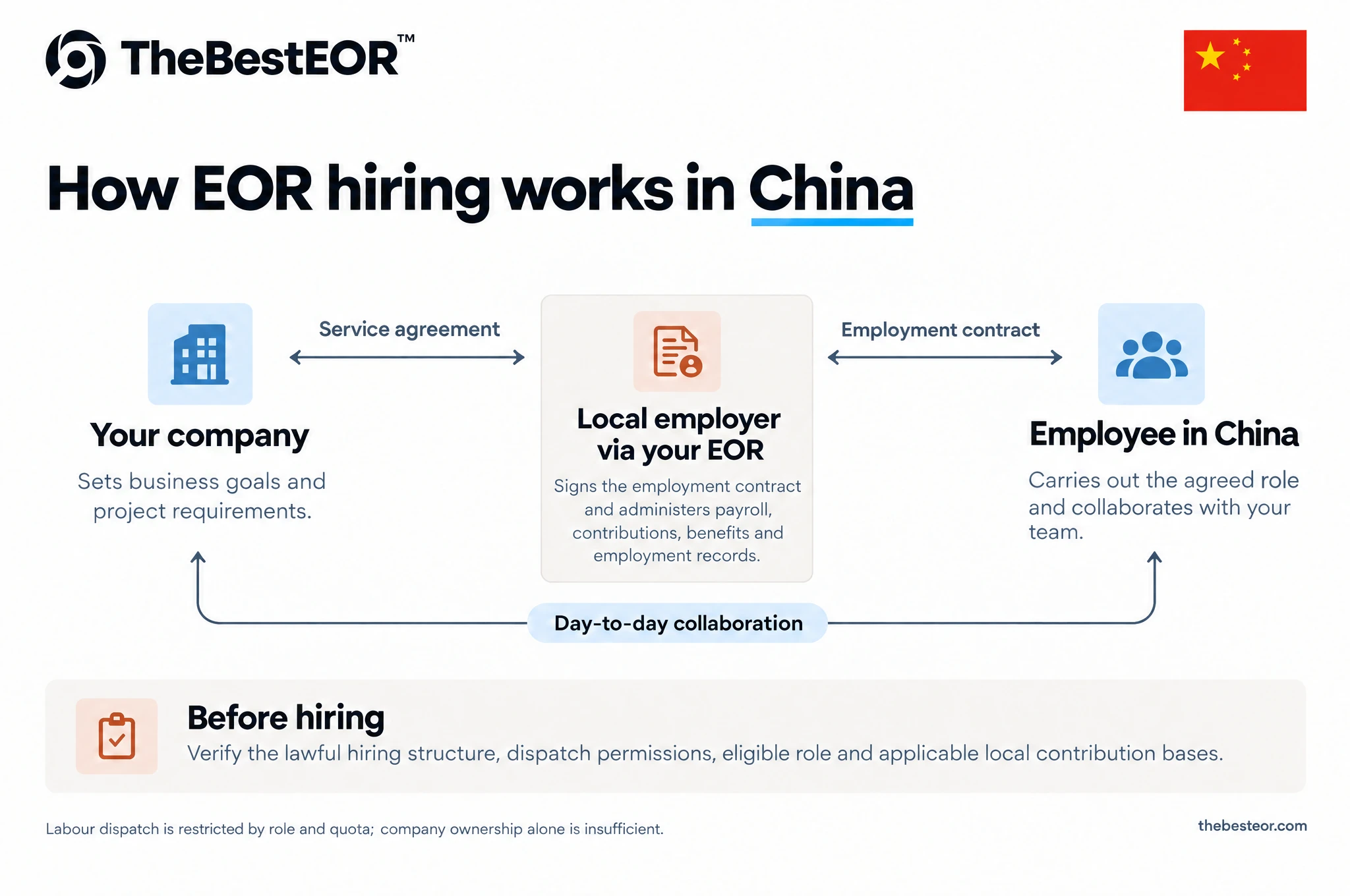
Division of responsibility

What the EOR handles, and what stays with you

Spell out the client’s duties under the hiring arrangement.

Use both the service agreement and the employment agreement to record who does what. The client can still have duties under the employment or dispatch arrangement.

Employer of record in China diagram showing the service agreement, employment contract, and day-to-day collaboration between your company and the employee.
Employer of record in China: how your company, the local employer and the employee work together. Select the image to enlarge.

The EOR handles

1
Being the legal employer in China: its entity on the contract, its name on the liability
2
Five-insurance and housing-fund registration and monthly remittance
3
Monthly cumulative IIT withholding and tax-bureau filing
4
The written Chinese-language labour contract, signed within one month
5
Statutory leave administration and the payslip
6
Z-visa and work-permit sponsorship, where its entity has standing
7
Tracking each city’s annual contribution-base reset
8
Compliant offboarding, the documented ground and economic compensation

You keep

1
What the hire actually works on each day, and to what standard
2
The pay package: base in renminbi, any Spring Festival bonus, any allowances
3
Which candidate gets the offer, and when a role is wound up
4
Performance records; without a statutory ground on file, a China dismissal is 2N territory
5
Hardware, software seats and who ships the laptop (a few EORs will do it for you)
6
Your business relationship itself, and the IP-assignment wording you specify for the Chinese-language contract

Review how the worker is managed and whether the arrangement is employment, labour dispatch or a genuine independent service. Moving a contractor onto payroll also does not erase liabilities from an earlier arrangement. The misclassification guide explains why the facts of the working relationship matter.

Work permits

Z visas and work-permit eligibility

The salary test depends on the work-permit route.

China has several routes into work-permit Categories A and B. The six-times and four-times local average wage tests are salary-based routes; they are not universal salary floors for everyone in those categories. Confirm the relevant route and current local evidence requirements before making an offer.

Category Salary-based route Other possible routes What to verify
Category
Category A
Salary-based route
At least 6× the relevant previous-year local average wage
Other possible routes
Qualifying talent programmes, recognised achievements, eligible roles or 85+ points
What to verify
The candidate’s qualifying route and supporting evidence
Category
Category B
Salary-based route
At least 4× the relevant previous-year local average wage
Other possible routes
Qualifying degree and experience, skills or professional routes, or 60+ points
What to verify
The role, qualifications and requirements of the local authority
Category
Category C
Salary-based route
No single salary rule stated here
Other possible routes
Specific permitted categories and any applicable quota
What to verify
Eligibility under the relevant programme before relying on this route

Fig. 7 · Work-permit categories and selected routes · Salary tests are alternatives within the classification system, not universal category floors.

For a typical overseas applicant taking a long-term role, the employer first applies for the Notification Letter of Foreigner’s Work Permit. The worker then applies for the appropriate entry visa and, after arrival, completes the work-permit and work-type residence-permit steps. Beijing’s published guidance calls for the work permit within 15 days and the residence permit within 30 days after entry. Confirm the applicable process for the candidate, including any route that allows an application from within China.

Ask the provider to identify the actual sponsoring entity and confirm the role, work location and candidate’s eligibility with the responsible authority. Obtain the required documents and a case-specific timetable before committing to a start date.

Salary benchmarks

Indicative salary ranges

Compare 2026 pay in Beijing, Shanghai and Shenzhen.

Monthly gross in renminbi with a USD equivalent at roughly RMB 7.2 to the dollar. Ranges reflect tier-1 cities (Beijing, Shanghai, Shenzhen) using 2026 market data from MS Advisory, Levels.fyi and SalaryExpert; lower-tier cities run materially below these. Verify current pay for the specific role, city and seniority before setting an offer.

Check current pay data for the role and location before you make an offer.

Role Gross RMB/month USD/month (approx)
Role
Software engineer
Gross RMB/month
RMB 25,000–45,000
USD/month (approx)
$3,470–6,250
Role
Senior software engineer
Gross RMB/month
RMB 40,000–70,000
USD/month (approx)
$5,560–9,720
Role
Product manager
Gross RMB/month
RMB 30,000–65,000
USD/month (approx)
$4,170–9,030
Role
Accountant
Gross RMB/month
RMB 12,000–25,000
USD/month (approx)
$1,670–3,470
Role
Customer support
Gross RMB/month
RMB 8,000–16,000
USD/month (approx)
$1,110–2,220
Role
Sales manager
Gross RMB/month
RMB 20,000–45,000
USD/month (approx)
$2,780–6,250
Role
HR manager
Gross RMB/month
RMB 20,000–40,000
USD/month (approx)
$2,780–5,560
Role
Designer (UX/UI)
Gross RMB/month
RMB 16,000–34,000
USD/month (approx)
$2,220–4,720

Fig. 8 · Role salary benchmarks, tier-1 cities, 2026 · MS Advisory, Levels.fyi and SalaryExpert data; lower-tier cities run materially below

Second-tier cities such as Chengdu, Hangzhou or Wuhan run materially below these tier-1 figures for the same role. For scale, the National Bureau of Statistics puts the 2025 average urban non-private unit wage at 129,441 yuan a year, about RMB 10,800 a month. Salaries above also exclude the customary Spring Festival 13th-month payment.

Fully-loaded cost

What a Chinese engineer costs per month

Start with RMB 32,000 a month in Shanghai.

For a different salary, estimate employer payroll costs in China.

Software engineer, Shanghai Gross base: RMB 32,000/month
Gross salary RMB 32,000

Pension employer (16%)

Applied to gross under the Shanghai cap
RMB 5,120

Medical (9%)

Shanghai, including maternity; 1 March 2026–28 February 2027
RMB 2,880
Unemployment (0.5%) RMB 160

Work-injury (~0.4%)

Industry-risk rate, indicative
RMB 128

Housing fund (7%)

7% selected for this illustration; Beijing allows 5–12%
RMB 2,240

EOR fee illustration

RemoFirst $199 ≈ RMB 1,433
⚠ Trustpilot warning: rating suspended for a breach of its guidelines; fake reviews removed
RMB 1,433

Monthly total, illustrative $199 fee

Annual ≈ RMB 527,532 (about USD 73,268 at the assumed RMB 7.2/USD)
RMB 43,961

Fig. 9 · Fully-loaded monthly cost, software engineer in Shanghai · the statutory load moves total cost more than the fee does

Statutory employer cost is RMB 10,528, about 32.9 percent on top of gross in Shanghai at these illustrative rates; selecting a 12 percent housing-fund rate instead of 7 percent on the same uncapped RMB 32,000 base adds RMB 1,600 a month for that contribution alone. Beijing permits 5–12 percent, so this is a rate comparison, not an automatic Beijing surcharge. At the illustration’s exchange rate, these hypothetical USD monthly service fees change the modelled total: an illustrative USD 499 fee (≈ RMB 3,593) lands near RMB 46,121/month, and a USD 699 service fee (≈ RMB 5,033) lands near RMB 47,561/month. Unlike most markets, in China the statutory load moves total cost more than the fee does, which is why the city and the contribution base matter as much as the provider you pick.

This is an illustrative budget, using a 7% housing-fund rate, 0.4% work-injury rate, 0.5% unemployment assumption, rounded EOR fees and assumed exchange rate of RMB 7.2 per USD. Confirm the applicable payroll-period rates and the written China fee. The cited 0.5% unemployment provision expressly covers 2025; its current application needs confirmation.

EOR vs your own entity

EOR or your own WFOE: compare costs

Factor EOR Your own WFOE
Factor
Setup cost
EOR
None
Your own WFOE
Incorporation costs plus registered capital
Factor
Time to first hire
EOR
5–10 days (local); weeks for a Z visa
Your own WFOE
Months: registration, licences, then a bank account
Factor
Per-employee cost
EOR
$199–699/employee/mo fee + statutory
Your own WFOE
Statutory only, plus shared overhead
Factor
Ongoing admin
EOR
Provider runs payroll, insurances & tax
Your own WFOE
Local accountant, annual audit, tax filings, fapiao
Factor
Compliance liability
EOR
Allocated by law and the actual employment or dispatch arrangement
Your own WFOE
On you and the legal representative
Factor
Wind-down
EOR
Meet the requirements for ending both agreements
Your own WFOE
Formal deregistration, not a quick exit

At an illustrative USD 199 monthly service fee, the service-fee component is about RMB 17,200 a year per employee before other EOR charges or entity administration costs. MS Advisory, a China corporate-services consultancy, quotes service or trading WFOE setup at USD 8,500 to 14,000 with 8 to 12 weeks to a working bank account, and puts annual compliance at USD 22,000 to 35,000 for a 10-person entity. A WFOE, once live, carries a local accountant, a mandatory annual audit, monthly tax filings and the fapiao invoicing system regardless of headcount, plus personal liability on the legal representative. The cost comparison depends on the complete EOR proposal, the WFOE’s setup and recurring charges, headcount and the hiring period.

The point at which your own entity becomes cheaper depends on its setup and ongoing costs. Use the EOR versus entity guide to compare those costs with your written EOR quote. A common path is to hire the first few through an EOR, prove the market, then stand up a WFOE and transfer staff once the team passes the break-even.

Agree the staff transfer before closing the EOR arrangement

A move to your own WFOE needs an employment handover as well as a new payroll account. Article 10 of the Labour Contract Law Implementation Regulations combines service where an employee is placed with a new employer for reasons not attributable to the employee. If the former employer has already paid economic compensation, that compensated service is excluded when the new employer later calculates economic compensation. Whether a particular EOR-to-WFOE move falls within this rule depends on how the transfer is arranged.

Before setting the date, record the original start date, recognised prior service, outstanding pay and leave, any compensation paid, and the new employment terms. Keep the EOR’s commercial deposit settlement separate from the employee’s employment settlement.

On termination, Article 50 requires the employer to issue the employment-ending certificate and complete personnel-file and social-insurance transfer procedures within 15 days. The employee must complete the agreed work handover. Identify who owns each step so a change of provider or entity does not leave payroll records and contribution accounts unresolved.

FAQ

EOR in China: common questions

What is the best EOR in China?

RemotePeople is our top pick for China in 2026 (4.9/5), followed by G-P (4.2/5) and Deel (4.7/5). We opened paid accounts with all 10 providers on this page, priced real hires and ran payroll.

RemotePeople employs staff in China through its own entity in Shanghai, where it has its regional headquarters. RemotePeople’s EOR Global plan starts at USD 499 per employee per month, and EOR Select at USD 199 where the hire qualifies. G-P starts at USD 599 per employee per month; Deel starts at USD 599 plus a mandatory Employer Liability Cost.

How does an employer of record work in China?

An employer of record in China becomes the worker’s legal employer through a local employing entity, while your company directs the day-to-day work. The EOR signs the written Chinese-language labour contract within one month of the start, registers and pays the five social insurances and the housing fund each month, and withholds individual income tax on the cumulative monthly method. It can sponsor a Z visa and work permit only where its entity has standing.

How fast can an EOR onboard an employee in China?

Ask for a timetable for the specific hire, with the start date conditional on signed documents, required registrations and any work permission. A foreign hire requires a separate immigration assessment, and payroll onboarding should not be treated as permission to start work.

How much does an EOR cost in China per month?

Published service fees for China run from USD 199 to USD 699 per employee per month across the 10 providers we tested: RemoFirst from USD 199; RemotePeople Global from USD 499, or Select from USD 199 only where country and salary qualify; Deel from USD 599 plus mandatory Employer Liability Cost; G-P from USD 599; Oyster USD 699 on monthly billing, with annual seats quoted separately. Multiplier Core advertises $499 monthly or $459 per month billed annually; Pebl advertises $399, with currency and commitment to confirm. Rippling starts at USD 499 plus its required platform from USD 8 per employee, and Papaya Global at USD 499. Borderless AI is USD 579 standard, with an eligible USD 399 promotion on fees billed through 31 December 2026. All amounts are per employee/month; salary and employment costs are separate. 

On top of the fee you pay the employee’s gross salary plus employer social insurance and the housing provident fund, which combined run roughly 27 to 40 percent of gross depending on the city: the Shanghai illustration on this page uses 7 percent housing fund, while Beijing permits an employer-selected standard rate of 5–12 percent. Calculate the actual contributions using the applicable bases, caps and rates.

What employer contributions are mandatory in China?

Five social insurances plus the housing provident fund. The employer pays pension at 16 percent, Shanghai medical at 9 percent including maternity from 1 March 2026 to 28 February 2027, unemployment at 0.5 percent, Shanghai work-injury baseline rates at 0.2 to 1.9 percent by industry category, with the actual assessed rate potentially different, maternity insurance (folded into medical in most cities), and the housing fund at 5 to 12 percent (Beijing allows 5–12 percent; the Shanghai example on this page selects 7 percent).

Contribution bases and caps must be checked separately for the city and payroll period. Beijing’s housing-fund base cap is RMB 36,348 for July 2026–June 2027. The combined cost depends on those bases and the selected fund rate; 27–40 percent is an indicative range, not a fixed city rate.

Can an EOR sponsor a Z visa and work permit in China?

It depends on the actual sponsoring entity, the role and the candidate. Ask the provider to confirm eligibility and the relevant application route with the local authority before agreeing a start date. Categories A and B have several qualifying routes: six-times and four-times local average wage tests are salary-based alternatives, not universal floors for all applicants.

What is the minimum wage in China in 2026?

As of 1 January 2026 Shanghai leads at RMB 2,740 per month, with Jiangsu and Zhejiang at RMB 2,660, Beijing at RMB 2,540, and Shenzhen at RMB 2,520. An EOR applies the correct city floor to the work location, which matters because a hire in Shanghai and one in a lower-tier city sit under different minimums.

How much severance applies when terminating in China?

Economic compensation is one month of average pay per year of service, with a remaining period of at least six months but less than one year counting as one year, and a shorter period attracting half a month’s pay (the N formula).

For a termination that meets the requirements of Article 40, the employer gives 30 days’ written notice or pays an additional month’s wage; the latter is often described as N+1 when economic compensation also applies.

Both the monthly salary used and the years counted are capped where pay exceeds three times the local average wage: the cap is three times that average and a maximum of 12 years. A three-year employee on RMB 30,000 receives about RMB 90,000 on the N formula, or RMB 120,000 as N+1.

What currency and payroll cycle does China use?

The Chinese yuan renminbi (CNY, RMB). Payroll runs monthly and individual income tax is withheld each month by the employer on a cumulative year-to-date basis through the tax bureau, then social insurance and the housing fund are remitted to the local bureaus monthly. About RMB 7.2 equals one US dollar in 2026. The Spring Festival 13th-month payment is customary across much of the private sector but is not mandated by national law.

Can I convert a Chinese contractor to an EOR employee?

A worker may move onto a local employment contract where the proposed arrangement is legal and compliant. Review the earlier working relationship separately: conversion does not erase any existing employment, tax or contribution liabilities. Confirm the employing entity, employment structure, accrued rights and registrations before the transition.

Do I need a WFOE to hire one person in China?

Confirm the employing entity, the actual working arrangement and any dispatch licence, role restriction or applicable exception. Compare the provider’s full quote with the costs and responsibilities of your own entity before deciding.

Is the housing provident fund mandatory for every China hire?

For Chinese national employees, yes: the housing provident fund is mandatory and both sides contribute the same percentage, subject to the applicable city rules (Beijing allows 5–12 percent; 7 percent is the selected rate in this page’s Shanghai example). Foreign employees are generally not required to join the housing fund, though some cities permit it voluntarily. Social insurance for foreigners is mandatory in most major cities, with a handful of bilateral totalisation exemptions, so the EOR applies the rules for the specific city and nationality.

Sources and as-of dates

Article references

The work-permit classification, Beijing housing-fund, unused annual-leave payment and labour-dispatch sources below were checked on 23 September 2026. Confirm city-specific rates and bases for the actual payroll period.

Hiring facts Checked 2 Oct 2026

Hiring facts

Checked 2 October 2026
Eligibility, local and collective rules apply. EOR fees extra.

PRC Labour Law and Labour Contract Law 4 sources

The standard working week is 40 hours. Labour Law Article 44 sets minimum overtime rates of 150% for extended hours, 200% for rest-day work where compensatory rest is unavailable, and 300% for statutory-holiday work. Labour Contract Law Articles 10 and 14 cover a written contract within one month and qualifying open-ended contracts after ten continuous years with the same employer or renewal following two consecutive fixed terms, subject to the statutory conditions.

Economic compensation 3 sources

Where economic compensation is due, Article 47 generally provides one month’s wage per completed service year (N), with statutory rounding for partial years. The additional month in lieu of 30 days’ notice applies to Article 40 terminations. Articles 48 and 87 provide reinstatement or, where applicable, compensation at twice the Article 47 amount for unlawful termination. The three-times-local-average wage basis and 12-year limit apply to employees whose monthly wage exceeds that threshold; they are not a universal cap.

Social insurance 5 sources

Social-insurance rates and contribution bases must be checked for the employment city and period. Shanghai’s published employer schedule lists pension at 16%. Its employer medical rate, including maternity cover, is 9% from March 2026 through February 2027. Shanghai’s 2026 work-injury baseline is 0.2–1.9% by industry, subject to floating rates. The cited 0.5% employer unemployment provision expressly covers 2025; confirm its current application. Shanghai’s monthly social-insurance base ceiling is RMB 37,731 from July 2026. These figures are a Shanghai example, not a national rate card.

Beijing housing provident fund 3 sources

standard employer-selected rate of 5–12%; monthly base cap RMB 36,348 for July 2026–June 2027. Beijing 2026 contribution notice, checked 23 September 2026. The Shanghai cost illustration selects 7%; confirm the applicable local rate and base.

Annual leave 3 sources

5, 10 or 15 days depending on cumulative working years. Where unused-leave compensation is payable, the statutory 300% includes ordinary wages already paid; the additional amount is normally 200%. Suzhou HRSS guidance on Implementing Measures, Articles 10–12, checked 23 September 2026.

Public holidays 2 sources

National statutory holidays for all citizens increased from 11 to 13 days from 2025, adding one Spring Festival day and one Labour Day day. Article 2 of the amended National Holidays and Commemorative Days Measures lists the statutory days; annual holiday schedules can include separate weekend adjustments.

Maternity / paternity 3 sources

The national maternity entitlement is 98 days, with additional leave for difficult or multiple births. Local extensions and paternity leave depend on the jurisdiction and eligibility rules. For qualifying births, Beijing adds 60 days of maternity leave and provides 15 days of paternity leave; Shanghai adds 60 days and provides 10 days of paternity leave. Check the applicable provincial or municipal rules rather than treating a national range as an entitlement.

Individual income tax (IIT) 3 sources

For resident individuals, comprehensive income is subject to seven progressive brackets from 3% to 45%, after the RMB 60,000 annual standard deduction and other permitted deductions. Employers generally use cumulative monthly withholding for resident employees’ wages and salaries. Non-residents and other income categories follow different calculation rules. IIT Law, Articles 1–3 and 6; State Taxation Administration withholding guidance.

Work permits 4 sources

salary-based routes are alternatives within the classifications. See Beijing’s Category A criteria and Category B criteria, checked 23 September 2026. Confirm the candidate’s route and current local requirements.

Minimum wage 5 sources

Monthly minimum wages are set locally. As of 1 January 2026: Shanghai RMB 2,740; Beijing RMB 2,540; Shenzhen RMB 2,520; and RMB 2,660 in the highest-rate areas of Jiangsu and Zhejiang. Jiangsu and Zhejiang also have RMB 2,430 and RMB 2,180 tiers, so confirm the city or county. These monthly figures apply to full-time employment; hourly standards and excluded pay components are separate.

Labour dispatch 4 sources

Articles 3–4 set general role and workforce limits; Article 25 gives specific exceptions; Article 27 covers arrangements labelled contracting or outsourcing that operate as dispatch. Interim Provisions on Labour Dispatch, checked 23 September 2026.

Salary benchmarks 2 sources

Indicative salary references include MS Advisory’s 2026 China guide and Levels.fyi’s China software-engineer data. They use different methods and compensation definitions: Levels.fyi reports total compensation, which can include stock and bonuses. Treat the salary ranges as budgeting estimates and the RMB 7.2 = USD 1 conversion as an approximation.

Provider pricing, entity model and onboarding 10 sources

Provider and legal sources Checked 19 Oct 2026

RemotePeople China entity and operating details — Own Chinese company, unified social credit code 91310000MA1GC8625Q; Shanghai headquarters and registered branches in Shenzhen, Chengdu, Beijing and Guangzhou; China service established in 2018. Updated 20 October 2026.

RemotePeople (formerly Horizons)-China Outsourcing Institute partnership (company announcement) — Company executive announcement concerning Horizons and the China Outsourcing Institute. Updated 20 October 2026.

Shanghai HRSS — pension contribution wage base, published 24 August 2026 — From July 2026: monthly social-insurance base ceiling RMB 37,731 and floor RMB 7,546; previous-year average basis and first-full-month rules for new hires. The capped-pension calculation is the illustration’s arithmetic, not an authority-provided example. Checked 19 October 2026.

Shanghai HRSS — social-insurance contribution rates — Official published employer pension rate of 16%, unemployment rate of 0.5%, and industry-category work-injury baseline rates of 0.2%–1.9%. Published 20 January 2025. The current medical rate is established by the 2026 Shanghai tax-authority notice below. Checked 19 October 2026.

Shanghai tax authority — 2026 employer medical-insurance rate notice — Employer medical contribution 9%, including maternity and the local medical addition; effective 1 March 2026 through 28 February 2027. The 10% rate on this notice concerns flexible workers, not the employer contribution for employees. Checked 19 October 2026.

PRC Labour Contract Law — official consolidated text — Articles 14, 19, 21, 36, 37, 40, 46, 47 and 50: conditional open-ended contracts; probation restrictions; employee resignation; mutual termination; specified employer grounds and notice; compensation; service rounding; termination documents and transfer procedures. Checked 19 October 2026.

Supreme People’s Court — Labour Disputes Interpretation II, effective 1 September 2025 — Article 10 specifies circumstances treated as two consecutive fixed-term contracts, including certain extensions and changes of signing entity; Article 11 addresses continued work after expiry. The renewal example above applies Article 10. Checked 19 October 2026.

MOHRSS Interim Provisions on Labour Dispatch — official Shanghai HRSS publication — Articles 3–4 define temporary, auxiliary and substitute positions, the auxiliary-role procedure and the 10% quota denominator. Articles 25 and 27 address specified exceptions and outsourcing operated as dispatch. Checked 19 October 2026.

State Council — Labour Contract Law Implementation Regulations — Article 10: qualifying employer changes, service continuity and prior economic compensation. Article 20: Article 40 pay in lieu uses the preceding month’s wage. Article 24: required contents of an employment-ending certificate. Checked 19 October 2026.

Shanghai government — work-permit points are one qualification pathway — August 2026 guidance describes points as one route to Category A or B and explains supporting evidence. A candidate must meet the requirements of the applicable route; a points assessment does not guarantee eligibility. Checked 19 October 2026.

State Council — Regulations on Paid Annual Leave for Employees — Articles 2–4: qualifying continuous work, cumulative-service bands of at least one but under ten years, at least ten but under twenty, and twenty or more; statutory exceptions. Checked 19 October 2026.

State Council — amended Regulations on Working Hours of Employees — The 1995 amendment and consolidated Article 3 set the standard eight-hour day and forty-hour week. The page also links application of overtime remuneration to Labour Law Article 44. Checked 19 October 2026.

G-P — China employer-of-record service — Provider describes China employment-contract, payroll, benefits and termination administration; local/regional variation; work-permit service depends on employer status and requirements. Checked 19 October 2026.

G-P — EOR features and add-ons — HCM/API integration, reporting, HR support; visa support, background checks, equity payroll and office/IT add-ons; platform-fee scope versus employment cost. Checked 19 October 2026.

G-P — published pricing — EOR starts at USD 599 per employee/month, volume discounts and proposal route; published international coverage is a provider claim. Checked 19 October 2026.

Deel — hiring through an EOR in China — Provider-stated 14 wholly owned entities/provinces, bilingual contracts, payroll and statutory administration, and as-little-as-four-day onboarding. Checked 19 October 2026.

Deel — current product pricing and terms — USD 599 per EOR employee/month; USD 49 per contractor/month; separate products; month-to-month service pricing; cancellation remains subject to local notice/severance obligations. Checked 19 October 2026.

Deel Help — Employer Liability Cost — ELC is mandatory for all EOR clients/countries, appears as a separate invoice item and is calculated per employee based on gross salary for the billing cycle. Checked 19 October 2026.

Deel developer documentation — create an EOR contract — API flow for country-specific contract forms, optional job-scope validation, available benefits and contract creation. Checked 19 October 2026.

Rippling — EOR product capabilities — Built-in HRIS, permissions, custom workflows, native time/expense/learning options and reporting across domestic/international workers. Checked 19 October 2026.

Rippling — pricing — EOR from USD 499 per employee per month; the required platform from USD 8 per employee per month plus a monthly base fee; other products are priced per employee. Exact China module inclusion is a quote question. Checked 19 October 2026.

Rippling — China EOR hiring guide — Published China hiring service context and explanation of employment administration. Guide is dated January 2025. Checked 19 October 2026.

Rippling — published EOR starting price in its product comparison — Rippling states its own EOR starting price is USD 499 per employee/month. Checked 19 October 2026.

Oyster — current pricing and funding terms — USD 699 per employee/month, annual discounts, add-on benefits, refundable EOR deposit, FX fee when payment and contract currency differ, public calculator and proposal/demo routes. Checked 19 October 2026.

Oyster Help — annual EOR seats — Annual seats can be reused; plan is non-refundable; standard annual payment upfront with net-30 invoice, with quarterly/semi-annual options at higher per-seat rates; seat quotes depend on headcount/location. Checked 19 October 2026.

Oyster — local and global benefits — Global benefits in 165+ countries, Allianz reference, mental-health/vision/telehealth features, optional dental/maternity care and local packages. Benefits are add-ons; exact China eligibility and policy details must come from the offer. Checked 19 October 2026.

Oyster — Direct+ service infrastructure — Oyster describes a mix of owned entities and vetted partners and provides self-service tools. Checked 19 October 2026.

Multiplier: Employer of Record in China — Provider advertises China contracts, payroll, tax and benefits administration. Checked 19 October 2026.

Multiplier: Employer of Record services — Published global product features: expenses, timesheets, pay incentives, headcount, gross-to-net and cost-centre reporting. Checked 19 October 2026.

Multiplier: Pricing and plan comparison — Core starts at $459 per employee/month annually or $499 monthly; Growth at $519 annually or $559 monthly. Growth adds integrations, custom reports and API access. Country pricing can vary. The page also lists implementation fees as applicable. Checked 19 October 2026.

Multiplier: Product and pricing FAQ — EOR and own-entity payroll use the same platform; no minimum headcount stated. FAQ says no setup, onboarding or offboarding fees, which conflicts with the implementation-fee wording on the pricing page. Checked 19 October 2026.

Pebl: Employer of Record in China — China EOR offering, payroll and benefits administration. Checked 19 October 2026.

Pebl: EOR pricing — Published $399 per employee/month and platform scope: onboarding, payroll, changes, reporting, offboarding, benefits access and support. Actual fees and commitments are governed by the order form. Checked 19 October 2026.

Pebl: EOR product-specific terms, October 2026 — Sections 7.1 (China contractual eligibility) and 3.2.1 (security funding). Provider terms, not general Chinese legislation. Checked 19 October 2026.

Pebl: Global Immigration — Immigration assessments, visa services and permit management are offered globally. Checked 19 October 2026.

Papaya Global: China PEO/EOR service — China service offering and workforce-spending BI reports. Checked 19 October 2026.

Papaya Global: Employer of Record product — Global workforce-cost visibility; HRIS/ERP integrations and API; journal-entry mapping; termination protections expressly subject to terms. Checked 19 October 2026.

Papaya Global: Pricing — EOR starts at $499 per employee/month; payroll is a separately priced service. The global price page gives no China-specific total price, minimum commitment or employing entity. Checked 19 October 2026.

Papaya Global: Updated delivery-model explanation — The article, updated 16 August 2026, describes a mix of direct operations and partners. It does not identify the China employer. Checked 19 October 2026.

RemoFirst: China hiring guide — Provider's published C-level/General Manager title restriction; China payroll invoicing currencies and consolidated salary funding. Checked 19 October 2026.

RemoFirst: Pricing — EOR starts at $199 per employee/month and may vary by country; no annual contracts or minimums stated. Partner delivery model and separately priced add-ons. Checked 19 October 2026.

RemoFirst: Employer of Record services — Dedicated account manager and global EOR support, payroll and HR administration. Checked 19 October 2026.

RemoFirst: International contractors — Free administration versus $25 per contractor/month payment-processing tier. Checked 19 October 2026.

Borderless AI: Platform and support — Dedicated Canada-based contact and around-the-clock support as provider claims; advertised HR/finance connections, illustrated with both Workday and ADP. Checked 19 October 2026.

Borderless AI: 2026 EOR pricing promotion — USD 399 per employee/month for eligible non-Canadian-headquartered customers on fees billed through 31 December 2026; USD 579 standard from 1 January 2027; country/employment exceptions. Month-to-month, salary and statutory costs extra. HRGPT is advertised with the service. Page links both ADP and Paychex marketplaces. Checked 19 October 2026.

Borderless AI: Global Mobility — Visa/work-permit service now exists. Country, citizenship, permit, cost and timing are case-specific and confirmed before commitment. Checked 19 October 2026.

Borderless AI: China hiring guide — Provider includes China in its country offering. The country page is old. Checked 19 October 2026.

Use the actual work city, contribution bases and housing-fund rate when comparing quotes. To expand your shortlist, browse EOR providers for China. Once you have proposals, enter the recurring amounts in USD in the EOR cost calculator. The country guides cover other hiring markets.

This guide is for general information only and does not provide legal, tax, accounting, or financial advice. For advice about your business, consult a qualified professional familiar with the rules where you hire. The research methodology explains how TheBestEOR assesses sources.