Reviewed by Michael EnnisMichael EnnisSenior Editor and Payroll Specialist · 20 years in payroll (Paychex, Namely, Vensure)·Fact-checked by Lucia AparicioLucia AparicioSenior Editor and HRIS Specialist · 10+ years in HRIS implementation
Updated 10 Nov 2026·~35 min read·Editorial details ⌄
Michael EnnisSenior Editor and Payroll Specialist
Reviewer
Lucia AparicioSenior Editor and HRIS Specialist
Fact-checker
Tested on a paid client account, fact-checked by a second editor and confirmed with the provider.
I’d look closely at Remote if you want employment through the provider’s own entities and connections to your existing HR systems. Its EOR service covers payroll, benefits and employment support, alongside separate contractor and payroll products. In this review, I examine onboarding, integrations, benefits and contract terms with the work of HR and finance in mind. That includes monthly versus annual pricing, possible reserve payments and the costs outside the advertised EOR fee.
Remote offers employment through its own entities and connections to existing HR systems. I’d compare the country proposal, billing commitment and any reserve alongside the starting service fee.
Worth considering if
I’d shortlist Remote when the named employer and the connection to your existing HR system matter to the decision.
My take
EOR fee from
$599
per employee/month
The $599 starting fee requires an annual contract. Confirm the country rate and payment schedule in your quote; annual commitment does not necessarily mean annual prepayment.
Countries
90+
Remote advertises EOR hiring in 90+ countries through its own entities. Confirm the local employer and eligibility for your hire in the country proposal.
Founded
2019
Employer / delivery model
Owned
Remote’s employer-of-record page describes an entirely owned entity network without third-party employers. That makes the legal employer easier to identify than with a partner network.
Service fee only. Salary, employer contributions, benefits, currency conversion and additional services affect the invoice; any reserve is separate funding.
Check before signing: Obtain the amount and release conditions before committing funds.
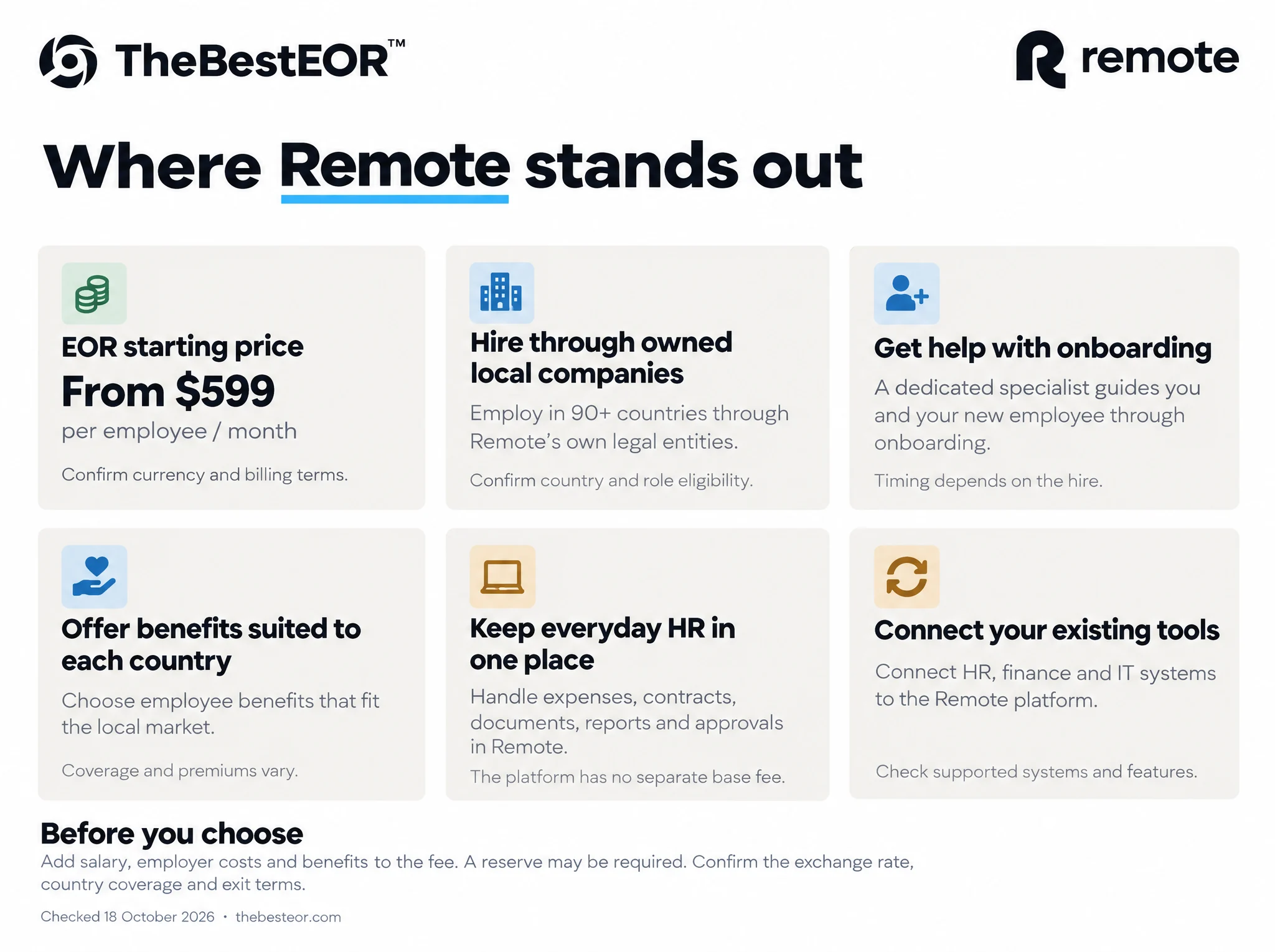
Where Remote stands out
EOR starting price
From $599
per employee/month
The $599 starting fee requires an annual contract. Confirm the country rate and payment schedule in your quote; annual commitment does not necessarily mean annual prepayment.
Owned-entity employment
Remote advertises EOR hiring in 90+ countries through its own entities. Confirm the local employer and eligibility for your hire in the country proposal.
Specialist onboarding support
The EOR offer includes a dedicated onboarding specialist and in-house experts for ongoing support. Agree the hiring steps, required documents and start date for the actual employee.
Connect your HR system
Remote lists Workday, HiBob, BambooHR and Personio integrations at no extra Remote charge. Check which employee fields sync; the other software may need its own subscription.
Equity support costs extra
Remote Equity is listed at $39 per EOR employee/month for employees receiving equity, on top of the EOR fee. Confirm the award’s country eligibility and reporting scope.
Budget for an EOR reserve
Remote normally requires a refundable reserve of one month’s gross salary plus mandatory employer costs. A credit review can reduce or waive the standard amount.
Remote separates EOR employment from payroll for your own entities, contractor services and US PEO. Choose the employment arrangement first, then compare the benefits and additional services needed for that hire.
Compare benefits employees can use
Country packages
Tiers vary by country; the UK page lists four health plans and a workplace pension.
Check the monthly premium, healthcare network, dependent cover and coverage start date.
International health
Allianz plans in listed countries; cover usually starts on the start date.
Check the opt-out deadline and how employees submit claims and reimbursement requests.
Optional packages
In many countries, Remote’s benefit packages are optional for customers.
Make sure the benefits promised in the offer letter are covered by the policy.
Remote says it does not charge a premium on its benefit plans, but its Allianz plan guide lists a benefits service fee of $15 per enrolled employee per month, charged once however many benefits you offer. Employer-paid benefits that do not appear on the payslip, such as health insurance, are listed separately on the invoice breakdown. Obtain the actual schedule and price for each employee before describing the benefits package in an offer.
Coverage
Remote advertises employer-of-record hiring in 90+ countries. Its country explorer invites you to “browse 190+ locations” across all its products and tags the services available in each. On 30 September 2026, the list showed 186 locations, 92 of them tagged Employer of Record. Filter for the product you need rather than relying on a headline total. Remote reports contractor payouts in 190+ countries, while Contractor of Record is unavailable in 25 listed countries and territories and in any country where your company has its own entity.
Remote operates in 90+ countries, and they state that each foreign entity is owned and operated entirely by Remote itself.
Some examples of foreign entities include Remote Technology Services Ltd in the UK, Remote Technology GmbH in Germany, Remote Infosystem Private Limited in India and Remote Brasil Fornecimento de Serviços Ltda in Brazil.
Michael’s perspective from the payroll industry:
Being in the payroll and tax industry for almost 20 years, I know first hand the importance of protecting the data. This company will have access to names, addresses, social security numbers, etc. This info can be dangerous in the wrong hands. Entity ownership alone does not establish how securely that information is handled. Review the applicable data-processing terms, access controls and current security reports.
Confirm the named employer and the applicable data-processing arrangements.
Remote’s owned entities use different contract models by country. In Germany, the Local Terms say employees are onboarded under the “AUG model”, Germany’s employee-leasing rules, through a master service agreement with Remote Technology GmbH that prevails over the Terms of Service where they conflict. In India, the local entity assigns employees to the tasks you request, but they stay under its direction and supervision and may not work from your premises. The Local Terms also set out a consultancy model for Bulgaria and the Czech Republic. Ask for the employing entity, the contract model and the local escalation contact for each hire.
Checks before the employment agreement
Confirm the role, work location and right-to-work position before approving an offer. Remote runs a right-to-work check, and a medical check in some countries, before the employment agreement is issued. Keep the employer name and escalation owner with the signed documents.
Pricing
Prices by product
Employer of Record
From$599
Remote EOR starts at US$599 per employee per month on an annual contract. Remote’s standard monthly EOR fee is US$699 per employee, billed by active usage.
Salary, employer costs and benefits are billed separately.
US PEO
From$99
USD per employee/month
US PEO pricing covers a co-employment arrangement for your US workforce.
Remote requires a U.S. bank account. A PEO co-employment arrangement has different requirements from international EOR employment.
Global Payroll
From$29
USD per employee/month
For organizations that might already have legal entities in foreign countries, but need centralized payroll infrastructure.
Confirm country availability, minimums and the full scope in your quote.
Contractor Management
From$29
USD per contractor/month
For companies engaging independent contractors across multiple countries. The fee is charged only for contractors you actively work with.
Contractor Management Plus
From$99
USD per contractor/month
Conditional indemnity up to $100,000 per contractor and $1 million across the term, for covered third-party claims arising from Remote’s breach of its Service Warranty. Check exclusions.
Contractor of Record
From$325
USD per contractor/month
For companies that want to engage and pay independent contractors with compliance support and less administrative work. Remote engages and pays the contractor directly; confirm the service scope and exclusions.
EOR offer and billing terms
Remote advertises EOR from $599 per employee per month for annual contracts. Its Help Center separately lists USD 699 per employee per month, billed monthly by active usage. Confirm the current country rate, currency and invoice schedule before signing.
This is billed separately from the employees’ net pay, taxes and benefits costs that you will incur with each payroll run.
Remote’s current pricing FAQ says every plan includes the platform with no setup or onboarding fee. The EOR management-fee guide describes monthly billing for active employees and Order Forms that can include committed arrangements and discounts.
Additional services have their own charges. The service cards distinguish HR subscriptions, EOR add-ons and payroll extras; confirm which ones your team needs before agreeing the quote.
Some Remote services are billed per employee, others per entity or transaction. Where a price shows only a dollar sign, ask which currency applies to your contract.
HR software
Remote HRIS
From US$12
per employee/month
For HR administration of your own workforce; employment and payroll services are separate.
Perform
Availability and price to confirm
per worker/month
Current terms describe a performance-review subscription. Confirm availability to new customers, the plan and its rate.
Remote Survey
Custom quote
per worker/month
Survey subscription; confirm the plan’s participant limits and billing scope.
Benefits and mobility
Employee Benefits
Custom quote
by country and selected plan
Ask for premiums and any administration charges separately from the employment fee.
Remote Equity
US$39
per eligible employee/month
Mandatory for EOR employees with active equity grants; added to the EOR invoice.
Mobility & Relocation
Custom quote
per case
Country, immigration route and requested support affect the fee.
IT and infrastructure
Global Entity Setup
Custom quote
per project
Ask which registrations, third-party charges and ongoing services the proposal includes.
Device Management
Custom quote
device and service scope
Equipment is supplied through Fleet. Include rental, shipping, returns and optional MDM in the quote.
Remote Embedded
Custom quote
partner agreement
For platforms embedding employment services; agree implementation and ongoing commercial terms.
Payroll extras
Year-end Payroll Processing
Price not publicly confirmed
annual charge
Mandatory for Payroll customers; covers employees who received a payslip during the fiscal year.
Salary Payment Delivery
Custom quote
payment arrangement
Choose a bank upload file or Remote’s payment execution; confirm the charge.
Statutory Payments Handling
US$150
per month
Government-payment handling; confirm whether the charge applies per country or entity.
Off-cycle Payroll
US$29 + country fee
per employee, per off-cycle run
For payments outside the regular payroll schedule.
Custom Payroll Report
US$250
per file
No charge if Remote confirms that no technical setup is needed.
Advice and screening
Ask an Expert
Custom quote
monthly subscription
Agree the number and length of calls. Unused sessions expire each billing cycle.
Non-standard Legal & Termination Support
Custom quote
per engagement
Request the service cost and employee liabilities separately.
Background Checks
Custom quote
per check
Choose the checks needed for the role and country; availability varies.
Health Checks
Custom quote
per required check
Ask whether a check is required and what will appear on the invoice.
Recruitment
Recruit / Remote Jobs
Closes 30 November 2026
Existing customers can recruit through 30 November 2026. December is view-only, and access ends after 31 December. November usage can appear on the December invoice.
Free access
Freelancer Hub
Free
freelancer account
Client-side contractor fees and bank charges can still apply.
Costs to include in your budget
Recurring employment budget
Put salary, employer contributions, benefits and the quoted EOR service fee on separate lines.
Reserve
Normally one month of gross salary plus mandatory employer costs, subject to credit review and the employee’s terms.
Payment charges
Credit card payments carry a 3.5% fee and bank transfers a $5 fee; Remote adds no fee for Direct Debit.
Employee exit costs
Budget notice pay, severance and unused leave. A termination after the payroll cutoff adds the next month’s fee.
Example: annual fees for 10 employees
Service fees only
At the advertised $599 starting fee with an annual contract, service fees for ten employees would total $5,990 per month, or $71,880 over 12 months if the fee and headcount stay the same. Using the standard USD 699 monthly rate in its Help Center gives $6,990 per month or $83,880 per year. Both exclude salary, employer contributions, benefits, taxes, reserves and payment charges.
How Remote calculates and refunds its EOR reserve
Remote normally requires a refundable EOR reserve equal to one month of the employee’s gross salary plus mandatory employer costs. The calculation excludes Remote’s management fee. A credit review can reduce or waive the standard reserve. Where a reserve is required, Remote must receive it before it invites the employee to begin onboarding.
Moving from 14-day to 30-day invoice terms adds one month of reserve per employee. Extended notice, guaranteed severance, recognized seniority or a paid non-compete can require more funding even if the standard reserve has been waived. For example, recognizing two to five years of prior service can add one or two months. Remote’s terms of service also allow it to require a standby letter of credit or another guarantee.
When employment ends or onboarding is cancelled, Remote processes the refund within 60 days after you pay the final invoice, provided all outstanding invoices have been settled. Keep the reserve separate from the cash you advance for regular payroll.
Currency and payment charges
Employees are paid in the currency of their employment agreement, but you are billed in the currency of your choosing, one of 12 you choose at onboarding. These currencies include the US Dollar, Great Britain Pound, Euro and others. This method creates a small problem with foreign exchange rates, as these rates fluctuate from day to day. Remote solves for this by fixing the rate each month, based on risk, its own costs and industry benchmarks. The Terms of Service allow for a transaction fee or margin where foreign exchange applies.
Remote does not publish a markup or reference rate. Compare the rate on a sample invoice with the mid-market rate for the same day.
How Remote invoices payroll
Pre-funding
Issued on the first business day of the month, with estimated salaries, contributions, approved incentives, expenses and benefits.
Reconciliation
Around the third business day of the next month, with actual costs and Remote’s management fee.
Due date
Invoices are usually due within 14 days. Moving to 30-day terms requires an additional month of reserve per EOR employee.
Late payment
Interest of up to 0.1% a day. Remote describes escalating steps, from blocking new hires to offboarding employees, and its Terms let it suspend or end services.
Use the invoice CSV breakdown for reconciliation. Remote lists statutory contributions, employer-paid benefits such as health insurance and one-time services such as background checks, immigration or legal support as separate lines. Have finance match them to the offer before approving the first payroll.
Salary, employer costs and any reserve are billed separately.
Best For
I’d shortlist Remote when the named employer and the connection to your existing HR system matter to the decision.
Remote’s employer-of-record page describes an entirely owned entity network without third-party employers. That makes the legal employer easier to identify than with a partner network.
You want the provider to be the legal employer
Shortlist Remote and ask for the entity named in each employment agreement.
You run Workday, HiBob, BambooHR or Personio
Check the listed integration and which fields sync in a demonstration.
Cash is tight when you hire
Budget one month of gross salary plus mandatory employer costs for the standard reserve. A credit review can reduce or waive it. Ask whether Remote will accept a letter of credit.
You need a basic hire at the lowest service fee
Compare a lower-priced offer before committing to Remote.
Alternatives to compare
Remote is often compared with Oyster HR, Deel, G-P and Multiplier.
I’d use the same employee, country, salary and benefit requirements in each request. Ask each provider for the total cost, any deposit or reserve, and the legal employer. The fees below are advertised service-fee benchmarks; billing commitments, currency, eligibility and the country quote can differ.
Use the Remote alternatives guide to compare replacement options. For a direct choice, Remote vs G-P examines responsibility for employment changes, while Remote vs Oyster looks at commitments, cash requirements and benefits for a small team.
My firsthand experience is with U.S. payroll and PEO companies. I have limited experience with the providers in this table. Some companies I worked with needed timesheets three days before payday. Others accepted them the day before. I’d ask each bidder for its cutoff and which payroll will include a late timesheet.
OptionProviderBest ForEOR fee from
Option 1
★★★★★4.5
Oyster is best for using one onboarding process for hires across countries
USD 699
Per employee per month on monthly billing. Annual seats are priced by quote, prepaid and non-refundable, and unused seats can be reused.
Compare Oyster’s benefits options and prepaid annual-seat terms against Remote’s quoted offer.
Provider
Oyster HR
Published EOR fee
USD 699 per employee per month on monthly billing. Annual seats are priced by quote, prepaid and non-refundable, and unused seats can be reused.
Additional comparison detail
EOR service fee USD 699 per employee/month, month-to-month. Annual seats are reusable and non-refundable, with negotiated prices. Payment is upfront; quarterly or semi-annual payments cost more per seat.
Oyster dashboard
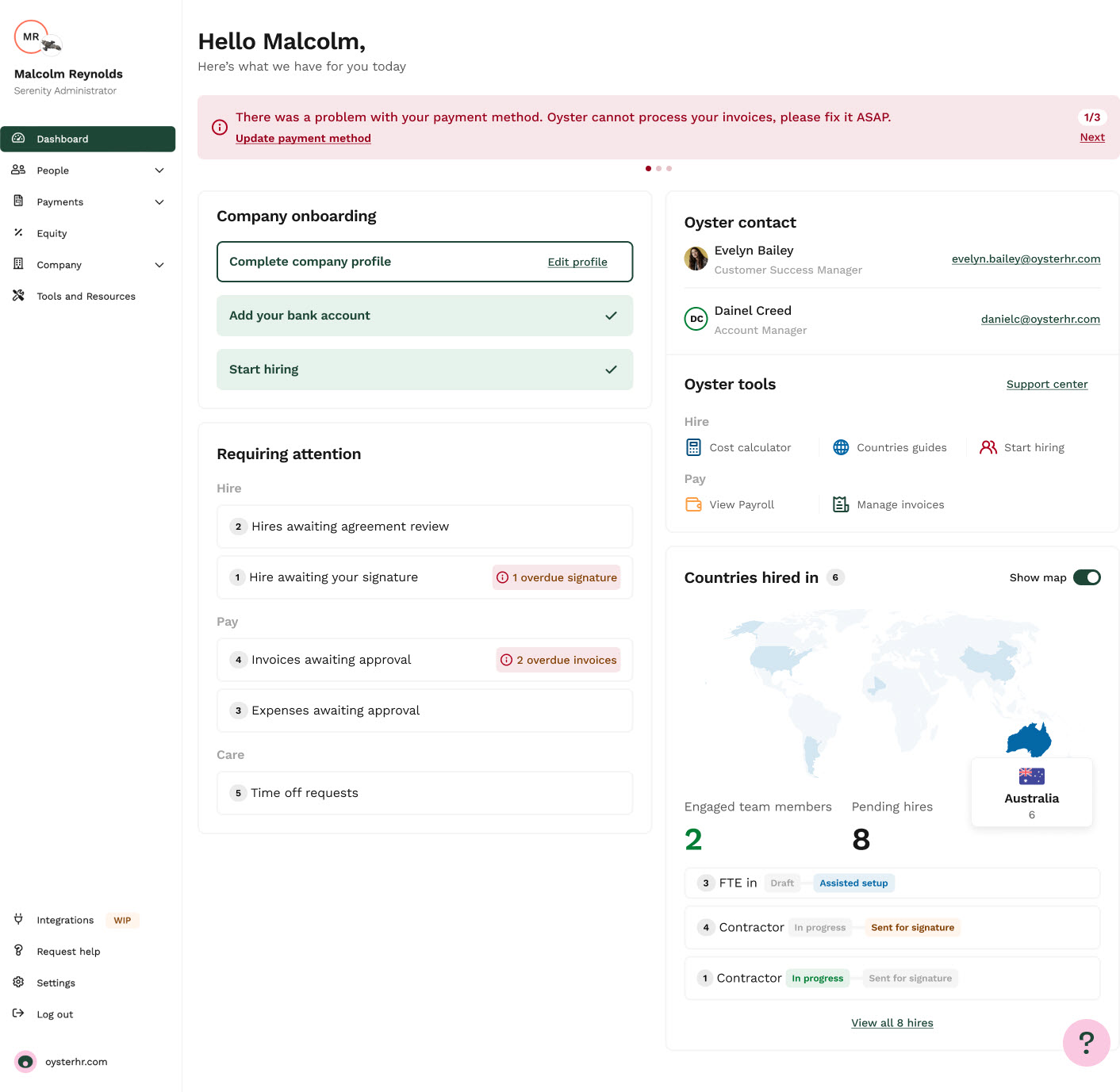
Oyster’s dashboard combines hiring, payment and time-off tasks with support contacts and a map of the team.
Multiplier is best for managing payroll, leave and expenses in one place
$499
Core: $499 per employee per month with monthly billing, or $459 billed annually. Currency unspecified; compliance add-ons cost extra and an implementation fee may apply.
A choice between the Core and Growth tiers; compare the currency and complete quote.
Provider
Multiplier
Published EOR fee
Core: $499 per employee/month with monthly billing, or $459 billed annually. Currency unspecified; compliance add-ons cost extra and an implementation fee may apply.
Additional comparison detail
EOR service fee Core: $499 per employee/month with monthly billing, or $459 billed annually. Currency unspecified; compliance add-ons cost extra and an implementation fee may apply.
Multiplier dashboard
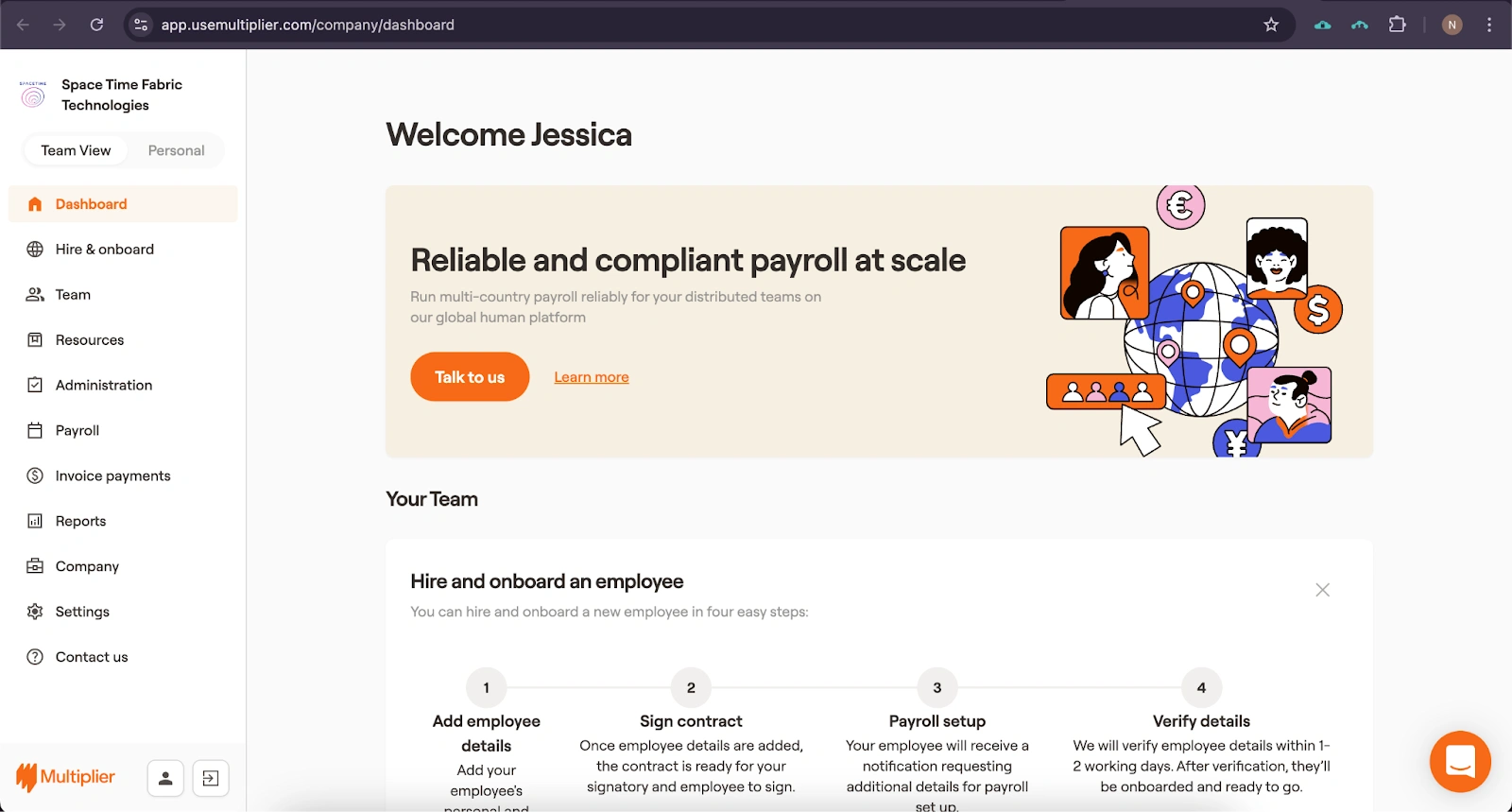
Multiplier’s dashboard shows an onboarding checklist, with hiring, payroll, invoices and reporting available from the side navigation.
Core: $499 per employee per month with monthly billing, or $459 billed annually. Currency unspecified; compliance add-ons cost extra and an implementation fee may apply.
Compare the country-specific quote, Select eligibility, recruitment scope and deposit terms.
Provider
RemotePeople
Published EOR fee
EOR Global from USD 499 per employee/month; Select from USD 199 only for eligible countries and salary ranges. Confirm commitment.
Additional comparison detail
EOR service fee EOR Global from USD 499 per employee/month; Select from USD 199 only for eligible countries and salary ranges. Billing commitment is set in the proposal.
RemotePeople dashboard
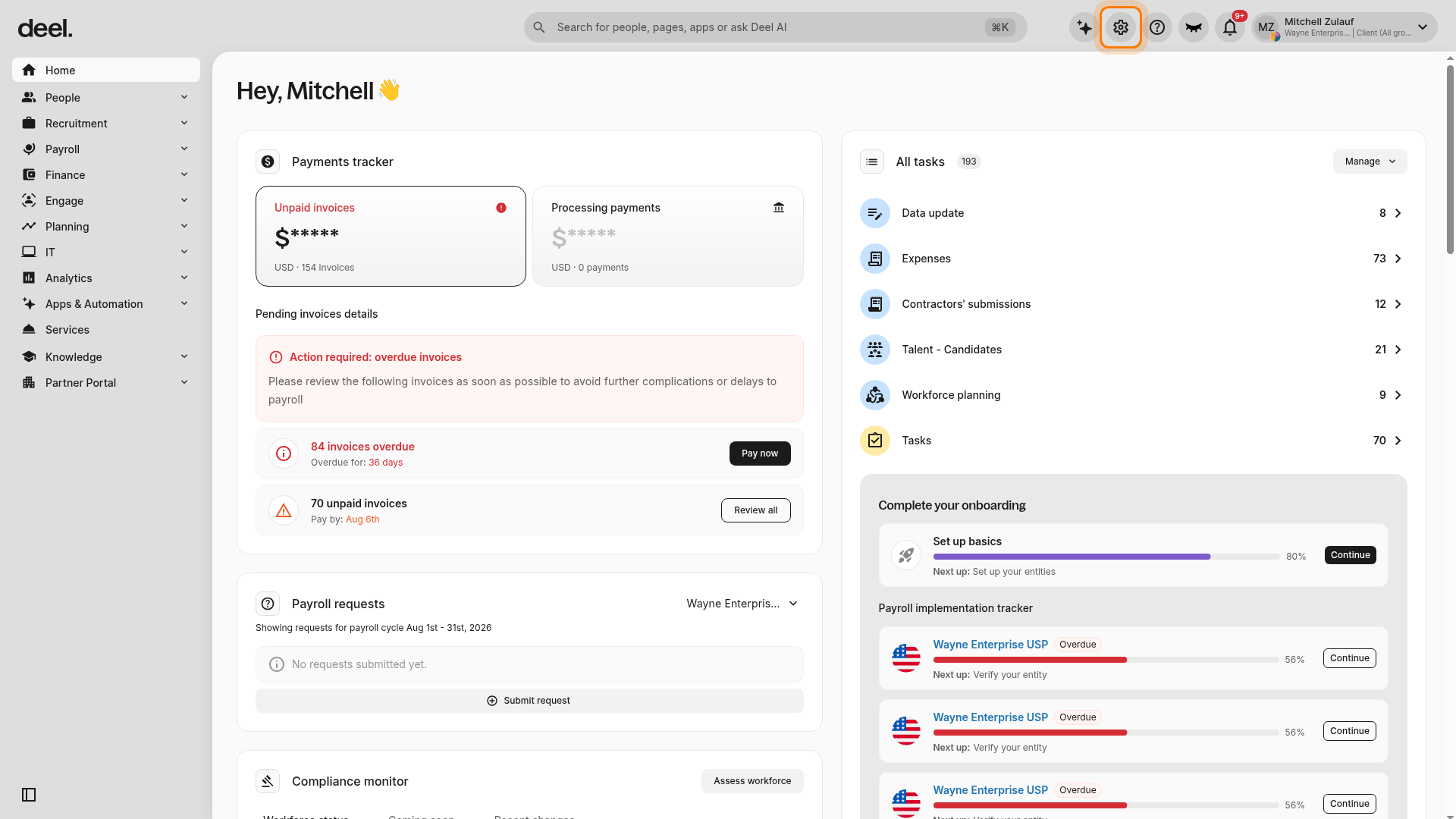
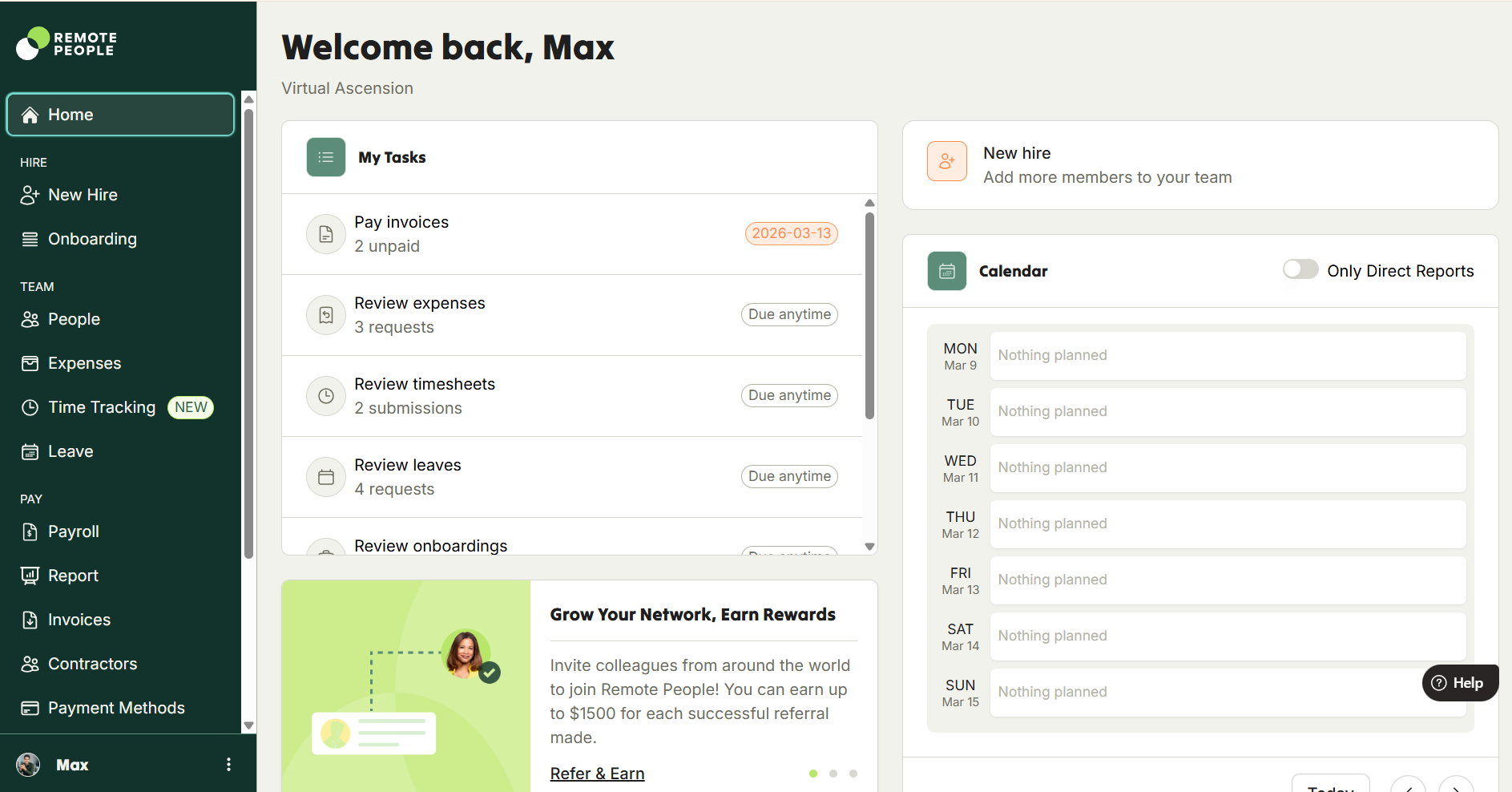
RemotePeople’s dashboard groups outstanding tasks, hiring shortcuts and a team calendar in one view.
The standard USD 699 monthly Remote scenario would add $12,000 in service fees for ten employees over 12 months: 10 × ($699 − $599) × 12. Use the signed quotes to establish whether that difference applies, and keep salary, benefits and employment costs constant.
Pros & Cons
Pros
Advertises EOR from $599 per employee per month with an annual contract, with the platform included and no setup or onboarding fee; confirm the quoted terms.
Says it owns and operates all its entities; its Local Terms name them by country.
Says its integrations, including Workday, HiBob, BambooHR and Personio, are free, as is building on its API.
Cons
A refundable reserve may still be required; confirm the triggers, amount and funding date for the actual hire.
Management fees are not prorated, and Remote does not accept redlines to its Terms of Service.
The $599 starting fee requires an annual contract; the Help Center separately lists $699 for monthly active-usage billing. Confirm the country quote.
Integrations
Remote’s published integrations cover several parts of an existing HR stack: BambooHR, HiBob, Personio and Workday for employee records; QuickBooks, Xero and NetSuite for finance; and Greenhouse for moving candidates into onboarding. Its directory also lists Slack and Zapier. Before choosing it, ask for a demonstration using the exact connection you need, including which fields move, the direction of the sync and how payroll changes are approved.
Integrations and AI tools
Remote says its customer integrations are free, although partner tools may require a separate subscription. Remote announced on 27 August 2026 that its EOR integration had achieved Workday Certified Integration status. Single sign-on uses SAML, with setup guides for Okta, Microsoft Entra ID, Google Workspace, OneLogin and JumpCloud.
Remote also publishes a REST API and webhooks, which customers can build on at no cost. Its hosted MCP server lets AI assistants work with workforce data; Remote states that this data is not used to train AI providers’ models.
Decide who may connect scripts or AI agents before enabling them, and test the sync with a new hire and a salary change.
Platform & Process
Remote now describes its included HR functionality as the Remote Platform. Its current product page covers employee records, documents and e-signature, leave and time tracking, expenses, roles, workflows, reporting and mobile self-service. The older HRIS guide explains managing your own-entity employees alongside EOR staff and contractors.
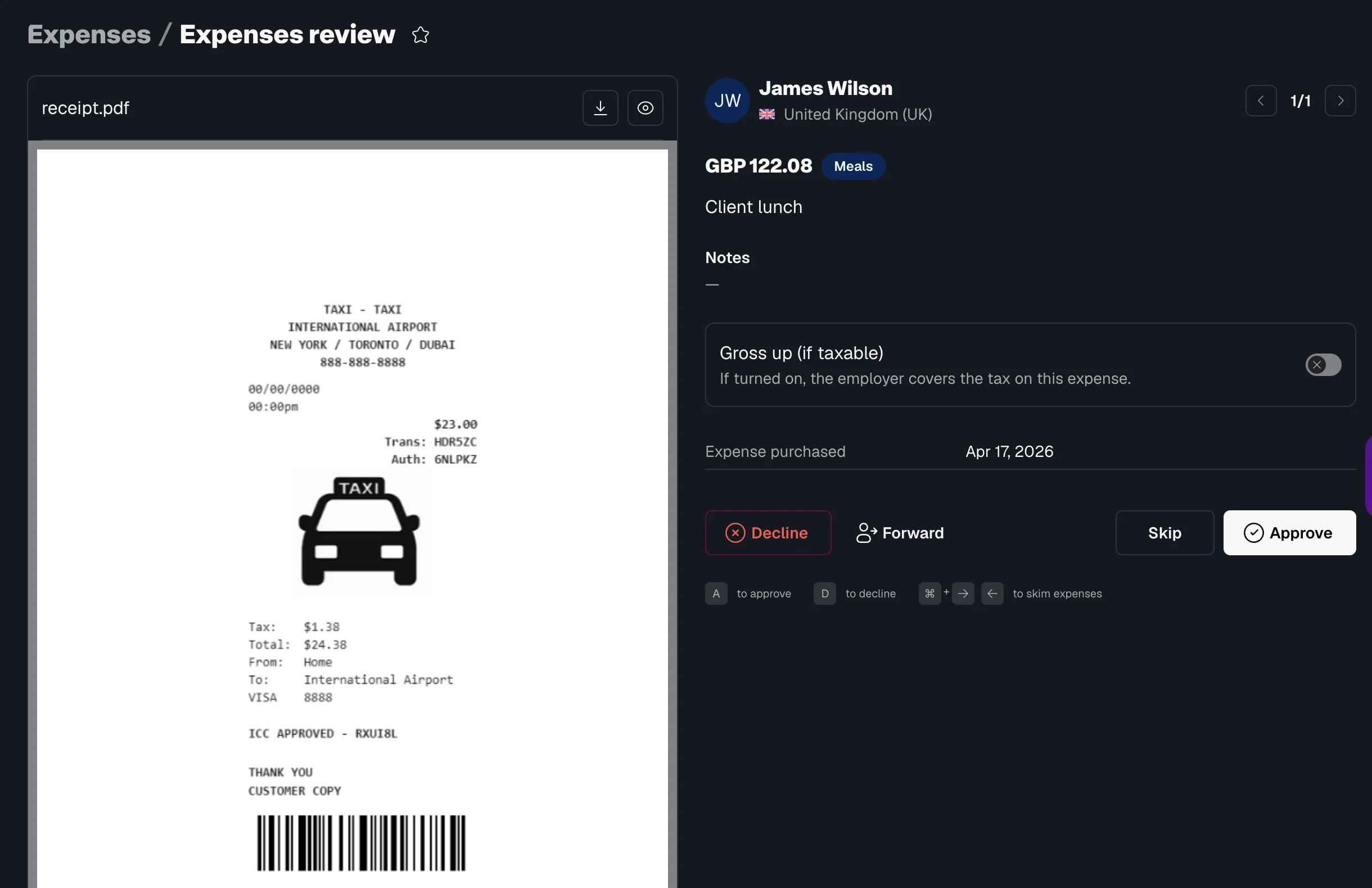
The receipt and expense details can be reviewed together before approval. This is a provider documentation example. Source: Remote Help Center (accessed 23 October 2026).
Data security
Remote says it holds ISO 27001 certification and has completed a SOC 2 Type 2 examination. SOC 2 is an examination of controls, rather than a certification. Remote also lists CSA STAR Level 1, a self-assessment.
Customers often ask for my company’s SOC 2 Type 2 report. Remote makes its report available through its trust center on request. Check which services and audit period it covers.
Onboarding & support
Remote’s current EOR product page advertises an average three-day employee onboarding time. The Help Center gives about three days once the employee has completed self-enrollment, and its table for the top 20 countries, last updated in April 2025 with 30-day averages, ranged from two working days (Canada, Finland, Ireland, the UK and the US) to six in Hungary. Treat those as averages for employees who already have the right to work, not a start-date commitment.
In my payroll onboarding work, I check pay rate, tax details and benefit deductions before the first run. A missing field can lead to a wrong paycheck or a missed payment.
From first invitation to first payroll
1
The first step in Remote’s onboarding process is to add the new employee’s details into the Remote ecosystem.
Your first invite also starts a Know Your Business review; you can add hires meanwhile, but onboarding and payments wait for approval.
2
From there, a formal invite is sent to the new employee by email, which instructs them to log in and begin the self-enrollment. This step involves filling in personal info and uploading supporting documents.
Agree notice, seniority and non-compete terms and pay any applicable reserve invoice.
3
The next step is back to Remote, where they begin the verification process to ensure the employee is legally allowed to work.
Remote also runs a medical check where required.
4
When the employee passes all verification checks, they are offered a formal employment agreement which must be signed by the employee and submitted back to Remote.
Meet the country’s payroll cutoff and agree any contract changes before the applicable deadline.
5
The final step is the activation of the new hire in both the payroll and HR systems and their status is set to Active.
Check the first payslip against the offer and invoices, and record who handles an urgent pay issue.
The payroll cutoff is 23:59 UTC on the 11th of each month in most countries and the 16th in 23 others, including India and the Netherlands. The US, Canada, Brazil and several other countries follow semi-monthly or other schedules, and Remote’s guides disagree on Germany: one lists the 16th, another says the date changes each month. The cutoff usually moves to the preceding business day when it falls on a weekend or public holiday. Expenses, commissions and time off approved later move to the following month, and salary or title changes need a contract amendment by the 5th. Remote’s pay-date articles give different dates, the 25th in one and the last business day of the month in another, so confirm the date for each country.
For a departure, submit the request in the platform. Remote reviews it against the employment agreement, local law and any collective agreement and, as the employer, carries out the termination; depending on the country, Remote, you or both of you tell the employee first. Its first advice can take up to five business days, and Remote says it cannot give a universal turnaround time. Its Help Center lists the costs an exit can add, including severance, payment in lieu of notice, unused leave, legal fees and an employee termination service, so ask whether a termination charge applies to your hire. Management fees are not prorated: a termination after the payroll cutoff incurs the next month’s fee. Ending the agreement with Remote also ends every employment agreement Remote holds for you, so plan a transfer to a new employer before giving notice.
Contract Terms
Contract length and price changes
The standard contract runs for 12 months and will renew automatically, but either side can terminate the contract with a 30 day written notice. One exception to this is if the contract sets a minimum value, then you will be responsible for the full cost, even if you end the contract early. Remote also reserves the right to increase the fees each year, also with a 30 day written notice.
An Order Form can override the general position through minimum commitments, renewal increases or specific exit charges. Under the published minimum-value terms, each renewal raises unit fees by the greater of 8% or the US CPI increase; the minimum remains payable on an early exit except for Remote’s material breach.
Early exit from a zero-minimum order can still cost money. Under the published Order Form terms, early termination of a multi-year Price Lock order with a zero minimum can require 50% of the monthly average of invoiced Estimated Annual Fees, multiplied by the months remaining, except for Remote’s material breach. Ending a one-year PAYG order early may instead change or remove volume discounts. Confirm which route the signed order uses.
In my payroll work, fixed-price contracts have helped customers budget but made some early exits expensive. With Remote, I’d calculate what the signed order requires on the intended exit date, including amounts due after notice.
Review the contract clauses before accepting. Remote’s Help Center says it does not accommodate redlines to its Terms of Service and cannot amend them after acceptance; any agreed change needs an addendum arranged beforehand.
Indemnities for EOR services sit outside both liability caps in Remote’s Terms, for your indemnities as well as Remote’s. Employment-claim costs are billed to you unless they arise solely from Remote’s breach of the Terms.
Intellectual property
For intellectual property, Remote says IP Guard transfers rights from the employee to the Remote entity and then to you, using local-law documents. Review the assignment documents for each country.
Customer Reviews
Remote has a Trustpilot TrustScore of 4.6 out of 5 from 3,586 reviews (checked 9 November 2026).
Remote is rated 4.5 out of 5 on G2 from 5,673 reviews (checked 9 November 2026) and 4.3 out of 5 on Capterra from 102 reviews (checked 16 October 2026). Some G2 reviews carry G2’s incentivized and seller-invite labels, and Trustpilot notes that Remote invites its customers to review. G2’s summary puts ease of use and helpful support at the top of what users like, and poor customer support (336 reviews) and delays (280 reviews) at the top of what they dislike.
AS/HR
Deposit experiences differ
Two G2 reviewers describe different arrangements. Adi S., a chief executive, said on 28 September 2026 that the company prepaid payroll each month and paid no per-employee deposit. On 30 August 2026, Himanshu R. described an upfront deposit of one to two months of gross salary plus taxes.
Remote’s current standard EOR reserve is one month of gross salary plus mandatory employer costs, excluding its management fee. Remote can reduce or waive the reserve after a credit review. Contract terms can require more.
RC
Chat support before a person
Ryan C., a people advisor at a mid-market company, rated Remote 2.5 out of 5 on 31 October 2025. The review credited Remote with simplifying overseas hiring and with its HiBob integration, but said the support chat often repeated help-site content and that reaching a person took longer than the reviewer wanted.
EF
Tax details at the first payroll
Elina F., an employee in the Netherlands whose employer pays Remote to manage payroll and relocation support, wrote on 25 June 2026 that her first salary was taxed at the 52% anonymous-employee rate. She said she had no citizen service number (BSN) at onboarding, that Remote never asked her to upload one or a wage tax credit form, and that follow-up questions were often ignored. Remote replied within a day, apologized and said it was reviewing her situation, including the communication about her payroll and open support cases.
Ask how a new employee’s tax and bank details are collected and checked before the first payroll.
Employee reviews
Glassdoor
Checked 2026-11-09 · Glassdoor
Employee rating: 3.3 out of 5 from 641 reviews.
Employees rate Remote 3.3 out of 5 on Glassdoor, from 641 reviews. Remote does not have an overall rating in our comparison yet, so this score is shown for information.
Sort the reviews by date and read what payroll and support staff say: they will handle your account.
FAQ
How much does Remote cost?
Remote advertises EOR from $599 per employee per month for annual contracts. Its Help Center separately lists US$699 per employee per month, billed monthly by active usage. Confirm the current country rate, currency and invoice schedule in your quote. Salary, employer contributions, benefits and one-off services are additional. Current starting prices are $29 for Contractor Management, $99 for Contractor Management Plus, $325 for Contractor of Record and $29 for Global Payroll, per worker per month. The pricing FAQ says the platform is included and there are no setup or onboarding fees on every plan; confirm the purchased scope and any extras.
Does Remote require an upfront deposit?
Usually, yes. Remote normally asks for a refundable reserve of one month’s gross salary plus mandatory employer costs for an EOR hire. It excludes Remote’s management fee. A credit review can reduce or waive that standard amount.
Remote must receive a required reserve before the employee is invited to onboard. Moving from 14-day to 30-day invoice terms adds one month per employee. Extended notice, guaranteed severance, recognized seniority or paid non-compete obligations can increase the reserve even if the standard amount is waived.
After employment ends or onboarding is cancelled, Remote processes the refund within 60 days of payment of the final invoice, once outstanding invoices have been settled. Regular payroll funding is separate.
Does Remote own its employing entities?
Remote says it owns and operates 100% of its entities, with no handoffs to third parties, and its Local Terms name the Remote company that contracts in each listed country, such as Remote Technology Services Ltd in the UK. Arrangements still vary: in Germany, employees are onboarded under what the Local Terms call the “AUG model”, Germany’s employee-leasing rules, through a master service agreement with Remote Technology GmbH. Ask for the entity and contract model for each hire.
Is Remote the same company as RemotePeople?
No. Remote (remote.com) is a global HR platform founded in 2019 by Job van der Voort and Marcelo Lebre. Its Terms name Remote Technology Services, Inc. for customers in the US and Remote Europe Holding B.V., in Amsterdam, for customers elsewhere. RemotePeople is a separate employer-of-record provider with its own review on this site. Check the company name on any proposal and contract.
What are the best Remote alternatives?
My shortlist would depend on your countries and the work your team needs to do. I’d compare Oyster for its benefits options and annual-seat terms; Deel for employee, contractor and accounting workflows; G-P for workforce transfers; and Multiplier when choosing between basic administration and a plan with integrations and custom reports. RemotePeople is another option if you also need recruitment or qualify for its country- and salary-specific EOR Select offer. Give each provider the same employee, country, salary and benefit requirements, then compare the complete quote, billing commitment, deposit, payroll calendar and exit terms. The ranking of EOR providers can help you build the shortlist.
How long does Remote take to onboard an employee?
Remote’s current EOR page advertises an average three-day onboarding time, and its Help Center, in an article last updated in April 2025, gives about three days once the employee has completed self-enrollment. Business verification on your first hire, a reserve invoice, right-to-work or medical checks and changes to the employment agreement can add time, and an employee must be fully onboarded before the start date.
Which countries does Remote cover?
Remote advertises employer-of-record hiring in 90+ countries, contractor payments in 190+ countries and payroll in 100+ countries. Its country explorer tags the products available in each location it lists: 186 locations on 30 September 2026, 92 of them tagged Employer of Record. Its Help Center payroll availability table lists fewer countries than the 100+ figure, so confirm payroll-only coverage separately. Contractor of Record is unavailable in 25 listed countries and territories.
Verdict
Remote’s owned-entity model and breadth of services would put it on my shortlist. I’d compare its country quote, reserve requirements and service commitments with other EORs before deciding.
EOR from USD 599 per employee per month on an annual contract (rechecked 31 Oct 2026); the Help Center separately lists a standard USD 699 billed monthly on active usage. The annual commitment does not establish annual prepayment: confirm the invoice schedule and any reserve. Salary, employer contributions, benefits, funding, FX and agreed services are extra. Checked 25 Oct 2026; EOR pricing rechecked 1 Nov 2026.
The standard refundable reserve is one month of the employee’s gross salary plus mandatory employer costs, excluding the management fee. A credit review can reduce or waive it; where required, Remote must receive it before inviting the employee to onboard. Checked 5 Nov 2026
Existing customers can recruit through 30 November 2026; December is view-only and access ends after 31 December. November usage can appear on the December invoice. Checked 25 Oct 2026