TheBestEOR

Best Employer of Record in Australia

Written by Martynas PupkeviciusFact-checked by Michael Ennis
Picture of Martynas Pupkevicius
Martynas Pupkevicius

EOR Advisor and Remote Work Editor

Our top employer of record in Australia for 2026 is RemotePeople, from USD 499 per employee a month, ahead of Deel and Rippling.

We tested all 10 providers with paid client accounts, real quotes and a live hire run through payroll. In Australia, the industry award sets minimum pay and conditions for the role, and employers pay superannuation and workers’ compensation insurance on top of salary.

Flag of Australia

Hiring in Australia at a glance

Currency
AUD
Australian dollar
Pay cycle
Monthly
At least monthly, some awards require weekly or every 2 weeks
Working hours
38 hours
Normal full time week, extra hours must be reasonable
Annual leave
4 weeks
5 for some shiftworkers, none for casuals
Extra pay
Leave loading
Extra pay on annual leave for some employees
Employer costs
Superannuation
Plus workers’ compensation, state payroll tax may apply
Before you hire:
Identify the industry award for the role and confirm if the quoted salary includes retirement contributions.

Country hiring overview · Australia

What to check before hiring in Australia

Start with the award, then compare the complete quote.

I’d start an Australian comparison with the modern award or agreement that covers the role. Ask how the proposed employer will handle payroll and employment administration, then compare providers using the same hours, salary and benefits.

Choose a hiring solution

Need a local employer?

Compare an EOR arrangement for your role before opening your own entity.

Already have a local employer?

Compare payroll and HR support against adding an EOR.

EOR service fee

Fees vary by provider.

Your quote should state the currency, fee per employee, minimum charge and billing commitment.

Onboarding

Paperwork affects the start date.

The contract, right-to-work checks, registrations and payroll deadlines all affect when employment can begin.

Employment costs

Include superannuation.

Superannuation, any applicable payroll tax and workers’ compensation add to the employment budget. Ask the provider to show each amount separately for the proposed hire.

Annual leave

The usual allowance is four weeks.

Under the National Employment Standards, full-time and part-time employees receive 4 weeks of annual leave. Casual employees are excluded, and some shiftworkers receive more.

Check before choosing

Confirm award classification, ordinary hours, superannuation, state payroll costs and workers’ compensation cover before agreeing the start date.

What your quote should include

Employment costs and service fees

1
Gross salary and agreed pay schedule
2
Superannuation, payroll tax and workers’ compensation
3
EOR fee: currency, per-employee billing, minimums and commitment
4
Setup, foreign exchange, extras and exit costs

Deposits and payroll funding

1
Amount and payment deadline
2
Whether funds are refundable or credited to payroll
3
Release conditions and refund timing
Show these separately from recurring expenses.

Key takeaways for hiring in Australia

A salary does not replace the award calculation

For an award-covered role, an annual salary needs a documented basis for the entitlements it covers. Annualised-wage clauses can require hours records and periodic reconciliation. Ask the provider to demonstrate a week with overtime or penalty hours, then show how any shortfall is identified and paid.

Super can be part of the payroll-tax base

In NSW, employer superannuation contributions are themselves taxable wages for payroll tax. A quote that applies the tax rate only to cash salary can therefore understate cost. Ask for the base calculation, not just the percentage, and keep the provider’s service fee separate from taxable employee pay.

A single hire can still attract payroll tax

Employment-agency rules look at the actual arrangement and the liable employer. A foreign client with one Australian worker should not assume that its own small headcount creates an exemption. The provider should identify the tax treatment, any applicable exemption and the supporting declaration for the proposed assignment.

Budget the state and employer actually involved

The ACT no longer fits a simple 6.85% upper-rate summary. Its 2026–27 schedule ranges from 6.75% to 8.75% according to Australia-wide wages. This is why an Australian quote needs the work location, relevant employer and taxable-wage calculation; a national average is only a rough planning aid.

Check age on the notice calculation

Under the NES, the extra week of notice applies when an employee is over 45 and has at least two years of continuous service. An employee aged exactly 45 does not qualify. Keep age, service dates and the applicable award or contract in the exit estimate instead of relying only on a tenure table.

Quick verdict

What is the best EOR in Australia?

My top three: RemotePeople, Deel and Rippling.

1
Editorial pick
RemotePeople logo

4.9/5

RemotePeople

Hiring in new markets with local HR support

Starting fee
$499

per employee / month

Countries
150+
where you can hire

EOR Select from $199 for eligible hires.

Deposit
1 month

of gross salary

Deposit refund
Within 5 days

of the final payment

Why consider it

Recruitment and EOR services through one provider.

Dedicated account manager in both EOR plans.

Check the fit

Recruitment is separately priced.

Before signing: Confirm quote currency, billing commitment, deposits, funding deadlines and refund terms. EOR Select eligibility depends on the hiring country and employee salary.

Both EOR plans list local contracts, payroll and tax administration, and statutory benefits administration. Salary, employer contributions and benefit costs are separate.


Legal employer in Australia
✓ Verified on register

Employing entity
Own private limited company, Queensland
ACN 661 070 471 · ABN 36 661 070 471

Labour hire licences
Queensland, Victoria and the ACT

Visit RemotePeople ↗

2
Deel logo

4.7/5

Deel

Paying employees and contractors on one platform

Starting fee
$599

per employee / month

Countries
130+
where you can hire

Plus a mandatory Employer Liability Cost.

Deposit
1–1.5 months

of gross salary

Deposit refund
Within 60 days

of offboarding

Why consider it

EOR, contractor management and payroll for your own entities.

Month-to-month EOR service pricing available.

Check the fit

The country-specific Employer Liability Cost is mandatory.

Before signing: Confirm the Employer Liability Cost amount, benefit costs and any additional products. Monthly service terms do not remove employment notice, severance or other exit obligations.

The EOR pricing page lists 130+ countries. Broader platform coverage figures may include other services.

Legal employer in Australia
✓ Verified on register

Employing entity
Deel Australia Services Pty Ltd, Victoria
ACN 646 477 723 · ABN 64 646 477 723

Labour hire licences
Victoria
VICLHL09692

Visit Deel ↗

3
Rippling logo

4.5/5

Rippling

Setting up payroll, laptops and app access for new hires

Starting fee
$499

per employee / month

Countries
115
where you can hire

Plus the Rippling Platform, from $8 per employee / month.

Deposit
Per quote

based on gross salary

Deposit refund
Per contract

set in your agreement

Why consider it

EOR, payroll, HR records and benefits administration in one platform.

Shared workflows and reporting for domestic and international teams.

Check the fit

Confirm whether the EOR quote includes platform access and each selected HR or IT product, or charges for them separately.

A paid Rippling Platform subscription is required on top of the EOR fee, from $8 per employee per month plus a monthly base fee. Rippling EOR starts at $499 per employee per month. Other HR and IT products are priced separately.

Rippling’s EOR page lists 115 countries. Confirm your hiring country and legal employer.

Legal employer in Australia
✓ Verified on register

Employing entity
Rippling Australia Pty Ltd, New South Wales
ACN 657 181 970 · ABN 88 657 181 970

Labour hire licences
Victoria
VICLHL07680

Visit Rippling ↗

No provider pays for a position on this page; some outbound links pay a referral fee. See the funding model and methodology.

Entity, sponsor status and fee, side by side

All 10 EOR providers for Australia, side by side

Prices are June 2026 list fees per employee per month.

Fees run $199 to $699 per employee per month across the ten. I weigh that fee alongside the identity of the Australian company that will sign the employment contract. For the order across all markets, see the ranking of the best employer of record services worldwide. For a wider shortlist, browse EOR providers for Australia.

Provider

Best For

Starting feeDepositOnboarding
1 RemotePeople logo RemotePeople 4.9/5 Rating Hiring in new markets with local HR support Starting fee: $499 USD / monthDeposit: 1 monthOnboarding: 3–6 days

My take

RemotePeople includes a dedicated account manager, local employment contracts, payroll and tax administration, and statutory-benefits administration.

Recruitment is a separate service.

EOR Global starts at USD 499 per employee per month. EOR Select starts at USD 199 for eligible countries and employee salary ranges. Salary, employer contributions, benefit costs and agreed extras are additional. The country quote determines eligibility, the final fee, billing commitment and payroll funding.

When this provider fits

I’d consider RemotePeople if the named contact will coordinate award classification, employee fund information and payroll exceptions.

Ask before signing

Who documents award coverage and handles a rejected super payment or employee fund-choice issue?

Deposit

1 month

Entity model

Owned / vetted local entity

First year, one hire

$5,988 in service fees

Reviewed by Martynas PupkeviciusFact-checked by Michael Ennis

Starting fee

$499

EOR Global. EOR Select starts at $199 where the country and employee salary qualify.

Against the 10 starting fees

$199 lowest$699 highest
2 Deel logo Deel 4.7/5 Rating Paying employees and contractors on one platform Starting fee: $599 USD / monthDeposit: 1–1.5 monthsOnboarding: 2–5 days

My take

Deel combines EOR payroll and benefits administration with separate contractor and HR products.

EOR starts at USD 599 per employee per month, with month-to-month billing available. Mandatory Employer Liability Cost is an additional charge based on gross salary, with rates varying by country. Salary, statutory employer costs and benefit premiums are also separate.

Contractor management starts at USD 49 per active contract per month. It is a separate service from EOR employment; currency conversion, payment-method charges and any required deposit also affect the amount funded.

When this provider fits

For Rippling, I’d want the Australian workflow and required integrations demonstrated before deciding whether they justify the complete fee.

Ask before signing

Show an award-covered salary reconciliation and itemise the Employer Liability Cost.

Deposit

1–1.5 months

Entity model

Owned entity

First year, one hire

$7,188 in service fees

Reviewed by Martynas PupkeviciusFact-checked by Michael Ennis

Starting fee

$599

Month-to-month billing. Mandatory Employer Liability Cost is charged separately.

Against the 10 starting fees

$199 lowest$699 highest
3 Rippling logo Rippling 4.5/5 Rating Setting up payroll, laptops and app access for new hires Starting fee: $499 USD / monthDeposit: Per quoteOnboarding: 2–5 days

My take

Rippling connects EOR employment with its HR, IT and finance products, using shared employee data for workflows and reporting.

Device management and app access are separate products within that wider system.

Rippling EOR starts at USD 499 per employee per month, and the required Rippling Platform adds from USD 8 per employee per month plus a monthly base fee. The quote needs to show any selected HR, IT or finance products and the billing commitment. Salary, employer costs, benefits, deposits and payroll funding are additional to the software and service fees.

When this provider fits

Choose it when the shared HR and IT record reduces real work in your current setup.

Ask before signing

Show an Australian employee with overtime, an allowance and a payroll adjustment, including which modules are required.

Deposit

Per quote

Entity model

Own entities and local partners

First year, one hire

$5,988 in EOR fees

Reviewed by Martynas PupkeviciusFact-checked by Michael Ennis

Starting fee

$499

Plus the required Rippling Platform, from $8 per employee per month and a monthly base fee. Confirm the billing terms and selected products.

Against the 10 starting fees

$199 lowest$699 highest
4 Oyster logo Oyster 4.5/5 Rating Using one onboarding process for hires across countries Starting fee: $699 USD / monthDeposit: ~1 monthOnboarding: 2–5 days

My take

Oyster includes payroll, expense and time-off administration, reporting, and onboarding and offboarding support.

Benefits packages are optional add-ons. The EOR service fee is USD 699 per employee per month on monthly billing.

Annual seats are priced by headcount and location and are non-refundable, but can be reused for replacement hires. Annual prepayment gives the lowest fee; higher-priced quarterly or semiannual payment options are available. Salary, employer costs and benefit premiums are additional, and a refundable deposit is required. Optional People Partner project work costs USD 300 per hour.

When this provider fits

Choose it if the actual Australian benefit options and service terms fit the employee.

Ask before signing

Which Australian policies are offered, at what employee and employer cost, and what does the annual commitment change?

Deposit

~1 month

Entity model

Owned entity

First year, one hire

$8,388 in service fees

Reviewed by Martynas PupkeviciusFact-checked by Michael Ennis

Starting fee

$699

Monthly billing. Annual seats are quoted separately, prepaid and non-refundable.

Against the 10 starting fees

$199 lowest$699 highest
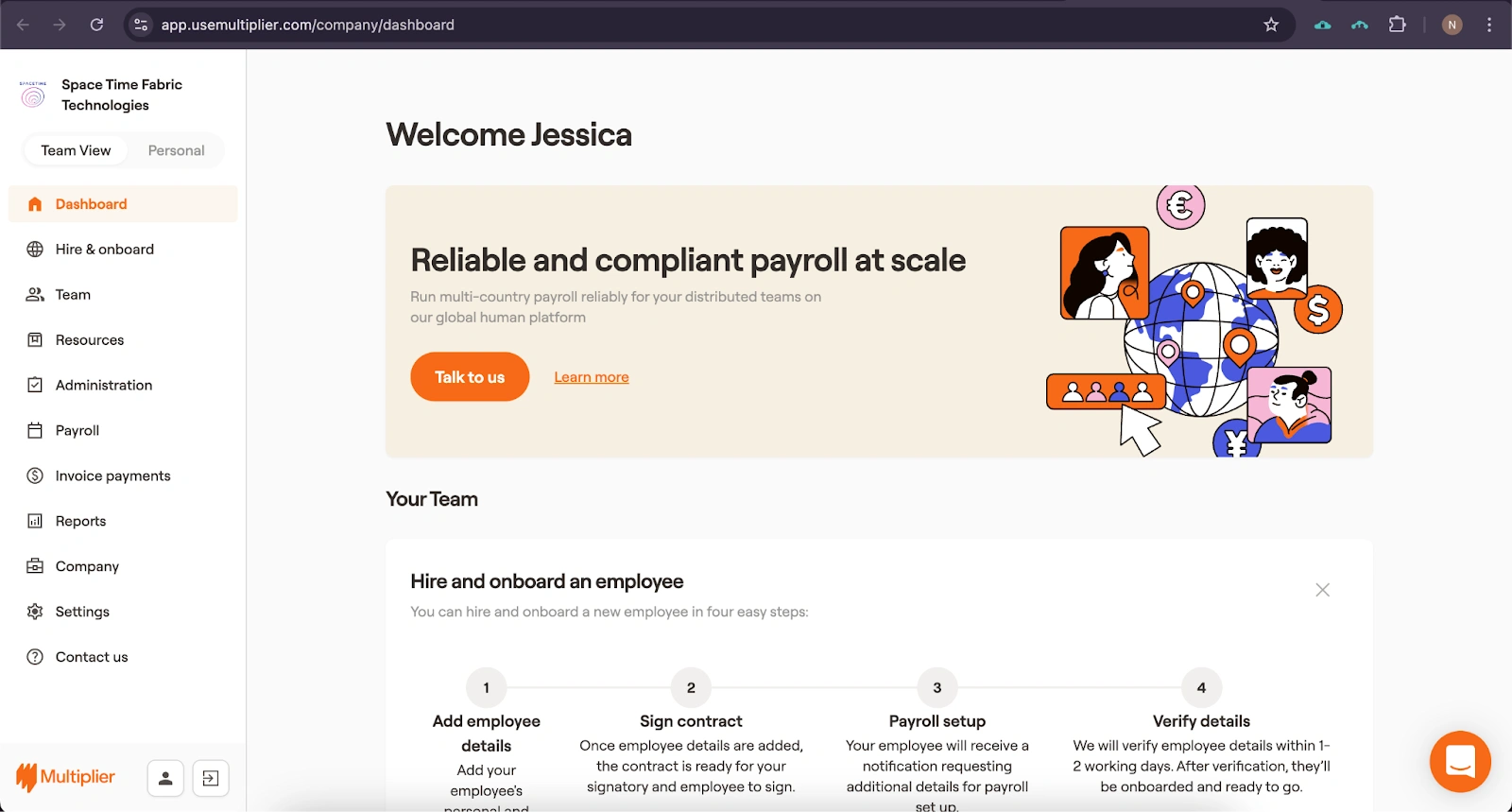
5 Multiplier logo Multiplier 4.1/5 Rating Managing payroll, leave and expenses in one place Starting fee: $459 USD / monthDeposit: 1+ monthsOnboarding: 2–5 days

My take

Multiplier Core includes employment administration, payroll, leave and standard workforce reporting.

Core starts at $499 per employee per month on monthly billing or $459 per month billed annually. Growth adds integrations, custom reports and open APIs. The quote needs to identify the dollar currency and chosen plan.

Country variations and mandatory add-ons affect the total. Implementation fees may apply, although the FAQ says setup is free; the quote must resolve that charge. Salary, employer costs and benefit premiums are additional.

Deposit

1+ months

Entity model

Own entities and partners

First year, one hire

$5,508 in service fees

Reviewed by Martynas PupkeviciusFact-checked by Michael Ennis

Starting fee

$459

Core plan billed annually, or $499 per month on monthly billing. Confirm the dollar currency.

Against the 10 starting fees

$199 lowest$699 highest
6 Pebl logo Pebl 4.2/5 Rating Hiring people who need visa or relocation support Starting fee: $399 USD / monthDeposit: Per quoteOnboarding: 5–7 days

My take

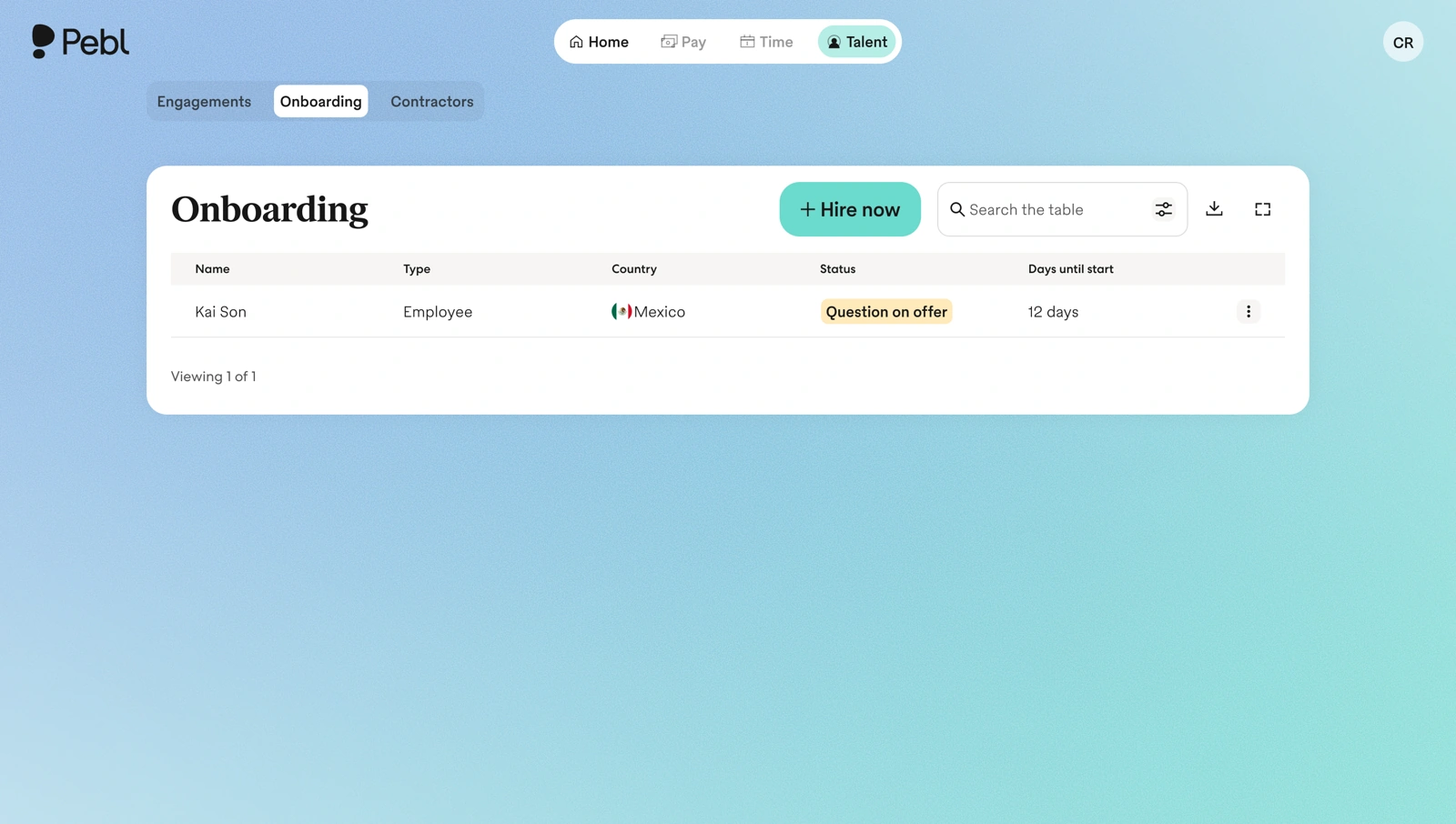
Pebl, formerly Velocity Global, combines hiring, payroll, employee changes, reporting and offboarding in one platform.

EOR starts at $399 per employee per month; the country quote must identify the dollar currency and billing commitment. Salary, employer costs, benefits and additional services are separate.

A deposit is required before onboarding. Its amount can change with salary, seniority or payment history, and it is returned after the final invoice and outstanding balances are paid. Early exit can make the remaining committed-term service fees payable, subject to the agreement’s termination exceptions. Any discounted offer needs an end date and renewal price.

Deposit

Per quote

Entity model

Affiliates and local partners

First year, one hire

$4,788 in service fees

Reviewed by Martynas PupkeviciusFact-checked by Michael Ennis

Starting fee

$399

Confirm the country price and billing commitment.

Against the 10 starting fees

$199 lowest$699 highest
7 G-P logo G-P 4.2/5 Rating Hiring abroad while keeping your existing HR system Starting fee: $599 USD / monthDeposit: 1–2.5 monthsOnboarding: 2–5 days

My take

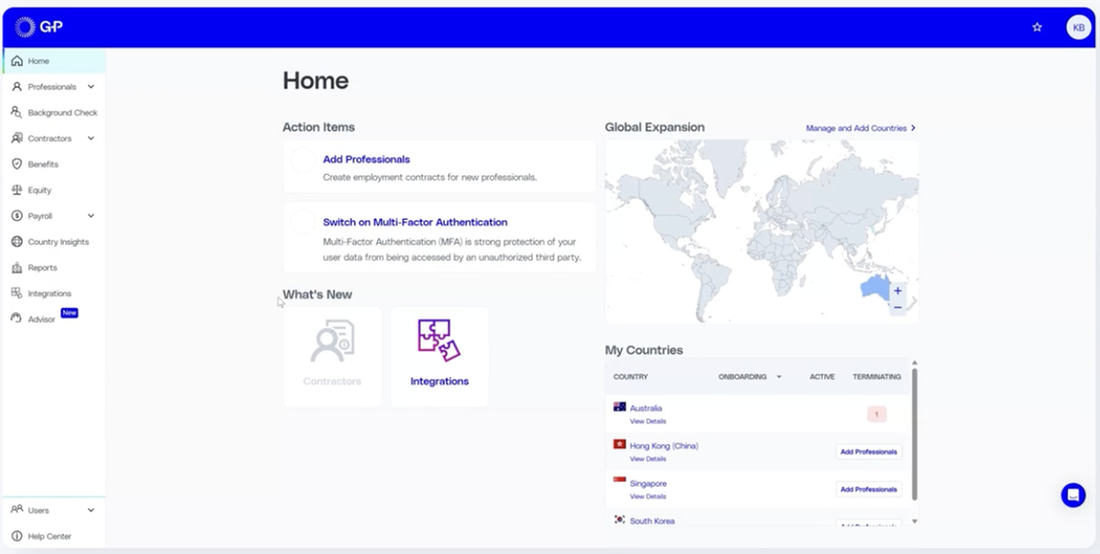
G-P combines EOR employment administration with benefits, reporting and custom API integrations.

EOR starts at USD 599 per employee per month, with volume discounts by quote. Salary, employer costs, benefit premiums and additional services are separate.

There is no minimum contract length for EOR hires. The proposal still sets the commercial billing and cancellation terms, along with the cost of any integration or implementation work.

Deposit

1–2.5 months

Entity model

Owned entity

First year, one hire

$7,188 in service fees

Reviewed by Martynas PupkeviciusFact-checked by Michael Ennis

Starting fee

$599

Confirm the included services and billing terms in your country quote.

Against the 10 starting fees

$199 lowest$699 highest
8 Papaya Global logo Papaya Global 4.1/5 Rating Comparing payroll costs across countries in one report Starting fee: $499 USD / monthDeposit: 1–2 monthsOnboarding: 5–7 days

My take

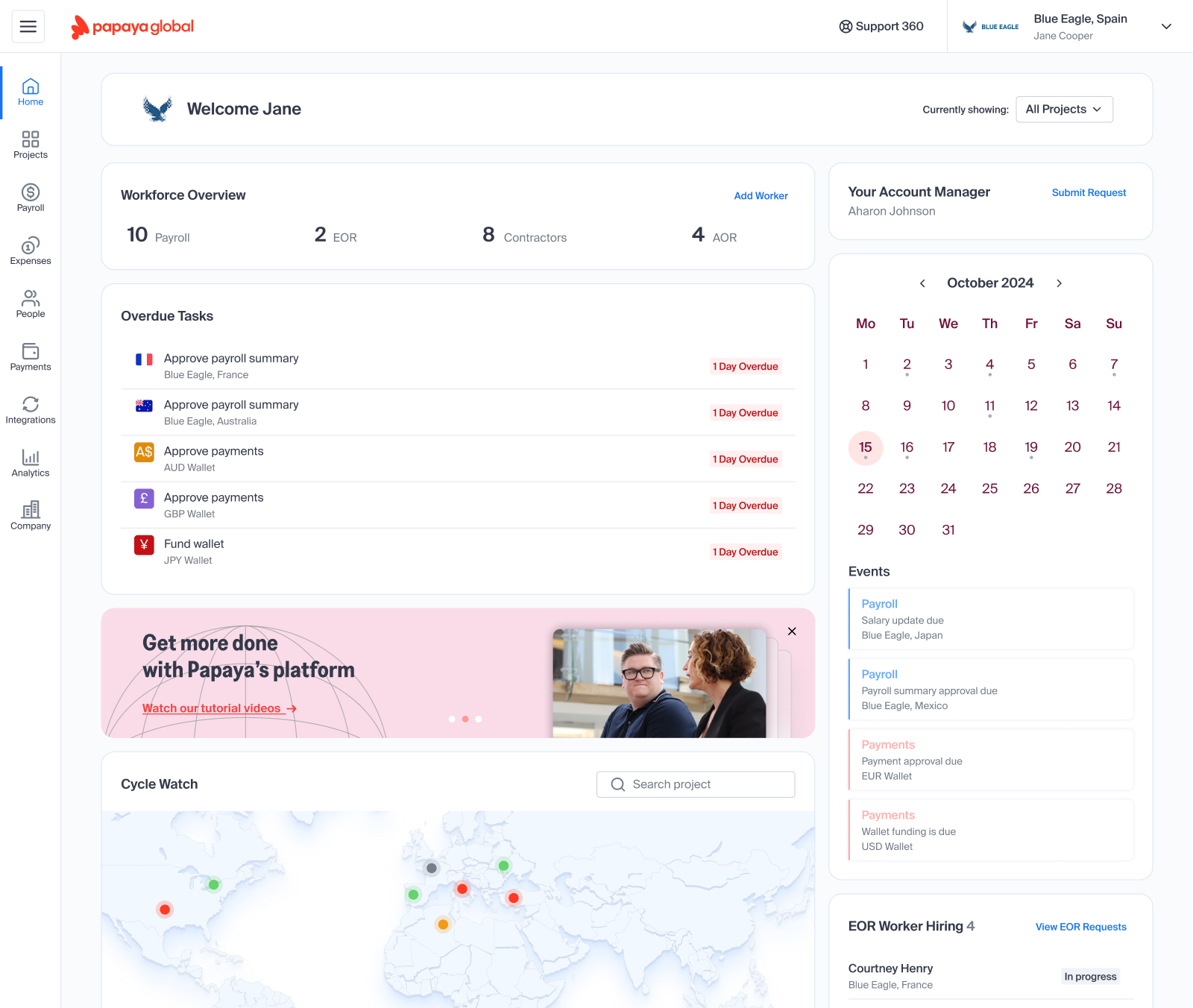
Papaya brings EOR employees, payroll for a company’s own entities and workforce payments into one platform, with consolidated reporting and payroll approval tools.

That payroll and payments connection is what I’d examine closely in a demonstration.

Papaya’s EOR service starts at USD 499 per employee per month. The country quote must identify the billing commitment and any additional services. Salary and employer costs are separate.

When this provider fits

Papaya would make my shortlist when Australian payroll needs to feed a wider finance-reporting process.

Ask before signing

Show the taxable-wage base, super and payroll-tax entries in the finance export.

Deposit

1–2 months

Entity model

Partner + payroll engine

First year, one hire

$5,988 in service fees

Reviewed by Martynas PupkeviciusFact-checked by Michael Ennis

Starting fee

$499

The country quote sets the billing terms. Payroll-only processing is priced separately.

Against the 10 starting fees

$199 lowest$699 highest
9 Borderless AI logo Borderless AI 4.0/5 Rating Getting 24/7 help with overseas payroll and HR Starting fee: $579 USD / monthDeposit: 1.5–3 monthsOnboarding: 5–8 days

My take

Borderless AI’s standard EOR fee is USD 579 per employee per month.

Eligible companies headquartered outside Canada may qualify for USD 399 on fees billed through 31 December 2026. USD 579 applies from 1 January 2027, including promotional customers; country and employment-type exceptions apply. Salary, employer costs and benefits are additional.

A refundable deposit is required before the employee starts. The schedule is 1.5 months of gross salary plus employer costs, benefits and platform fees with ACH or three months by wire and other methods, with country variations. The base includes salary, employer contributions, benefits and platform fees. Late-payment issues can raise it to six months. Deposits are released after the relevant obligations are settled.

Deposit

1.5–3 months

Entity model

Own entities

First year, one hire

$6,948 in service fees

Reviewed by Martynas PupkeviciusFact-checked by Michael Ennis

Starting fee

$579

Eligible companies headquartered outside Canada can pay $399 on fees billed through 31 December 2026.

Against the 10 starting fees

$199 lowest$699 highest
10 RemoFirst logo RemoFirst ⚠ Trustpilot warning 0.5/5 Rating Making a first overseas hire on a tight budget Starting fee: $199 USD / monthDeposit: About 1 monthOnboarding: 4–7 days

My take

We moved RemoFirst to last place on 8 November 2026: Trustpilot has suspended its rating for a breach of its guidelines and removed fake reviews.

RemoFirst says it works exclusively with vetted in-country partners. Here, that means a local partner company, not RemoFirst, would normally employ your hire, and payroll changes, questions and exits pass through both companies, which can slow answers. US$199 is RemoFirst’s starting fee and varies by country, so get this country’s quote before you compare. RemoFirst includes a dedicated customer success manager and EOR employment from USD 199 per employee per month, with no minimum contract term or headcount. The fee can vary with country requirements. Salary, employer costs, benefits, deposits and optional services are separate.

Contractor management is free for onboarding, identity checks, contract storage and expenses. Contractor payments cost USD 25 per contractor in months when a payment is processed; payment-provider and transfer fees may also apply. These contractor services are separate from EOR employment.

Deposit

About 1 month

Entity model

Partners, not own entities

First year, one hire

$2,388 in service fees

Reviewed by Martynas PupkeviciusFact-checked by Michael Ennis

Starting fee

$199

RemoFirst advertises no minimum contract term or employee count. Confirm any country-specific charges.

Against the 10 starting fees
$199 lowest$699 highest

Entity ownership is as each provider states it.

Confirm the immigration scope, start date and first-payroll cutoff.

Which top pick · Australia

Ask for a written quote covering the salary, benefits and services you need. Enter its recurring costs in USD in the EOR cost calculator to compare proposals.

Local Australian alternatives (researched, unranked): several Australia-focused firms also provide EOR, PEO or payroll outsourcing, including Employsure and CXC on the workforce-compliance side and payroll specialists such as Ayers Group and Oncore. They are not ranked because none runs a multi-country entity network. An employer hiring only in Australia, with no expansion plans, may still find one of them sufficient.

Get your EOR discount

Get up to 30% off eligible EOR service fees. Your quote confirms the discount and terms.

Employment framework

Employment and payroll in Australia

The applicable award can change pay and allowances.

Award classification can affect minimum pay, allowances and payroll calculations. Australian onboarding must also coordinate PAYG, Single Touch Payroll, superannuation and any required immigration steps.

Confirm the modern award and classification

Confirm whether a modern award covers the role and which classification applies. Industry and occupation awards can set minimum pay, penalty rates, allowances and annual-leave loading alongside the National Employment Standards.

Ask the EOR to identify the applicable award terms and show how they affect the contract and payroll calculation. An incorrect classification can lead to underpayment, back-pay orders and Fair Work penalties.

Australian employment contract

The EOR’s Australian entity becomes the legal employer under a contract governed by the Fair Work Act 2009 and National Employment Standards.

You direct the day-to-day work. The EOR’s Pty Ltd holds the employment contract and administers superannuation, PAYG withholding, Single Touch Payroll reporting and workers’ compensation cover.

Before choosing a provider: request the legal employer’s name and registration details.

PAYG, superannuation and ATO reporting

PAYG and Single Touch Payroll

Each pay run, the EOR withholds PAYG income tax, calculates 12 percent super guarantee on qualifying earnings subject to the annual contribution base, and reports gross pay, tax and super to the Australian Taxation Office through Single Touch Payroll on or before payday.

Payday Super timing

Payday Super applies to earnings paid from 1 July 2026. Contributions generally must reach the employee’s super fund within seven business days after payday, with the information needed to allocate them to the employee’s account. Specified longer timeframes can apply. Sending a payment to a clearing house is not enough if the fund receives it late.

Other employer payments and insurance

The EOR also remits withheld PAYG through its activity statement, holds workers’ compensation cover for the relevant state, and registers for and pays state payroll tax where its Australian wage bill clears the threshold.

Coordinate award, immigration and payroll setup

1

Prepare the employment and payroll records

Agree salary and the proposed start date. The EOR prepares the contract, checks award coverage and classification, and collects the tax file number declaration and super-fund choice. It then arranges PAYG and Single Touch Payroll setup and workers’ compensation.

2

Confirm sponsorship and visa steps where required

For a foreign hire, confirm the applicable visa route, the employing entity’s sponsorship eligibility and who handles any Skills in Demand nomination and application. Obtain dates for the immigration steps separately from payroll setup.

3

Follow the agreed pay schedule

Once employment starts, the EOR follows the agreed pay schedule, reports STP each run and pays super to the nominated fund.

Employer cost

Statutory employer contributions in Australia

Payroll tax can change the cost beyond super.

All figures as of 2026. The combined employer load is about 12 to 19 percent of gross depending on payroll-tax exposure, before the EOR fee.

Contribution Employer rate Basis / threshold Collected by
Contribution

Superannuation guarantee

12% since 1 July 2025
Employer rate
12%
Basis / threshold
Qualifying earnings for eligible workers; annual SG contribution base AUD 270,830 for 2026–27. Additional award or enterprise-agreement obligations may apply.
Collected by
Employee's super fund (ATO oversight)
Contribution

State payroll tax

Varies by state
Employer rate
Varies by state and wage bill; ACT 2026–27: 6.75–8.75%
Basis / threshold
Only above the state threshold (~AUD 1.0M–2.5M of wages/yr)
Collected by
State revenue office
Contribution

Workers' compensation

Priced by industry risk
Employer rate
~0.5–3%+
Basis / threshold
On wages, rate set by state scheme and industry
Collected by
State scheme / approved insurer
Contribution

PAYG withholding

Withheld from the employee, not an employer cost
Employer rate
Per ATO tables
Basis / threshold
Income tax deducted each pay run, to 45% top rate
Collected by
Australian Taxation Office

Fig. 2 · Mandatory employer contributions in Australia, 2026 rates

Take an AUD 120,000 salary: superannuation at 12 percent is AUD 14,400 a year. State payroll tax is the line that moves the total most. Workers’ compensation is the third line, priced by each state scheme: the 2025-26 average scheme rates are 1.343 percent of wages in Queensland, 1.8 percent in Victoria, 1.823 percent in the ACT, 1.85 percent in South Australia and 2.06 percent in Western Australia, and NSW’s icare lifted its average premium 8 percent for 2025-26. Dedicated clerical and office classifications usually price below those scheme-wide averages. Add it in, and the all-in statutory employer load lands a little above 12 percent if payroll tax does not apply and around 19 percent if it does. The EOR fee is a separate line again, over and above every figure here.

Working time & leave

Working hours, overtime and statutory leave

The applicable award sets overtime and penalty rates.

Hours and pay

Ordinary week 38 hours
National Minimum Wage AUD 26.44/hr
Weekly minimum AUD 1,004.90
Casual loading 25%
Casual minimum ~AUD 33.05/hr
Public holidays/yr 7 national + state

Fig. 3 · Hours and minimum pay · National Minimum Wage AUD 26.44/hr from 1 July 202

The National Minimum Wage rose to AUD 26.44 per hour (AUD 1,004.90 a week) on 1 July 2026 under the Annual Wage Review 2026, up from AUD 24.95 in 2025-26. Overtime and penalty rates are set by the relevant modern award, not the NES, so they vary by industry. Australia has 7 national public holidays, with the total reaching 9 to 13 once state and territory holidays are added; Victoria has the most.

Statutory leave

Annual leave 4 weeks (20 days)
Annual leave loading
where the award provides
17.5%
Personal / carer's leave 10 days/yr
Long service leave State-specific; Victoria ~6.07 weeks at 7 years
Paid parental leave
government-funded
26 weeks
Compassionate leave 2 days/occasion

Fig. 4 · Statutory leave under the NES · long service leave is state-legislated; parental leave government-funded

Annual leave accrues from day one and carries over with no statutory cap. Personal/carer’s leave (10 days, covering sick and carer’s needs) accumulates year to year. Long service leave is state-legislated: Victoria allows access after seven years, when the ordinary accrual is about 6.07 weeks (one week per 60 weeks of continuous employment). New South Wales generally provides 8.67 weeks after ten years. Government Paid Parental Leave is 26 weeks for births from 1 July 2026 (24 weeks for earlier births), paid at the national minimum wage rate.

Ending employment

Probation, notice and redundancy in Australia

Years of service affect notice and redundancy pay.

Notice and redundancy both scale with tenure under the NES, and dismissal protection is strong: an eligible employee can bring an unfair-dismissal claim, so the EOR documents the basis for any exit.

Tenure Minimum notice (NES) Redundancy pay (NES)
Tenure
1 year or less
Minimum notice (NES)
1 week
Redundancy pay (NES)
Nil (4 wks from exactly 1 yr)
Tenure
Over 1 year, up to 3 years
Minimum notice (NES)
2 weeks
Redundancy pay (NES)
6 weeks (1–2 yr: 4 wks)
Tenure
Over 3, up to 5 years
Minimum notice (NES)
3 weeks
Redundancy pay (NES)
7 weeks (3–4 yr); 8 weeks (4–5 yr)
Tenure
Over 5 years
Minimum notice (NES)
4 weeks
Redundancy pay (NES)
10 to 16 weeks, then 12 at 10+ yrs

Fig. 5 · NES minimum notice and redundancy pay by tenure · notice bands are inclusive at the upper bound; redundancy bands not

Tenure bands in the notice column follow s.117 of the Fair Work Act, where the upper bound is inclusive: exactly 3 years of service still takes 2 weeks’ notice. Redundancy bands instead run “at least X, under Y” of completed service, so at exactly 3 years the NES minimum is 2 weeks’ notice but 7 weeks’ redundancy, which is precisely what the calculation below pays.

Employees over 45 with at least two years of continuous service get an extra week of NES notice, subject to the applicable exclusions. Redundancy pay rises with tenure to a peak of 16 weeks at nine to ten years, then drops to 12 weeks at ten years or more, because long service leave has accrued by then. Small businesses with fewer than 15 employees are exempt from NES redundancy pay, though an EOR with many Australian staff is not a small business. An eligible employee dismissed without a valid reason and a fair process can claim unfair dismissal at the Fair Work Commission, where the compensation cap is AUD 95,050 for dismissals on or after 1 July 2026.

Redundancy of a 3-year employee on AUD 120,000/year Weekly wage = AUD 120,000 / 52 = AUD 2,307.69

Notice (1–3 yr tier)

2 weeks (under 45; exactly 3 years still falls in the 1–3 tier), paid in lieu = 2 × AUD 2,307.69
AUD 4,615

Redundancy pay

7 weeks at 3 completed years (at least 3, under 4) = 7 × AUD 2,307.69
AUD 16,154

Accrued unused annual leave

Assume 2 weeks outstanding × AUD 2,307.69 (plus 17.5% loading where the award applies))
AUD 4,615

Indicative exit cost

Before superannuation on the notice component and any ex-gratia sum
AUD 25,384

Fig. 6 · Redundancy of a 3-year employee · NES minimums; an award or contract can provide more

Superannuation is not payable on the genuine redundancy payment or on the unused-leave payout, but payment in lieu of notice counts as ordinary time earnings, so super applies to the notice component. The total excludes any negotiated ex-gratia sum. Before you budget an exit, put Australia’s scale next to other markets in the termination across jurisdictions guide.

Payroll & tax

Payroll cycle and income tax in Australia

Report payroll to the ATO on or before payday.

Australian payroll runs fortnightly or monthly in Australian dollars, with real-time reporting to the ATO every pay run. The EOR files Single Touch Payroll on or before each payday, remits PAYG on its activity statement and pays super to the nominated fund.

STP reports salary, PAYG withholding and super information to the ATO from the payroll system when employees are paid, subject to the applicable reporting exceptions. Reporting a liability is different from paying the employee or transferring super to their fund.

Payday Super began on 1 July 2026, so an old quarterly-super calendar should not be used for a new Australian payroll plan. Check the fund-payment deadline and payroll-system transition requirements for the actual pay run.

Before the first run, reconcile the AUD gross salary, withholding, net payment, super liability and the provider invoice. Agree the payroll cutoff and employee payday, and ask how STP submissions, super transfers and rejected payments are evidenced.

The employment contract

Contract requirements, awards and casual rules

Check the award before setting the contract terms.

The contract of employment is in English and must operate alongside the National Employment Standards and any applicable modern award, neither of which it can undercut. Every new employee must also receive the Fair Work Information Statement, and casual employees the Casual Employment Information Statement. The contract sets the salary, hours, leave and notice, but if the role is award-covered, the award’s minimum pay, penalty rates, allowances and the 17.5 percent leave loading override anything less generous in the contract. The EOR maps the role to the correct award and classification so the contract and the award line up.

Casual employment is a distinct status in Australia. A casual is paid the 25 percent loading instead of paid leave, but under the casual-conversion rules a casual who works a regular pattern can become entitled to convert to permanent employment, and from the 2024 reforms an employee can notify a move to permanent status where the relationship is no longer genuinely casual. Misusing casual status to avoid leave and notice is a sham-contracting and misclassification risk the EOR manages by classifying the engagement correctly from the start. Fixed-term contracts are now capped, generally at two years or two consecutive terms, after the 2023 limits on rolling fixed terms.

There is no statutory 13th-month salary or guaranteed bonus in Australia. A discretionary or contractual bonus is common in some sectors, but it is not mandated, and super guarantee at 12 percent applies to bonuses included in qualifying earnings, subject to the annual contribution base and any additional award or agreement obligations. Allowances such as a tool, travel or phone allowance are usually set by the award or the contract; some are superable and some are not, which the EOR applies correctly. If you offer a bonus, write it into the contract as either guaranteed or performance-linked so the basis, and the super treatment, are unambiguous.

Show how the salary covers the award

Once the award and classification are identified, ask which pay mechanism the contract uses. An award annualised-wage arrangement and a contractual salary arrangement are not interchangeable labels. The provider should identify the clauses relied on and the payments intended to be covered.

For an award annualised arrangement, Fair Work explains that the award can require a written calculation, limits on included overtime or penalty hours, and records of starting and finishing times and unpaid breaks. Many awards require reconciliation every 12 months or earlier when the arrangement or employment ends. The actual award determines the obligations.

Use a realistic busy week in the payroll demonstration. Include late work, a public holiday or an allowance relevant to the role. Agree who records and approves those hours, who checks the result against the award and how additional pay reaches the employee.

Division of responsibility

What the EOR handles, and what stays with you

Confirm who handles super, PAYG and award duties.

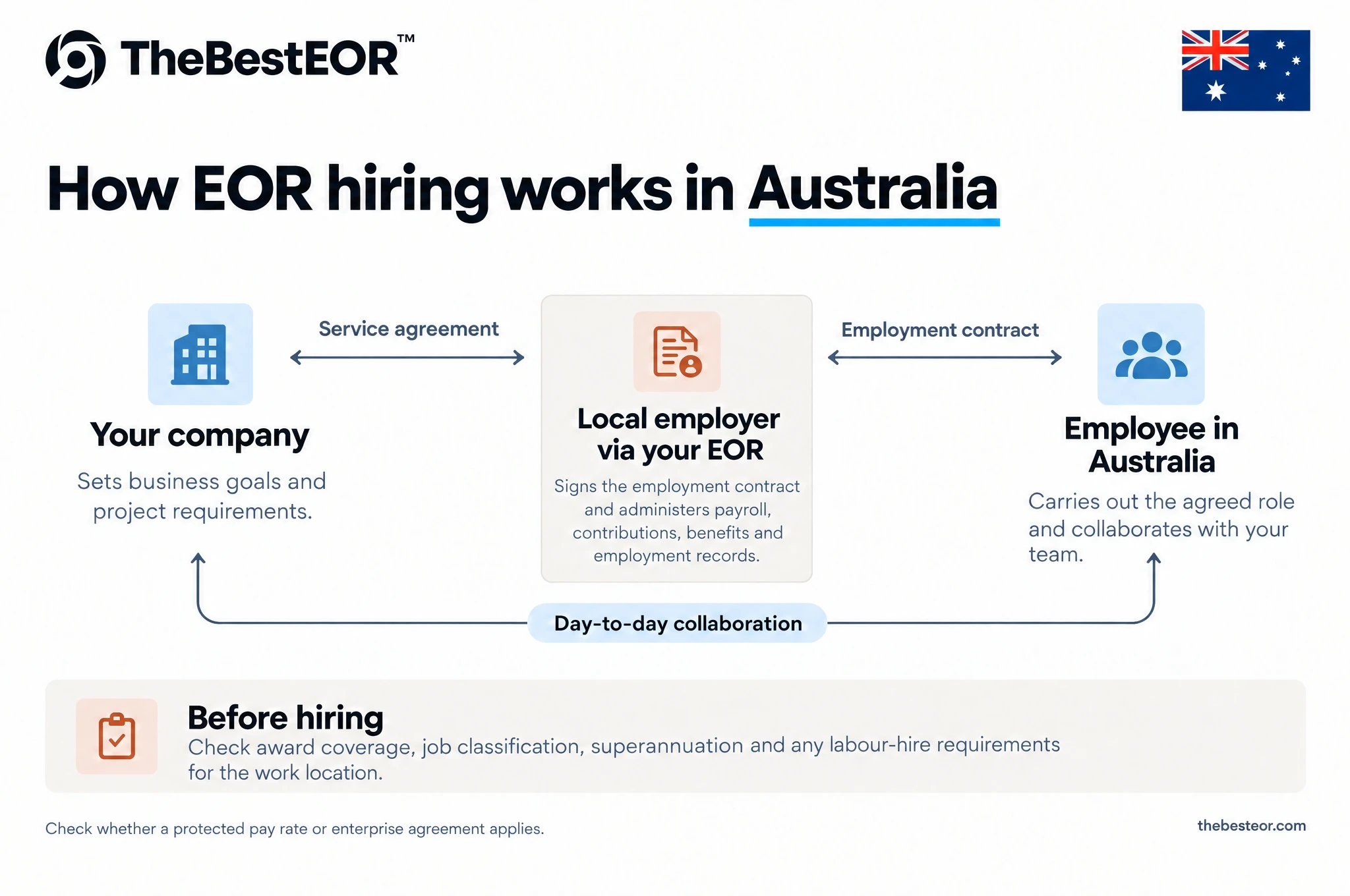
Employer of record in Australia diagram showing the service agreement, employment contract, and day-to-day collaboration between your company and the employee.
Employer of record in Australia: how your company, the local employer and the employee work together. Select the image to enlarge.

The EOR handles

1
Employer of record status on its Australian Pty Ltd, and the statutory exposure that comes with it
2
12% superannuation to the employee’s nominated fund
3
PAYG withholding and Single Touch Payroll reporting each pay run
4
State payroll tax registration and payment where the threshold is met
5
Workers’ compensation cover for the relevant state
6
Modern award identification, classification and the 17.5% leave loading
7
The compliant contract plus the Fair Work Information Statement
8
Skills in Demand 482 sponsorship, if its entity is an approved sponsor
9
Compliant offboarding, notice, redundancy and the documented dismissal case

You keep

1
Direct the work: tasks, deadlines and deliverables stay yours
2
Set the pay: salary, bonus and any allowances
3
Decide who joins, and when someone leaves
4
Manage performance, and build the file any dismissal will rest on
5
Pick the equipment; a few providers will ship and manage devices if you ask
6
Hold the commercial relationship and the IP assignment, which goes into the contract on your terms

If you engage an Australian worker as an independent contractor while they work set hours under your direction, the Fair Work Commission or the ATO can treat them as an employee, with back superannuation, PAYG, leave entitlements and civil penalties attached. The ATO can also deem certain contractors employees for superannuation purposes alone. The same person on an EOR employment contract from day one, with super and PAYG running, gives that question nothing to attach to. The misclassification guide covers the multi-factor test Australian courts apply. Before you engage a contractor, check how the work is actually done with our employee misclassification calculator.

Work permits

Skills in Demand visa thresholds (2025-26)

Check which salary floor applies to the visa stream.

The subclass 482 Skills in Demand visa replaced the old 457/TSS in December 2024 and runs three income-based streams. These are the 2025-26 salary floors, with the indexed rates that took effect on 1 July 2026 alongside.

Stream Salary floor (2026) From 1 July 2026 Typical duration PR pathway
Stream
Core Skills (CSIT)
Salary floor (2026)
AUD 76,515/yr
From 1 July 2026
AUD 79,423 rate
Typical duration
Up to 4 years
PR pathway
Yes, via subclass 186
Stream
Specialist Skills (SSIT)
Salary floor (2026)
AUD 141,210/yr
From 1 July 2026
AUD 146,576
Typical duration
Up to 4 years
PR pathway
Yes, faster processing
Stream
Labour Agreement
Salary floor (2026)
Per the agreement
From 1 July 2026
Per the agreement
Typical duration
Varies
PR pathway
Negotiated

Fig. 7 · Skills in Demand 482 streams and salary floors · the threshold that applies is set by the lodgement date

Confirm the proposed sponsorship route before planning a foreign hire. Owning an Australian company does not by itself give permission to sponsor the worker or place them with your business. Standard Business Sponsorship approval is distinct from optional accredited status; a labour agreement may provide a different route.

Standard business sponsor obligations restrict supplying sponsored workers to another business. The associated-entity and exempt-occupation exceptions have specific conditions. Ask the provider’s immigration adviser to explain how the proposed EOR arrangement is permitted, identify the sponsor and confirm the role, salary and nomination requirements.

Sources checked 6 October 2026: Home Affairs guidance on Standard Business Sponsorship, sponsorship routes and sponsor obligations.

Salary benchmarks

What roles cost in Australia, 2026

The Australian dollar figures cover base pay only.

PayScale reports the following national average annual base salaries in Australian dollars. The ranges are its rounded 10th–90th percentiles. These figures cover mixed experience levels within each role and exclude separately reported bonuses and commissions. Check location, experience and superannuation terms when comparing an individual offer.

Role and source Average base pay / year 10th–90th percentile / year Source sample and update
Role and source
Software engineer
Average base pay / year
AUD 90,878
10th–90th percentile / year
AUD 68,000–127,000
Source sample and update
1,011 profiles · 14 July 2026
Role and source
Senior software engineer
Average base pay / year
AUD 135,920
10th–90th percentile / year
AUD 102,000–175,000
Source sample and update
520 profiles · 1 July 2026
Role and source
Accountant
Average base pay / year
AUD 69,467
10th–90th percentile / year
AUD 53,000–91,000
Source sample and update
1,424 profiles · 9 July 2026
Role and source
Customer-service representative
Average base pay / year
AUD 59,501
10th–90th percentile / year
AUD 48,000–70,000
Source sample and update
668 profiles · 25 June 2026
Role and source
National sales manager
Average base pay / year
AUD 120,339
10th–90th percentile / year
AUD 81,000–167,000
Source sample and update
156 profiles · 25 June 2026
Role and source
HR manager
Average base pay / year
AUD 105,163
10th–90th percentile / year
AUD 78,000–151,000
Source sample and update
387 profiles · 7 July 2026
Role and source
Graphic designer
Average base pay / year
AUD 66,082
10th–90th percentile / year
AUD 51,000–83,000
Source sample and update
921 profiles · 14 July 2026

Fig. 8 · PayScale national base-salary data · source updates June–July 2026; checked 2 October 2026

Use the linked role pages to compare experience and city filters before setting an offer. A national survey average is a reference point; the pay needed for a particular hire depends on the job, location and candidate.

Fully-loaded cost

What an Australian engineer really costs per month

Start with AUD 115,000 in gross annual pay.

Software engineer, Sydney Gross base: AUD 115,000/yr (AUD 9,583/mo)
Gross salary AUD 9,583

Superannuation (12%)

On the illustrated qualifying earnings, below the annual SG base
AUD 1,150

State payroll tax (~5.45%)

Illustrative NSW rate on salary plus super; assumes the EOR is above the threshold
AUD 585

Workers' compensation (~1.5%)

Indicative office-role rate, varies by state and industry
AUD 144

EOR fee illustration

RemoFirst $199 ≈ AUD 283
⚠ Trustpilot warning: rating suspended for a breach of its guidelines; fake reviews removed
AUD 283

Monthly total, cheapest fee

Annual ≈ AUD 140,940; USD equivalent depends on the exchange rate
AUD 11,745

Fig. 9 · Fully-loaded monthly cost, illustrative AUD115,000 salary · NSW illustration, with payroll tax on salary plus super from the first hire; USD fee conversions retain the original August 2026 assumptions

An illustrative $499 fee (≈ AUD 709) lands at AUD 12,171/month, and an illustrative $599 fee (≈ AUD 851) gives a monthly total of AUD 12,313/month (≈ AUD 147,756/year). Superannuation is the largest fixed statutory line in Australia, and state payroll tax is the biggest variable.

Reconcile the NSW payroll-tax line

For a Sydney hiring budget, separate the payroll-tax base from cash salary. Revenue NSW includes employer superannuation contributions in taxable wages. Using the table’s rounded monthly salary of AUD 9,583 and super of AUD 1,150 gives AUD 10,733 before any other taxable items.

At the example’s assumed 5.45% rate, that salary-plus-super base gives about AUD 585, rather than AUD 522 on salary alone. The actual provider must apply the proper threshold, deductions, grouping and employment-agency treatment.

Revenue NSW distinguishes wages from the fee paid to an employment agency and the GST component, which are not taxable wages under that guidance. Ask for a reconciliation showing salary, super, other taxable remuneration, exclusions and the tax calculation.

EOR vs your own entity

EOR or your own Pty Ltd: compare costs

A Pty Ltd needs a resident director.

Factor EOR Your own Pty Ltd
Factor
Setup cost
EOR
None
Your own Pty Ltd
~AUD 636 ASIC registration + agent/legal setup
Factor
Time to first hire
EOR
2–7 days
Your own Pty Ltd
2–6 weeks (company, TFN/ABN, PAYG, super, workers' comp)
Factor
Resident director
EOR
Not required
Your own Pty Ltd
At least one Australia-resident director + Director ID
Factor
Per-employee cost
EOR
$199–599/employee/mo fee + statutory
Your own Pty Ltd
Statutory only, plus shared overhead
Factor
Ongoing admin
EOR
Provider runs payroll, super & STP
Your own Pty Ltd
Your own payroll, STP, BAS, ASIC annual review (AUD 342)
Factor
Compliance liability
EOR
On the EOR
Your own Pty Ltd
On you and your directors

Fig. 10 · Illustrative EOR-versus-entity comparison; the crossover depends on the fee plan, local operating costs and hiring duration.

At an illustrative USD 199 monthly service fee, the service-fee component is about AUD 3,400 a year per employee before other EOR charges or entity administration costs. For your own Pty Ltd, accounting, payroll, Single Touch Payroll, the ASIC annual review and workers’ compensation administration add roughly AUD 12,000 to AUD 25,000 a year in fixed overhead regardless of headcount, plus director compliance liability.

Annualise the selected service fee for the hires you expect to keep, then compare it with the PtyLtd setup, ASIC costs, payroll/STP administration and insurance. Count setup costs over the same hiring horizon and include payroll, benefits, transition and exit charges on both sides. A higher service-fee plan moves the financial crossover earlier; lower recurring entity overhead or a longer hiring horizon can do the same. Short hiring duration, setup costs and the need for local administration can move it later.

FAQ

EOR in Australia: common questions

What is the best EOR in Australia?

RemotePeople is our top pick for Australia in 2026 (4.9/5), followed by Deel (4.7/5) and Rippling (4.5/5). We opened paid accounts with all 10 providers on this page, priced real hires and ran payroll.

RemotePeople employs Australian staff through its own Queensland company (ACN 661 070 471), which holds labour hire licences in Queensland, Victoria and the ACT. RemotePeople’s EOR Global plan starts at USD 499 per employee per month, and EOR Select at USD 199 where the hire qualifies. Deel starts at USD 599 plus a mandatory Employer Liability Cost; Rippling starts at USD 499 plus its required platform subscription.

How does an employer of record work in Australia?

An employer of record in Australia becomes the worker’s legal employer through a local employing entity, while your company directs the day-to-day work. The EOR pays 12% superannuation to the employee’s fund, runs PAYG withholding with Single Touch Payroll reporting, arranges workers’ compensation and state payroll tax where the threshold is met, and applies the right modern award with the Fair Work Information Statement.

How fast can an EOR onboard an employee in Australia?

Estimated onboarding times for Australia range from 2 to 8 days across the providers we tested. By provider: Deel 2–5 days, Rippling 2–5 days, Oyster 2–5 days, Multiplier 2–5 days, RemotePeople 3–6 days and Borderless AI 5–8 days.

Australia is a tier-1 market: RemotePeople, Deel, Oyster, Multiplier and G-P all say they run direct entities here, and they onboard inside that window. Single Touch Payroll reporting and the superannuation fund nomination add no material delay once the entity is in place.

How much does an EOR cost in Australia per month?
Published service fees for Australia run from USD 199 to USD 699 per employee per month across the 10 providers we tested: RemoFirst from USD 199; RemotePeople Global from USD 499, or Select from USD 199 only where country and salary qualify; Deel from USD 599 plus mandatory Employer Liability Cost; G-P from USD 599; Oyster USD 699 on monthly billing, with annual seats quoted separately. Multiplier Core advertises $499 monthly or $459 per month billed annually; Pebl advertises $399, with currency and commitment to confirm. Rippling starts at USD 499 plus its required platform from USD 8 per employee, and Papaya Global at USD 499. Borderless AI is USD 579 standard, with an eligible USD 399 promotion on fees billed through 31 December 2026. All amounts are per employee/month; salary and employment costs are separate. On top of the fee you pay the employee’s gross salary plus 12 percent superannuation and, once the employer crosses the state payroll-tax threshold, state payroll tax at the applicable rate and threshold. ACT general rates for 2026–27 are 6.75% to 8.75%; the total employer load depends on the wage base, state and other applicable costs.
 
What employer contributions are mandatory in Australia?

For eligible workers, super guarantee is 12 percent of qualifying earnings, subject to the annual SG contribution base of AUD 270,830 in 2026–27. Additional award or enterprise-agreement obligations can apply. State payroll tax depends on the employer or group wage bill, local taxable wages and the applicable threshold. ACT general rates for 2026–27 range from 6.75% to 8.75%. Workers’ compensation insurance is also mandatory and priced by state and industry. An EOR pools wages across its clients, so payroll tax often applies from your first hire.

What is superannuation and what rate applies in 2026?

Superannuation is Australia’s retirement savings system. For eligible workers, the minimum employer super guarantee is 12 percent of qualifying earnings. The 2026–27 annual SG contribution base is AUD 270,830; an award or enterprise agreement may require additional contributions.

Payday Super applies to earnings paid from 1 July 2026. Contributions generally must reach the fund within seven business days after payday with enough information to allocate them to the employee’s account. Specified extensions include 20 business days for a first eligible contribution for a new employee or a new complying fund. The final April–June 2026 quarterly payment was due on 28 July 2026; quarterly payment is not the current rule for earnings paid from July.

What is the minimum wage in Australia in 2026?

The National Minimum Wage is AUD 26.44 per hour, or AUD 1,004.90 a week for a 38-hour week, effective 1 July 2026 under the Annual Wage Review 2026. Casual employees receive a 25 percent loading on top, lifting the casual floor to about AUD 33.05 per hour. Most employees are covered by a modern award that sets a higher minimum for their classification, so the award rate usually applies rather than the National Minimum Wage.

How much notice and redundancy pay applies when terminating in Australia?

Redundancy pay scales from four weeks at one to two years up to sixteen weeks at nine to ten years, then drops to twelve weeks at ten years or more. A three-year employee on AUD 120,000 made redundant receives seven weeks’ redundancy plus two weeks’ notice, about AUD 20,769.

See the notice and redundancy section above for eligibility, exclusions and the applicable service band. The employee’s age and continuous service can also affect notice.

What currency and payroll cycle does Australia use?

The Australian dollar (AUD). Payroll commonly runs fortnightly or monthly, and every pay run is reported to the Australian Taxation Office through Single Touch Payroll on or before payday. PAYG income tax is withheld each pay run and remitted on the employer’s activity statement. For earnings paid from 1 July 2026, Payday Super generally requires the fund to receive the contribution within seven business days after payday, with allocation information; specified longer timeframes can apply. About AUD 1.42 equals one US dollar at the July 2026 exchange rate.

Can an EOR sponsor a Skills in Demand (482) visa in Australia?

An Australian EOR’s entity does not mean it can sponsor the proposed client assignment. For the Skills in Demand Core Skills route, distinguish Standard Business Sponsorship approval from accredited-sponsor status, and check the nomination, role and candidate requirements. A sponsor’s approval is one part of the assessment.

Ask for the proposed visa route and sponsor, the actual workplace and client assignment, and the applicable salary threshold for the nomination date. Have the provider explain any restriction on supplying the worker to another business before committing to a start. A person who already has unrestricted permission to work needs only a right-to-work check.

Can I convert an Australian contractor to an EOR employee?

A move to employment should include a review of past contractor obligations. An Australian contractor who works set hours under your direction can be found to be an employee, exposing you to back superannuation, PAYG, leave entitlements and Fair Work penalties. The ATO can also treat some contractors as employees for super purposes alone. An EOR issues a compliant employment contract, runs PAYG and 12 percent super, and reports through Single Touch Payroll, usually within a week. See the contractor misclassification guide.

Do I need a Pty Ltd to hire one person in Australia?

Ask for the legal employer’s name and registration details.

Annualise the selected service fee for the hires you expect to keep, then compare it with the PtyLtd setup, ASIC costs, payroll/STP administration and insurance.

Does payroll tax apply to a single EOR hire in Australia?

Payroll-tax rates and thresholds depend on the state, employer or group wage bill and applicable concessions or surcharges. For the ACT in 2026–27, general rates run from 6.75% to 8.75% by Australia-wide wages.

Ask for the legal employer’s name and registration details.

Sources and as-of dates

Article references

Check any figure against the agency that sets it. Where a rate stepped up on 1 July 2026, the new figure is shown with that date.

Hiring facts Checked 2 Oct 2026

Hiring facts

Checked 2 October 2026
Eligibility, local and collective rules apply. EOR fees extra.

Fair Work Act 2009 and the National Employment Standards 2 sources

For employees covered by the National Employment Standards: a 38-hour full-time week plus reasonable additional hours; 4 weeks of paid annual leave, with an extra week for some shiftworkers; and 10 days of paid personal/carer’s leave for full-time employees, pro rata for part-time employees. Casuals receive only specified NES entitlements. Notice and redundancy follow the applicable NES scales and exceptions. Fair Work Ombudsman.

Superannuation guarantee and Payday Super 8 sources

12% of qualifying earnings for eligible workers, subject to the 2026–27 annual SG base of AUD 270,830. For earnings paid from 1 July 2026, contributions generally must be received and allocable within seven business days after payday; specified longer periods apply. The final April–June quarter remained due on 28 July 2026.

National Minimum Wage 2 sources

The adult National Minimum Wage is AUD 26.44 per hour or AUD 1,004.90 per week from the first full pay period starting on or after 1 July 2026, for employees not covered by an award or enterprise agreement. Eligible casual employees receive a 25% loading. Different minimum rates can apply to juniors, apprentices, trainees and some employees with disability. Fair Work Ombudsman and the Fair Work Commission’s Annual Wage Review 2026.

Annual leave loading 1 source

Annual leave loading, often 17.5%, applies where the relevant modern award or enterprise agreement provides it; it is not a universal NES entitlement. Some awards require the higher of the loading and specified shift or penalty payments. Fair Work Ombudsman.

Redundancy and notice 2 sources

Under the NES, redundancy pay reaches 16 weeks for at least 9 but less than 10 years of continuous service, then 12 weeks at 10 years or more. Most employees of businesses with fewer than 15 employees are exempt, subject to counting rules and exceptions, including some industry-specific provisions. Notice is normally 1–4 weeks by service, plus an extra week for employees over 45 with at least 2 years’ service. Fair Work Ombudsman.

Unfair dismissal 2 sources

For dismissals on or after 1 July 2026, the high income threshold is AUD 190,100 and the statutory unfair-dismissal compensation cap is AUD 95,050. The individual compensation limit is the lower of that cap and half the employee’s annual wage. Award or enterprise-agreement coverage can preserve eligibility above the income threshold. Fair Work Commission.

Long service leave 2 sources

Long service leave usually depends on state legislation and the applicable employment arrangements. In Victoria, most eligible workers can take accrued leave after 7 years, accruing one week per 60 weeks of continuous service, or about 6.07 weeks after 7 years. In NSW, the standard entitlement is 2 months (8.67 weeks) after 10 years; some termination circumstances permit earlier pro-rata payment. State coverage and exceptions apply.

State payroll tax 5 sources

State and territory payroll tax depends on total Australian or group wages, local taxable wages and applicable deductions. Queensland’s general rates are 4.75% or 4.95%, with a AUD 1.3 million annual threshold. For 2026–27, ACT rates range from 6.75% to 8.75%, with a AUD 1.75 million threshold; the 8.75% tier began in January 2026. Annual thresholds include Victoria AUD 1 million, South Australia AUD 1.5 million and Northern Territory AUD 2.5 million. Regional concessions, surcharges and threshold adjustments can apply.

PAYG and Single Touch Payroll 3 sources

Australian resident income-tax rates are progressive, reaching 45%; for 2026–27 the first taxable bracket is 15% above the tax-free threshold and up to AUD 45,000. The Medicare levy is generally 2%, with reductions and exemptions. Employers generally report salary, PAYG withholding and super through Single Touch Payroll each time employees are paid.

Skills in Demand visa (subclass 482) 2 sources

For Skills in Demand (subclass 482) nomination applications, the Core Skills Income Threshold was AUD 76,515 and the Specialist Skills Income Threshold AUD 141,210 for 1 July 2025–30 June 2026. For nominations lodged 1 July 2026–30 June 2027, the thresholds are AUD 79,423 and AUD 146,576 respectively. The annual market salary requirement also applies. Department of Home Affairs.

Pty Ltd setup 3 sources

A Pty Ltd company incurs an initial ASIC registration fee and an annual review fee; confirm the applicable amounts in ASIC’s current fee schedule, which is indexed each July. At least one director must normally live in Australia, and directors must apply for a Director ID before appointment. Australian Securities and Investments Commission.

Salary benchmarks 7 sources

Each role links to its own PayScale Australia salary page and sample/update paragraph. The table uses the publisher’s average annual base pay and rounded 10th–90th percentiles, with June–July 2026 source updates. These national samples mix experience levels and exclude the employer’s additional hiring costs.

Provider pricing, entity model and onboarding 10 sources

Sources on annualised wages, payroll tax and notice Checked 19 Oct 2026

Fair Work Ombudsman annualised wages and salaries — Award-specific annualised arrangements, records and reconciliation; a high salary does not dispense with applicable award conditions. Checked 19 October 2026.

Revenue NSW superannuation and payroll tax — Employer superannuation contributions are taxable wages in NSW. Checked 19 October 2026.

Revenue NSW employment agencies — Agency-contract treatment, taxable wages including super, non-taxable agency fees and GST, and exemptions. Checked 19 October 2026.

ACT Revenue Office current payroll-tax rates — 2026–27 rates range from 6.75% to 8.75% by Australia-wide wages; threshold AUD 1.75 million. Checked 19 October 2026.

Fair Work Ombudsman dismissal and notice — Additional notice applies to employees over 45 with at least two years service; full pay-in-lieu scope and exceptions. Checked 19 October 2026.

Ask the provider to itemise salary, superannuation and other charges. Use the directory to compare EOR providers for Australia, or see the country guides for another market. The EOR cost calculator totals the recurring USD amounts from each proposal.

This guide is for general information only and does not provide legal, tax, accounting, or financial advice. For advice about your business, consult a qualified professional familiar with the rules where you hire. The research methodology explains how TheBestEOR assesses sources.