



Guide overview

What makes up your EOR budget?

Recurring expense: salary, employer contributions, benefits, the EOR service fee and any recurring currency or payment charges. One-time expense: setup, event and exit charges you’ve agreed to. Upfront cash: deposits, reserves and payroll funded in advance.

EOR pricing comparison: fees per employee per month, 10 providers

Providers are listed alphabetically so you can find a fee by name. Our recommendations also weigh service and contract terms, which we cover in our comparison of the best EOR services.

Fees are per employee per month. We show USD only where the currency is confirmed: Multiplier and Pebl use a dollar sign without saying which dollar. Annual prices require the annual commitment. Salary, employer contributions, benefit premiums and separately charged services are extra. We may earn commissions or referral fees when a reader becomes a customer through our links or provider introductions.

Our team has tested every provider in this table, and our provider ratings show the order in which we recommend them overall. A rating isn’t a score for any single fee, contract term, certification or country.

Best For: Getting 24/7 help with overseas payroll and HR
Starting fee: $579
USD / employee / month
See details
Countries and services

Pricing & terms

EOR fee from

US$579

Billing and minimums

USD 579 as standard. Eligible companies headquartered outside Canada can pay USD 399 on EOR fees billed through 31 December 2026, then USD 579 from 1 January 2027. Exceptions apply for some countries and employment types.

Additional costs and cash

A deposit is due before onboarding, usually 1.5 months of gross salary plus employer costs and fees if you pay by ACH, or three months for other payment methods. That total covers salary, employer contributions, benefits and platform fees. Country terms can differ, and late payments can raise the deposit. This conflicts with the no-deposit claim in Borderless AI’s marketing.

Our rating

4.0/5

Borderless AI dashboard

Enlarge screenshot
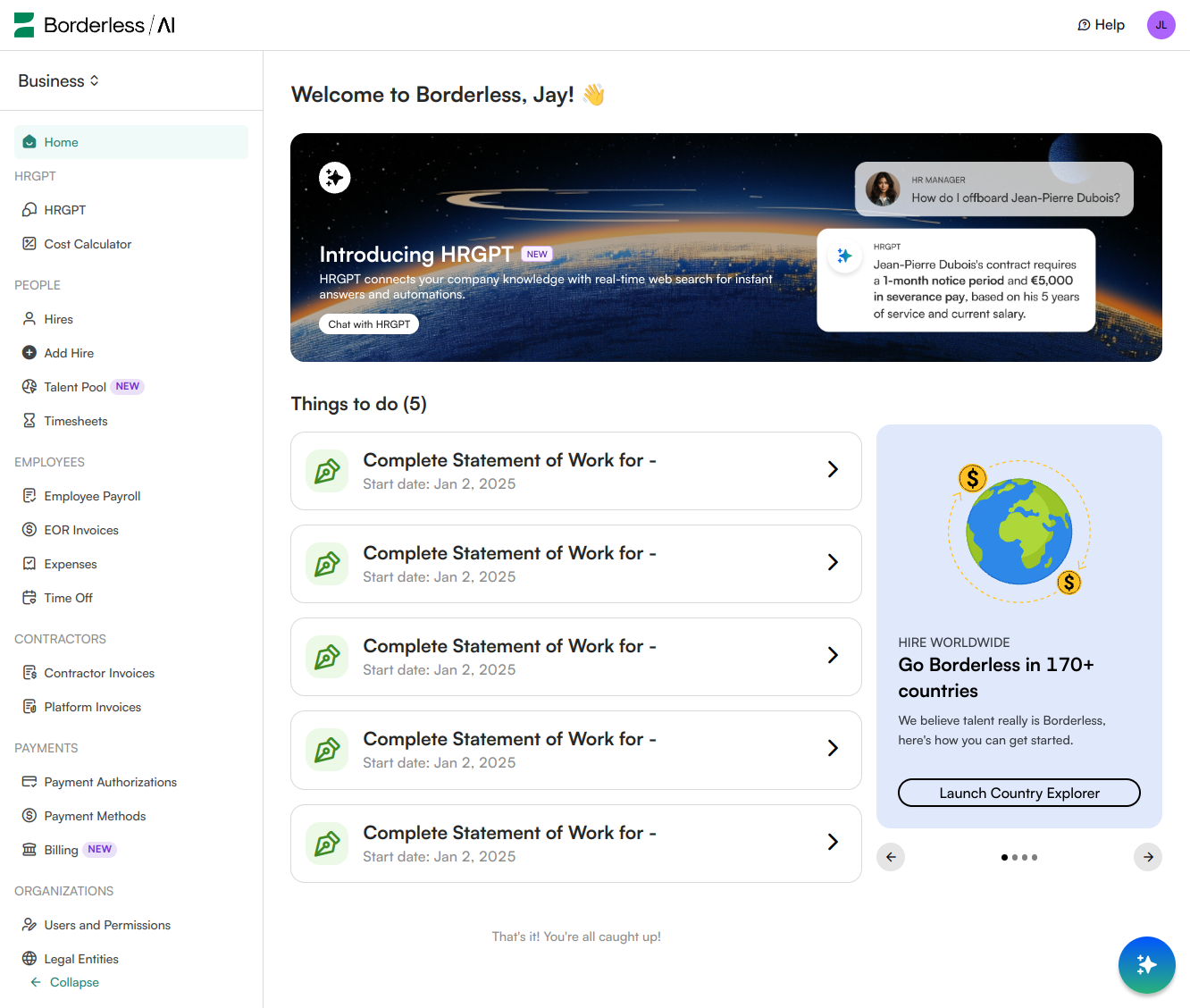
Borderless AI dashboard with outstanding tasks and links to HRGPT, hiring, payroll, invoices and expenses.
Borderless AI’s dashboard shows outstanding tasks and links to HRGPT, hiring, payroll, invoices and expenses.

Reviewed by Martynas PupkeviciusFact-checked by Michael Ennis

Opens hireborderless.com

Best For: Paying employees and contractors on one platform
Starting fee: $599
USD / employee / month
See details
Countries and services

Pricing & terms

EOR fee from

US$599

Billing and minimums

Billed month to month, with no long-term commitment.

Additional costs and cash

The Employer Liability Cost is mandatory and varies by country. Ask for that amount, the deposit and any currency charges along with the service fee.

Our rating

4.7/5

Deel dashboard

Enlarge screenshot
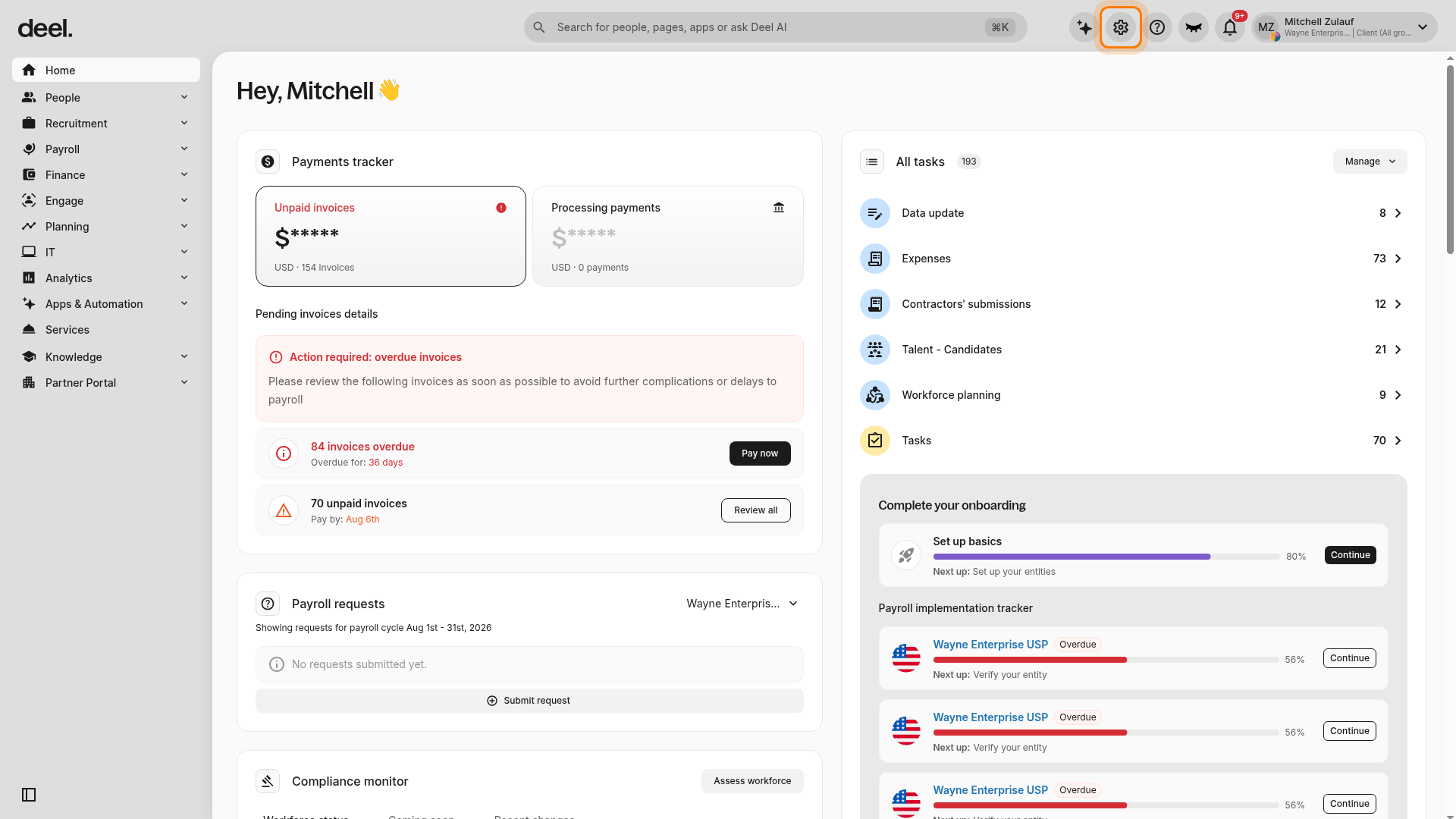
Deel dashboard with a payments tracker, outstanding tasks, onboarding progress and payroll requests.
Deel’s dashboard puts payment activity, outstanding tasks and onboarding progress alongside its HR and payroll navigation.

Reviewed by Martynas PupkeviciusFact-checked by Michael Ennis

Opens deel.com

Best For: Hiring abroad while keeping your existing HR system
Starting fee: From $599
USD / employee / month
See details
Countries and services

Pricing & terms

EOR fee

From US$599

Billing and minimums

No minimum duration for an EOR hire. Client billing, cancellation and employee exit terms are set separately.

Additional costs and cash

The published starting fee isn’t the final price for a country. Ask for a country proposal with the required employment costs, funding terms and any extra services.

Our rating

4.2/5

G-P dashboard

Enlarge screenshot
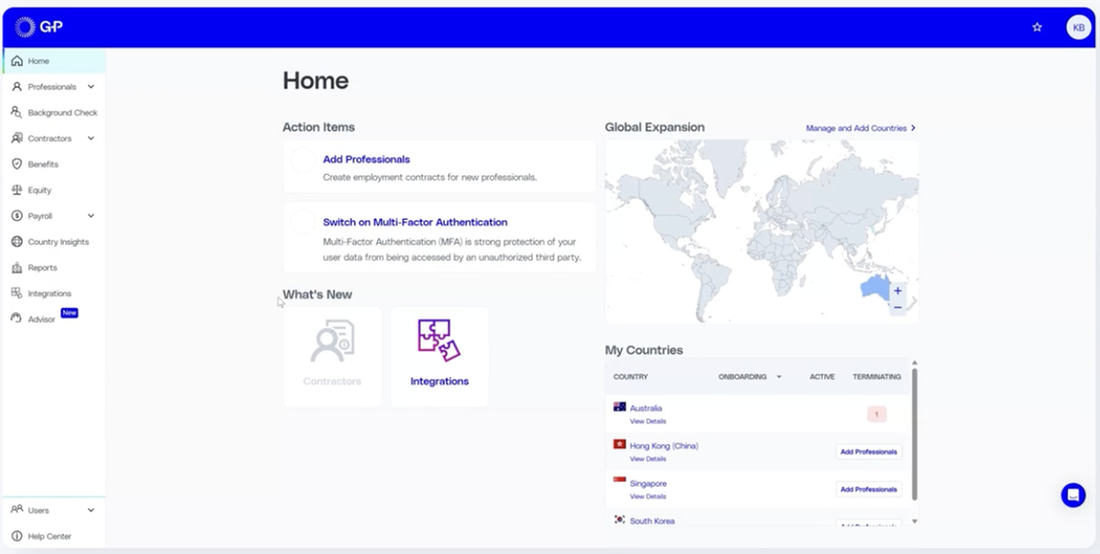
G-P dashboard with action items, a global workforce map and status summaries by country.
G-P’s dashboard combines action items with a global workforce map and status summaries by country.

Reviewed by Martynas PupkeviciusFact-checked by Michael Ennis

Opens globalization-partners.com

Best For: Managing payroll, leave and expenses in one place
Starting fee: $499
Dollar not stated
See details
Countries and services

Pricing & terms

EOR fee from

$499

Core plan: $499 billed monthly, or $459 a month billed annually

Billing and minimums

The pricing page doesn’t say which dollar. The $459 rate is the monthly equivalent of an annual bill.

Additional costs and cash

Compliance add-ons are charged separately. Implementation fees may apply, though the FAQ says setup is free, so your quote must settle it. Growth and Enterprise plans are priced differently.

Our rating

4.1/5

Multiplier dashboard

Enlarge screenshot
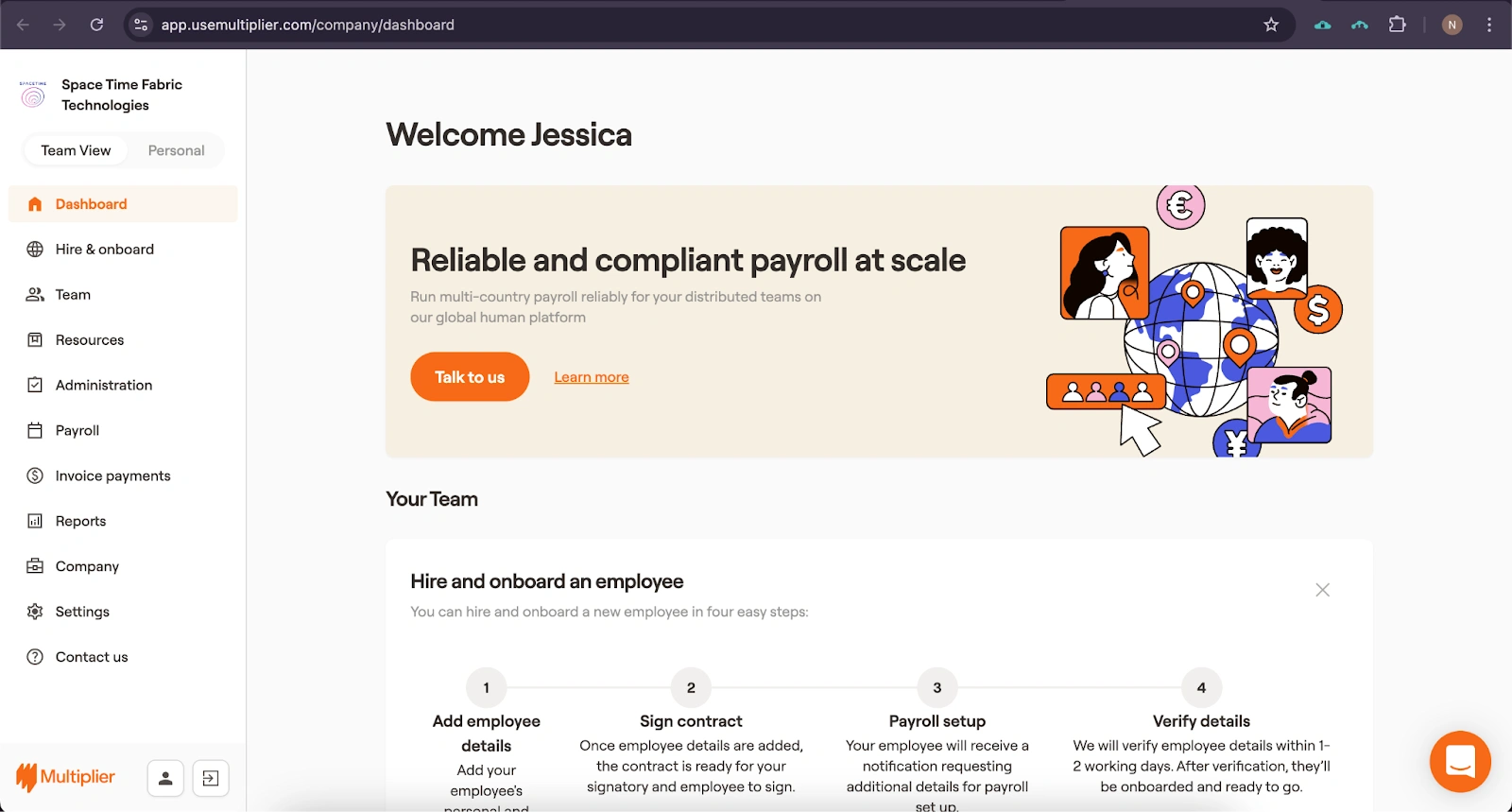
Multiplier dashboard with an onboarding checklist and navigation to hiring, payroll, invoices and reports.
Multiplier’s dashboard shows an onboarding checklist, with hiring, payroll, invoices and reporting available from the side navigation.

Reviewed by Martynas PupkeviciusFact-checked by Michael Ennis

Opens usemultiplier.com

Best For: Using one onboarding process for hires across countries
Starting fee: $699
USD / employee / month
See details
Countries and services

Pricing & terms

EOR fee from

US$699

Billing and minimums

USD 699 on monthly billing. Annual seats are priced by quote, nonrefundable and reusable. Prepaying the year gets the lowest seat price; paying quarterly or semiannually costs more.

Additional costs and cash

A deposit of at least one month of gross salary plus employer costs and service fees, with possible top-ups. Currency conversion fees apply if your payment currency differs from the contract currency. Optional benefits and advice cost extra.

Our rating

4.5/5

Oyster dashboard

Enlarge screenshot
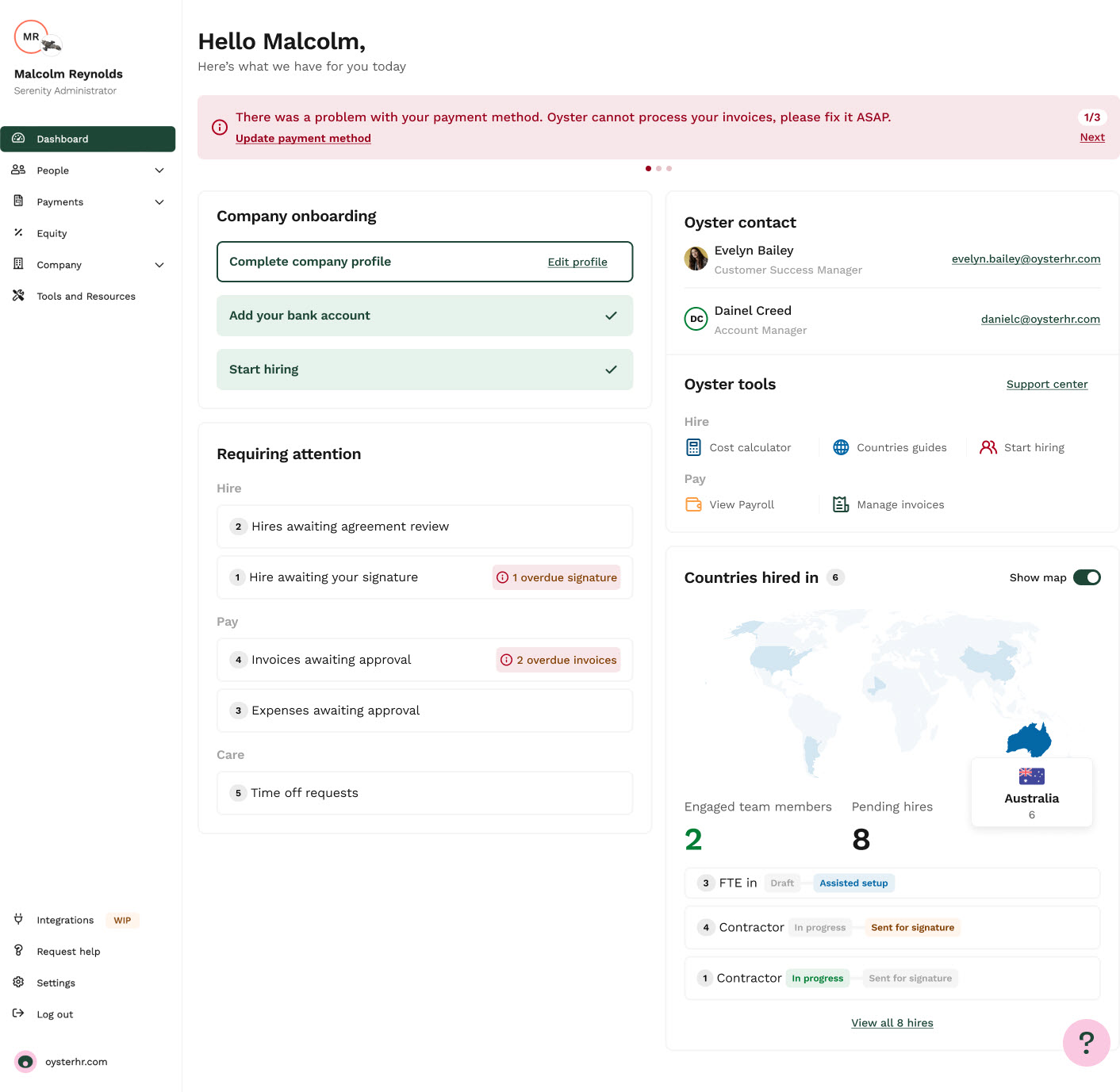
Oyster dashboard with hiring, payment and time-off tasks, support contacts and a map of team locations.
Oyster’s dashboard combines hiring, payment and time-off tasks with support contacts and a map of the team.

Reviewed by Martynas PupkeviciusFact-checked by Michael Ennis

Opens oysterhr.com

Best For: Comparing payroll costs across countries in one report
Starting fee: From $499
USD / employee / month
See details
Countries and services

Pricing & terms

EOR fee

From US$499

Billing and minimums

Papaya’s pricing page lists EOR from $499 per employee per month. Your country quote must confirm the billing commitment and any extra services.

Additional costs and cash

Salary, employer contributions, benefits, deposits and currency or payment charges are separate from the service fee. The agreement sets funding deadlines and any extra services.

Our rating

4.1/5

Papaya Global dashboard

Enlarge screenshot
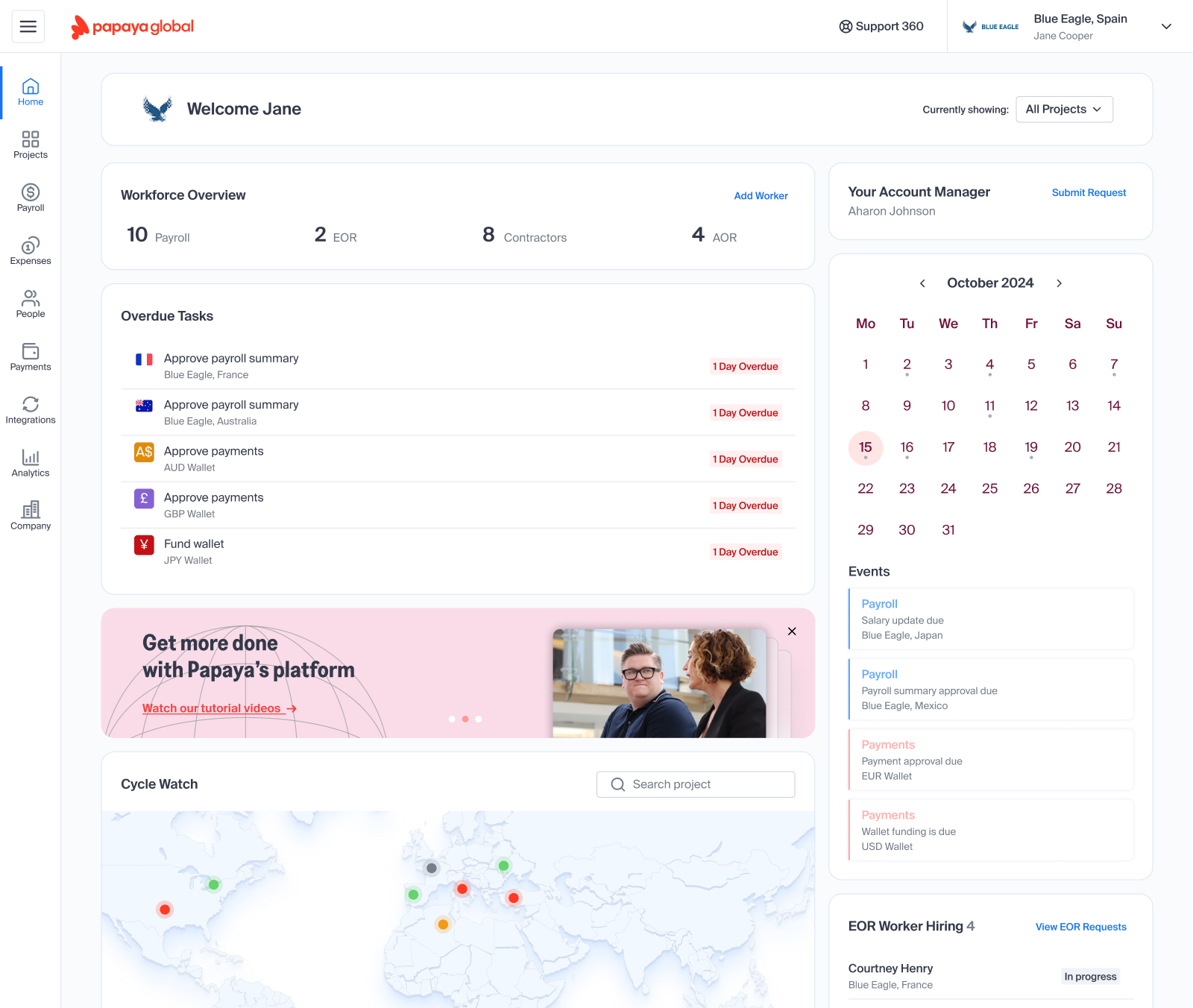
Papaya Global dashboard showing workforce totals, overdue payroll and payment tasks, a calendar and country activity.
Workforce totals, overdue payroll and payment tasks, a calendar and country activity appear on Papaya Global’s dashboard.

Reviewed by Martynas PupkeviciusFact-checked by Michael Ennis

Opens papayaglobal.com

Best For: Hiring people who need visa or relocation support
Starting fee: $399
Dollar not stated
See details
Countries and services

Pricing & terms

EOR fee from

$399

$399 (which dollar isn’t stated)

Billing and minimums

The order sets the billing commitment, country offer and renewal terms; the general $399 price doesn’t settle any of them.

Additional costs and cash

A security deposit is due before onboarding. Offboarding a worker takes at least 90 days’ notice, starting from the next calendar month, and service fees continue during that time. Salary, employer costs and statutory exit obligations are extra.

Our rating

4.2/5

Pebl onboarding

Enlarge screenshot
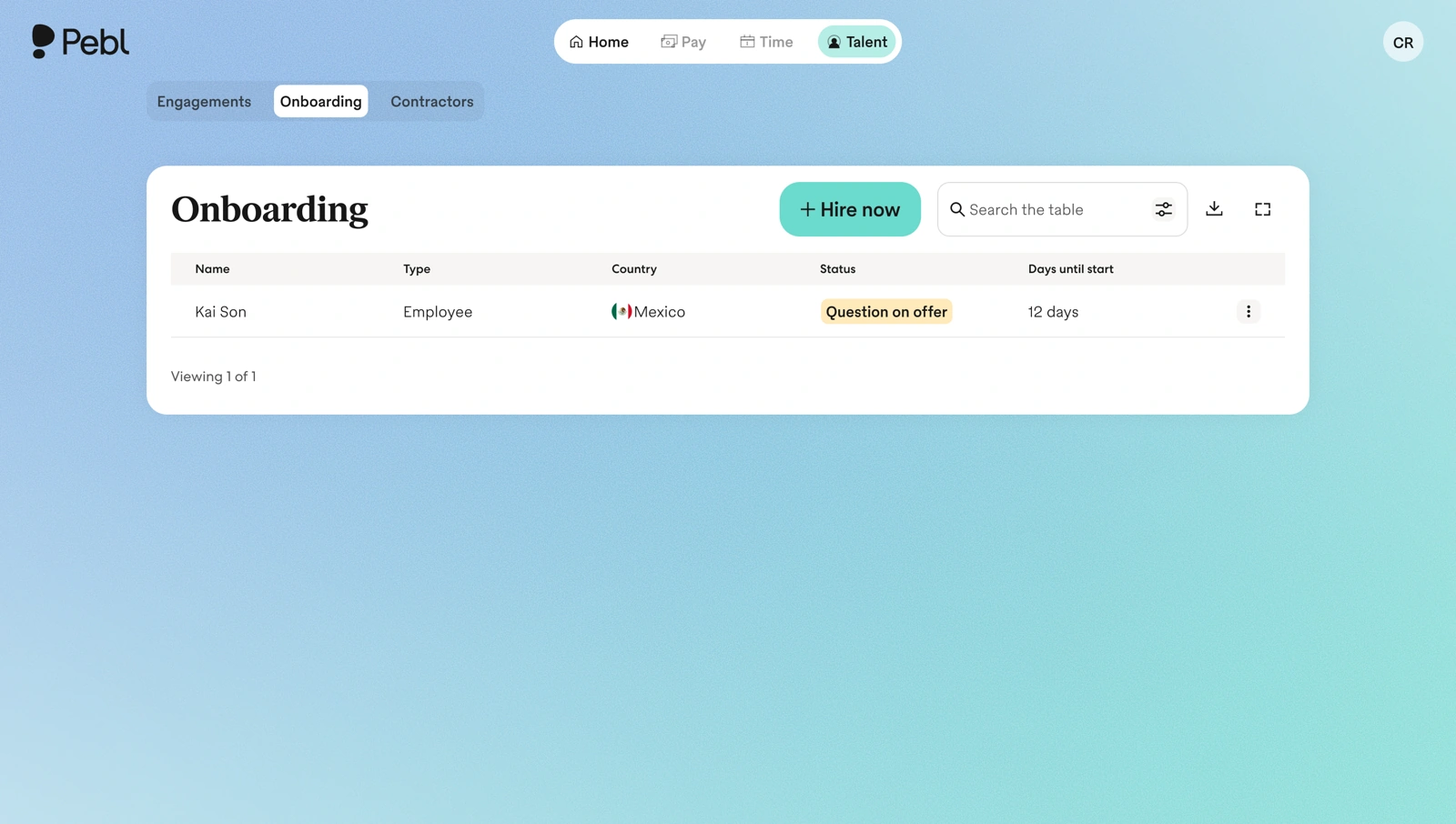
Pebl onboarding list with a sample hire in Mexico, offer status and days until the planned start.
Pebl’s onboarding view shows a sample hire’s country, offer status and planned start, with hiring controls above the list.

Reviewed by Martynas PupkeviciusFact-checked by Michael Ennis

Opens hellopebl.com

Best For: Making a first overseas hire on a tight budget
Starting fee: From $199
USD / employee / month
See details
Countries and services

Pricing & terms

EOR fee

From US$199

Billing and minimums

No minimum contract term or employee count.

Additional costs and cash

Country fees can be higher than the USD 199 starting price. Optional insurance, equipment, visas and checks cost extra. There are no setup, onboarding or termination-processing fees, but statutory exit costs for the employee are separate. The country proposal sets the deposit and payroll funding terms.

Our rating

0.5/5

⚠ Trustpilot warning: rating suspended for a breach of its guidelines; fake reviews removed (8 Nov 2026)

RemoFirst dashboard

Enlarge screenshot
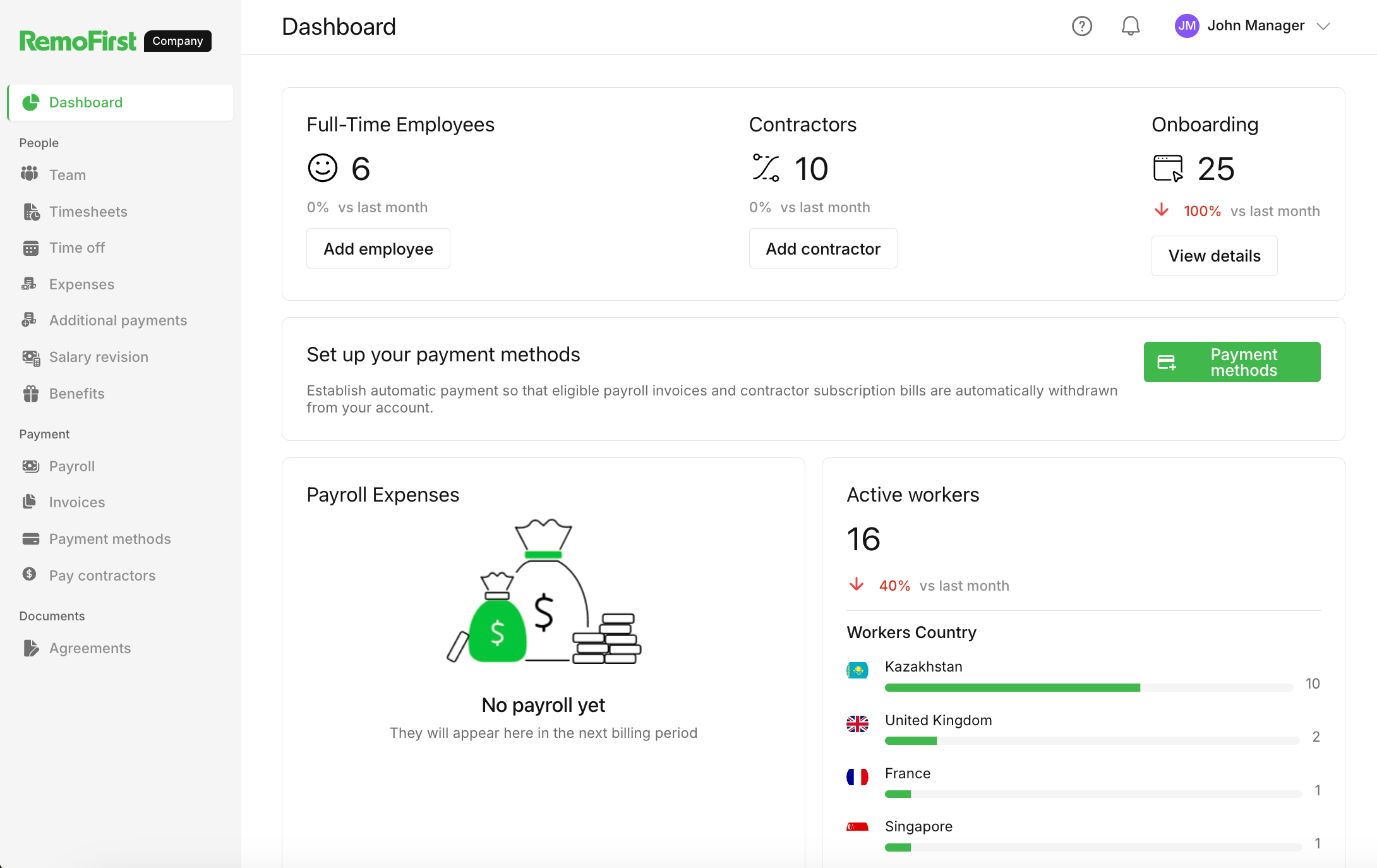
RemoFirst dashboard with workforce and onboarding totals, payment setup, payroll expenses and workers by country.
RemoFirst’s dashboard summarises employees, contractors and onboarding, alongside payment setup, payroll expenses and workforce locations.

Reviewed by Martynas PupkeviciusFact-checked by Michael Ennis

Opens remofirst.com

Best For: Hiring in new markets with local HR support
Starting fee: From $499
USD · Select from $199
See details
Countries and services

Pricing & terms

EOR fee

from USD 499

Global from USD 499; Select from USD 199

Billing and minimums

Select is limited to eligible countries and salary ranges. The country proposal sets which plan applies and the billing terms.

Additional costs and cash

Salary and employer contributions are extra. The quote for your plan sets any setup charge, the deposit amount and refund conditions.

Our rating

4.9/5

RemotePeople dashboard

Enlarge screenshot
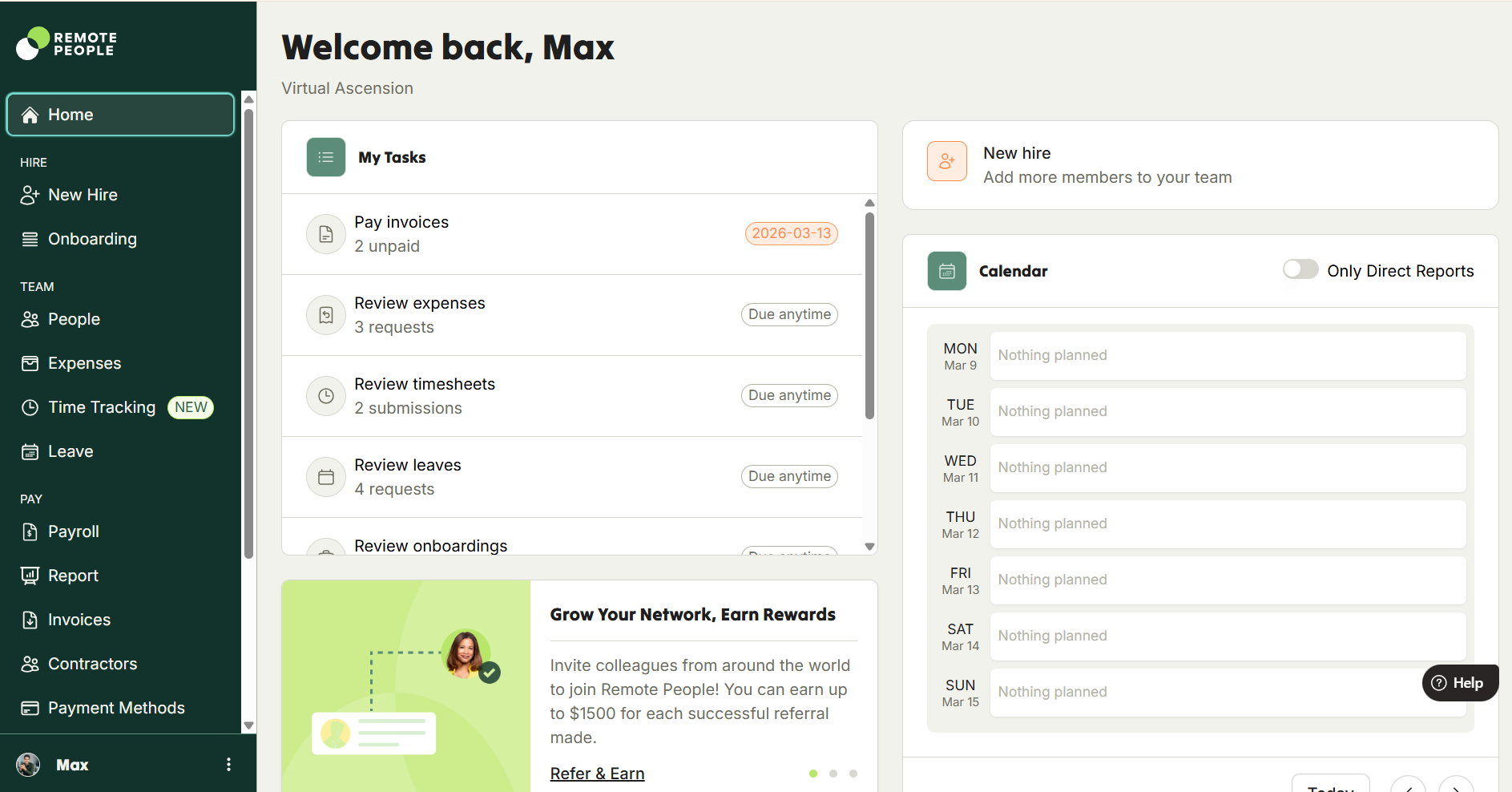
RemotePeople dashboard with invoice, expense and leave tasks, a hiring shortcut and team calendar.
RemotePeople’s dashboard groups outstanding tasks, hiring shortcuts and a team calendar in one view.

Reviewed by Martynas PupkeviciusFact-checked by Michael Ennis

Opens remotepeople.com

Best For: Setting up payroll, laptops and app access for new hires
Starting fee: From $499
USD / employee / month
See details
Countries and services

Pricing & terms

EOR fee

From US$499

Billing and minimums

Plus the required Rippling Platform, from $8 per employee per month and a monthly base fee.

Additional costs and cash

The Rippling Platform subscription is charged on top of the EOR fee. Optional products can add further charges.

Our rating

4.5/5

Rippling dashboard

Enlarge screenshot
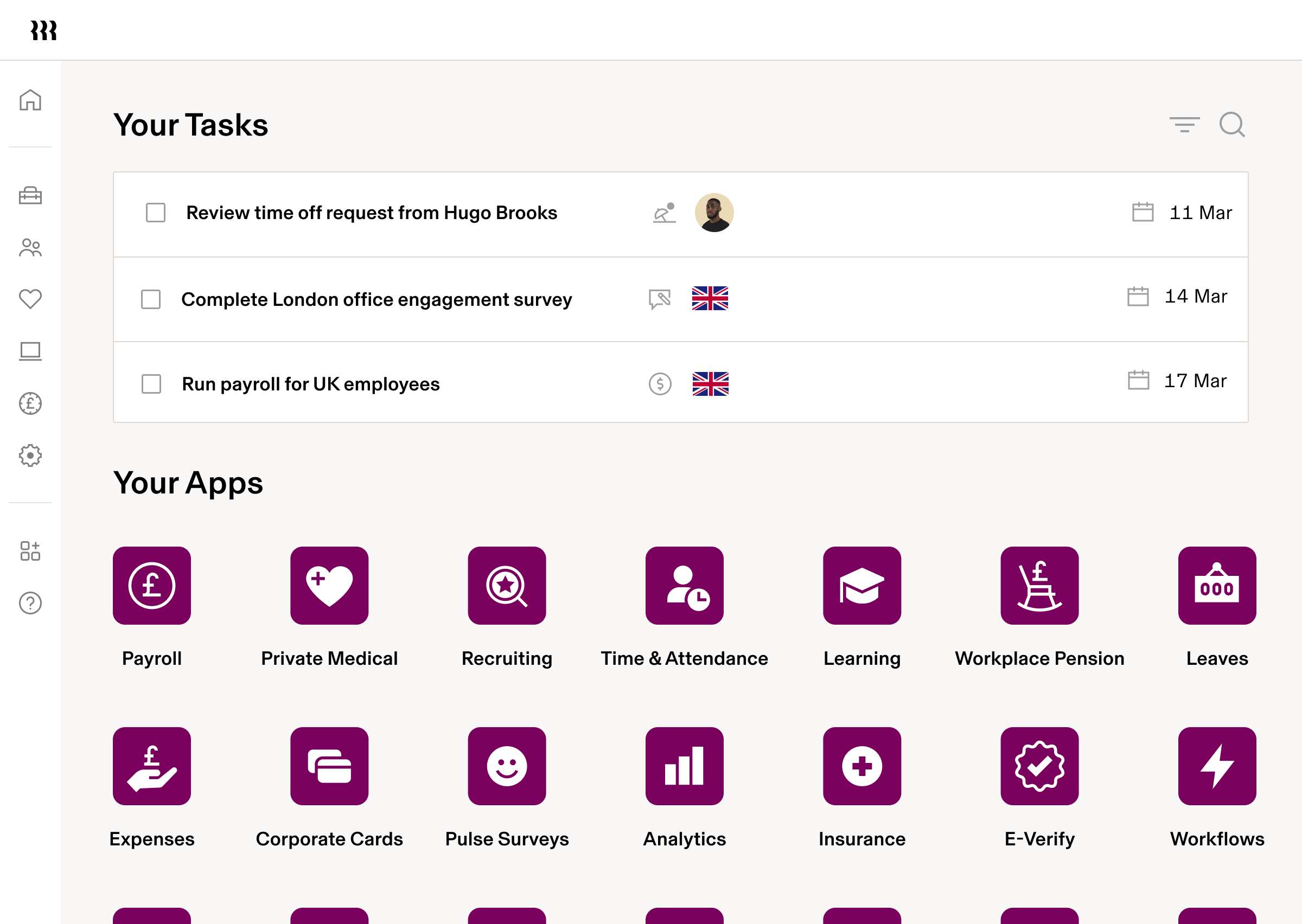
Rippling dashboard with time-off, survey and UK payroll tasks above HR and payroll app shortcuts.
Rippling’s dashboard example places upcoming tasks above shortcuts to payroll, benefits, recruiting and other apps.

Reviewed by Martynas PupkeviciusFact-checked by Michael Ennis

Opens rippling.com

By starting fee: USD 199 for RemoFirst, and for RemotePeople Select where the country and salary qualify; USD 499 to USD 599 for RemotePeople Global, Papaya Global, Rippling (plus its required platform), Borderless AI, Deel and G-P; and USD 699 for Oyster on monthly billing. We rank the lowest starting fees separately. Multiplier ($499) and Pebl ($399) don’t say which dollar.

Two providers outside the table are also worth comparing. Remote lists EOR from USD 599 per employee per month on an annual contract, or USD 699 as its standard monthly fee. An annual contract doesn’t necessarily mean paying for the year upfront, so confirm the country and invoice terms. Our Remote EOR pricing review compares monthly and annual billing and the costs outside the advertised fee, and our Remote alternatives comparison helps you build a shortlist to test against that quote. RemotePass’s Saudi Arabia page shows $350 a month billed annually (which dollar isn’t stated) and USD 460 billed monthly, but its pricing card mixes employee and contractor labels. Rechecked 1 November 2026: get a quote that confirms the product, currency and countries covered before you compare that offer.

Rippling lists EOR from USD 499 per employee per month, and its pricing page says the required platform starts at $8 per employee per month plus a monthly base fee.

What does an EOR service fee include?

The service fee pays the provider to run the employment relationship. Deel and RemoFirst, for example, list contract and onboarding support, payroll processing, tax filings and ongoing HR support as part of their EOR services.

The employee’s salary, employer contributions and benefit premiums sit outside that fee, so they need their own lines in the hiring budget. The global payroll calculator estimates employer contributions and take-home pay for a salary in 150 countries. Ask the provider to split its own charges from the money it collects to pay payroll and benefits.

Then check the scope against what you need: who answers employee questions, which payroll events are included, and whether immigration, recruitment, equipment or specialist advice cost extra.

EOR pricing models: flat fee or percentage of payroll

Read two things in every quote: how the fee is calculated and what you commit to. A low monthly figure may depend on buying an annual seat or meeting a minimum commitment.

Flat fee or percentage of payroll
Flat fee per employeeUSD 199 to USD 699 a month in this comparison
Percentage of payroll10% of a USD 5,000 salary is USD 500

Fixed fees per employee

You pay a set amount for each employee each month. Check whether it changes by country or plan, when billing starts, and how part months and vacant seats are handled. An annual discount lowers the monthly equivalent but commits you for longer.

Percentage-based fees

If a quote charges a percentage of salary or payroll, the signed fee schedule has to define the base, so get that definition before the quote goes into your forecast. At 10%, a hypothetical USD 5,000 monthly salary gives a USD 500 service fee. Check whether bonuses, employer contributions or benefits count toward the base, and whether there’s a minimum fee.
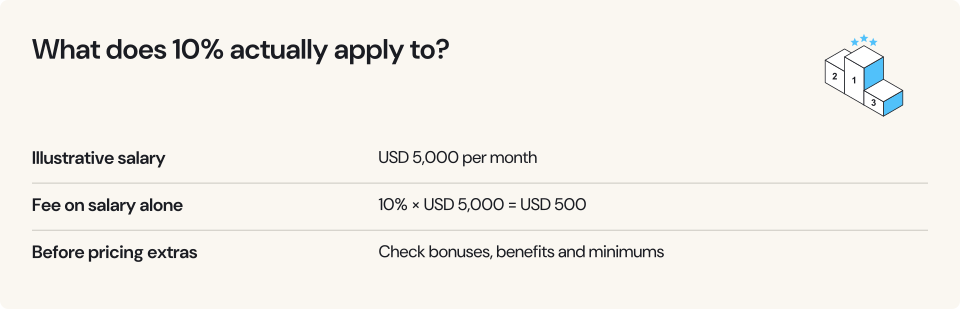
A 10% fee on a USD 5,000 monthly salary is USD 500. Adding other compensation to the base can change the price.

Custom quotes and platform charges

A custom quote can still be built on fixed or percentage fees. Ask for the fee schedule for each country, any platform subscription you have to buy, and the rules for adding or removing employees. Then compare providers on the full package you’d need.

What affects EOR pricing?

Some factors change the provider’s fee; others change the cost of employing the person. A higher salary means more payroll to fund, but it doesn’t automatically raise a fixed EOR fee.

Country and employee profile

Providers can charge different fees in different countries, and RemoFirst says outright that its starting fee can vary with local requirements. The employment budget then depends on salary, contribution ceilings, benefit eligibility and any required extra salary payments. Ask for a calculation based on the actual employee and start date.

Services and support

Compare the tasks and support each offer covers. Visa help, recruitment, equipment, extra benefits and specialist advice may be priced separately. A higher fee should buy a difference in scope or service that your team will use.

Contract length and team size

Ask for monthly and annual options, plus a written volume quote for the headcount you plan. Check minimum seats, renewal terms and what happens if a hire leaves. Use the discount you’re actually offered rather than assuming a standard percentage.

Currency and payment method

What you pay depends on your invoice currency, the payroll currency, the conversion method and how you pay. Ask the provider to show the exchange rate and every charge on the amount you plan to fund. Keep payment processing fees separate from currency conversion.

How to calculate the total cost of an EOR hire

Start the budget in the currency of the employee’s contract, and keep the billing currency and the amount to be converted in view. The seven lines below keep employment expense apart from cash the provider holds.
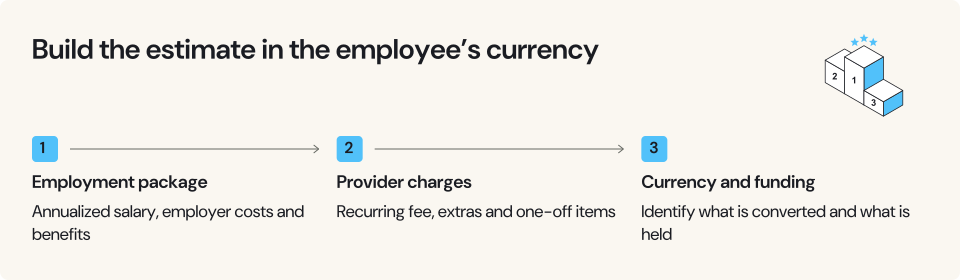
Build the employment package in contract currency, add provider charges, and separately identify converted amounts and cash held.
Use the same salary and benefits assumptions for every bid, so a lower headline service fee is a fair comparison.
1
Annual gross compensation. Record base salary, the number of salary payments, bonuses, allowances and statutory extra pay. Add a 13th salary or vacation supplement only if it isn’t already in annual compensation or a quoted accrual.
2
Employer taxes and contributions. Use a payroll calculation for this employee, with the wage bases, thresholds, caps and coverage that apply. Income tax and employee contributions withheld from gross pay are already inside the gross salary line, so don’t add them again as an employer expense.
3
Benefit premiums and provisions. Include required and chosen benefit premiums, and show any gratuity or other provision apart from amounts payable now. Check whether the employer-cost quote already includes each item.
4
EOR service and required platform fees. Use the country, plan, headcount and billing commitment in the order form. For a full-year illustration you can multiply the monthly fee by twelve; also note any minimum commitment or required platform charge.
5
Additional charges. Add any quoted currency, payment, setup, event-processing and administration charges. A currency percentage applies only to the conversion base set in the contract. Enter zero for included services. If an input is still unresolved, label it as an assumption instead of adding a blanket uplift.
6
Deposits, pre-funding and reserves. Put these in the cash schedule with payment dates, deductions and release conditions. Match funded payroll against payroll expense so it isn’t counted twice, and keep any optional financing assumption on its own line.
7
Exit costs and cash. Ask for an illustration of salary and benefits through the notice period, accrued leave, severance where it applies, provider charges and other employment liabilities. Include the timing and any deposit offset shown in the quote.

Compare providers on all of these inputs for the same employee, benefits and employment terms. Our EOR cost calculator compares recurring monthly and annual quote totals in USD; keep one-off charges and deposits separate.

EOR cost by country: employer costs in 7 countries

A contribution ceiling can lower the effective rate on a higher salary, while statutory extra pay and benefits can push the budget up. Each example below takes one pay profile and set of eligibility rules and adds up selected costs, using official 2026 figures checked on 14 October 2026. The verified employer components come to about 5% of salary in Ontario, 14% in Singapore, 16% in the UK and 20% in Germany.

The examples cover only some employment costs. Your budget also needs salary, benefit premiums, provider fees, currency charges and anything else an example leaves out.

Hiring somewhere else? Our country guides, such as employer of record in Mexico and employer of record in the Netherlands, compare providers and employer costs for one country.

Country / profile Salary and payment assumptions Verified employer component subtotal Costs still to price
Germany: public health insurance, outside Saxony €78,000 annual salary; full 2026 year; average 2.9% health top-up About €15,627 for pension, unemployment, public health and nursing care Actual health top-up, accident insurance, levies, benefits and provider charges
France: ordinary full-time profile €78,000 annual salary; full year at 35 hours a week Not calculated; needs a full payroll simulation Entity, location, collective agreement, status, insurance, pension, benefits and provider charges
United Kingdom: standard employer NI and qualifying-earnings pension £71,000 annual salary; 2026/27; eligible for automatic enrolment About £11,221 NI plus minimum employer pension, before payroll-period rounding and entity reliefs Reliefs, any levy allocation, benefits, pension above the minimum and provider charges
Brazil: full qualifying year R$30,000 monthly base; twelve base salaries; constant pay R$40,000 of statutory extra compensation; employer contributions not calculated Contributions, FGTS, risk and other levies, benefits, collective-agreement costs and provider charges
India: monthly-rated gratuity illustration ₹50,000 monthly statutory wages, rather than an assumed share of gross pay ₹28,846 gratuity per completed year of service (illustration); total employer costs not calculated Wage base, PF/ESI coverage, contributions, gratuity eligibility and cap, benefits and provider charges
Canada: Ontario, full-year CPP/EI coverage CAD 123,000 pensionable and insurable annual salary CAD 6,219 employer CPP, CPP2 and EI, rounded Employing entity’s EHT treatment, WSIB coverage and rate, benefits and provider charges
Singapore: citizen or third-year-or-later PR, age 55 or under SGD 116,000 in twelve equal ordinary monthly payments; no Additional Wages SGD 16,320 employer CPF; also allow SGD 11.25 a month for SDL before entity-level rounding Any Additional Wages, other employment costs, benefits and provider charges

Germany: employer costs and contribution ceilings

This full-year example assumes a €78,000 salary, voluntary membership of public health insurance and a job outside Saxony. Employer pension at 9.3% and unemployment at 1.3% apply to the whole €78,000, because it’s below the 2026 ceiling of €101,400. Public health insurance (7.3% plus half the 2.9% average additional contribution) and employer nursing care (1.8%) are capped at the €69,750 health and care ceiling. That gives €8,268 + €6,103.13 + €1,255.50, about €15,627 before accident insurance and other levies. The employee’s actual health fund and insurance status can change the result.

France: employer costs need a full payroll calculation

A flat 45% allowance can’t price a specific French hire. The quote depends on where the employing entity is and how big it is, the employee’s status and collective agreement, contribution brackets, insurance and benefits. For the ordinary €78,000, full-year, 35-hour profile above, pay is over the 2026 RGDU reduction ceiling, which is based on three times the reference SMIC at 1 January 2026. The standard unemployment contribution is 4%, with exceptions and bonus-malus rules. Retirement calculations for 2026 also use the €48,060 annual Social Security ceiling and Agirc-Arrco salary brackets.

United Kingdom: employer NI and pension costs

This full-year illustration for the 2026/27 tax year uses standard employer National Insurance at 15% above the £5,000 annual secondary threshold and the minimum 3% employer pension on qualifying earnings between £6,240 and £50,270. On a £71,000 salary that’s £9,900 of NI and £1,320.90 of pension, about £11,221 in total. It assumes the employee is eligible for automatic enrolment, with no special NI category relief and no Employment Allowance allocated. Payroll-period rounding, reliefs available to the employing entity, levies, benefits and the chosen pension scheme can all change the quote.

Brazil: employer costs and statutory extra pay

Over a full qualifying year at a constant R$30,000 monthly base salary, twelve base salaries come to R$360,000. A R$30,000 13th salary and a R$10,000 vacation supplement take compensation to R$400,000 before employer contributions. Ordinary salary paid during the vacation month is already inside the twelve base salaries; the extra amount is the one-third supplement. Ask the EOR to spell out how contributions are treated, along with FGTS, the employing entity’s regime, risk levies, benefits and collective-agreement costs.

India: employer costs, wages and gratuity

India’s Ministry of Labour guidance applies the Labour Codes’ definition of wages and explains how gratuity is treated for relevant events on or after 21 November 2025. The Ministry also announced an increase in the mandatory EPF coverage wage ceiling to ₹25,000 a month, effective 17 September 2026. Coverage and the contribution calculation still have to be checked for the specific employee and employing establishment, so don’t reuse the older ₹15,000 threshold without checking how it’s treated now.

For a hypothetical monthly-rated employee with ₹50,000 of statutory wages, the 15/26 gratuity formula gives ₹28,846 per completed year of service. Divided by twelve, that’s a simple planning provision of ₹2,404 a month. It’s only one part of the budget; payment and the actual entitlement depend on the event, employment type, service, coverage, any cap and the rules that apply.

Canada (Ontario): employer costs and federal caps

A CAD 123,000 full-year salary in Ontario, all of it pensionable and insurable, reaches the 2026 employer maximums: CAD 4,230.45 for CPP, CAD 416 for CPP2 and CAD 1,572.30 for EI, or CAD 6,218.75 in total. Ontario Employer Health Tax depends on the employing entity’s payroll and exemption status. WSIB depends on coverage, classification and the employer rate that applies, and the 2026 insurable earnings ceiling is CAD 121,700.

Singapore: employer CPF by citizenship, age and wage type

This example assumes a Singapore citizen, or a PR from the third year of PR status, aged 55 or under and on full contribution rates throughout 2026. The SGD 116,000 is paid in twelve equal ordinary monthly payments, with no Additional Wages. Employer CPF is 17% of the SGD 8,000 monthly Ordinary Wage ceiling, so SGD 1,360 a month or SGD 16,320 a year. At this salary, allow SGD 11.25 a month for the Skills Development Levy (SDL) before employer-level rounding. Bonuses classed as Additional Wages have a separate ceiling, based on SGD 102,000 minus the ordinary wages already subject to CPF. Newer PRs, older workers and foreign employees are treated differently for CPF.

Checked 14 October 2026. The annual figures illustrate the components named in each example; payroll-period rounding and the employee’s actual quote take precedence.

Hidden EOR fees and deposits: what you pay upfront

Check each of these in the offer and the agreement, and ask the provider to mark each one as included, charged separately or not needed for your hire.

1
Currency and payment charges. Find out which amounts get converted, when the rate is set and which payment fees apply. Deel’s funding guidance treats payment processing fees and FX charges as separate items.
2
Setup, off-cycle payroll and offboarding. Ask for the fee schedule for these events. They don’t always cost extra: Oyster’s pricing page says setup, onboarding and termination processing are included in its subscription. Notice and termination payments to the employee are separate from the provider’s processing fee.
3
Benefits and other services. Keep premiums and purchase costs apart from administration charges, and price the coverage and services your employee needs.
4
Service taxes. Ask which sales or service taxes apply to the invoice and whether the quoted figures include them.

Deel’s On-Demand Payroll costs USD 29 per affected employee, but Deel’s invoice FAQ mentions fee waivers for some events, so confirm the charge for the actual payroll event. Our EOR payroll guide, EOR currency conversion guide and additional EOR charges guide go into more detail.

Deposits and payroll funding

A refundable deposit raises the cash you need upfront without becoming a second monthly service expense. Oyster normally asks for about one month of the hire’s gross salary plus employer costs and fees and can require more in some cases. Its terms let it use the deposit to cover outstanding amounts and say the remaining balance is returned after settlement.

Ask for the deposit amount, any later top-ups, permitted deductions and when it’s refunded. Ask for a funding calendar too: paying payroll in advance changes when cash leaves your account, so show the payment date without counting the same salary twice.

Example: monthly expense, annual cost and upfront cash

Take a fictional quote for one full month. Salary is USD 5,000, employer costs are USD 900 and benefits add USD 250. The EOR charges USD 500 for its service plus USD 50 in currency and payment charges. Assume these monthly costs stay the same. At the start you also pay a USD 300 setup fee and a USD 6,150 deposit, which the provider holds through the first quarter.
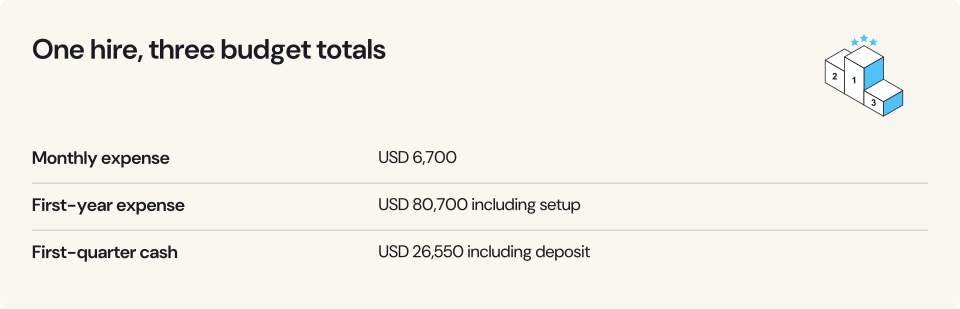
The worked example yields USD 6,700 monthly expense, USD 80,700 first-year expense and USD 26,550 first-quarter cash.
The USD 6,150 deposit is part of the quarter’s cash requirement. Leave it out when you annualize monthly expenses.

Monthly expense and cash in this example

Employment funding: $6,150

$5,000 salary + $900 employer costs + $250 benefits.

EOR service fee: $500

Assumed monthly provider charge.

Currency/payment: $50

Assumed monthly charge in the fictional quote.

Monthly expense: $6,700

$6,150 + $500 + $50.

Deposit: $6,150

Cash the provider holds under the fictional terms.

Salary, employer costs and benefit premiums are each counted once.

Budget line Monthly amount Treatment
Gross salary $5,000 Recurring employment cost
Employer taxes and contributions $900 Assumed employment cost for this employee
Benefit premiums $250 Recurring employment cost
EOR service fee $500 Recurring provider charge
Currency/payment charges $50 Assumed recurring charge from the quote
Total recurring monthly expense $6,700 $5,000 + $900 + $250 + $500 + $50

Three months at USD 6,700 plus the USD 300 setup fee gives a first-quarter expense of USD 20,400. You pay out USD 26,550 in cash because the provider still holds the USD 6,150 deposit. With the same recurring costs for twelve months, first-year expense comes to USD 80,700 before any charges the fictional quote leaves out.

The deposit itself is cash held separately. If part of it is later used to pay a genuine employment cost, match it against that cost so the same amount isn’t counted twice. Pre-funding payroll brings the payment date forward; it doesn’t create a second salary expense.

If you want to model the cost of tied-up cash, put the assumed rate and holding period on a separate financing line. That opportunity cost isn’t a provider fee or an extra invoice.

EOR cost calculator and budget template

Download the editable EOR budget worksheet

The worksheet comes filled in with the fictional hire: USD 6,700 of monthly expense, USD 80,700 of first-year expense including setup, and USD 26,550 of first-quarter cash including the deposit. Replace the inputs with your employee’s quote, and note where each figure came from and when you checked it. Enter zero only when a charge is included elsewhere or doesn’t apply.

Annualize all required compensation once before you enter the monthly salary. Add any irregular pay, event charges or exit costs to your own schedule, along with the actual funding dates.

EOR vs entity: when is your own entity cheaper?

Once you expect to keep a team in one country, weigh the EOR offer against the cost and work of running your own local employing entity. That means formation, registrations, accounting, tax filings, payroll, employment advice, benefits administration and the people who’ll manage all of it.

You pay salary and employer contributions under either route, so focus on the costs that change. Then account for transferring employees, running both arrangements during the transition, and eventually closing the entity if your plans change.

Work out first-year and ongoing costs for your own headcount and time horizon. There’s no headcount at which an entity becomes cheaper for everyone. Our EOR versus own-entity guide covers the inputs for the decision.

How to compare two EOR quotes

Send both providers the same brief, then put their answers side by side in one worksheet.
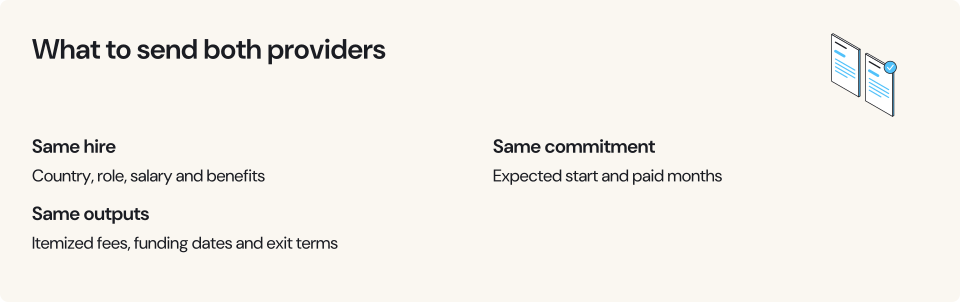
Send both bidders the same hire and commitment, then request itemized fees, payroll funding dates and exit terms.
Enter a confirmed zero differently from a charge the provider hasn’t answered.
1
Fix the hiring profile. Use the same country, start date, annual compensation, number of salary payments and benefits.
2
Match the service scope. Include the same payroll events, support, immigration help and any other services you need.
3
Match the commitment. Compare monthly offers with monthly offers, or show the annual commitment next to each discounted rate.
4
Reconcile the charges. Include required platform costs, administration, currency conversion, payment charges and any service taxes that apply.
5
Compare expense and cash separately. Show annual operating cost, one-time charges and the upfront deposit or funding requirement.
6
Check change and exit terms. Note price changes, cancellation, notice, vacant-seat rules, termination costs, and deposit deductions or release.

A lower fee only counts as a saving when both offers cover the same hire and the service suits your team. For the full list of questions, see how to compare EOR pricing.

Employer of record cost FAQs

How much does an EOR cost per employee per month?

Verified USD starting fees in this comparison run from USD 199 a month (RemoFirst, and RemotePeople Select in eligible countries and salary ranges) to USD 699 (Oyster on monthly billing). Other offers need a country quote or currency confirmation, and billing commitments differ. Salary, employer contributions, benefits and any additional services add to the total. Check the table’s terms and dates, then get a quote for your country and hire.

How much does an EOR cost per employee per year?

At the published starting fees in this comparison, the EOR service fee comes to USD 2,388 to USD 8,388 a year: USD 199 to USD 699 a month for twelve months. Salary, employer contributions, benefits and one-off charges come on top. In the fictional example above, one hire’s first-year expense is USD 80,700 including setup.

Which EOR is the cheapest?

In this comparison, RemoFirst has the lowest published starting fee: USD 199 per employee per month, though its fee can be higher in some countries. RemotePeople’s Select plan also starts at USD 199 where the country and salary qualify. Oyster’s USD 699 on monthly billing is the highest. Get quotes for the same hire, because the lowest headline fee isn’t always the lowest total cost. See all 11 prices in our cheapest employer of record comparison.

Is the cheapest EOR always the best choice?

Not necessarily. Price both offers for the same hire and billing period. If one costs more, work out what the extra fee buys for that employee or your payroll team: country coverage, a different payroll process, support or better contract terms.

Do EOR fees include salary and employer taxes?

No. The service fee pays for employment administration; the employee’s salary and mandatory employer contributions come on top, even when one invoice collects all of them. Ask for a breakdown showing compensation, employer costs, benefit premiums and provider charges.

Do EOR providers charge setup fees?

Some do. RemoFirst says it charges no setup, onboarding or termination-processing fees, and Oyster’s pricing page says setup, onboarding and termination processing are included in its subscription. Multiplier says implementation fees may apply, though its FAQ says setup is free, so your quote has to settle it. Ask for the fee schedule and keep one-off charges apart from the monthly fee in your budget.

Do EOR providers charge a deposit?

Many do. Oyster asks for at least one month of gross salary plus employer costs and service fees, and Borderless AI says a deposit is due before onboarding: usually 1.5 months of gross salary plus employer costs and fees if you pay by ACH, or three months for other payment methods. Pebl also requires a security deposit before onboarding, while RemoFirst and RemotePeople set the amount in the country proposal or quote. Ask how the deposit is calculated, when it can rise and when it’s refunded. Our EOR security deposit guide compares amounts and refund terms.

Why can the first EOR invoice be higher than the monthly fee?

It can include payroll costs, an advance, a deposit and any setup or extra-service charges you’ve agreed to. Ask for a sample first invoice and the dates each payment must clear. Put the refundable deposit on your cash forecast, and check what the provider can deduct before it returns the balance.

Which EOR providers have no minimum contract?

In this comparison, Deel bills month to month with no long-term commitment, G-P has no minimum duration for an EOR hire, and RemoFirst has no minimum contract term or employee count. Check the order or proposal anyway, because notice periods and exit terms can still add costs.

Is 13th-month salary included in an EOR quote?

It depends on the quote, so check the compensation schedule. Some quotes already include required extra salary payments in the annual total; others show them as separate amounts. Count each payment once, and ask which contributions apply to it. Twelve times the monthly base salary isn’t always the full annual compensation.

How much should I budget for EOR currency conversion?

Base it on the provider’s written conversion terms and the amount that actually needs converting. Ask how the rate is set, whether there’s a spread or a separate conversion charge, and what payment processing costs. Then compare, for the same payment in the currencies you’ll use, how much arrives and what each charge is.

Is an EOR cheaper than setting up an entity?

It depends on your headcount and how long you’ll stay. An EOR spares you the cost and work of a local employing entity: formation, registrations, accounting, tax filings, payroll and employment advice. You pay salary and employer contributions either way. Work out first-year and ongoing costs for your own headcount and time horizon, because there’s no headcount at which an entity becomes cheaper for everyone.

Sources and price-check dates

The sources behind this guide, grouped by topic. Dates show when we last checked a page. Prices and terms change, so confirm them in your quote.

Employer costs by country

19 sources
  1. Germany · Germany Trade & Invest (GTAI)

    Employment and social insurance in Germany

    Employer pension at 9.3% and unemployment at 1.3%.

  2. Germany · Federal Labour Ministry (BMAS)

    Social insurance calculation values ordinance 2026

    The 2026 ceiling of €101,400 for pension and unemployment contributions.

  3. France · Service Public

    Reduction in employer contributions (RGDU)

    The 2026 RGDU reduction ceiling is based on three times the reference SMIC at 1 January 2026.

  4. France · Unédic

    Unemployment insurance contribution rates

    The standard unemployment contribution is 4%.

  5. France · Agirc-Arrco

    Parameters and statistical data

    The Agirc-Arrco salary brackets.

  6. United Kingdom · HMRC

    Rates and thresholds for employers, 2026/27

    Standard employer National Insurance at 15% above the £5,000 annual secondary threshold.

  7. United Kingdom · GOV.UK

    Workplace pensions for employers: how to enrol staff

    Minimum 3% employer pension on qualifying earnings between £6,240 and £50,270.

  8. Brazil · Planalto

    Law on the 13th salary (gratificação de Natal)

    A 13th salary of R$30,000 over a full qualifying year at a constant R$30,000 monthly base salary.

  9. Brazil · Planalto

    Federal Constitution

    The one-third vacation supplement, R$10,000 in the example. Ordinary salary for the vacation month is already inside the twelve base salaries.

  10. Brazil · Ministry of Labour and Employment (MTE)

    FGTS (Fundo de Garantia do Tempo de Serviço)

  11. India · Ministry of Labour and Employment

    Guidance on wages and gratuity under the Labour Codes

    Applies the Labour Codes’ definition of wages and explains how gratuity is treated for relevant events on or after 21 November 2025.

  12. India · Press Information Bureau (PIB)

    Press release on the EPF coverage wage ceiling

    Announces an increase in the mandatory EPF coverage wage ceiling to ₹25,000 a month, effective 17 September 2026.

  13. India · Ministry of Labour and Employment

    Guidance on the 15/26 gratuity formula

    For a monthly-rated employee with ₹50,000 of statutory wages, the formula gives ₹28,846 per completed year of service, or ₹2,404 a month as a planning provision.

  14. Canada · Canada Revenue Agency (CRA)

    Payroll deductions formulas

    The 2026 employer maximum of CAD 416 for CPP2.

  15. Canada · Government of Ontario

    Employer Health Tax (EHT)

    Depends on the employing entity’s payroll and exemption status.

  16. Canada · Workplace Safety and Insurance Board (WSIB)

    2026 premium rates

    WSIB depends on coverage, classification and the employer rate that applies. The 2026 insurable earnings ceiling is CAD 121,700.

  17. Singapore · CPF Board

    How much CPF contributions to pay

    Employer CPF is 17% of the SGD 8,000 monthly Ordinary Wage ceiling (citizen, or PR from the third year, aged 55 or under).

  18. Singapore · CPF Board

    Skills Development Levy

    SGD 11.25 a month for the Skills Development Levy (SDL) at the example salary.

  19. Singapore · CPF Board

    What constitutes wages for CPF contributions

    The Additional Wage ceiling is SGD 102,000 minus the ordinary wages already subject to CPF.

Provider pricing and terms

12 sources
  1. Borderless AI

    PricingOffer for companies outside CanadaDeposit policyFAQ

    USD 579 as standard. Eligible companies headquartered outside Canada can pay USD 399 on EOR fees billed through 31 December 2026, then USD 579 from 1 January 2027, with exceptions for some countries and employment types. The FAQ conflicts with the deposit policy. Pricing checked 1 Nov 2026.

  2. Deel

    PricingEmployer Liability CostExchange rates and feesOn-Demand PayrollEOR invoice FAQ

    Lists contract and onboarding support, payroll processing, tax filings and ongoing HR support as EOR services. The Employer Liability Cost is mandatory and varies by country. Payment processing and FX charges are separate items. On-Demand Payroll costs USD 29 per affected employee; the invoice FAQ mentions waivers for some events. Pricing checked 1 Nov 2026.

  3. G‑P

    Pricing

    Checked 1 Nov 2026

  4. Multiplier

    Pricing

    Uses a dollar sign without saying which dollar. Checked 1 Nov 2026

  5. Oyster

    PricingWhy a deposit is requiredCustomer terms

    Setup, onboarding and termination processing are included in the subscription; notice and termination pay to the employee is separate. The deposit is normally about one month of the hire’s total cost, sometimes more; the terms let Oyster use it for outstanding amounts and return the balance after settlement. Pricing checked 1 Nov 2026.

  6. Papaya Global

    Pricing

    Checked 8 Nov 2026

  7. Pebl

    EOR pricing

    Uses a dollar sign without saying which dollar. Checked 1 Nov 2026

  8. RemoFirst

    Pricing

    Lists contract and onboarding support, payroll processing, tax filings and ongoing HR support as EOR services. Checked 1 Nov 2026

  9. Remote

    Pricing

    EOR from USD 599 per employee per month on an annual contract, or USD 699 as the standard monthly fee. An annual contract doesn’t necessarily mean paying for the year upfront, so confirm the country and invoice terms.

  10. RemotePass

    Saudi Arabia EOR page

  11. RemotePeople

    Pricing

    Checked 1 Nov 2026

  12. Rippling

    PricingEOR pricing page

    EOR from USD 499 per employee per month. The required platform starts at $8 per employee per month plus a monthly base fee (pricing page checked 8 Nov 2026).

Our research

3 sources
  1. The Best EOR

    Review methodology

  2. The Best EOR

    About the team

  3. The Best EOR

    How we make money

The table separates annual commitments from monthly billing and shows USD only where the currency is confirmed. The provider agreement sets the final price and funding terms.

If you spot a changed price or a conflicting source, send it through the contact page and we’ll review it.

This guide is for general information only and does not provide legal, tax, accounting, or financial advice. For advice about your business, consult a qualified professional familiar with the rules where you hire. Read our research methodology to learn how we assess sources.