TheBestEOR

Best Employer of Record in Nigeria

Written by Martynas PupkeviciusFact-checked by Michael Ennis
Picture of Martynas Pupkevicius
Martynas Pupkevicius

EOR Advisor and Remote Work Editor

Our top employer of record in Nigeria for 2026 is RemotePeople, from USD 499 per employee a month, ahead of Deel and G-P.

We tested all 10 providers with paid client accounts, real quotes and a live hire run through payroll. Nigerian employers pay pension contributions and group life insurance on top of salary, and the Labour Act excludes some administrative, executive, technical and professional staff.

Flag of Nigeria

Hiring in Nigeria at a glance

Currency
NGN
Nigerian naira
Pay cycle
Monthly
Max 1 month apart under Labour Act, payday in contract
Working hours
By agreement
Set by contract, union or wage board, extra is overtime
Annual leave
6 days
Working days after 12 months’ continuous service
Extra pay
Per contract
Or union agreement, confirm amount and dates in writing
Employer costs
Pension
Plus group life insurance, training fund levy if qualifying
Before you hire:
Confirm whether the Labour Act covers the role, as it excludes some executive and professional staff.

Country hiring overview · Nigeria

Hiring in Nigeria, at a glance.

Compare the employment scope and currency conversion.

For a Nigerian hire, I’d begin by asking who will employ the person and handle the relevant payroll registrations. Have providers separate salary, statutory items, benefits and fees, and show how the local salary is funded from your invoice currency.

Choose a hiring solution

Need a local employer?

Compare an EOR arrangement for your role before opening your own entity.

Already have a local employer?

Compare payroll and HR support against adding an EOR.

EOR service fee

Fees vary by provider.

Your quote should state the currency, fee per employee, minimum charge and billing commitment.

Onboarding

Paperwork affects the start date.

The contract, right-to-work checks, registrations and payroll deadlines all affect when employment can begin.

Employment costs

Check pension and fund charges.

Ask for separate pension, NSITF and ITF amounts, with an explanation of which charges apply. Include the employee’s agreed benefits when comparing the full employment budget.

Annual leave

Coverage depends on the role.

Adult workers covered by the Labour Act receive at least six working days of annual leave after 12 months. Check that the role falls within the Act’s scope.

Check before choosing

Confirm the applicable employment-law coverage, state PAYE handling, contribution eligibility, NGN salary and exchange-rate basis.

What your quote should include

Employment costs and service fees

1
Gross salary and agreed pay schedule
2
Pension, NSITF, ITF and relevant employee benefits
3
EOR fee: currency, per-employee billing, minimums and commitment
4
Setup, foreign exchange, extras and exit costs

Deposits and payroll funding

1
Amount and payment deadline
2
Whether funds are refundable or credited to payroll
3
Release conditions and refund timing
Show these separately from recurring expenses.

Key takeaways for hiring in Nigeria

The 12% contribution estimate excludes some benefit costs

The pension, compensation and training example does not price required group life cover for a covered employee. The insured amount and the insurance premium are different numbers. Add a quoted premium and any health-plan costs before calling the result fully loaded.

Read the pension base before comparing percentages

The contractual monthly-emoluments base must be at least basic salary plus housing and transport. It can be broader. Two quotes showing the same 10% employer rate can therefore produce different pension contributions even when both start with the same gross salary.

Pension remittance deadlines run from payday

Pension contributions must be remitted within seven working days after salary payment. Agree who reconciles the employee identifier, contribution period and credited amount after the first payroll.

NHF is a separate employee choice in the private sector

The amended law allows qualifying private-sector employees to contribute 2.5% of monthly income. Record whether the employee participates and use the amended base. It is an employee deduction that the employer remits.

Quick verdict

What is the best EOR in Nigeria?

My top three: RemotePeople, Deel and G-P.

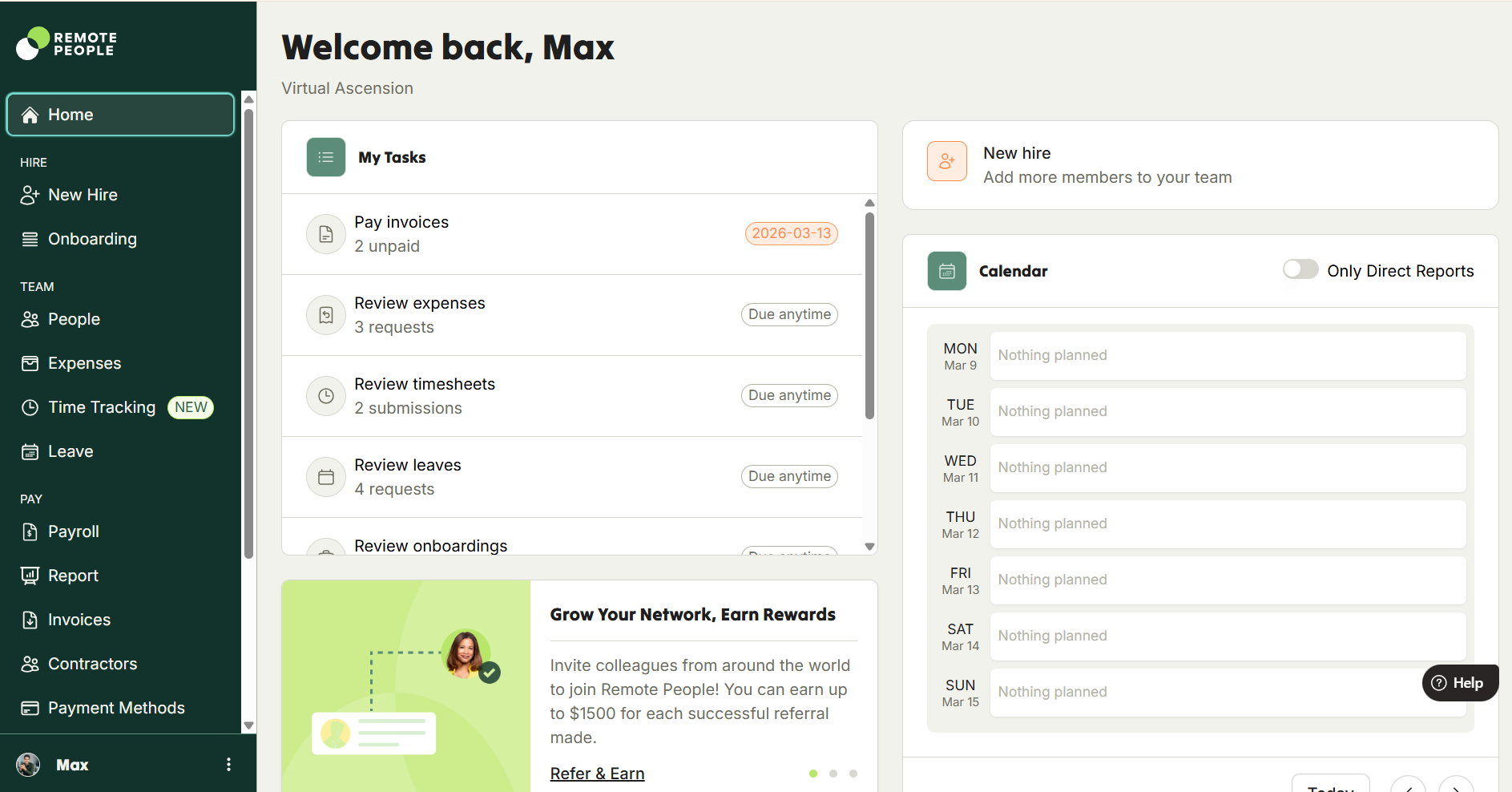
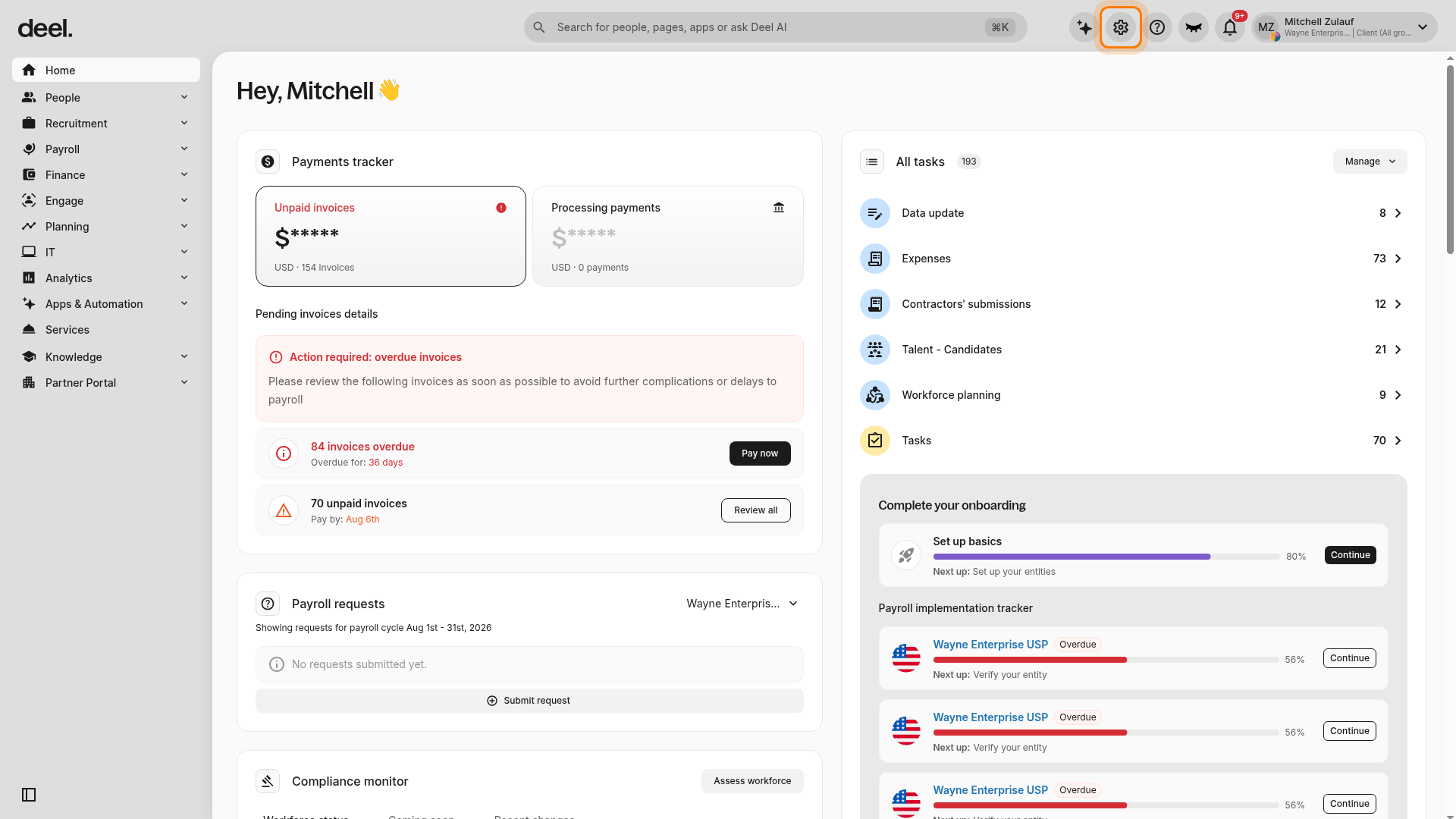
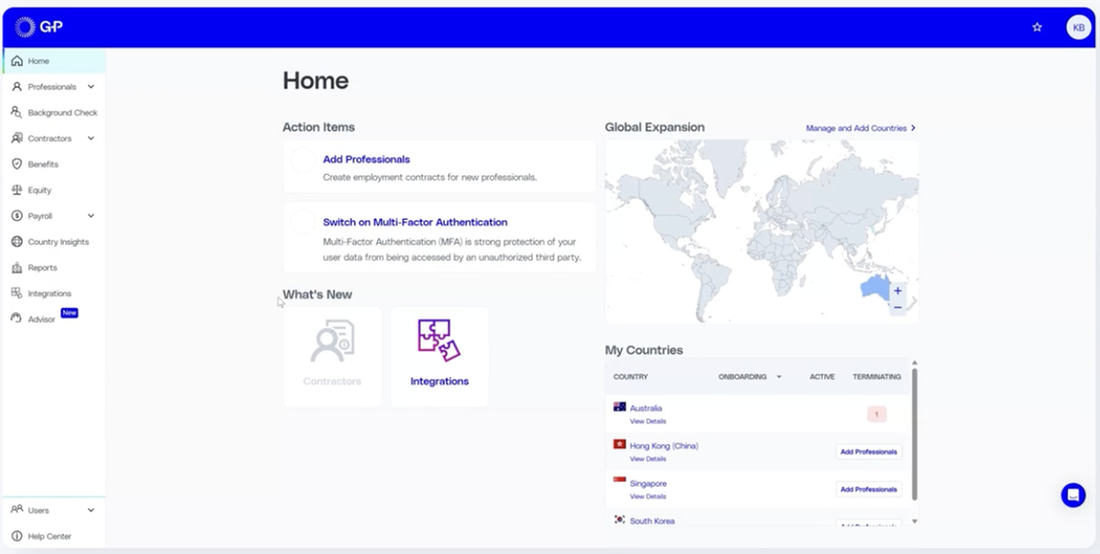
For a hire in Nigeria, I’d shortlist RemotePeople first. It offers recruitment and EOR through one provider, with a dedicated account manager on both EOR plans. Its EOR Global plan starts at USD 499 per employee per month, or USD 199 on EOR Select where the hire qualifies. Deel, from USD 599 plus a mandatory Employer Liability Cost, fits when Nigeria is one part of a wider employee and contractor programme. G-P, from USD 599 per employee per month, fits a company that wants to hire abroad while keeping its existing HR system.

None of the ten owns a Nigerian entity. Compare the complete service-fee quote and whether the provider holds your salary cash in naira while it depreciates; the published USD amounts shown do not establish every provider’s country price.

1
Editorial pick
RemotePeople logo

4.9/5

RemotePeople

Hiring in new markets with local HR support

Starting fee
$499

per employee / month

Countries
150+
where you can hire

EOR Select from $199 for eligible hires.

Deposit
1 month

of gross salary

Deposit refund
Within 5 days

of the final payment

Why consider it

Recruitment and EOR services through one provider.

Dedicated account manager in both EOR plans.

Check the fit

Recruitment is separately priced.

Before signing: Confirm quote currency, billing commitment, deposits, funding deadlines and refund terms. EOR Select eligibility depends on the hiring country and employee salary.

Both EOR plans list local contracts, payroll and tax administration, and statutory benefits administration. Salary, employer contributions and benefit costs are separate.

Visit RemotePeople ↗

2
Deel logo

4.7/5

Deel

Paying employees and contractors on one platform

Starting fee
$599

per employee / month

Countries
130+
where you can hire

Plus a mandatory Employer Liability Cost.

Deposit
1–1.5 months

of gross salary

Deposit refund
Within 60 days

of offboarding

Why consider it

EOR, contractor management and payroll for your own entities.

Month-to-month EOR service pricing available.

Check the fit

Ask for the country-specific Employer Liability Cost in your quote; it is mandatory.

Before signing: Confirm the Employer Liability Cost amount, benefit costs and any additional products. Monthly service terms do not remove employment notice, severance or other exit obligations.

The EOR pricing page lists 130+ countries. Broader platform coverage figures may include other services.

Visit Deel ↗

3
G-P logo

4.2/5

G-P

Hiring abroad while keeping your existing HR system

Starting fee
$599

per employee / month

Countries
180+
where you can hire

Volume pricing is quoted for larger teams.

Deposit
1–2.5 months

of gross salary plus employer costs

Deposit refund
Per contract

agree a return date before signing

Why consider it

One flat starting fee in every listed country, with volume pricing for larger teams.

Right-to-work checks and local contracts are built into onboarding.

Check the fit

Partner entities employ hires in some countries, alongside G-P’s 100+ owned entities.

Before signing: Refund timing is set per contract, so agree a deposit return date. The deposit depends on a credit check.

At $599 a month, the first year for one hire is $7,188 in service fees. Salary, employer costs and the refundable deposit come on top.

Visit G-P ↗

No provider pays for a position on this page; some outbound links pay a referral fee. See the funding model and methodology.

Entity, deposit, quota

All 10 EOR providers for Nigeria, side by side

Prices are June 2026 list fees per employee per month.

Security deposits and payroll funding are separate from the recurring service fee. Oyster requires a deposit of at least one month of gross salary plus employer costs and service fees. Borderless AI’s typical deposit is 1.5 months of gross salary plus employer costs and fees for ACH or three months for other payment methods, with country variations. Pebl also requires security before onboarding. Compare the deposit currency, payroll-funding dates and refund conditions for the actual hire. See the best EOR providers overall. For a wider shortlist, browse EOR providers for Nigeria.

Provider

Best For

Starting feeDepositOnboarding
1 RemotePeople logo RemotePeople 4.9/5 Rating Hiring in new markets with local HR support Starting fee: $499 USD / monthDeposit: 1 monthOnboarding: 2–8 days

My take

I’d consider RemotePeople for a Nigerian hire when payroll and immigration support both matter.

Its Nigeria service combines naira payroll, PAYE administration, pension and NHIA registration with recruitment and CERPAC sponsorship support for expatriates. Its Nigeria guide outlines one- to two-week onboarding for Nigerian nationals, with additional time for immigration processing. I’d confirm the legal employer in the proposal: the Nigerian employing entity and CAC registration number are not disclosed.

Both RemotePeople EOR plans include employment contracts, payroll and tax administration, statutory benefits administration, a dedicated account manager and ongoing employment support.

EOR Global starts at USD 499 per employee per month. EOR Select starts at USD 199 for eligible countries and employee salary ranges. Salary, employer contributions and benefits are separate; the proposal sets the applicable plan, billing commitment, deposit and payroll funding terms.

When this provider fits

I’d compare these proposals for the same employee and confirmed plan eligibility. RemotePeople’s named-account support and RemoFirst’s advertised starting fee are useful starting points, but the practical choice is the full naira funding calculation, response commitment and local escalation arrangement.

Deposit

1 month

Entity model

Own entities in core markets

First year, one hire

$5,988 in service fees

Reviewed by Martynas PupkeviciusFact-checked by Michael Ennis

Starting fee

$499

EOR Global. EOR Select starts at $199 where the country and employee salary qualify.

Against the 10 starting fees

$199 lowest$699 highest
2 Deel logo Deel 4.7/5 Rating Paying employees and contractors on one platform Starting fee: $599 USD / monthDeposit: 1–1.5 monthsOnboarding: 2–5 days

My take

I’d include Deel’s deposit in the cash budget before comparing its monthly fee.

It is normally 1–1.5 months of gross salary, with higher requirements possible. Payments or refunds outside the deposit’s designated currency involve currency conversion.

Deel’s global EOR service starts at USD 599 per employee per month, with month-to-month pricing available. Mandatory Employer Liability Cost is charged separately and varies by country. Salary, employer contributions, benefits and any additional services sit outside the starting service fee.

Deposit

1–1.5 months

Entity model

Own entities and partners

First year, one hire

$7,188 in service fees

Reviewed by Martynas PupkeviciusFact-checked by Michael Ennis

Starting fee

$599

Month-to-month billing. Mandatory Employer Liability Cost is charged separately.

Against the 10 starting fees

$199 lowest$699 highest
3 G-P logo G-P 4.2/5 Rating Hiring abroad while keeping your existing HR system Starting fee: $599 USD / monthDeposit: 1–2.5 monthsOnboarding: 2–5 days

My take

G-P would make my shortlist if you also need visa support, background checks or equity payroll management.

These are optional services alongside its employment service, with their own eligibility and charges.

G-P’s global EOR fee starts at USD 599 per employee per month, with a tailored country proposal. There is no minimum duration for an EOR hire; the client’s billing, cancellation and employee exit terms remain separate contract terms.

Deposit

1–2.5 months

Entity model

100+ own entities, plus partners

First year, one hire

$7,188 in service fees

Reviewed by Martynas PupkeviciusFact-checked by Michael Ennis

Starting fee

$599

Confirm the included services and billing terms in your country quote.

Against the 10 starting fees

$199 lowest$699 highest
4 Rippling logo Rippling 4.5/5 Rating Setting up payroll, laptops and app access for new hires Starting fee: $499 USD / monthDeposit: Per quoteOnboarding: 5–10 days

My take

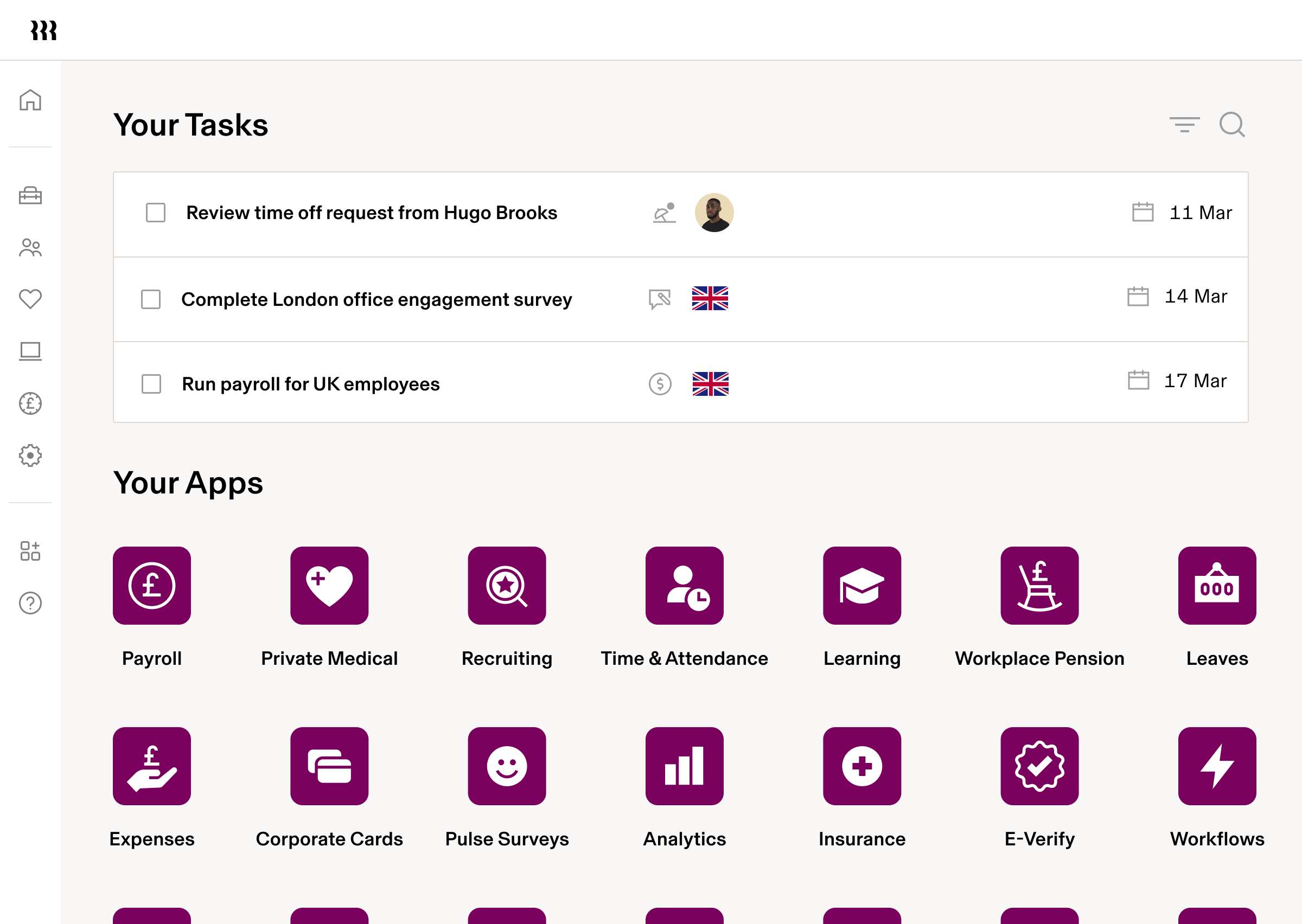
I’d look at Rippling when you want EOR employees to share HR records and workforce reporting with the rest of the organisation.

App access and device management are separate products, so I’d keep those costs distinct in the comparison.

Rippling EOR starts at USD 499 per employee per month, plus the required Rippling Platform from USD 8 per employee per month plus a monthly base fee. Billing commitment and optional HR or IT modules are quote-specific.

Deposit

Per quote

Entity model

Own entities and local partners

First year, one hire

$5,988 in EOR fees

Reviewed by Martynas PupkeviciusFact-checked by Michael Ennis

Starting fee

$499

Plus the required Rippling Platform, from $8 per employee per month and a monthly base fee. Confirm the billing terms and selected products.

Against the 10 starting fees

$199 lowest$699 highest
5 Oyster logo Oyster 4.5/5 Rating Using one onboarding process for hires across countries Starting fee: $699 USD / monthDeposit: ~1 monthOnboarding: 7–14 days

My take

My first budget check with Oyster would be the deposit. It is at least one month of gross salary plus employer costs and service fees, and can rise with costs or liabilities.

That money is separate from the monthly EOR fee.

Oyster’s month-to-month EOR rate is USD 699 per employee per month. Annual seats are quoted separately. Standard annual billing is prepaid and non-refundable; quarterly or semiannual payment is available at a higher seat price. A seat can be reused for a replacement hire. Salary, employer costs, deposits and optional services are additional.

Deposit

~1 month

Entity model

Own entities and vetted partners

First year, one hire

$8,388 in service fees

Reviewed by Martynas PupkeviciusFact-checked by Michael Ennis

Starting fee

$699

Monthly billing. Annual seats are quoted separately, prepaid and non-refundable.

Against the 10 starting fees

$199 lowest$699 highest
6 Pebl logo Pebl 4.2/5 Rating Hiring people who need visa or relocation support Nigeria residence permits · Confirm the employing company’s expatriate quota and support for this hire’s e-CERPAC application. Starting fee: $399 USD / monthDeposit: Per quoteOnboarding: 7–12 days

My take

I’d consider Pebl, formerly Velocity Global, for payroll and benefits administration together with employment support.

If you need immigration support or supplementary benefits, I’d ask for those additional services to be priced explicitly.

Pebl lists an EOR fee of $399 per employee per month, but the general price does not specify the dollar currency or billing commitment. The country proposal determines availability, any offer period and renewal terms; salary, employer costs and additional services are separate.

When this provider fits

Shortlist Pebl for a foreign-hire proposal if its written scope includes the immigration coordination you need. The employing entity’s quota slot and the candidate’s residence process must be identified separately. For a Nigerian citizen, compare the employment and payroll service on its own merits.

Deposit

Per quote

Entity model

Affiliates and local partners

First year, one hire

$4,788 in service fees

Reviewed by Martynas PupkeviciusFact-checked by Michael Ennis

Starting fee

$399

Confirm the country price and billing commitment.

Against the 10 starting fees

$199 lowest$699 highest
7 Papaya Global logo Papaya Global 4.1/5 Rating Comparing payroll costs across countries in one report Starting fee: $499 USD / monthDeposit: 1–2 monthsOnboarding: 7–12 days

My take

Papaya’s support arrangement is one reason I’d include it in a payroll shortlist: an account manager coordinates payroll, legal, finance and benefits specialists.

Employees can also raise tickets through its worker app or WhatsApp.

Papaya’s EOR service starts at USD 499 per employee per month. The country quote must identify the billing commitment and any additional services. Salary and employer costs are separate.

When this provider fits

Papaya is worth comparing when Nigeria needs to appear in a consolidated payroll report alongside other countries. For a Nigeria-only hire, test that reporting benefit against the complete fee and funding terms. The written proposal should identify the employing partner, deposit currency and refund basis.

Deposit

1–2 months

Entity model

Partner model; confirm employer

First year, one hire

$5,988 in service fees

Reviewed by Martynas PupkeviciusFact-checked by Michael Ennis

Starting fee

$499

The country quote sets the billing terms. Payroll-only processing is priced separately.

Against the 10 starting fees

$199 lowest$699 highest
8 Multiplier logo Multiplier 4.1/5 Rating Managing payroll, leave and expenses in one place Starting fee: $459 USD / monthDeposit: 1+ monthsOnboarding: 7–12 days

My take

With Multiplier, I’d choose the plan before comparing fees. Core starts at $499 per employee per month on monthly contracts, or $459 per employee per month billed annually.

The dollar currency is not specified. Country variations and compliance add-ons affect the quote. Growth adds integrations, custom reports and open API access. Implementation fees may apply, although the FAQ says setup is free; I’d have the quote resolve that charge.

Deposit

1+ months

Entity model

Own entities and partners

First year, one hire

$5,508 in service fees

Reviewed by Martynas PupkeviciusFact-checked by Michael Ennis

Starting fee

$459

Core plan billed annually, or $499 per month on monthly billing. Confirm the dollar currency.

Against the 10 starting fees

$199 lowest$699 highest
9 Borderless AI logo Borderless AI 4.0/5 Rating Getting 24/7 help with overseas payroll and HR Starting fee: $579 USD / monthDeposit: 1.5–3 monthsOnboarding: 7–12 days

My take

Before shortlisting Borderless AI, I’d budget for the refundable deposit due before onboarding.

Its standard calculation is 1.5 months of gross salary plus employer costs, benefits and platform fees for ACH or three months for wire and other methods, with country variations. Balances unpaid for 15 days, or more than two late payments during the term, can raise the deposit to six months. Refunds follow account closure and settlement of outstanding balances.

Borderless AI’s standard fee is USD 579 per employee per month. Eligible companies headquartered outside Canada can pay USD 399 on fees billed through 31 December 2026; USD 579 applies from 1 January 2027, including promotional customers. Some countries and employment types are priced separately. Salary and employer costs are additional.

Deposit

1.5–3 months

Entity model

Own entities

First year, one hire

$6,948 in service fees

Reviewed by Martynas PupkeviciusFact-checked by Michael Ennis

Starting fee

$579

Eligible companies headquartered outside Canada can pay $399 on fees billed through 31 December 2026.

Against the 10 starting fees

$199 lowest$699 highest
10 RemoFirst logo RemoFirst ⚠ Trustpilot warning 0.5/5 Rating Making a first overseas hire on a tight budget Starting fee: $199 USD / monthDeposit: About 1 monthOnboarding: 5–10 days

My take

We moved RemoFirst to last place on 8 November 2026: Trustpilot has suspended its rating for a breach of its guidelines and removed fake reviews.

RemoFirst says it works exclusively with vetted in-country partners. Here, that means a local partner company, not RemoFirst, would normally employ your hire, and payroll changes, questions and exits pass through both companies, which can slow answers. US$199 is RemoFirst’s starting fee and varies by country, so get this country’s quote before you compare. I’d separate RemoFirst’s contractor offer from its EOR price when reviewing a mixed workforce. The free contractor tier covers administration, including contract management and identity checks. Contractor payments cost USD 25 per contractor in months when a payment is processed; payment-provider and transfer fees may also apply.

RemoFirst’s global EOR fee starts at USD 199 per employee per month, with no minimum contract term or employee count. The country fee, deposit, payroll funding and add-ons depend on the proposal. Salary and employer costs are additional.

Deposit

About 1 month

Entity model

Partners, not own entities

First year, one hire

$2,388 in service fees

Reviewed by Martynas PupkeviciusFact-checked by Michael Ennis

Starting fee

$199

RemoFirst advertises no minimum contract term or employee count. Confirm any country-specific charges.

Against the 10 starting fees
$199 lowest$699 highest

“Says owned” identifies a provider ownership claim. A salary deposit ties up cash, but a change in the naira does not automatically reduce its value. The result depends on the deposit and refund currencies, conversion rules and settlement terms.

Pricing note (26 September 2026). Confirm billing terms, deposits, the employing entity, immigration fees and start dates; recalculate the budget using your quote.

Which top pick · Nigeria

Request a quote for the proposed salary and service plan, then enter its recurring charges in USD in the EOR cost calculator.

Local Nigerian alternatives (researched, unranked): four Nigeria-focused firms also provide EOR, PEO or local payroll outsourcing: Workforce Group, PaidHR and Norebase on the local HR and compliance side, alongside the payroll platform SeamlessHR. None of the four is in the ranking above: they are Nigeria-focused rather than multi-country. If you are hiring only in Lagos and have no plans beyond Nigeria, a domestic firm that already holds the pension, PAYE and NSITF registrations may still serve you well.

Get your EOR discount

Get up to 30% off eligible EOR service fees. Your quote confirms the discount and terms.

Employment framework

Employment and payroll in Nigeria

A foreign hire needs quota and residence approvals.

The Nigerian employer handles the employment contract and several separate payroll remittances. For a foreign hire, expatriate-quota and residence approvals also affect readiness to start.

Confirm foreign-worker approvals

A foreign hire needs the relevant immigration approvals as well as payroll registration. The employing entity must hold an expatriate quota, an approval from the Ministry of Interior that authorises a set number of foreign positions, and each foreign hire then needs a Combined Expatriate Residence Permit and Aliens Card (CERPAC).

Employment contract and local employer

The named Nigerian entity signs a written employment contract under the Labour Act (Cap L1). Request its name and registration details and confirm its responsibilities for the employment relationship and payroll filings. You retain day-to-day direction of the work.

Payroll contributions and reporting

Pension

The pension rate needs a contractual base and a credited account

Suppose gross monthly pay is ₦600,000, with basic salary, housing and transport adding up to ₦450,000. If the contractual pensionable emoluments are ₦450,000, minimum contributions are ₦45,000 employer and ₦36,000 employee. If the contract makes all ₦600,000 pensionable, those amounts become ₦60,000 and ₦48,000. These are two stated assumptions, not permission to reduce an existing contractual entitlement.

The difference changes both employer cost and take-home pay, so put the base beside the rate in the proposal. Preserve the employee’s existing RSA details when moving employment and reconcile the contribution against that account. PenCom’s seven-working-day deadline runs from salary payment. Include the remittance evidence in the first-payroll handover rather than waiting for an annual compliance certificate.

Employer and employee pension contributions are remitted to the employee’s Pension Fund Administrator under the Pension Reform Act 2014 within seven working days of payday.

PAYE

Income tax is withheld and paid to the relevant State Internal Revenue Service, normally by the tenth of the following month. PAYE is collected by the state where the employee resides rather than the federal government.

National Housing Fund

For participating staff, the EOR deducts the 2.5 percent contribution and remits it to the Federal Mortgage Bank of Nigeria. Participation has been voluntary for private-sector employees since the Business Facilitation Act 2023.

NSITF and ITF

The EOR pays the NSITF employee-compensation contribution at 1 percent of payroll and handles the annual ITF levy at 1 percent of annual payroll.

From offer to first payroll

1

Agree terms and any immigration support

Confirm salary, the intended start date and candidate details. For a foreign hire, agree the expatriate-quota and CERPAC process separately from payroll onboarding.

2

Prepare the contract and records

The identified employer prepares the written contract, collects identity and bank details, and confirms the pension Retirement Savings Account, state tax ID and applicable NHF and NSITF records.

3

Confirm readiness for first payroll

Resolve the relevant immigration requirements before the employee starts, then confirm the first monthly payroll date.

Employer cost

Statutory employer contributions in Nigeria

Pension and injury payments go to separate bodies.

Nigeria routes each statutory charge to a different collector: pension to a PFA regulated by PenCom, employee compensation to the NSITF, the training levy to the ITF, and housing money, for staff who opt in, to the Federal Mortgage Bank. The table below shows the 2026 rate for each and the slice of pay it is charged on. The employer-only load is about 12 percent of gross, before the EOR fee; the employee also has deductions the employer withholds and remits.

Fig. 2 · Where the ~12% goes: employer contributions as a share of gross
Contribution Employer rate Basis / cap Agency
Contribution
Pension (RSA)
Employee also pays 8%
Employer rate
10%
Basis / cap
Basic + housing + transport allowance
Agency
PFA / PenCom
Contribution
NSITF (employee compensation)
Employer only, no deduction from staff
Employer rate
1%
Basis / cap
Total monthly payroll
Agency
NSITF
Contribution
ITF levy
Annual, due by 31 March; confirm the applicable annual notice
Employer rate
1%
Basis / cap
Annual payroll, if ≥5 staff or turnover ≥ ₦50m
Agency
Industrial Training Fund
Contribution
National Housing Fund (NHF)
Voluntary for private-sector staff since 2023; employer remits for participants
Employer rate
0% (employee pays 2.5%)
Basis / cap
2.5% of monthly income for qualifying private-sector participants; participation is voluntary
Agency
Federal Mortgage Bank

Fig. 3 · Mandatory employer contributions in Nigeria, 2026 rates

On a ₦600,000 monthly salary, treating the full gross as pensionable for simplicity: pension 10% = ₦60,000, NSITF 1% = ₦6,000, and the ITF levy at 1% accrues at about ₦6,000 a month, a combined employer load near ₦72,000 or roughly 12 percent on top of gross. The employee separately has 8 percent pension withheld, plus 2.5 percent NHF where they have opted in, since private-sector NHF participation became voluntary under the Business Facilitation Act 2023; the EOR deducts and remits both, but neither is an employer cost. Health insurance is mandatory under section 14 of the National Health Insurance Authority Act 2022 for any employer with five or more employees; in practice most EORs satisfy it through a licensed HMO plan rather than a fixed statutory percentage. The EOR fee sits on top of all of this.

Add group life cover to the employment budget

For an employee covered by the contributory pension scheme, the employer must maintain group life insurance of at least three times annual total emoluments. On an illustrative gross package of ₦600,000 a month, with no additional remuneration, that means minimum cover of ₦21.6 million. It does not mean the annual premium is ₦21.6 million, or that a fixed percentage can safely be added to every payroll.

Ask for the insurer’s premium and confirmation that the employee appears on the policy schedule from the relevant start date. The schedule should identify cover, renewal, emoluments and premium payment. Keep this separate from the pension account and any health plan: a dashboard saying benefits are active is less useful than the actual coverage record.

Working time & leave

Working hours, overtime and statutory leave

Compare contract terms with the applicable leave floor.

The Labour Act sets a low statutory floor and leaves much to the contract, so most Nigerian employers offer more than the minimum to stay competitive. The figures below are the legal minimum; the market norm is noted where it differs.

Hours and overtime

Hours of work Set by contract
Common full-time week 40 hours
Overtime rate By contract
Rest period 1 day per week
Public holidays/yr ~13 federal

Fig. 4 · Hours and overtime under the Labour Act · no statutory weekly maximum or overtime multiplier; the contract governs

The Labour Act does not fix a maximum weekly hours figure or a statutory overtime multiplier; normal hours and any overtime premium are set in the contract, with a 40-hour week the common standard. The Act requires at least one rest day in each period of seven days. Nigeria observes about 13 federal public holidays, including the two Eid holidays and Christian holidays whose dates move each year.


Statutory leave

Annual leave
after 12 months
6 working days
Sick leave (paid) up to 12 days
Maternity
at 50% pay minimum
12 weeks
Paternity (federal/Lagos) 14 / 10 working days
Market-norm annual 15–25 days

Fig. 5 · Statutory leave entitlements · the 6-day legal minimum sits well below the 15-to-25-day market norm

Statutory annual leave is just 6 working days after a year of continuous service, but the competitive market norm is 15 to 25 days, which most EOR contracts adopt. Paid sick leave is up to 12 working days a year on a medical certificate. Maternity leave is 12 weeks at a minimum of 50 percent pay under the Labour Act, though many employers pay full salary; the federal civil service grants fathers 14 working days of paternity leave and Lagos State grants 10. There is no statutory annual-leave carryover rule, so carryover is set by contract.

Ending employment

Probation, notice and severance in Nigeria

Check the redundancy terms in the contract or agreement.

Notice scales with tenure under the Labour Act, but there is no general statutory severance formula. What a redundancy actually pays comes from the contract or a collective agreement, and since the National Industrial Court will hear an unfair-dismissal claim, the EOR puts the reason for every exit in writing.

Tenure Minimum notice Statutory severance
Tenure
Under 3 months
Minimum notice
1 day
Statutory severance
None (contract governs)
Tenure
3 months to under 2 years
Minimum notice
1 week
Statutory severance
None (contract governs)
Tenure
2 to under 5 years
Minimum notice
2 weeks
Statutory severance
None (contract governs)
Tenure
5 years or more
Minimum notice
1 month
Statutory severance
None (contract governs)

Fig. 6 · Minimum notice by tenure · no general statutory severance; redundancy pay comes from the contract or a collective agreement

Notice of one week or more must be in writing, and either side can pay salary in lieu of notice. The Labour Act provides no general redundancy or severance pay; section 20 only requires the employer to inform the union, adopt the “last in, first out” principle subject to merit, and negotiate redundancy payments, so the actual sum comes from the contract or a collective agreement. Common market practice is a number of weeks or one month of salary per year of service. Nigeria is not an at-will jurisdiction in the way the United States is: the National Industrial Court can hear a claim of unfair or wrongful dismissal and award damages, so the EOR builds a documented case before any exit.

Redundancy of a 3-year employee on ₦600,000/month
Weekly wage ≈ ₦600,000 / 4.33 = ₦138,568

Notice (2–5 yr tier)

2 weeks, paid in lieu = ₦138,568 × 2
₦277,136

Redundancy (market benchmark)

1 month per year × 3 years (contractual; no statutory formula)
₦1,800,000

Accrued unused leave

Assume 8 days outstanding × ₦27,692 daily
₦221,536

Indicative exit cost

Before any negotiated ex-gratia sum
₦2,298,672

Fig. 7 · Redundancy cost, 3-year employee at ₦600,000/month · the redundancy line is a market benchmark, not a statutory formula

Because Nigeria has no statutory redundancy formula, the ₦1,800,000 line is a market benchmark, one month per year of service, not a legal mandate; the legally required element is the notice (or pay in lieu) and accrued leave. The total excludes any negotiated ex-gratia sum, which is common in mutual separations and often larger than the benchmark. At ₦1,370 to the dollar, the July 2026 CBN official rate, this indicative exit is roughly $1,678. Most markets in the termination across jurisdictions guide write the severance formula into statute; Nigeria hands it to your contract instead.

Payroll & tax

Payroll cycle and income tax in Nigeria

PAYE and pension remittances have different deadlines.

Monthly payroll, monthly PAYE to the state, naira throughout, under a brand-new tax code. The EOR runs all of it: PAYE to the right state by the tenth, pension within seven working days of payday, NSITF monthly, the ITF return once a year.

Income tax is withheld through PAYE, and the State Internal Revenue Service of the state where the employee resides collects it, not the federal government, so a Lagos hire pays the Lagos State Internal Revenue Service and an Abuja hire pays the FCT Internal Revenue Service. The EOR registers the employee with the right state authority and remits PAYE, normally by the tenth of the following month. The Nigeria Tax Act 2025, signed in June 2025 and in force from 1 January 2026, replaced the old Personal Income Tax Act with a single code and new bands.

Annual chargeable income Rate (NTA 2025)
Annual chargeable income
First ₦800,000
Rate (NTA 2025)
0%
Annual chargeable income
Next ₦2,200,000 (to ₦3m)
Rate (NTA 2025)
15%
Annual chargeable income
Next ₦9,000,000 (to ₦12m)
Rate (NTA 2025)
18%
Annual chargeable income
Next ₦13,000,000 (to ₦25m)
Rate (NTA 2025)
21%
Annual chargeable income
Next ₦25,000,000 (to ₦50m)
Rate (NTA 2025)
23%
Annual chargeable income
Above ₦50,000,000
Rate (NTA 2025)
25%

Fig. 8 · Personal income tax bands under the Nigeria Tax Act 2025 · in force from 1 January 2026; the first ₦800,000 is exempt

The new code exempts the first ₦800,000 of chargeable income and anyone earning the national minimum wage or less, removes the old consolidated relief, and adds a rent relief of 20 percent of annual rent up to ₦500,000. The employee’s 8 percent pension deduction, and the 2.5 percent NHF contribution where they participate, reduce chargeable income before the bands apply. A non-resident who spends fewer than 183 days in Nigeria is taxed only on Nigeria-source employment income. Payroll runs monthly and salaries are usually paid on or near the last working day of the month; there is no statutory 13th-month salary, though a year-end or “13th month” bonus is a common contractual benefit.

The employee’s payroll schedule and the provider’s funding schedule need separate dates. The cost examples here use NGN salary; show the agreed gross pay, employee deductions and net payment in that currency before converting an overseas funding invoice.

Ask the provider to identify the relevant PAYE authority and the pension and insurance obligations for this employment, then supply a reconciliation and remittance evidence. Fix the exchange-rate source, conversion date, markup and any salary-review arrangement.

The employment contract

Contract requirements and 13th-month norms

Is a year-end bonus due under the employment terms?

For workers covered by Nigeria’s Labour Act, section 7 requires written particulars of employment within three months of starting. The Act’s worker definition has exclusions, including specified administrative, executive, technical and professional functions.

Have the offer state the job, employer, pay and pay frequency, hours, notice and benefits before the hire begins. If a 13th-month payment or annual bonus is offered, state whether it is a contractual entitlement, how it is calculated and how a midyear joiner or leaver is treated.

Division of responsibility

What the EOR handles, and what stays with you

Who remits the pension contributions and state PAYE?

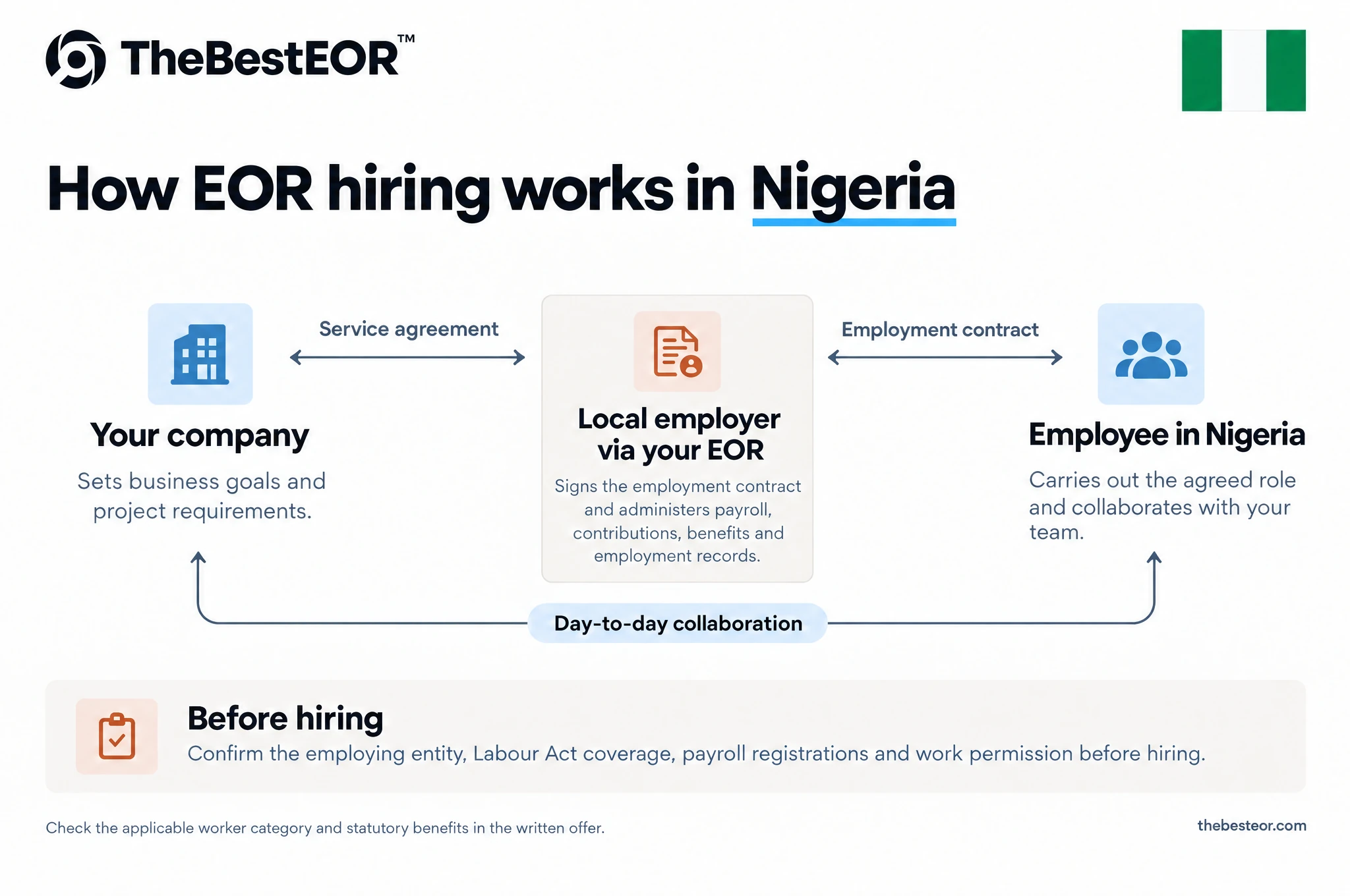
Employer of record in Nigeria diagram showing the service agreement, employment contract, and day-to-day collaboration between your company and the employee.
Employer of record in Nigeria: how your company, the local employer and the employee work together. Select the image to enlarge.

The EOR handles

1
Pension registration and remittance within 7 working days of payday
2
PAYE withholding and filing with the correct State Internal Revenue Service
3
NSITF remittance, plus NHF deductions for staff who opt in
4
The ITF annual levy where the threshold is met
5
The written contract of employment, in English
6
Statutory leave administration and the payslip
7
Compliant offboarding, notice and the documented termination case

You keep

1
The work itself: what your hire builds, for whom, on what deadline
2
The pay package: base, allowances and any bonus
3
Who joins and who leaves, and when; the EOR runs the contract and termination steps
4
Performance management, in writing: if an exit is ever challenged, that record is what the EOR will ask you for
5
Laptops, tools and your IP terms: buying and shipping kit stays yours, and the IP assignment belongs in the employment contract before signature

Engage a Lagos developer as an independent contractor on fixed hours under your direction and a tribunal can call the relationship employment, with unremitted pension, back PAYE and penalties attached to the finding. An employment arrangement that meets local requirements can change how the worker is engaged from then on, but it does not settle earlier classification liabilities. The misclassification guide covers the tests Nigerian courts apply.

Work permits

Expatriate quota and CERPAC for foreign hires

Check the quota slot before the residence permit.

Hiring a foreign national in Nigeria is a two-stage approval: the company first secures an expatriate quota position, then each expatriate obtains a CERPAC. The May 2025 reforms tightened the justification and added understudy requirements.

Step What it is Who holds it Cost / timing
Step
Expatriate quota
What it is
Ministry of Interior approval for a set number of foreign positions
Who holds it
The employing (partner) entity
Cost / timing
Weeks; tied to roles and justification
Step
STR visa
What it is
Subject to Regularisation entry visa for the named hire
Who holds it
The expatriate, from a Nigerian mission abroad
Cost / timing
Before travel
Step
CERPAC
What it is
Combined work-and-residence card, regularised after entry
Who holds it
The expatriate, sponsored by the entity
Cost / timing
$2,000 (employed expatriate)
Step
Understudy plan
What it is
Two Nigerian understudies per expatriate, skill-transfer milestones
Who holds it
The employer
Cost / timing
Ongoing, monitored

Fig. 9 · The two-stage foreign-hire approval · quota and CERPAC add roughly eight to sixteen weeks on top of contract signing

The whole process now runs online through the Expatriate Administration System, and the CERPAC fee for an employed expatriate is $2,000. The May 2025 reforms require strong justification that no qualified Nigerian is available, and the assignment of two understudies per expatriate with monitored skill-transfer milestones, which lengthens approval. There is no single published minimum-salary threshold for an Employment-class hire the way some countries set one; the quota is granted against the role, qualifications and experience. Realistically the quota and CERPAC steps add eight to sixteen weeks on top of contract signing.

So for a foreign hire, confirm the partner entity holds quota capacity for the role before you commit. Pebl runs an in-house immigration team that manages the case end to end, which earns it a place with buyers who expect to relocate staff into Nigeria; for a Nigerian-citizen hire, none of this applies.

Salary benchmarks

Indicative salary ranges

Compare monthly gross salaries in Nigerian naira.

Monthly gross in naira with a USD equivalent at roughly ₦1,370 to the dollar, the July 2026 CBN official rate. Ranges are 2026 market data from Glassdoor, PayScale and Profolio; use the midpoint as a starting offer, not a ceiling. Lagos commands a clear premium.

Check current pay data for the role and location before you make an offer.

Role Gross NGN/month USD/month (approx)
Role
Software engineer
Gross NGN/month
₦400,000–1,200,000
USD/month (approx)
$292–876
Role
Senior software engineer
Gross NGN/month
₦1,200,000–3,500,000
USD/month (approx)
$876–2,555
Role
Product manager
Gross NGN/month
₦500,000–1,500,000
USD/month (approx)
$365–1,095
Role
Accountant
Gross NGN/month
₦200,000–600,000
USD/month (approx)
$146–438
Role
Customer support
Gross NGN/month
₦120,000–350,000
USD/month (approx)
$88–255
Role
Sales manager
Gross NGN/month
₦500,000–1,700,000
USD/month (approx)
$365–1,241
Role
HR manager
Gross NGN/month
₦400,000–1,200,000
USD/month (approx)
$292–876
Role
UX / product designer
Gross NGN/month
₦250,000–700,000
USD/month (approx)
$182–511

Fig. 10 · Monthly gross salary benchmarks, 2026 · converted at ₦1,370 to the dollar, the July 2026 CBN official rate

Salaries cluster in Lagos, with Abuja close behind; other states pay less for the same role. Two notes for foreign employers. First, naira salaries look low in dollar terms today partly because the currency has depreciated, so a market-rate offer can still attract strong talent while costing far less than the equivalent role in Europe or the United States. Second, top Nigerian engineers also field offers from international companies paying in dollars, so the upper end of the software ranges moves quickly; benchmark against remote-first pay if you are competing for senior developers.

Fully-loaded cost

What a Nigerian engineer really costs per month

Start with ₦600,000 gross, before insurance premiums.

The example excludes group-life and health-insurance premiums and converts the fee at ₦1,370 to the dollar. For a different salary, estimate employer payroll costs in Nigeria.

Software engineer, Lagos
Gross base: ₦600,000/month
Gross salary ₦600,000

Pension employer (10%)

On basic + housing + transport (full gross assumed here)
₦60,000

NSITF (1%)

On total payroll
₦6,000

ITF levy (1%)

Annual levy accrued monthly, if employer threshold met
₦6,000

EOR fee, cheapest

RemoFirst from $199 ≈ ₦272,630
⚠ Trustpilot warning: rating suspended for a breach of its guidelines; fake reviews removed
₦272,630

Illustrative monthly subtotal

Annual ≈ ₦11.34m; excludes group-life and health-insurance premiums
₦944,630

Fig. 11 · Fully-loaded monthly cost at ₦600,000 gross, illustrative service fee · the $199 fee alone is close to half the salary

Statutory employer cost is ₦72,000, about 12 percent on top of gross. The EOR fee dominates the headline total: at roughly ₦272,630, the $199 fee alone is close to half the ₦600,000 salary. Swap in a premium fee and the total moves. Oyster at $699 (≈ ₦957,630) lands at ₦1,629,630/month, before any deposit. Because the fee, not the statutory load, is the dominant cost in Nigeria, the price column drives much of the ranking above. Foreign-currency fees also mean the naira cost of the same hire rises whenever the naira weakens.

EOR vs your own entity

EOR or your own Nigerian entity: compare costs

Budget for ongoing filings as well as incorporation.

A Nigerian company is cheap to incorporate but costly to run compliantly with filing requirements across four agencies.

Factor EOR Your own Nigerian entity
Factor
Setup cost
EOR
None
Your own Nigerian entity
CAC incorporation + legal, then four agency registrations
Factor
Time to first hire
EOR
2–14 days (by provider)
Your own Nigerian entity
6–12 weeks (CAC, bank, pension, PAYE, NSITF, ITF)
Factor
Per-employee cost
EOR
$199–699/employee/mo fee + statutory
Your own Nigerian entity
Statutory only (~12%), plus shared overhead
Factor
Ongoing admin
EOR
Provider runs payroll & all filings
Your own Nigerian entity
In-house payroll, four monthly/annual filings, annual audit
Factor
Compliance liability
EOR
On the EOR partner entity
Your own Nigerian entity
On you and your directors

Fig. 12 · Illustrative EOR-versus-entity comparison; the crossover depends on the fee plan, local operating costs and hiring duration.

Take the $199 floor: a year of it is roughly ₦3.3m per employee beyond what the statutory lines would cost you directly, nearly all of it dollar-denominated fee rather than Nigerian cost. A Nigerian entity’s incorporation is cheap, but the real burden is operating it: monthly pension, PAYE and NSITF filings, NHF remittance for participating staff, the annual ITF return, statutory audit, and the management time to keep all four agencies, including the State Internal Revenue Service, current. The EOR fee buys out that fixed overhead.

Annualise the selected service fee for the hires you expect to keep, then compare it with the Nigerian company setup, accounting, payroll, pension and insurance administration. Count setup costs over the same hiring horizon and include payroll, benefits, transition and exit charges on both sides. A higher service-fee plan moves the financial crossover earlier; lower recurring entity overhead or a longer hiring horizon can do the same. Short hiring duration, setup costs and the need for local administration can move it later. The legal suitability of each arrangement remains a separate question.

FAQ

EOR in Nigeria: common questions

Who receives PAYE, and when is the pension due?\

What is the best EOR in Nigeria?

RemotePeople is our top pick for Nigeria in 2026 (4.9/5), followed by Deel (4.7/5) and G-P (4.2/5). We opened paid accounts with all 10 providers on this page, priced real hires and ran payroll.

RemotePeople offers recruitment and EOR through one provider, with a dedicated account manager on both EOR plans. RemotePeople’s EOR Global plan starts at USD 499 per employee per month, and EOR Select at USD 199 where the hire qualifies. Deel starts at USD 599 plus a mandatory Employer Liability Cost; G-P starts at USD 599 per employee per month.

How does an employer of record work in Nigeria?

An employer of record in Nigeria becomes the worker’s legal employer through a local employing entity, while your company directs the day-to-day work. The EOR registers the employee for pension and remits within 7 working days of payday, withholds and files PAYE with the correct State Internal Revenue Service, remits NSITF and any NHF deductions, and pays the ITF levy where the threshold is met.

How fast can an EOR onboard an employee in Nigeria?

Estimated onboarding times for Nigeria range from 2 to 14 days across the providers we tested. By provider: Deel 2–5 days, G-P 2–5 days, RemotePeople 2–8 days, Rippling 5–10 days and Oyster 7–14 days.

Most providers in the top ten run Nigeria through a vetted local partner entity that completes pension, NSITF and tax registration (Multiplier and G-P say they use their own entities). A foreign hire who needs an expatriate quota slot and a CERPAC adds eight to sixteen weeks for the immigration steps.

How much does an EOR cost in Nigeria per month?

Published service fees for Nigeria run from USD 199 to USD 699 per employee per month across the 10 providers we tested: RemoFirst from USD 199; RemotePeople Global from USD 499, or Select from USD 199 only where country and salary qualify; Deel from USD 599 plus mandatory Employer Liability Cost; G-P from USD 599; Oyster USD 699 on monthly billing, with annual seats quoted separately. Multiplier Core advertises $499 monthly or $459 per month billed annually; Pebl advertises $399, with currency and commitment to confirm. Rippling starts at USD 499 plus its required platform from USD 8 per employee, and Papaya Global at USD 499. Borderless AI is USD 579 standard, with an eligible USD 399 promotion on fees billed through 31 December 2026. All amounts are per employee/month; salary and employment costs are separate. 

On top of the fee you pay the employee’s gross salary plus roughly 12 percent in employer statutory contributions: pension at 10 percent, NSITF at 1 percent and the ITF levy at 1 percent.

What employer contributions are mandatory in Nigeria?
The employer pays pension at 10 percent of basic, housing and transport allowance under the Pension Reform Act 2014, the NSITF employee-compensation contribution at 1 percent of total payroll, and the ITF levy at 1 percent of annual payroll for employers with five or more staff or turnover above 50 million naira. The employer also withholds and remits the employee’s 8 percent pension, plus the 2.5 percent National Housing Fund contribution where the employee participates; NHF has been voluntary for private-sector staff since the Business Facilitation Act 2023. The employer-only load is about 12 percent of gross.
 
Can an EOR sponsor a work permit in Nigeria?

It depends on the proposed employer and immigration route. Nigeria Immigration’s R2A employment residence class is tied to an expatriate quota.

Ask the provider to name the quota-holding employer, confirm an appropriate quota slot for the role and explain the entry and residence process for the candidate. Request application fees, required documents and start-date conditions separately from the EOR service fee.

What is the minimum wage in Nigeria in 2026?
70,000 naira per month, set by the National Minimum Wage Act 2024 signed in July 2024. Implementation varies by state: Lagos State pays its workers 85,000 naira to reflect the higher cost of living. An employee earning the national minimum wage or less is exempt from PAYE income tax under the Nigeria Tax Act 2025.
 
How much notice applies when terminating in Nigeria?
Under the Labour Act, statutory notice is one day for service under three months, one week for three months to under two years, two weeks for two to under five years, and one month for five years or more. There is no general statutory severance or redundancy formula; redundancy pay is set by contract or collective agreement, commonly a number of weeks per year of service. The EOR documents the basis for any exit, because the National Industrial Court can review unfair dismissals.
 
What currency and payroll cycle does Nigeria use?

Local payroll and cost illustrations use Nigerian naira (NGN); provider service fees may be quoted in USD. Agree the employee’s contractual salary currency and payday separately from the currency and deadline on your invoice.

For workers covered by the Labour Act, section 15 makes wages due at the end of the agreed daily, weekly or other pay period, with intervals no longer than one month for longer engagements. The Act’s definition excludes specified administrative, executive, technical and professional functions, among other categories; do not apply that rule to every role without checking coverage.

Ask for the actual payroll calendar, funding cutoff, FX source and markup, payment method, payslip and PAYE remittance evidence.

Can I convert a Nigerian contractor to an EOR employee?

A provider can assess a move to Nigerian employment for the actual role. Agree the new employer, employment terms, gross salary, payroll deductions and start date, and close or amend the contractor engagement so the two arrangements do not overlap accidentally.

Review the contractor history before the transfer, including unpaid invoices, intellectual-property terms and any classification concerns. Conversion changes the future arrangement; it does not settle prior claims.

Do I need a Nigerian entity to hire one person?

No. An EOR employs the worker through its registered Nigerian partner entity, so you hire without incorporating. Registering your own Nigerian company with the Corporate Affairs Commission, then registering for pension, PAYE, NSITF and ITF, takes weeks and carries ongoing filing and audit overhead.

Annualise the selected service fee for the hires you expect to keep, then compare it with the Nigerian company setup, accounting, payroll, pension and insurance administration. Count setup costs over the same hiring horizon and include payroll, benefits, transition and exit charges on both sides. A higher service-fee plan moves the financial crossover earlier; lower recurring entity overhead or a longer hiring horizon can do the same. Short hiring duration, setup costs and the need for local administration can move it later. The legal suitability of each arrangement remains a separate question.

Is the ITF levy charged on every Nigerian hire?

The ITF levy of 1 percent of annual payroll applies to employers with five or more employees, or fewer than five but with annual turnover of 50 million naira or more. It is remitted once a year by 31 March for the prior year; confirm the applicable annual ITF notice.

Sources and as-of dates

Article references

Rates are as of June 2026, each traced to the statute it lives in; conversions use the July 2026 CBN official rate, the one figure on this page with a short shelf life.

Hiring facts Checked 2 Oct 2026

Hiring facts

Checked 2 October 2026
Eligibility, local and collective rules apply. EOR fees extra.

Labour Act (Cap L1, LFN 2004) 4 sources

For workers within the Act’s scope: at least 6 working days’ annual leave after 12 months, up to 12 paid working days for certified illness, and 12 weeks’ maternity leave with at least 50% pay after six months’ continuous employment. Notice is 1 day, 1 week, 2 weeks or 1 month according to service; section 20 governs redundancy. Section 91 excludes several professional, technical and managerial categories.

Pension Reform Act 2014 2 sources

Under the contributory pension scheme, minimum contributions are 10% from the employer and 8% from the employee. The contractual monthly-emoluments base must be at least basic salary plus housing and transport allowances. Contributions must be remitted within 7 working days after salary payment.

NSITF / Employees' Compensation Act 2010 1 source

NSITF states that registered employers fund the Employees’ Compensation Scheme at 1% of total monthly payroll; this is an employer contribution.

Industrial Training Fund Act 2 sources

ITF describes a contribution of 1% of total annual payroll for employers with at least 5 employees, or fewer than 5 employees and annual turnover of at least ₦50 million. Its current FAQ states a payment deadline of 31 March each year; confirm the applicable return and deadline with ITF.

National Housing Fund Act 2 sources

The Business Facilitation (Miscellaneous Provisions) Act 2022, effective 8 February 2023, amended the NHF rules: private-sector employees earning at least the national minimum wage may contribute 2.5% of monthly income. The corresponding contribution is mandatory for public-sector employees and self-employed people within the amended provision’s scope.

National Health Insurance Authority Act 2022 1 source

Section 14 makes health insurance mandatory for residents of Nigeria, expressly including public- and private-sector employers and employees with five or more staff, informal-sector employees and other residents. Private insurance does not remove participation requirements under a state-mandated scheme.

Nigeria Tax Act 2025 5 sources

The Nigeria Tax Act 2025, signed 26 June 2025 and effective 1 January 2026, sets annual individual taxable-income bands: first ₦800,000 at 0%; next ₦2.2 million at 15%; next ₦9 million at 18%; next ₦13 million at 21%; next ₦25 million at 23%; and income above ₦50 million at 25%. Rent relief is 20% of annual rent paid, capped at ₦500,000, subject to the required declaration. Employment income at or below the national minimum wage is exempt.

National Minimum Wage Act 2024 2 sources

The national minimum wage was increased to ₦70,000 per month under the 2024 amendment. Apply the Act’s coverage and exemptions. Any higher Lagos State public-service pay scale should be distinguished from the national statutory floor for private employers.

Immigration Act 2015 and 2025 reforms 4 sources

The NIS R2A employment-visa guidance describes employer expatriate-quota approval, an STR application and regularisation to obtain CERPAC. NIS currently quotes USD 2,000 for employed foreigners’ CERPAC applications. Interior Ministry rules require two Nigerian understudies per occupied expatriate-quota position. The Ministry announced the Expatriate Administration System in March 2025.

Salary benchmarks 2 sources

PayScale’s Nigeria software-engineer dataset reports annual pay from 155 profiles, updated on 15 June 2026. The ₦1,370-per-USD conversion is illustrative.

Provider fees, entity routing and estimated onboarding times 10 sources

Further sources (October 2026) 4 sources

PenCom pension FAQ 2023 — Monthly-emolument definition, 10%/8% minimum contributions, existing RSA and contribution remittance. Accessed 19 October 2026.

PenCom revised group life insurance guidelines — Minimum cover three times annual gross emoluments; coverage, premium and employee schedule evidence. Accessed 19 October 2026.

PenCom May 2025 compliance circular — Seven working days after salary payment; recovery of unpaid pension contributions. Accessed 19 October 2026.

Business Facilitation Act: NHF amendments, NIPC-hosted gazette — Private-sector NHF participation voluntary and 2.5% monthly-income base, sections 44–46. Accessed 19 October 2026.

Obtain a dated quote and confirm the exchange rate used in the proposal. To expand your shortlist, browse EOR providers for Nigeria. Once you have proposals, enter the recurring amounts in USD in the EOR cost calculator. The country guides cover other hiring markets.

This guide is for general information only and does not provide legal, tax, accounting, or financial advice. For advice about your business, consult a qualified professional familiar with the rules where you hire. The research methodology explains how TheBestEOR assesses sources.