


Guide overview
Employer of record, at a glance.
Understand the employer, the work and the responsibilities.
An employer of record is a company that legally employs a worker who performs work for your business. The local employer signs the employment contract and handles the agreed payroll and employment administration, while your team directs the work and funds the employment costs. Whether the arrangement fits depends on the country, role and contracts.
Legal employer
Identify the employer
Identify the entity that signs the employment contract.
Day-to-day work
Your team directs it
Agree how work instructions and employment administration connect.
Service scope
Employment service scope
Read what the EOR handles and what remains with your team.
Hiring options
Compare alternatives
Check which other hiring options local rules allow for this role.
Check before acting
Confirm the country, role, employing entity and service agreement before treating an EOR as the right route.
What to record in the worksheet
Scope
Step · Client responsibility · EOR / employee confirmation
Evidence and follow-up
Evidence · Owner · Ready date
Read the part you need first
Hiring one person through an EOR? Start with the two contracts and the example of a designer’s first payroll. If another arrangement might suit you better, see the alternatives section. Once you know who should employ the person, compare EOR providers for the hire.
1. What is an employer of record?
An employer of record (EOR) is the company that legally employs someone who works for your team. Where local law allows it, the provider’s own entity or a local partner signs the employment contract. That employer registers the hire, runs payroll in local currency, pays employer taxes and contributions, and handles statutory benefits. You still decide who to hire, what to offer and what the person works on.
To employ someone directly instead, check whether you need a local entity or can register as an employer another way. That depends on the country and the work.
2. How an EOR works: three parties, two contracts
The employment contract and service agreement
The service agreement covers fees, invoicing and exit terms.
The employing entity signs the employment contract.
Your team directs the day-to-day work.
Local law and the two contracts set out who is responsible for what.
Each month, you pay the EOR the gross salary, employer costs and its fee. The EOR then pays the employee’s net salary and sends the taxes and contributions to the authorities. If you’re comparing EOR providers for a hire in France, ask each one to calculate employer contributions for the same salary and benefits, since contribution ceilings and what each quote covers can change the result. The global payroll calculator shows the employer contributions a French quote should include.
Some countries treat EOR employment as agency work or labour leasing, so check which licences or restrictions apply to the role. Section 8 shows why this matters in Germany.
3. What an employer of record does and what stays with you
Responsibilities to confirm
Confirm the employer, local requirements and contract terms for your hire, because responsibilities can overlap.
| Task | Typical lead | What your company should confirm |
|---|---|---|
Task
Employment contract and registrations
|
Typical lead
EOR as the named legal employer
|
What your company should confirm
The actual employing entity, local eligibility and employee documents.
|
Task
Day-to-day work
|
Typical lead
Your managers
|
What your company should confirm
Work instructions that comply with local rules, working time, safety and employee treatment.
|
Task
Payroll and statutory filings
|
Typical lead
EOR, using information you supply
|
What your company should confirm
Cut-off dates, approval responsibilities and correction process.
|
Task
Funding employment costs
|
Typical lead
Your company
|
What your company should confirm
Salary, employer costs, benefits, service charges and any deposit.
|
Task
Changes and termination
|
Typical lead
Coordinated with the EOR
|
What your company should confirm
Required process, permitted grounds, timing and who bears each cost.
|
Task
IP, data and tax exposure
|
Typical lead
Both parties, with specialist review as needed
|
What your company should confirm
Contract chain, security duties and any separate business-tax obligations.
|
The service agreement decides who does which task and who pays for it.
The EOR’s fee covers the services named in your agreement. If a claim arises, local law and the agreement both apply, so read the indemnities, exclusions and liability limits to see which costs the provider can pass back to you. Your company is still responsible for its own conduct.
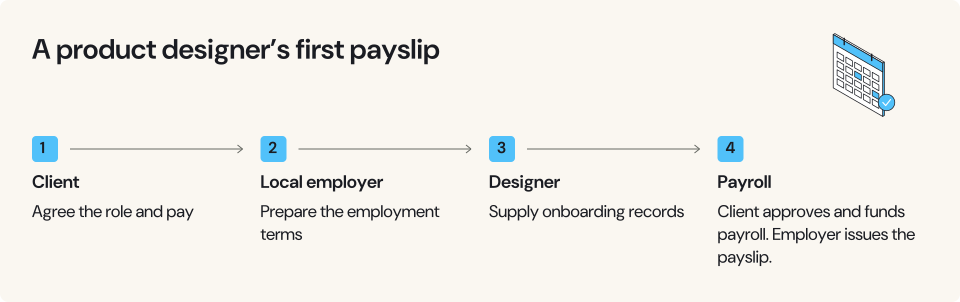
One hire, from offer to first payroll
Suppose you want to hire a product designer in a country where you have no entity. Your manager defines the role and agrees the pay. The EOR names the local employer and prepares a contract for the designer to review. Before the first payroll, the designer supplies the required documents and your payroll team approves the inputs and sends the funds by the agreed deadline. The employer runs payroll and issues the payslip. Meanwhile, the manager directs the designer’s work and checks they can use their benefits and reach support. The start and pay dates depend on the country, paperwork and payroll calendar.
| The working record | Fields to complete |
|---|---|
The working record
Scope
|
Fields to complete
Step · Client responsibility · EOR / employee confirmation
|
The working record
Evidence and follow-up
|
Fields to complete
Evidence · Owner · Ready date
|
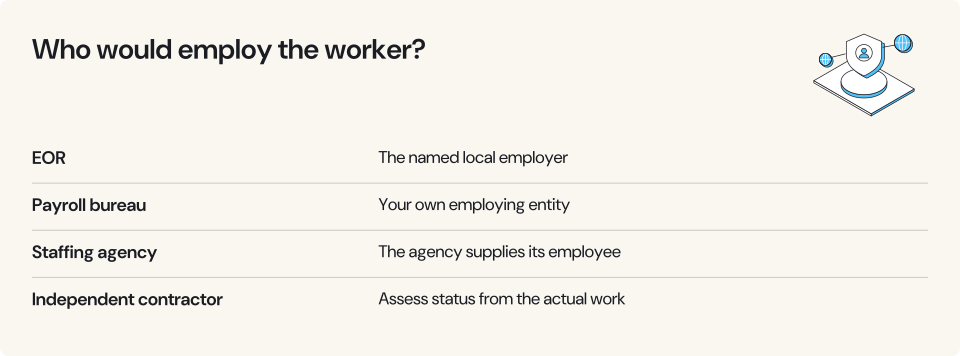
4. EOR vs PEO, payroll provider, staffing agency and contractor
Start with the employment contract. Who signs it, and who will handle the work your team wants to outsource?
| Model | What you're buying | Legal employer | Cost basis to compare |
|---|---|---|---|
Model
EOR
|
What you're buying
Local employment under an eligible EOR arrangement; confirm the actual employer
|
Legal employer
The EOR
|
Cost basis to compare
Country-specific service fee, employment costs and funding requirements
|
Model
PEO
|
What you're buying
Outsourced HR and benefits inside a country where you already have an entity (almost always the US)
|
Legal employer
You, co-employed with the PEO
|
Cost basis to compare
Obtain a country-specific payroll, HR and benefits quote
|
Model
Staffing agency
|
What you're buying
The agency finds and supplies the worker, usually for temporary roles
|
Legal employer
The agency
|
Cost basis to compare
Markup on the worker's wage
|
Model
Payroll bureau
|
What you're buying
Payroll calculation, payslips, and filings under your own entity's registrations
|
Legal employer
You
|
Cost basis to compare
Quote for the employee count, payroll frequency, filings and service scope
|
Model
Contractor services
|
What you're buying
Management, AOR and COR scopes differ; confirm responsibilities
|
Legal employer
Worker remains independent only if correctly classified
|
Cost basis to compare
Product-specific quote; COR can cost more than basic management
|
Fig. 1 · EOR vs PEO, staffing agency, payroll bureau, and AOR/COR: legal employer and cost basis across five models
US co-employment. A professional employer organization (PEO) shares specified employment duties with your business, which already employs the team. A supplier may sell something different overseas under the name “global PEO.” Ask which entity signs the local employment contract.
Staffing. A staffing agency recruits and supplies workers, commonly for temporary cover, and charges a markup. If you need someone to find candidates, check whether the EOR proposal includes recruitment or prices it separately.
Payroll services. A payroll provider can calculate pay and file returns using your entity’s registrations. Your company remains the employer. If you have no employer ready in the country, check which direct registration or EOR routes are available.
Contractor services. A basic management service may handle agreements and payments. An agent-of-record or contractor-of-record service may take on specific contractual duties, subject to its coverage, exclusions and limits. Whether the person is genuinely self-employed depends on the law and the work. Assess the working relationship under local rules and arrange employment if that is what the role requires.
5. What does an EOR cost?
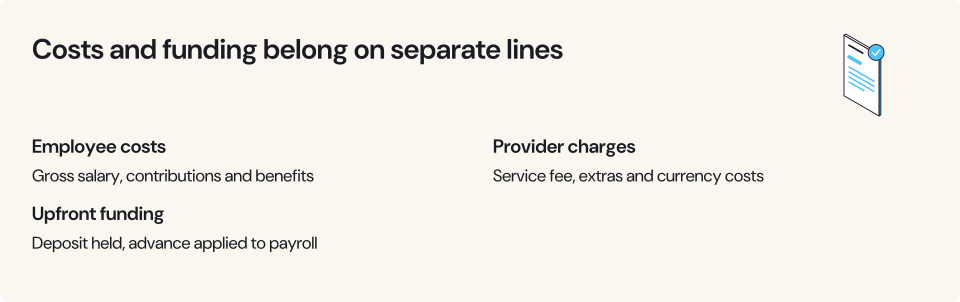
To estimate the full cost of an EOR hire, start with gross salary and add employer contributions, benefits and the provider’s fee. Include any setup, extra services or currency charges that apply. Then build a cash forecast for the deposit and payroll funding. Treasury may need both before the employee receives a first payslip.
Our provider ratings show the order in which we recommend providers overall. They are not scores for an individual fee, contract term, certification or country.
★★★★★0.5
Pricing & termsPer employee per month
EOR fee
From US$199
Plan and quote conditions
⚠ Trustpilot warning: rating suspended for a breach of its guidelines; fake reviews removed (8 Nov 2026).
No annual contract or employee-count minimum advertised. Fee can vary by local country requirements. Optional health insurance, equipment, visas and checks cost extra. Confirm deposit/funding terms. No setup, onboarding or termination service fees are advertised; local employment obligations still apply.
Our rating
0.5/5
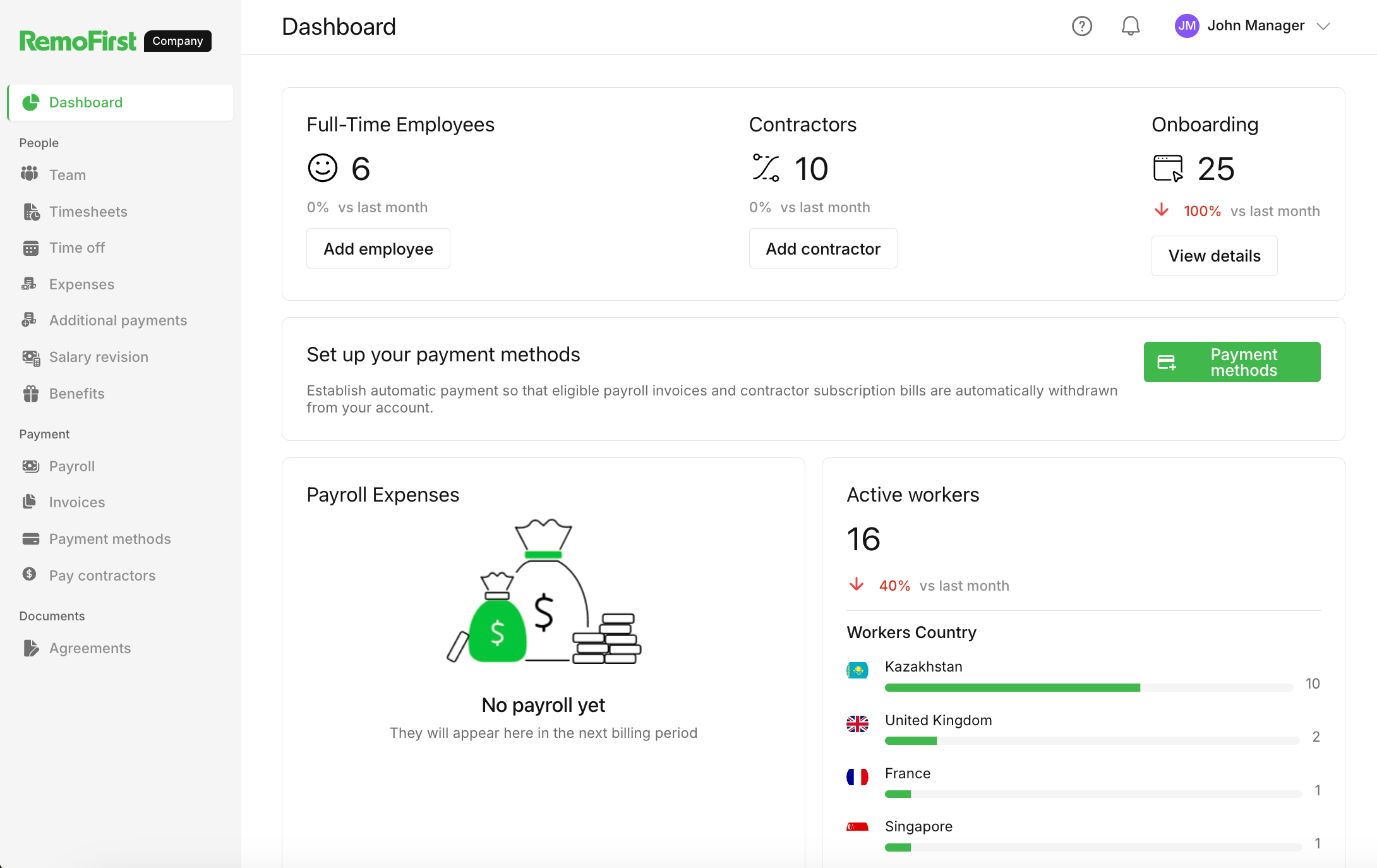
RemoFirst dashboard
Enlarge screenshot
![]()
Reviewed by Martynas Pupkevicius · Fact-checked by Lucia Aparicio
Opens remofirst.com

★★★★★4.9
Pricing & terms
EOR fee
from USD 499
Global from USD 499; Select from USD 199
Plan and quote conditions
Select is available only in selected countries and qualifying employee salary ranges. Prices are per employee/month. Confirm the quote currency, rate, commitment, headcount and deposit terms.
Our rating
4.9/5
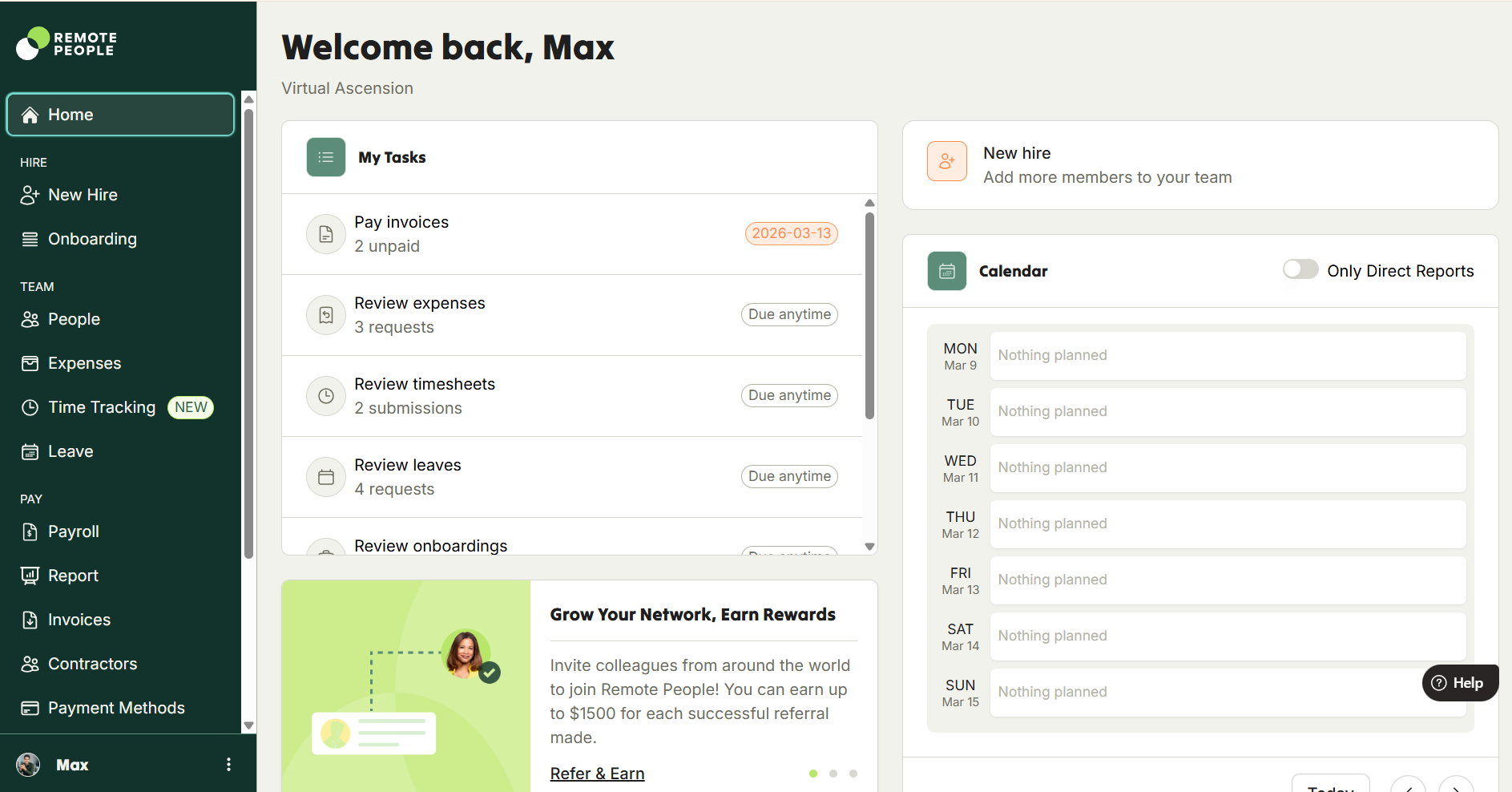
RemotePeople dashboard
Enlarge screenshot
![]()
Reviewed by Martynas Pupkevicius · Fact-checked by Lucia Aparicio
Opens remotepeople.com

★★★★★4.2
Pricing & terms
EOR fee from
$399
Per employee per month; dollar currency unspecified
Plan and quote conditions
The country order sets the currency, billing commitment, offer period and renewal terms. A security deposit is due before onboarding. At least 90 days’ offboarding notice starts on the next calendar month, with service fees continuing during that period.
Our rating
4.2/5
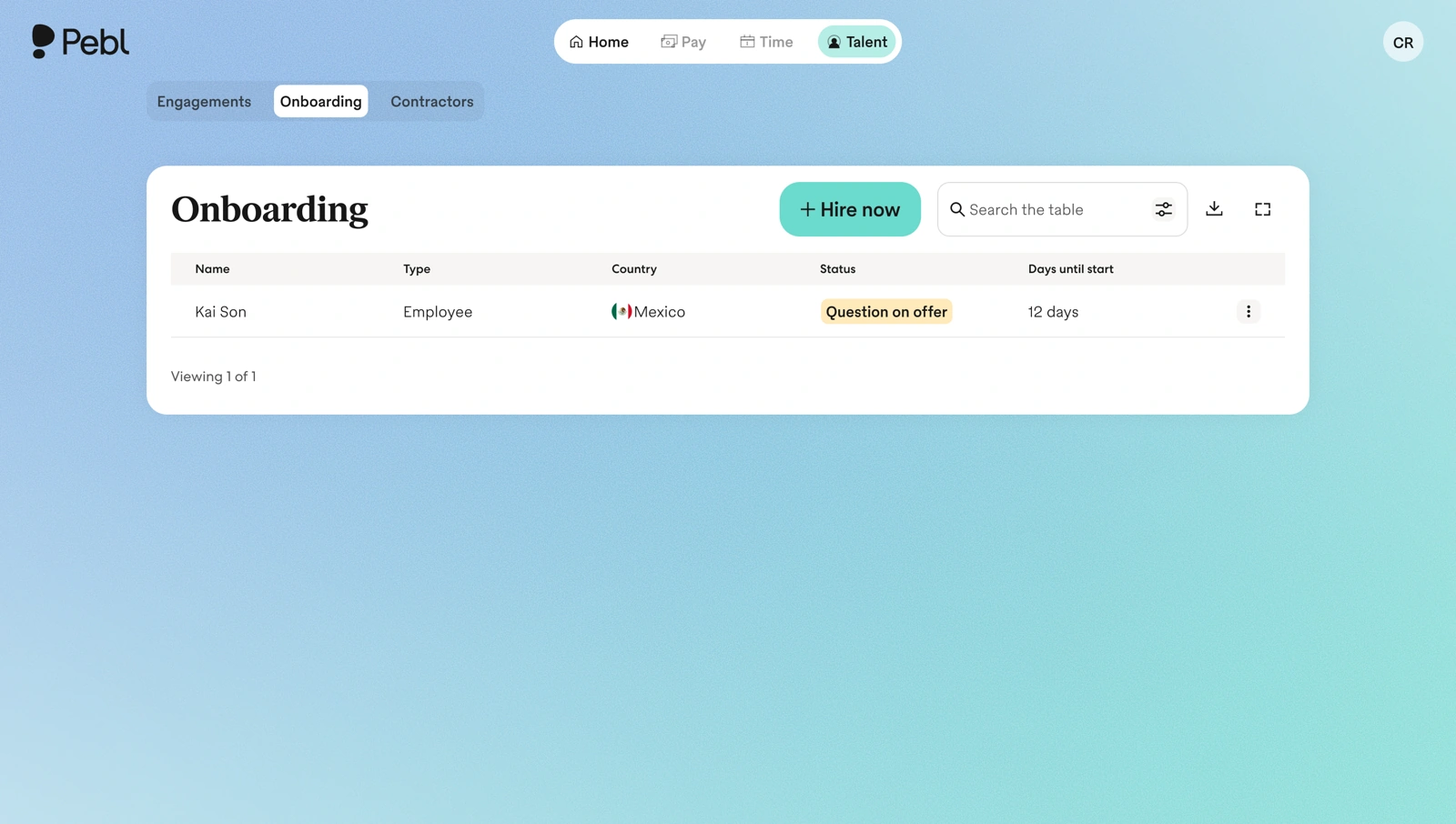
Pebl onboarding
Enlarge screenshot
![]()
Reviewed by Martynas Pupkevicius · Fact-checked by Lucia Aparicio
Opens hellopebl.com

★★★★★4.1
Pricing & terms
EOR fee from
$499
Core costs $499 per employee per month with monthly billing, or $459 per employee per month billed annually.
Plan and quote conditions
Prices are per employee; the dollar currency is not specified. Country variations and compliance add-ons affect the quote. Implementation fees may apply, although the FAQ says setup is free. Growth and Enterprise have different pricing.
Our rating
4.1/5
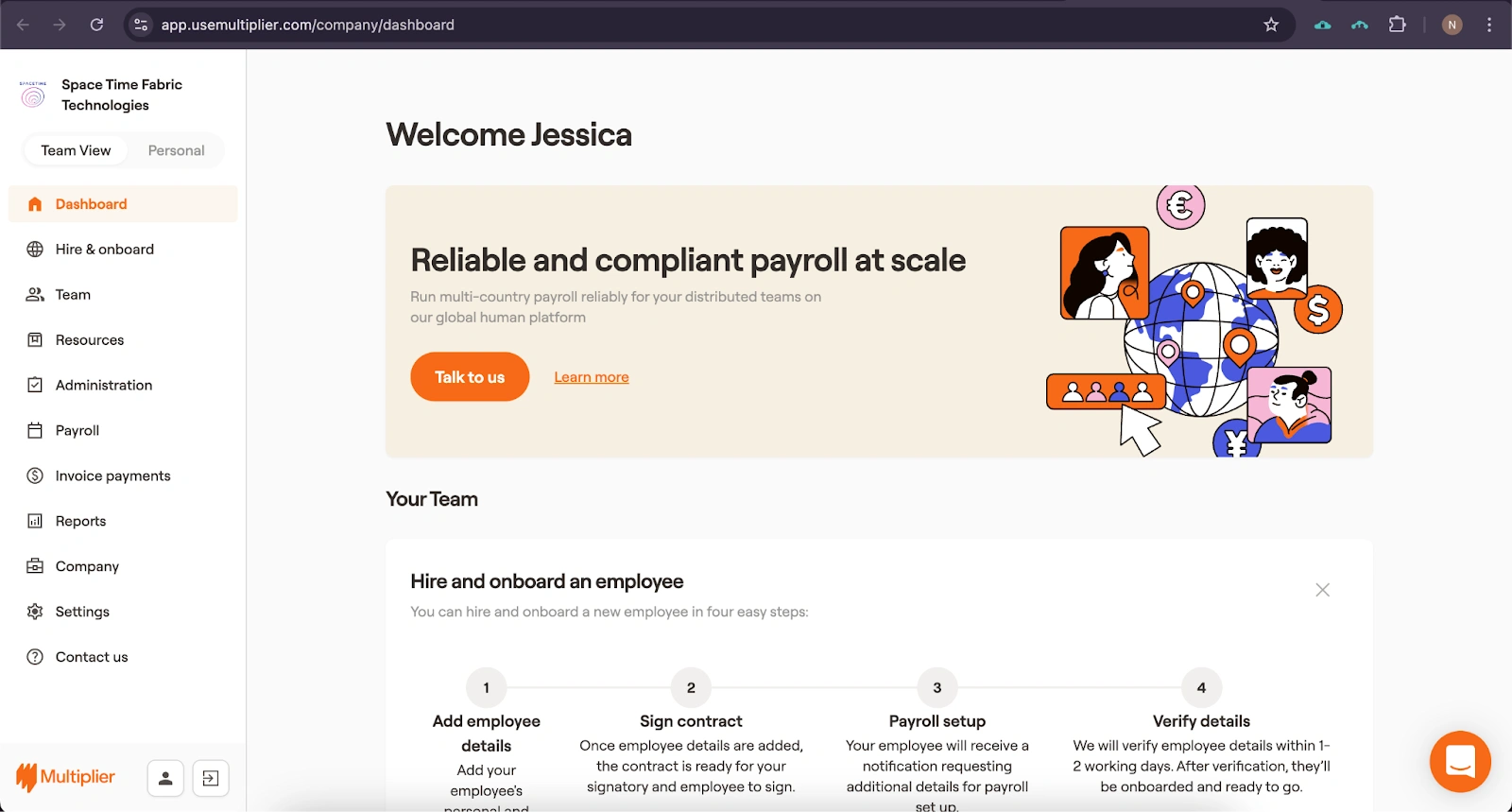
Multiplier dashboard
Enlarge screenshot
![]()
Reviewed by Martynas Pupkevicius · Fact-checked by Lucia Aparicio
Opens usemultiplier.com

★★★★★4.5
Pricing & termsPer employee per month
EOR fee
From USD 499
Plan and quote conditions
Plus the required Rippling Platform, from $8 per employee per month and a monthly base fee.
Our rating
4.5/5
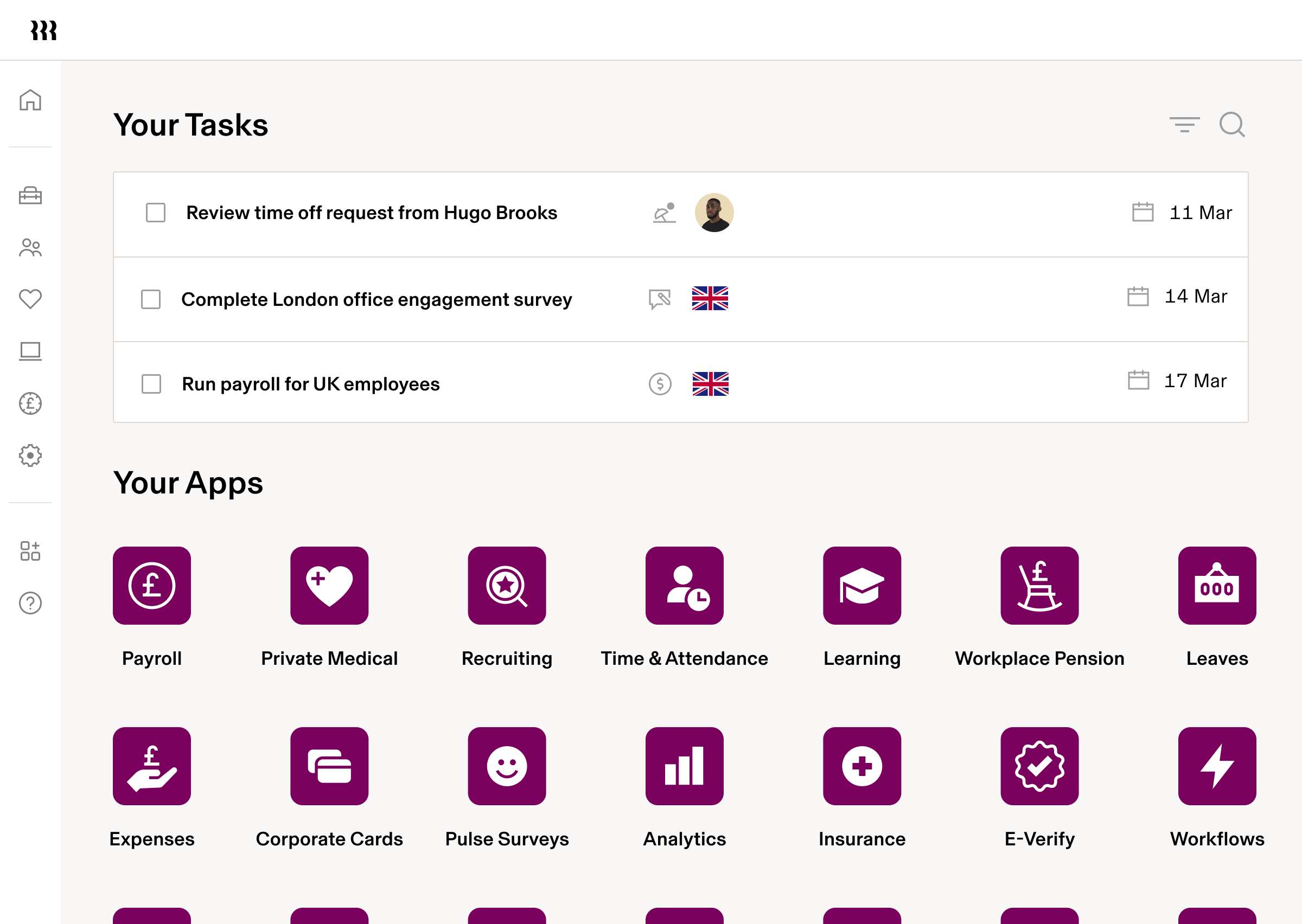
Rippling dashboard
Enlarge screenshot
![]()
Reviewed by Martynas Pupkevicius · Fact-checked by Lucia Aparicio
Opens rippling.com

★★★★★4.1
Pricing & termsPer employee per month
EOR fee
From USD 499
Plan and quote conditions
EOR starts at $499 per employee per month. The country quote must establish the billing commitment and additional services. Salary, employer costs and payroll funding are separate.
Our rating
4.1/5
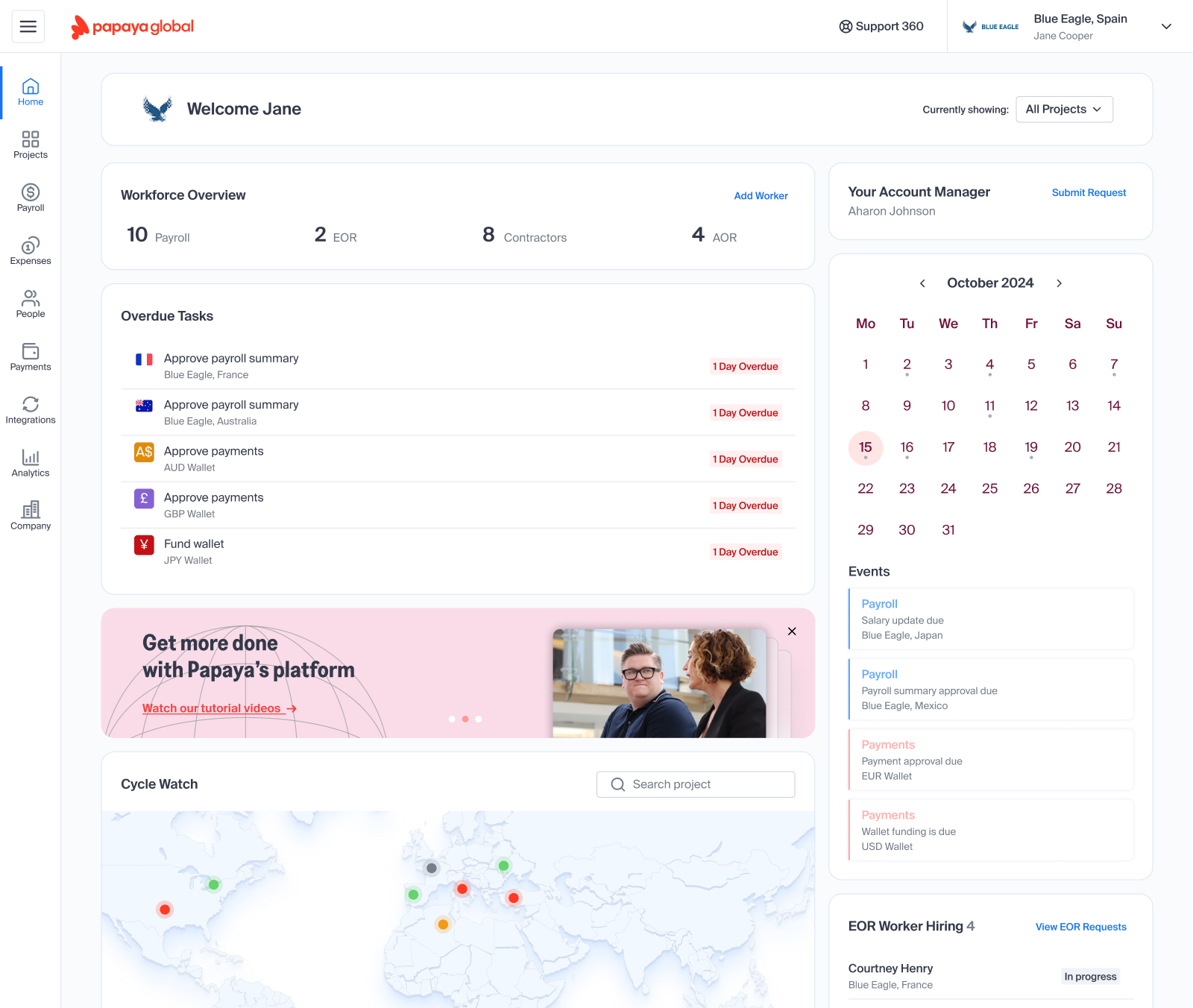
Papaya Global dashboard
Enlarge screenshot
![]()
Reviewed by Martynas Pupkevicius · Fact-checked by Lucia Aparicio
Opens papayaglobal.com

★★★★★4.0
Pricing & termsPer employee per month
EOR fee from
US$579
Plan and quote conditions
USD 579 standard. Eligible companies headquartered outside Canada may pay USD 399 on fees billed through 31 December 2026; USD 579 applies from 1 January 2027. Country and employment-type exceptions apply. A deposit is required before onboarding, typically 1.5 months of gross salary plus employer costs and fees by ACH or three months with other payment methods, with country variations.
Our rating
4.0/5
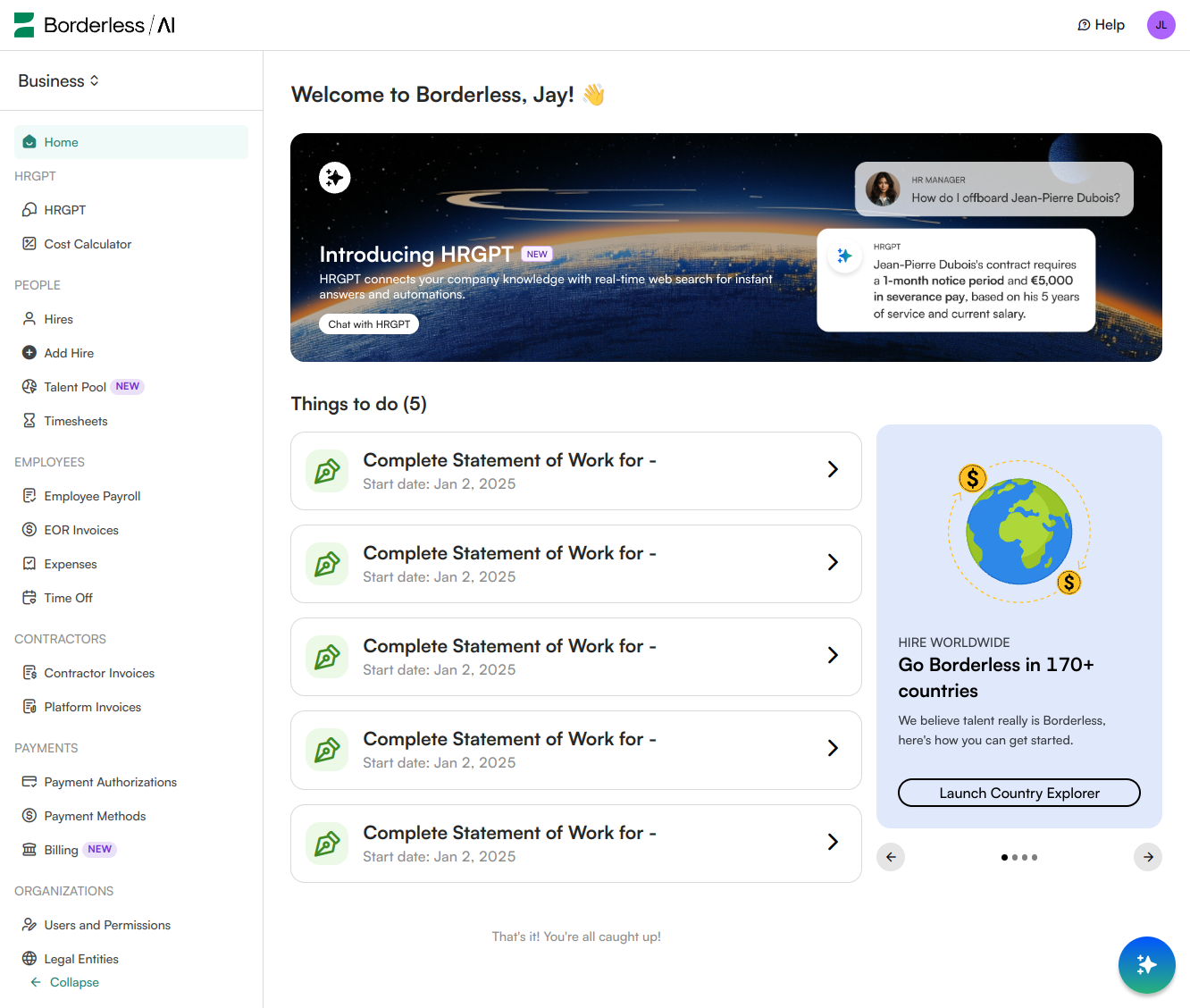
Borderless AI dashboard
Enlarge screenshot
![]()
Reviewed by Martynas Pupkevicius · Fact-checked by Lucia Aparicio
Opens hireborderless.com
★★★★★4.7
Pricing & termsPer employee per month
EOR fee from
US$599
Plan and quote conditions
Month-to-month service pricing is available. Salary, employer contributions, benefits and the mandatory Employer Liability Cost are additional. The liability charge varies by country. Deposit, exchange-rate and payment charges also affect the total.
Our rating
4.7/5
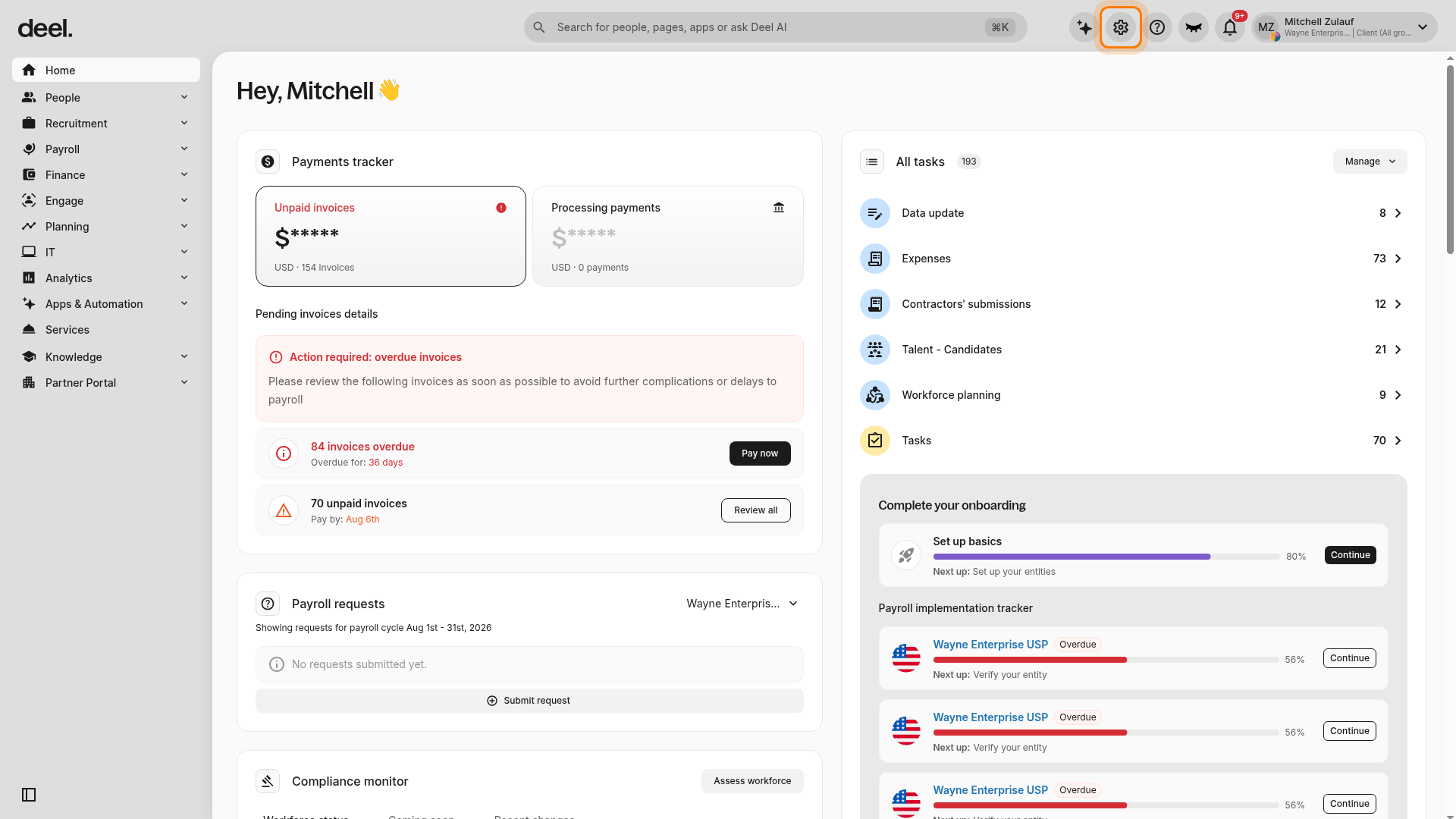
Deel dashboard
Enlarge screenshot
![]()
Reviewed by Martynas Pupkevicius · Fact-checked by Lucia Aparicio
Opens deel.com

★★★★★4.5
Pricing & termsPer employee per month
EOR fee from
US$699
Plan and quote conditions
USD 699 per employee/month on monthly billing. Annual seats are quoted, nonrefundable and reusable; quarterly or semiannual payments cost more than annual prepayment. A deposit of at least one month of gross salary plus employer costs and service fees is required. Benefits, advice and currency conversion can add charges.
Our rating
4.5/5
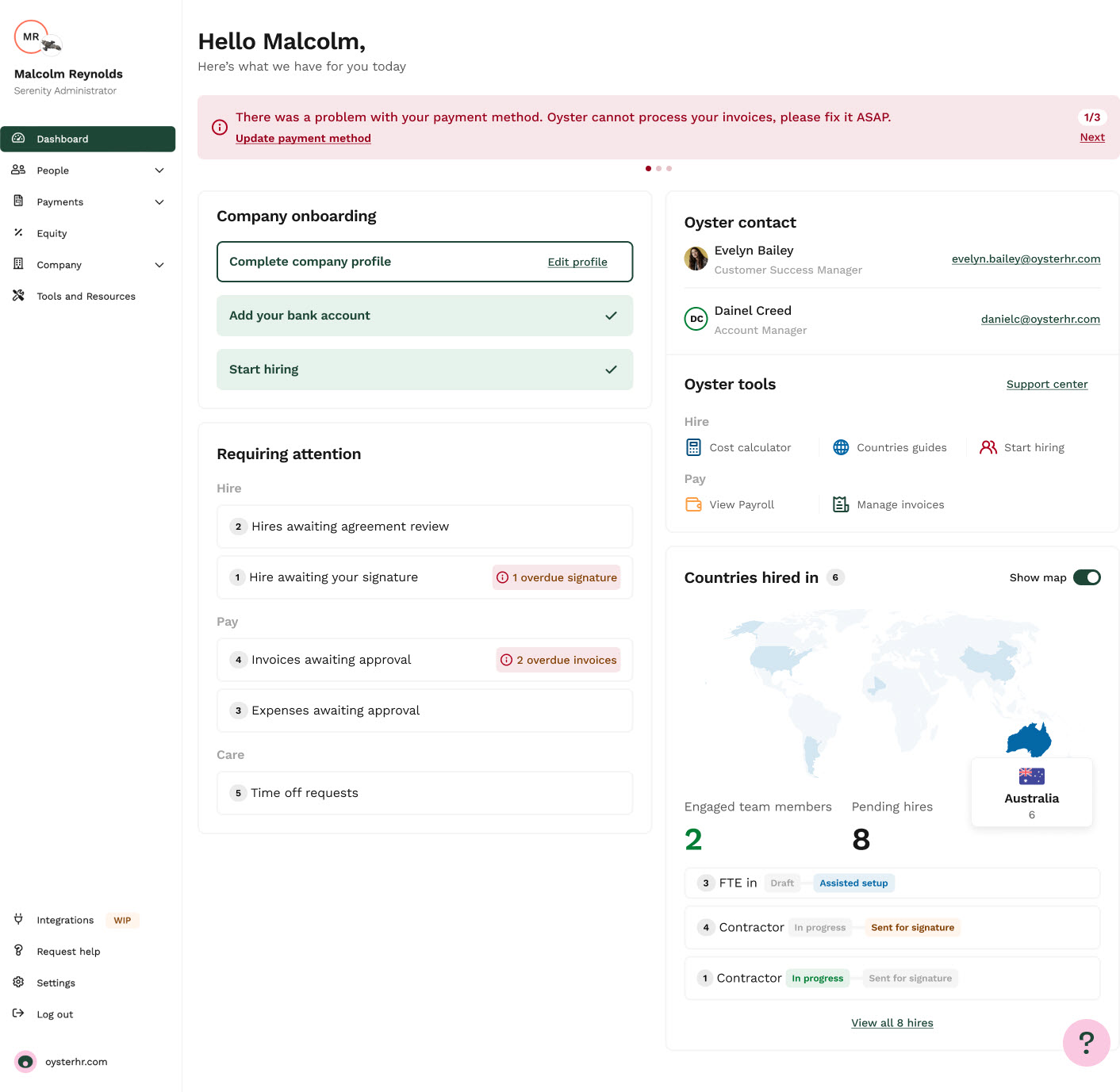
Oyster dashboard
Enlarge screenshot
![]()
Reviewed by Martynas Pupkevicius · Fact-checked by Lucia Aparicio
Opens oysterhr.com
Fig. 2 · Selected starting service fees from nine reviewed providers. Fees are per employee/month and exclude salary, employer contributions, deposits and other applicable charges. Country and billing conditions can change the price.
USD appears only where the provider states it; Multiplier and Pebl show a dollar sign without naming the currency. Fees and billing terms checked on 1 November 2026.
G‑P, which is not in the table, lists its EOR service from USD 599 per employee per month. Ask G‑P for the country-specific fee, deposit and deposit-return terms.
Build the budget from the quote. Ask for service fees, employer costs, benefits, currency charges, setup and exit charges, and any deposit or pre-funding. The extra-charge checklist explains the questions to ask.
What to check beside an advertised fee
Next to any advertised fee, check the currency, billing period, country, plan and commitment.
6. Should you hire through an EOR?
Answer the questions in order and stop at the first “yes”.
- Q1. Are you hiring an employee in a country where you have no legal entity?
- YES → Check that an EOR is allowed and suits the role and country, then compare it with the other ways to employ the person.
- NO → continue to Q2
- Q2. Do you have a contractor abroad who works set hours, on your tools, for you alone?
- YES → Run a local classification assessment. If the role should be employment, compare employing the person directly with using an EOR.
- NO → continue to Q3
- Q3. Do your plans for the country justify comparing an EOR with setting up your own entity?
- YES → Model your own entity alongside the EOR with real costs and what you’d need to employ people yourself.
- NO → Check that the arrangement you have in mind is legal for the work. If you need help, tell us where and how you plan to hire.
Whether it’s your first hire in a new market or an employee moving abroad, the question is the same: which employer can put this person on payroll, and when? Ask for a schedule for that country covering the employment terms, right-to-work checks, documents, benefits, funding and first payday, and use those dates when you agree the start date with the employee.
7. When you don’t need an EOR
Another arrangement may fit better when it meets the role’s legal and practical requirements:
The guide to when you may not need an EOR covers five such buyer profiles.
8. Risks and limits of using an EOR
Permanent establishment risk stays yours. Under the OECD Model Tax Convention (Article 5), an employee who habitually concludes contracts on your behalf, typically a salesperson who closes deals, can create a permanent establishment even when an EOR employs them.
Germany limits EOR assignments to 18 months. German law treats EOR employment as labor leasing under the AÜG. The provider needs a license from the Federal Employment Agency, and unlicensed leasing can be fined up to €30,000, or up to €500,000 where foreign workers without permission to do the work are used. The statutory default is 18 consecutive months with the same user enterprise, counting prior assignments separated by no more than three months. Certain collective-agreement arrangements can vary that maximum. Confirm the applicable rules and decide how the work can continue before the assignment reaches its limit; do not treat a break or provider switch as an automatic solution.
An EOR only protects the people it employs. Contractors you keep on invoices remain your misclassification risk, and enforcement is tightening. By January 2023, Spain had fined Glovo about €205 million in total over alleged breaches of the rules on hiring riders. The Dutch tax authority resumed enforcement against false self-employment on 1 January 2025. Its published 2026 policy permits culpability penalties but does not impose default penalties that year. Back assessments normally start no earlier than 1 January 2025, with exceptions for malicious conduct or failure to comply with earlier directions. The EU Platform Work Directive (2024/2831) requires national implementation by December 2, 2026, including a presumption within its platform-work scope.
Where it’s allowed and suits the role, an EOR lets you start employing someone without setting up a new entity. Confirm the legal model and the country’s milestones before you commit to a start date.
9. Frequently asked questions
Who is liable if something goes wrong with an EOR employee?
The EOR carries the employer-side obligations: payroll taxes, statutory contributions, contract validity and the legal process around terminations. You stay exposed for what you control: how your managers treat the person, what your sales staff sign in the country, and how you handle the worker’s IP and data. Local law sets the underlying duties. The service agreement can split costs and remedies between you and the EOR, within the law and its exclusions and liability limits, but it can’t remove employee rights or statutory duties.
How fast can an EOR hire someone?
Timing depends on the country, role, documents, right-to-work checks, contract review, benefits and payroll cut-off. Ask the provider to confirm each milestone and any conditions. A promise of contracts in minutes doesn’t tell you when the employee can start work or get paid.
What does an EOR cost per month?
Published service fees are a starting point, not the price of a hire. Ask for one quote for the country that covers gross salary, employer costs, benefits, the plan and commitment, extra services, currency charges and any funding schedule. Use the EOR cost guide to compare quotes on the same employee assumptions. A refundable deposit is cash you get back, not an extra monthly fee.
Is using an EOR legal in every country?
Not without conditions. It depends on the country, the role and how the provider delivers the service, and some countries require licences or restrict sectors or assignment length. Germany’s AÜG, for example, treats EOR employment as agency work and sets a default 18-month assignment maximum, with some exceptions.
Can I give stock options to an EOR employee?
Sometimes. It depends on your equity plan, the employee’s country and local securities and tax rules. Check eligibility, tax treatment and payroll reporting before promising a grant. The EOR may have to report or withhold tax even though your company issues the equity.
What happens when I stop using the EOR?
Moving the employee may mean a transfer, new employment documents or another process that local law allows. Don’t ask them to resign by default. Confirm their rights, any consent or consultation requirements, continuity of service, accrued leave and notice before setting the transfer date. Before you sign with the EOR, get its service notice, exit fees, continuing employment costs and deposit-return terms in writing.
10. Sources
The sources behind this guide, grouped by topic. Dates show when we last checked a page. Prices and terms change, so confirm them in your quote.
Employment law and enforcement
10 sourcesInternational · ILO
Private Employment Agencies Convention (No. 181), Articles 1 and 12
Used in the hiring example in section 3. Checked 3 Oct 2026
Germany · gesetze-im-internet.de
Temporary Employment Act (AÜG), official text
German title: Arbeitnehmerüberlassungsgesetz. Section 1 is used in the hiring example in section 3, checked 3 Oct 2026.
Germany · Federal Labour Ministry (BMAS)
Breaks of up to three months don’t restart the 18-month maximum. Checked Sep 2026
Germany · German Customs (Zoll)
Consequences of illegal labor leasing
Fines up to €30,000 for unlicensed lending of workers, and up to €500,000 where foreign workers without permission to work are used.
France · URSSAF
Concealed-work enforcement in France
Check the applicable procedure date, offence conditions and current rates.
France · Service Public
Current concealed-work sanctions
Gives 35% and 50%, with conditions. Government guidance verified 3 Jul 2026. Checked 15 Oct 2026
Netherlands · Business.gov.nl
Avoiding false self-employment
DBA enforcement.
European Union · EUR-Lex
Directive (EU) 2024/2831 on improving working conditions in platform work
Spain · Business & Human Rights Resource Centre
United States · IRS
Independent contractor or employee
The classification tests behind Q2 in section 6.
Tax, contributions and co-employment
6 sourcesInternational · OECD
Model Tax Convention: permanent establishment (Article 5)
Update on cross-border remote work (Nov 2025)
The update is used in the hiring example in section 3, checked 3 Oct 2026.
Germany · Germany Trade & Invest
Employer social-insurance components, contribution bases and ceilings
Germany · StBVV §34
France · URSSAF
United States · IRS
United States · NAPEO
The US co-employment model in the comparison table.
Provider pricing and terms
10 sourcesBorderless AI
PricingOffer for companies outside CanadaFAQCustomer deposit policy
The FAQ and the customer deposit policy (updated 27 Aug 2026) conflict, so the signed terms settle the quote. Cross-checked 15 Oct 2026.
Deel
PricingEmployer of Record page
$599 per EOR employee per month and contractor management at $49 (EOR fee rechecked 1 Nov 2026). Owned entities in 130+ countries (checked Sep 2026).
G‑P
Employer of Record pageContractor pricing
EOR from $599 per employee per month (checked Sep 2026). Contractor pricing is separate from the EOR fee.
Multiplier
$499 per employee per month billed monthly, or $459 billed annually. The dollar currency isn’t stated. Checked 1 Nov 2026
Oyster
PricingWhy a deposit is requiredCustomer terms
$699 per employee per month, annual discounts and a refundable deposit (EOR fee rechecked 1 Nov 2026). The deposit is about one month of the hire’s gross salary plus employer costs and fees (checked Sep 2026). Terms checked 3 Oct 2026.
Papaya Global
EOR from $499 per employee per month. The country quote sets the billing commitment and additional charges. Checked 8 Nov 2026
Pebl
$399 per employee per month; the dollar currency isn’t stated (rechecked 1 Nov 2026). No setup or offboarding service fees (checked 24 Sep 2026); current contract terms may require notice and continuing service fees.
RemoFirst
$199 per employee per month and the published no-fee policy.
RemotePeople
Global from USD 499 per employee per month; Select from USD 199 in selected countries and qualifying salary ranges. Confirm the quote currency, rate, commitment and deposit terms. Checked 1 Nov 2026
Rippling
EOR from USD 499 per employee per month, plus the Rippling platform from $8 per employee per month and a monthly base fee. Checked 8 Nov 2026
Our research
2 sourcesThe Best EOR
The Best EOR
Current starting-fee conditions for every provider in the table.
If you spot a changed price or a conflicting source, send it through the contact page and we’ll review it.
This guide is for general information only and does not provide legal, tax, accounting, or financial advice. For advice about your business, consult a qualified professional familiar with the rules where you hire. Read our research methodology to learn how we assess sources.