TheBestEOR

Best Employer of Record in Singapore

Written by Martynas PupkeviciusFact-checked by Michael Ennis
Picture of Martynas Pupkevicius
Martynas Pupkevicius

EOR Advisor and Remote Work Editor

Our top employer of record in Singapore for 2026 is RemotePeople, from USD 499 per employee a month, ahead of Multiplier and Deel.

We tested all 10 providers with paid client accounts, real quotes and a live hire run through payroll. An EOR cannot obtain a work pass for a foreigner based in Singapore to work for an overseas company.

Flag of Singapore

Hiring in Singapore at a glance

Currency
SGD
Singapore dollar
Pay cycle
Monthly
Within 7 days after the pay period ends
Working hours
44 hours
Manual staff to S$4,500, other non-managers to S$2,600
Annual leave
7 days
1st year after 3 months, rising to 14 with service
Extra pay
Per contract
13th-month pay only if contract or agreement says so
Employer costs
Provident Fund
For citizens and permanent residents, plus training levy
Before you hire:
Confirm the hire needs no work pass, as an EOR cannot get one for a foreigner working for an overseas firm.

Country hiring overview · Singapore

Hiring in Singapore, at a glance.

Check work rights before comparing an EOR quote.

For a Singapore hire, establish the worker’s right to work and the proposed employment arrangement first. MOM says EORs cannot obtain work passes for foreigners based in Singapore while working for overseas companies. Compare eligible employment, payroll and CPF scope separately.

Choose a hiring solution

Need a local employer?

Compare an EOR arrangement for your role before opening your own entity.

Already have a local employer?

Compare payroll and HR support against adding an EOR.

EOR service fee

Fees vary by provider.

Your quote should state the currency, fee per employee, minimum charge and billing commitment.

Onboarding

Paperwork affects the start date.

The contract, right-to-work checks, registrations and payroll deadlines all affect when employment can begin.

Employment costs

CPF depends on the employee.

Ask for the CPF calculation that applies to the employee’s circumstances. The quote should show any applicable levies and agreed benefits separately from salary.

Annual leave

Leave increases with service.

Employees covered by the Employment Act become eligible after three months. Annual entitlement ranges from seven to 14 days, depending on service, and prorating rules apply.

Check before choosing

Confirm work eligibility, the actual employer, CPF by age/wages/PR year, and payroll and leave scope. An EOR is not a substitute work-pass route for an overseas company.

What your quote should include

Employment costs and service fees

1
Gross salary and agreed pay schedule
2
Worker-specific CPF, applicable levies and benefits
3
EOR fee: currency, per-employee billing, minimums and commitment
4
Setup, foreign exchange, extras and exit costs

Deposits and payroll funding

1
Amount and payment deadline
2
Whether funds are refundable or credited to payroll
3
Release conditions and refund timing
Show these separately from recurring expenses.

Key takeaways for hiring in Singapore

Resolve the work route before choosing a provider

MOM’s restriction already rules out EOR pass applications for foreigners based in Singapore working for overseas companies. A local entity or recruitment licence does not override that rule. Compare providers only after establishing an eligible employment arrangement.

The monthly CPF ceiling does not finish the bonus budget

Additional Wages have an annual ceiling calculated separately from monthly Ordinary Wages. A bonus can create additional employer CPF even when monthly salary has reached its ceiling. Put the annual salary and bonus assumptions into the same calculation.

Shared parental leave expanded again in April 2026

Eligible parents share ten weeks for the qualifying 2026 cohort. It is a shared allocation, not ten weeks automatically for each parent. The provider’s leave calendar should record the allocation and the reimbursement process alongside maternity or paternity leave.

An exit may require withholding for tax clearance

Ordinary payroll does not use general monthly salary-tax withholding, but an applicable IR21 case can require the employer to hold money due to the employee. Check the actual departure or cessation scenario and IRAS exceptions before promising an unconditional final-pay date.

Quick verdict

What is the best EOR in Singapore?

I’d check CPF status before comparing monthly costs.

For a citizen or permanent resident on full CPF rates, aged 55 or below, the 17% employer contribution on Ordinary Wages is capped at S$1,360 a month in 2026. Additional Wages have a separate ceiling. Other age groups and first- or second-year PRs can have different rates. Foreign employees generally do not receive CPF, but other levies and obligations can apply.

1
Multiplier logo

4.1/5

Multiplier

Managing payroll, leave and expenses in one place

Starting fee
$459

per employee / month

Countries
150+
where you can hire

Billed annually. $499 billed monthly.

Deposit
1+ months

of gross salary plus contributions

Deposit refund
Within 60 days

of the last working day

Check the fit

Why consider it

A set monthly payroll calendar, with salaries paid at month-end.

SOC 2 Type II audited every year and ISO 27001:2022 certified.

Check the fit

Integrations and API access need the Growth plan.

Before signing: An implementation fee can apply on some plans, so get setup confirmed as free in your quote. Confirm the employing entity for each country in your contract.

At $459 a month billed annually, the first year for one hire is $5,508 in service fees. Salary, employer costs and the refundable deposit come on top.

Visit Multiplier ↗

2
Editorial pick
RemotePeople logo

4.9/5

RemotePeople

Hiring in new markets with local HR support

Starting fee
$499

per employee / month

Countries
150+
where you can hire

EOR Select from $199 for eligible hires.

Deposit
1 month

of gross salary

Deposit refund
Within 5 days

of the final payment

Why consider it

Recruitment and EOR services through one provider.

Dedicated account manager in both EOR plans.

Check the fit

Recruitment is separately priced.

Before signing: Confirm quote currency, billing commitment, deposits, funding deadlines and refund terms. EOR Select eligibility depends on the hiring country and employee salary.

Both EOR plans list local contracts, payroll and tax administration, and statutory benefits administration. Salary, employer contributions and benefit costs are separate.

Legal employer in Singapore
✓ Verified on register

Employing entity
Own Pte. Ltd.
UEN 202117926G · incorporated May 2021 · group holding company

EA licence
Held in its own name
MOM Employment Agency licence 22S1361

Local office
261 Waterloo Street, #03-36, Waterloo Centre, Singapore 180261

Visit RemotePeople ↗

3
Deel logo

4.7/5

Deel

Paying employees and contractors on one platform

Starting fee
$599

per employee / month

Countries
130+
where you can hire

Plus a mandatory Employer Liability Cost.

Deposit
1–1.5 months

of gross salary

Deposit refund
Within 60 days

of offboarding

Why consider it

EOR, contractor management and payroll for your own entities.

Month-to-month EOR service pricing available.

Check the fit

The country-specific Employer Liability Cost is mandatory.

Before signing: Confirm the Employer Liability Cost amount, benefit costs and any additional products. Monthly service terms do not remove employment notice, severance or other exit obligations.

The EOR pricing page lists 130+ countries. Broader platform coverage figures may include other services.

Employing entity
Letsdeel Pte. Ltd. (per ACRA)
UEN 202110571D · registered 2021 · Deel states it operates a wholly-owned Singapore entity

EA licence
Not published
No MOM Employment Agency licence number found

Local office
2 Shenton Way #15-04, SGX Centre I, Singapore 068804
Register address

Visit Deel ↗

No provider pays for a position on this page; some outbound links pay a referral fee. See the funding model and methodology.

Employment arrangements and services

All 10 EOR providers for Singapore, side by side

Check work-pass eligibility before comparing quotes.

Compare the employing entity, service scope, support and total quote for an eligible local hire. The work-pass column records the restriction on EOR applications for foreigners working for an overseas company. Fees below show their published currency or flag where the dollar currency needs confirmation, and onboarding estimates require confirmation for the actual hire.

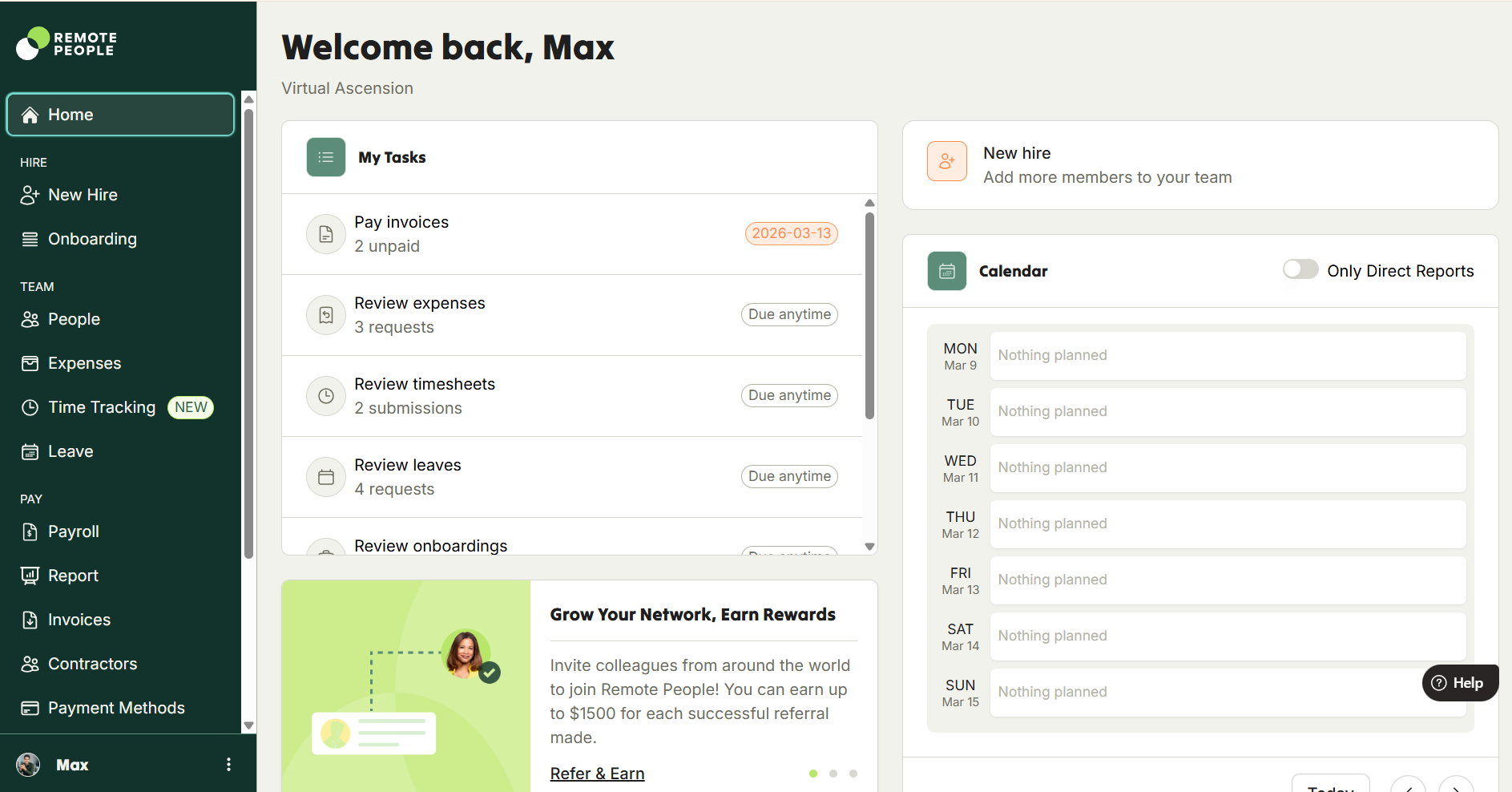
Once the hire is eligible, I’d use these profiles to compare the employing arrangement, service scope and full fee. The same ten providers appear side by side in the global EOR ranking. For a wider shortlist, browse EOR providers for Singapore.

Provider

Best For

Starting feeDepositOnboarding
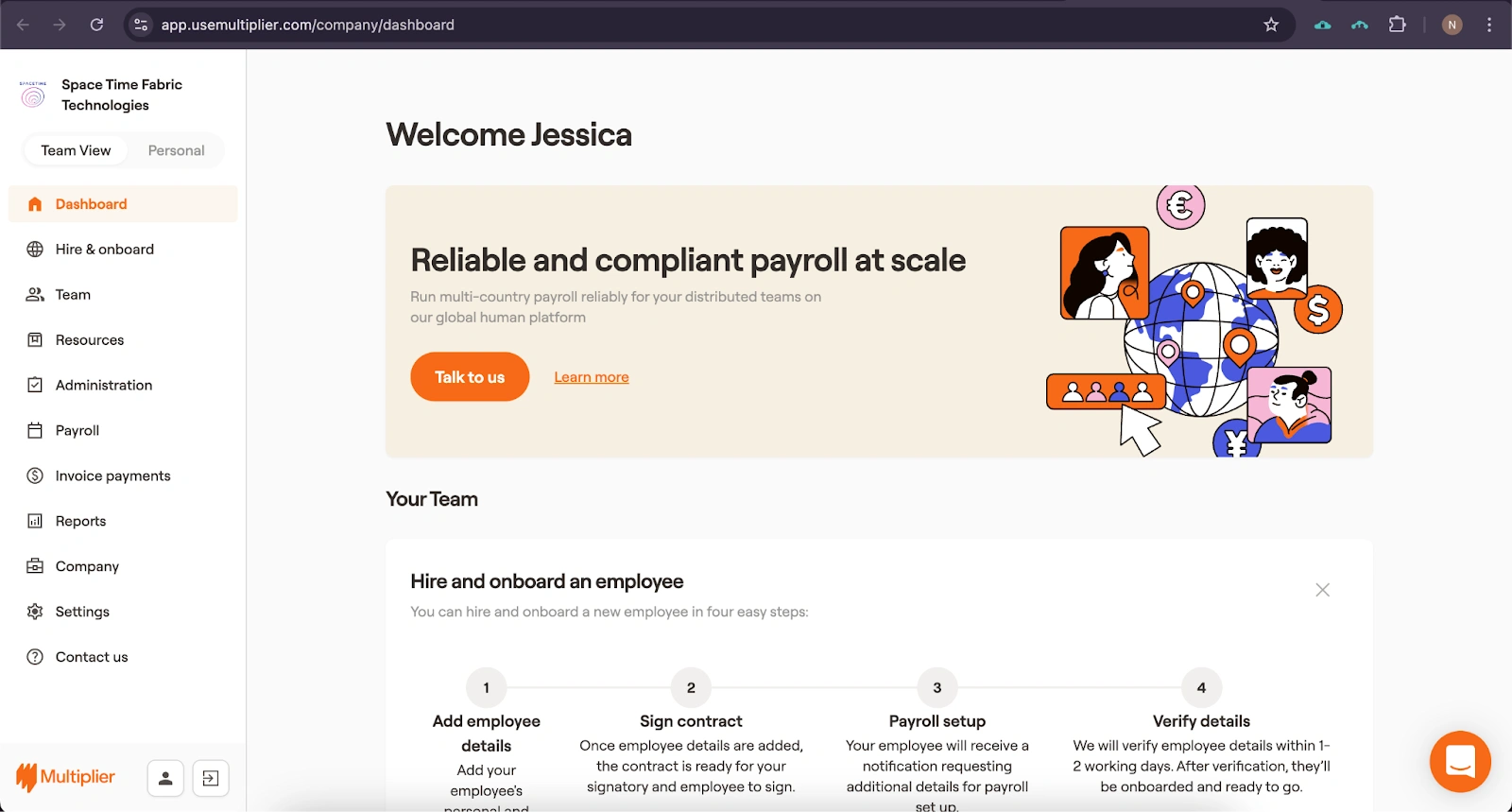
1 Multiplier logo Multiplier 4.1/5 Rating Managing payroll, leave and expenses in one place Starting fee: $459 USD / monthDeposit: 1+ monthsOnboarding: 48–72 hours

My take

Singapore’s Ministry of Manpower prohibits an EOR from obtaining work passes for foreigners based in Singapore who work for overseas companies.

Immigration services do not remove that restriction; the employment arrangement must be eligible before a start date is agreed.

My starting point with Multiplier would be Core, which covers employment administration, payroll, leave and standard workforce reporting. Core starts at $499 per employee per month on monthly billing or $459 per month billed annually. I’d consider Growth if you need the integrations, custom reports and open APIs it adds. The quote needs to identify the dollar currency and chosen plan.

Country variations and mandatory add-ons affect the total. Implementation fees may apply, although the FAQ says setup is free; the quote must resolve that charge. Salary, employer costs and benefit premiums are additional.

When this provider fits

Compare Multiplier’s Core plan with Deel’s complete Singapore proposal for an eligible local hire. Annual commitment, required charges and the systems your team already uses are practical differences. Ask each provider to demonstrate the same CPF and bonus scenario.

Deposit

1+ months

Entity model

Own entities and partners

First year, one hire

$5,508 in service fees

Reviewed by Martynas PupkeviciusFact-checked by Michael Ennis

Starting fee

$459

Core plan billed annually, or $499 per month on monthly billing. Confirm the dollar currency.

Against the 10 starting fees

$199 lowest$699 highest
2 RemotePeople logo RemotePeople 4.9/5 Rating Hiring in new markets with local HR support Starting fee: $499 USD / monthDeposit: 1 monthOnboarding: 5–8 days

My take

For a hire that needs a named contact, I’d look at RemotePeople’s dedicated account manager.

The service includes local employment contracts, payroll and tax administration, and statutory-benefits administration. Recruitment is separate.

EOR Global starts at USD 499 per employee per month. EOR Select starts at USD 199 for eligible countries and employee salary ranges. Salary, employer contributions, benefit costs and agreed extras are additional. The country quote determines eligibility, the final fee, billing commitment and payroll funding.

When this provider fits

For a citizen or permanent-resident hire, compare the applicable plan, named employer, payroll contact and funding terms. RemotePeople Select needs country and salary eligibility; RemoFirst’s headline fee needs its own country scope.

Deposit

1 month

Entity model

Own entities in core markets

First year, one hire

$5,988 in service fees

Reviewed by Martynas PupkeviciusFact-checked by Michael Ennis

Starting fee

$499

EOR Global. EOR Select starts at $199 where the country and employee salary qualify.

Against the 10 starting fees

$199 lowest$699 highest
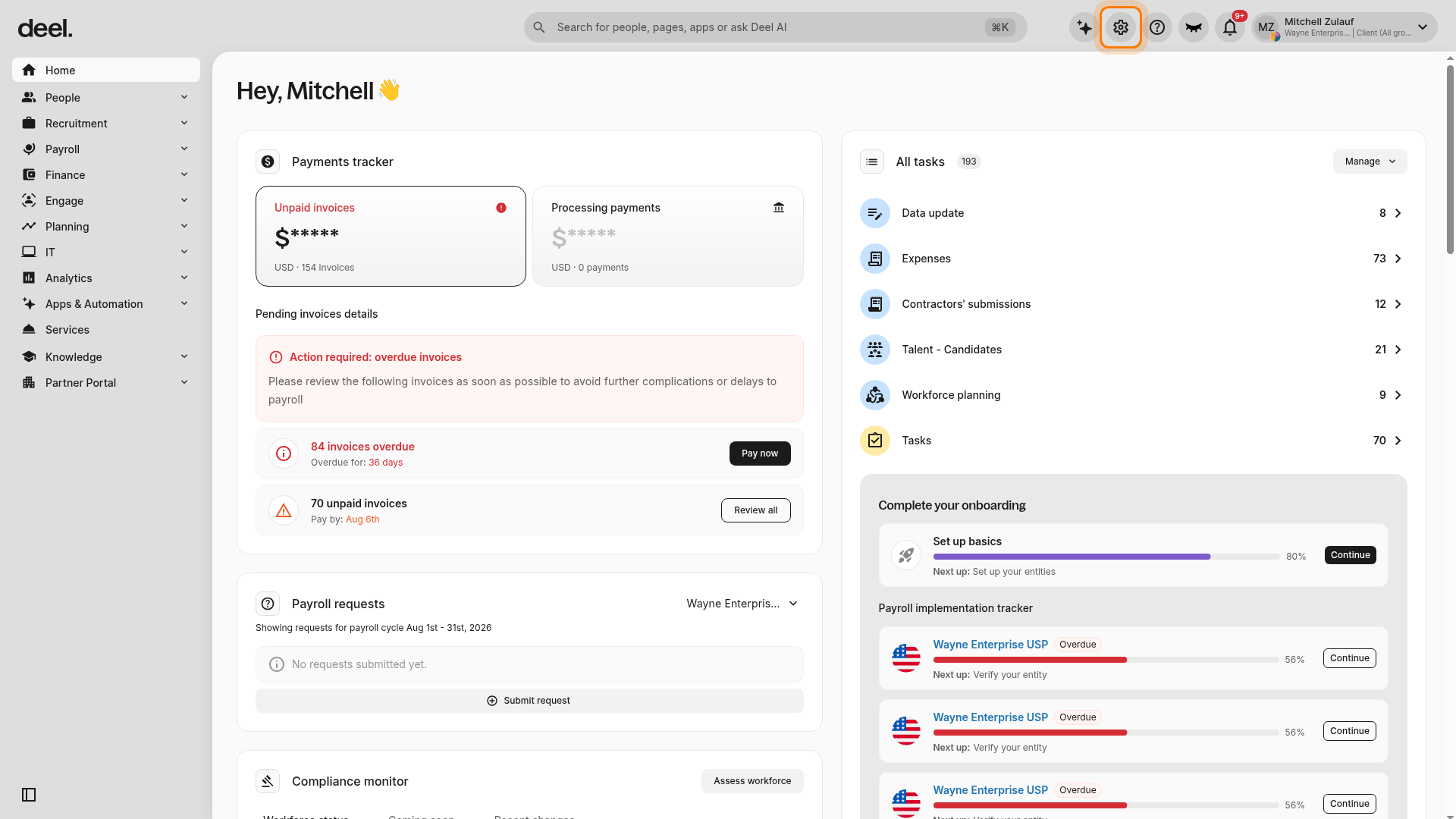
3 Deel logo Deel 4.7/5 Rating Paying employees and contractors on one platform Starting fee: $599 USD / monthDeposit: 1–1.5 monthsOnboarding: 2–5 days

My take

Deel would be on my shortlist if you need EOR payroll and benefits administration alongside separate contractor and HR products.

EOR starts at USD 599 per employee per month, with month-to-month billing available. Mandatory Employer Liability Cost is an additional charge based on gross salary, with rates varying by country. Salary, statutory employer costs and benefit premiums are also separate.

Contractor management starts at USD 49 per active contract per month. It is a separate service from EOR employment; currency conversion, payment-method charges and any required deposit also affect the amount funded.

Deposit

1–1.5 months

Entity model

Owned entity

First year, one hire

$7,188 in service fees

Reviewed by Martynas PupkeviciusFact-checked by Michael Ennis

Starting fee

$599

Month-to-month billing. Mandatory Employer Liability Cost is charged separately.

Against the 10 starting fees

$199 lowest$699 highest
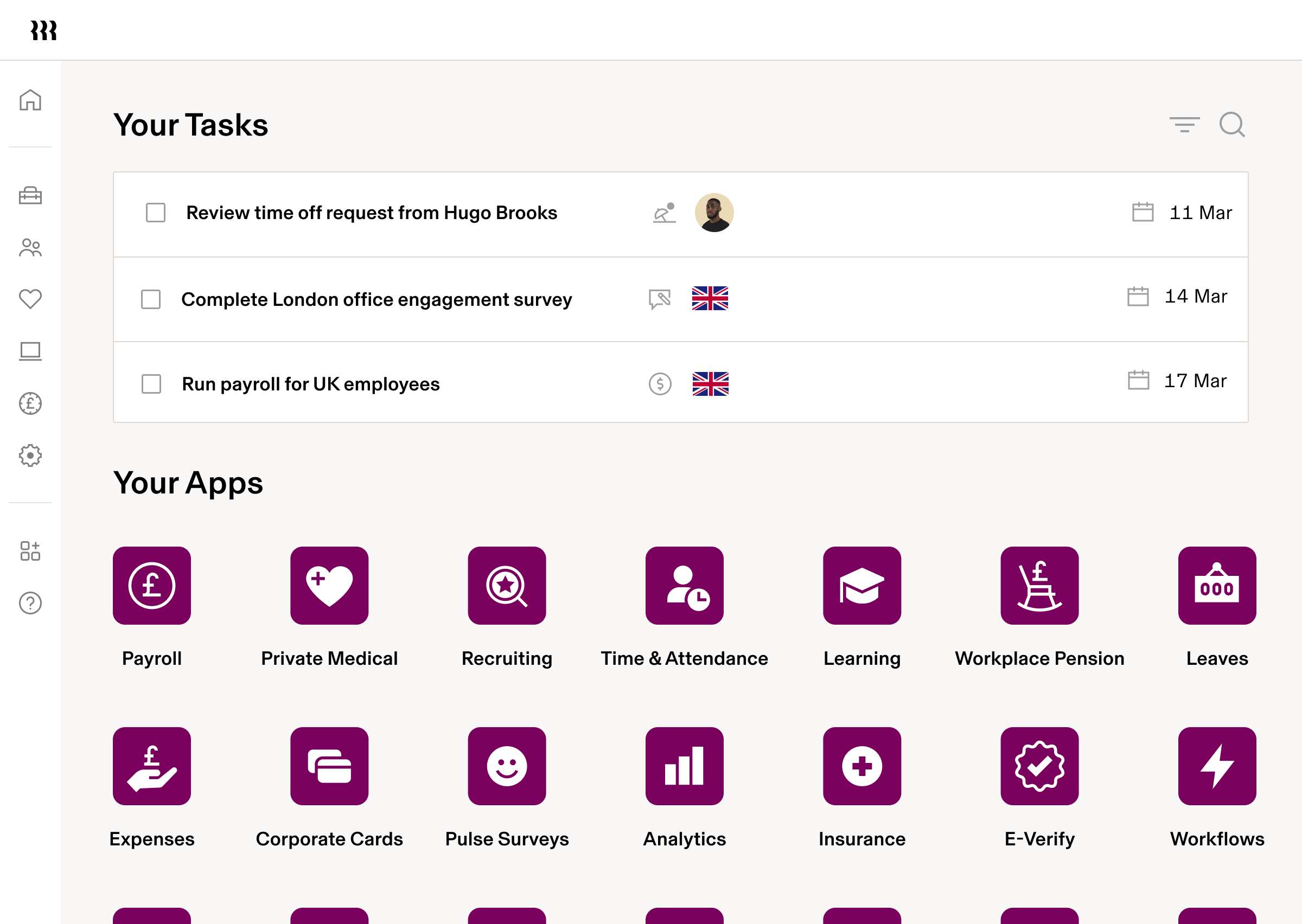
4 Rippling logo Rippling 4.5/5 Rating Setting up payroll, laptops and app access for new hires Starting fee: $499 USD / monthDeposit: Per quoteOnboarding: 2–5 days

My take

Rippling makes more sense to me when you also need its HR, IT or finance products: shared employee data connects the workflows and reporting.

Device management and app access are separate products within that wider system.

Rippling EOR starts at USD 499 per employee per month, and the required Rippling Platform adds from USD 8 per employee per month plus a monthly base fee. The quote needs to show any selected HR, IT or finance products and the billing commitment. Salary, employer costs, benefits, deposits and payroll funding are additional to the software and service fees.

When this provider fits

Rippling merits comparison when the hire joins an existing HR and IT system; Papaya is relevant when finance needs Singapore inside a multi-country payroll close. Price the additional platform or reporting value against a standalone local hire, with the same CPF category and bonus assumptions.

Deposit

Per quote

Entity model

Own entities and local partners

First year, one hire

$5,988 in EOR fees

Reviewed by Martynas PupkeviciusFact-checked by Michael Ennis

Starting fee

$499

Plus the required Rippling Platform, from $8 per employee per month and a monthly base fee. Confirm the billing terms and selected products.

Against the 10 starting fees

$199 lowest$699 highest
5 Pebl logo Pebl 4.2/5 Rating Hiring people who need visa or relocation support Singapore work passes · An EOR cannot obtain a work pass for someone based in Singapore who works for an overseas company. Starting fee: $399 USD / monthDeposit: Per quoteOnboarding: 5–9 days

My take

Singapore’s Ministry of Manpower prohibits an EOR from obtaining work passes for foreigners based in Singapore who work for overseas companies.

Immigration services do not remove that restriction; the employment arrangement must be eligible before a start date is agreed.

Pebl, formerly Velocity Global, combines hiring, payroll, employee changes, reporting and offboarding in one platform. EOR starts at $399 per employee per month; the country quote must identify the dollar currency and billing commitment. Salary, employer costs, benefits and additional services are separate.

I’d check Pebl’s deposit and exit terms before committing. A deposit is required before onboarding; its amount can change with salary, seniority or payment history. It is returned after the final invoice and outstanding balances are paid. Early exit can make the remaining committed-term service fees payable, subject to the agreement’s termination exceptions. Any discounted offer needs an end date and renewal price.

Deposit

Per quote

Entity model

Affiliates and local partners

First year, one hire

$4,788 in service fees

Reviewed by Martynas PupkeviciusFact-checked by Michael Ennis

Starting fee

$399

Confirm the country price and billing commitment.

Against the 10 starting fees

$199 lowest$699 highest
6 Oyster logo Oyster 4.5/5 Rating Using one onboarding process for hires across countries Starting fee: $699 USD / monthDeposit: ~1 monthOnboarding: 7–12 days

My take

Oyster covers payroll, expenses, time off and reporting, with onboarding and offboarding support.

Optional benefits packages cost extra. At USD 699 per employee per month on monthly billing, I’d weigh that service against the annual commitment described below.

Annual seats are priced by headcount and location and are non-refundable, but can be reused for replacement hires. Annual prepayment gives the lowest fee; higher-priced quarterly or semiannual payment options are available. Salary, employer costs and benefit premiums are additional, and a refundable deposit is required. Optional People Partner project work costs USD 300 per hour.

Deposit

~1 month

Entity model

Own entities and vetted partners

First year, one hire

$8,388 in service fees

Reviewed by Martynas PupkeviciusFact-checked by Michael Ennis

Starting fee

$699

Monthly billing. Annual seats are quoted separately, prepaid and non-refundable.

Against the 10 starting fees

$199 lowest$699 highest
7 G-P logo G-P 4.2/5 Rating Hiring abroad while keeping your existing HR system Starting fee: $599 USD / monthDeposit: 1–2.5 monthsOnboarding: 2–5 days

My take

G-P is worth a closer look if your requirements extend to custom API integrations.

I’d assess those alongside its EOR employment administration, benefits and reporting. EOR starts at USD 599 per employee per month, with volume discounts by quote. Salary, employer costs, benefit premiums and additional services are separate.

There is no minimum contract length for EOR hires. The proposal still sets the commercial billing and cancellation terms, along with the cost of any integration or implementation work.

Deposit

1–2.5 months

Entity model

100+ own entities, plus partners

First year, one hire

$7,188 in service fees

Reviewed by Martynas PupkeviciusFact-checked by Michael Ennis

Starting fee

$599

Confirm the included services and billing terms in your country quote.

Against the 10 starting fees

$199 lowest$699 highest
8 Papaya Global logo Papaya Global 4.1/5 Rating Comparing payroll costs across countries in one report Starting fee: $499 USD / monthDeposit: 1–2 monthsOnboarding: 7–10 days

My take

Papaya brings EOR employees, payroll for a company’s own entities and workforce payments into one platform, with consolidated reporting and payroll approval tools.

That payroll and payments connection is the part I’d focus on when comparing it with a standalone EOR service.

Papaya’s EOR service starts at USD 499 per employee per month. The country quote must identify the billing commitment and any additional services. Salary and employer costs are separate.

Deposit

1–2 months

Entity model

Partner model; confirm employer

First year, one hire

$5,988 in service fees

Reviewed by Martynas PupkeviciusFact-checked by Michael Ennis

Starting fee

$499

The country quote sets the billing terms. Payroll-only processing is priced separately.

Against the 10 starting fees

$199 lowest$699 highest
9 Borderless AI logo Borderless AI 4.0/5 Rating Getting 24/7 help with overseas payroll and HR Starting fee: $579 USD / monthDeposit: 1.5–3 monthsOnboarding: 7–12 days

My take

I’d use Borderless AI’s standard EOR fee of USD 579 per employee per month when planning beyond the promotion.

Eligible companies headquartered outside Canada may qualify for USD 399 on fees billed through 31 December 2026. USD 579 applies from 1 January 2027, including promotional customers; country and employment-type exceptions apply. Salary, employer costs and benefits are additional.

A refundable deposit is required before the employee starts. The schedule is 1.5 months of gross salary plus employer costs, benefits and platform fees with ACH or three months by wire and other methods, with country variations. The base includes salary, employer contributions, benefits and platform fees. Late-payment issues can raise it to six months. Deposits are released after the relevant obligations are settled.

Deposit

1.5–3 months

Entity model

Own entities

First year, one hire

$6,948 in service fees

Reviewed by Martynas PupkeviciusFact-checked by Michael Ennis

Starting fee

$579

Eligible companies headquartered outside Canada can pay $399 on fees billed through 31 December 2026.

Against the 10 starting fees

$199 lowest$699 highest
10 RemoFirst logo RemoFirst ⚠ Trustpilot warning 0.5/5 Rating Making a first overseas hire on a tight budget Starting fee: $199 USD / monthDeposit: About 1 monthOnboarding: 5–9 days

My take

We moved RemoFirst to last place on 8 November 2026: Trustpilot has suspended its rating for a breach of its guidelines and removed fake reviews.

RemoFirst says it works exclusively with vetted in-country partners. Here, that means a local partner company, not RemoFirst, would normally employ your hire, and payroll changes, questions and exits pass through both companies, which can slow answers. US$199 is RemoFirst’s starting fee and varies by country, so get this country’s quote before you compare. The lack of a minimum contract term or headcount is what I like about RemoFirst’s offer. EOR employment starts at USD 199 per employee per month and includes a dedicated customer success manager. The fee can vary with country requirements. Salary, employer costs, benefits, deposits and optional services are separate.

Contractor management is free for onboarding, identity checks, contract storage and expenses. Contractor payments cost USD 25 per contractor in months when a payment is processed; payment-provider and transfer fees may also apply. These contractor services are separate from EOR employment.

Deposit

About 1 month

Entity model

Partners, not own entities

First year, one hire

$2,388 in service fees

Reviewed by Martynas PupkeviciusFact-checked by Michael Ennis

Starting fee

$199

RemoFirst advertises no minimum contract term or employee count. Confirm any country-specific charges.

Against the 10 starting fees
$199 lowest$699 highest

Fig. 1 · Provider comparison for eligible local hires. Pass eligibility must be resolved before an offer or start date is agreed.

Pricing as of 26 September 2026. Recalculate cost illustrations with your quote.

Which top pick · Singapore

I’d start with the worker’s eligibility and the proposed arrangement. For a Singapore citizen or permanent resident, compare the named legal employer, applicable CPF treatment, benefits, payroll support and total quote. For a foreign candidate who would work in Singapore for your overseas company, do not choose an EOR on the promise of pass sponsorship; first establish who is eligible to apply for the pass.

Obtain a confirmed start date only after the required work authorisation, contract and payroll checks are complete. Once you have a written quote, enter its recurring amounts in USD in the EOR cost calculator.

Local Singapore alternatives (unranked): Several Singapore-based HR and payroll firms also provide EOR or local payroll outsourcing, including BoardRoom and Talenox on the payroll side and QuickHR for HR software with managed payroll. All three stop at the border: none places hires outside Singapore. A company that will only ever employ in Singapore may still find one of them enough.

Get your EOR discount

Get up to 30% off eligible EOR service fees. Your quote confirms the discount and terms.

Employment framework

Employment and payroll in Singapore

The employee’s status changes payroll and pass options.

Singapore’s payroll and contribution rules depend on the worker’s status. MOM also restricts EOR work-pass applications for people based in Singapore while working for overseas companies.

MOM restricts the overseas-company EOR route

MOM prohibits EOR work-pass applications for foreigners based in Singapore while working for overseas companies. The provider’s ownership of its local employer does not change the rule.

MOM points overseas companies toward establishing an eligible local presence, such as incorporation or a qualifying representative office.

Contract and responsibilities

For an eligible Singapore hire, the EOR acts as the named employer under the contract of service and administers the agreed employment obligations.

Review the actual arrangement and each party’s responsibilities. A service agreement does not eliminate every obligation of the client company.

CPF and payroll reporting

Worker-specific CPF calculation

For citizens and permanent residents, payroll must apply the CPF rates and wage ceilings appropriate to the worker. CPF contributions are due at the end of the calendar month.

Contribution deadline and reporting

CPF Board takes enforcement action if contributions remain unpaid by the 14th of the following month, or the next working day if that date falls on a weekend or public holiday. The employer also accounts for SDL and applicable IRAS reporting requirements.

Confirm the route before onboarding

1

Confirm employment eligibility and the start date

Confirm the worker’s status and whether the proposed employment is legal and compliant. Do not start work while a required authorisation is unresolved.

For citizens and permanent residents, obtain the provider’s confirmed onboarding date instead of assuming a published estimate applies.

2

Complete employment and payroll setup

Agree the contract and payroll date, collect the required records, and complete applicable CPF, benefits and reporting setup.

Employer cost

Statutory employer contributions in Singapore

Age and permanent resident status affect CPF rates.

CPF depends on citizenship or PR status, age, wages and the applicable wage ceilings. The 17% employer rate below is the full rate for workers aged 55 or below with wages above S$750; first- and second-year PRs can have graduated rates. Foreign employees generally do not receive CPF, but SDL, foreign-worker levies or other obligations may still apply. Confirm that the proposed hiring arrangement is legal and compliant before calculating costs.

Fig. 2 · Illustrative full-rate CPF cohort, age 55 or below; applicable wage ceilings and SDL cap limit the amounts. Other CPF categories use different rates.

Contribution Employer rate Cap / basis Agency
Contribution

CPF (provident fund)

Full-rate citizens/PRs; employee share depends on age and wages
Employer rate
17% (full-rate cohort, age ≤ 55, wages > S$750)
Cap / basis
Ordinary Wage ceiling S$8,000/mo from Jan 2026; annual cap S$102,000
Agency
CPF Board
Contribution

Skills Development Levy (SDL)

Every employee, local or foreign
Employer rate
0.25%
Cap / basis
Min S$2, max S$11.25 (wages ≥ S$4,500)
Agency
CPF Board / SWDA
Contribution

CPF, foreign work-pass holders

EP / S Pass / Work Permit
Employer rate
0% (exempt)
Cap / basis
No CPF due
Agency
CPF Board
Contribution

Foreign Worker Levy (FWL)

S Pass & Work Permit only, not EP
Employer rate
Tier & quota based
Cap / basis
Monthly per worker, by sector
Agency
Ministry of Manpower

Fig. 3 · Mandatory employer contributions in Singapore, 2026 rates and monthly ceilings

For a Singapore citizen aged 55 or below earning S$6,000 of Ordinary Wages, employer CPF is S$1,020 and the employee’s share is deducted from gross wages. The per-employee SDL calculation is S$11.25, giving S$1,031.25 before employer-level SDL rounding. CPF rates vary for older workers and first- or second-year PRs; use the applicable CPF Board table rather than a single percentage for every employee. Add the provider’s fees and other agreed employment costs separately.

Working time & leave

Working hours, overtime and statutory leave

Check whether the employee qualifies for overtime pay.

The Employment Act caps the work week and reserves overtime pay for lower-wage employees; leave scales with tenure, and family leave was extended in 2025.

Hours and overtime

Standard week 44 hours
Standard day 8–9 hours
Overtime rate 1.5× hourly
Overtime cap 72 hrs/month
Rest day 1 per week
Public holidays/yr 11 gazetted

Fig. 4 · Hours and overtime · statutory only for Part IV employees; above the S$4,500 and S$2,600 thresholds these terms are contractual

The 44-hour week, overtime at 1.5 times and the 72-hour monthly overtime cap are statutory only for Part IV employees: workmen earning up to S$4,500 a month and non-workmen earning up to S$2,600. Above those thresholds, hours and overtime are contractual. Singapore gazettes 11 public holidays a year; a holiday that falls on a rest day is observed the next working day.

Statutory leave

Annual leave

Eligible after 3 months; prorated first year
7 → 14 days
Sick leave (outpatient) 14 days

Hospitalisation

inclusive of the 14
60 days
Maternity 16 or 12 weeks, subject to eligibility
Paternity 4 weeks, subject to scheme eligibility

Fig. 5 · Statutory leave entitlements · annual leave rises one day a year from 7 to the 14-day cap at eight years’ service

Employees covered by the Employment Act qualify for paid annual leave after at least three months with the employer. The first-year annual entitlement is seven days, prorated for completed months of service; it increases by one day per year to fourteen days from the eighth year. A contract may provide more.

Paid sick leave reaches fourteen outpatient days at six months of service, with prorated eligibility from three months. The hospitalisation entitlement includes outpatient sick leave. Family-leave entitlement depends on the relevant scheme’s service, child-citizenship and other conditions.

Maternity leave can be sixteen weeks under the Government-Paid Maternity Leave scheme or twelve weeks under the Employment Act. The sixteen-week route generally requires a Singapore-citizen child and at least three continuous months of service before birth. Payment and notice conditions differ; check MOM’s eligibility guidance for the individual case.

Put shared parental leave on the staffing calendar

For the qualifying cohort from 1 April 2026, eligible parents share ten weeks of shared parental leave. Employee eligibility includes a Singapore-citizen child and at least three continuous months with the employer before birth, with additional conditions for fathers and adoption cases. Do not add ten weeks to each parent’s individual entitlement: the actual sharing arrangement determines each parent’s allocation.

Plan coverage from the recorded allocation and agreed dates. MOM requires four weeks’ notice unless the employer agrees to less. Leave may be taken flexibly within twelve months by agreement; without agreement, the default is one continuous block within twenty-six weeks of birth. The employer pays during leave and claims reimbursement for the allocated weeks, subject to the S$2,500 weekly cap. The EOR agreement should make the funding and reimbursement credit clear so staffing and cash-flow planning use the same dates.

Ending employment

Probation, notice and severance in Singapore

Check what the contract promises on retrenchment.

Notice scales with tenure under the contract, there is no statutory severance, and retrenchment benefit is a contractual norm rather than a legal entitlement.

Tenure Minimum notice (Act default) Retrenchment benefit (market norm)
Tenure
Under 26 weeks
Minimum notice (Act default)
1 day
Retrenchment benefit (market norm)
None (ex-gratia only)
Tenure
26 weeks to under 2 years
Minimum notice (Act default)
1 week
Retrenchment benefit (market norm)
None (ex-gratia only)
Tenure
2 to under 5 years
Minimum notice (Act default)
2 weeks
Retrenchment benefit (market norm)
2 weeks–1 month per year
Tenure
5 years or more
Minimum notice (Act default)
4 weeks
Retrenchment benefit (market norm)
2 weeks–1 month per year

Fig. 6 · Notice and retrenchment benefit by tenure · notice figures are the Employment Act defaults where the contract is silent; retrenchment benefit is a market norm, not statutory

Notice must be the same for employer and employee and is whatever the contract states; the figures above are the Employment Act defaults where the contract is silent, and pay in lieu of notice is permitted. Singapore has no statutory severance pay. Only employees with at least two years of service qualify for retrenchment benefit, and the benefit is contractual: the prevailing norm is two weeks to one month of salary per year of service depending on the company’s position. Either party may end employment before the notice period expires by paying salary in lieu of notice; notice may also be waived by mutual agreement. Breach of employment terms can permit termination without notice, subject to the applicable rules and notice-pay obligations. Dismissal for misconduct without notice or notice pay requires a formal inquiry that establishes misconduct. The employee should be told the allegation, have an opportunity to present their case and be heard by someone who is not in a position suggesting bias. An employer with a Singapore-registered business and at least 10 employees must notify MOM of any retrenchment within five working days after notifying the affected employee. There is no five-retrenchments-in-six-months threshold.

Retrenchment of a 3-year employee on S$6,000/month Daily rate basis = S$6,000 / 21.75 = S$275.86

Notice (2–5 yr tier)

2 weeks, paid in lieu = S$6,000 × 2 / 4.33
S$2,772

Retrenchment benefit

Market norm, take 1 month/yr × 3 yrs (contractual, not statutory)
S$18,000

Accrued unused leave

Assume 6 days outstanding × S$275.86
S$1,655

Indicative exit cost

Final pay on last day; within 3 working days if not possible
S$22,427

Fig. 7 · Retrenchment of a 3-year employee on S$6,000/month · takes one month per year of service, the upper end of the market norm

Retrenchment benefit is contractual in Singapore, not mandated, so the figure swings with what the contract or company policy sets; the example takes one month per year, the upper end of the two-weeks-to-one-month market norm. A leaner policy at two weeks per year would put the benefit at S$9,000 and the total near S$13,400. The total excludes any negotiated ex-gratia sum. The S$22,427 above is a market-norm exit, not a statutory one; the guide on termination across jurisdictions prices the same departure in markets where the formula is law.

Payroll & tax

Payroll cycle and income tax in Singapore

Tax filing and payday follow different schedules.

Monthly payroll, no monthly tax withholding, Singapore dollars throughout. The EOR files every line of it, and pays and reports to IRAS and the CPF Board on your behalf.

For wages attracting CPF, the employer’s payment and the employee’s salary payment are separate transactions. CPF contributions are due on the last day of the calendar month. CPFB takes enforcement action if payment is not made by the fourteenth of the following month, or the next working day when that date falls on a Saturday, Sunday or public holiday. Late-payment interest starts the day after the month-end due date; the enforcement threshold is not a different due date.

The payroll should distinguish SGD gross salary, the employee CPF deduction, net pay, employer CPF and other applicable employer costs. Check citizenship or permanent-resident status, age and the relevant wage categories before applying a percentage or ceiling.

The employment contract

Contract requirements and 13th-month norms

Specify any year-end bonus in the key employment terms.

The contract of service is written in English, the working language of Singapore law and business, and the EOR supplies it. Since 2016 the Employment Act has required employers to issue Key Employment Terms (KETs) in writing within 14 days of the start date to employees on a contract of at least 14 days: job title, duties, working hours, salary period, fixed and variable pay, leave, medical benefits and notice. The EOR builds the KETs into the contract, along with itemised payslips, which are also mandatory. Failure to issue KETs or payslips carries MOM civil penalties.

Fixed-term contracts are permitted and common in Singapore, though a series of back-to-back fixed terms for continuous work can attract scrutiny over continuity of service for benefits that vest with tenure. The EOR uses a fixed term where the work is genuinely time-bound and an open-ended contract for permanent roles. Probation is customary at three to six months but confers no special right to dismiss arbitrarily; the contract terms still govern.

There is no statutory 13th-month salary in Singapore. The Annual Wage Supplement, usually one month of pay paid in December, is customary across much of the private sector and many candidates expect it, but it is not mandated by the Employment Act and MOM frames it as voluntary. If you offer it, write it into the contract as either guaranteed or performance-linked so the basis is unambiguous; the EOR pays it through payroll and applies CPF for a citizen or PR like any other wage. A separate variable bonus tied to company and individual performance is also common and similarly contractual.

Division of responsibility

What the EOR handles, and what stays with you

Agree who approves payroll and handles CPF filings.

The employing entity administers the CPF and payroll obligations that apply to the worker. Set out the division of duties in writing, including records, payroll approval, employee queries and filings.

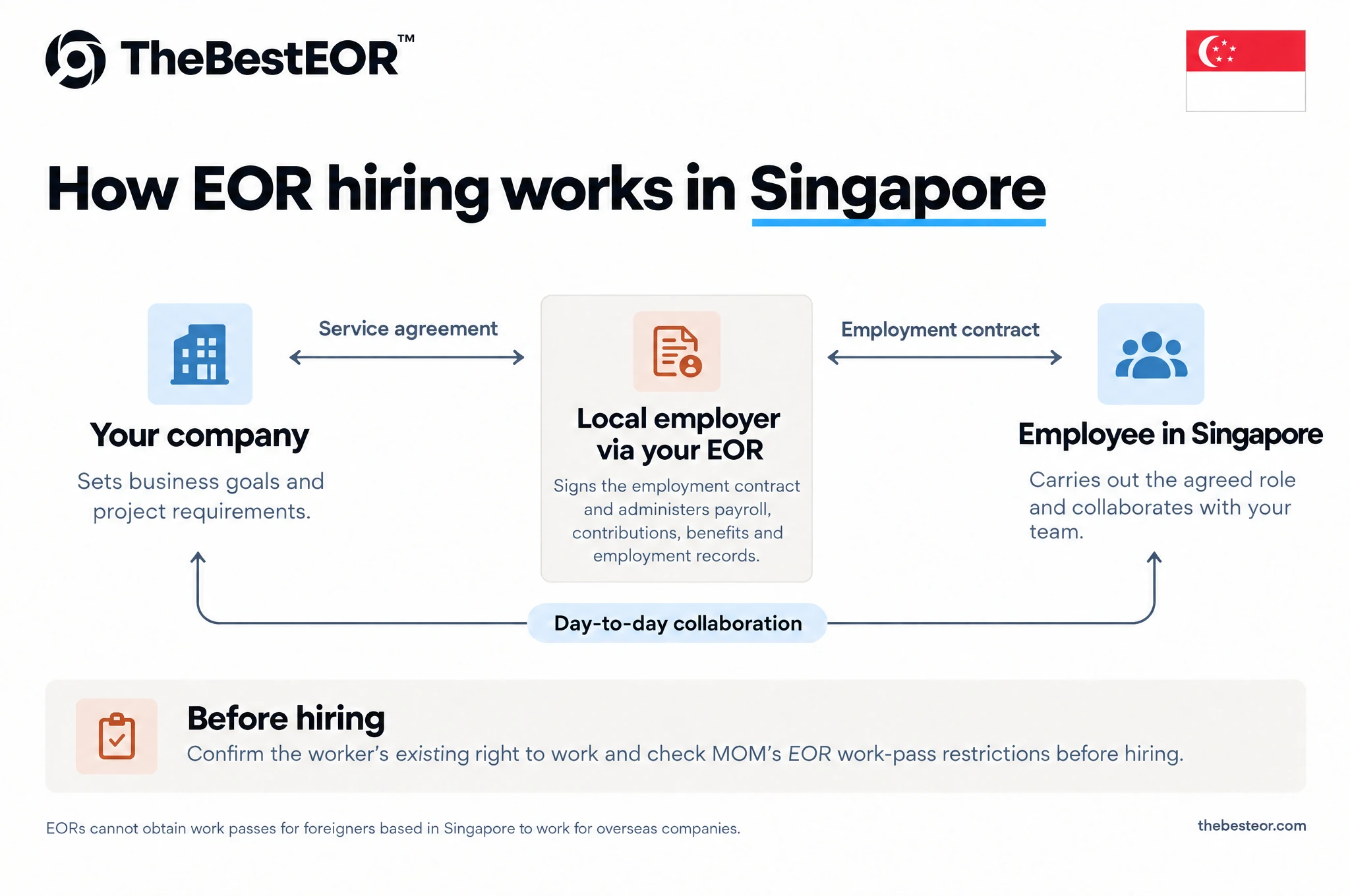
Employer of record in Singapore diagram showing the service agreement, employment contract, and day-to-day collaboration between your company and the employee.
Employer of record in Singapore: how your company, the local employer and the employee work together. Select the image to enlarge.

The EOR handles

1
Employer of record on the contract of service, and the statutory liability that follows it
2
CPF registration and contributions under the applicable rates, ceilings and payment rules
3
The Skills Development Levy on every employee
4
Annual income reporting to IRAS under the Auto-Inclusion Scheme
5
Key Employment Terms, itemised payslips and the local contract
6
Statutory leave administration and family-leave claims
7
Checking the proposed employment arrangement and referring immigration questions for route-specific assessment
8
IR21 tax clearance and compliant offboarding

You keep

1
What the person works on each day, and the standard it must meet
2
The salary, and whether the offer carries an AWS month or any allowance
3
Which candidate gets the contract, and when a role ends
4
Performance management, and the due-inquiry record Section 14 demands before any summary dismissal
5
Laptops and tooling (Rippling device management is a separate paid product)
6
Your master agreement with the EOR, and the IP clauses you need carried into the employment contract

Whether someone is an employee or an independent contractor depends on the actual working relationship, not just the contract label. A finding of employment can lead to unpaid contributions and other liabilities. Moving a worker to an EOR can establish an employment arrangement going forward, but it does not erase earlier exposure. Review both the past engagement and the proposed structure. The misclassification guide explains the issues to assess.

Work permits

Work passes and COMPASS thresholds (2026)

Check the salary threshold for the applicant’s age.

The pass thresholds below describe general work-pass eligibility in Singapore. EP applicants must meet the age- and sector-specific salary requirement and, unless exempt, pass COMPASS. Confirm the relevant application or renewal date.

Pass Minimum salary (2026) Who it is for Assessment From 2027
Pass
Employment Pass (EP)
Minimum salary (2026)
S$5,600/mo (S$6,200 financial services), rising with age
Who it is for
Professionals, managers, executives
Assessment
COMPASS, min 40 points unless exempt
From 2027
S$6,000; S$6,600 financial services (new applications from 1 Jan 2027)
Pass
S Pass
Minimum salary (2026)
S$3,300/mo; S$3,800 financial services, rising with age
Who it is for
Mid-skilled staff
Assessment
Quota + Foreign Worker Levy
From 2027
S$3,600; S$4,000 financial services
Pass
Work Permit
Minimum salary (2026)
No fixed floor
Who it is for
Lower-skilled roles, set sectors
Assessment
Quota + levy by sector
From 2027
Sector rules apply

Fig. 8 · General work-pass criteria, checked against MOM on 23 September 2026. EP and S Pass salaries increase with age. The 2027 floors apply to new applications from 1 January 2027 and renewals of passes expiring from 1 January 2028.

For the overseas-company arrangement, EOR sponsorship is not permitted. Incorporation or an eligible representative office may provide a route to assess.

For a qualifying EP application, COMPASS normally requires 40 points across individual and firm criteria, with bonus criteria available. Exemptions include a fixed monthly salary of at least S$22,500, qualifying overseas intra-corporate transferees, and roles lasting one month or less. Check MOM’s EP eligibility rules and the EOR-specific FAQ.

Salary benchmarks

Indicative salary ranges

The benchmarks show monthly pay in Singapore dollars.

Monthly gross in Singapore dollars with a USD equivalent at roughly S$1.35 to the dollar. Ranges are 2026 market data from the Michael Page Singapore Salary Guide, published 26 January 2026, plus Robert Walters and NodeFlair; use the midpoint as a starting offer, not a ceiling.

Check current pay data for the role and location before you make an offer.

Role Gross SGD/month USD/month (approx)
Role
Software engineer
Gross SGD/month
S$5,500–9,500
USD/month (approx)
$4,074–7,037
Role
Senior software engineer
Gross SGD/month
S$9,500–15,000
USD/month (approx)
$7,037–11,111
Role
Product manager
Gross SGD/month
S$8,000–14,000
USD/month (approx)
$5,926–10,370
Role
Accountant
Gross SGD/month
S$4,500–7,500
USD/month (approx)
$3,333–5,556
Role
Customer support
Gross SGD/month
S$3,000–4,800
USD/month (approx)
$2,222–3,556
Role
Sales manager
Gross SGD/month
S$7,000–13,000
USD/month (approx)
$5,185–9,630
Role
HR manager
Gross SGD/month
S$7,000–12,000
USD/month (approx)
$5,185–8,889
Role
Designer
Gross SGD/month
S$4,500–8,000
USD/month (approx)
$3,333–5,926

Fig. 9 · Monthly gross by role, 2026 · ranges from the Michael Page Singapore Salary Guide plus Robert Walters and NodeFlair; USD at roughly S$1.35 to the dollar

For a foreign candidate, check the applicable age- and sector-specific qualifying salary, COMPASS requirements or exemption, and whether the employment arrangement is legal and compliant.

Fully-loaded cost

What a Singapore engineer costs per month

See how CPF applies to S$7,500 in Ordinary Wages.

This budget example assumes S$7,500 of monthly Ordinary Wages for a Singapore citizen aged 55 or below, or a PR on the same full contribution rates. First- and second-year PRs and older workers may have different CPF rates. It excludes bonuses, benefits, insurance, setup charges, deposits and other contract-specific costs.

For illustration, convert US-dollar fees at US$1 = S$1.35 and round each displayed monthly line to the nearest Singapore dollar before summing. SDL is S$11.25 per employee before the employer totals its SDL and rounds that aggregate down under CPF Board’s rules. For a different salary, estimate employer payroll costs in Singapore.

Illustrative full-rate CPF employee, age 55 or below Gross base: S$7,500/month
Gross salary S$7,500

CPF employer (17%)

On Ordinary Wage ceiling S$8,000; full salary below the cap
S$1,275

Skills Development Levy (0.25%)

Capped at S$11.25
S$11

EOR fee assumption

US$199 × 1.35 ≈ S$269
S$269

Illustrative monthly total

Annual budget: S$108,660 (12 × S$9,055)
S$9,055

Fig. 10 · Rounded SGD budget: S$7,500 salary + S$1,275 employer CPF + S$11 SDL + S$269 illustrative EOR fee = S$9,055/month.

The displayed employer contributions total S$1,286, about 17.1% of gross pay. Using the same rounding convention, an illustrative US$499 fee becomes S$674 and produces S$9,460/month; a US$699 fee becomes S$944 and produces S$9,730/month. Use the actual quote, exchange rate and worker’s CPF category when budgeting.

The employee’s CPF share is deducted from gross pay; it is not an additional employer cost on top of the salary shown. Foreign-worker costs require a separate check of the hire’s eligibility and can include levies, insurance and immigration expenses.

How a bonus affects the CPF calculation

Consider a Singapore citizen aged 55 or below, on full CPF rates, earning S$7,500 of Ordinary Wages for all twelve months with the same employer. Annual Ordinary Wages subject to CPF are S$90,000. The Additional Wage ceiling is therefore S$102,000 minus S$90,000, or S$12,000. If the employee receives S$15,000 in qualifying Additional Wages and no other such payments, CPF applies to S$12,000 of that amount.

At the assumed 17% employer rate, the extra employer CPF is S$2,040. Add the bonus itself and that contribution to the annual budget; do not multiply the bonus by 17% without checking the ceiling. A partial-year hire, changed salary, different age/PR category or other Additional Wages requires a fresh calculation. The ceiling operates per employee, employer and calendar year, so a change of employing entity also deserves an explicit payroll handover.

EOR vs your own entity

EOR or your own Pte Ltd: compare costs

Work-pass eligibility can narrow the choice of employer.

Check the work-pass requirements and the work the employee will do to assess whether either arrangement is legal and compliant.

Factor EOR Your own Pte Ltd
Factor
Setup cost
EOR
Confirm setup charges and deposits in the quote
Your own Pte Ltd
~S$315 ACRA + S$600–2,000 first-year secretarial/address
Factor
Time to first hire
EOR
Confirm for the eligible hire; not a work-pass timetable
Your own Pte Ltd
1–3 weeks to incorporate, plus CPF and bank setup
Factor
Resident director
EOR
No separate client Pte Ltd for an eligible local hire; assess immigration separately
Your own Pte Ltd
Mandatory (citizen, PR or pass holder), or pay a nominee
Factor
Per-employee cost
EOR
$199–699/employee/mo fee + statutory
Your own Pte Ltd
Statutory only, plus shared overhead
Factor
Ongoing admin
EOR
Provider runs payroll & filings
Your own Pte Ltd
Company secretary, annual filing, your own payroll & AIS
Factor
Compliance liability
EOR
Defined by law and the actual arrangement; client duties may remain
Your own Pte Ltd
On you and your resident director

Using the rounded US$199 fee example, annual EOR fees are S$269 × 12 = S$3,228 per employee, before salary, statutory contributions and other charges. Compare that with the full annual cost of a company: incorporation, director arrangements where required, company secretary, address, accounting, payroll, filings, insurance and internal administration.

An S$3,000–8,000 overhead assumption alone does not put the break-even at five to eight people. Obtain itemised quotes and compare equivalent services and risks. For a foreign candidate, resolve the legal employment and immigration route first. The EOR versus entity guide and migration guide cover the broader planning questions.

FAQ

EOR in Singapore: common questions

Check the applicable CPF rate, deadline and pass rule.

What is the best EOR in Singapore?

RemotePeople is our top pick for Singapore in 2026 (4.9/5), followed by Multiplier (4.1/5) and Deel (4.7/5). We opened paid accounts with all 10 providers on this page, priced real hires and ran payroll.

RemotePeople offers recruitment and EOR through one provider, with a dedicated account manager on both EOR plans. Its EOR Global plan starts at USD 499 per employee per month, and EOR Select at USD 199 where the hire qualifies. Multiplier Core starts at $499 per employee per month on monthly billing, or $459 billed annually; Deel starts at USD 599 plus a mandatory Employer Liability Cost.

How does an employer of record work in Singapore?

An employer of record in Singapore becomes the worker’s legal employer through a local employing entity, while your company directs the day-to-day work. The EOR registers the employee for CPF and pays contributions at the applicable rates, pays the Skills Development Levy, reports annual income to IRAS under the Auto-Inclusion Scheme and issues the Key Employment Terms and itemised payslips.

How fast can an EOR onboard an employee in Singapore?

Estimated onboarding times for Singapore range from 2 to 12 days across the providers we tested that give an estimate. By provider: Deel 2–5 days, Rippling 2–5 days, G-P 2–5 days, RemotePeople 5–8 days and Oyster 7–12 days.

For an eligible local hire, the date depends on the employing arrangement, completed documents, contract, benefits and payroll cut-off. Treat provider estimates as indicative and obtain a written start date. An EOR onboarding estimate is not a work-pass approval timetable; resolve any immigration requirement before the employee starts work.

How much does an EOR cost in Singapore per month?

Published EOR service fees for Singapore run from USD 199 to USD 699 per employee per month across the 10 providers we tested.

Confirmed USD starting fees and monthly rates shown include USD 199 to USD 699 per employee/month. Other providers need currency confirmation or current quotes; compare complete proposals and exclusions. Add salary, the worker’s applicable CPF contributions, SDL, benefits and any other agreed costs. The illustrative full-rate CPF case at S$7,500 gross uses rounded SGD lines and totals S$9,055/month with a US$199 fee at an assumed S$1.35 per US dollar.

What employer contributions are mandatory in Singapore?

CPF rates depend on citizenship or PR status, age and wages. In 2026, the full-rate cohort aged 55 or below has a 17% employer rate, subject to the S$8,000 monthly Ordinary Wage ceiling and the separate Additional Wage ceiling. First- and second-year PRs may have graduated rates. SDL is generally 0.25% of monthly wages, with S$2 and S$11.25 per-employee limits; the employer totals SDL before rounding down. Foreign-worker levies and other obligations depend on the employment arrangement and applicable work-pass rules.

Can an EOR sponsor an Employment Pass in Singapore?

No, for the arrangement addressed by MOM: an EOR cannot obtain a work pass for a foreigner based in Singapore while working for an overseas company. MOM says that applying under this arrangement is an offence. A provider’s Singapore entity does not remove that restriction.

Assess other arrangements separately, including a genuine Singapore business presence and the candidate’s existing work status.

Do foreign employees pay CPF in Singapore?

CPF generally applies to Singapore citizens and permanent residents, not foreign employees on work passes. On becoming a PR, the worker may enter graduated contribution rates before full rates apply; age and wages also matter. CPF exemption does not mean employment has no statutory cost.

How much notice and severance applies when terminating in Singapore?

Check the contract’s notice clause; the notice period must be the same for employer and employee. Where the contract is silent, the Employment Act defaults depend on length of service. Assess retrenchment benefits under the contract, any collective agreement and the applicable guidance.

A Singapore-registered employer with at least ten employees must notify MOM of any retrenchment within five working days after informing the affected employee. Final salary on employer termination is due on the last day, or within three working days if payment that day is not possible; tax-clearance requirements may also apply. See MOM’s retrenchment rule and salary-payment guidance.

What currency and payroll cycle does Singapore use?

Payroll is normally monthly in Singapore dollars (SGD, S$). CPF contributions are due at the end of the calendar month; CPF Board takes enforcement action if unpaid by the 14th of the following month, or the next working day where applicable. Confirm salary-payment and IRAS reporting duties for the employee. The S$1.35-per-US-dollar rate in the examples is an illustrative budget assumption.

Is the Annual Wage Supplement (13th month) mandatory in Singapore?

No. The Annual Wage Supplement, the Singapore 13th-month payment, is not required by law. It is customary across much of the private sector, usually one month of pay paid in December, and becomes a contractual obligation only once it is written into the contract or company handbook. If you offer it, the EOR pays it through payroll and applies CPF for citizens and permanent residents.

Can I convert a Singapore contractor to an EOR employee?

An eligible worker can move to an employment arrangement, subject to the actual work relationship, right to work and required documentation. That does not erase any liability from the earlier contractor engagement. Review historical classification, contributions and tax obligations, then confirm the proposed employer’s responsibilities.

Do I need a Pte Ltd to hire one person in Singapore?

It depends on the worker and the employment arrangement. An EOR may be an option for an eligible local hire, but it is not a work-pass route for a foreigner based in Singapore while working for an overseas company. Resolve eligibility first. Then compare itemised EOR quotes with the full cost of operating a company.

What is COMPASS and how does it affect hiring in Singapore?

COMPASS is MOM’s points-based assessment for EP applications unless an exemption applies. A candidate must first meet the applicable salary requirement; passing COMPASS normally requires 40 points. Exemptions include a fixed monthly salary of at least S$22,500, qualifying overseas intra-corporate transferees and roles lasting one month or less. COMPASS does not override the restriction on EOR applications for overseas-company workers. Check MOM’s eligibility guidance.

Sources and as-of dates

Article references

The official Singapore sources below support the work-pass, contribution, leave and notification rules, checked on 23 September 2026.

Hiring facts Checked 2 Oct 2026

Hiring facts

Checked 2 October 2026
Eligibility, local and collective rules apply. EOR fees extra.

MOM: EOR work-pass applications for foreigners working for overseas companies 1 source

MOM’s restriction on EOR work-pass applications for foreigners based in Singapore while working for overseas companies.

MOM: Employment Pass eligibility 3 sources

Qualifying salary by age and sector, COMPASS and exemptions.

MOM: S Pass eligibility 1 source

Current and announced S Pass salary floors, including financial services. The announced increases apply to new applications from 1 January 2027 and renewals of passes expiring from 1 January 2028.

CPF Board: contribution rates and computation 2 sources

CPF contribution rates and computation by citizenship, age, wage band and year of permanent-resident status.

CPF Board: Ordinary Wage ceiling 1 source

S$8,000 monthly Ordinary Wage ceiling from 1 January 2026.

CPF Board: Skills Development Levy 2 sources

Skills Development Levy rate, per-employee limits and rounding of the employer’s total.

CPF Board: contribution due date 1 source

Month-end CPF contribution due date and enforcement if payment is not made by the 14th of the following month, or the next working day when the 14th falls on a weekend or public holiday.

MOM: annual leave eligibility and entitlement 2 sources

Annual leave eligibility after three months for employees covered by the Employment Act, and proration by completed months of service.

MOM: maternity leave eligibility 2 sources

Sixteen- and twelve-week maternity leave routes, eligibility and payment conditions.

MOM: mandatory retrenchment notifications 1 source

Mandatory retrenchment notification for Singapore-registered employers with at least ten employees, within five working days after the affected employee is notified.

MOM: termination with notice 2 sources

Equal employer and employee notice periods, and the statutory defaults when the contract specifies no notice period.

MOM: paying salary 2 sources

Normal and final salary deadlines, including overtime and foreign-employee tax-clearance exceptions.

MOM: Work Permit sector rules 6 sources

Further sources (October 2026) 5 sources

MOM EOR work-pass restriction — EOR cannot obtain a pass for a foreigner based in Singapore working for an overseas company. Accessed 19 October 2026.

CPF Board: Additional Wage ceiling — AW ceiling 102,000 minus annual OW subject to CPF; per employee, employer and calendar year. Accessed 19 October 2026.

CPF Board: contribution calculation — Current contribution rates from 1 January 2026: employer 17% for a Singapore citizen or third-year-and-later permanent resident aged 55 or below with monthly wages above S$750. CPF Board page updated 7 October 2026; also explains age and PR-category differences. Accessed 19 October 2026.

MOM shared parental leave — 10 weeks for qualifying children from April 2026; shared allocation, conditions, notice, scheduling and reimbursement cap. Accessed 19 October 2026.

IRAS tax clearance for employees — Tax-clearance assessment, notice and withholding; citizenship/residence and scenario exceptions. Accessed 19 October 2026.

The Singapore cost illustration uses the stated salary, CPF cohort and illustrative exchange rate.

The country guides cover other markets. For this hire, browse EOR providers for Singapore and use the EOR cost calculator to compare the recurring amounts in your proposals in USD.

This guide is for general information only and does not provide legal, tax, accounting, or financial advice. For advice about your business, consult a qualified professional familiar with the rules where you hire. The research methodology explains how TheBestEOR assesses sources.