


Guide overview
EOR or contractor, at a glance.
Assess the working relationship before comparing fees.
An independent contractor runs a genuine services relationship; an employee hired through an EOR works under an employment arrangement. Choose between them by the actual work and the applicable local rules before comparing fees. A contract label, short project or company invoice does not settle status.
Working practices
Record the facts
Document direction, independence and how the work is performed.
Local rules
Review worker status
Apply the relevant employment, tax and social-security tests.
Hiring options
Choose after review
Compare the arrangements local rules allow for this work.
Cost comparison
Use equal scope
Keep hypothetical figures separate from an employee-specific budget.
Check before acting
Complete the local review first.
What to record in the worksheet
Scope
Fact to review · Current practice · Evidence / interview date
Evidence and follow-up
Applicable legal question · Reviewer · Action
Record the work as it happens
Bring the adviser a recent assignment, its instructions, the invoices and the schedule the person actually followed. Who supplied the equipment? Could the person send a substitute or take on another client? Record who confirmed each fact, including anything that points away from your initial view.
For a guided version of this fact-gathering step, review one arrangement in the employee misclassification calculator. It highlights mixed answers and missing evidence without deciding status.
| The working record | Fields to complete |
|---|---|
The working record
Scope
|
Fields to complete
Fact to review · Current practice · Evidence / interview date
|
The working record
Evidence and follow-up
|
Fields to complete
Applicable legal question · Reviewer · Action
|
The evidence to assess before comparing fees
These questions help organize a country-specific review.
| Evidence | What to record | Why it matters |
|---|---|---|
Evidence
Control in practice
|
What to record
Who sets methods, hours, location and how work is supervised.
|
Why it matters
A contract can describe independence while daily work shows something else.
|
Evidence
Business independence
|
What to record
Clients, investment, insurance, pricing and exposure to profit or loss.
|
Why it matters
Review the real business, not just its registration.
|
Evidence
Personal service
|
What to record
Whether a substitute may actually be used and any practical limits.
|
Why it matters
A clause that would never be accepted is weak evidence.
|
Evidence
Integration and duration
|
What to record
Role in the team, continuing responsibilities and renewal history.
|
Why it matters
Short duration or a project label does not automatically permit contracting.
|
Evidence
Applicable rules
|
What to record
Work location, tax test, employment-rights test and sector exceptions.
|
Why it matters
Different rules can apply to the same engagement.
|
Evidence
Available employment route
|
What to record
Direct employer or eligible EOR model, required permits and local conditions.
|
Why it matters
If employment is required, confirm what must happen before the employee starts.
|
Document the conclusion and reassess when the facts change. Prospective employment does not erase any obligations from an earlier misclassified period.
Record direction, integration, independence and other relevant facts.
Tax and employment status can require separate assessments.
Compare the permitted contracting options.
Assess direct employment or an eligible EOR arrangement.
Obtain local review; do not treat uncertainty as a pass.
Classification comes before the fee comparison.
Policy cross-check, 15 October 2026: the Belastingdienst enforcement page distinguishes correction/assessment from penalties. It permits vergrijp penalties in 2026 under their conditions and excludes verzuim penalties for 2026. The California DIR classification FAQ explains the ABC test and statutory exceptions.
1. Employer of record vs contractor: speed, cost and risk
A genuinely independent contractor may be able to start quickly once the agreement and payment process are ready and local requirements are met. If the work turns out to be employment, tax obligations and employee rights can reach back into the period you treated as contracting.
An EOR hire adds statutory contributions, the applicable provider fee, benefits and other country-specific charges. Onboarding time depends on the country, documents, right-to-work checks, funding and payroll cut-offs. In exchange, the worker is legally employed in their country and the provider handles payroll filings under contract. An EOR arrangement can still be challenged under local rules.
In the Dutch example in section 5, the two budgets differ by about EUR 13,500. Use that figure to understand the cost assumptions. Decide separately which arrangement the work qualifies for.
2. Five areas to examine in a local classification review
Classification rules differ by jurisdiction and legal purpose. These five areas organize the facts to review:
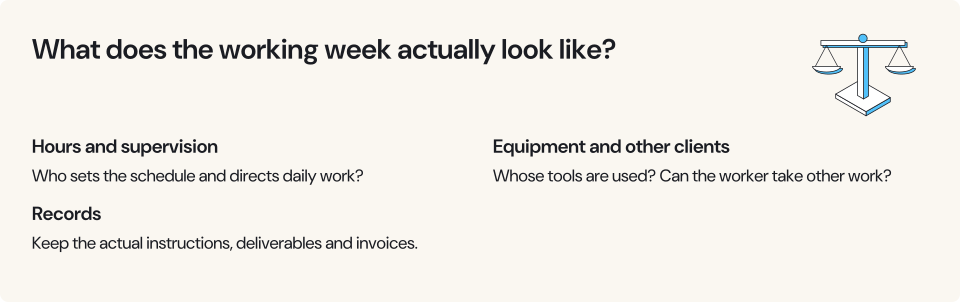
An ongoing role under a manager’s close direction deserves a closer look. Who supplies the laptop or whether someone joins the team meeting may help explain the arrangement. Weigh those details alongside the rest of the relationship under the applicable local test.
Separate rights, tax and social-security questions
Record where the person works, which entities contracted with each other and the period under review. An adviser answering a payroll tax question may need a different test from one reviewing employment rights or social security. Record the conclusion for each question.
3. Classification tests in 2026, by jurisdiction
United States: two federal tests plus the states
The IRS common-law test groups its factors into behavioral control, financial control and the relationship of the parties. Either side can ask the IRS to rule on a specific worker with Form SS-8. Have a US tax adviser calculate any applicable IRC §3509 liability using the relevant year’s tax rates, wage bases and conditions, separately from interest and state liabilities.
For the Department of Labor analysis, distinguish the regulation from agency enforcement policy. WHD’s 1 May 2025 guidance changed the analysis used in its investigations but did not repeal the codified rule. DOL announced a replacement proposal on 26 February 2026, published on 27 February. The eCFR text displayed as current through 9 October 2026 still contains the 2024 six-factor analysis. Check the current regulation, enforcement guidance and applicable court precedent for the case.
California applies the stricter ABC test (codified by AB5, in force since January 1, 2020): a worker is an employee unless they are (A) free from your control, (B) doing work outside your usual course of business, and (C) running an independently established trade. Assess the actual services and any statutory exception. Willful misclassification costs $5,000 to $15,000 per violation under Labor Code 226.8, rising to $10,000 to $25,000 for a pattern or practice. The Proposition 22 carve-out, upheld by the California Supreme Court on July 25, 2024, covers app-based drivers only.
United Kingdom: IR35
Under the reformed off-payroll rules, public-sector clients and medium or large private and voluntary-sector clients with a UK connection generally determine tax status for work through an intermediary. The intermediary generally decides for a small non-public-sector client, or a wholly overseas client without a UK connection. Who must operate PAYE depends on the supply chain and compliance with the rules. Tax status and employment rights are separate questions; use HMRC’s client and agency guidance for the arrangement.
HMRC does not always win. It pursued Gary Lineker for £4.9 million, lost at tribunal in March 2023 and dropped its appeal in 2024. Its CEST tool gives a free status answer, but tribunals are not bound by it.
European Union: the platform-work directive
Directive (EU) 2024/2831, in force since December 1, 2024, creates a rebuttable legal presumption of employment for platform work whenever the facts indicate direction and control, and puts the burden of proof on the platform. Member states must transpose it by December 2, 2026, and for contracts already running, the presumption applies only from that date.
Netherlands and Germany: enforcement rules to check
Dutch judges apply the nine-factor Deliveroo test that the Supreme Court set on March 24, 2023, which puts substance over form. The DBA enforcement moratorium ended on January 1, 2025. Since then, the Belastingdienst has been able to impose payroll-tax corrections and back-assessments directly; its 2025 soft landing did not suspend those powers. Its published 2026 policy permits culpability penalties while not imposing default penalties that year. Under the published enforcement policy, the authority normally does not assess earlier than January 1, 2025. Exceptions include malicious conduct or failure to comply with earlier directions. Separately, a June 2026 law introduces an hourly-rate employment presumption from 31 December 2026. The legislation provides for an indexed threshold and a ministerial regulation setting the initial applicable amount. Confirm that amount and the presumption’s scope for the engagement; the hourly rate is not a safe harbor for higher-paid work.
In Germany, a finding of Scheinselbständigkeit (false self-employment) makes you liable for both halves of social contributions, calculated using the applicable contribution bases, ceilings and coverage, for up to 4 years back (30 years if intent is proven), plus late fees of 1% per month. Under §28g SGB IV, a missed deduction of the employee’s contribution share can generally be recovered only through the next three wage or salary payments. The statute has exceptions, including an omission without employer fault and specified employee conduct; obtain advice before making deductions. Intentional withholding can be a criminal offense under §266a StGB.
4. What misclassification has cost
| Where | Who and what | The bill | When |
|---|---|---|---|
Where
New Jersey, US
|
Who and what
Uber and subsidiary Rasier: unemployment-insurance audit covering 297,866 drivers
|
The bill
$100M ($78M back contributions + $22M penalties and interest)
|
When
Sep 2022
|
Where
New York, US
|
Who and what
Uber and Lyft: attorney-general settlement over driver pay and benefits
|
The bill
$328M ($290M Uber, $38M Lyft)
|
When
Nov 2023
|
Where
California, US
|
Who and what
FedEx Ground: 2,300 delivery drivers reclassified after a federal appeals ruling
|
The bill
$228M settlement
|
When
2015
|
Where
Spain
|
Who and what
Glovo: riders kept as freelancers after the 2021 Riders Law
|
The bill
Over €205M in accumulated fines; move to employment announced in Dec 2024
|
When
2022–2024
|
Where
France
|
Who and what
Deliveroo: criminal conviction for concealed work (2015–2017 couriers)
|
The bill
€375,000 corporate fine (the legal maximum) plus suspended prison sentences for two former managers
|
When
Apr 2022
|
Where
United Kingdom
|
Who and what
Department for Work and Pensions: wrong IR35 determinations on its own contractors
|
The bill
£87.9M paid to HMRC
|
When
Jul 2021
|
Where
Netherlands
|
Who and what
Deliveroo: Supreme Court confirmed riders were employees all along
|
The bill
Reclassification; its nine-factor test now anchors Dutch enforcement
|
When
Mar 2023
|
Fig. 1 · Misclassification fines, settlements and rulings: seven public cases · 2015–2024
If a worker is reclassified, start with the years at issue. Calculate contributions and entitlements using the employee’s coverage and the ceilings that applied in each period, then assess interest and penalties separately. Before ending a long-running engagement, review whether the worker could also have an employment claim.
5. Illustrative costs at assumed take-home pay
What would it cost to give a senior developer in the Netherlands about €54,000 a year in take-home pay on either route? The example uses rounded assumptions and the same work. It puts benefits and employer costs back into the comparison. For a real offer, replace the illustrative figures with local gross-to-net calculations.
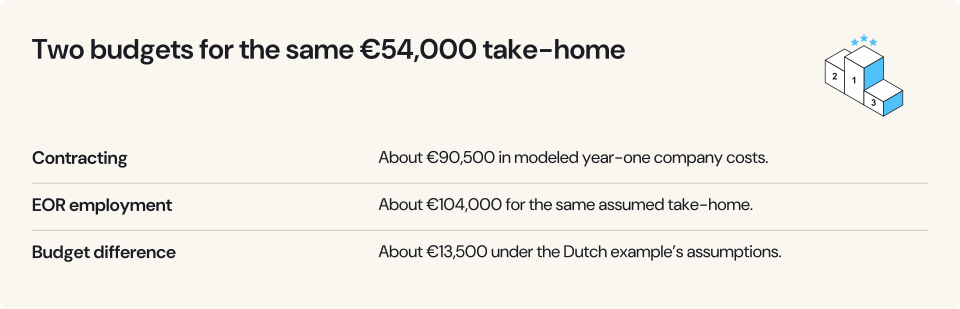
| Line item | Contractor: hypothetical assumptions | Employee via EOR: hypothetical assumptions |
|---|---|---|
Line item
What you pay them
|
Contractor: hypothetical assumptions
€90,000 invoiced (about €64/hour over 1,400 billable hours)
|
Employee via EOR: hypothetical assumptions
€80,000 gross salary (includes the 8% holiday allowance)
|
Line item
Employer social contributions
|
Contractor: hypothetical assumptions
No employer payroll cost assumed here; the invoice must fund the contractor’s own applicable obligations.
|
Employee via EOR: hypothetical assumptions
€17,600 (assumed 22% for this model; verify the actual cost base)
|
Line item
Pension, disability, paid leave
|
Contractor: hypothetical assumptions
Funded out of the rate: ~€8,000 pension, ~€2,500 disability insurance (AOV), ~38 unpaid days off
|
Employee via EOR: hypothetical assumptions
Assumed package for this illustration; check actual pension, leave, insurance and employer costs separately.
|
Line item
Platform fee
|
Contractor: hypothetical assumptions
Contractor management ~$49/month (~€525/year)
|
Employee via EOR: hypothetical assumptions
EOR fee $599/employee/mo at Deel (~€6,400/year)
|
Line item
Worker's take-home
|
Contractor: hypothetical assumptions
~€54,000
|
Employee via EOR: hypothetical assumptions
~€54,000
|
Line item
Reclassification risk
|
Contractor: hypothetical assumptions
Historical liabilities depend on the facts and assessment period. For 2026, vergrijp penalties can apply under their conditions; no verzuim penalties for 2026. No automatic surcharge band.
|
Employee via EOR: hypothetical assumptions
Employment is intended; confirm the EOR model is legal and compliant for the role and each party knows its responsibilities
|
Line item
Year-one true cost to you
|
Contractor: hypothetical assumptions
~€90,500
|
Employee via EOR: hypothetical assumptions
~€104,000
|
Fig. 2 · Contractor vs EOR in the Netherlands at equal take-home, seven line items · hypothetical assumptions, not a personal tax or benefits calculation
In this hypothetical model, the €90,000 invoice is allocated to €24,000 tax and health levy, €8,000 pension, €2,500 disability cover, €1,500 equipment and insurance, and €54,000 take-home. Those assumptions produce a modeled cost difference of about €13,500.
A contractor’s actual quote can be above or below the employment budget. Compare the same scope, hours, benefits expectations and commercial risk using real proposals.
Use the person's actual figures in the cost comparison
The workbook has a separate pay comparison: annual contractor invoices less business costs, an adviser-provided contractor tax estimate, and an employee gross-to-net estimate. It then adds employer contributions, benefits and the EOR fee to show employer cost. Replace every fictional input with dated payroll and tax estimates. Compare annual take-home and benefits together.
6. Questions for a local worker-classification review
Answer the five questions below in order.
- Q1. Is the engagement a defined project with an end date and a deliverable you accept or reject?
- YES → continue to Q2
- NO → Assess employment status under the relevant local rules. If employment is needed, compare direct employment and an eligible EOR arrangement.
- Q2. Do they decide how, when and where the work gets done?
- YES → continue to Q3
- NO → Direction and control may point toward employment. Complete the local assessment before deciding how to engage the worker.
- Q3. Do they run a real business: other clients, own equipment, a substitution right you'd honor?
- YES → continue to Q4
- NO → Review the complete relationship promptly under local law. Agree compliant remediation if needed; there is no general 90-day grace period.
- Q4. Have the applicable local classification rules and any sector exceptions been assessed?
- YES → continue to Q5
- NO → Obtain the relevant local assessment before choosing how to engage the worker.
- Q5. Does the complete assessment support genuine contracting, and have you recorded why?
- YES → A contractor arrangement may fit. Document the local assessment and keep working practices under review (section 7).
- NO → Resolve the classification question with local review; if employment is required, confirm how the person can be employed under local rules.
The worker profile to avoid. An ongoing, closely directed role can raise substantial classification risk. Apply the local rules and exceptions to the full facts. IRS, state, UK and Dutch tests differ, and the EU platform-work presumption has a specific scope.
7. If you choose the contractor route
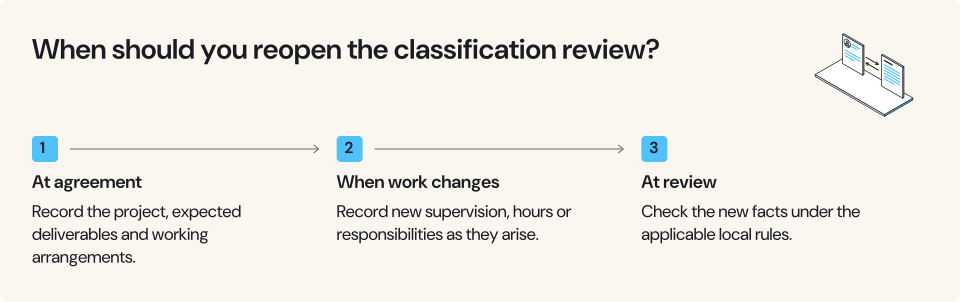
A project can grow into an ongoing role even if nobody changes the original agreement. Revisit the classification when the work changes. The following questions help you record what happens in practice.
For an engagement assessed as genuine independent contracting, our Contractor of Record broker service can help you compare providers. Check each provider’s scope, eligibility and exclusions.
Contractor-management tools ($49 per contractor per month at Deel) standardize agreements, invoices and payments across countries, but no tool changes a worker's legal status. Our misclassification guide sets out the full tests country by country.
8. When to convert, and what it costs
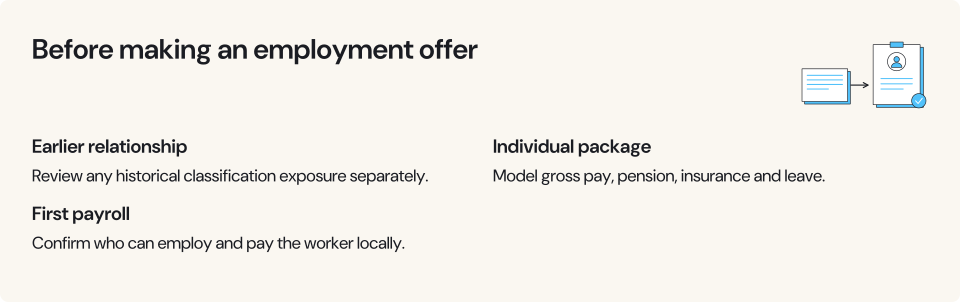
If local review finds employment is required, compare permitted ways to employ the person and address the earlier relationship separately. Before making an offer, obtain an individual gross-to-net calculation, compare pension, insurance and leave, agree compensation with the worker, and confirm the employer’s readiness. Do not convert an invoice to salary using section 5’s hypothetical figures. If an EOR is the appropriate route, compare employer of record services before requesting country-specific proposals.
Actual conversion costs depend on the agreed package, employer costs, service charges and any earlier liabilities. In the US, the IRS VCSP offers eligible taxpayers partial federal employment-tax relief. The payment is 10% of the prior year’s employment-tax liability calculated at reduced section 3509(a) rates. Eligibility includes reporting and audit conditions; apply at least 120 days before the requested reclassification. In the Netherlands, where 2026 falls inside the enforcement window, convert going forward and handle past liability with a lawyer rather than backdating anything.
Our conversion playbook sets out the steps in order, including how to explain the change without losing the person. To price a specific country, use our global payroll calculator.
9. Frequently asked questions
Does a signed contractor agreement protect me from misclassification?
Is it safer if the contractor invoices through their own limited company?
How far back can authorities assess unpaid contributions?
Can an employer of record manage independent contractors too?
Does the EU platform work directive affect non-platform companies?
10. Sources
The sources behind this guide, grouped by topic. Dates show when we last checked a page. Prices and terms change, so confirm them in your quote.
United States law and guidance
11 sourcesUnited States · IRS
Independent contractor (self-employed) or employee?
Independent contractor vs employee
Common-law factors and Form SS-8. The contractor vs employee page is used in the worker classification example, checked 3 Oct 2026.
United States · Cornell LII
Reduced employment-tax rules. Calculate the applicable rates and wage bases for the relevant year.
United States · Cornell LII
IRS assessment limits: 3 years, unlimited for fraud or no return.
United States · IRS
Voluntary Classification Settlement Program (VCSP)
Conditional partial federal employment-tax relief for eligible taxpayers. The payment is 10% of the prior year’s employment-tax liability at reduced section 3509(a) rates. Eligibility includes reporting and audit conditions; check the application requirements.
United States · Department of Labor (DOL)
Employee or Independent Contractor Classification rulemaking
Covers the 2024 rule, FAB 2025-1 and the 2026 proposal.
United States · Department of Labor (DOL)
2026 rulemaking on independent contractor status
Proposal of 27 Feb 2026; comments closed 28 Apr 2026.
United States · DOL Wage and Hour Division (WHD)
Field Assistance Bulletin 2025-1
Checked 15 Oct 2026
United States · eCFR
Displayed currency through 9 Oct 2026. Checked 15 Oct 2026
California · Labor and Workforce Development Agency (LWDA)
Covers the ABC test, AB5 and Labor Code 226.8.
California · Department of Industrial Relations (DIR)
Independent contractor classification FAQ
Explains the ABC test and statutory exceptions. Checked 15 Oct 2026
California · State Legislature
Willful misclassification penalties of $5,000 to $25,000.
UK and European law and guidance
20 sourcesUnited Kingdom · HMRC
United Kingdom · HMRC
Off-payroll working rules for clients
Includes the UK connection and client-size tests.
United Kingdom · HMRC
United Kingdom · GOV.UK
National Insurance rates and category letters
Employer Class 1 at 15% since April 2025.
United Kingdom · HMRC
Compliance Handbook CH51000: assessment time limits
Limits of 4, 6 and 20 years.
European Union · EUR-Lex
Directive (EU) 2024/2831 on improving working conditions in platform work
European Union · Council of the EU
Used in the worker classification example. Checked 3 Oct 2026
Netherlands · Business.gov.nl
Wet DBA enforcement.
Netherlands · Belastingdienst
Enforcement of employment relationships
Direct corrections and assessments from 1 January 2025, with different penalty treatment in 2025 and 2026. In 2026, vergrijp penalties are permitted under their conditions and verzuim penalties are excluded. Checked 15 Oct 2026
Netherlands · Supreme Court (Rechtspraak.nl)
Deliveroo ruling of 24 March 2023 (ECLI:NL:HR:2023:443)
The nine-factor test.
Netherlands · Eerste Kamer (Senate)
Bill 36.783: hourly-rate employment presumption
Check the enacted text, indexed amount and commencement.
Netherlands · Officiële bekendmakingen
Hourly-rate presumption law (June 2026)
The commencement decree (Staatsblad 2026, 207) sets 31 December 2026. The initial indexed amount needs the applicable ministerial regulation. Checked 15 Oct 2026
Netherlands · Lexology
Historical commentary from March 2026; use enacted primary sources for the current scope.
Netherlands · Business.gov.nl
The statutory 8% minimum.
Netherlands · PwC Tax Summaries
Employer social contributions and the Zvw levy.
Germany · gesetze-im-internet.de
Contribution claw-back: 4 years, 30 if intentional.
Germany · gesetze-im-internet.de
Missed employee-share deductions: the next three wage payments, with exceptions. Checked 15 Oct 2026
Germany · gesetze-im-internet.de
Withholding social contributions as a criminal offence.
Germany · gesetze-im-internet.de
Temporary Employment Act (AÜG), section 1
Used in the worker classification example. Checked 3 Oct 2026
Spain · BOE
Ley 20/2007, Estatuto del trabajo autónomo
Article 11 sets the TRADE 75% dependence threshold.
Misclassification cases and settlements
8 sourcesUnited Kingdom · DWP (GOV.UK)
DWP annual report and accounts 2020 to 2021
The £87.9M IR35 settlement.
United Kingdom · BAILII
Gary Lineker Media v HMRC [2023] UKFTT 340 (TC)
Tribunal decision, March 2023.
New Jersey · Department of Labor
Uber pays $100M in driver misclassification case
Press release, 13 Sep 2022.
New York · Attorney General
$328M settlement with Uber and Lyft
Announced 2 Nov 2023.
United States · Reuters
FedEx Ground $228M settlement with 2,300 California drivers
Reported June 2015.
Spain · France 24
Glovo announces the move of Spanish riders to employment
December 2024, after fines passing €205M.
Spain · Delivery Hero
Announcement of Glovo’s planned employment-model change in Spain
Announced 2 Dec 2024.
France · Reuters
Deliveroo fined €375,000 by the Paris criminal court
Reported 19 Apr 2022.
Provider pricing
1 sourceDeel
Contractor management at $49 per month and EOR fees.
Our research
1 sourceThe Best EOR
How we rate EOR providers.
If you spot a changed price or a conflicting source, send it through the contact page and we’ll review it.
This guide is for general information only and does not provide legal, tax, accounting, or financial advice. For advice about your business, consult a qualified professional familiar with the rules where you hire. Read our research methodology to learn how we assess sources.