


Guide overview
Choosing an EOR, at a glance.
Set requirements, collect evidence and compare consistently.
Choose an EOR by testing the same country and hiring brief with each finalist. Identify the local employer, confirm the proposed route can cover the hire, compare complete costs and agreements, and test payroll and support. Use a scorecard to organize the evidence after mandatory requirements are resolved.
Country and role
Define the brief
Ask each provider to meet the same hiring requirements.
Mandatory checks
Resolve gaps first
Identify any unmet legal or operational requirement.
Scoring
Fix the weights
Set weights before reviewing results and keep them consistent.
Evidence
Support every rating
Use written evidence for compliance, cost, coverage, delivery and exit.
Check before acting
A good overall score cannot resolve an unmet mandatory requirement. Clear those requirements before shortlisting.
What to record in the worksheet
Scope
Criterion · Weight (%) · Score (1–5)
Evidence and follow-up
Evidence / contract reference · Gate outcome · Owner · Review date
Request the evidence before scoring
Send every finalist the same hire and salary in each country. Ask for the employer’s legal name, an annual cost breakdown and the dates treasury must send funds. Get the country employment documents and controlling service terms, including exclusions, data safeguards and exit arrangements. In the worksheet, name the reviewer, identify the version they saw and leave unanswered questions visible.
Decision gates to clear before scoring
Use these checks to confirm the requirements are met.
| Decision gate | Evidence to keep | If the answer is missing |
|---|---|---|
Decision gate
Is this employment model legal and compliant for the role?
|
Evidence to keep
Country-specific explanation, legal employer name and any required licence.
|
If the answer is missing
Resolve before promising a start date.
|
Decision gate
Who is responsible when something goes wrong?
|
Evidence to keep
Employment contract, service agreement, liability limits and escalation owner.
|
If the answer is missing
Request a written responsibility map.
|
Decision gate
What will this exact hire cost?
|
Evidence to keep
Country quote showing salary, employer costs, service charges, FX and funding.
|
If the answer is missing
Compare only after the missing lines are priced.
|
Decision gate
Can the hire reach the intended first payroll?
|
Evidence to keep
Document checklist, right-to-work steps and payroll cut-off dates.
|
If the answer is missing
Record a conditional date, not a sales estimate.
|
Decision gate
Can you leave without losing employee records?
|
Evidence to keep
Notice rules, transfer process, data export and deposit settlement terms.
|
If the answer is missing
Price a realistic exit before signing.
|
Decision gate
What supports the service claims?
|
Evidence to keep
Dated sample documents, relevant references and evidence from any actual pilot.
|
If the answer is missing
Mark unsupported claims as unverified.
|
Local law and the agreed service scope determine the final responsibilities.
Country, role, working pattern and start date.
Confirm that the proposed employment arrangement is available.
Obtain the country schedule, service terms and employment documents.
Use the same employee assumptions and funding dates.
A score does not clear an unresolved legal or contractual issue.
Use our comparison of the best EOR providers to identify candidates, then apply the same checks to each one.
1. Set your requirements before the weights
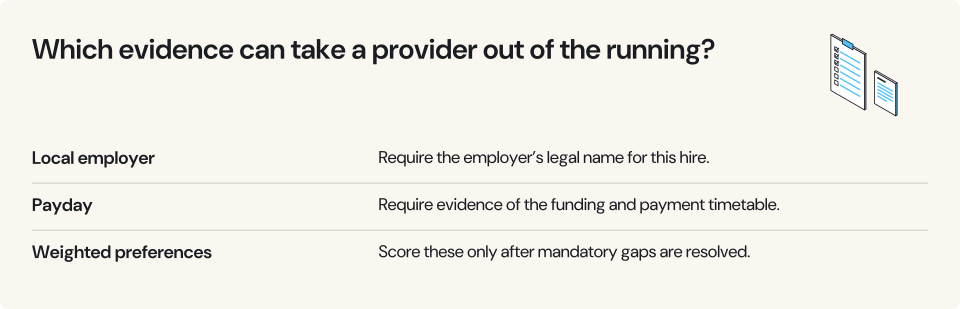
Set your priorities before you see the providers’ scores. The worksheet’s six weights are a starting point you can change. Keep mandatory requirements on a separate list. If a provider can’t document who will employ the person or how it will meet payday, leave that question open regardless of the points it earns elsewhere.
| Factor | Weight | The question it answers |
|---|---|---|
Factor
Compliance & Risk
|
Weight
25%
|
The question it answers
Does the proposal document an employment model allowed for the role, local responsibilities and the required rights chain?
|
Factor
True Cost (Year 1)
|
Weight
20%
|
The question it answers
What is the recurring cost, and what cash must you fund or hold as a deposit?
|
Factor
Country Coverage
|
Weight
15%
|
The question it answers
Does it have local depth in your countries, beyond a homepage country count?
|
Factor
Onboarding Speed
|
Weight
15%
|
The question it answers
What are the milestones from signed offer to the first permitted workday and, separately, first payroll?
|
Factor
Support & Account Management
|
Weight
15%
|
The question it answers
Who answers when something breaks, and how fast?
|
Factor
Switching & Exit Flexibility
|
Weight
10%
|
The question it answers
What does leaving cost you in notice, fees, and employee continuity?
|
Fig. 1 · The six scoring factors and their weights, 25% down to 10%
2. Confirm the employment arrangement and responsibilities
Confirm the proposed employment arrangement before scoring its convenience or price. Classification, licensing, employer contributions and employee rights depend on the country and the actual work. When shortlisting EOR providers in France or EOR providers in Germany, review the specific hire locally; the data-protection review needs its own documented responsibilities. Ask qualified advisers to resolve material gaps for your hire.
Ask for the legal name of the employer that would sign each employee’s contract. Use that name to check the evidence below.
Before giving a provider a high score on compliance, check the proposed employer, any licence it needs and the terms assigning responsibility for the hire. An ownership chart, security certificate or indemnity answers a narrower question. If the supplier won’t name the employer, the hiring decision is still open.
3. Compare complete first-year costs and funding
The starting fees in our EOR cost comparison cover different plans, commitments and countries. For each proposal, add salary, employer costs, currency charges, setup and any extras to the fee. Build a separate schedule for payroll funding and any refundable deposit the plan requires. When must the money arrive, what may the provider deduct and when is the balance due back?
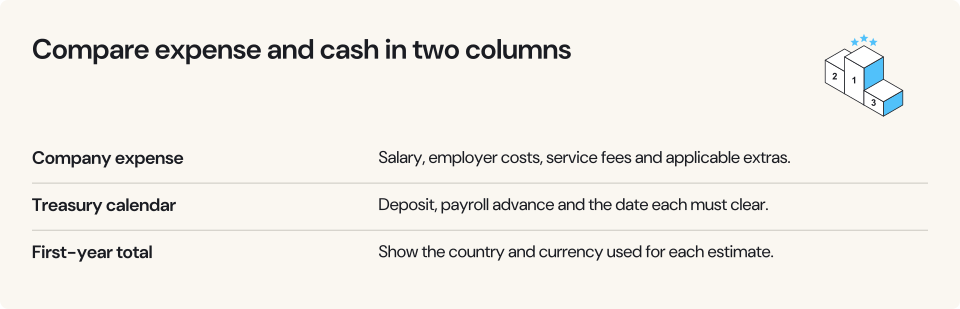
Check how the conversion is calculated. Match the currency pair, quote direction, contractual rate source, fixing time and explicit fees before calculating a rate difference. A same-day XE mid-market rate is an indicative benchmark; the gap alone does not prove the provider’s margin. If a disclosed 2% charge applies to a USD 8,000 conversion base, that charge is USD 160 per month or USD 1,920 over 12 identical months.
Ask every finalist to price the same hire in writing, line by line, and collect:
Deel’s currency terms depend on the currency pair and funding route, so there is no single FX percentage to quote. Our guide to hidden fees in EOR pricing lists seven charges to check.
4. Check delivery in the countries you need
For each country on your hiring plan, ask who will sign the employment contract and who will answer the employee if something goes wrong with pay. A provider may use its own company or a local partner. Check how the proposed employer meets the requirements for that role.
Check these points with each provider:
5. Test onboarding milestones and employee access
Ask for separate dates for contract signature, the first day the employee is permitted to work and the first payday. Then check who must do what to meet them. Once a real hire goes through onboarding, you can compare those dates with what happened.
Then look at the following:
To test onboarding before you commit the rest of the team, run a pilot covering onboarding and a complete payroll cycle for one real hire.
6. Test support and escalation
During the request for proposals, send every provider the same payslip correction and the same termination question that needs in-country counsel. Record when each one responds and when you get an answer you could act on. The first acknowledgement alone tells you little about resolution.
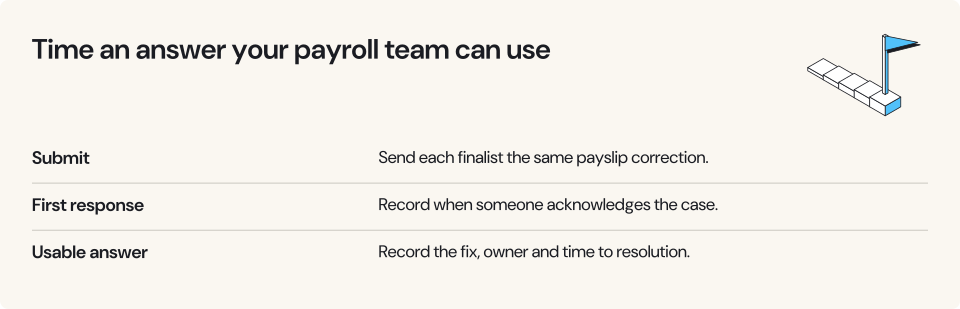
Score support on these points, using that log wherever it applies:
7. Agree exit and transfer terms
Read the country schedule alongside the main service agreement while you still have room to negotiate. Ask the provider to put the following exit terms in writing.
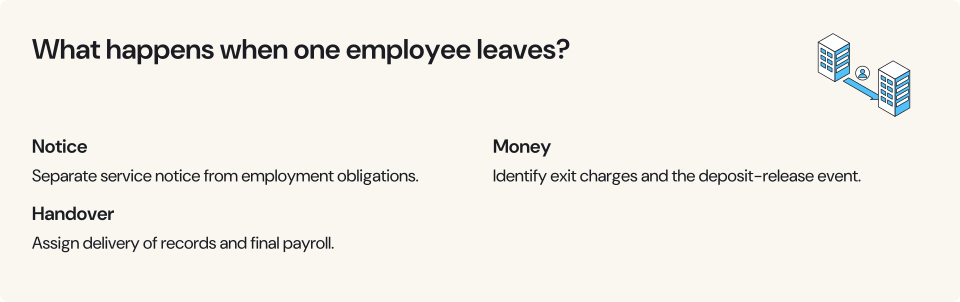
Obtain the agreement for the specific product and employing entity. Confirm service notice, employee exit requirements, offboarding fees and the local transfer process separately.
8. How to score a provider: a hypothetical example
Step 1: score each factor from 1 to 5. Use the evidence lists above (or the 47-question RFP checklist, which maps onto the six factors) and this scale:
Decimals are fine, but whole and half points are enough for an internal selection.
Step 2: apply the weights. Composite = (compliance × 0.25 + true cost × 0.20 + coverage × 0.15 + onboarding × 0.15 + support × 0.15 + switching × 0.10) × 2. With scores restricted to 1–5, the result ranges from 2.0 to 10.0: all 5s give 10.0 and all 1s give 2.0.
Step 3: read the internal rubric label. 9.0–10 Excellent · 8.0–8.9 Strong · 7.0–7.9 Good · 6.0–6.9 Mixed · below 6.0 Skip.
Example: hypothetical Vendor A
Vendor A is fictional. The six scores below are invented to demonstrate the calculation.
| Factor | Weight | Score (1–5) | Weighted points |
|---|---|---|---|
Factor
Compliance & Risk
|
Weight
25%
|
Score (1–5)
4.8
|
Weighted points
1.200
|
Factor
True Cost (Year 1)
|
Weight
20%
|
Score (1–5)
3.8
|
Weighted points
0.760
|
Factor
Country Coverage
|
Weight
15%
|
Score (1–5)
4.7
|
Weighted points
0.705
|
Factor
Onboarding Speed
|
Weight
15%
|
Score (1–5)
4.6
|
Weighted points
0.690
|
Factor
Support & Account Management
|
Weight
15%
|
Score (1–5)
4.5
|
Weighted points
0.675
|
Factor
Switching & Exit Flexibility
|
Weight
10%
|
Score (1–5)
3.5
|
Weighted points
0.350
|
Factor
Weighted average
|
Weight
100%
|
Score (1–5)
|
Weighted points
4.380
|
Factor
Composite (× 2)
|
Weight
|
Score (1–5)
|
Weighted points
8.76 → rounds to 8.8 (Strong)
|
Fig. 2 · Hypothetical Vendor A: six assumed scores produce an 8.8 composite
Score the actual proposals using the documents you have.
Suppose two providers both score 8.4. Look at their two weakest categories. One may have an unclear payroll cutoff in your hiring country, while the other has left an exit charge open. Put those questions back to the suppliers before signing.
Use the score bands for your internal comparison.
Two proposals can have the same score and different risks
Fictional example: Proposal A scores 4/5 for compliance, cost and coverage, 3/5 for onboarding and support, and 4/5 for exit. Proposal B scores 4/5 for compliance, 3/5 for cost, 4/5 for coverage, 5/5 for onboarding, 3/5 for support and 3/5 for exit. Both total 74/100 with the weights above, equivalent to 7.4/10 on this rubric. A offers a clearer cost schedule; B offers a faster documented onboarding plan. If B has not identified the legal employer in a required country, keep that gate open and resolve it before selection.
9. A worksheet to compare EOR providers
Copy the table into a spreadsheet, with one column block per vendor.
| Factor | Weight | Your score (1–5) | Weighted points |
|---|---|---|---|
Factor
Compliance & Risk
|
Weight
0.25
|
Your score (1–5)
|
Weighted points
score × 0.25
|
Factor
True Cost (Year 1)
|
Weight
0.20
|
Your score (1–5)
|
Weighted points
score × 0.20
|
Factor
Country Coverage
|
Weight
0.15
|
Your score (1–5)
|
Weighted points
score × 0.15
|
Factor
Onboarding Speed
|
Weight
0.15
|
Your score (1–5)
|
Weighted points
score × 0.15
|
Factor
Support & Account Management
|
Weight
0.15
|
Your score (1–5)
|
Weighted points
score × 0.15
|
Factor
Switching & Exit Flexibility
|
Weight
0.10
|
Your score (1–5)
|
Weighted points
score × 0.10
|
Factor
Weighted average
|
Weight
1.00
|
Your score (1–5)
|
Weighted points
sum of the six rows above
|
Factor
Composite (2–10)
|
Weight
|
Your score (1–5)
|
Weighted points
weighted average × 2
|
Fig. 3 · The blank scoring worksheet, six weighted factors plus composite
If you need providers to assess, our EOR broker service can help you build a shortlist matched to your countries, headcount and budget, which you then score against your own requirements.
Follow these rules when you score:
Use pass/fail checks for requirements that cannot be traded off. If you adapt the weights, document why and apply them consistently to every finalist:
- Q1. Is one requirement non-negotiable (owned entity in China, EEA data residency, union experience)?
- YES → Make it a pass/fail gate and score only the vendors that pass.
- NO → continue to Q2
- Q2. Is your budget capped at a hard number? If so, start with the EORs under USD 400 a month.
- YES → Drop vendors over the ceiling, then score the rest on all six factors.
- NO → continue to Q3
- Q3. Do you want to raise a weight because one factor matters more to you?
- YES → Choose and document the weights before reviewing results. Keep them fixed for every finalist during this selection.
- NO → Run the worksheet as published.
Use the scoring and evidence workbook
Record the evidence beside each score so another reviewer can see why you assigned it. The workbook updates the total as you enter scores. You can change its six weights to reflect your buying priorities. Keep a missing requirement in view even if the total looks good.
| The working record | Fields to complete |
|---|---|
The working record
Scope
|
Fields to complete
Criterion · Weight (%) · Score (1–5)
|
The working record
Evidence and follow-up
|
Fields to complete
Evidence / contract reference · Gate outcome · Owner · Review date
|
10. Frequently asked questions
What should I check before shortlisting an EOR?
How should I compare two EOR quotes?
How can I test EOR payroll and support before moving the whole team?
Can a high score make up for an unanswered employment or payroll requirement?
Which exit terms should I agree before signing with an EOR?
11. Sources
The sources behind this guide, grouped by topic. Dates show when we last checked a page. Prices and terms change, so confirm them in your quote.
Employment, data and immigration law
11 sourcesInternational · ILO
Private Employment Agencies Convention, Articles 1 and 12
Used in the provider selection checklist. Checked 3 Oct 2026
European Union · EUR-Lex
Regulation (EU) 2016/679 (GDPR)
Article 83 fine ceilings.
European Union · EUR-Lex
Brazil · Planalto
The statutory 13th salary.
France · Légifrance
Code du travail, Titre II: Travail dissimulé
Articles L8221-1 to L8224-6.
France · Légifrance
Code de la sécurité sociale, article L244-3
Five-year contribution look-back for concealed work.
France · URSSAF
Travail dissimulé penalties and surcharges.
Germany · gesetze-im-internet.de
Temporary Employment Act (AÜG), section 1
Used in the provider selection checklist. Checked 3 Oct 2026
Germany · gesetze-im-internet.de
Social Code Book IV, Section 25
Back contributions are recoverable for four years, or thirty if intentional.
Germany · gesetze-im-internet.de
Works Constitution Act (Betriebsverfassungsgesetz)
Works-council eligibility and election conditions.
Germany · Make it in Germany
EU Blue Card and German work-visa requirements
Requirements for non-EU hires, from the Federal Government portal.
Standards, certifications and exchange rates
5 sourcesInternational · ISO
International · ISO
ISO/IEC 27701:2025, Privacy information management systems
Published 14 Oct 2025.
AICPA & CIMA
System and Organization Controls (SOC) suite
The framework behind SOC 2 Type II reports.
United States · IRS
XE
Indicative mid-market exchange-rate reference
Use the contractual method when checking an invoice.
Provider pricing and terms
3 sourcesDeel
PricingEmployer of Record pageOwned-entities announcement
$599 per employee per month, no setup fee. Owned entities and payroll engine in 130+ countries (checked Sep 2026); the announcement gave 100+ countries as of Sep 2025.
Oyster
Published starting fee, used as an example; confirm billing and country terms. The customer terms are used in the provider selection checklist, checked 3 Oct 2026.
RemoFirst
Published starting fee, used as an example. Country pricing and services vary.
Our research
1 sourceThe Best EOR
If you spot a changed price or a conflicting source, send it through the contact page and we’ll review it.
This guide is for general information only and does not provide legal, tax, accounting, or financial advice. For advice about your business, consult a qualified professional familiar with the rules where you hire. Read our research methodology to learn how we assess sources.