



Guide overview

What makes two EOR quotes comparable?

Use the same hire, scope and committed period.

Compare EOR quotes for the same country, employee, salary, benefits, currency route and committed period. Add required services and event charges, then show deposits and payroll pre-funding separately. Use the signed fee schedule and order form to compare first-year cost, renewal exposure and cash needed—not only the advertised monthly fee.

Service fee

Confirm the billing basis

Check currency, employee scope, commitment and inclusions.

Cash and currency

Review deposits and FX

Record conversion charges and cash-return conditions.

Event charges

Identify the triggers

Ask about extra payroll runs, offboarding and other priced events.

Renewal and exit

Read the later costs

Check renewal terms, service fees and employment liabilities.

Check before acting

Get written answers to the pricing questions and record the agreed terms in the controlling order form.

What to record in the worksheet

Scope

Question / charge · Supplier response · Currency / unit

Evidence and follow-up

First-year amount · Renewal amount · Trigger / minimum · Contract reference · Open question

Normalize two quotes before picking the lower price

Both quotes assume $6,000 of employment funding a month. The only charges compared here are the service fee and currency conversion.

Comparison input Quote A Quote B
Comparison input
Monthly service fee
Quote A
$400
Quote B
$450
Comparison input
Assumed conversion charge
Quote A
1% of $6,000 = $60
Quote B
0% of $6,000 = $0
Comparison input
Service plus conversion subtotal
Quote A
$460/month
Quote B
$450/month
Comparison input
Employment funding, equal in this example
Quote A
$6,000/month
Quote B
$6,000/month
Comparison input
Monthly amount before other charges
Quote A
$6,460
Quote B
$6,450
Comparison input
Still to obtain in writing
Quote A
Deposit, minimum term, extras and exit costs
Quote B
Deposit, minimum term, extras and exit costs

Quote A comes to $460 and Quote B to $450, so the higher service fee costs $10 less a month on these assumptions. Check that the country, services, employment costs, commitment and exit terms also match before choosing.

Compare service fee plus conversion

Hypothetical monthly USD charges on the same $6,000 employment funding. Bars share a $0–$500 scale. Subtotals exclude employment funding, deposits and other charges.

Quote A · service fee — $400
Quote A · conversion — $60
Quote A · subtotal — $460
Quote B · service fee — $450
Quote B · conversion — $0
Quote B · subtotal — $450

Quote A assumes 1% on $6,000; Quote B assumes no conversion charge.

A dated sample of EOR fees and contract terms

The sample below was first assembled in June 2026. Published service fees and their stated billing terms were rechecked on 1 November 2026; currency and plan eligibility must be matched before comparing. Select’s $199 offer requires selected-country and qualifying-salary eligibility. The sample covers RemotePeople, Pebl, Multiplier, Deel and Oyster below.

What you pay is set by the master service agreement and the order form, and any deposit, FX and termination terms missing from the pricing sheet still need resolving. The hidden fees guide gives a hypothetical example in which $213 of assumed monthly costs take a $599 fee to $812.

Our provider ratings show the order in which we recommend providers overall. They are not scores for an individual fee, contract term, certification or country.

Option 1

Best For: Hiring in new markets with local HR supportSetup fee: Our rating 4.9/5. Confirm in quote
from USD 499
Global from USD 499; Select from USD 199 per employee per month. Select requires an eligible country and salary range; confirm commitment and invoice currency.
See details
Countries and services

Pricing & terms

EOR fee

from USD 499

Global from USD 499; Select from USD 199 per employee per month. Select requires an eligible country and salary range; confirm commitment and invoice currency.

Setup fee

Confirm in quote

Deposit

Confirm deposit amount, calculation base, deductions and return deadline for the quoted Global or Select plan.

FX markup

Use the applicable agreement for currency terms

Exit fee

Use the applicable agreement

Our rating

4.9/5

RemotePeople dashboard

Enlarge screenshot
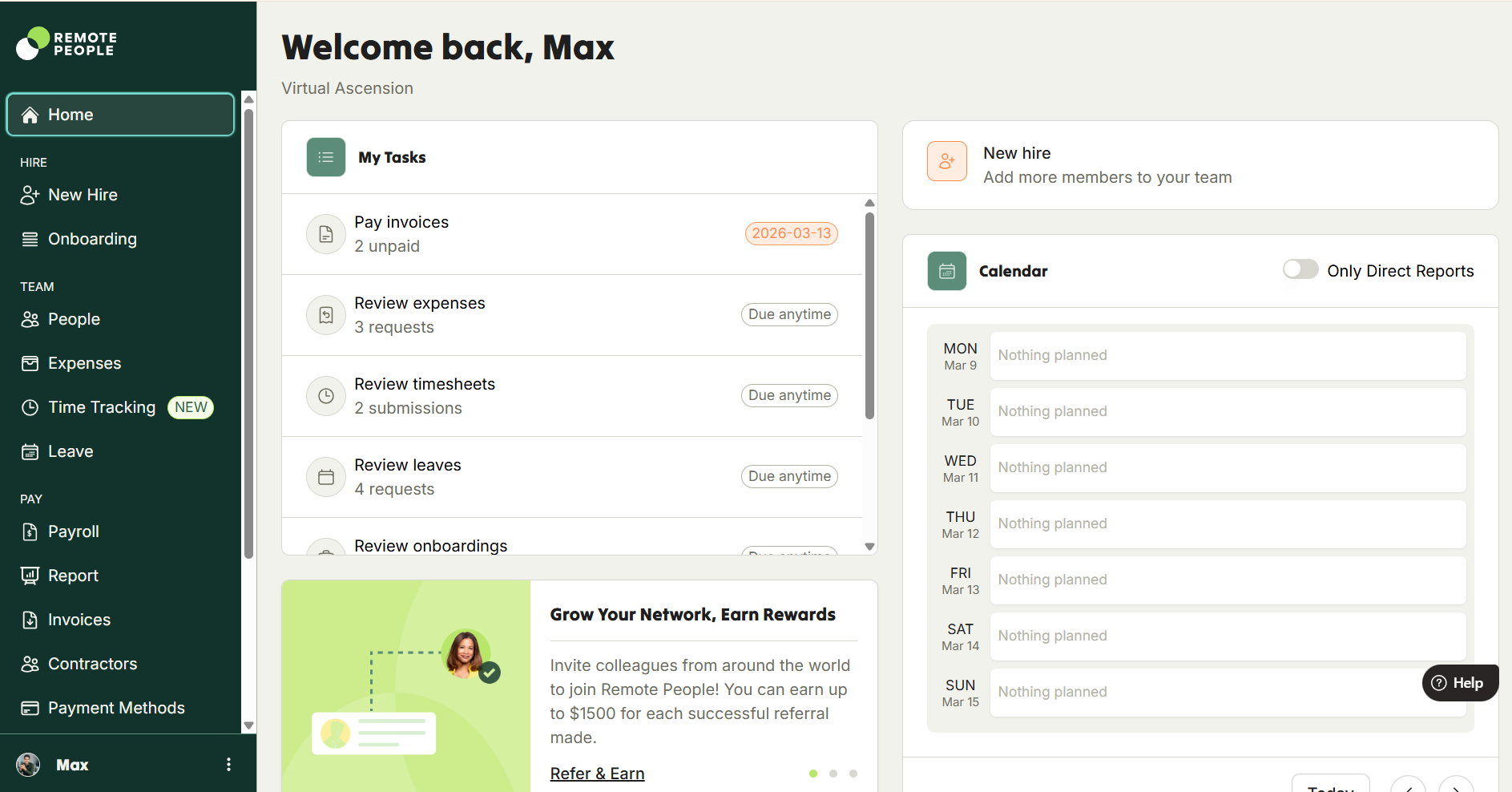
RemotePeople dashboard with invoice, expense and leave tasks, a hiring shortcut and team calendar.
RemotePeople’s dashboard groups outstanding tasks, hiring shortcuts and a team calendar in one view.

Reviewed by Martynas PupkeviciusFact-checked by Michael Ennis

Opens remotepeople.com

Option 2

Best For: Hiring people who need visa or relocation supportSetup fee: Our rating 4.2/5. No setup fee on the advertised EOR offer
$399
Per employee per month; dollar currency and billing commitment unspecified
See details
Countries and services

Pricing & terms

EOR fee from

$399

Per employee per month; dollar currency and billing commitment unspecified

Setup fee

No setup fee on the advertised EOR offer

Deposit

Security deposit due before onboarding; amount set in the order and subject to later adjustment

FX markup

The agreement must specify conversion rates and any currency charges; no universal percentage established

Exit fee

At least 90 days’ offboarding notice, starting on the next calendar month. Service fees continue; employment liabilities and remaining commitments may also be due.

Our rating

4.2/5

Pebl onboarding

Enlarge screenshot
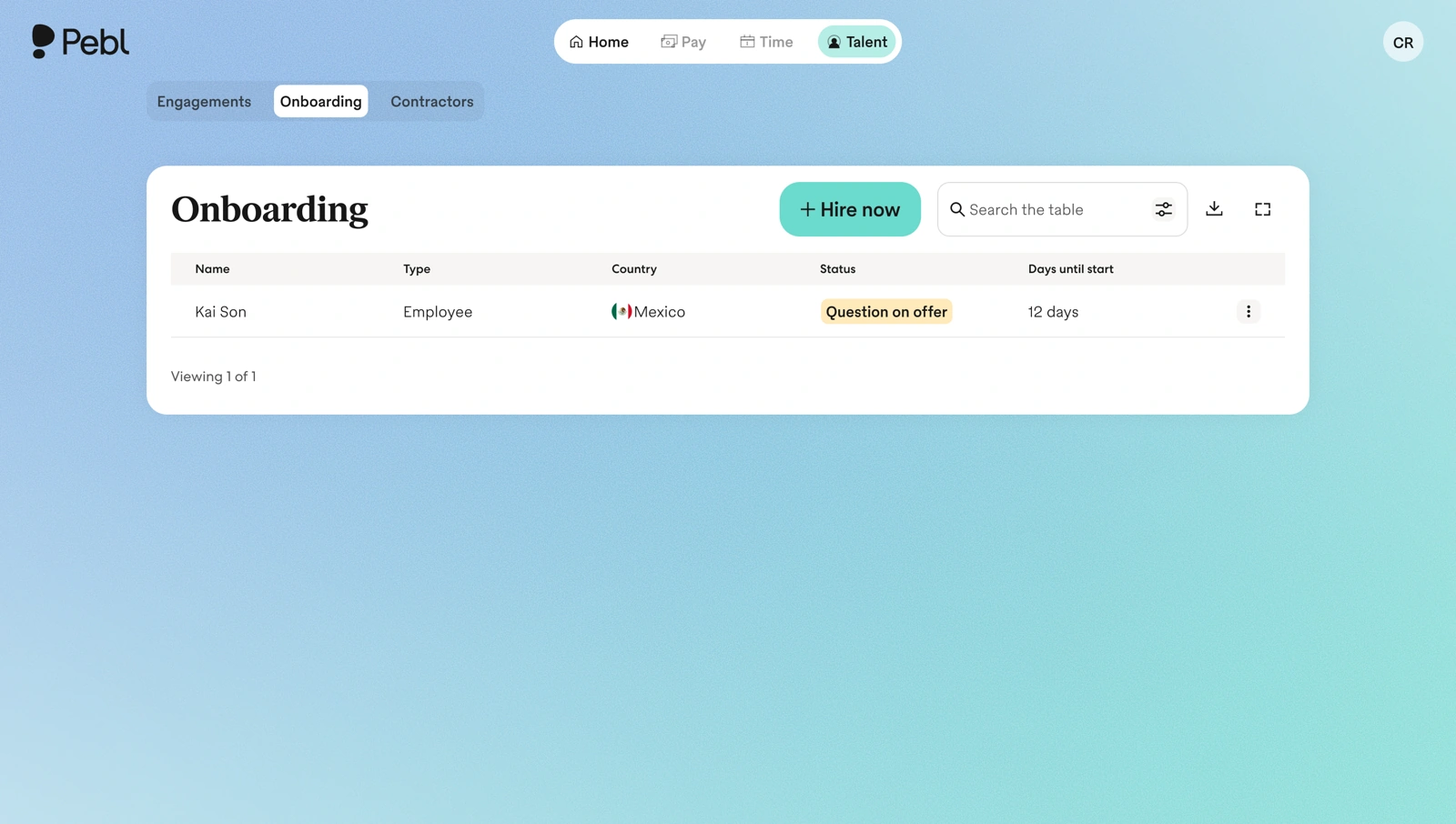
Pebl onboarding list with a sample hire in Mexico, offer status and days until the planned start.
Pebl’s onboarding view shows a sample hire’s country, offer status and planned start, with hiring controls above the list.

Reviewed by Martynas PupkeviciusFact-checked by Michael Ennis

Opens hellopebl.com

Option 3

Best For: Managing payroll, leave and expenses in one placeSetup fee: Our rating 4.1/5. Implementation fees may apply, although the FAQ says setup is free; the quote must resolve the charge
$499
Core costs $499 per employee per month with monthly billing, or $459 per employee per month billed annually. Confirm the dollar currency.
See details
Countries and services

Pricing & terms

EOR fee from

$499

Core costs $499 per employee per month with monthly billing, or $459 per employee per month billed annually. Confirm the dollar currency.

Setup fee

Implementation fees may apply, although the FAQ says setup is free; the quote must resolve the charge

Deposit

The agreement sets the deposit amount, deductions and return conditions

FX markup

Not published

Exit fee

The FAQ says no offboarding service fee; employee notice, severance and other exit costs remain separate

Our rating

4.1/5

Multiplier dashboard

Enlarge screenshot
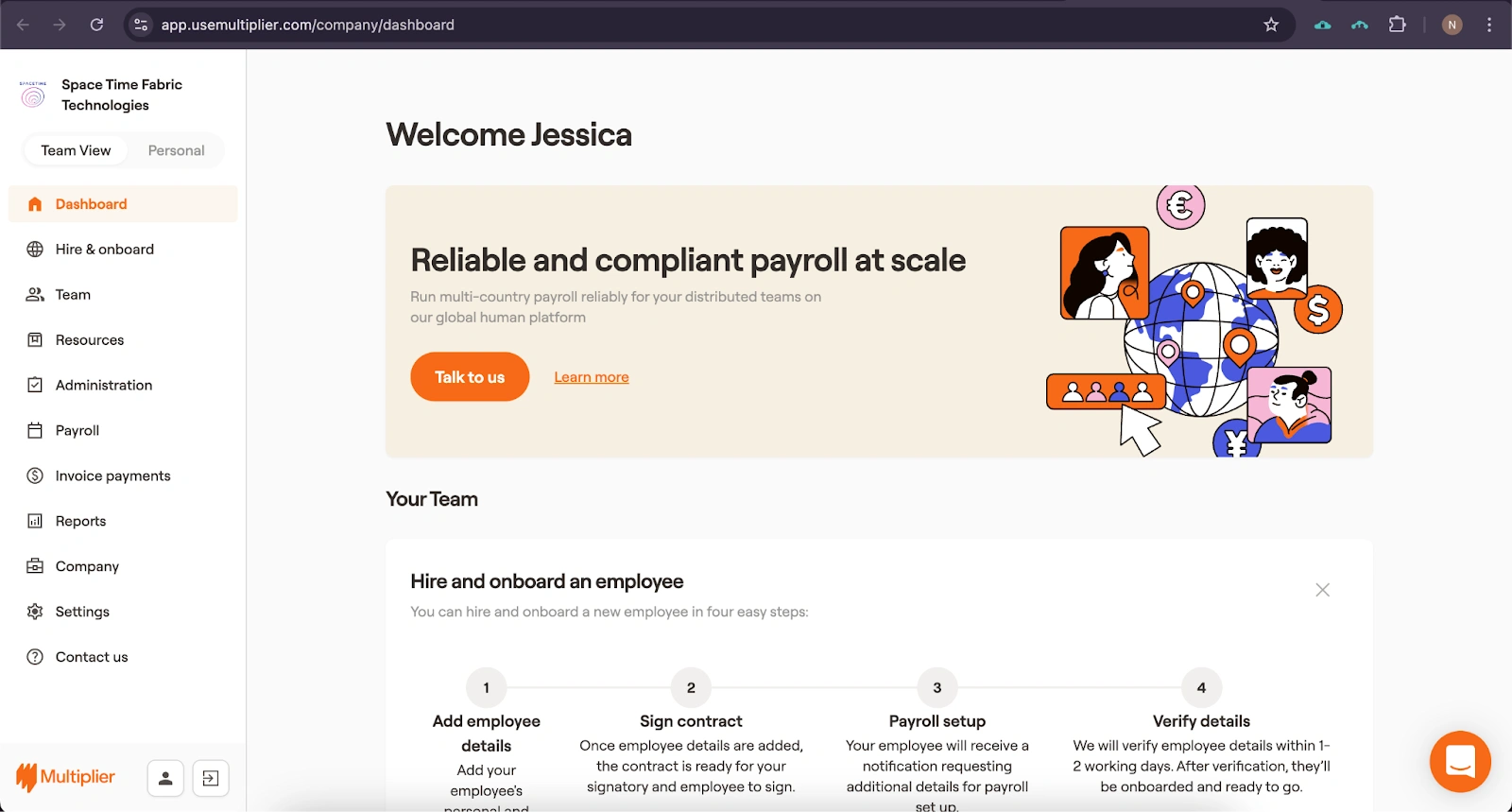
Multiplier dashboard with an onboarding checklist and navigation to hiring, payroll, invoices and reports.
Multiplier’s dashboard shows an onboarding checklist, with hiring, payroll, invoices and reporting available from the side navigation.

Reviewed by Martynas PupkeviciusFact-checked by Michael Ennis

Opens usemultiplier.com

Option 4

Best For: Paying employees and contractors on one platformSetup fee: Our rating 4.7/5. None
From USD 599
From USD 599; month-to-month available
See details
Countries and services

Pricing & terms

EOR fee

From USD 599

From USD 599; month-to-month available

Setup fee

None

Deposit

1–1.5x monthly charges

FX markup

Forward rates for cross-currency funding; no single published %

Exit fee

None disclosed; notice period not published

Our rating

4.7/5

Deel dashboard

Enlarge screenshot
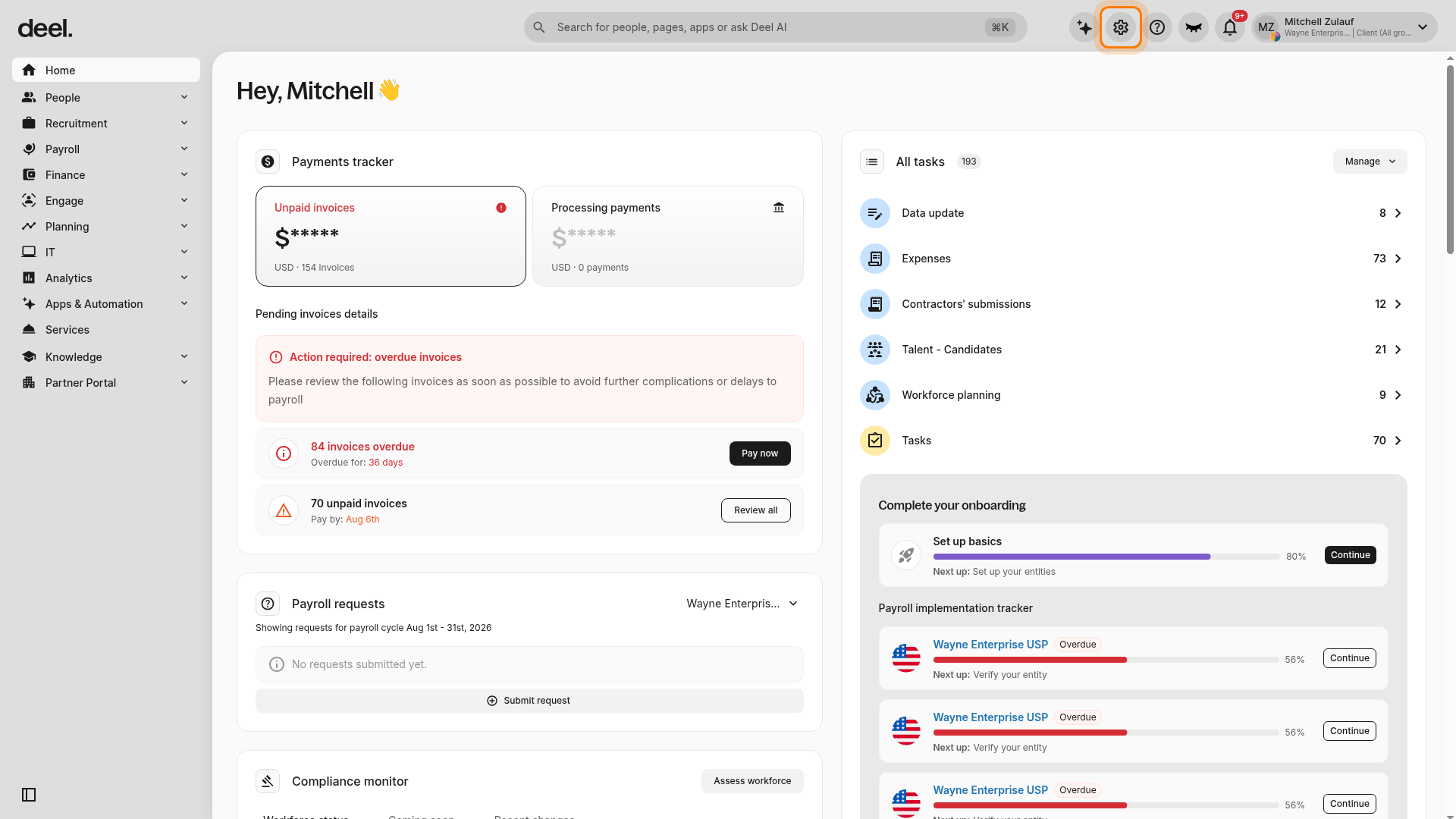
Deel dashboard with a payments tracker, outstanding tasks, onboarding progress and payroll requests.
Deel’s dashboard puts payment activity, outstanding tasks and onboarding progress alongside its HR and payroll navigation.

Reviewed by Martynas PupkeviciusFact-checked by Michael Ennis

Opens deel.com

Option 5

Best For: Using one onboarding process for hires across countriesSetup fee: Our rating 4.5/5. None
USD 699
Per employee per month on monthly billing. Annual seats are nonrefundable and quoted separately; quarterly or semiannual payments cost more than annual prepayment.
See details
Countries and services

Pricing & terms

EOR fee from

USD 699

Per employee per month on monthly billing. Annual seats are nonrefundable and quoted separately; quarterly or semiannual payments cost more than annual prepayment.

Setup fee

None

Deposit

At least one month of employment and service costs; top-ups may apply. Refund timing follows final settlement and the applicable credit-note or cash-refund conditions.

FX markup

Cross-currency only; % not published

Exit fee

No additional termination-processing fee; 30-day client notice. Employee exit costs and annual-seat commitments remain.

Our rating

4.5/5

Oyster dashboard

Enlarge screenshot
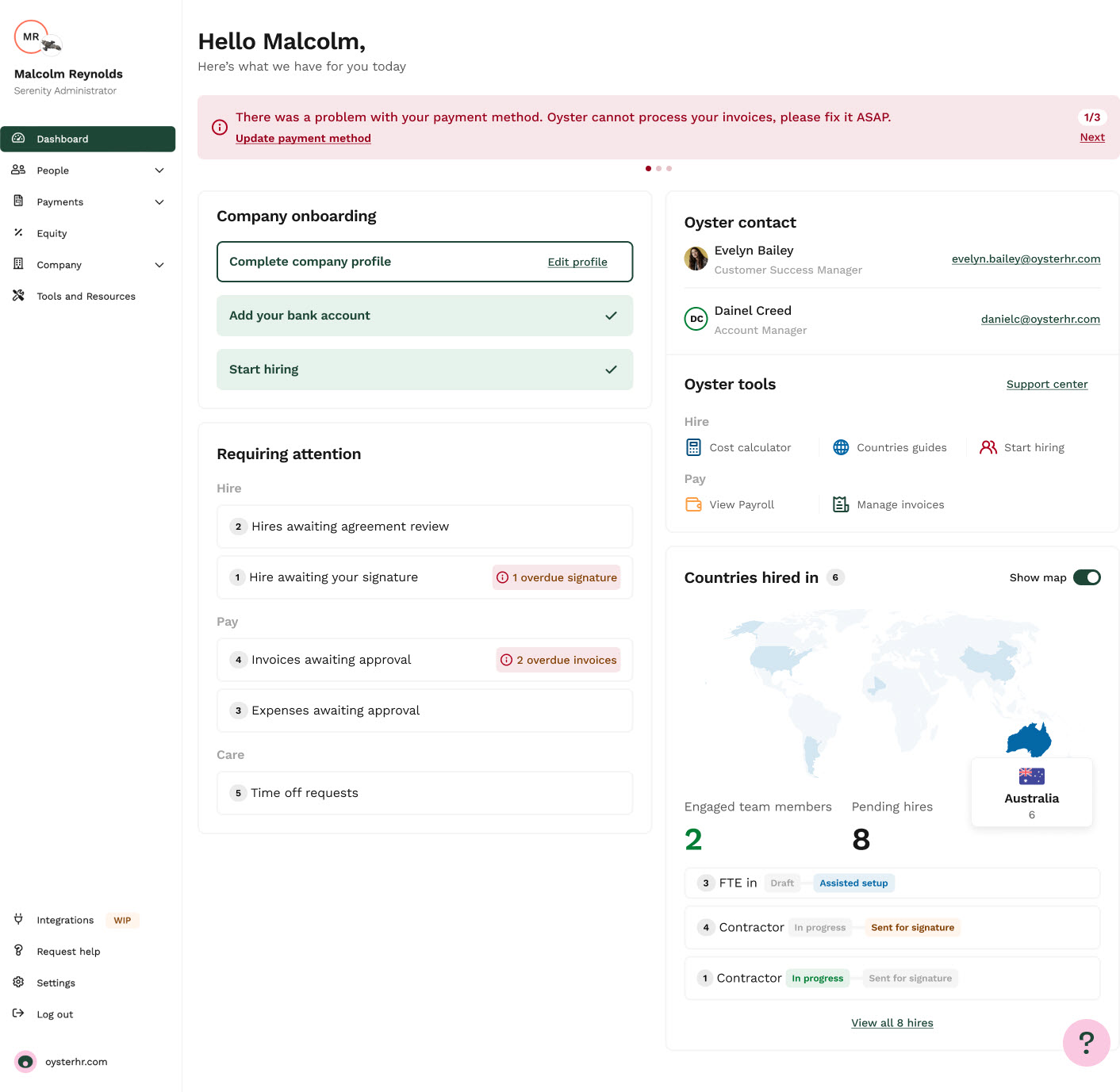
Oyster dashboard with hiring, payment and time-off tasks, support contacts and a map of team locations.
Oyster’s dashboard combines hiring, payment and time-off tasks with support contacts and a map of the team.

Reviewed by Martynas PupkeviciusFact-checked by Michael Ennis

Opens oysterhr.com

Fig. 1 · Published fee terms for five providers, from list price to exit fee · Original comparison: June 2026, with quoted figures marked. Pebl’s service-fee policy and the RemotePeople and Deel FX descriptions were updated on 24 September 2026, Oyster’s deposit description on 30 September 2026, RemotePeople’s Global and Select price cards and Select’s country and salary eligibility were rechecked on 16 October 2026; current deposit and commitment terms require a quote. Other figures keep their original comparison dates. A “Not published” cell means we found no printed figure, so do not read it as zero, and circle it before the sales call.

Service fees and stated billing terms rechecked on 1 November 2026. Multiplier and Pebl do not establish dollar currency on their general price pages. Contract, deposit and FX observations retain their stated historical dates; request the applicable current agreement.

Questions to resolve before you sign

Ask the 11 questions below in writing, attach the answers to the order form as an exhibit, and model the totals in the EOR cost calculator before you compare vendors. If you still need a shortlist, compare EOR companies and their service terms.

Monthly fees, required services and country surcharges

Question 1: What does the per-employee fee include?

Each provider puts different services in its “EOR fee.” Confirm what the selected Deel plan and country quote include; a published service fee is not the total invoice, which also includes employment funding and any other applicable charges. Oyster’s fee covers locally compliant contracts, payroll, statutory benefits administration and offboarding. Where any of these is an add-on, the list price understates your bill from month one.

Confirm in the agreement: a written inclusion list naming contract issuance, payroll runs and payslips, statutory filings and registrations, onboarding, offboarding, the support tier and indemnity. If offboarding is included, that also answers part of question 7.

Check before comparing. If the provider lists a platform subscription or a separate compliance service, ask whether you must buy it and whether your quote already includes its price. Add each required charge once.

Question 2: What triggers a surcharge above the list rate?

Treat a starting price as an offer subject to its stated scope. Papaya Global, for example, starts at $499 per employee per month for EOR. That service fee is separate from salary and employer costs. The country quote must identify its billing commitment and any additional services. Papaya’s EOR cost guide explains those cost categories. Circle every qualifier next to the fee, such as “from”, “starting at” or “in select markets”, and ask which conditions change the fee. Before you sign, obtain the price and currency for each country and required service.

Confirm in the agreement: a per-country rate card attached to the order form as an exhibit, with every surcharge named next to its country.

Open question: “complexity surcharges may apply” with no country list and no cap. Resolve the applicable country, trigger and amount before signing.

Deposits, payroll funding and currency conversion

Question 3: What is the deposit, and when is it returned?

Deel’s help center puts its standard deposit at 1–1.5x total monthly charges. The cited RemoFirst pricing page does not state a deposit amount. Request the actual deposit and return terms in the quote; an unstated amount is not zero. For RemotePeople Global or Select, obtain the current deposit amount, calculation base, deductions and return deadline in the country quote. Oyster takes about one month of each hire’s gross salary plus employer costs and fees. For a 10-person team in Germany with a total monthly cost of about $6,500 per employee, that ties up about $65,000 for the life of the engagement.

Compare the deposit amount, how long it is held, deduction conditions and return deadline together. Oyster’s published customer terms return the deposit within 60 days of Oyster receiving or confirming all amounts owing, whichever is later. The same terms let Oyster apply the deposit to “transition costs” and overdue amounts, with no cap stated. Uncapped deductions like these can use up the whole deposit you expected to get back.

Confirm in the agreement: the order form states the amount, a return deadline in days, and the permitted deduction categories and any limits; a cap is a term to negotiate.

Open question: return “after final reconciliation” with no day count, or deductions defined as “any amounts owing.”

Question 4: What is the FX methodology, and can we audit it?

Currency charges depend on the provider, currency pair and funding route. Deel’s help center describes forward rates for cross-currency funding and separate payment-method fees, but no single FX percentage. Oyster says its conversion fee applies only when you pay in a currency other than the contract currency, and RemotePeople’s currency terms are in the applicable agreement. We checked these policies on 24 September 2026, and the FX markup guide compares them. In a hypothetical example, a 1–1.5% charge on $850,000 of funding would cost $8,500–$12,750.

Confirm in the agreement: written terms covering the currencies and invoice lines converted, the rate source and fixing time, any forward-pricing method, each separate charge and any caps. Check invoices against those terms. A difference from the ECB reference rate, which is for information only, does not prove an overcharge.

Open question: currency-conversion wording with no rate-setting method or separate-fee schedule.

Check which currency you pay in. Paying in the required invoice or contract currency may avoid a provider conversion on that payment, but not your bank’s conversion or transfer charges. Confirm the supported currency, funding route, fees and deadline before changing your payment instructions.

Resolve an ambiguous proposal before comparing it

Suppose a proposal reads “USD 500 per month, FX included, one-month deposit.” Is that USD 500 for each employee? For which country, plan and commitment, and at what renewal price? Ask the supplier to show the rate and any spread behind “FX included,” then calculate the deposit for one of your hires. Those answers let you separate the annual cost from the cash due with the first invoice.
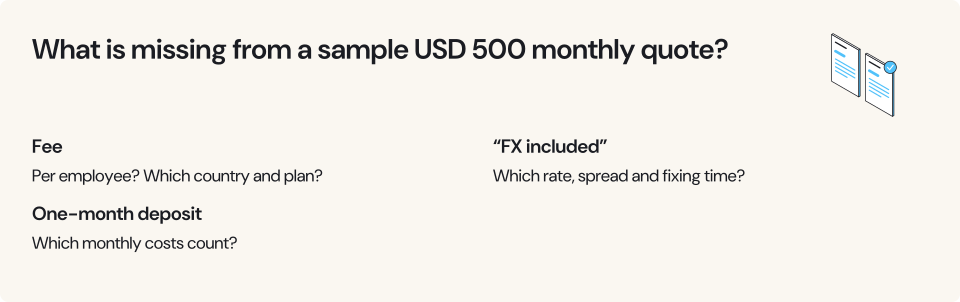
Resolve the fee unit and country, the exchange-rate method and the cost base behind the deposit before using the quoted USD 500.
A written answer to each line gives you enough detail to separate annual fees from first-invoice cash.

Benefits, extra payroll and offboarding charges

Question 5: Are benefits passed through at cost or marked up?

For statutory benefits, ask which amounts the provider passes through at cost and which attract an administration charge. For supplemental coverage, request the insurer’s premium and the fee for administering it. A 15% markup on a $3,000 annual premium would add $450 per employee. Both figures are hypothetical. Your quote should show whether you’ll actually pay that charge.
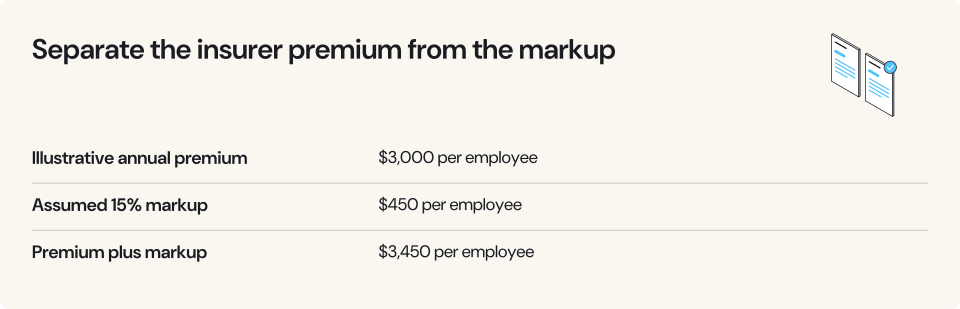
A hypothetical $3,000 premium with a 15% markup adds $450, bringing the annual amount to $3,450 per employee.
Compare equivalent coverage and ask for the premium and administration charge on separate lines.

Confirm in the agreement: the benefit premium or statutory amount, the administration scope and the charging basis: fixed, percentage-based, bundled or included. Request supporting insurer or provider evidence where available and compare equivalent coverage.

Open question: a benefit charge with no explanation of the coverage, charging basis or supporting evidence.

Question 6: What does an off-cycle payroll run cost?

Terminations, signing bonuses, corrections and statutory extras may require an off-cycle run, depending on the payroll calendar and local deadlines. Ask which payments fit the normal cycle and which trigger a separate charge. One dated example is in Deel’s help center, which lists on-demand payroll at $29 per affected employee. Other providers put the price in the order form, if anywhere.

Confirm in the agreement: the price and unit, included events, billing trigger and approval process. Negotiate inclusion or waivers where useful; do not assume every final-pay or statutory-extra run is free.

Open question: off-cycle runs “billed at then-current rates,” which leaves the future rate uncertain unless a fee schedule or advance approval process is agreed.

Question 7: What does termination administration cost?

A provider’s termination administration fee is separate from severance, notice pay and other employment liabilities, which depend on local law and the circumstances of the termination. Pebl’s pricing page says it charges no offboarding service fee (checked 24 September 2026), though the page does not give Pebl’s contractual notice period. RemoFirst publishes a “no setup, onboarding, or termination fees” policy, and Oyster includes offboarding in its base fee.

Confirm in the agreement: offboarding named as included in the monthly fee, or a fixed published fee per termination.

Check before signing: if termination support is quoted per case, ask for the pricing basis, approval process and an illustrative cost range. Local facts may change the work required, but the commercial process should be clear.

Renewal prices, volume discounts and unused seats

Question 8: What happens to the price at renewal?

Oyster’s published annual-plan guidance describes a 5% cap on per-seat increases at renewal; confirm the terms applicable to your order. Ask each finalist for the price-change mechanism, notice, any cap and your cancellation rights.

What “then-current list price” means. The phrase ties your year-two fee to the vendor’s public list price at renewal, which the vendor sets and you cannot change. Model the potential renewal cost and any cancellation rights. A cap or price lock is a term to negotiate; a disclosed uncapped mechanism can still be compared using explicit price scenarios.

Confirm in the agreement: a fixed percentage or CPI-linked cap written into the order form. Use Oyster’s cited annual-plan cap as one comparison point. Request an appropriate cap and notice mechanism for your plan, weighing the fee and commitment together.

Open question. What will the supplier charge at renewal? If the contract allows it to apply its future list price, you can see how the price will be set but you still don’t know the amount. Ask for a cap or notice period before you agree.

Question 9: What volume discounts apply, in writing?

Check whether the actual quote offers volume bands, when they apply and whether published or negotiated terms cover your countries.

Confirm in the agreement: the headcount bands, eligible countries, start date and whether a discount applies to all seats or only new seats. Automatic repricing is a preference to negotiate.

Open question: a quoted discount without the thresholds, eligible seats or period in writing. Compare the terms actually offered.

Question 10: Is there a minimum commitment, and are unused seats refunded?

Confirm the commitment, headcount minimum and unused-seat terms for the quoted RemotePeople Global or Select plan. Deel sells month-to-month. Oyster’s annual discount requires a quoted commitment, and its help center says the annual plan is non-refundable, although seats can be reused at no additional cost. If an employee resigns in month four, only a refund rule you have in writing will apply.
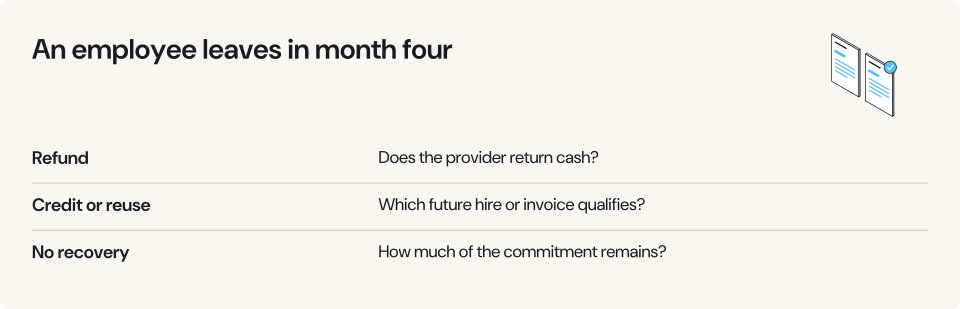
For an employee who leaves in month four, an annual seat could be refunded, credited, reassigned or left unused according to the order.
Ask the bidder to show the outcome for this departure before using its annual discount in your budget.

Confirm in the agreement: the order form states the monthly and annual commitments and what happens to unused seats: refund, credit, reuse or no refund. Weigh the annual discount against the exit exposure.

Open question. If a hire leaves early, how much of the annual seat price will you still owe? Weigh the discount against that amount and any right to reuse the seat or claim a credit.

Notice, exit support and employment liabilities

Question 11: What exit assistance is included, in writing?

The contract you sign sets the cost of leaving. Calculate charges through the contractual service end and the employee transfer or termination required under local rules, including any continuing costs beyond service notice, exit fee (question 7) and agreed administration work. Document service continuity and accrued rights under the applicable local transfer rules. A letter can record the agreement, but it does not replace statutory protections or determine every notice and severance entitlement.

Oyster’s published customer terms illustrate why service notice and the actual end of employment must be budgeted separately. Either party can terminate at any time on 30 days’ written notice, and no exit fee is stated. You remain liable for applicable fees and transition costs until the relevant service ends under the contract and applicable law. Oyster’s terms say this can extend beyond the 30-day notice period, so do not budget for only one month. Deel does not publish its service notice period or exit charges. Obtain the agreement for the specific product and employer, and distinguish service termination from employee exit requirements. RemotePeople markets its EOR Switch offer as covering up to 12 months of your previous provider’s exit fees, but get the coverage terms in writing before you rely on them. The full cut-over plan is in the 90-day switching guide.

Confirm in the agreement: the order form states the notice period in days and the deposit return deadline, includes continuity-of-service letters and a full data export with an SLA, and states any agreed exit charge. No exit fee or a faster service-level commitment is a negotiation preference.

Open question: no exit terms in the sheet or the MSA, which leaves your exit budget uncertain and should be resolved before signing.

The 11 questions to get answered in writing

Run the written answers through the rule below, then print the table and take it into the sales call. Allow time for country and contract questions, and resolve missing answers before signing. The 47-question RFP checklist also covers compliance, IP and integrations.

# The question Term to confirm Open question or negotiation preference
#
1
The question
What does the monthly fee include?
Term to confirm
Written scope, required services and any separately priced support or indemnity
Open question or negotiation preference
Required services missing from the total quote
#
2
The question
What triggers surcharges?
Term to confirm
Per-country rate card as an exhibit
Open question or negotiation preference
“Surcharges may apply,” no list, no cap
#
3
The question
Deposit amount and return date?
Term to confirm
Amount, release trigger/deadline, permitted deductions and any limits
Open question or negotiation preference
Return “after reconciliation,” undefined deductions
#
4
The question
FX reference rate, margin, audit right?
Term to confirm
Agreed currencies, method, fixing time and separate charges
Open question or negotiation preference
“Prevailing rate,” no timestamp
#
5
The question
Benefits at cost or marked up?
Term to confirm
Premium/coverage and fixed, percentage, bundled or included administration basis
Open question or negotiation preference
Unexplained coverage, charging basis or supporting evidence
#
6
The question
Off-cycle run price?
Term to confirm
Price/unit, included events, trigger and waiver/approval process
Open question or negotiation preference
“Billed at then-current rates”
#
7
The question
Termination admin fee?
Term to confirm
Included scope or an agreed fixed/case-based fee and approval process
Open question or negotiation preference
Per-case quote with no pricing basis or approval process
#
8
The question
Renewal escalator?
Term to confirm
Price-change mechanism, notice and any cap for your order; compare the cited Oyster annual-plan example
Open question or negotiation preference
Unexplained renewal mechanism; a disclosed list-price clause is a negotiation choice
#
9
The question
Volume bands?
Term to confirm
Written eligible seats, countries, thresholds and effective date
Open question or negotiation preference
Unwritten discount conditions; all-seat repricing is a preference
#
10
The question
Minimum commitment?
Term to confirm
Confirm monthly commitment and annual-seat refund, credit, reuse or no-refund terms
Open question or negotiation preference
Annual-seat forecast exposure to weigh against the discount
#
11
The question
Exit assistance?
Term to confirm
Notice in days, continuity letters, export SLA, deposit return deadline
Open question or negotiation preference
No exit terms anywhere

Fig. 2 · Eleven questions: record the confirmed term, unresolved information and any term you want to negotiate.

Use a supplier response sheet

Send every supplier the same questions and ask for the contract clause or schedule behind each answer. Enter zero only after the supplier confirms there’s no charge. Leave missing amounts open, and for a disputed item get both a sample invoice and the event that allows the supplier to bill it.
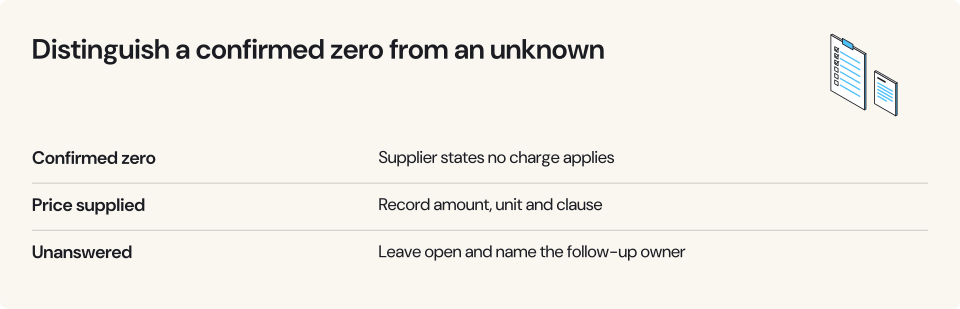
Mark zero only when the supplier confirms no charge. Record a priced charge with its clause and retain unanswered items as open.
Two quotes can look equal if a blank cell is treated as zero. Keep that cell open until the supplier answers.
The working record Fields to complete
The working record
Scope
Fields to complete
Question / charge · Supplier response · Currency / unit
The working record
Evidence and follow-up
Fields to complete
First-year amount · Renewal amount · Trigger / minimum · Contract reference · Open question

Download the EOR quote comparison worksheet

Use the workbook to build separate year-one and year-two totals. Spread the monthly fee over the commitment you’ll actually sign, show mandatory extras, setup, renewal and exit charges separately, and put the deposit in the cash forecast. Carry an introductory price into year two only if the supplier promises it in writing.

EOR pricing comparison FAQs

How much does an EOR cost per employee per month?

The sample began in June 2026; service fees and stated billing terms were rechecked on 1 November 2026. RemotePeople Global starts at USD 499, with Select from USD 199 for eligible countries and salary ranges. Deel starts at USD 599 with month-to-month pricing available. Oyster is USD 699 on monthly billing; annual seats require a quote and are prepaid and non-refundable. Multiplier Core is $499 monthly or $459 per month billed annually, with dollar currency unconfirmed. Pebl advertises $399 without establishing dollar currency or commitment. Compare current country quotes, deposits, FX, notice and employment costs before selecting.

Do all EOR providers take a deposit?
Requirements vary by plan and agreement. Deel’s standard deposit is 1–1.5 months of gross salary, and Oyster’s is about one month of each hire’s gross salary plus employer costs and fees, returned within 60 days after all amounts owing are received or confirmed paid, whichever is later, subject to the applicable documents and deductions from the unused balance. The cited RemoFirst pricing page does not state a deposit amount; obtain the terms in the quote. Confirm the quoted RemotePeople Global or Select deposit amount, calculation base, deductions and return deadline.
What FX markup is normal for an EOR?
No single FX markup is normal for every EOR, currency and payment route. Compare written offers on the same funding amount, currency pair and fixing method, and ask what the rate includes and what is charged separately. Any percentage in an example is an assumption. The FX markup guide compares providers’ current published policies.
Can you negotiate EOR pricing?
You can request changes to price and contract terms; acceptance depends on the provider and proposal. Ask for written prices and benefits administration charges for your headcount, and trade the commitment the vendor wants for written caps, volume bands and exit terms.
Is the EOR with the lowest monthly fee the cheapest overall?

Not necessarily, because the monthly fee does not show the total cost. We worked this out for the lowest-fee EORs. Pebl, for example, publishes $399 per employee per month and no setup or offboarding service fees (checked 24 September 2026). Its pricing page does not state the deposit, FX markup or contractual notice period, so get those in writing. Then compare offers on the same salary, employer contributions, benefits, currencies and contract period, using your written quotes in place of the assumptions in the EOR cost guide.

The general $399 price was rechecked on 1 November 2026, but dollar currency and commitment remain unconfirmed. A no-offboarding-administration-fee observation does not remove contractual notice or remaining service fees; check the applicable agreement and our provider contract research.

Sources and contract check dates

The sources behind this guide, grouped by topic. Dates show when we last checked a page. Prices and terms change, so confirm them in your quote.

Statutory pay rules

1 source
  1. Philippines · Official Gazette

    Presidential Decree No. 851

    Statutory 13th-month pay. Confirm processing within the agreed payroll calendar.

Exchange rates and price indexes

2 sources
  1. European Union · European Central Bank

    Euro foreign exchange reference rates

    Informational reference rates. Checked 24 Sep 2026

  2. United States · Bureau of Labor Statistics (BLS)

    Using the Consumer Price Index for contract escalation

    Web version

    The CPI-linked renewal cap in Q8. The web version is used in the quote comparison, checked 3 Oct 2026.

Provider pricing and terms

7 sources
  1. Deel

    Home pageExchange rates and feesOff-cycle payments

    Published pricing verified Jun 2026. Forward rates for cross-currency invoice funding and separate payment-method fees (checked 24 Sep 2026). Off-cycle payments and On-Demand Payroll: $29 per affected employee, the published off-cycle price for Q6.

  2. Multiplier

    Home page

    Pricing and reported standard terms. Checked Jun 2026

  3. Oyster

    Home pagePricingPricing detailsPre-funding and settlement invoicesWhy a deposit is requiredHow EOR annual worksCustomer terms

    $699 per employee per month billed monthly, in USD, EUR, GBP or CAD; conversion fee only outside the contract currency. No extra setup, onboarding or offboarding fees. Refundable deposit of about one month of the hire’s total cost of services (Q3). Annual plan non-refundable, seats reusable, per-seat renewal rises capped at 5% (Q8, Q10). Checked Jun, Aug and Sep 2026; terms 3 Oct 2026, used in the quote comparison.

  4. Papaya Global

    PricingEOR cost guide

    EOR from $499 per employee per month (checked 8 Nov 2026), separate from salary and employer costs. The country quote determines the billing commitment and additional charges; the cost guide explains those cost categories.

  5. Pebl

    EOR pricing

    $399 per employee per month (rechecked 1 Nov 2026), but the generic advertisement doesn’t establish dollar currency or commitment. No setup or offboarding service fees (checked 24 Sep 2026). The page doesn’t state deposit, FX or contractual notice terms; current contract terms may require notice and continuing service fees.

  6. RemoFirst

    PricingPrice page

    Published service-fee policy. The page doesn’t state a deposit amount.

  7. RemotePeople

    PricingEOR Switch program

    Global from USD 499 and Select from USD 199 per employee per month; Select requires selected-country and qualifying-salary eligibility (checked 1 Nov 2026). Confirm quote currency, commitment and deposit terms. The EOR Switch program covers up to 12 months of a previous provider’s exit fees.

Our research

4 sources
  1. The Best EOR

    Methodology and rubric

    How we rate EOR providers.

  2. The Best EOR

    Deel review

  3. The Best EOR

    Oyster review

  4. The Best EOR

    RemotePeople review

If you spot a changed price or a conflicting source, send it through the contact page and we’ll review it.

This guide is for general information only and does not provide legal, tax, accounting, or financial advice. For advice about your business, consult a qualified professional familiar with the rules where you hire. Read our research methodology to learn how we assess sources.