TheBestEOR

Best Employer of Record in Mexico

Written by Lucia AparicioFact-checked by Michael Ennis
Picture of Lucia Aparicio
Lucia Aparicio

Senior Editor and HRIS Specialist

Our top employer of record in Mexico for 2026 is RemotePeople, from USD 499 per employee a month, ahead of Deel and Rippling.

We tested all 10 providers with paid client accounts, real quotes and a live hire run through payroll. Mexico restricts personnel outsourcing, and specialized services may need REPSE registration with the labour ministry.

Flag of Mexico

Hiring in Mexico at a glance

Currency
MXN
Mexican peso
Pay cycle
Every 15 days
Manual workers must be paid at least weekly
Working hours
48 hours
Weekly in 2026, 8 h a day for daytime work
Annual leave
12 days
After the 1st year, rising with service
Extra pay
Aguinaldo
Christmas bonus, plus vacation pay and profit share
Employer costs
Social security
Plus retirement and housing fund contributions
Before you hire:
Confirm the hiring arrangement is legal, since personnel outsourcing is restricted in Mexico.

Country hiring overview · Mexico

Hiring in Mexico, at a glance.

Check the employment model before comparing fees.

For a Mexican hire, I’d ask the provider to explain the proposed employment structure and whether it is permitted for the work involved. Establish whether REPSE applies rather than treating a registration number as approval of every arrangement.

Choose a hiring solution

Need a local employer?

Compare an EOR arrangement for your role before opening your own entity.

Already have a local employer?

Compare payroll and HR support against adding an EOR.

EOR service fee

Fees vary by provider.

Your quote should state the currency, fee per employee, minimum charge and billing commitment.

Onboarding

Paperwork affects the start date.

The contract, right-to-work checks, registrations and payroll deadlines all affect when employment can begin.

Employment costs

Include housing contributions.

The quote should separate IMSS social security, INFONAVIT housing contributions and benefits. Ask how any applicable PTU profit sharing is calculated rather than treating it as a fixed salary surcharge.

Annual leave

Leave increases with service.

Employees receive at least 12 working days of annual leave after their first year of service. The minimum allowance increases as their service grows.

Check before choosing

Confirm the employment structure, any REPSE scope, vacation premium, aguinaldo, PTU treatment and salary/invoice currencies.

What your quote should include

Employment costs and service fees

1
Gross salary and agreed pay schedule
2
IMSS, INFONAVIT, benefits and any applicable PTU
3
EOR fee: currency, per-employee billing, minimums and commitment
4
Setup, foreign exchange, extras and exit costs

Deposits and payroll funding

1
Amount and payment deadline
2
Whether funds are refundable or credited to payroll
3
Release conditions and refund timing
Show these separately from recurring expenses.

Key takeaways for hiring in Mexico

Check the REPSE number against the proposed work

Registration and a permitted arrangement are different questions: where specialised-services rules apply, the registered scope must fit the actual work and beneficiary.

Price telework as part of employment

Mexico’s telework framework addresses equipment, agreed work locations, safety and work-related costs. Ask the proposal to identify the employer’s arrangements for these items and the amount charged to the client, rather than hiding them inside a general benefits line.

Base salary and contribution salary are different

The SBC used for social-security calculations incorporates relevant remuneration and benefits, subject to statutory exclusions. A quote that multiplies every contribution rate by monthly cash salary can understate the cost. Request the daily SBC and an explanation of how the promised aguinaldo, vacation premium and variable pay affect it.

Plan the 2027 schedule before signing a long contract

The ordinary weekly limit remains forty-eight hours during 2026, with a statutory reduction to forty-six in 2027 and further staged reductions thereafter. For a role hired now, ask how the employer and your manager will adapt schedules and coverage. The contract should not treat the current maximum as a permanent operating assumption.

Obtain a reasoned termination calculation

The exit route determines which payments are due. The twenty-days-per-year component depends on the applicable legal remedy; it is not an automatic payment in every case. Ask for a breakdown tied to the facts, including accrued benefits and the correct salary basis, before using the existing example as a reserve target.

Quick verdict

What is the best EOR in Mexico?

My top three: RemotePeople, Deel and Rippling.

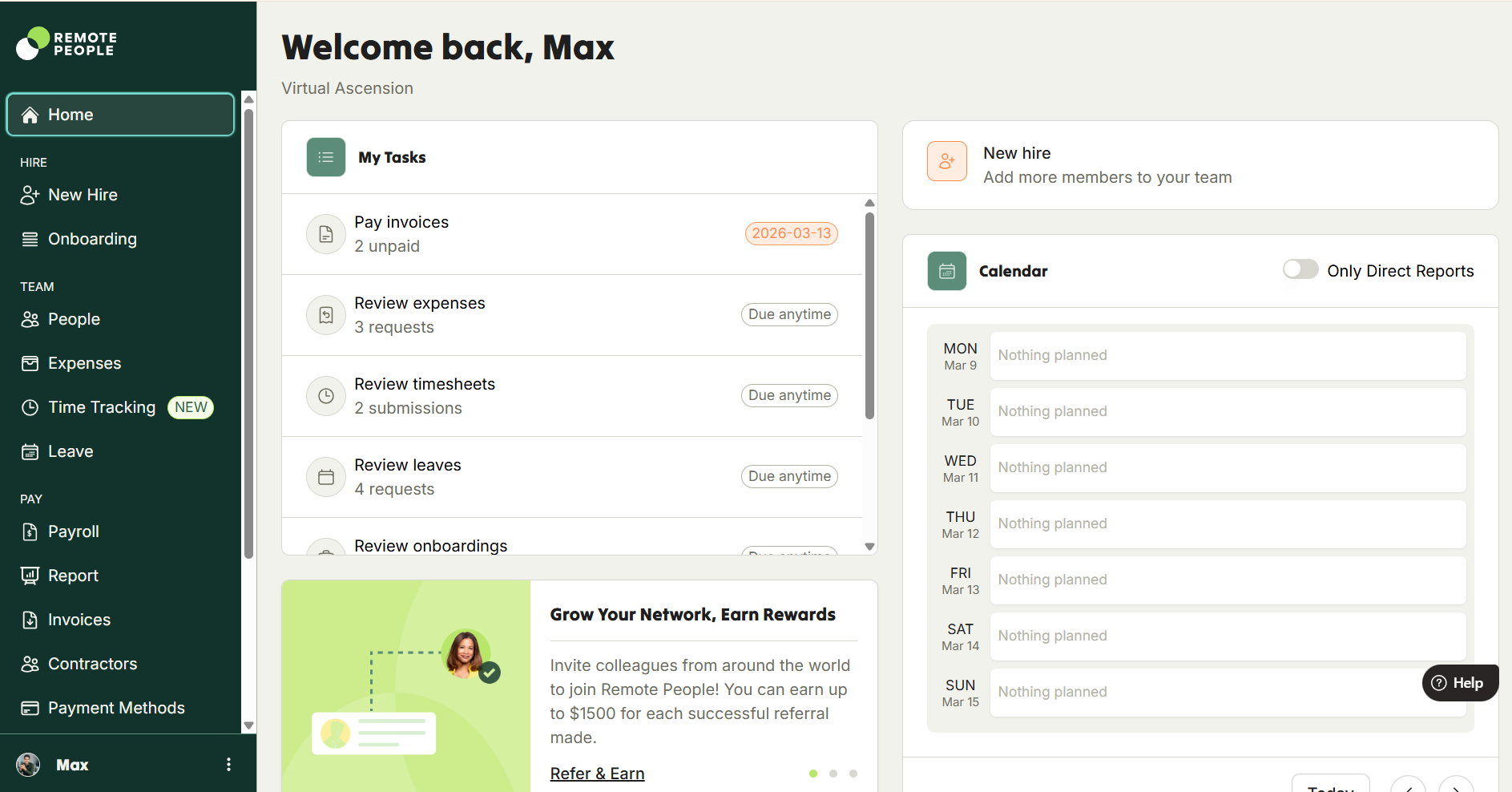
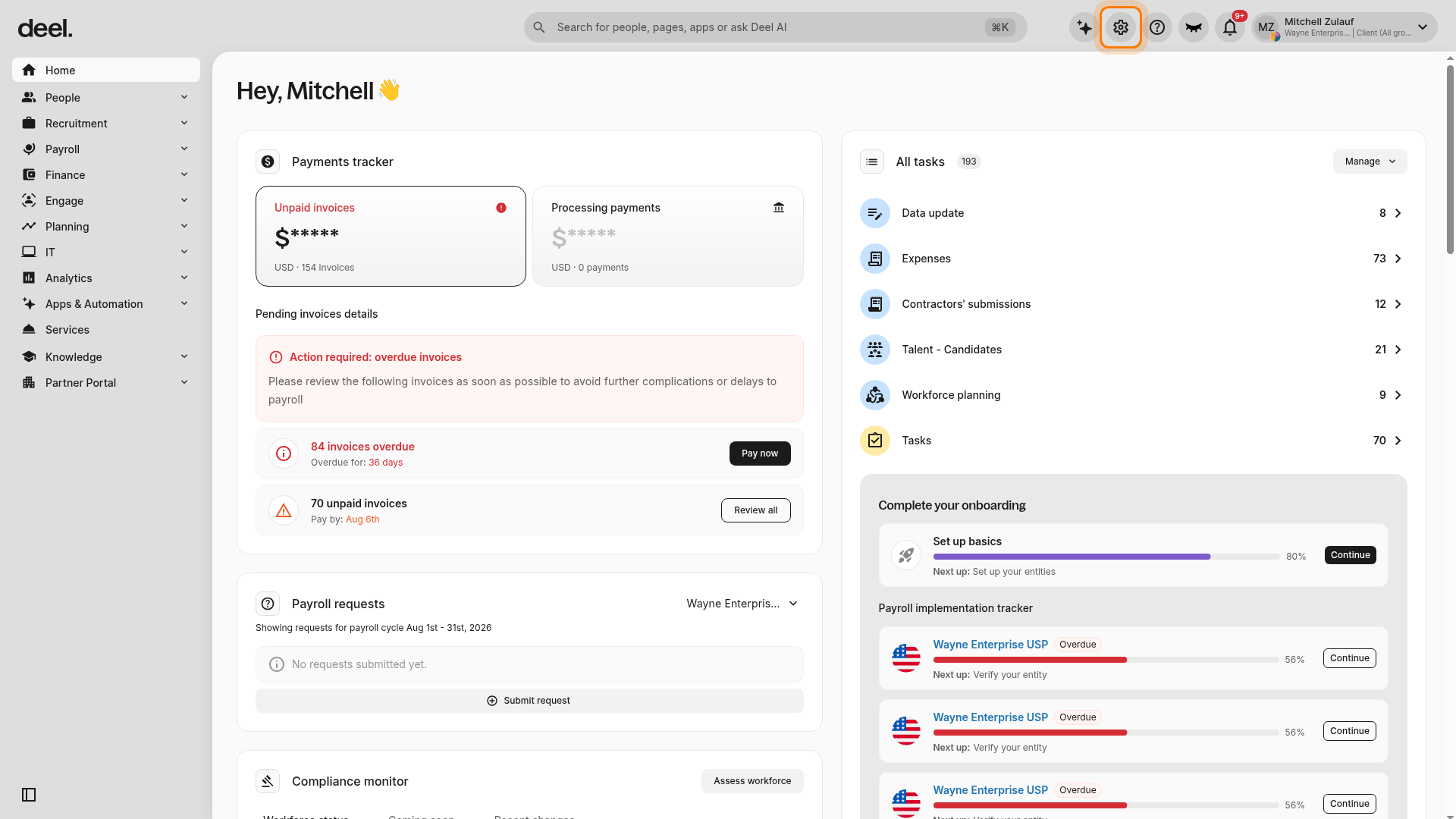
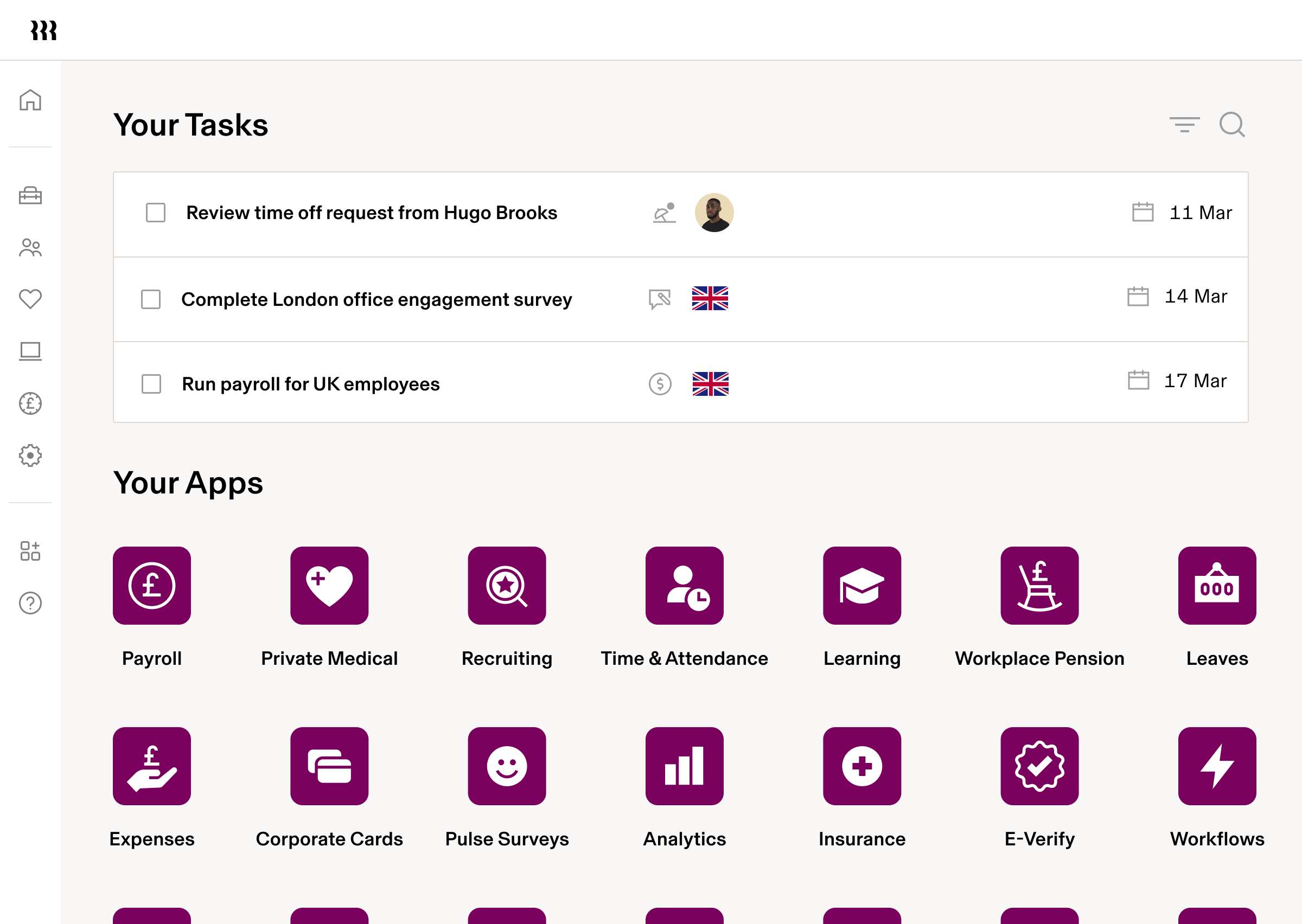
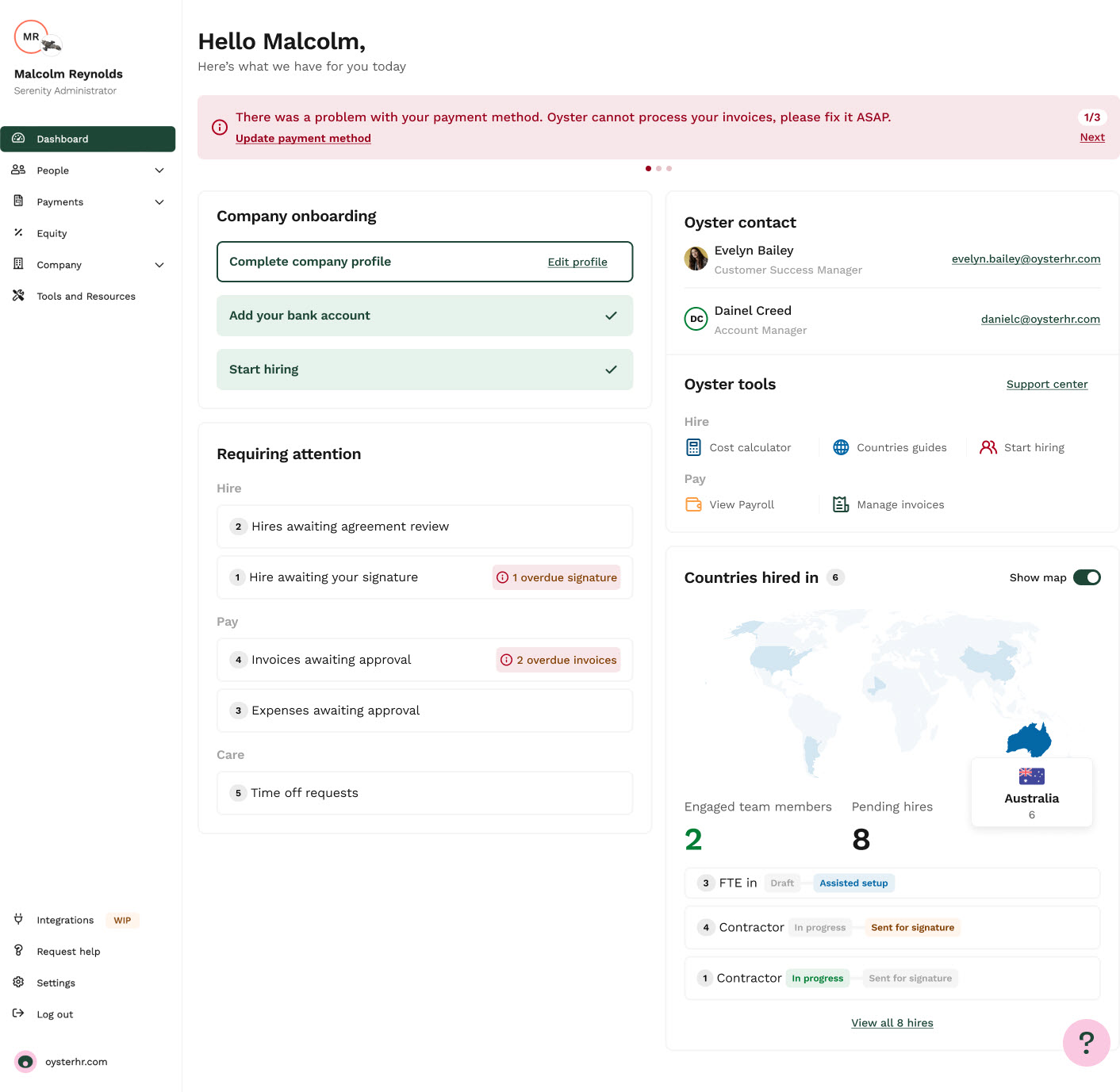
For a hire in Mexico, I’d shortlist RemotePeople first. It employs Mexican staff through its own S. de R.L. de C.V. in Mexico City. Its EOR Global plan starts at USD 499 per employee per month, or USD 199 on EOR Select where the hire qualifies. Deel, from USD 599 plus a mandatory Employer Liability Cost, fits when Mexico is one part of a wider employee and contractor programme. Rippling, from USD 499 plus its required platform, fits a team that already runs HR or IT on Rippling.

I’d start a Mexican shortlist with three questions: who holds an active REPSE registration, who locks up deposit cash, and who can sponsor the work visa through an INM employer account.

1
Editorial pick
RemotePeople logo

4.9/5

RemotePeople

Hiring in new markets with local HR support

Starting fee
$499

per employee / month

Countries
150+
where you can hire

EOR Select from $199 for eligible hires.

Deposit
1 month

of gross salary

Deposit refund
Within 5 days

of the final payment

Why consider it

Recruitment and EOR services through one provider.

Dedicated account manager in both EOR plans.

Check the fit

Recruitment is separately priced. Confirm its fee and payment schedule.

Before signing: Confirm quote currency, billing commitment, deposits, funding deadlines and refund terms. EOR Select eligibility depends on the hiring country and employee salary.

Both EOR plans list local contracts, payroll and tax administration, and statutory benefits administration. Salary, employer contributions and benefit costs are separate.

Legal employer in Mexico
✓ Own entity

Employing entity
Own S. de R.L. de C.V., Mexico City
RFC HGM2209287F3

Local office
Río Guadiana 11, Col. Cuauhtémoc, 06500 Ciudad de México

Visit RemotePeople ↗

2
Deel logo

4.7/5

Deel

Paying employees and contractors on one platform

Starting fee
$599

per employee / month

Countries
130+
where you can hire

Plus a mandatory Employer Liability Cost.

Deposit
1–1.5 months

of gross salary

Deposit refund
Within 60 days

of offboarding

Why consider it

EOR, contractor management and payroll for your own entities.

Month-to-month EOR service pricing available.

Check the fit

Ask for the country-specific Employer Liability Cost in your quote; it is mandatory.

Before signing: Confirm the Employer Liability Cost amount, benefit costs and any additional products. Monthly service terms do not remove employment notice, severance or other exit obligations.

The EOR pricing page lists 130+ countries. Broader platform coverage figures may include other services; confirm EOR availability for your hiring country.

Legal employer in Mexico
– Confirm in your contract

Employing entity
Own Mexican entity
Deel states it employs through its own entity in Mexico; confirm in your proposal

Local office
Confirm in your quote

Visit Deel ↗

3
Rippling logo

4.5/5

Rippling

Setting up payroll, laptops and app access for new hires

Starting fee
$499

per employee / month

Countries
115
where you can hire

Plus the Rippling Platform, from $8 per employee / month.

Deposit
Per quote

based on gross salary

Deposit refund
Per contract

set in your agreement

Why consider it

EOR, payroll, HR records and benefits administration in one platform.

Shared workflows and reporting for domestic and international teams.

Check the fit

Ask for an itemised quote showing the required platform and each HR or IT module.

A paid Rippling Platform subscription is required on top of the EOR fee, from $8 per employee per month plus a monthly base fee. Rippling EOR starts at $499 per employee per month. Other HR and IT products are priced separately.

Rippling’s EOR page lists 115 countries. Confirm your hiring country and legal employer. Confirm current availability and the legal employer for your hiring country.

Legal employer in Mexico
– Confirm in your contract

Employing entity
Confirm in your contract
Ask Rippling to name the employer and say whether it is owned or a partner

Local office
Confirm in your quote

Visit Rippling ↗

No provider pays for a position on this page; some outbound links pay a referral fee. See the funding model and methodology.

REPSE, deposits and visas

The 10 best EOR providers for Mexico ranked

Which entity employs the worker and holds REPSE?

When analyzing providers, one of the first steps is identifying the employing entity and checking if it complies with all legal requirements, including REPSE registration.

Below you will find a list of ten providers ranked by compliance (25%), cost (20%), coverage (15%), onboarding (15%), support (15%) and how easy it is to switch providers (10%). There are no verified scores for Mexico yet. If you are hiring in many countries, start with the ranking of the 10 best EOR services overall. For a wider shortlist, browse EOR providers for Mexico.

Provider

Best For

Starting feeDepositOnboarding
1 RemotePeople logo RemotePeople 4.9/5 Rating Hiring in new markets with local HR support Starting fee: $499 USD / monthDeposit: 1 monthOnboarding: 1–2 weeks

My take

I’d compare RemotePeople’s two plans against your eligibility and budget.

Both include employment contracts, payroll and tax administration, statutory benefits administration, a dedicated account manager and ongoing employment support.

EOR Global starts at USD 499 per employee per month. EOR Select starts at USD 199 for eligible countries and employee salary ranges. Salary, employer contributions and benefits are separate; the proposal sets the applicable plan, billing commitment, deposit and payroll funding terms.

When this provider fits:

RemotePeople is a great fit when you want coordinated onboarding and a named contact. Compare the Global or Select price for your employee and the projected first-year payment schedule to determine whether it’s the lowest-cost option.

Ask before signing:

Are telework charges and the vacation premium included in the budget, or are they charged separately?

Deposit

1 month

Entity model

Own entities in core markets

First year, one hire

$5,988 in service fees

Reviewed by Lucia AparicioFact-checked by Michael Ennis

Starting fee

$499

EOR Global. EOR Select starts at $199 where the country and employee salary qualify.

Against the 10 starting fees

$199 lowest$699 highest
2 Deel logo Deel 4.7/5 Rating Paying employees and contractors on one platform Starting fee: $599 USD / monthDeposit: 1–1.5 monthsOnboarding: Start date agreed per hire

My take

I’d consider Deel when you need EOR employment and contractor management in one system.

Contractor management starts at USD 49 per contractor per month and is separate from the EOR service, so I’d compare those two budgets separately.

Deel’s global EOR service starts at USD 599 per employee per month, with month-to-month pricing available. Mandatory Employer Liability Cost is charged separately and varies by country. Salary, employer contributions, benefits and any additional services sit outside the starting service fee.

Deposit

1–1.5 months

Entity model

Own entities and partners

First year, one hire

$7,188 in service fees

Reviewed by Lucia AparicioFact-checked by Michael Ennis

Starting fee

$599

Month-to-month billing. Mandatory Employer Liability Cost is charged separately.

Against the 10 starting fees

$199 lowest$699 highest
3 Rippling logo Rippling 4.5/5 Rating Setting up payroll, laptops and app access for new hires Starting fee: $499 USD / monthDeposit: Per quoteOnboarding: Start date agreed per hire

My take

I’d look at Rippling when you want EOR employees to share HR records and workforce reporting with the rest of the organisation.

App access and device management are separate products, so I’d keep those costs distinct in the comparison.

Rippling EOR starts at USD 499 per employee per month, plus the required Rippling Platform from USD 8 per employee per month plus a monthly base fee. Billing commitment and optional HR or IT modules are quote-specific.

When this provider fits:

Rippling makes the most sense for current Rippling users. Ask how its workflow coordinates with the Mexican employer’s telework obligations, which steps stay with your IT or management team, and how the full module price compares with a simpler EOR service.

Deposit

Per quote

Entity model

Own entities and local partners

First year, one hire

$5,988 in EOR fees

Reviewed by Lucia AparicioFact-checked by Michael Ennis

Starting fee

$499

Plus the required Rippling Platform, from $8 per employee per month and a monthly base fee. Confirm the billing terms and selected products.

Against the 10 starting fees

$199 lowest$699 highest
4 Oyster logo Oyster 4.5/5 Rating Using one onboarding process for hires across countries Starting fee: $699 USD / monthDeposit: ~1 monthOnboarding: Start date agreed per hire

My take

My main workflow reservation with Oyster in Mexico is the lack of automation through its automated Global Hiring workflow.

Its virtual hiring assistant, automated Team Member onboarding, automated agreements and electronic signature are unavailable there.

Oyster’s month-to-month EOR rate is USD 699 per employee per month. Annual seats are quoted separately. Standard annual billing is prepaid and non-refundable; quarterly or semiannual payment is available at a higher seat price. A seat can be reused for a replacement hire. Salary, employer costs, deposits and optional services are additional.

When this provider fits:

Oyster fits when its benefits and written exit terms justify the price, but its refundable deposit will tie up cash in the meantime.

Ask before signing:

What local policy and eligibility rules apply to the proposed health cover?

Deposit

~1 month

Entity model

Own entities and vetted partners

First year, one hire

$8,388 in service fees

Reviewed by Lucia AparicioFact-checked by Michael Ennis

Starting fee

$699

Monthly billing. Annual seats are quoted separately, prepaid and non-refundable.

Against the 10 starting fees

$199 lowest$699 highest
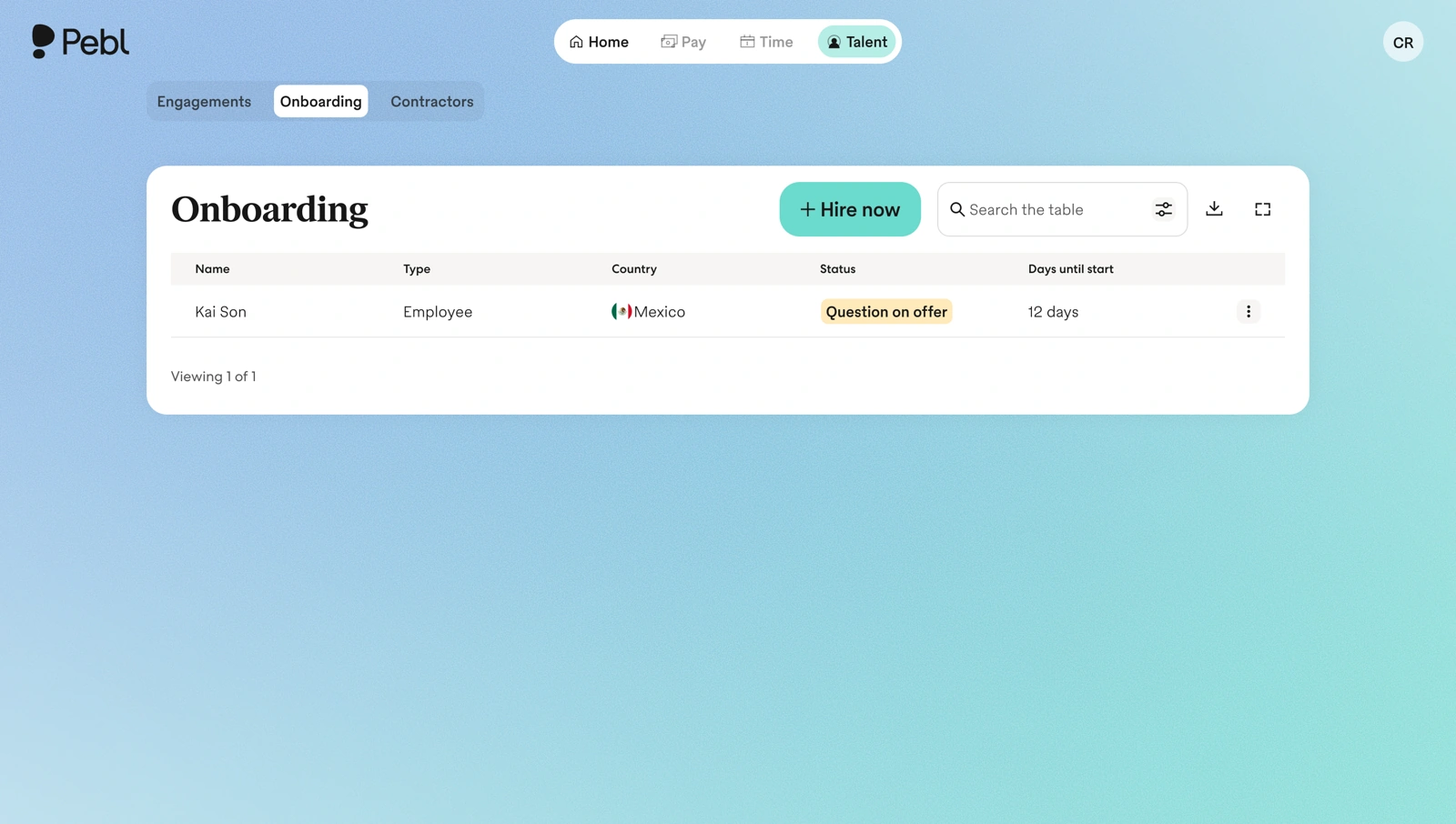
5 Pebl logo Pebl 4.2/5 Rating Hiring people who need visa or relocation support Starting fee: $399 USD / monthDeposit: Per quoteOnboarding: Start date agreed per hire

My take

Pebl’s local-entity restriction would be my first check if you’re planning a Mexican company.

At onboarding in Mexico, its EOR terms require that neither the client nor its affiliates is locally incorporated, owns or controls a local entity, or plans to establish, acquire or reorganise as one. Later changes must be reported promptly in writing to Pebl, which will work with the client to resolve the resulting issues.

Pebl lists an EOR fee of $399 per employee per month, but the general price does not specify the dollar currency or billing commitment. The country proposal determines availability, any offer period and renewal terms; salary, employer costs and additional services are separate.

Deposit

Per quote

Entity model

Affiliates and local partners

First year, one hire

$4,788 in service fees

Reviewed by Lucia AparicioFact-checked by Michael Ennis

Starting fee

$399

Confirm the country price and billing commitment.

Against the 10 starting fees

$199 lowest$699 highest
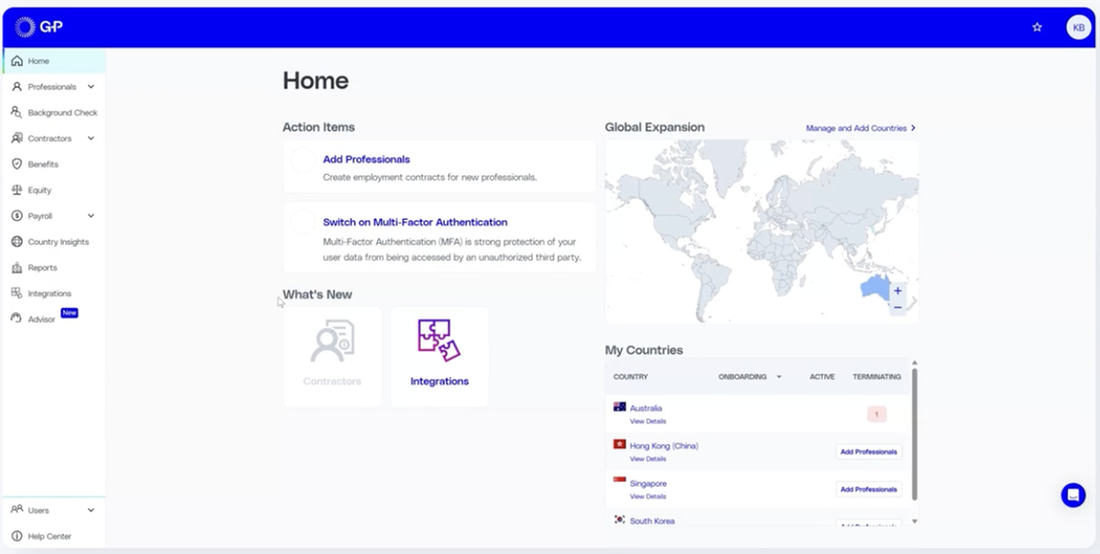
6 G-P logo G-P 4.2/5 Rating Hiring abroad while keeping your existing HR system Starting fee: $599 USD / monthDeposit: 1–2.5 monthsOnboarding: Start date agreed per hire

My take

G-P would make my shortlist if you also need visa support, background checks or equity payroll management.

These are optional services alongside its employment service, with their own eligibility and charges.

G-P’s global EOR fee starts at USD 599 per employee per month, with a tailored country proposal. There is no minimum duration for an EOR hire; the client’s billing, cancellation and employee exit terms remain separate contract terms.

Deposit

1–2.5 months

Entity model

100+ own entities, plus partners

First year, one hire

$7,188 in service fees

Reviewed by Lucia AparicioFact-checked by Michael Ennis

Starting fee

$599

Confirm the included services and billing terms in your country quote.

Against the 10 starting fees

$199 lowest$699 highest
7 Papaya Global logo Papaya Global 4.1/5 Rating Comparing payroll costs across countries in one report Starting fee: $499 USD / monthDeposit: 1–2 monthsOnboarding: Start date agreed per hire

My take

Papaya’s support arrangement is one reason I’d include it in a payroll shortlist: an account manager coordinates payroll, legal, finance and benefits specialists.

Employees can also raise tickets through its worker app or WhatsApp.

Papaya’s EOR service starts at USD 499 per employee per month. The country quote must identify the billing commitment and any additional services. Salary and employer costs are separate.

When this provider fits

Papaya is most relevant when the Mexican payroll joins an existing multi-country reporting project. Compare its complete funding calendar with the other offers on the same salary and pay cycle.

Ask before signing

What is the largest cash balance required before first payroll, and how is each reserve reconciled?

Deposit

1–2 months

Entity model

Own entities in 80+ countries

First year, one hire

$5,988 in service fees

Reviewed by Lucia AparicioFact-checked by Michael Ennis

Starting fee

$499

The country quote sets the billing terms. Payroll-only processing is priced separately.

Against the 10 starting fees

$199 lowest$699 highest
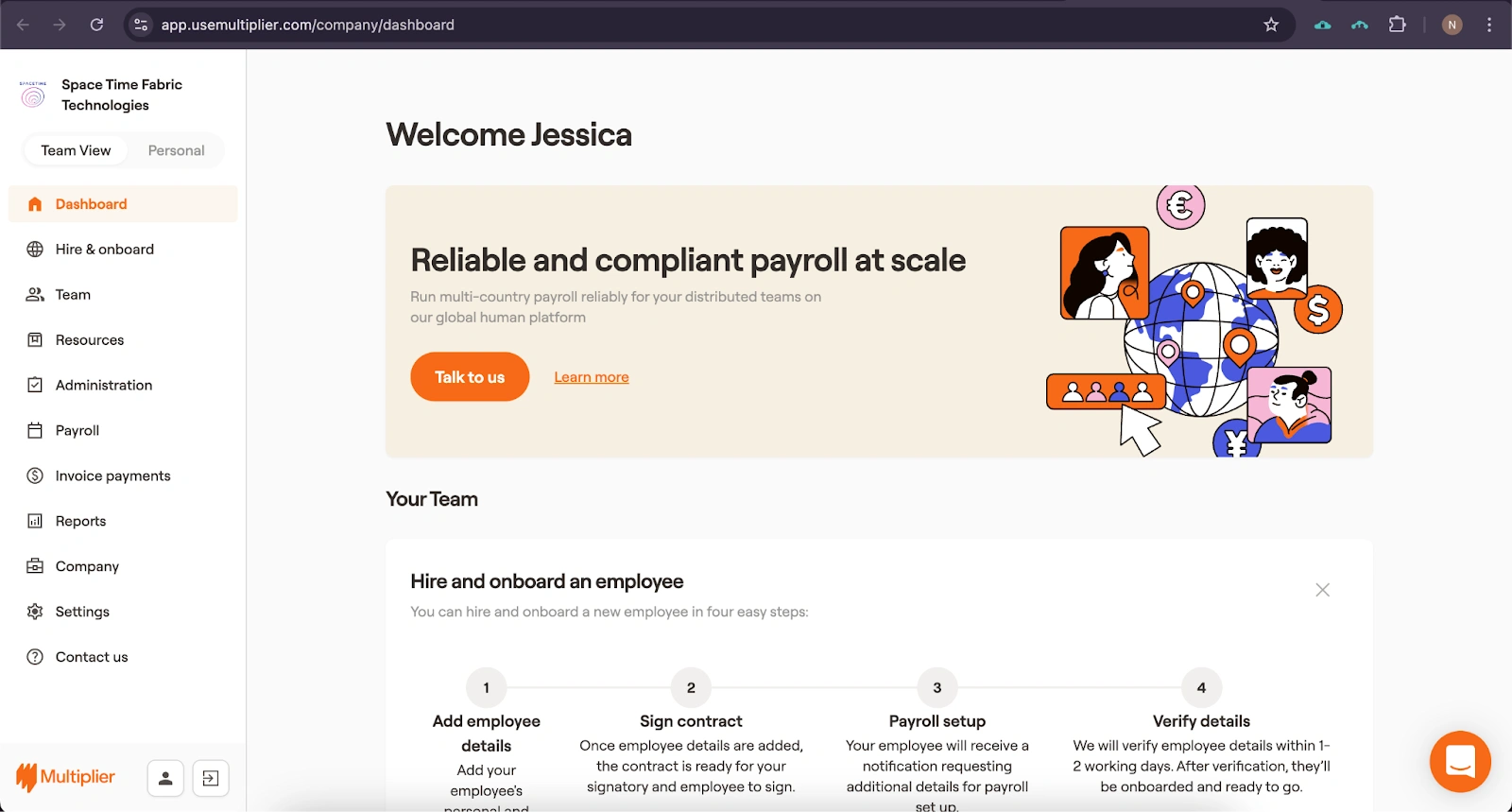
8 Multiplier logo Multiplier 4.1/5 Rating Managing payroll, leave and expenses in one place Starting fee: $459 USD / monthDeposit: 1+ monthsOnboarding: Start date agreed per hire

My take

With Multiplier, I’d choose the plan before comparing fees. Core starts at $499 per employee per month on monthly contracts, or $459 per employee per month billed annually.

The dollar currency is not specified. Country variations and compliance add-ons affect the quote. Growth adds integrations, custom reports and open API access. Implementation fees may apply, although the FAQ says setup is free; I’d have the quote resolve that charge.

Deposit

1+ months

Entity model

Own entities and partners

First year, one hire

$5,508 in service fees

Reviewed by Lucia AparicioFact-checked by Michael Ennis

Starting fee

$459

Core plan billed annually, or $499 per month on monthly billing. Confirm the dollar currency.

Against the 10 starting fees

$199 lowest$699 highest
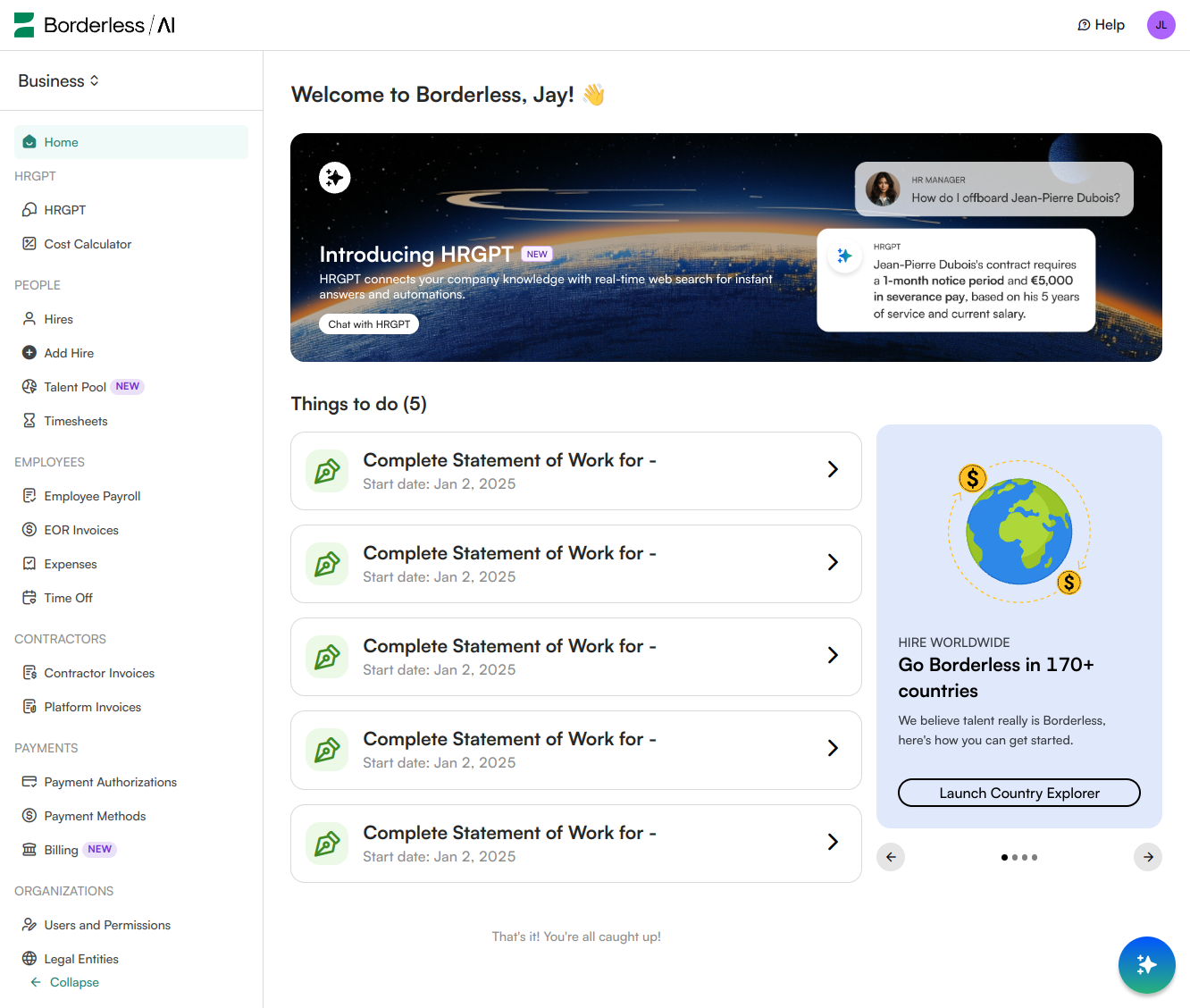
9 Borderless AI logo Borderless AI 4.0/5 Rating Getting 24/7 help with overseas payroll and HR Starting fee: $579 USD / monthDeposit: 1.5–3 monthsOnboarding: Start date agreed per hire

My take

Before shortlisting Borderless AI, I’d budget for the refundable deposit due before onboarding.

Its standard calculation is 1.5 months of gross salary plus employer costs, benefits and platform fees for ACH or three months for wire and other methods, with country variations. Balances unpaid for 15 days, or more than two late payments during the term, can raise the deposit to six months. Refunds follow account closure and settlement of outstanding balances.

Borderless AI’s standard fee is USD 579 per employee per month. Eligible companies headquartered outside Canada can pay USD 399 on fees billed through 31 December 2026; USD 579 applies from 1 January 2027, including promotional customers. Some countries and employment types are priced separately. Salary and employer costs are additional.

Deposit

1.5–3 months

Entity model

Own entities

First year, one hire

$6,948 in service fees

Reviewed by Lucia AparicioFact-checked by Michael Ennis

Starting fee

$579

Eligible companies headquartered outside Canada can pay $399 on fees billed through 31 December 2026.

Against the 10 starting fees

$199 lowest$699 highest
10 RemoFirst logo RemoFirst ⚠ Trustpilot warning 0.5/5 Rating Making a first overseas hire on a tight budget Starting fee: $199 USD / monthDeposit: About 1 monthOnboarding: Start date agreed per hire

My take

We moved RemoFirst to last place on 8 November 2026: Trustpilot has suspended its rating for a breach of its guidelines and removed fake reviews.

RemoFirst says it works exclusively with vetted in-country partners. Here, that means a local partner company, not RemoFirst, would normally employ your hire, and payroll changes, questions and exits pass through both companies, which can slow answers. US$199 is RemoFirst’s starting fee and varies by country, so get this country’s quote before you compare. I’d separate RemoFirst’s contractor offer from its EOR price when reviewing a mixed workforce. The free contractor tier covers administration, including contract management and identity checks. Contractor payments cost USD 25 per contractor in months when a payment is processed; payment-provider and transfer fees may also apply.

RemoFirst’s global EOR fee starts at USD 199 per employee per month, with no minimum contract term or employee count. The country fee, deposit, payroll funding and add-ons depend on the proposal. Salary and employer costs are additional.

Deposit

About 1 month

Entity model

Partners, not own entities

First year, one hire

$2,388 in service fees

Reviewed by Lucia AparicioFact-checked by Michael Ennis

Starting fee

$199

RemoFirst advertises no minimum contract term or employee count. Confirm any country-specific charges.

Against the 10 starting fees
$199 lowest$699 highest

Fig. 1 · All ten providers: fee, entity model and deposit · June 2026.

Conclusion

Mexico is a large market, and your company may be in any industry and use different systems, so here is what I can tell you. With every provider, verify REPSE registration. In a country like Mexico, with several statutory obligations such as vacation pay, bonuses and others, compare the quoted annual amounts item by item in the EOR cost calculator, using USD throughout. Also check the payroll pre-funding timelines to make sure they fit your processes.

As for the top choice, if you value specialized onboarding, consider RemotePeople and compare its complete country proposal. Check whether the employee qualifies for Select before using its starting fee in a comparison. If your company is large or growing and needs strong integration and reporting capabilities, Deel is a great option, since it is one of the most established platforms. Finally, among the top three, if you already use Rippling and want payroll, IT and HR in one place, ask for an EOR quote.

Local Mexican alternatives (researched, unranked): several Mexico-focused firms provide EOR or payroll administration under REPSE, including manufacturing-shelter and nearshoring specialists such as Prodensa and Tetakawi, and domestic payroll outsourcers operating REPSE-registered entities. I leave them unranked: they are built for factory workforces on the nearshoring corridor rather than office hires, and they employ in Mexico only. A Mexico-only manufacturer under the shelter model may still find a domestic specialist a better fit than a global platform.

Get your EOR discount

Get up to 30% off eligible EOR service fees. Your quote confirms the discount and terms.

How I compare

How I compare these providers for Mexico

No provider pays for a position.

None of the ten publishes a verifiable Mexican REPSE folio.

Employment framework

Employment and payroll in Mexico

Is this hiring arrangement legal and compliant?

A Mexican hire needs an employment contract and payroll registrations under a permitted employment model. The provider’s REPSE status must be considered alongside the actual work.

Check the permitted outsourcing arrangement

Mexico’s 2021 reform restricted personnel outsourcing. Ask the provider to explain how the proposed services meet the specialised-services restrictions.

Request REPSE registration where required, including a verifiable folio. Confirm the allocation of employment, tax and contribution responsibilities.

Employment contract and legal employer

The identified Mexican employer signs the written individual employment contract under the Ley Federal del Trabajo (Federal Labor Law). Request its name and registration details. You direct the agreed work; the EOR handles the employment relationship and the applicable filings.

Payroll registrations and remittances

Employee records

The EOR handles IMSS social-security registration, INFONAVIT housing-fund records and the worker’s RFC tax record with SAT.

Deductions and employer costs

Payroll starts with gross salary, employee IMSS deductions and ISR income-tax withholding. Employer remittances include the IMSS branches, the 2 percent retirement contribution, graduated cesantia y vejez contributions, INFONAVIT housing and state payroll tax.

Payment calendar and payslips

Separate monthly IMSS contributions from RCV retirement contributions and INFONAVIT payments due every two months. Ask for the employer’s remittance calendar and applicable due dates. Each payslip is issued as a CFDI digital payroll receipt stamped with SAT.

From offer to first payroll

1

Confirm terms and any immigration route

Agree salary and a proposed start date. For a foreign hire, ask the named employer to show its relevant immigration registration and sponsorship eligibility.

2

Prepare the contract and records

The EOR prepares the Spanish contract, collects the CURP and bank details, and handles the applicable IMSS, INFONAVIT and RFC records.

3

Complete required immigration steps

Agree who handles the job offer, consular stage and residence-card formalities. Obtain a realistic schedule before setting a firm start date.

4

Set the first payroll

Agree pay frequency, the first-payroll cutoff and the remittance calendar. You manage the work while the EOR maintains registrations and filings.

Employer cost

Statutory employer contributions in Mexico

Budget for any profit sharing separately.

Figures as of June 2026; the daily UMA is MXN 117.31 from 1 February 2026. The combined employer-load estimate is about 30 to 34 percent of salary before PTU. PTU is a separate profit-based obligation where applicable.

Contribution Employer rate Basis / cap Agency
Contribution
IMSS: sickness & maternity
Fixed quota + excess + cash + pensioner medical
Employer rate
20.4% of UMA + 1.10% / 0.70% / 1.05%
Basis / cap
Fixed quota on UMA; 1.10% on SBC above 3 UMA; rest on SBC
Agency
IMSS
Contribution
IMSS: disability & life
Employer rate
1.75%
Basis / cap
On SBC (cap 25 UMA)
Agency
IMSS
Contribution
IMSS: childcare & social
Employer rate
1.00%
Basis / cap
On SBC
Agency
IMSS
Contribution
IMSS: work risk
Class set by activity; office work ~Class II
Employer rate
~0.54–7.59% (≈1.13% office)
Basis / cap
On SBC, by risk class
Agency
IMSS
Contribution
Retirement (Retiro / SAR)
Employer rate
2.00%
Basis / cap
On SBC (cap 25 UMA)
Agency
IMSS / Afore
Contribution
Cesantia y vejez (employer)
Graduated, phasing up through 2030
Employer rate
3.150% → 7.513%
Basis / cap
By SBC tier in UMA
Agency
IMSS / Afore
Contribution
INFONAVIT (housing)
Employer rate
5.00%
Basis / cap
On SBC (cap 25 UMA)
Agency
INFONAVIT
Contribution
State payroll tax (ISN)
4% in Mexico City since 1 Jan 2025; varies by state
Employer rate
2.00–4.25%
Basis / cap
On total payroll
Agency
State treasury

Fig. 2 · Mandatory employer contributions in Mexico, 2026 rates and caps

Contributions are calculated on the salario base de cotizacion (SBC), the integrated daily salary that bundles the base wage with the proportional value of the aguinaldo and vacation premium, and the IMSS, retirement and INFONAVIT bases are capped at 25 UMA (about MXN 89,000 a month from February 2026). The 30-to-34-percent estimate above excludes PTU. Do not add ten percentage points of salary to it: PTU starts from 10 percent of the employing entity’s taxable profit for the prior fiscal year, subject to the applicable rules and exemptions. The distributable pool is allocated half by eligible days worked and half by eligible wages, then the individual limits apply. Budget the aguinaldo separately and ask the EOR for a documented PTU allocation and billing estimate. The EOR fee is additional.

Working time & leave

Working hours, overtime and statutory leave

Annual leave rises with years of service.

The standard week is 48 hours, and the 2023 Vacaciones Dignas reform doubled the vacation floor to 12 days after one year, rising to 20 by year five. Overtime carries a 100 percent premium, and the first nine overtime hours a week are double pay.

Hours and overtime

Standard week 48 hours
Overtime (first 9h/wk) 2.0× hourly
Overtime (beyond 9h/wk) 3.0× hourly
Sunday premium +25%
Mandatory holiday worked 3.0×
Federal holidays/yr 7 (Art. 74)

Fig. 3 · Hours and overtime premiums under the Federal Labor Law · overtime capped at three hours a day and three times a week as a rule

The day’s standard is eight hours; a night shift is seven and a mixed shift seven and a half. Overtime is capped at three hours a day and three times a week as a rule. Mexico gazettes only seven mandatory rest days under Article 74 of the Federal Labor Law, far fewer than most countries, plus the once-every-six-years presidential inauguration day; bank and school holidays are separate and not paid days off by law.


Statutory leave

Annual vacation
yr1 → yr5; 22 days from yr6
12 → 20 days
Vacation premium +25% (prima)
Maternity 12 weeks (84 days)
Paternity 5 days
Sick (IMSS) 60% from day 4

Fig. 4 · Statutory leave entitlements · under the 2023 reform, vacation starts at 12 days after year one and reaches 20 by year five

Under the 2023 reform, vacation starts at 12 days after the first year and rises two days a year to 20 days at year five; year six brings 22 days, and after that the floor adds two days every five years. The prima vacacional is at least 25 percent of the salary for those days. Maternity is 12 weeks at 100 percent of the registered salary, paid by IMSS for an employee with the required contribution weeks; paternity is 5 working days paid by the employer. For ordinary illness, IMSS pays 60 percent of the registered salary from the fourth day of a certified incapacidad.

Ending employment

Probation, notice and severance in Mexico

Check severance before a dismissal without cause.

Mexico has no at-will employment and no statutory notice period; instead a dismissal without just cause triggers constitutional severance. The EOR documents the cause, because contested dismissals go to the labor courts.

Component Amount Notes
Component
Constitutional indemnity
Amount
3 months of aggregate daily salary
Notes
The core payment for dismissal without just cause
Component
Service premium
Amount
20 days’ salary per year in specified cases; not automatic for every unjustified dismissal
Notes
Aggregate daily salary, all years
Component
Seniority premium
Amount
12 days' salary per year
Notes
Capped at twice the minimum daily wage
Component
Accrued amounts
Amount
Aguinaldo, vacation + 25% premium
Notes
Proportional to the year worked

Fig. 5 · Severance components for dismissal without just cause · the seniority premium is capped at twice the daily minimum wage

There is no probationary free-dismissal window of the kind some countries allow; trial periods and initial-training contracts exist under the law but a worker still cannot be dismissed arbitrarily, and an unjustified dismissal can be challenged before the new labor courts, which can order reinstatement or the constitutional severance. The seniority premium is capped at twice the daily minimum wage per year of service, which for a high earner is far below 12 days of actual salary. Just causes for dismissal are listed in Article 47; without one of them, the employer pays the package below.

Unjustified dismissal of a 3-year employee on MXN 35,000/month Daily salary = MXN 35,000 / 30 = MXN 1,166.67

Constitutional indemnity

3 months × MXN 35,000
MXN 105,000

Service premium

Conditional illustration only: 20 days/yr × 3 yrs = 60 days × MXN 1,166.67; the remedy and integrated salary basis must support this calculation
MXN 70,000

Seniority premium

12 days/yr × 3 yrs, capped at 2× min wage (MXN 630.08/day)
MXN 22,683

Accrued aguinaldo + vacation

15 days aguinaldo + 8 days vacation + 25% prima
MXN 29,167

Indicative exit cost

Before any negotiated settlement
MXN 226,850

Fig. 6 · Dismissal cost, 3-year employee on MXN 35,000/month · roughly 6.5 months of salary, before any negotiated settlement

The displayed assumptions total about MXN 227,000, roughly 6.5 months of the illustrated salary, only if the selected remedy includes the 20-days-per-year component. The seniority premium is small here only because the cap at twice the minimum wage applies. Severance is computed on the aggregate daily salary, which includes proportional bonuses and benefits, so the real figure for a role with large bonuses or benefits runs higher. The guide on termination across jurisdictions sets this constitutional package beside the notice-driven regimes elsewhere.

Payroll & tax

Payroll cycle and income tax in Mexico

Each payslip is a stamped digital receipt.

Income tax is the Impuesto Sobre la Renta (ISR), a pay-as-you-earn system administered by the Servicio de Administracion Tributaria (SAT). Resident employees are taxed on progressive rates that run from 1.92 percent to 35 percent, with the 35 percent band starting above roughly MXN 5.11 million of annual income per PwC’s January 2026 summary; non-residents are taxed only on Mexican-source income at withholding rates that scale to 30 percent. The EOR computes ISR each pay period, nets off any employment subsidy, withholds the tax, and remits it to the SAT monthly, along with the IMSS, INFONAVIT and retirement contributions on their own schedule.

Payroll usually runs twice a month, on the 15th and the last day, because the Federal Labor Law caps the pay period at one week for manual workers and 15 days for workers outside the manual-work category. The currency is the Mexican peso (MXN), roughly MXN 17.4 to one US dollar in June 2026. Every payslip must be issued as a CFDI de nomina, a digital payroll receipt stamped by the SAT, a requirement few countries impose. There is no extra statutory pay period beyond the aguinaldo, though many employers add a year-end bonus on top of the 15-day legal floor.

Two payroll rules surprise foreign employers.

First, PTU is an annual legal obligation where the employer and worker qualify. The employing entity’s taxable profit supplies the 10 percent pool; half is allocated by eligible days worked and half by eligible wages. The general individual cap is the more favourable of three months’ salary or the worker’s average PTU received in the prior three years. SAT’s 2026 payment window ends on 30 May for company employers and 29 June for individual employers. Employer exemptions and worker exclusions apply. An EOR must explain the employing entity’s PTU allocation and how any amount is billed to you.

Second, the SBC that drives every contribution must be recalculated when variable pay changes, and a wrong SBC is a common source of IMSS assessments, which is part of what you are paying the EOR to get right.

The employment contract

Contract requirements and the aguinaldo

Budget for the aguinaldo and any profit sharing.

The individual employment contract must be in writing and in Spanish, and the Federal Labor Law sets out the particulars it must contain: the worker’s identity, the nature and place of the work, the working day, the salary and how it is paid, the rest days and holidays, and the training arrangements. The EOR drafts and holds this contract on its Mexican entity. A copy goes to the worker, and the obligations bind the employer regardless of what the contract says, because the law sets them as minimums; a clause that tries to waive a statutory right is void.

The default contract is open-ended. Fixed-term and specific-task contracts are permitted only where the nature of the work justifies them, and Mexican labor courts read that requirement strictly: a fixed term used for work that is genuinely permanent can be set aside, leaving the worker with the protection of an indefinite contract. A careful EOR refuses to paper a permanent role onto a temporary contract. Fixed terms go to work with a real end date, a defined project or a season; that restraint is your protection against reclassification. Trial and initial-training periods are available within limits, but they do not create an at-will window.

Annual benefits also need a separate budget. The aguinaldo is a Christmas bonus of at least 15 days of salary, set by Article 87, payable before 20 December, and prorated for a partial year; many larger employers pay 30 days, but 15 is the legal minimum and the EOR pays it through payroll with the usual withholdings. PTU is the separate profit-based obligation described above, subject to employer exemptions and worker eligibility. For the 2026 distribution, SAT gives a 30 May deadline for company employers and 29 June for individual employers. Budget the applicable employee allocation separately. Allowances such as a food voucher (vales de despensa) or a savings fund (fondo de ahorro) are common and carry tax advantages within limits, and the EOR can administer them.

For remote hires, agree the home-working arrangement

Where the telework framework applies, onboarding should include the agreed place of work, the equipment supplied and the arrangements for connectivity, electricity and health and safety. NOM-037 sets requirements for the employer’s telework policy and the agreed location. The practical comparison is whether the provider can show how those requirements are handled for this employee.

Ask who carries out the workplace assessment, how the worker reports a location change and what happens if the agreed workspace becomes unsuitable. Agree working and contact hours, including disconnection outside them. These are employment arrangements to coordinate with the client manager.

The quote should identify equipment and recurring work-related cost payments separately from the EOR service fee. Keep a clear record of what the client supplies and what the employer administers. That lets you compare a device-management package with an employment-only proposal without assuming either one includes every telework obligation.

Division of responsibility

What the EOR handles, and what stays with you

Who signs the employment and services agreements?

Review the employment contract signed with the worker and the separate services agreement with your company. For specialist services under the 2021 reform, check the provider’s applicable REPSE registration.

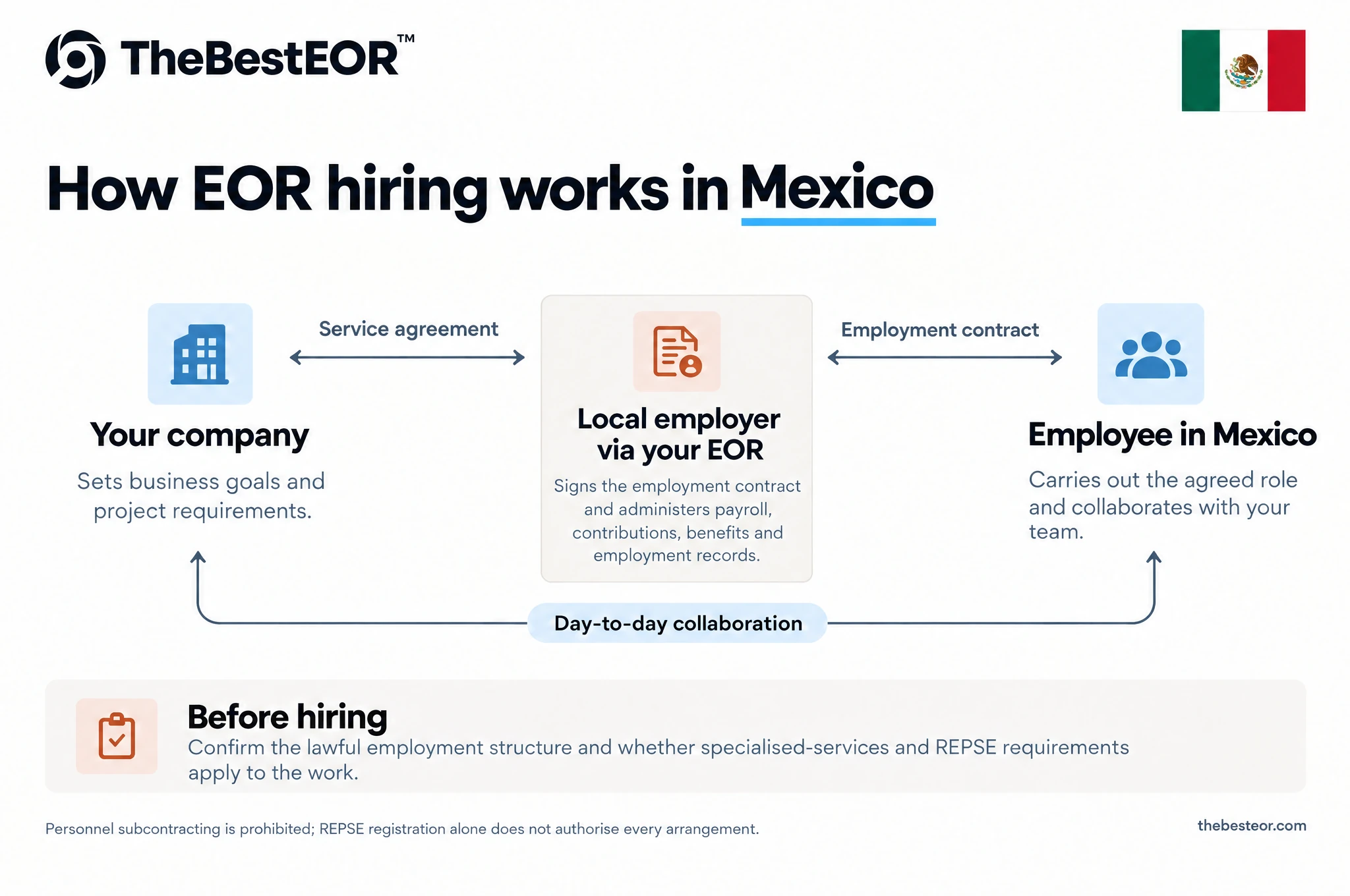
Employer of record in Mexico diagram showing the service agreement, employment contract, and day-to-day collaboration between your company and the employee.
Employer of record in Mexico: how your company, the local employer and the employee work together. Select the image to enlarge.

The EOR handles

1
Signing and holding the employment contract: legal-employer status, and the statutory liability that follows it, on its REPSE-registered Mexican entity
2
IMSS, INFONAVIT and retirement registration and remittance
3
ISR income-tax withholding and the CFDI de nomina payslip
4
The state payroll tax (ISN) in the relevant state
5
The written contract of employment in Spanish
6
Aguinaldo, PTU, vacation and the 25% vacation premium
7
Work-visa sponsorship through its INM employer registration
8
Compliant offboarding and the documented just-cause case

You keep

1
Direction of the day-to-day work and what gets delivered
2
The pay package: salary, bonus, vales de despensa if you offer them
3
Recruiting the person, and deciding if and when the employment ends
4
Performance management, and documenting the Article 47 cause if it comes to dismissal
5
Laptops and tooling, whether bought by you or through a provider’s device add-on
6
The client relationship, and the IP terms you want the Spanish contract to carry

The proposed arrangement needs its own classification and outsourcing review. Mexico’s reform prohibits personnel subcontracting and permits registered specialised services or works outside the beneficiary’s corporate purpose and predominant economic activity, subject to the requirements.

If a worker moves from contracting to employment, assess the past relationship as well as the future contract, contributions and payroll. A new EOR agreement does not erase earlier classification liabilities or all obligations retained by the beneficiary. Obtain the employer identity and applicable registration, then have the actual work and client assignment reviewed before signing. See the contractor-classification guide for the related assessment.

Work permits

Work visas and INM sponsorship

Which employer will register the job offer with INM?

Mexico’s work visa is employer-sponsored through the Instituto Nacional de Migracion (INM). The employer registers as a sponsor, files the job offer, and the worker collects the visa abroad. There is no fixed salary threshold; the offer is the qualifier.

Status What it is Duration Work authorization
Status
Temporary Resident Visa (with work permit)
What it is
The main employer-sponsored route; entered via an INM offer of employment
Duration
1 year, renewable to 4
Work authorization
Yes, tied to the sponsoring employer
Status
Permanent Resident
What it is
For long residence, family ties or retirement; open work rights
Duration
Indefinite
Work authorization
Yes, not employer-tied
Status
Visitor with work permission
What it is
Short assignments where INM grants a work-authorized visitor permit
Duration
Up to 180 days
Work authorization
Only if expressly authorized

Fig. 7 · Residence statuses and work authorization · no fixed salary threshold; a genuine offer from an INM-registered employer is the qualifier

The mechanics are employer-driven. The sponsoring entity must hold a Constancia de Inscripcion del Empleador with INM, then files the job offer; INM issues an authorization, the worker books a consular appointment abroad to collect the Temporary Resident Visa, enters Mexico, and exchanges it for a residence card (and the associated work permission) at an INM office within 30 days. The whole process runs about four to six weeks, with the INM employer registration itself taking two to three weeks if the provider does not already hold one. Unlike India or Germany, Mexico does not set a statutory minimum salary band for the work visa; the qualifier is a genuine job offer from a registered employer, and the income thresholds that circulate online belong to the separate economic-solvency track used by retirees and remote workers, not employer-sponsored employment.

Salary benchmarks

Indicative salary ranges

Compare gross monthly pay in Mexican pesos.

Monthly gross in pesos with a USD equivalent at roughly MXN 17.4 to the dollar (June 2026). Ranges are 2026 market data from SalaryExpert, Glassdoor and Levels.fyi; use the midpoint as a starting offer, not a ceiling.

Check current pay data for the role and location before you make an offer.

Role Gross MXN/month USD/month (approx)
Role
Software engineer
Gross MXN/month
MXN 45,000–90,000
USD/month (approx)
$2,590–5,170
Role
Senior software engineer
Gross MXN/month
MXN 90,000–160,000
USD/month (approx)
$5,170–9,200
Role
Product manager
Gross MXN/month
MXN 60,000–110,000
USD/month (approx)
$3,450–6,320
Role
Accountant
Gross MXN/month
MXN 25,000–45,000
USD/month (approx)
$1,440–2,590
Role
Customer support
Gross MXN/month
MXN 15,000–28,000
USD/month (approx)
$860–1,610
Role
Sales manager
Gross MXN/month
MXN 40,000–90,000
USD/month (approx)
$2,300–5,170
Role
HR manager
Gross MXN/month
MXN 40,000–80,000
USD/month (approx)
$2,300–4,600
Role
Designer
Gross MXN/month
MXN 30,000–55,000
USD/month (approx)
$1,720–3,160

Fig. 8 · Monthly gross salary benchmarks by role, 2026 · SalaryExpert, Glassdoor and Levels.fyi data; secondary cities run roughly 10 to 20 percent below the capital

Salaries cluster in Mexico City, Guadalajara (the Jalisco tech hub) and Monterrey; secondary cities run roughly 10 to 20 percent below the capital for the same role. English-fluent engineers hired by US companies command the top of these bands; a senior developer with that profile often reaches MXN 160,000. These are gross monthly figures before the 30-to-34-percent employer load and before the aguinaldo and PTU, so the fully-loaded cost runs well above the gross figure.

Cost illustration before PTU

Illustrative monthly budget for a Mexican engineer

The MXN 45,000 example excludes profit sharing.

An illustrative monthly subtotal for a software engineer at MXN 45,000 gross, using the contribution and EOR-fee assumptions below. PTU is excluded because the employing entity’s profit pool and the worker’s allocation are unknown. For a different salary, estimate employer payroll costs in Mexico. Ask the provider to address PTU separately in its quote.

Software engineer, Mexico City Gross base: MXN 45,000/month
Gross salary MXN 45,000

IMSS employer branches

Sickness, disability, childcare, work-risk + fixed quota
MXN 3,950

Retirement + cesantia y vejez

2% retiro + 7.513% CV (top SBC tier, 2026)
MXN 4,281

INFONAVIT (5%)

Housing fund on SBC
MXN 2,250

State payroll tax (4%)

Mexico City rate since 2025; varies by state
MXN 1,800

Aguinaldo provision

Full year at fixed salary: MXN 45,000 ÷ 30 × 15 ÷ 12
MXN 1,875

PTU

Separate profit-based allocation; request the employing entity’s calculation
Not estimated; excluded from subtotal

EOR fee, cheapest

RemoFirst from $199 ≈ MXN 3,463
⚠ Trustpilot warning: rating suspended for a breach of its guidelines; fake reviews removed
MXN 3,463

Monthly subtotal before PTU

Annual subtotal before PTU: MXN 751,428
MXN 62,619

Fig. 9 · Illustrative monthly subtotal before PTU · fixed salary, 15-day aguinaldo provision and the contribution and fee assumptions shown; PTU must be estimated separately

The listed contributions and aguinaldo provision total MXN 14,156 per month before PTU. Oyster at $699 (≈ MXN 12,163) gives MXN 71,319/month before PTU (MXN 855,828/year before PTU). Ask the EOR for the applicable PTU amount and any other benefits or charges.

Show the contribution salary behind the cost table

The engineer example is an arithmetic subtotal. Its retirement and housing lines are calculated from MXN 45,000, while the Social Security Law requires the relevant integrated contribution salary. Ask the provider to show the daily base wage, the included fixed benefits and any variable-pay treatment before applying the contribution rates.

For a fixed-pay illustration with fifteen days of aguinaldo and twelve vacation days carrying the minimum twenty-five percent premium, those fixed benefits add eighteen salary days across a year: fifteen plus three. That explains why the contribution basis is above the cash daily wage. The actual calculation changes with tenure, contractual benefits, variable remuneration and statutory limits.

Keep benefit cash funding separate from contribution integration. Including a benefit in SBC determines the contribution calculation; it does not pay the aguinaldo or vacation premium to the employee. A complete quote therefore shows both the integrated basis and the separate benefit provisions, without counting an already included salary payment twice.

EOR vs your own entity

EOR or your own Mexican entity: compare costs

Factor EOR Your own Mexican entity
Factor
Setup cost
EOR
None
Your own Mexican entity
~US$3,000–8,000 incorporation + notary
Factor
Time to first hire
EOR
2–14 days (citizen)
Your own Mexican entity
6–12 weeks (notary, RFC, IMSS, bank, REPSE if applicable)
Factor
Per-employee cost
EOR
$199–699/employee/mo fee + statutory
Your own Mexican entity
Statutory only, plus shared overhead
Factor
Ongoing admin
EOR
Provider runs payroll, CFDI & filings
Your own Mexican entity
Accountant, monthly SAT filings, your own payroll & CFDI
Factor
Compliance liability
EOR
On the EOR (with REPSE)
Your own Mexican entity
On you and your legal representative

Annualise the selected service fee for the hires you expect to keep, then compare it with the Mexican company setup, accounting, payroll/CFDI and the actual outsourcing or REPSE position. Count setup costs over the same hiring horizon and include payroll, benefits, transition and exit charges on both sides. A higher service-fee plan moves the financial crossover earlier; lower recurring entity overhead or a longer hiring horizon can do the same. Short hiring duration, setup costs and the need for local administration can move it later. The legal suitability of each arrangement remains a separate question.

FAQ

EOR in Mexico: common questions

What do REPSE and profit sharing mean for this hire?\

What is the best EOR in Mexico?

RemotePeople is our top pick for Mexico in 2026 (4.9/5), followed by Deel (4.7/5) and Rippling (4.5/5). We opened paid accounts with all 10 providers on this page, priced real hires and ran payroll.

RemotePeople employs Mexican staff through its own S. de R.L. de C.V. in Mexico City. RemotePeople’s EOR Global plan starts at USD 499 per employee per month, and EOR Select at USD 199 where the hire qualifies. Deel starts at USD 599 plus a mandatory Employer Liability Cost; Rippling starts at USD 499 plus its required platform subscription.

How does an employer of record work in Mexico?

An employer of record in Mexico becomes the worker’s legal employer through a local employing entity, while your company directs the day-to-day work. The EOR registers the worker with IMSS for social security, keeps the INFONAVIT housing-fund records and the RFC tax record with SAT, withholds ISR income tax and pays the employer IMSS, retirement, INFONAVIT and state payroll-tax contributions.

How fast can an EOR onboard an employee in Mexico?

The first question is whether the proposed Mexican arrangement is legal and compliant for the actual work. Have the provider explain the employer structure and whether the specialised-services and REPSE rules apply. Then agree contract, worker-registration and payroll milestones. A work-visa case needs a separate schedule.

How much does an EOR cost in Mexico per month?

Published service fees for Mexico run from USD 199 to USD 699 per employee per month across the 10 providers we tested: RemoFirst from USD 199; RemotePeople Global from USD 499, or Select from USD 199 only where country and salary qualify; Deel from USD 599 plus mandatory Employer Liability Cost; G-P from USD 599; Oyster USD 699 on monthly billing, with annual seats quoted separately. Multiplier Core advertises $499 monthly or $459 per month billed annually; Pebl advertises $399, with currency and commitment to confirm. Rippling starts at USD 499 plus its required platform from USD 8 per employee, and Papaya Global at USD 499. Borderless AI is USD 579 standard, with an eligible USD 399 promotion on fees billed through 31 December 2026. All amounts are per employee/month; salary and employment costs are separate.

On top of the fee you pay the employee’s gross salary plus roughly 30 to 34 percent in employer IMSS, INFONAVIT, retirement and state payroll-tax contributions. Budget aguinaldo and any applicable PTU separately. PTU depends on the employing entity’s taxable profit, the eligible worker’s allocation and the applicable cap.

What is REPSE and does my EOR need it?

REPSE is the registry for providers of specialised services or works under Mexico’s outsourcing reform. The law prohibits personnel subcontracting; permitted specialised services must fall outside the beneficiary’s corporate purpose and predominant economic activity and meet the applicable conditions.

If the proposed arrangement requires REPSE, verify the active registration and that it covers the actual service. Ask for the folio and supporting employer documents, but assess the arrangement itself as well. Registration is not universal permission to supply a client’s core staff, and recipient responsibilities can remain if the provider defaults.

What employer contributions are mandatory in Mexico?
IMSS social-security branches (sickness and maternity, disability and life, childcare, work-risk and the fixed quota), the 2 percent retirement contribution, the graduated cesantia y vejez contribution, INFONAVIT housing at 5 percent of the integrated salary, and the state payroll tax of 2 to 4.25 percent depending on the state (4 percent in Mexico City since 1 January 2025). The combined employer-load estimate is about 30 to 34 percent of salary before PTU. Where PTU applies, its profit-based pool and the worker’s allocation must be calculated separately.
 
What is the aguinaldo in Mexico?
Article 87 of the Federal Labor Law sets a mandatory year-end bonus of at least 15 days of salary, payable before 20 December: the aguinaldo. Employees with less than a full year receive a proportional amount. Many larger employers pay 30 days, effectively a 13th-month salary, but 15 days is the legal floor. The EOR pays it through payroll and applies the usual withholdings.
 
How much vacation do employees get in Mexico?
Since the Vacaciones Dignas reform took effect on 1 January 2023, employees get 12 days of paid vacation after their first year, rising by two days a year to 20 days at year five; from year six the entitlement is 22 days, and it then adds two more days every five years of service. On top of the vacation days the employer pays a vacation premium of at least 25 percent of the salary for those days, the prima vacacional, set by Articles 76 and 80 of the Federal Labor Law.
 
What is PTU profit sharing in Mexico?

PTU is a share of the employing entity’s taxable profit, not a 10 percent salary surcharge. The starting pool is 10 percent of the prior fiscal year’s taxable profit under the applicable income-tax rules, with unclaimed prior distributions added where required. Half of the distributable pool is allocated by eligible days worked and half by eligible wages. The general individual cap is the more favourable of three months’ salary or the worker’s average PTU received in the previous three years; it is a limit, not a guaranteed payment. 

Worker eligibility and employer exemptions matter. Directors, administrators and general managers are excluded; temporary employees need at least 60 days worked in the profit year. Other exclusions and special allocation rules appear in Articles 124–127 of the Federal Labor Law and SAT’s participation guidance. A newly created company’s first operating year is one employer exemption; hiring a new employee through an established EOR does not itself create that exemption. 

For the 2026 distribution, SAT gives payment windows of 1 April–30 May for company employers and 1 May–29 June for individual employers. Ask the EOR for its employing entity’s calculation, the employee allocation and the amount charged under your contract.

How much notice and severance applies when terminating in Mexico?
Mexico has no at-will employment. The remedy under Articles 48–50 determines the indemnity. Twenty days per year applies in specified cases and should not be added automatically to every unjustified dismissal. Assess the applicable three-month indemnity, seniority premium, accrued entitlements and integrated salary basis for the actual case. The MXN 227,000 example above is conditional on its stated assumptions.
 
Can an EOR sponsor a work visa in Mexico?
Yes. The employer must be registered with the Instituto Nacional de Migracion (INM) as a sponsor, then files the job offer so the worker can collect a Temporary Resident Visa with work authorization at a consulate and exchange it for a residence card within 30 days of arrival. An EOR that holds the INM employer registration sponsors the visa; the whole process runs about four to six weeks. Confirm the provider’s INM registration the same way you confirm REPSE.
 
What currency and payroll cycle does Mexico use?
The Mexican peso (MXN). Payroll is usually run twice a month, on the 15th and the last day, because the Federal Labor Law caps the pay period for manual workers at one week and for other employees at two weeks. IMSS, INFONAVIT and retirement contributions are remitted monthly and bimonthly, and income tax (ISR) is withheld every pay period through the SAT. About MXN 17.4 equals one US dollar in June 2026.
 
Can I convert a Mexican contractor to an EOR employee?

A contractor can be assessed for a move to Mexican employment, but the new arrangement must itself meet the classification and outsourcing rules. REPSE is relevant where the permitted specialised-services rules apply.

Agree the future employer, contract, payroll and social-security steps, and review the earlier relationship for possible liabilities. Do not treat conversion as erasing past obligations or assume a one-week start from the provider’s general onboarding claim.

Sources and as-of dates

Article references

No employment contract can dip below these floors, and the legal checks use the LFT, the LSS and the DOF. Provider facts come from TheBestEOR’s 2026 review program; all figures as of June 2026.

Hiring facts Checked 2 Oct 2026

Hiring facts

Checked 2 October 2026
Eligibility, local and collective rules apply. EOR fees extra.

Ley Federal del Trabajo (Federal Labor Law) 7 sources

Federal Labor Law: the 2026 transition retains a 48-hour ordinary workweek; the statutory phase-down is 46 hours in 2027, 44 in 2028, 42 in 2029 and 40 in 2030. Articles 59–68 cover working time and overtime; Articles 47, 48 and 50 cover dismissal notice and remedies; Article 87 covers aguinaldo; Articles 76 and 80 cover vacation and prima vacacional. Article 74 lists seven annually recurring holidays, plus the presidential inauguration holiday every six years and applicable election days.

Vacaciones Dignas reform 2 sources

The Vacaciones Dignas reform raised the first-year vacation entitlement to 12 working days, increasing by two days per year to 20; from the sixth year, entitlement rises by two days for each five years of service. Published in the Diario Oficial de la Federación on 27 December 2022 and effective 1 January 2023.

2021 outsourcing reform / REPSE 3 sources

The 2021 reform prohibits subcontracting personnel and permits registered specialized services or works outside the beneficiary’s corporate purpose and predominant economic activity (Articles 12–15). The labor-law provisions took effect on 24 April 2021. The transitional REPSE registration deadline was extended to 1 September 2021; registration must be renewed every three years.

PTU profit sharing 7 sources

SAT’s 2026 guidance covers payment dates, the 50/50 allocation and the general individual cap. SAT’s participation guidance lists worker exclusions and employer exemptions. The current Federal Labor Law, Articles 120 and 122–127, sets the taxable-profit basis, carry-forward of unclaimed distributions, allocation, eligibility and limits. Checked 23 September 2026.

IMSS contributions 4 sources

Employer IMSS branches use different calculation bases: cuota fija 20.4% of UMA; excedente 1.10% of the SBC above three UMA; prestaciones en dinero 0.70%, gastos médicos pensionados 1.05%, invalidez y vida 1.75%, guarderías 1.00% and retiro 2.00% of SBC. Work-risk premiums depend on the employer’s risk assessment; cesantía y vejez ranges from 3.150% to 7.513% of SBC under the 2026 salary-band schedule. UMA is MXN 117.31 daily and MXN 3,566.22 monthly from 1 February 2026, following the INEGI publication of 9 January 2026.

INFONAVIT 3 sources

The employer housing contribution is 5% of the applicable contribution salary (SBC), subject to the 25-UMA contribution ceiling. Article 29(II) of the INFONAVIT Law governs the contribution and links the salary calculation to the Social Security Law.

State payroll tax (Impuesto Sobre Nominas) 3 sources

State payroll-tax rates and relief vary. The official sources below support a 4% general rate in Mexico City and 4.25% in Baja California. Mexico City reports fiscal benefits for micro and small employers in 2026; eligibility and the amount of relief must be checked under the applicable rules before using a reduced rate.

Minimum wage 2026 1 source

CONASAMI’s resolution sets the general minimum wage at MXN 315.04 per day and the Northern Border Free Zone minimum at MXN 440.87 per day, effective 1 January 2026. Separate professional minimum wages apply to the occupations listed in the resolution.

Income tax (ISR) 2 sources

Resident individual income-tax brackets range from 1.92% to 35% in the 2026 tariff. For non-resident Mexican-source employment income, Article 154 provides an annual exemption for the first MXN 125,900, 15% on the next band up to MXN 1,000,000, and 30% above MXN 1,000,000, subject to applicable exemptions and treaty provisions. These employment-income rules are not a universal withholding rate for every type of non-resident income.

Work visa 1 source

The offer-of-employment route requires INM employer registration and an employment offer. Temporary residence is the applicable category where the employment exceeds 180 days; a visitor category with permission for paid activities applies to shorter qualifying assignments. The 4–6 week timeline is an indicative planning assumption.

Employer-cost estimate 4 sources

The approximately 30–34% salary-based employer-cost figure is an illustrative planning estimate and excludes PTU. PTU is calculated separately from the employing entity’s taxable profit and employee allocation. The calculation uses its stated contribution and fee assumptions, with a separate minimum 15-day aguinaldo provision under Article 87. Actual employer costs depend on the contribution salary, risk premium, state tax, benefits and provider quote.

Salary benchmarks 1 source

The page’s salary ranges are editorial benchmarks attributed to SalaryExpert, Glassdoor and Levels.fyi. The linked Levels.fyi Mexico data reports software-engineer total compensation and changes as submissions are updated; it does not validate every role or the historical 2026 ranges. The approximately MXN 17.4 = USD 1 conversion is a June 2026 assumption.

Provider pricing, entity model and onboarding 12 sources

Rippling advertised EOR price 2 sources

Rippling’s EOR pricing page lists EOR from USD 499 per employee per month. The required Rippling Platform starts at USD 8 per employee per month plus a monthly base fee, according to its pricing page. Checked 8 November 2026. This is a global starting price; confirm the EOR and required platform services in an itemized proposal.

Further sources Checked 19 Oct 2026

Mexico — current Federal Labour Law — Articles 12–15, 48–50, 76, 80, 88 and 330-A onward; 2026 working-time transition. Checked 19 October 2026.

Mexico — Social Security Law, Articles 27–30 — Integrated contribution salary and its distinction from cash base salary. Checked 19 October 2026.

STPS — NOM-037-STPS-2023 — Telework safety, agreed workplace, equipment, costs and disconnection arrangements. Checked 19 October 2026.

The country guides cover other markets. For this hire, browse EOR providers for Mexico and use the EOR cost calculator to compare the recurring amounts in your proposals in USD.

This guide is for general information only and does not provide legal, tax, accounting, or financial advice. For advice about your business, consult a qualified professional familiar with the rules where you hire. The research methodology explains how TheBestEOR assesses sources.