TheBestEOR

Best Employer of Record in Canada

Written by Martynas PupkeviciusFact-checked by Michael Ennis
Picture of Martynas Pupkevicius
Martynas Pupkevicius

EOR Advisor and Remote Work Editor

Our top employer of record in Canada for 2026 is RemotePeople, from USD 499 per employee a month, ahead of Deel and Rippling.

We tested all 10 providers with paid client accounts, real quotes and a live hire run through payroll. Pay, hours and leave rules in Canada depend on the employee’s province or on federal labour law, and Quebec has separate payroll arrangements.

Flag of Canada

Hiring in Canada at a glance

Currency
CAD
Canadian dollar
Pay cycle
By province
British Columbia: most staff paid at least 2 times a month
Working hours
By province
Provincial or federal law sets hours and overtime
Annual leave
By province
Ontario: 2 weeks, 3 after 5 years
Extra pay
Per contract
Or union agreement, separate from vacation pay
Employer costs
Public pensions
Plus employment insurance and provincial payroll charges
Before you hire:
Confirm the employee’s province and whether federal labour law applies before setting entitlements.

Country hiring overview · Canada

Hiring in Canada, at a glance.

Choose the province before comparing employment terms.

Before comparing Canadian EOR quotes, I’d establish the province or territory and whether federal labour standards apply. Each provider needs to price the same work location, benefits and payroll scope.

Choose a hiring solution

Need a local employer?

Compare an EOR arrangement for your role before opening your own entity.

Already have a local employer?

Compare payroll and HR support against adding an EOR.

EOR service fee

Fees vary by provider.

Your quote should state the currency, fee per employee, minimum charge and billing commitment.

Onboarding

Paperwork affects the start date.

The contract, right-to-work checks, registrations and payroll deadlines all affect when employment can begin.

Employment costs

Costs depend on the province.

Request a calculation for the province where the employee will work. It should show the applicable employer contributions, insurance and agreed benefits separately from salary.

Annual leave

Leave depends on the jurisdiction.

For a federally regulated job, federal vacation rules determine the allowance. Other jobs follow provincial or territorial rules. Entitlement can change with length of service.

Check before choosing

Confirm the applicable employment standards, legal employer, vacation pay, benefit eligibility and the provincial payroll and final-pay process.

What your quote should include

Employment costs and service fees

1
Gross salary and agreed pay schedule
2
Province-specific contributions, insurance and benefits
3
EOR fee: currency, per-employee billing, minimums and commitment
4
Setup, foreign exchange, extras and exit costs

Deposits and payroll funding

1
Amount and payment deadline
2
Whether funds are refundable or credited to payroll
3
Release conditions and refund timing
Show these separately from recurring expenses.

Key takeaways for hiring in Canada

Payroll province needs its own determination

The province used for payroll deductions is not automatically the employee’s home address. CRA rules consider where the worker reports and, for a qualifying full-time remote arrangement, the employer establishment to which the worker is reasonably attached. Ask the EOR to record its reasoning rather than choosing a province because its rates are convenient.

An address change needs a payroll review

A remote employee moving province should trigger a review of the payroll facts and employment terms. CRA’s remote-work policy governs specified deductions. Put relocation approval and notification into the onboarding process before a worker moves.

Ontario agency rules can matter to the client

For an arrangement within Ontario’s temporary-help-agency rules, the client has responsibilities as well as the agency. Request the relevant licensing position and an explanation of assignment records and wage responsibilities.

Tie the ROE deadline to the pay cycle

An electronic ROE for weekly, biweekly or semi-monthly payroll is generally due within five calendar days after the end of the pay period containing the interruption of earnings. Monthly payroll has an additional earlier-deadline test. Agree the correct trigger and date before an employee leaves or starts qualifying unpaid leave.

Check how holiday pay is calculated

Ontario’s ordinary public-holiday formula includes relevant vacation pay as well as regular wages for the four work weeks before the holiday week, divided by twenty. Ask for a sample involving recent vacation or variable hours.

Quick verdict

What is the best EOR in Canada?

My top three: RemotePeople, Deel and Rippling.

For a hire in Canada, I’d shortlist RemotePeople first. It employs Canadian staff through its own federal corporation (corporation number 13082831), with an office in Toronto. Its EOR Global plan starts at USD 499 per employee per month, or USD 199 on EOR Select where the hire qualifies. Deel, from USD 599 plus a mandatory Employer Liability Cost, fits when Canada is one part of a wider employee and contractor programme. Rippling, from USD 499 plus its required platform, fits a team that already runs HR or IT on Rippling.

The global starting fees shown here range from $199 to $699 per employee per month; the proposals can differ in funding, benefits, support and additional charges.

1
Editorial pick
RemotePeople logo

4.9/5

RemotePeople

Hiring in new markets with local HR support

Starting fee
$499

per employee / month

Countries
150+
where you can hire

EOR Select from $199 for eligible hires.

Deposit
1 month

of gross salary

Deposit refund
Within 5 days

of the final payment

Why consider it

Recruitment and EOR services through one provider.

Dedicated account manager in both EOR plans.

Check the fit

Recruitment is separately priced. Confirm its fee and payment schedule.

Before signing: Confirm quote currency, billing commitment, deposits, funding deadlines and refund terms. EOR Select eligibility depends on the hiring country and employee salary.

Both EOR plans list local contracts, payroll and tax administration, and statutory benefits administration. Salary, employer contributions and benefit costs are separate.


Legal employer in Canada
✓ Verified on register

Employing entity
Own federal corporation
Corporation number 13082831 · incorporated under the Canada Business Corporations Act

Local office
111 Peter Street, Suite 700, Toronto, ON M5V 2H1

Visit RemotePeople ↗

2
Deel logo

4.7/5

Deel

Paying employees and contractors on one platform

Starting fee
$599

per employee / month

Countries
130+
where you can hire

Plus a mandatory Employer Liability Cost.

Deposit
1–1.5 months

of gross salary

Deposit refund
Within 60 days

of offboarding

Why consider it

EOR, contractor management and payroll for your own entities.

Month-to-month EOR service pricing available.

Check the fit

Ask for the country-specific Employer Liability Cost in your quote; it is mandatory.

Before signing: Confirm the Employer Liability Cost amount, benefit costs and any additional products. Monthly service terms do not remove employment notice, severance or other exit obligations.

The EOR pricing page lists 130+ countries. Broader platform coverage figures may include other services.

Legal employer in Canada
✓ Verified on register

Employing entity
Deel Canada Services Inc.
BC1255865 · incorporated under the British Columbia Business Corporations Act, 2020

Local office
Confirm in your quote
Registered office: 700 West Georgia Street, Suite 2200, Vancouver, BC V7Y 1K8

Visit Deel ↗

3
Rippling logo

4.5/5

Rippling

Setting up payroll, laptops and app access for new hires

Starting fee
$499

per employee / month

Countries
115
where you can hire

Plus the Rippling Platform, from $8 per employee / month.

Deposit
Per quote

based on gross salary

Deposit refund
Per contract

set in your agreement

Why consider it

EOR, payroll, HR records and benefits administration in one platform.

Shared workflows and reporting for domestic and international teams.

Check the fit

Ask for an itemised quote showing the required platform and each HR or IT module.

A paid Rippling Platform subscription is required on top of the EOR fee, from $8 per employee per month plus a monthly base fee. Rippling EOR starts at $499 per employee per month. Other HR and IT products are priced separately.

Rippling’s EOR page lists 115 countries. Confirm your hiring country and legal employer.

Legal employer in Canada
✓ Verified on register

Employing entity
Rippling Canada Services, Inc.
BC1558932 · incorporated under the British Columbia Business Corporations Act, 2025

Local office
200 Wellington Street West, Toronto, ON

Visit Rippling ↗

No provider pays for a position on this page; some outbound links pay a referral fee. See the funding model and methodology.

Entity, price and Quebec in one table

All 10 EOR providers for Canada, side by side

The August 2026 comparison converts US fees to CAD.

Prices are USD list fees per employee per month, converted near CAD 1.41 to the dollar at the August 2026 check.

Fees run $199 to $699 a month for the same statutory obligations. Hiring in several countries? Start with the 10 best EOR services overall. For a wider shortlist, browse EOR providers for Canada.

Provider

Best For

Starting feeDepositOnboarding
1 RemotePeople logo RemotePeople 4.9/5 Rating Hiring in new markets with local HR support Starting fee: $499 USD / monthDeposit: 1 monthOnboarding: 2–5 days

My take

RemotePeople becomes the legal employer through its own Canadian federal corporation (number 13082831), incorporated under the Canada Business Corporations Act.

Its Toronto office is at 111 Peter Street, Suite 700, Toronto, ON M5V 2H1.

Both RemotePeople EOR plans include employment contracts, payroll and tax administration, statutory benefits administration, a dedicated account manager and ongoing employment support.

EOR Global starts at USD 499 per employee per month. EOR Select starts at USD 199 for eligible countries and employee salary ranges. Salary, employer contributions and benefits are separate; the proposal sets the applicable plan, billing commitment, deposit and payroll funding terms.

When this provider fits

RemotePeople fits a buyer who values a named coordinator.

Ask before signing

Who documents the payroll-province decision and reviews it if the employee moves?

Deposit

1 month

Entity model

Own entities in core markets

First year, one hire

$5,988 in service fees

Reviewed by Martynas PupkeviciusFact-checked by Michael Ennis

Starting fee

$499

EOR Global. EOR Select starts at $199 where the country and employee salary qualify.

Against the 10 starting fees

$199 lowest$699 highest
2 Deel logo Deel 4.7/5 Rating Paying employees and contractors on one platform Starting fee: $599 USD / monthDeposit: 1–1.5 monthsOnboarding: 1–4 days

My take

Deel offers EOR employment and contractor management in one system. Contractor management starts at USD 49 per contractor per month and is separate from the EOR service.

Deel’s global EOR service starts at USD 599 per employee per month, with month-to-month pricing available. Mandatory Employer Liability Cost is charged separately and varies by country. Salary, employer contributions, benefits and any additional services sit outside the starting service fee.

When this provider fits

I’d consider Deel when the proposed Canadian workflow covers the provinces in your hiring plan.

Ask before signing

Can you show the Quebec contract-language workflow and a sample payroll breakdown for this role?

Deposit

1–1.5 months

Entity model

Owned entity

First year, one hire

$7,188 in service fees

Reviewed by Martynas PupkeviciusFact-checked by Michael Ennis

Starting fee

$599

Month-to-month billing. Mandatory Employer Liability Cost is charged separately.

Against the 10 starting fees

$199 lowest$699 highest
3 Rippling logo Rippling 4.5/5 Rating Setting up payroll, laptops and app access for new hires Starting fee: $499 USD / monthDeposit: Per quoteOnboarding: 2–5 days

My take

Rippling’s Canadian presence includes Rippling Canada Services, Inc., recorded in British Columbia under amalgamation number 1558932 in October 2025, and a Toronto office at 200 Wellington Street West.

Rippling uses native payroll software for Canadian EOR employees, alongside payroll for the wider workforce. EOR employees share HR records and reporting with other staff; device and app-management products are priced separately.

Rippling EOR starts at USD 499 per employee per month, plus the required Rippling Platform from USD 8 per employee per month plus a monthly base fee. Billing commitment and optional HR or IT modules are quote-specific.

When this provider fits

Rippling would be on my shortlist when an existing US HR and IT setup will also serve the Canadian employee.

Ask before signing

What happens in the system when an employee changes province, and who approves the local payroll treatment?

Deposit

Per quote

Entity model

Own entities and local partners

First year, one hire

$5,988 in EOR fees

Reviewed by Martynas PupkeviciusFact-checked by Michael Ennis

Starting fee

$499

Plus the required Rippling Platform, from $8 per employee per month and a monthly base fee. Confirm the billing terms and selected products.

Against the 10 starting fees

$199 lowest$699 highest
4 Borderless AI logo Borderless AI 4.0/5 Rating Getting 24/7 help with overseas payroll and HR Starting fee: $579 USD / monthDeposit: 1.5–3 monthsOnboarding: 2–5 days

My take

Founded in Toronto in 2022, Borderless AI has its Canadian headquarters at 1 University Avenue, third floor, Toronto, ON M5J 2P1, and provides a Canada-based client contact.

Its privacy policy names Borderless AI Ventures Inc.; Canadian onboarding includes tax forms and benefits enrolment.

A refundable deposit is due before onboarding. Borderless AI’s standard calculation is 1.5 months of gross salary plus employer costs, benefits and platform fees for ACH or three months for wire and other methods, with country variations. Balances unpaid for 15 days, or more than two late payments during the term, can raise the deposit to six months. Refunds follow account closure and settlement of outstanding balances.

Borderless AI’s standard fee is USD 579 per employee per month. Eligible companies headquartered outside Canada can pay USD 399 on fees billed through 31 December 2026; USD 579 applies from 1 January 2027, including promotional customers. Some countries and employment types are priced separately. Salary and employer costs are additional.

When this provider fits

Borderless AI’s Canadian headquarters would put it on my shortlist. I’d make the decision on the employment documents and local support it proposes.

Ask before signing

Who reviews a Quebec contract or Ontario assignment arrangement before the employee signs?

Deposit

1.5–3 months

Entity model

Own entities

First year, one hire

$6,948 in service fees

Reviewed by Martynas PupkeviciusFact-checked by Michael Ennis

Starting fee

$579

Eligible companies headquartered outside Canada can pay $399 on fees billed through 31 December 2026.

Against the 10 starting fees

$199 lowest$699 highest
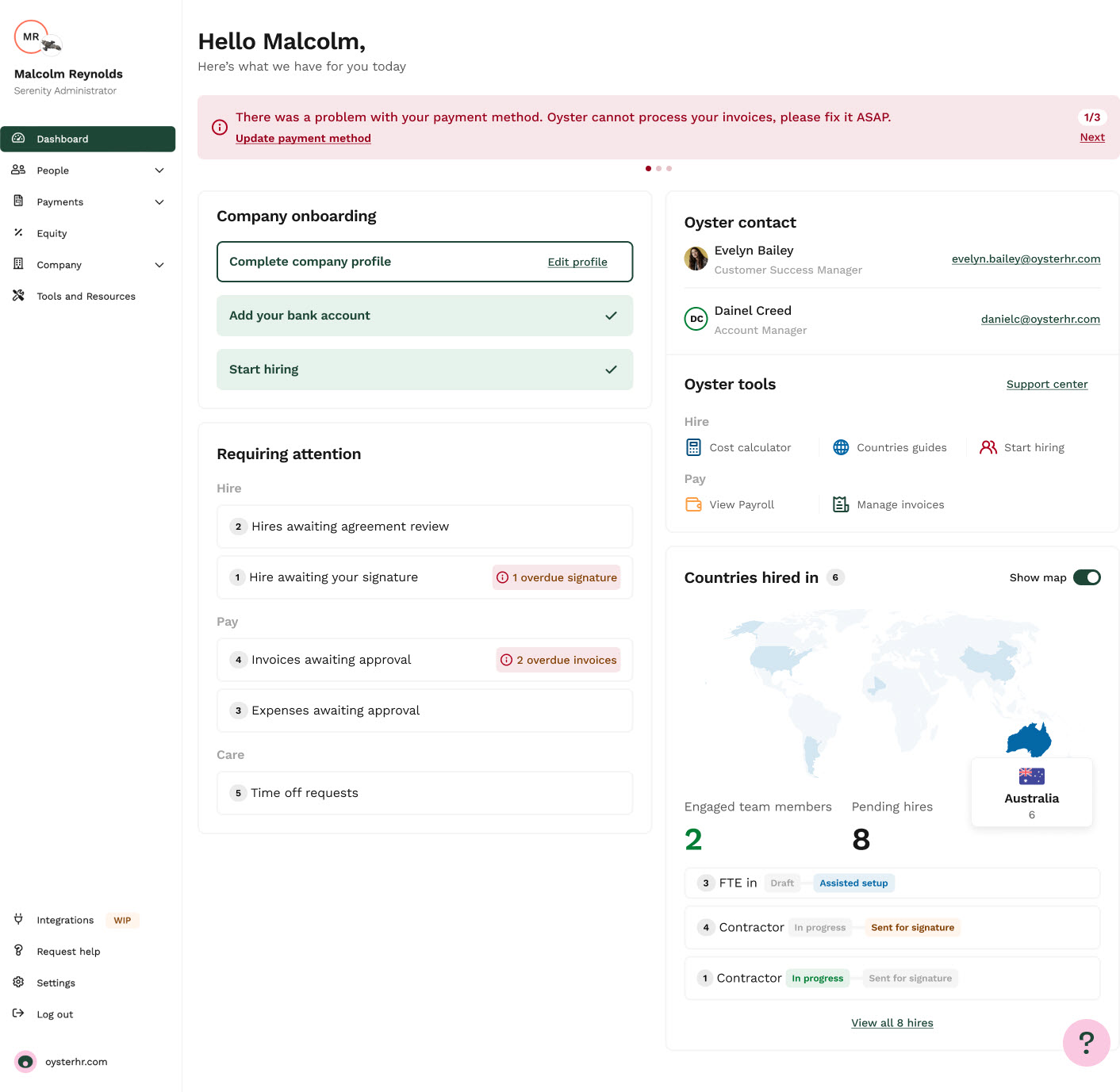
5 Oyster logo Oyster 4.5/5 Rating Using one onboarding process for hires across countries Starting fee: $699 USD / monthDeposit: ~1 monthOnboarding: 2–7 days

My take

Oyster’s automated Global Hiring workflow supports Team Member onboarding and electronic signature across Canada.

Automated agreements are available in the other provinces but exclude Quebec.

Oyster’s month-to-month EOR rate is USD 699 per employee per month. Annual seats are quoted separately. Standard annual billing is prepaid and non-refundable; quarterly or semiannual payment is available at a higher seat price. A seat can be reused for a replacement hire. Salary, employer costs, deposits and optional services are additional.

Deposit

~1 month

Entity model

Own entities and vetted partners

First year, one hire

$8,388 in service fees

Reviewed by Martynas PupkeviciusFact-checked by Michael Ennis

Starting fee

$699

Monthly billing. Annual seats are quoted separately, prepaid and non-refundable.

Against the 10 starting fees

$199 lowest$699 highest
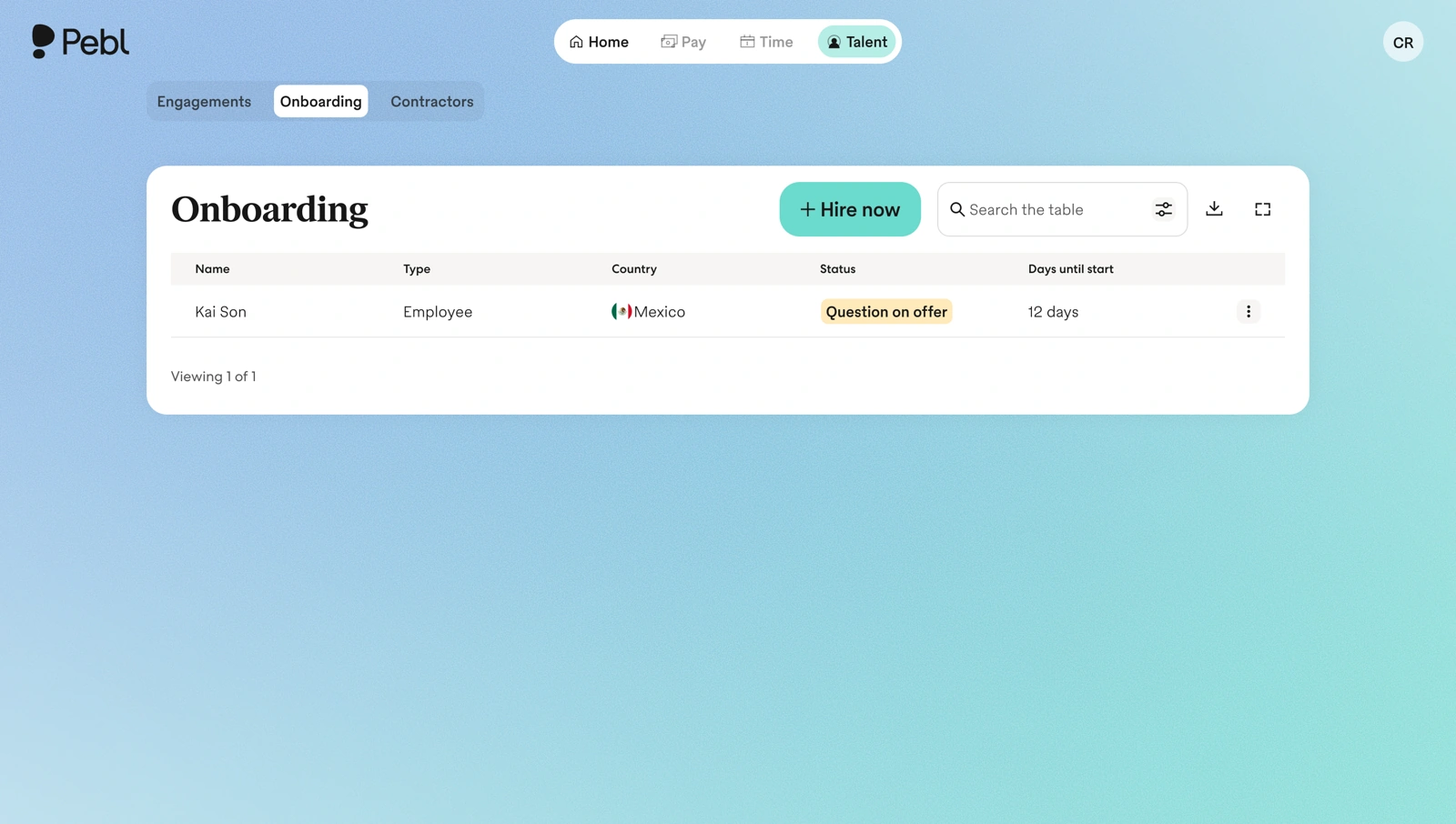
6 Pebl logo Pebl 4.2/5 Rating Hiring people who need visa or relocation support Starting fee: $399 USD / monthDeposit: Per quoteOnboarding: 5–8 days

My take

Pebl, formerly Velocity Global, offers payroll and benefits administration together with employment support.

Immigration support and supplementary benefits are available as additional services.

Pebl lists an EOR fee of $399 per employee per month, but the general price does not specify the dollar currency or billing commitment. The country proposal determines availability, any offer period and renewal terms; salary, employer costs and additional services are separate.

Deposit

Per quote

Entity model

Affiliates and local partners

First year, one hire

$4,788 in service fees

Reviewed by Martynas PupkeviciusFact-checked by Michael Ennis

Starting fee

$399

Confirm the country price and billing commitment.

Against the 10 starting fees

$199 lowest$699 highest
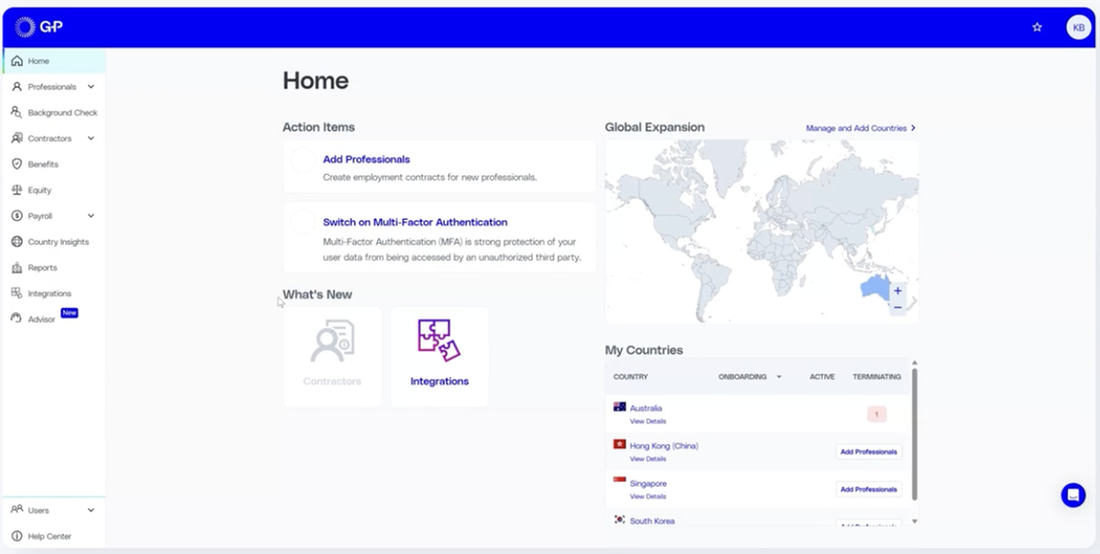
7 G-P logo G-P 4.2/5 Rating Hiring abroad while keeping your existing HR system Starting fee: $599 USD / monthDeposit: 1–2.5 monthsOnboarding: 2–5 days

My take

G-P offers optional visa support, background checks and equity payroll management alongside its employment service. Additional services have their own eligibility and charges.

G-P’s global EOR fee starts at USD 599 per employee per month, with a tailored country proposal. There is no minimum duration for an EOR hire; the client’s billing, cancellation and employee exit terms remain separate contract terms.

Deposit

1–2.5 months

Entity model

100+ own entities, plus partners

First year, one hire

$7,188 in service fees

Reviewed by Martynas PupkeviciusFact-checked by Michael Ennis

Starting fee

$599

Confirm the included services and billing terms in your country quote.

Against the 10 starting fees

$199 lowest$699 highest
8 Papaya Global logo Papaya Global 4.1/5 Rating Comparing payroll costs across countries in one report Starting fee: $499 USD / monthDeposit: 1–2 monthsOnboarding: 3–7 days

My take

Papaya provides an account manager who coordinates payroll, legal, finance and benefits specialists. Employees can also raise tickets through its worker app or WhatsApp.

Papaya’s EOR service starts at USD 499 per employee per month. The country quote must identify the billing commitment and any additional services. Salary and employer costs are separate.

When this provider fits

Papaya is most relevant when Canada forms part of a broader payroll-reporting project.

Ask before signing

Which legal employer and local team handle the employment file, separately from the payment service?

Deposit

1–2 months

Entity model

Partner + Canadian MSB licence

First year, one hire

$5,988 in service fees

Reviewed by Martynas PupkeviciusFact-checked by Michael Ennis

Starting fee

$499

The country quote sets the billing terms. Payroll-only processing is priced separately.

Against the 10 starting fees

$199 lowest$699 highest
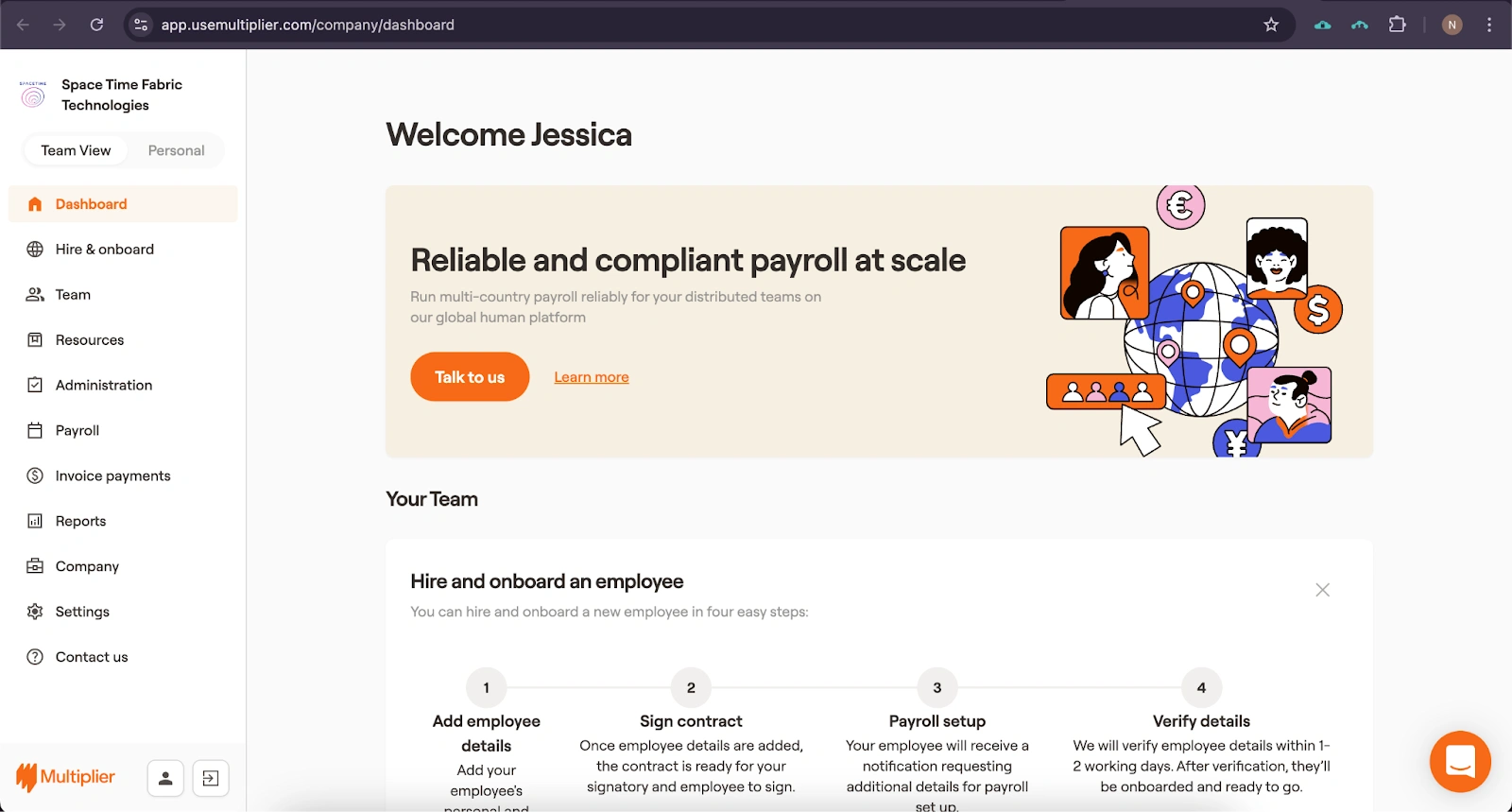
9 Multiplier logo Multiplier 4.1/5 Rating Managing payroll, leave and expenses in one place Starting fee: $459 USD / monthDeposit: 1+ monthsOnboarding: 5–9 days

My take

Multiplier Core starts at $499 per employee per month on monthly contracts, or $459 per employee per month billed annually.

The dollar currency is not specified. Country variations and compliance add-ons affect the quote. Growth adds integrations, custom reports and open API access. Implementation fees may apply, although the FAQ says setup is free; the quote must resolve that charge.

Deposit

1+ months

Entity model

Own entities and partners

First year, one hire

$5,508 in service fees

Reviewed by Martynas PupkeviciusFact-checked by Michael Ennis

Starting fee

$459

Core plan billed annually, or $499 per month on monthly billing. Confirm the dollar currency.

Against the 10 starting fees

$199 lowest$699 highest
10 RemoFirst logo RemoFirst ⚠ Trustpilot warning 0.5/5 Rating Making a first overseas hire on a tight budget Starting fee: $199 USD / monthDeposit: About 1 monthOnboarding: 5–9 days

My take

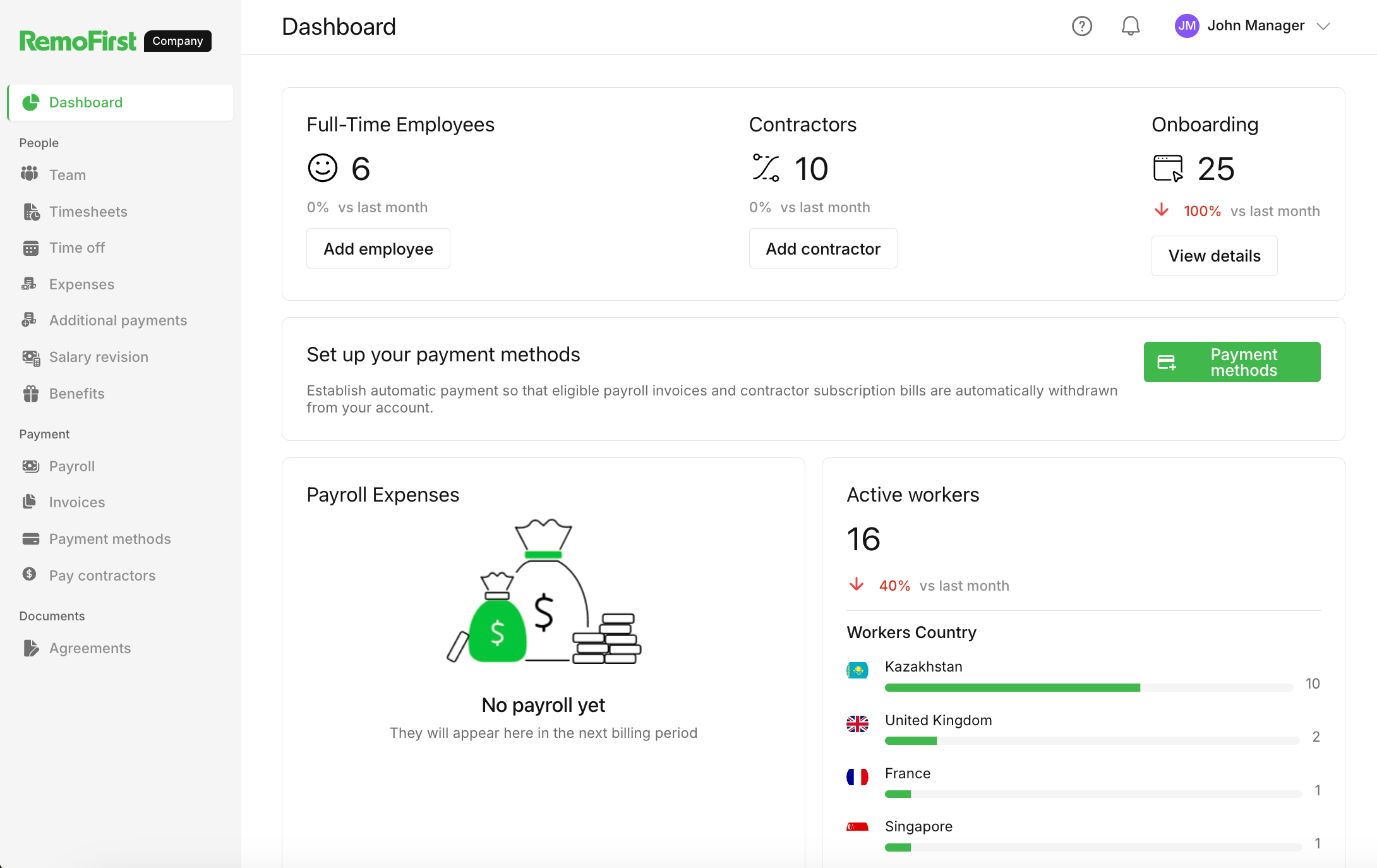
We moved RemoFirst to last place on 8 November 2026: Trustpilot has suspended its rating for a breach of its guidelines and removed fake reviews.

RemoFirst says it works exclusively with vetted in-country partners. Here, that means a local partner company, not RemoFirst, would normally employ your hire, and payroll changes, questions and exits pass through both companies, which can slow answers. US$199 is RemoFirst’s starting fee and varies by country, so get this country’s quote before you compare. RemoFirst’s free contractor tier covers administration, including contract management and identity checks. Contractor payments cost USD 25 per contractor in months when a payment is processed; payment-provider and transfer fees may also apply.

RemoFirst’s global EOR fee starts at USD 199 per employee per month, with no minimum contract term or employee count. The country fee, deposit, payroll funding and add-ons depend on the proposal. Salary and employer costs are additional.

Deposit

About 1 month

Entity model

Partners, not own entities

First year, one hire

$2,388 in service fees

Reviewed by Martynas PupkeviciusFact-checked by Michael Ennis

Starting fee

$199

RemoFirst advertises no minimum contract term or employee count. Confirm any country-specific charges.

Against the 10 starting fees
$199 lowest$699 highest
Which top pick · Canada

If you’re adding a Canadian employee to a US team, I’d compare Rippling’s native Canadian payroll on the same platform with Deel’s support for a wider global rollout. Quebec employment includes QPP, QPIP and the applicable French-language contract. Request an itemised quote for the hire. The EOR cost calculator lets you compare the recurring amounts in USD.

Local Canadian alternatives: several domestic firms also provide EOR or payroll-and-PEO services in Canada, including ADP Canada and Dayforce (formerly Ceridian) on the payroll side and HR-outsourcing players such as Knit People and The Payroll Edge. I leave them unranked: ADP Canada and Dayforce are payroll platforms first, Knit People and The Payroll Edge are domestic HR outsourcers, and none of the four carries the multi-country footprint of the ten above. An employer hiring only in Canada, especially one already running payroll on ADP or Dayforce rails, may still find a domestic provider sufficient.

Get your EOR discount

Get up to 30% off eligible EOR service fees. Your quote confirms the discount and terms.

Why this order

Why the Canada order differs from the overall ranking

Borderless AI jumps five places here. Multiplier drops one.

Statutory contributions are fixed at roughly 10 to 12 percent of gross outside Quebec whoever employs, so the provider fee, $199 to $699 a month, is the one cost a Canadian hire lets you control. A buyer who weights a long compliance record over a Toronto address can rebuild the order from the plaques above.

Employment framework

Employment and payroll in Canada

Province and sector determine which rules apply.

The employee’s work location and sector determine which Canadian employment standards apply. Payroll and benefit administration must also reflect provincial differences, particularly in Quebec.

Establish the provincial or federal framework

The employment contract follows the labour standards of the province where the employee works, or the Canada Labour Code in a federally regulated sector such as banking, telecommunications or interprovincial transport.

Minimum wage, vacation, statutory holidays and termination notice differ by province. An Ontario hire and a British Columbia hire therefore operate under different statutes.

Remote work: separate the payroll province from the work location

For a remote hire, document two decisions: which employment rules govern the work and which province is used for payroll deductions. They are related questions, but the payroll answer follows CRA’s own reporting and establishment rules. The CRA policy for full-time remote work can attach a worker to an employer establishment even when the worker never attends it physically.

The provider should explain which facts support that attachment. The location the employee would report to without the remote arrangement is a primary consideration; the assessment must reflect the real relationship. Choosing a convenient establishment solely to avoid deductions or employer contributions is not an acceptable use of the policy.

Ask for this explanation in the employee’s onboarding file and a process for reviewing it when the employee moves or reporting arrangements change. That gives finance a reason for the deductions on the payslip and gives HR a separate prompt to review employment terms. The employee’s personal tax position may still differ from payroll withholding.

Employment contract and responsibilities

The named Canadian entity signs the written employment contract. Request its name and registration details and confirm its employment, CRA and provincial filing responsibilities. You retain day-to-day direction of the work.

Ontario temporary-help-agency rules

An EOR proposal should explain whether the Ontario arrangement falls within the province’s temporary-help-agency rules. Where it does, ask for the relevant agency licensing evidence and a clear assignment document.

The client should also know its own responsibilities. Ontario provides for joint and several client liability for specified unpaid wages of assignment employees, including regular wages, overtime and public-holiday pay. Request a routine way to reconcile approved hours with the payroll records, and an escalation process when the employee reports an underpayment.

The answer should name the employer, explain the applicable provincial regime and identify the records the client receives.

Payroll and employment records

Pay and deductions

The EOR collects the Social Insurance Number and sets up the hire under its CRA payroll program account. Each pay cycle it calculates gross-to-net pay and deducts applicable employee CPP, EI and income tax.

CRA remittances

The EOR remits those deductions and employer CPP and EI contributions to the CRA. A regular remitter pays by the 15th of the month after deductions were withheld.

Cover and employment records

It enrols the worker with the provincial workers’ compensation board where required, accrues vacation pay and issues a T4 each February. It handles the Record of Employment with Service Canada when required.

Additional requirements for a Quebec hire

Quebec uses the Quebec Pension Plan instead of CPP and the Quebec Parental Insurance Plan instead of the parental-benefit portion of EI. CNESST is the authority for labour standards and workplace safety.

The Charter of the French Language applies to the contract and workplace communications. Ask the provider to explain the French-language and provincial requirements for the actual hire.

Employer cost

Statutory employer contributions in Canada

Quebec has its own contribution schedule.

All figures for 2026. The federal load is about 10 to 12 percent of gross on a mid-range salary outside Quebec, before the EOR fee; Quebec runs higher.

Contribution Employer rate Cap / basis (2026) Agency
Contribution
CPP (pension, outside Quebec)
Employee also pays 5.95%
Employer rate
5.95%
Cap / basis (2026)
$3,500 exemption to $74,600 YMPE; max $4,230.45
Agency
Canada Revenue Agency
Contribution
CPP2 (second earnings tier)
Employee also pays 4%
Employer rate
4.00%
Cap / basis (2026)
On earnings $74,600 to $85,000; max $416
Agency
Canada Revenue Agency
Contribution
EI (employment insurance)
Employer pays 1.4× the employee rate
Employer rate
$2.28 per $100
Cap / basis (2026)
Ceiling $68,900; max $1,572.30 (Quebec lower)
Agency
Canada Revenue Agency
Contribution
Employer Health Tax (Ontario)
Rate and threshold vary by province
Employer rate
up to 1.95%
Cap / basis (2026)
Eligible employers: CAD 1M exemption; payroll over CAD 5M generally loses the exemption, rather than taxing only the excess
Agency
Ontario Ministry of Finance
Contribution
Workers' compensation (WSIB, Ontario)
Rate varies by province and industry
Employer rate
~$1.23 per $100 (avg)
Cap / basis (2026)
On insurable payroll; industry-rated
Agency
WSIB / provincial board

Fig. 2 · Mandatory employer contributions in Canada, 2026 rates and caps

Take a CAD 90,000 Ontario salary: employer CPP and CPP2 hit the maximums of about CAD 4,646 combined, EI at 1.4 times runs to its CAD 1,572.30 maximum, Employer Health Tax at 1.95 percent is about CAD 1,755 where the employer is over the exemption, and WSIB at roughly CAD 1.23 per CAD 100 is about CAD 1,107, a total near CAD 9,080 or roughly 10 percent on top of gross. In Quebec the mix changes: the Quebec Pension Plan replaces CPP at a higher employer rate of 5.3 percent base plus 1 percent additional to the YMPE, the Quebec Parental Insurance Plan adds a 0.602 percent employer premium to a CAD 103,000 ceiling, the EI rate is lower because QPIP carries parental leave, and the CNESST collects the workers’ compensation premium, which lifts the Quebec employer load above the common-law provinces. The EOR fee sits on top of all of this.

Working time & leave

Working hours, overtime and statutory leave

Ontario is the baseline for the figures below.

Hours, overtime and leave are set province by province. The numbers below are the Ontario baseline, the most common province for a first Canadian hire; other provinces differ, and a national EOR applies the rate for the work location.

Hours and overtime

Standard week 40 hours
Overtime after 44 hours/week (ON)
Overtime rate 1.5× hourly
Statutory holidays (ON) 9 per year
Federal holidays 10 (federally regulated)

Fig. 3 · Hours and overtime, Ontario baseline · other provinces set their own thresholds

Statutory holidays range from 9 in Ontario to 10 or more elsewhere, and federally regulated employees get 10. Holiday pay in Ontario is calculated as regular wages earned plus applicable vacation pay payable for the four work weeks before the holiday week, divided by 20, subject to eligibility and special rules.

Vacation and statutory leave

Vacation, under 5 years
4% vacation pay
2 weeks
Vacation, 5+ years
6% vacation pay
3 weeks
Sick leave (ON, unpaid, job-protected) 3 days
Parental (EI / QPIP funded) up to 18 months
Bereavement (ON) 2 days

Fig. 4 · Ontario vacation baseline · Federally regulated employees have separate entitlements, including four weeks and 8% vacation pay after ten consecutive years.

Vacation is two weeks at 4 percent vacation pay under five years and three weeks at 6 percent at five years or more, the Ontario baseline. Federally regulated employees additionally receive four weeks and 8% after ten consecutive years with the employer; Saskatchewan starts at three weeks. Maternity and parental leave is job-protected and income is paid through EI, or QPIP in Quebec, not by the employer. There is no statutory 13th-month salary in Canada; year-end bonuses are contractual.

Ending employment

Probation, notice and severance in Canada

Check what the contract says about notice.

Statutory notice is small, but common-law reasonable notice can be many times larger, and the only thing that limits it is a valid written contract. The EOR drafts that contract.

Service under Ontario ESA Individual termination notice Statutory severance
Service under Ontario ESA
3 months to under 1 year
Individual termination notice
1 week
Statutory severance
Normally not yet eligible
Service under Ontario ESA
1 to under 3 years
Individual termination notice
2 weeks
Statutory severance
Normally not yet eligible
Service under Ontario ESA
3 to under 8 years
Individual termination notice
3–7 weeks, increasing with completed years
Statutory severance
Separate eligibility test from 5 years
Service under Ontario ESA
8 years or more
Individual termination notice
8 weeks
Statutory severance
If eligible: one week per year, with completed partial-year months prorated, capped at 26 weeks

Fig. 5 · Ontario statutory minimums for individual termination · Severance requires at least five years’ service and either the global-payroll test or qualifying permanent-closure test; exceptions and separate group rules apply.

For most individual terminations under Ontario’s ESA, employees with at least 3 months’ continuous employment receive 1 week’s notice below 1 year, 2 weeks from 1 to under 3 years, then 3–8 weeks as service increases, capped at 8 weeks from 8 years. Eligible employees with at least 5 years’ service also receive statutory severance of 1 week’s regular wages per year, with completed partial-year months prorated, capped at 26 weeks, where the employer has global payroll of at least CAD 2.5 million or the qualifying permanent-closure test is met.

For federally regulated employees, individual notice is generally 2 weeks after 3 months and rises from 3 weeks after 3 years to a maximum of 8 weeks; the graduated rules took effect on 1 February 2024. After at least 12 consecutive months, eligible employees also receive severance equal to the greater of 2 days’ wages per completed year or 5 days’ wages. Exceptions and separate group-termination rules apply.

Without-cause termination of a 3-year employee on CAD 90,000/year (Ontario) Weekly pay = CAD 90,000 / 52 = CAD 1,731
Statutory notice (ESA)
1 week/yr × 3 yrs = 3 weeks, paid in lieu
CAD 5,192
Statutory severance pay
Not payable: under 5 years' service
CAD 0
Accrued vacation pay
Assume 1 week (4%) outstanding
CAD 1,731
Common-law notice (typical)
~1 month/yr × 3 = ~3 months if no enforceable clause; offsets the ESA notice
~CAD 22,500
Indicative exit cost
With a valid clause: ~CAD 6,923; without: ~CAD 24,231
CAD 7k–24k

Fig. 6 · Without-cause exit of a 3-year employee on CAD 90,000 · the termination clause decides the CAD 17,000 spread

One contract clause accounts for the CAD 17,000 spread. With an enforceable termination clause the employee is limited to the ESA notice of about CAD 6,923 including accrued vacation; without one, common-law notice of roughly three months pushes the cost to about CAD 24,231, and the common-law figure replaces rather than stacks on the statutory notice. A 3-year employee draws no statutory severance because that entitlement needs five years and a CAD 2.5 million payroll. The termination across jurisdictions guide sets these numbers against other markets.

Payroll & tax

Payroll cycle and income tax in Canada

Check the remittance schedule and the T4 deadline.

Income tax is withheld at source under a pay-as-you-earn system run by the Canada Revenue Agency, combining federal tax with the applicable provincial or territorial payroll withholding determined under CRA’s province-of-employment rules. The employee files a TD1 form so the EOR applies the right credits, and the EOR computes and remits the tax with CPP and EI each cycle. For a regular remitter, remittances are due by the 15th of the month after the deductions were withheld; larger payrolls remit more frequently.

The currency is the Canadian dollar (CAD), roughly CAD 1.41 to one US dollar at the August 2026 check, so a USD-funded company should check the provider’s FX markup, since a 2 to 5 percent spread on every CAD payroll run adds up. The pay schedule itself is whatever the employment contract fixes, and the EOR holds to it; Canadian payroll providers report bi-weekly and semi-monthly as the dominant schedules, monthly pay is uncommon, and provincial employment-standards rules set a minimum frequency, in some provinces at least every 16 days. Each February the EOR issues a T4 slip summarising the year’s pay and deductions, which the employee uses to file a personal return, and an RL-1 slip in Quebec.

Two payroll items catch foreign employers.

First, the Record of Employment is mandatory and time-bound: for electronic weekly, biweekly or semi-monthly payroll, the employer must file it with Service Canada within five calendar days after the end of the pay period containing the interruption; monthly or thirteen-period payroll and paper ROEs follow different rules. Interruptions can include termination, layoff or unpaid leave; the ROE supports Service Canada’s EI decision. A national EOR files it electronically through ROE Web, which removes a common compliance miss.

Second, vacation pay is a running liability: an employer accrues 4 or 6 percent of wages as vacation pay and must pay it out on termination if untaken, so the EOR tracks it from day one.

The employment contract

Contract requirements and bonus norms

Check Quebec’s rules on contracts in French.

A Canadian employment contract is normally written in English in the common-law provinces, and in French in Quebec, where the Charter of the French Language requires the contract and workplace communications to be available in French unless the employee expressly asks for another language. The contract should state the wage, pay frequency, hours, vacation, benefits and a termination clause. The termination clause is the most consequential clause in a Canadian contract: a clause that limits the employee to the statutory minimum is what protects you from common-law reasonable notice, and Canadian courts will strike a clause that tries to undercut the Employment Standards Act, voiding the limit entirely. The EOR uses a clause drafted to current case law.

Probation is commonly three months, the point at which most provinces’ notice obligations begin, so a clean probation clause matters. Fixed-term contracts are permitted but carry a specific Canadian risk: if a fixed-term contract has no early-termination clause and the employer ends it early, the employer can owe the wages for the entire remaining term, which can exceed common-law notice. The EOR uses a fixed term only where the work is genuinely time-bound and always with an early-termination clause; for permanent roles it issues an indefinite contract.

A year-end or performance bonus is common in technology and finance roles and many candidates expect it, but it is not mandated. If you offer one, write it into the contract as either guaranteed or discretionary and define how it is earned, because a bonus that is described as discretionary but paid every year can be found to be an implied term that survives termination. The EOR pays any bonus through payroll and applies CPP, EI and tax to it like any other wage. Benefits such as extended health, dental and a group retirement match are not mandatory but are close to standard for salaried roles, and many EORs offer a Canadian benefits package you can layer on.

Division of responsibility

What the EOR handles, and what stays with you

Check client wage liability for Ontario agency hires.

The EOR carries employer duties, but client obligations and contractual cost allocation must be assessed separately. Covered Ontario agency arrangements can leave the client liable for specified unpaid wages.

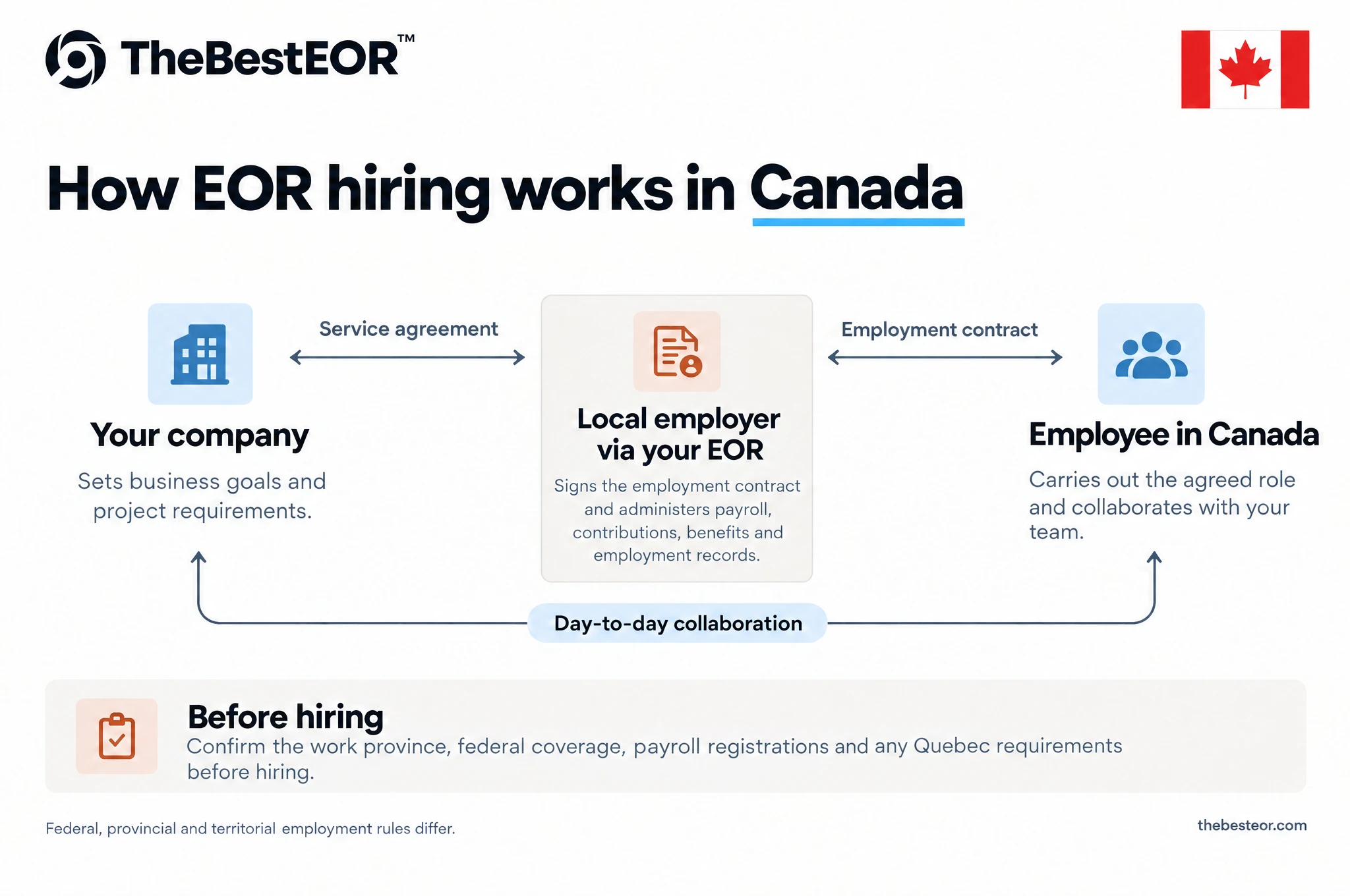
Employer of record in Canada diagram showing the service agreement, employment contract, and day-to-day collaboration between your company and the employee.
Employer of record in Canada: how your company, the local employer and the employee work together. Select the image to enlarge.

The EOR handles

1
Employer-of-record status on its Canadian entity, and the statutory exposure that comes with it
2
CPP, EI and income-tax deduction and remittance to the CRA by the 15th
3
QPP, QPIP and the CNESST filings for a Quebec hire
4
Provincial workers’ compensation enrolment and premiums
5
The provincial employment contract, in English or French, with a current termination clause
6
Vacation-pay accrual, the T4 (and RL-1 in Quebec), and the payslip
7
The Record of Employment by the applicable Service Canada deadline; the filing method and pay cycle affect the timing.
8
Compliant offboarding, statutory notice and the documented termination

You keep

1
The work itself: what gets built, shipped and prioritised each day
2
The CAD salary, any bonus, and whatever you add above the statutory floor
3
Who gets hired, and when a role ends
4
Performance management, and the paper trail a Canadian dismissal will lean on
5
Laptops and tooling; a few providers, Rippling among them, will provision devices
6
Your commercial contract with the EOR, including the IP-assignment language you want in the employment agreement

Classification needs its own review. Engaging a Canadian worker as an independent contractor when they work set hours under your control and depend on your business can lead the CRA or a labour board to deem them a dependent contractor or an employee, which exposes you to back CPP, EI, unpaid vacation pay and penalties, and can trigger common-law notice on termination. An employment arrangement that meets local requirements can change how the worker is engaged from then on. It does not settle earlier classification liabilities, and the staffing model and any immigration route require their own assessment. The misclassification guide covers the control-and-dependency tests Canadian authorities apply. You can gather the facts for one engagement in our employee misclassification calculator.

Work permits

Work permits and LMIAs: limits on EOR sponsorship

Check whether the proposed employer can obtain an LMIA.

For an LMIA-supported hire, Service Canada must recognise the applicant as the employer. Its current Temporary Foreign Worker Program guidance says staffing or employment agencies recruiting workers for other businesses cannot be approved to hire those workers under that program. That restriction does not apply to candidates who already have permission to work; an LMIA-exempt route requires its own assessment.

Route What it is Can an EOR run it? Processing
Route
Citizen / PR
What it is
No permit needed
Can an EOR run it?
Yes, the core EOR case
Processing
Standard onboarding
Route

Open work permit

e.g. PGWP, spousal, IEC
What it is
Holder can work for any employer
Can an EOR run it?
Yes, EOR employs them
Processing
Already held by the worker
Route
LMIA-based closed permit
What it is
Tied to one employer via a Labour Market Impact Assessment
Can an EOR run it?
No TFWP agency/client hire
Processing
Weeks to months
Route
Global Talent Stream (Cat B)
What it is
Fast LMIA for tech roles on the Global Talent Occupations List
Can an EOR run it?
Same TFWP employer restriction
Processing
~2 weeks (LMIA portion)

Fig. 7 · Work-permit routes and whether an EOR can run them · an EOR fits citizens, permanent residents and open-permit holders

An employer-specific work permit may be based on an LMIA or an exemption. For the LMIA-supported Temporary Foreign Worker Program, ESDC examines who hires, directs, pays and can dismiss the worker. Its agency restriction applies to the described arrangement recruiting workers for another business; a provider’s legal-employer label does not overcome it.

Global immigration assistance does not mean a Canadian EOR can sponsor this hire.

Salary benchmarks

Indicative salary ranges

Compare gross annual salaries in Canadian dollars.

Annual gross in Canadian dollars with a USD equivalent at roughly CAD 1.41 to the dollar (August 2026). Ranges blend the Robert Half 2026 Canada Salary Guide with market data from Glassdoor and Payscale; use the midpoint as a starting offer, not a ceiling.

Check current pay data for the role and location before you make an offer.

Role Gross CAD/year USD/year (approx)
Role
Software engineer
Gross CAD/year
CAD 90,000–130,000
USD/year (approx)
$63,800–92,200
Role
Senior software engineer
Gross CAD/year
CAD 120,000–165,000
USD/year (approx)
$85,100–117,000
Role
Product manager
Gross CAD/year
CAD 110,000–150,000
USD/year (approx)
$78,000–106,400
Role
Accountant
Gross CAD/year
CAD 65,000–95,000
USD/year (approx)
$46,100–67,400
Role
Customer support
Gross CAD/year
CAD 50,000–70,000
USD/year (approx)
$35,500–49,600
Role
Sales manager
Gross CAD/year
CAD 90,000–130,000
USD/year (approx)
$63,800–92,200
Role
HR manager
Gross CAD/year
CAD 90,000–125,000
USD/year (approx)
$63,800–88,700
Role
Designer
Gross CAD/year
CAD 80,000–120,000
USD/year (approx)
$56,700–85,100

Fig. 8 · Role salary benchmarks for Canada, 2026 · Robert Half, Glassdoor and Payscale blend; USD at roughly CAD 1.41 to the dollar

Salaries cluster in Toronto, Vancouver and Montreal; Toronto and Vancouver run highest for technology roles, and many provinces outside the three major hubs run 10 to 20 percent below the Toronto figure for the same role. Quebec roles often list a little below Ontario for equivalent work, partly offset by lower living costs. The figures are base salary only and exclude bonus, equity and the extended-health and retirement-match benefits that are close to standard for salaried Canadian roles.

Fully-loaded cost

What a Canadian software engineer costs per month

See what a CAD 105,000 salary costs in Ontario.

The Ontario example compares an illustrative USD 199 monthly fee with higher service fees. For a different salary, estimate employer payroll costs in Canada.

Software engineer, Toronto
Gross base: CAD 105,000/year (CAD 8,750/month)
Gross salary CAD 8,750
CPP + CPP2 employer
Annual max ~CAD 4,646, spread monthly
CAD 387
EI employer (1.4×)
Annual max CAD 1,572.30, spread monthly
CAD 131
Employer Health Tax (1.95%)
If employer is over the CAD 1M exemption
CAD 171
WSIB (~1.23%)
Industry-rated; office/tech is lower
CAD 108
EOR fee, cheapest
RemoFirst from $199 ≈ CAD 281
⚠ Trustpilot warning: rating suspended for a breach of its guidelines; fake reviews removed
CAD 281
Monthly total, cheapest fee
Annual ≈ CAD 117,936 (about $83,600)
CAD 9,828

Fig. 9 · Fully-loaded monthly cost, software engineer in Toronto · priced at an illustrative USD 199 monthly service fee, higher service-fee scenarios substituted in below

Statutory employer cost is about CAD 797 a month, roughly 9 percent on top of gross outside Quebec. At the illustration’s exchange rate, these hypothetical USD monthly service fees change the modelled total: a USD 579 service fee (≈ CAD 816) lands at CAD 10,363/month (≈ CAD 124,356/year), and a USD 699 service fee (≈ CAD 986) lands at CAD 10,533/month (≈ CAD 126,396/year). The fee, not the statutory load, is the biggest lever on total cost outside Quebec, which is why the price column drives so much of the ranking above. A Quebec hire adds QPP and QPIP, lifting the statutory share by a few points.

EOR vs your own entity

EOR or your own Canadian entity: compare costs

Factor EOR Your own Canadian entity
Factor
Setup cost
EOR
None
Your own Canadian entity
Typically CAD 1,000–3,000 incorporation + registrations
Factor
Time to first hire
EOR
2–9 days
Your own Canadian entity
Typically 3–6 weeks (incorporation, CRA account, WCB, payroll)
Factor
Per-employee cost
EOR
$199–699/employee/mo fee + statutory
Your own Canadian entity
Statutory only, plus shared overhead
Factor
Ongoing admin
EOR
Provider runs payroll, ROE & filings
Your own Canadian entity
Payroll, T4s, ROEs, annual returns, your own compliance
Factor
Compliance liability
EOR
The EOR carries employer duties; applicable client wage liability can remain.
Your own Canadian entity
On you and your directors

Fig. 10 · Illustrative EOR-versus-entity comparison; the crossover depends on the fee plan, local operating costs and hiring duration.

Annualising an illustrative $199 monthly starting service fee gives about CAD 3,370 using the example’s exchange rate. Incorporating in Canada is inexpensive to set up, but a CRA payroll account, provincial registrations, workers’ compensation, T4 and ROE filing, an annual return and either in-house or outsourced payroll add real fixed overhead regardless of headcount, plus director compliance liability and the termination risk you now carry directly.

There is no single break-even headcount for Canada; the EOR vs entity break-even guide shows the math. The break-even depends on complete current quotes, including setup, administration, funding, benefits, FX and exit costs. A common path is to hire the first few through an EOR, then stand up a Canadian entity and transfer staff once committed to Canada long-term; the EOR-to-entity migration guide covers that handover.

FAQ

EOR in Canada: common questions

What is the best EOR in Canada?

RemotePeople is our top pick for Canada in 2026 (4.9/5), followed by Deel (4.7/5) and Rippling (4.5/5). We opened paid accounts with all 10 providers on this page, priced real hires and ran payroll.

RemotePeople employs Canadian staff through its own federal corporation (corporation number 13082831), with an office in Toronto. RemotePeople’s EOR Global plan starts at USD 499 per employee per month, and EOR Select at USD 199 where the hire qualifies. Deel starts at USD 599 plus a mandatory Employer Liability Cost; Rippling starts at USD 499 plus its required platform subscription.

How does an employer of record work in Canada?

An employer of record in Canada becomes the worker’s legal employer through a local employing entity, while your company directs the day-to-day work. The EOR deducts and remits CPP, EI and income tax to the CRA, enrols the employee in provincial workers’ compensation and issues the provincial employment contract in English or French, the T4 and the Record of Employment. For a Quebec hire it also handles QPP, QPIP and the CNESST filings.

How fast can an EOR onboard an employee in Canada?

Estimated onboarding times for Canada range from 1 to 9 days across the providers we tested. By provider: Deel 1–4 days, RemotePeople 2–5 days, Rippling 2–5 days, Borderless AI 2–5 days and Multiplier 5–9 days.

The province, the candidate’s existing right to work and the payroll cutoff determine the plan. Ask for the signed-contract date, provincial payroll setup and first payday separately. For Quebec, include the QPP/QPIP setup and the contract-language review in that plan; a new work-permit application is a separate process.

How much does an EOR cost in Canada per month?
Published service fees for Canada run from USD 199 to USD 699 per employee per month across the 10 providers we tested: RemoFirst from USD 199; RemotePeople Global from USD 499, or Select from USD 199 only where country and salary qualify; Deel from USD 599 plus mandatory Employer Liability Cost; G-P from USD 599; Oyster USD 699 on monthly billing, with annual seats quoted separately. Multiplier Core advertises $499 monthly or $459 per month billed annually; Pebl advertises $399, with currency and commitment to confirm. Rippling starts at USD 499 plus its required platform from USD 8 per employee, and Papaya Global at USD 499. Borderless AI is USD 579 standard, with an eligible USD 399 promotion on fees billed through 31 December 2026. All amounts are per employee/month; salary and employment costs are separate. On top of the fee you pay the employee’s gross salary plus roughly 10 to 12 percent in employer CPP, EI and, in Ontario, Employer Health Tax and WSIB. Quebec runs higher because of QPP and QPIP.
What employer contributions are mandatory in Canada?
Outside Quebec: CPP at 5.95 percent on earnings between $3,500 and $74,600 for 2026 (maximum $4,230.45), CPP2 at 4 percent on earnings from $74,600 to $85,000 (maximum $416), and EI at 1.4 times the employee rate, so $2.28 per $100 to a $68,900 ceiling (maximum $1,572.30). Provincial costs add Employer Health Tax and workers’ compensation. In Quebec the QPP, QPIP and CNESST replace the federal CPP and part of EI.
 
Can an EOR sponsor a work permit in Canada?

For an LMIA-supported hire under the Temporary Foreign Worker Program, Service Canada assesses the real employer relationship, including who benefits from the work, directs it and pays the worker. Its guidance says staffing or employment agencies recruiting workers for other businesses cannot be approved to hire those workers under this program.

Assess an LMIA-exempt route or an existing permit separately against the candidate’s actual status and the proposed employer.

What is the minimum wage in Canada in 2026?
There is no single national figure because minimum wage is provincial. The federal minimum wage, for federally regulated sectors only, is $18.15 per hour from 1 April 2026. Ontario’s general minimum wage is $17.95 per hour from 1 October 2026 and Quebec’s is $16.60 per hour from 1 May 2026. Each province sets and indexes its own rate, so an EOR applies the rate for the province where the employee works.
How much notice and severance applies when terminating in Canada?

For most individual terminations under Ontario’s ESA, employees with at least 3 months’ continuous employment receive 1 week’s notice below 1 year, 2 weeks from 1 to under 3 years, then 3–8 weeks as service increases, capped at 8 weeks from 8 years. Eligible employees with at least 5 years’ service also receive statutory severance of 1 week’s regular wages per year, with completed partial-year months prorated, capped at 26 weeks, where the employer has global payroll of at least CAD 2.5 million or the qualifying permanent-closure test is met.

For federally regulated employees, individual notice is generally 2 weeks after 3 months and rises from 3 weeks after 3 years to a maximum of 8 weeks; the graduated rules took effect on 1 February 2024. After at least 12 consecutive months, eligible employees also receive severance equal to the greater of 2 days’ wages per completed year or 5 days’ wages. Exceptions and separate group-termination rules apply.

What currency and payroll cycle does Canada use?
The Canadian dollar (CAD). Pay dates follow the schedule set in the employment contract; bi-weekly and semi-monthly are the dominant schedules, and provincial rules set a minimum pay frequency, in some provinces at least every 16 days. The EOR remits CPP, EI and income tax to the Canada Revenue Agency by the 15th of the following month for a regular remitter, issues a T4 each February, and files a Record of Employment within the applicable Service Canada deadline: for electronic weekly, biweekly or semi-monthly payroll, five calendar days after the end of the pay period containing the interruption; monthly or thirteen-period payroll and paper ROEs follow different rules. About CAD 1.41 equalled one US dollar at the August 2026 check.
Can I convert a Canadian contractor to an EOR employee?
Yes, and conversion is how foreign employers usually head off Canada’s dependent-contractor exposure. A Canadian contractor who works set hours under your control and depends on your business can be ruled a dependent contractor or an employee by the CRA or a labour board, exposing you to back CPP, EI, vacation pay and penalties. An EOR issues a compliant employment contract, runs CPP, EI and tax withholding, and enrols the worker for vacation pay, usually within a week. See the contractor misclassification guide.
Do I need a Canadian entity to hire one person in Canada?
No. An EOR employs the worker on its Canadian entity, so you hire without registering a federal or provincial corporation or a CRA payroll account. Setting up your own entity adds incorporation, a CRA program account, provincial registrations, workers’ compensation and either in-house or outsourced payroll. Use current country and entity-administration quotes to establish a break-even for your team.
How is hiring in Quebec different from the rest of Canada?

Quebec payroll has its own administration: applicable deductions and contributions include Quebec income tax, QPP, QPIP, the health services fund and other employer charges. The employee’s province of employment and the employer’s circumstances determine which lines apply.

Ask the provider for a Quebec-specific payroll breakdown rather than applying the Ontario cost example. The offer also needs a separate review of Quebec employment standards and contract-language requirements.

What is a Record of Employment and who files it?
The Record of Employment, or ROE, is the form Service Canada uses to decide an Employment Insurance claim. The employer must issue it within the applicable Service Canada deadline: for electronic weekly, biweekly or semi-monthly payroll, five calendar days after the end of the pay period containing the interruption; monthly or thirteen-period payroll and paper ROEs follow different rules. An interruption can include termination, layoff or unpaid leave. When you hire through an EOR, the EOR is the legal employer, so it files the ROE electronically through ROE Web; you do not touch the form, which removes a common compliance miss for foreign employers.

Sources and as-of dates

Article references

Every statutory number above traces to the agency that collects it: the Canada Revenue Agency, Revenu Québec, the Ontario Ministry of Finance, the WSIB and Service Canada. Rates are as of June 2026.

Hiring facts Checked 2 Oct 2026

Hiring facts

Checked 2 October 2026
Eligibility, local and collective rules apply. EOR fees extra.

CPP / CPP2 2 sources

For 2026, the employer CPP contribution is 5.95% on annual pensionable earnings above CAD 3,500 up to CAD 74,600 (maximum CAD 4,230.45). CPP2 adds 4% on earnings above CAD 74,600 up to CAD 85,000 (maximum CAD 416). Quebec uses the QPP instead. Canada Revenue Agency, contribution rates and maximums.

Employment Insurance 2 sources

For 2026, the employee EI rate outside Quebec is CAD 1.63 per CAD 100 of insurable earnings. The standard employer rate is 1.4 times the employee rate: 2.282% (approximately CAD 2.28 per CAD 100). Maximum insurable earnings are CAD 68,900 and the employer maximum is CAD 1,572.30. For Quebec workers covered by QPIP, the employee rate is 1.30% and the employer rate is 1.82%. Approved premium reductions can apply to employers with qualifying wage-loss plans. Canada Employment Insurance Commission and Canada Revenue Agency.

Quebec Pension Plan 2 sources

For 2026, the employer QPP contribution is 5.3% base plus 1% first additional contribution on pensionable earnings above the CAD 3,500 basic exemption up to CAD 74,600 (maximum CAD 4,479.30). A second additional contribution of 4% applies to earnings above CAD 74,600 up to CAD 85,000 (maximum CAD 416). Revenu Québec.

Quebec Parental Insurance Plan 1 source

For 2026, the QPIP employer premium is 0.602% and the employee premium is 0.430%, on maximum annual insurable earnings of CAD 103,000. The corresponding annual maximums are CAD 620.06 for the employer and CAD 442.90 for the employee. Revenu Québec.

Employer Health Tax (Ontario) 2 sources

Ontario’s Employer Health Tax has a CAD 1 million exemption for eligible employers, shared where associated-employer rules apply. The 1.95% rate applies when total Ontario remuneration exceeds CAD 400,000 and is charged on remuneration remaining after any available exemption. Employers or associated groups with annual Ontario payroll over CAD 5 million generally lose the exemption, so the tax is not limited to the portion above CAD 5 million; registered charities have special rules. Ontario Ministry of Finance.

WSIB (Ontario) 2 sources

WSIB’s 2026 average premium is CAD 1.23 per CAD 100 of insurable payroll. A business’s actual rate depends on its industry classification and claims experience. Workplace Safety and Insurance Board.

Vacation and holidays 4 sources

For employees covered by Ontario’s ESA, the minimum is 2 weeks of vacation and 4% vacation pay with less than 5 years of employment, rising to 3 weeks and 6% at 5 years; Ontario has 9 public holidays, subject to eligibility rules. Federally regulated employees receive 2 weeks/4% after 1 year, 3 weeks/6% after 5 consecutive years and 4 weeks/8% after 10 consecutive years with the same employer. Provincial and federal rules are separate.

Termination 4 sources

For most individual terminations under Ontario’s ESA, employees with at least 3 months’ continuous employment receive 1 week’s notice below 1 year, 2 weeks from 1 to under 3 years, then 3–8 weeks as service increases, capped at 8 weeks from 8 years. Eligible employees with at least 5 years’ service also receive statutory severance of 1 week’s regular wages per year, with completed partial-year months prorated, capped at 26 weeks, where the employer has global payroll of at least CAD 2.5 million or the qualifying permanent-closure test is met.

For federally regulated employees, individual notice is generally 2 weeks after 3 months and rises from 3 weeks after 3 years to a maximum of 8 weeks; the graduated rules took effect on 1 February 2024. After at least 12 consecutive months, eligible employees also receive severance equal to the greater of 2 days’ wages per completed year or 5 days’ wages. Exceptions and separate group-termination rules apply.

Minimum wage 3 sources

General minimum hourly wages in CAD: federal CAD 18.15 from 1 April 2026; Ontario CAD 17.95 from 1 October 2026; Quebec CAD 16.60 from 1 May 2026. The federal rate applies to federally regulated employment, with the higher provincial or territorial rate applying where relevant. Provincial special rates and exemptions must be checked for the worker’s category.

Work permits 3 sources

LMIA and Global Talent Stream applications must satisfy ESDC’s employer and program requirements; IRCC also requires the appropriate work authorization unless an exemption applies. ESDC assesses who hires, directs, pays and can dismiss the worker. Its guidance says staffing or employment agencies recruiting workers for other businesses are not eligible to hire those workers under the Temporary Foreign Worker Program where the required employer–employee relationship is absent. An EOR arrangement should therefore be assessed against the actual relationship and applicable immigration route.

Salary benchmarks 2 sources

Canada’s Job Bank reports hourly wages for software engineers and designers (NOC21231), with regional source periods. The linked release was updated in November 2025 and uses 2023–2024 national observations. CAD1.41 per USD is illustrative; the Bank of Canada’s August 2026 average was CAD1.3898.

Provider pricing, entity model and onboarding 10 sources

Further sources Checked 19 Oct 2026

CRA — determine the province of employment — Payroll province and remote-work attachment. Checked 19 October 2026.

Service Canada — completing a Record of Employment — Electronic and paper ROE deadlines differ; electronic deadline depends on pay frequency. Checked 19 October 2026.

Ontario — temporary help agencies — Agency and client duties, assignment records and licensed operation. Checked 19 October 2026.

Ontario — public holidays — Public-holiday pay includes relevant vacation pay as well as regular wages. Checked 19 October 2026.

Ontario — policy manual, temporary help agencies — Section 74.18: covered client joint and several liability for specified wages. Checked 19 October 2026.

The country guides cover other markets. For this hire, browse EOR providers for Canada and use the EOR cost calculator to compare the recurring amounts in your proposals in USD.

This guide is for general information only and does not provide legal, tax, accounting, or financial advice. For advice about your business, consult a qualified professional familiar with the rules where you hire. The research methodology explains how TheBestEOR assesses sources.