TheBestEOR

Best Employer of Record in Hong Kong

Written by Martynas PupkeviciusFact-checked by Michael Ennis
Picture of Martynas Pupkevicius
Martynas Pupkevicius

EOR Advisor and Remote Work Editor

Our top employer of record in Hong Kong for 2026 is RemotePeople, from USD 499 per employee a month, ahead of Deel and Rippling.

We tested all 10 providers with paid client accounts, real quotes and a live hire run through payroll. Hong Kong employers must contribute to the Mandatory Provident Fund retirement scheme and insure staff against work injuries.

Flag of Hong Kong

Hiring in Hong Kong at a glance

Currency
HKD
Hong Kong dollar, pegged to the US dollar
Pay cycle
Monthly
Usually 1 month unless another period is set
Working hours
Per contract
Contract states normal hours and overtime pay
Annual leave
7 to 14 days
After 12 months’ continuous employment
Extra pay
Per contract
Bonus or extra month’s pay is not automatic by law
Employer costs
MPF
Retirement scheme, plus work injury insurance
Before you hire:
Check if the employee’s weekly hours qualify for statutory rights and confirm MPF enrolment.

Country hiring overview · Hong Kong

Hiring in Hong Kong, at a glance.

Compare the employer, MPF scope and any visa support.

For Hong Kong, I compare the local legal employer and the employment and payroll services actually included. I’d ask how MPF, employees’ compensation cover and any immigration work appear in the proposal, alongside the service fee.

Choose a hiring solution

Need a local employer?

Compare an EOR arrangement for your role before opening your own entity.

Already have a local employer?

Compare payroll and HR support against adding an EOR.

EOR service fee

Fees vary by provider.

Your quote should state the currency, fee per employee, minimum charge and billing commitment.

Onboarding

Paperwork affects the start date.

The contract, right-to-work checks, registrations and payroll deadlines all affect when employment can begin.

Employment costs

Include MPF and insurance.

The employment budget includes Mandatory Provident Fund contributions, employees’ compensation insurance and agreed benefits. The provider should calculate each amount for the proposed hire.

Annual leave

Leave increases with service.

Employees receive 7–14 days of annual leave after each 12 months under a continuous contract.

Check before choosing

Confirm the continuous-contract terms, MPF treatment, insurance cover, salary currency and any employee-specific visa support.

What your quote should include

Employment costs and service fees

1
Gross salary and agreed pay schedule
2
MPF, employees’ compensation and agreed benefits
3
EOR fee: currency, per-employee billing, minimums and commitment
4
Setup, foreign exchange, extras and exit costs

Deposits and payroll funding

1
Amount and payment deadline
2
Whether funds are refundable or credited to payroll
3
Release conditions and refund timing
Show these separately from recurring expenses.

Key takeaways for hiring in Hong Kong

A quiet week can still count as continuous employment

From 18 January 2026, a week below 17 hours can qualify through the rolling 68-hour test. For a new employee, the first three weeks still need at least 17 hours each. Keep weekly hours with the same employer; a part-time label does not decide benefit eligibility.

Split older service at 1 May 2025

For qualifying service spanning the MPF offset change, calculate the pre-transition and post-transition portions separately. They can use different wage bases. Mandatory employer MPF benefits cannot offset the post-transition portion, so an exit quote should show which service period each offset relates to.

Contribution dates do not define the offset test

The important distinction is the period of employment being compensated. Mandatory employer MPF benefits, including later contributions, may still offset eligible pre-transition service. Voluntary benefits follow separate rules. A proposal that simply divides contributions into old and new pots can produce the wrong result.

Departure clearance can temporarily stop final pay

A chargeable employee leaving Hong Kong for more than one month can trigger departure reporting and payment withholding, with a frequent-business-travel exception. The withholding period is one month from notification or until an IRD release arrives, whichever is earlier. Build that step into the departure timetable.

Quick verdict

What is the best EOR in Hong Kong?

My top three: RemotePeople, Deel and Rippling.

For a hire in Hong Kong, I’d shortlist RemotePeople first. It offers recruitment and EOR through one provider, with a dedicated account manager on both EOR plans. Its EOR Global plan starts at USD 499 per employee per month, or USD 199 on EOR Select where the hire qualifies. Deel, from USD 599 plus a mandatory Employer Liability Cost, fits when Hong Kong is one part of a wider employee and contractor programme. Rippling, from USD 499 plus its required platform, fits a team that already runs HR or IT on Rippling.

Ask the provider for a complete local quote and the name of the company that will administer payroll and MPF.

1
Editorial pick
RemotePeople logo

4.9/5

RemotePeople

Hiring in new markets with local HR support

Starting fee
$499

per employee / month

Countries
150+
where you can hire

EOR Select from $199 for eligible hires.

Deposit
1 month

of gross salary

Deposit refund
Within 5 days

of the final payment

Why consider it

Recruitment and EOR services through one provider.

Dedicated account manager in both EOR plans.

Check the fit

Recruitment is separately priced.

Before signing: Confirm quote currency, billing commitment, deposits, funding deadlines and refund terms. EOR Select eligibility depends on the hiring country and employee salary.

Both EOR plans list local contracts, payroll and tax administration, and statutory benefits administration. Salary, employer contributions and benefit costs are separate.

Visit RemotePeople ↗

2
Deel logo

4.7/5

Deel

Paying employees and contractors on one platform

Starting fee
$599

per employee / month

Countries
130+
where you can hire

Plus a mandatory Employer Liability Cost.

Deposit
1–1.5 months

of gross salary

Deposit refund
Within 60 days

of offboarding

Why consider it

EOR, contractor management and payroll for your own entities.

Month-to-month EOR service pricing available.

Check the fit

The country-specific Employer Liability Cost is mandatory.

Before signing: Confirm the Employer Liability Cost amount, benefit costs and any additional products. Monthly service terms do not remove employment notice, severance or other exit obligations.

The EOR pricing page lists 130+ countries. Broader platform coverage figures may include other services.

Visit Deel ↗

3
Rippling logo

4.5/5

Rippling

Setting up payroll, laptops and app access for new hires

Starting fee
$499

per employee / month

Countries
115
where you can hire

Plus the Rippling Platform, from $8 per employee / month.

Deposit
Per quote

based on gross salary

Deposit refund
Per contract

set in your agreement

Check the fit

Why consider it

EOR, payroll, HR records and benefits administration in one platform.

Shared workflows and reporting for domestic and international teams.

A paid Rippling Platform subscription is required on top of the EOR fee, from USD 8 per employee per month plus a monthly base fee. Rippling EOR starts at USD 499 per employee per month. Other HR and IT products are priced separately.

Rippling’s EOR page lists 115 countries. Confirm your hiring country and legal employer.

Visit Rippling ↗

No provider pays for a position on this page; some outbound links pay a referral fee. See the funding model and methodology.

Fees and visa sponsorship

All 10 EOR providers for Hong Kong, side by side

If a visa is needed, identify the sponsoring company.

For Hong Kong, I give particular attention to the fee and who would sponsor an employment visa if your hire needs one, given its relatively light employment administration. Prices are list fees per employee per month in US dollars; estimated onboarding times come from each provider’s stated service levels.

Hong Kong bends the overall order less than almost any market I cover. The statutory load is capped and the visa route has no quota and no points test. See how they compare globally in the ranking of the best EOR providers overall. For a wider shortlist, browse EOR providers for Hong Kong.

Provider

Best For

Starting feeDepositOnboarding
1 RemotePeople logo RemotePeople 4.9/5 Rating Hiring in new markets with local HR support Starting fee: $499 USD / monthDeposit: 1 monthOnboarding: 5–8 days

My take

RemotePeople includes a dedicated account manager, local employment contracts, payroll and tax administration, and statutory-benefits administration.

Recruitment is a separate service.

EOR Global starts at USD 499 per employee per month. EOR Select starts at USD 199 for eligible countries and employee salary ranges. Salary, employer contributions, benefit costs and agreed extras are additional. The country quote determines eligibility, the final fee, billing commitment and payroll funding.

Deposit

1 month

Entity model

Own entities in core markets

First year, one hire

$5,988 in service fees

Reviewed by Martynas PupkeviciusFact-checked by Michael Ennis

Starting fee

$499

EOR Global. EOR Select starts at $199 where the country and employee salary qualify.

Against the 10 starting fees

$199 lowest$699 highest
2 Deel logo Deel 4.7/5 Rating Paying employees and contractors on one platform Starting fee: $599 USD / monthDeposit: 1–1.5 monthsOnboarding: 2–5 days

My take

Deel combines EOR payroll and benefits administration with separate contractor and HR products.

EOR starts at USD 599 per employee per month, with month-to-month billing available. Mandatory Employer Liability Cost is an additional charge based on gross salary, with rates varying by country. Salary, statutory employer costs and benefit premiums are also separate.

Contractor management starts at USD 49 per active contract per month. It is a separate service from EOR employment; currency conversion, payment-method charges and any required deposit also affect the amount funded.

When this provider fits

For a candidate who needs a work-visa sponsor, I’d compare Deel and Pebl on the Hong Kong application service included in the proposal: the named employer, document preparation and responsibility for responding to immigration queries. For someone who already has permission to work, that service may add little value.

Deposit

1–1.5 months

Entity model

Own entities and partners

First year, one hire

$7,188 in service fees

Reviewed by Martynas PupkeviciusFact-checked by Michael Ennis

Starting fee

$599

Month-to-month billing. Mandatory Employer Liability Cost is charged separately.

Against the 10 starting fees

$199 lowest$699 highest
3 Rippling logo Rippling 4.5/5 Rating Setting up payroll, laptops and app access for new hires Starting fee: $499 USD / monthDeposit: Per quoteOnboarding: 2–5 days

My take

Rippling connects EOR employment with its HR, IT and finance products, using shared employee data for workflows and reporting.

Device management and app access are separate products within that wider system.

Rippling EOR starts at USD 499 per employee per month, and the required Rippling Platform adds from USD 8 per employee per month plus a monthly base fee. The quote needs to show any selected HR, IT or finance products and the billing commitment. Salary, employer costs, benefits, deposits and payroll funding are additional to the software and service fees.

When this provider fits

I’d consider Rippling when the Hong Kong employee will join HR and IT workflows your team already operates. For a standalone hire, those wider tools may matter less than the local payroll and support package.

Deposit

Per quote

Entity model

Own entities and local partners

First year, one hire

$5,988 in EOR fees

Reviewed by Martynas PupkeviciusFact-checked by Michael Ennis

Starting fee

$499

Plus the required Rippling Platform, from $8 per employee per month and a monthly base fee. Confirm the billing terms and selected products.

Against the 10 starting fees

$199 lowest$699 highest
4 Multiplier logo Multiplier 4.1/5 Rating Managing payroll, leave and expenses in one place Starting fee: $459 USD / monthDeposit: 1+ monthsOnboarding: 3–6 days

My take

Multiplier Core includes employment administration, payroll, leave and standard workforce reporting.

Core starts at $499 per employee per month on monthly billing or $459 per month billed annually. Growth adds integrations, custom reports and open APIs. The quote needs to identify the dollar currency and chosen plan.

Country variations and mandatory add-ons affect the total. Implementation fees may apply, although the FAQ says setup is free; the quote must resolve that charge. Salary, employer costs and benefit premiums are additional.

Deposit

1+ months

Entity model

Own entities and partners

First year, one hire

$5,508 in service fees

Reviewed by Martynas PupkeviciusFact-checked by Michael Ennis

Starting fee

$459

Core plan billed annually, or $499 per month on monthly billing. Confirm the dollar currency.

Against the 10 starting fees

$199 lowest$699 highest
5 Pebl logo Pebl 4.2/5 Rating Hiring people who need visa or relocation support Starting fee: $399 USD / monthDeposit: Per quoteOnboarding: 5–9 days

My take

Pebl, formerly Velocity Global, combines hiring, payroll, employee changes, reporting and offboarding in one platform.

EOR starts at $399 per employee per month; the country quote must identify the dollar currency and billing commitment. Salary, employer costs, benefits and additional services are separate.

A deposit is required before onboarding. Its amount can change with salary, seniority or payment history, and it is returned after the final invoice and outstanding balances are paid. Early exit can make the remaining committed-term service fees payable, subject to the agreement’s termination exceptions. Any discounted offer needs an end date and renewal price.

Deposit

Per quote

Entity model

Affiliates and local partners

First year, one hire

$4,788 in service fees

Reviewed by Martynas PupkeviciusFact-checked by Michael Ennis

Starting fee

$399

Confirm the country price and billing commitment.

Against the 10 starting fees

$199 lowest$699 highest
6 Oyster logo Oyster 4.5/5 Rating Using one onboarding process for hires across countries Starting fee: $699 USD / monthDeposit: ~1 monthOnboarding: 7–12 days

My take

Oyster includes payroll, expense and time-off administration, reporting, and onboarding and offboarding support.

Benefits packages are optional add-ons. The EOR service fee is USD 699 per employee per month on monthly billing.

Annual seats are priced by headcount and location and are non-refundable, but can be reused for replacement hires. Annual prepayment gives the lowest fee; higher-priced quarterly or semiannual payment options are available. Salary, employer costs and benefit premiums are additional, and a refundable deposit is required. Optional People Partner project work costs USD 300 per hour.

When this provider fits

I’d give Oyster a closer look when the employee’s medical cover is an important part of the offer. Compare the proposed policy, eligibility, exclusions and dependants’ cover with the other quotes.

Deposit

~1 month

Entity model

Own entities and vetted partners

First year, one hire

$8,388 in service fees

Reviewed by Martynas PupkeviciusFact-checked by Michael Ennis

Starting fee

$699

Monthly billing. Annual seats are quoted separately, prepaid and non-refundable.

Against the 10 starting fees

$199 lowest$699 highest
7 G-P logo G-P 4.2/5 Rating Hiring abroad while keeping your existing HR system Starting fee: $599 USD / monthDeposit: 1–2.5 monthsOnboarding: 2–5 days

My take

G-P combines EOR employment administration with benefits, reporting and custom API integrations.

EOR starts at USD 599 per employee per month, with volume discounts by quote. Salary, employer costs, benefit premiums and additional services are separate.

There is no minimum contract length for EOR hires. The proposal still sets the commercial billing and cancellation terms, along with the cost of any integration or implementation work.

Deposit

1–2.5 months

Entity model

100+ own entities, plus partners

First year, one hire

$7,188 in service fees

Reviewed by Martynas PupkeviciusFact-checked by Michael Ennis

Starting fee

$599

Confirm the included services and billing terms in your country quote.

Against the 10 starting fees

$199 lowest$699 highest
8 Papaya Global logo Papaya Global 4.1/5 Rating Comparing payroll costs across countries in one report Starting fee: $499 USD / monthDeposit: 1–2 monthsOnboarding: 7–10 days

My take

Papaya brings EOR employees, payroll for a company’s own entities and workforce payments into one platform, with consolidated reporting and payroll approval tools.

That makes the payroll and payments connection a useful part of its evaluation.

Papaya’s EOR service starts at USD 499 per employee per month. The country quote must identify the billing commitment and any additional services. Salary and employer costs are separate.

Deposit

1–2 months

Entity model

Partner model; confirm employer

First year, one hire

$5,988 in service fees

Reviewed by Martynas PupkeviciusFact-checked by Michael Ennis

Starting fee

$499

The country quote sets the billing terms. Payroll-only processing is priced separately.

Against the 10 starting fees

$199 lowest$699 highest
9 Borderless AI logo Borderless AI 4.0/5 Rating Getting 24/7 help with overseas payroll and HR Starting fee: $579 USD / monthDeposit: 1.5–3 monthsOnboarding: 7–12 days

My take

Borderless AI’s standard EOR fee is USD 579 per employee per month.

Eligible companies headquartered outside Canada may qualify for USD 399 on fees billed through 31 December 2026. USD 579 applies from 1 January 2027, including promotional customers; country and employment-type exceptions apply. Salary, employer costs and benefits are additional.

A refundable deposit is required before the employee starts. The schedule is 1.5 months of gross salary plus employer costs, benefits and platform fees with ACH or three months by wire and other methods, with country variations. The base includes salary, employer contributions, benefits and platform fees. Late-payment issues can raise it to six months. Deposits are released after the relevant obligations are settled.

Deposit

1.5–3 months

Entity model

Own entities

First year, one hire

$6,948 in service fees

Reviewed by Martynas PupkeviciusFact-checked by Michael Ennis

Starting fee

$579

Eligible companies headquartered outside Canada can pay $399 on fees billed through 31 December 2026.

Against the 10 starting fees

$199 lowest$699 highest
10 RemoFirst logo RemoFirst ⚠ Trustpilot warning 0.5/5 Rating Making a first overseas hire on a tight budget Starting fee: $199 USD / monthDeposit: About 1 monthOnboarding: 5–9 days

My take

We moved RemoFirst to last place on 8 November 2026: Trustpilot has suspended its rating for a breach of its guidelines and removed fake reviews.

RemoFirst says it works exclusively with vetted in-country partners. Here, that means a local partner company, not RemoFirst, would normally employ your hire, and payroll changes, questions and exits pass through both companies, which can slow answers. US$199 is RemoFirst’s starting fee and varies by country, so get this country’s quote before you compare. RemoFirst includes a dedicated customer success manager and EOR employment from USD 199 per employee per month, with no minimum contract term or headcount. The fee can vary with country requirements. Salary, employer costs, benefits, deposits and optional services are separate.

Contractor management is free for onboarding, identity checks, contract storage and expenses. Contractor payments cost USD 25 per contractor in months when a payment is processed; payment-provider and transfer fees may also apply. These contractor services are separate from EOR employment.

Deposit

About 1 month

Entity model

Partners, not own entities

First year, one hire

$2,388 in service fees

Reviewed by Martynas PupkeviciusFact-checked by Michael Ennis

Starting fee

$199

RemoFirst advertises no minimum contract term or employee count. Confirm any country-specific charges.

Against the 10 starting fees
$199 lowest$699 highest

Entity ownership is as each provider states it.

Comparison as of 6 October 2026.

Which top pick · Hong Kong

The statutory numbers are the same whichever provider you choose: 5 percent MPF to HK$1,500, and the rest of the cost is salary and fee. Ask for a written quote covering the salary, benefits and services you need. Enter its recurring costs in USD in the EOR cost calculator to compare proposals.

Local and regional alternatives (unranked): several Asia-based firms with deep Hong Kong payroll practices also offer EOR or payroll outsourcing, among them Links International, BIPO and FastLane Group.

Get your EOR discount

Get up to 30% off eligible EOR service fees. Your quote confirms the discount and terms.

Employment framework

Employment and payroll in Hong Kong

Check the employees’ compensation insurance cover.

Hong Kong employment requires clear contract, MPF and insurance arrangements. Employees’ compensation insurance is a separate employer obligation, so check its scope alongside the payroll service.

Confirm employees’ compensation insurance

The insurance covers liabilities for work injuries under the ordinance and common law. It is not automatically included in the MPF contribution or the advertised EOR service fee.

Employment contract and responsibilities

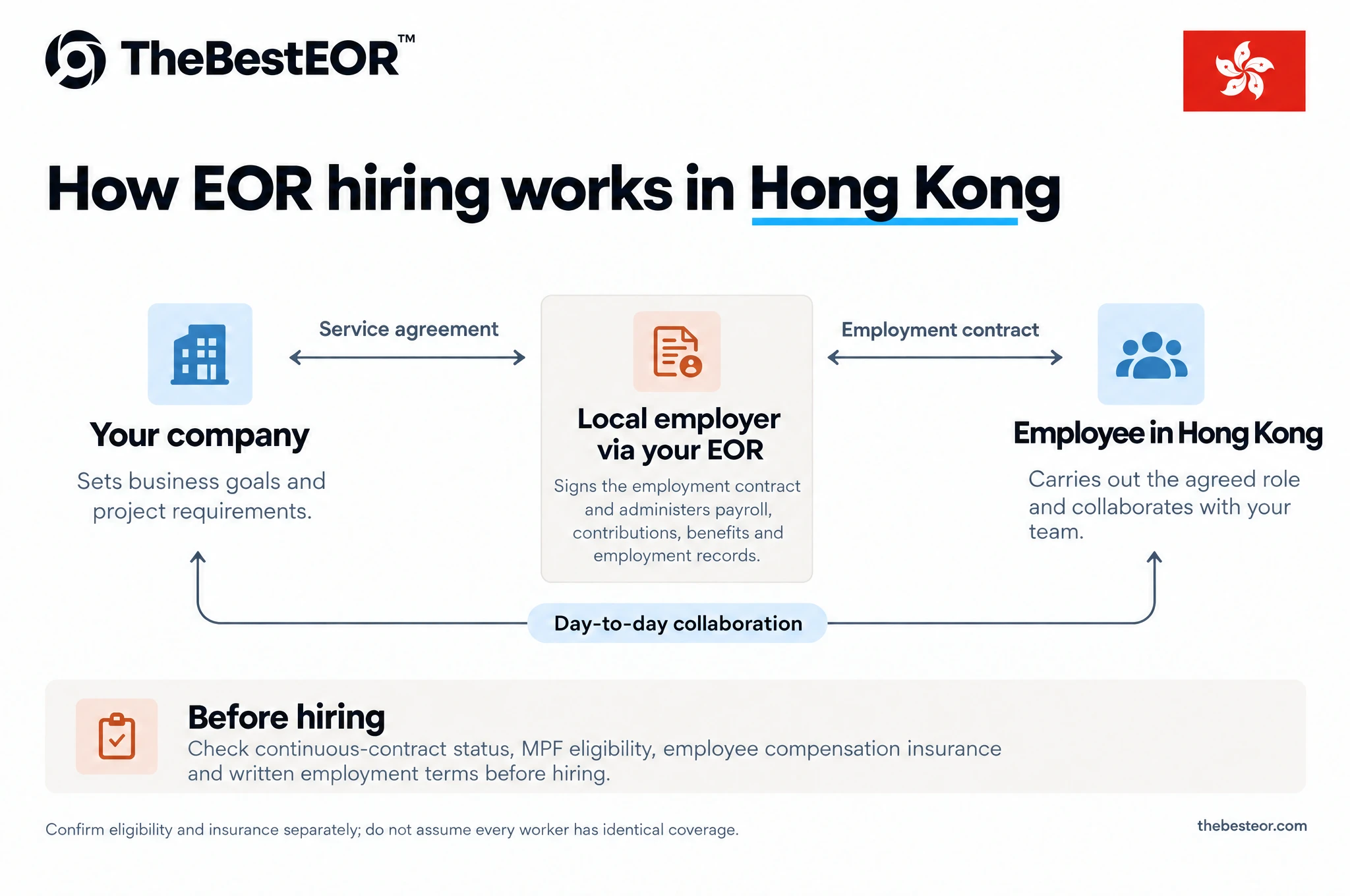
You direct the work, while the proposed Hong Kong employer signs the employment contract and administers local payroll.

The agreement should identify contract terms, salary payment, MPF arrangements and responsibility for employment records.

Documents to confirm

Identify the actual employing entity, insurance policy and any work-authorisation support in the proposal. Check those documents against the individual role.

Employer cost

Statutory employer contributions in Hong Kong

Employer costs include capped MPF and insurance.

Hong Kong’s mandatory employer costs fit in two working lines: a capped MPF contribution and an insurance premium. There is no separate payroll tax or routine salaries-tax withholding. Departure tax-clearance rules can nevertheless require the employer to hold payments temporarily.

Fig. 2 · Where the employer money goes: MPF up to its HK$1,500 monthly cap, plus the employees’ compensation premium, which is set by the insurer per role and shown indicatively here

Contribution Employer rate Cap / basis Agency
Contribution

MPF mandatory contribution

Employee also pays 5%, waived below HK$7,100/mo income
Employer rate
5%
Cap / basis
Capped at HK$1,500/mo (relevant income ceiling HK$30,000/mo)
Agency
MPFA-registered trustee
Contribution

Employees' compensation insurance

Mandatory for every employee, full or part time
Employer rate
Premium varies
Cap / basis
Set by insurer, by role and industry
Agency
Labour Department (Employees' Compensation Ordinance)
Contribution

Income-tax withholding

Employee pays salaries tax directly
Employer rate
0% routine payroll withholding; departure holds can apply
Cap / basis
Employer files IR56 returns instead
Agency
Inland Revenue Department
Contribution

Other social security

No unemployment, health or pension charge beyond MPF
Employer rate
None
Cap / basis
No further charge exists
Agency
n/a

Fig. 3 · Mandatory employer contributions in Hong Kong, 2026 rates and monthly ceilings

Take a HK$25,000 salary: employer MPF is a straight 5 percent, HK$1,250 a month. Move to HK$45,000 and the 5 percent calculation would reach HK$2,250, but the statutory cap holds the contribution at HK$1,500, an effective 3.3 percent, and the effective rate keeps falling as pay rises. The employees’ compensation premium sits on top, priced by the insurer per role and typically modest for office work. The EOR fee sits on top of all of it.

Working time & leave

Working hours, overtime and statutory leave

The contract sets adult working hours and overtime pay.

Hong Kong sets no statutory limit on adult working hours and no statutory overtime rate; the contract governs both. Leave is where the Employment Ordinance does its work, and the statutory holiday count is climbing year by year.

Hours and pay

Standard week Contract-set
Common practice 40–48 hrs, 5-day weeks
Overtime rate Contractual
Rest day 1 per 7 days
Statutory holidays 15 in 2026
Minimum wage HK$43.10/hour
From 1 May 2026; covered workers

Fig. 4 · Hours and overtime · no statutory maximum working hours or overtime premium for adult employees; the rest day and holidays are statutory

Professional roles commonly set a 40-to-48-hour, five-day week in the contract. The statutory floor is elsewhere: one rest day in every seven for continuous-contract employees, a statutory minimum wage of HK$43.10 an hour from 1 May 2026 for workers covered by the Minimum Wage Ordinance, and statutory holidays that stand at 15 in 2026 and rise stepwise to 17 by 2030 under the 2021 amendment to the Employment Ordinance.

For a wage period spanning 1 May 2026, the new rate applies only to hours worked on or after that date. Statutory exclusions still apply. See the Labour Department’s current minimum-wage rate and 2026 revision notice.

Statutory leave

Annual leave
7 days after year 1, rising to 14
7 → 14 days
Sickness allowance
4/5 of wages, 4+ consecutive days
Up to 120 days
Sick-day accrual
2/month in year 1, then 4/month
2–4 days/mo
Maternity
at 4/5 of wages
14 weeks
Paternity
at 4/5 of wages
5 days

Fig. 5 · Statutory leave entitlements · annual leave rises one day a year from 7 to the 14-day cap at nine years’ service

Paid annual leave starts at 7 days after twelve months of continuous employment and rises one day a year to a 14-day statutory cap at nine years; professional contracts commonly offer more. Paid sickness days accrue at two per month in the first year and four per month after, to a 120-day bank, with sickness allowance at four-fifths of average wages payable when the absence runs four consecutive days or longer. Statutory maternity leave is 14 weeks at four-fifths of wages, with the final four weeks reimbursable to the employer by the government up to a cap of HK$80,000 per employee; paternity leave is 5 days at the same four-fifths rate.

Ending employment

Probation, notice, severance and long service payment

The reason for leaving affects exit pay.

Notice lives mostly in the contract with a statutory floor beneath it, and the money owed at exit comes from a single formula that answers to two different names depending on why the employment ended.

Scenario Trigger What is owed
Scenario
First month of probation
Trigger
Either side ends the contract
What is owed
No notice required
Scenario
Ordinary termination
Trigger
Continuous contract, either side
What is owed
Contract notice, statutory minimum 7 days; one month is the market norm, pay in lieu permitted
Scenario
Redundancy
Trigger
24+ months of service
What is owed
Severance payment: 2/3 of last month's wages (wage capped at HK$22,500) × years of service
Scenario
Dismissal, not redundancy or misconduct
Trigger
5+ years of service
What is owed
Long service payment: same formula, never payable alongside severance
Scenario
Summary dismissal
Trigger
Serious misconduct
What is owed
No notice, no severance or long service payment

Fig. 6 · Termination scenarios under the Employment Ordinance · the severance and long service formula caps the counted wage at HK$22,500 and the total payment at HK$390,000

Hong Kong termination is contract-first: no cause needs to be shown for an ordinary dismissal with notice, and the Employment Ordinance’s role is the floor beneath the contract, a 7-day minimum notice on a continuous contract, protection against dismissal in specified circumstances such as pregnancy or sick leave on sickness allowance, and the exit payments in the table. Severance payment and long service payment share one formula and never stack; which one applies depends on whether the job disappeared. Since 1 May 2025, the offset test divides service before and after the transition date. Benefits derived from mandatory employer MPF contributions cannot offset the post-transition portion of severance or long service payment. They can offset an eligible pre-transition portion regardless of when those contributions were made. The EOR should show the two service portions separately in the exit calculation.

Redundancy of a 3-year employee on HK$30,000/month Formula wage base = 2/3 × HK$30,000 = HK$20,000, capped at HK$15,000

Notice

One-month contract norm, paid in lieu
HK$30,000

Severance payment

Capped HK$15,000 × 3 years of service
HK$45,000

Accrued unused leave

Assume 5 days × ≈ HK$986 daily wage
HK$4,932

Indicative exit cost

≈ $10,250 at HK$7.8 to the dollar
HK$79,932

Fig. 7 · Redundancy of a 3-year employee on HK$30,000/month · statutory severance formula plus the one-month contractual notice norm

The formula is statutory, so unlike Singapore’s negotiated retrenchment norms this figure moves only with the wage and the years: the counted wage caps at HK$22,500 (so a HK$60,000 earner and a HK$35,000 earner accrue the same HK$15,000 per year) and the total payment caps at HK$390,000. Any year-end payment promised in the contract accrues pro rata to the exit as well. The guide on termination across jurisdictions prices the same departure in markets where the formula runs steeper.

An exit calculation with service on both sides of the change

Suppose an eligible redundancy involves one complete year of service before 1 May 2025 and two after it. Assume the applicable pre-transition monthly wage is HK$18,000 and the applicable termination wage is HK$24,000. The pre-transition calculation is HK$18,000 × 2/3 × 1 = HK$12,000. The later portion uses the HK$22,500 wage ceiling: HK$22,500 × 2/3 × 2 = HK$30,000. The combined illustration is HK$42,000 before any permitted offset.

This example assumes those wage bases apply; the statutory wage-election rules can matter. Ask the provider to retain the service split, wage evidence and offset calculation. Mandatory employer MPF benefits may offset the eligible earlier portion, but not the HK$30,000 later-service portion; voluntary benefits and service-based gratuities need separate treatment. Notice, unused leave and other sums remain separate.

Payroll & tax

Payroll cycle and salaries tax in Hong Kong

Departure tax clearance can temporarily hold up payment.

Monthly payroll, no routine salaries-tax withholding, and a currency pegged to the US dollar. Departure tax clearance can require a temporary payment hold. The EOR files every return; here is what moves between it, the trustee and the Inland Revenue Department.

Hong Kong runs no pay-as-you-earn system. The employer’s tax role is reporting: it notifies the Inland Revenue Department of a new hire within three months of the start date, files an annual return of each employee’s remuneration after the tax year ends on 31 March, and the IRD assesses the employee directly. Ordinary payroll does not withhold salaries tax, but departure tax-clearance rules can require the employer to hold payments.

Payroll itself runs monthly in Hong Kong dollars, and the Employment Ordinance requires wages within seven days of the end of the wage period; holding payment longer accrues interest and is an offence. MPF follows by the 10th of the next month. The Hong Kong dollar has been pegged to the US dollar since 1983, trading in a band of 7.75 to 7.85, so a US-headquartered employer budgeting a Hong Kong salary carries effectively no exchange risk, and every conversion on this page uses HK$7.8 to the dollar.

Departure tax clearance can affect final pay. Where a chargeable employee will leave Hong Kong for more than one month, the employer generally files IR56G at least one month before departure; frequent business travel is an exception. From notification, the employer withholds payments for one month or until an IRD letter of release arrives, whichever comes first. Agree the filing and release dates before the employee leaves.

The employment contract

Contract requirements and 13th-month norms

Specify any year-end payment in the contract.

Hong Kong law does not require an employment contract to be written, but written contracts in English or Chinese are universal practice and the EOR supplies one, because the Employment Ordinance requires the employer to state the conditions of employment, wages, wage period, notice and any year-end payment, before employment begins, and to give written particulars on request. The Ordinance’s minimum entitlements are implied into every contract and cannot be signed away; a clause that purports to extinguish a statutory right simply fails. Itemised pay records must be kept, and the EOR issues payslips as standard.

Probation is customary at one to three months. The statutory posture is permissive: no notice is needed from either side inside the first month of probation, and after that the contract’s probation notice applies with a 7-day statutory floor. Fixed-term contracts are permitted without a statutory limit on renewals, but the continuous-contract test keeps counting across renewals, so a chain of fixed terms builds the same severance and long-service tenure an open-ended contract would; the EOR uses fixed terms only where the work is genuinely time-bound.

There is no statutory 13th month. The year-end payment, typically one month’s pay landing before Lunar New Year, is a market custom strong enough that many candidates read a package without it as below-market. The Employment Ordinance takes a distinctive position: it does not require the payment, but once the contract provides one, statutory end-of-year payment rules attach, including proportional payment for an employee who has served a completed part of the bonus year when employment ends. So the drafting matters more than in most markets: state the payment as guaranteed or as genuinely discretionary, and the EOR will administer whichever the contract says.

Division of responsibility

What the EOR handles, and what stays with you

The EOR remits MPF on the salary you agree.

The EOR remits the employer contribution to the MPF trustee by the 10th and handles insurance and tax filings. You set the salary.

Employer of record in Hong Kong diagram showing the service agreement, employment contract, and day-to-day collaboration between your company and the employee.
Employer of record in Hong Kong: how your company, the local employer and the employee work together. Select the image to enlarge.

The EOR handles

1
Legal employer on the employment contract, and the statutory liability that follows it
2
MPF scheme enrolment within 60 days and monthly remittance by the 10th
3
Employees’ compensation insurance cover for every hire
4
IRD reporting: commencement notification, the annual employer’s return, and departure clearance
5
Wages within seven days of period end, itemised pay records and payslips
6
Statutory leave, sickness allowance and maternity/paternity administration
7
Severance and long service payment calculation, including the two MPF offset pools around the 1 May 2025 change

You keep

1
What the person works on each day, and the standard it must meet
2
The salary, and whether the offer carries a year-end payment or any allowance
3
Which candidate gets the contract, and when a role ends
4
Performance management and the record behind any summary-dismissal decision
5
Laptops and tooling (Rippling device management is a separate paid product)
6
Your master agreement with the EOR, and the IP clauses you need carried into the employment contract

Misclassification in Hong Kong is priced in back-payments and offences. Engage someone as an independent contractor while directing fixed hours and the courts can find employment on the substance of the relationship; that finding arrives with back MPF for both shares plus surcharges, the full set of Employment Ordinance entitlements, and, most seriously, the offence of having employed someone without employees’ compensation insurance, which carries fines and potential imprisonment. An employment arrangement that meets local requirements can change how the worker is engaged from then on. It does not settle earlier classification liabilities. The misclassification guide covers the control-and-integration tests Hong Kong courts apply.

Work visas

Employment visas: GEP, ASMTP and the Top Talent Pass

Check whether the hire needs an employer sponsor.

Hong Kong admits professionals through employer-sponsored schemes with no quota and no points test, plus a talent pass that needs no job offer at all. Which route your hire uses decides whether the EOR’s entity matters to immigration.

Scheme Who it is for Sponsor Key requirements Processing
Scheme
General Employment Policy (GEP)
Who it is for
Professionals from outside mainland China
Sponsor
The employing entity
Key requirements
Degree or strong professional experience, market-rate package, case for hiring a non-local
Processing
~4 weeks with complete documents
Scheme
Admission Scheme for Mainland Talents (ASMTP)
Who it is for
Mainland Chinese professionals
Sponsor
The employing entity
Key requirements
Mirrors the GEP tests
Processing
~4 weeks with complete documents
Scheme
Top Talent Pass Scheme (TTPS)
Who it is for
High earners and graduates of eligible universities
Sponsor
None needed
Key requirements
HK$2.5M+ prior-year income, or a degree from the eligible-universities list
Processing
Applied for by the individual

Fig. 8 · The three main admission routes for professional hires · GEP and ASMTP are employer-sponsored; a Top Talent Pass holder already has the right to work for any employer

The General Employment Policy is the workhorse. There is no quota, no labour-market lottery and no points framework; the Immigration Department quotes around four weeks of processing once all documents are in.

The Top Talent Pass Scheme changes the buying decision more than any provider feature: a candidate who qualifies, on prior-year income of HK$2.5 million or more or a degree from the scheme’s eligible-universities list, applies without any employer at all and arrives already entitled to work. Hiring a TTPS holder through an EOR is therefore identical to hiring a local, sponsorship never enters, and the $199 tier serves them as well as the $599 tier does.

Salary benchmarks

Indicative salary ranges

Compare gross monthly salaries in Hong Kong dollars.

Monthly gross in Hong Kong dollars with a USD equivalent at the pegged HK$7.8 to the dollar. Ranges are compiled from the 2026 Hong Kong salary guides of the major recruiters, Michael Page and Robert Walters among them; use the midpoint as a starting offer, not a ceiling.

Check current pay data for the role and location before you make an offer.

Role Gross HKD/month USD/month (approx)
Role
Software engineer
Gross HKD/month
HK$35,000–60,000
USD/month (approx)
$4,487–7,692
Role
Senior software engineer
Gross HKD/month
HK$55,000–85,000
USD/month (approx)
$7,051–10,897
Role
Product manager
Gross HKD/month
HK$50,000–80,000
USD/month (approx)
$6,410–10,256
Role
Accountant
Gross HKD/month
HK$30,000–50,000
USD/month (approx)
$3,846–6,410
Role
Customer support
Gross HKD/month
HK$18,000–28,000
USD/month (approx)
$2,308–3,590
Role
Sales manager
Gross HKD/month
HK$45,000–75,000
USD/month (approx)
$5,769–9,615
Role
HR manager
Gross HKD/month
HK$40,000–65,000
USD/month (approx)
$5,128–8,333
Role
Designer
Gross HKD/month
HK$28,000–45,000
USD/month (approx)
$3,590–5,769

Fig. 9 · Monthly gross by role, 2026 · recruiter salary-guide ranges; USD at the pegged HK$7.8 to the dollar

The employer MPF contribution reaches its HK$1,500 monthly cap at HK$30,000 of relevant income. In the illustrative HK$45,000 monthly salary example below, the contribution is capped. Employee-compensation insurance and other applicable employment costs still need to be budgeted separately.

Selected monthly costs

What a Hong Kong engineer costs per month

The example starts at HK$45,000 gross per month.

Software engineer, Hong Kong Gross base: HK$45,000/month
Gross salary HK$45,000
MPF employer contribution
5% capped at HK$1,500 above the HK$30,000 income ceiling
HK$1,500
Employees' compensation insurance
Premium set by insurer per role; modest for office work, excluded here
Varies
EOR fee illustration
RemoFirst $199 ≈ HK$1,552
⚠ Trustpilot warning: rating suspended for a breach of its guidelines; fake reviews removed
HK$1,552
Monthly total, cheapest fee
Annual ≈ HK$576,624 (about $73,900)
HK$48,052

Fig. 10 · Illustrated monthly subtotal, illustrative software-engineer salary at HK$45,000 gross · statutory cost is the capped MPF line; the EC insurance premium varies by policy

The illustrated employer MPF contribution is HK$1,500 monthly. Employees’ compensation insurance is mandatory, and its premium is not included in the HK$48,052 subtotal. At the same exchange rate, fees of US$499, US$599 and US$699 give subtotals of HK$50,392, HK$51,172 and HK$51,952 before that premium and any other applicable costs. Compare the policy, benefits, funding and support scope alongside the fee.

EOR vs your own entity

EOR or your own Hong Kong company: compare costs

Allow for a bank account and the annual audit.

Factor EOR Your own limited company
Factor
Setup cost
EOR
None
Your own limited company
Roughly HK$4,000–5,000 in incorporation and business-registration fees, plus service-provider costs
Factor
Time to first hire
EOR
2–12 days
Your own limited company
Incorporation in days; corporate bank account and MPF scheme setup often take weeks
Factor
Local requirements
EOR
None for you
Your own limited company
No resident director needed, but a Hong Kong-resident company secretary and a local registered address are mandatory
Factor
Per-employee cost
EOR
$199–699/employee/mo fee + statutory
Your own limited company
Statutory only, plus shared overhead
Factor
Ongoing admin
EOR
Provider runs payroll & filings
Your own limited company
Company secretary, annual return, audited accounts every year, profits tax, your own payroll, MPF and IR56 filings
Factor
Compliance liability
EOR
On the EOR
Your own limited company
On you and your directors

At an illustrative USD 199 monthly service fee, a year of EOR fees is about HK$18,600 per employee on top of statutory costs you would owe either way. A Hong Kong company’s registry fees are trivial by global standards and no resident director is required, but the recurring obligations are not free: a Hong Kong-resident company secretary, a registered address, an annual return, a profits tax filing and, unusually for a market this light-touch elsewhere, a statutory audit of the accounts every year regardless of company size. On typical market quotes those recurring services run roughly HK$20,000 to HK$40,000 a year before anyone runs payroll.

Annualise the selected service fee for the hires you expect to keep, then compare it with the limited company’s secretary, registered address, accounting/audit, MPF and payroll costs. Count setup costs over the same hiring horizon and include payroll, benefits, transition and exit charges on both sides. A higher service-fee plan moves the financial crossover earlier; lower recurring entity overhead or a longer hiring horizon can do the same. Short hiring duration, setup costs and the need for local administration can move it later.

FAQ

EOR in Hong Kong: common questions

Check MPF caps, payroll deadlines and exit rules.

What is the best EOR in Hong Kong?

RemotePeople is our top pick for Hong Kong in 2026 (4.9/5), followed by Deel (4.7/5) and Rippling (4.5/5). We opened paid accounts with all 10 providers on this page, priced real hires and ran payroll.

RemotePeople offers recruitment and EOR through one provider, with a dedicated account manager on both EOR plans. RemotePeople’s EOR Global plan starts at USD 499 per employee per month, and EOR Select at USD 199 where the hire qualifies. Deel starts at USD 599 plus a mandatory Employer Liability Cost; Rippling starts at USD 499 plus its required platform subscription.

How does an employer of record work in Hong Kong?

An employer of record in Hong Kong becomes the worker’s legal employer through a local employing entity, while your company directs the day-to-day work. The EOR enrols the employee in an MPF scheme within 60 days and pays contributions by the 10th of each month, arranges employees’ compensation insurance and handles the IRD commencement notice and annual employer’s return. It pays wages within seven days of the period end and calculates any severance or long service payment.

How fast can an EOR onboard an employee in Hong Kong?

Estimated onboarding times for Hong Kong range from 2 to 12 days across the providers we tested. By provider: Deel 2–5 days, Rippling 2–5 days, G-P 2–5 days, Multiplier 3–6 days, RemotePeople 5–8 days and Oyster 7–12 days.

A foreign hire who needs an employment visa under the General Employment Policy adds the Immigration Department’s processing time, which runs about four weeks once all documents are in, whichever provider you pick.

How much does an EOR cost in Hong Kong per month?

Published service fees for Hong Kong run from USD 199 to USD 699 per employee per month across the 10 providers we tested: RemoFirst from USD 199; RemotePeople Global from USD 499, or Select from USD 199 only where country and salary qualify; Deel from USD 599 plus mandatory Employer Liability Cost; G-P from USD 599; Oyster USD 699 on monthly billing, with annual seats quoted separately. Multiplier Core advertises $499 monthly or $459 per month billed annually; Pebl advertises $399, with currency and commitment to confirm. Rippling starts at USD 499 plus its required platform from USD 8 per employee, and Papaya Global at USD 499. Borderless AI is USD 579 standard, with an eligible USD 399 promotion on fees billed through 31 December 2026. All amounts are per employee/month; salary and employment costs are separate. 

On top of the fee you pay the gross salary, employer MPF of 5 percent capped at HK$1,500 a month, and the premium on mandatory employees’ compensation insurance. There is no employer income-tax withholding to fund.

What employer contributions are mandatory in Hong Kong?

Two items. The employer pays 5 percent of the employee’s relevant income into a Mandatory Provident Fund scheme, capped at HK$1,500 a month once income reaches HK$30,000, and must hold employees’ compensation insurance for every employee under the Employees’ Compensation Ordinance. There is no employer social security beyond that and no payroll tax, which is why Hong Kong’s statutory employer load is among the lowest of any major hiring market.

Can an EOR sponsor a work visa in Hong Kong?

Yes. The EOR’s Hong Kong entity acts as the sponsoring employer on a General Employment Policy application, which asks for a degree or strong professional experience, a market-rate package and a case for why the role goes to a non-local. There is no quota and no points test for professionals. A candidate holding a Top Talent Pass already has the right to work, so any provider can employ them without sponsorship.

Is a 13th-month payment mandatory in Hong Kong?

No. Hong Kong law does not require a 13th month, but a year-end payment of one month’s pay is a widespread market custom and many candidates treat it as part of the package. Once a contract promises it, the Employment Ordinance’s end-of-year payment rules apply, including pro-rata payment for a completed part of the bonus year. Write the year-end payment into the contract as guaranteed or discretionary so the status is never argued.

How does Hong Kong’s continuous-contract test work in 2026?

From 18 January 2026, an employee needs at least four weeks of continuous employment with the same employer. A week qualifies with at least 17 hours, or, when it falls below 17, with at least 68 hours in that week plus the three immediately preceding weeks with that employer.

The 68-hour alternative cannot be used for the first three weeks of new employment; each needs at least 17 hours. Periods before 18 January 2026 still use the former 18-hour weekly test. Meeting this definition does not automatically satisfy the separate service and payment conditions for every benefit. See the Labour Department’s current-rule explanation and transition FAQ.

A four-week schedule that passes the new test

Consider a hypothetical employee who starts after 18 January 2026 and works 20, 20, 20 and 8 hours in the first four weeks. The first three weeks each clear 17 hours. The fourth is below 17, but those four weeks total 68 hours, so it qualifies under the alternative test.

The following week needs its own assessment. You cannot keep reusing the first four-week total after the window moves. Give the EOR the hours for each week, not only a monthly total, and preserve records against the same employing entity.

What severance or long service payment do I owe in Hong Kong?

One or the other, never both. Redundancy after 24 months of service triggers severance payment; dismissal for reasons other than redundancy or serious misconduct after five years of service triggers long service payment. Both use the same formula: two-thirds of the last month’s wages, capped at two-thirds of HK$22,500, per year of service, to a maximum of HK$390,000. For service spanning 1 May 2025, split the payment into pre- and post-transition portions. Employer mandatory MPF benefits cannot offset the portion for service from that date, but can offset eligible earlier-service amounts regardless of when contributions were made; voluntary contributions and service-based gratuities follow separate rules.

Do I need a Hong Kong company to hire one person?

No. An EOR employs the worker through its Hong Kong limited company, so you skip incorporation, the Hong Kong-resident company secretary, the registered address, the annual audit that every Hong Kong company must file, and the corporate bank account that often takes longer to open than the company itself.

Annualise the selected service fee for the hires you expect to keep, then compare it with the limited company’s secretary, registered address, accounting/audit, MPF and payroll costs.

Sources and as-of dates

Article references

Hong Kong’s payroll rules are unusually stable, and the recent changes worth knowing, the MPF offset abolition and the rising statutory holiday count, were legislated years in advance. All rates as of August 2026.

Hiring facts Checked 2 Oct 2026

Hiring facts

Checked 2 October 2026
Eligibility, local and collective rules apply. EOR fees extra.

Employment Ordinance (Cap. 57) 11 sources

Continuous-contract rules effective 18 January 2026: at least four weeks with the same employer, with 17 hours in each week or the qualifying rolling 68-hour test; first-three-week and transition rules apply. Eligible employees receive one rest day per seven days and 7–14 days of annual leave by tenure. Sickness allowance is four-fifths of average daily wages, subject to eligibility and accumulated paid sickness days, up to a 120-day bank. Maternity leave is 14 weeks and paternity leave five days; paid entitlement generally requires 40 weeks under a continuous contract plus the relevant notice and evidence, at four-fifths of average daily wages. Maternity pay for weeks 11–14 is capped at HK$80,000. The Ordinance also sets notice requirements and governs contractual end-of-year payments. Wages must be paid as soon as practicable and no later than seven days after the wage period ends. Labour Department.

Mandatory Provident Fund Schemes Ordinance 4 sources

For covered regular employees paid monthly, employer and employee each contribute 5% of relevant income, subject to a HK$30,000 monthly ceiling (HK$1,500 per side). No employee contribution is required below HK$7,100 a month; the employer still contributes 5%. Enrolment is generally due within the first 60 days of employment. Contributions are normally due by the 10th of the following month, with special first-contribution and non-working-day rules; new employees have an employee-side contribution holiday. Employer contributions are calculated from the first day of employment. Mandatory Provident Fund Schemes Authority (MPFA).

Severance & long service payment 3 sources

For eligible monthly-rated employees, severance or long service payment is generally two-thirds of the relevant monthly wage, capped at a HK$22,500 wage base, for each year of service, with an overall HK$390,000 maximum. Severance generally requires at least 24 months under a continuous contract and redundancy or lay-off; long service payment requires at least five years and a qualifying termination or other statutory circumstance. An employee cannot receive both for the same termination. For service spanning 1 May 2025, the calculation is split into pre- and post-transition portions. Employer mandatory MPF benefits cannot offset the portion for service from that date; they can still offset the earlier-service portion, regardless of when the contributions were made. Employer voluntary MPF benefits and service-based gratuities retain separate offset rules. Labour Department.

Statutory holidays 2 sources

15 statutory holidays in 2026, rising to 16 from 2028 and 17 from 2030 under the Employment (Amendment) Ordinance 2021. Easter Monday is the additional holiday in 2026, followed by Good Friday in 2028 and the day following Good Friday in 2030. Statutory holiday pay has separate eligibility conditions. Labour Department.

Employees' compensation insurance 2 sources

Employees’ compensation insurance is compulsory under the Employees’ Compensation Ordinance, including for part-time and temporary employees. Employers should obtain an insurer’s quote for the actual workforce, duties and risk profile. Labour Department.

Salaries tax 4 sources

Salaries Tax is assessed on the employee. The calculation compares progressive rates of 2–17% on net chargeable income with the two-tier standard rate on net income: 15% on the first HK$5 million and 16% above, using the lower result. Employer reporting includes an IR56E within three months of starting employment where the employee is likely to be chargeable, an annual return following the 31 March year end (normally within one month of issue), and an IR56G at least one month before a chargeable employee leaves Hong Kong for more than a month, subject to the frequent-business-travel exception. Departure payments must be withheld for one month from notification or until an IRD letter of release arrives, whichever is earlier. Inland Revenue Department (IRD).

Statutory Minimum Wage 2 sources

For covered workers, the minimum wage is HK$43.10 per hour for hours worked from 1 May 2026. These two updates checked on 23 September 2026.

Immigration 5 sources

The General Employment Policy and Admission Scheme for Mainland Talents and Professionals provide employer-sponsored professional routes that are generally quota-free; their Technical Professionals Stream has quotas and specified-trade conditions. The Top Talent Pass Scheme has income and eligible-university degree routes, does not require an employment offer at application, and its Category C is quota-limited. The Immigration Department normally quotes around four weeks for complete entry applications and the required application fee.

Currency 2 sources

The Hong Kong dollar’s link to the US dollar began in 1983. The HK$7.75–7.85 convertibility band was introduced through refinements in 2005. Conversions on this page use HK$7.8 = US$1; actual transaction rates and fees can differ.

Incorporation 5 sources

For a Hong Kong local company with share capital, the Companies Registry incorporation fee is HK$1,545 electronically or HK$1,720 on paper, plus the applicable IRD business registration fee and levy. For incorporation submissions from 1 April 2026 to 31 March 2027, the business registration fee and levy total HK$2,350 for a one-year certificate (HK$2,200 fee plus HK$150 levy), or HK$6,170 for a three-year certificate. A company secretary must be either an individual ordinarily resident in Hong Kong or a corporate secretary with a registered or principal office in Hong Kong; the company also needs a Hong Kong registered office. Financial statements normally require an audit, with a statutory exception for dormant companies. Recurring-overhead estimates are market quotations and need a dated, itemised quote; they are not official government fees.

Salary benchmarks 1 source

Jobsdb publishes employer-disclosed monthly HKD salary information for Hong Kong software engineers. Compare the same role and district, and check included benefits. USD figures use the illustrative HK$7.8-per-dollar conversion.

Provider pricing, entity model and onboarding 10 sources

Further sources (October 2026) 3 sources

Labour Department — 2026 continuous-contract explanation — 17-hour and rolling 68-hour tests, first-three-week restriction, 18 January 2026 commencement and separate benefit eligibility. Accessed 19 October 2026.

Labour Department — abolition of MPF offsetting FAQ — Separate pre/post-1 May 2025 service portions and wage bases; mandatory versus voluntary benefit offset rules. Accessed 19 October 2026.

Inland Revenue Department — departure tax clearance, April 2026 — Chargeable employees departing over one month; business-travel exception; notification and one-month-or-release withholding period. Accessed 19 October 2026.

The country guides cover other markets. For this hire, browse EOR providers for Hong Kong and use the EOR cost calculator to compare the recurring amounts in your proposals in USD.

This guide is for general information only and does not provide legal, tax, accounting, or financial advice. For advice about your business, consult a qualified professional familiar with the rules where you hire. The research methodology explains how TheBestEOR assesses sources.