


Guide overview
How does the monthly EOR payroll cycle work?
Agree the inputs, approvals, funding and evidence.
You supply and approve payroll changes; the EOR calculates pay, arranges employee payments and fulfils the agreed employer filing duties. Track the actual country calendar, cleared funding, payslips and reconciliation. Provider cutoffs and extra-run terms do not replace statutory wage deadlines.
Inputs
Agree the cutoff
Submit complete changes and identify late-input exceptions.
Approval
Assign the sign-off
Agree who checks and approves the payroll inputs.
Funding
Confirm the deadline
Make the payment and funding dates explicit.
Reconciliation
Review the results
Confirm payments, filings and outstanding exceptions.
Check before acting
A processing cutoff does not override wage-payment obligations. If an input is late, agree how payroll will meet the applicable payment deadline.
What to record in the worksheet
Scope
Milestone / issue · Country / employee · Date and timezone
Evidence and follow-up
Owner · Amount / currency · Approval / temporary payment plan · Evidence · Resolution status
The five monthly payroll handoffs
Confirm pay, changes, leave and approved expenses.
Check the calculation and investigate differences.
Meet the agreed funding requirements for the pay run.
Confirm the correct amount reaches the employee on time.
Match the invoice and filings.
Give each handoff an owner and a deadline for the country where the employee works. Put statutory payments on the same calendar. Some are due before payday.
Payroll controls for exceptions
Before the first run, agree what payroll and the EOR will do if an input arrives late, a calculation looks wrong or a payment goes missing.
| Exception | Client action | Evidence to close it |
|---|---|---|
Exception
Change after cutoff
|
Client action
Escalate the amount, effective date and employee impact immediately.
|
Evidence to close it
Written payment plan that meets the applicable deadline.
|
Exception
Funding still in transit
|
Client action
Confirm cleared funds and escalate any likely shortfall.
|
Evidence to close it
Provider acknowledgment of available payroll funding.
|
Exception
Unexpected payslip
|
Client action
Compare approved inputs, tax setup, benefits and calculation.
|
Evidence to close it
Explained correction and revised payslip where needed.
|
Exception
Overpayment
|
Client action
Check the local rules for recovering an overpayment before making deductions.
|
Evidence to close it
Calculation, required consent or notices, and repayment record.
|
Exception
First or final payroll
|
Client action
Check prorations, special payments, leave and pay deadlines.
|
Evidence to close it
Approved itemized calculation and payment confirmation.
|
Exception
Month-end reconciliation
|
Client action
Match payroll totals, provider invoices, funding and adjustments.
|
Evidence to close it
Reconciliation record with each variance resolved or owned.
|
A wrong payment can start with an input, a payroll setting, a calculation, a tax change or a bank transfer. Check the records with the EOR to find out what happened. Establish who will correct the payroll, arrange any payment and amend the filing if necessary.
Selected EOR payroll dates to put in your calendar
These are examples from different providers and countries. For your own pay run, get the employee’s country schedule and mark when inputs close, funds must arrive, wages are due and statutory filings must be made.
| When | What happens | Who acts |
|---|---|---|
When
1st (first business day)
|
What happens
Remote issues its pre-funding invoice for the month’s estimated payroll, usually due in 14 days
|
Who acts
EOR bills you
|
When
1st–5th
|
What happens
Change window: raises, new-hire data, terminations, and expenses go into the platform
|
Who acts
You
|
When
11th or 16th (Remote examples)
|
What happens
Remote example: standard cutoff 11th at 23:59 UTC, with some countries using the 16th; confirm your current country calendar
|
Who acts
You
|
When
11th–20th
|
What happens
Gross-to-net calculation runs in each country; the EOR reviews the draft payroll
|
Who acts
EOR
|
When
20th
|
What happens
Deel example: cutoff 20th in the cited rollout; confirm the country, current schedule and required expense approvals
|
Who acts
You
|
When
23rd–24th
|
What happens
Deel issues the month’s invoices (23:59 Pacific Time on the 23rd), due in 5 calendar days
|
Who acts
EOR bills you
|
When
24th–28th
|
What happens
You fund the invoice, the payment is converted if you pay in another currency, and the money reaches the EOR’s local payroll accounts
|
Who acts
You
|
When
3rd-to-last banking day
|
What happens
German social contributions are due, estimated and trued up next month; the contribution statement is due two banking days earlier
|
Who acts
EOR
|
When
Last working day
|
What happens
Payday: payslips go out, and the UK Full Payment Submission is filed on or before this day
|
Who acts
EOR
|
When
Next month, 5th
|
What happens
France DSN: 5th for employers with 50+ staff paying in the same month; normally 15th if paying the following month. Confirm the actual calendar. Remote’s reconciliation invoice is usually out by now (since January 2026, around the 3rd business day)
|
Who acts
EOR
|
When
Next month, 10th
|
What happens
German Lohnsteuer-Anmeldung (wage tax return) due
|
Who acts
EOR
|
When
Next month, 15th
|
What happens
France DSN and contributions due for employers under 50 staff
|
Who acts
EOR
|
When
Next month, 22nd
|
What happens
UK PAYE and National Insurance payment due (electronic)
|
Who acts
EOR
|
Fig. 1 · Selected provider and country deadline examples · Remote and Deel calendars checked September 2026.
Once treasury sends the funds, check that employees received their pay and match the invoice to the payroll records. The EOR handles employer filings. Some fall due the following month, so an error can still surface after payday.
Keep a calendar for each country cycle
Enter the actual input cutoff, approval, funding, payday and filing/remittance dates with timezone and owner. Account for the applicable local business calendar and bank processing. Keep any global internal deadline alongside the country’s required dates.
| The working record | Fields to complete |
|---|---|
The working record
Scope
|
Fields to complete
Milestone / issue · Country / employee · Date and timezone
|
The working record
Evidence and follow-up
|
Fields to complete
Owner · Amount / currency · Approval / temporary payment plan · Evidence · Resolution status
|
Payroll cutoffs and late changes
The payroll cutoff is the last time the provider accepts inputs for the scheduled run. After that, it calculates and locks the payroll and arranges funding. The dates below are the country-specific cutoffs Remote and Deel published when we checked in September 2026. If you’re choosing between them, you can also compare their EOR services.
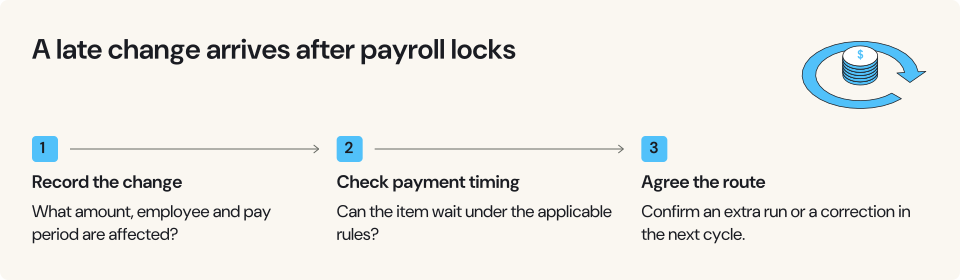
Cutoffs vary by country even at one provider, because local banks, tax agencies and payment rails differ. Get the calendar for every country where you employ, and plan around the earliest date.
A change that misses the cutoff may still be payable this month. Check the contractual and statutory pay dates for the employee, whether the change is a raise already in effect or wages a new hire has earned. Agree with the EOR how to meet the deadline, including an off-cycle payment if needed. Tell the employee the confirmed payment date.
Which payroll inputs you approve
The EOR calculates payroll from your decisions, so five kinds of input need your action before the cutoff:
Use a final payroll-input reminder. Set a recurring check three business days before each country’s cutoff to verify approvals and missing inputs. Start amendments, terminations and other date-sensitive work by their own deadlines; do not wait for this reminder.
Payroll funding and the two invoice models
Confirm the employing entity’s payment account and the agreed funding deadline, including any advance-funding or credit arrangement. For an initial budget, use our global payroll calculator to estimate employer costs and take-home pay by country, then confirm the actual funding requirement with your EOR.
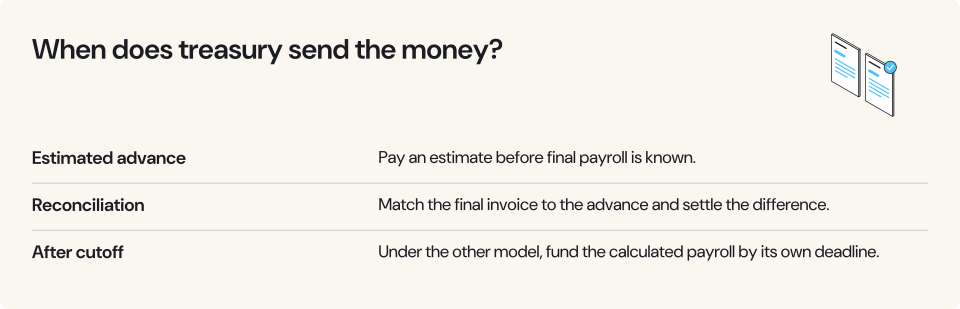
Pre-funding (invoice first, reconcile later). Remote invoices estimated payroll on the first business day of the month, usually due in 14 days, so you finance the month up front. A reconciliation invoice then settles the difference between the estimate and actual costs, including raises, expenses and FX movement. Since January 2026, Remote has issued it around the 3rd business day of the following month.
Calculate-then-invoice (invoice after the cutoff). Deel issues the month’s invoices at 23:59 Pacific Time on the 23rd, with five calendar days to pay, so funds arrive shortly before a month-end payday. You receive a payroll invoice in the employee’s local currency, covering salary, employer contributions and approved extras, plus a separate fee invoice. Confirm whether this arrangement permits later corrections, reconciliation invoices or other adjustments; the funding window can be tight. If you miss the due date, late payment fees apply and payday is at risk.
Use direct debit where your provider offers it, so the payment is collected automatically on the due date. Deel offers it in five currencies: ACH for USD, SEPA for EUR, BACS for GBP, PAD for CAD and BECS for AUD. Wires must arrive by the due date. At Deel, domestic bank transfers take 1–3 business days and international SWIFT transfers 3–7, so sending a wire on the due date may miss the cleared-funds deadline.
Expect a larger first invoice. Oyster, for example, normally takes a deposit of about one month of the new hire’s gross salary plus employer costs and fees, before the first run and provides for return within 60 days after all relevant sums have been received or confirmed, whichever is later, subject to permitted deductions and the final balance. The deposit is cash held under the agreement; confirm its amount, deductions and return conditions covered in the hidden fees guide.
Check when and how currency is converted
If you pay in a different currency from your employee’s salary, the conversion follows the agreed currency method, and providers may fix the rate at different points. Oyster uses the rate on the last day of the previous month for both its pre-funding and settlement invoices. Deel invoices payroll in the employee’s local currency, so any conversion happens when you pay.
Divide the converted amount by the local-currency amount to get the implied exchange rate. Keep the units in that order when you compare it with a reference rate. A difference can reflect the fixing time or a forward or guaranteed rate, so check the agreed benchmark and any separate charges before calling it a markup. The ECB euro reference rates and the WM/Reuters 4pm London benchmark are useful only when the date, time, currency direction and rate type match.
Conversion terms differ by provider, contract currency and payment route. The FX guide’s dated policy table and four-step invoice check distinguish advertised claims from verified invoice evidence. Confirm accepted funding currencies, conversion timing, rate source and separate charges in your quote.
Payday and payslip checks
Most EOR countries pay monthly, unlike the biweekly schedule common in the US, and payday is on or near the last working day of the month. Some markets, such as the Philippines and Mexico, pay twice a month, with two cutoffs. Deel pays on the Friday before when payday falls on a weekend, in monthly and twice-monthly countries alike.
Issuing payslips is a legal duty of the employer, which means the EOR:
On a first payslip, compare gross pay with the contract and check how payroll prorated it if the employee started mid-month. Match deductions to the payroll calculation and the net amount to the payment and bank details. Where the payslip omits employer contributions, use the payroll register or employer-cost report to reconcile them separately. Offer the employee 20 minutes with the EOR’s payroll contact to go through unfamiliar deductions.
Payroll filing and payment deadlines by country
Identify the legal employer, registered declarant or authorised payroll agent responsible for each filing, and record any duties your company retains. A filing deadline and a payment deadline can fall on different days. Put both on the calendar, name the person who will follow up, and keep the submission confirmation. An error can affect the employee’s record as well as the employer’s liability.
| Filing | Country | Deadline | If it is late |
|---|---|---|---|
Filing
Full Payment Submission (RTI)
|
Country
UK
|
Deadline
On or before each payday
|
If it is late
Monthly late-reporting penalties can be £100–£400 by headcount; exceptions and further charges may apply
|
Filing
PAYE + NIC remittance
|
Country
UK
|
Deadline
Electronic payment: 22nd after the tax month, or after the tax quarter if quarterly; 19th for payment by cheque through the post
|
If it is late
1–4% for repeated late monthly/quarterly payments; daily interest and additional 6-/12-month charges may apply
|
Filing
Lohnsteuer-Anmeldung (wage tax)
|
Country
Germany
|
Deadline
10th day after the applicable monthly, quarterly or annual reporting period (§41a EStG)
|
If it is late
A late-filing surcharge may apply under AO §152 according to the declaration and circumstances; €25,000 ceiling, not a 10% cap
|
Filing
Social contributions + Beitragsnachweis
|
Country
Germany
|
Deadline
3rd-to-last banking day of the same month; statement two banking days earlier
|
If it is late
Normally 1% per started month on the relevant arrears rounded down to €50; statutory exceptions apply
|
Filing
DSN (social declaration)
|
Country
France
|
Deadline
5th of the following month for 50+ staff paid in the same month; normally 15th for 50+ staff paid the following month and for fewer than 50 staff. Non-working-day extension applies; confirm the actual scheme.
|
If it is late
Late declaration: €60 per employee per month or part-month; a short-delay cap and conditional cancellation may apply
|
Fig. 2 · Statutory filings around payday and selected late penalties in the UK, Germany and France.
Two of these deadlines explain EOR practices that look arbitrary to clients. German social contributions are due before the month ends, so the EOR remits an estimate and trues it up in the next run. In the UK, the FPS goes to HMRC on or before payday, so check the FPS submission and reported pay date separately if funding or payment is late. Check the actual agreement for any allocation of penalties or correction costs.
Once a quarter, ask your EOR for filing confirmations in each country where you employ. Agree which acknowledgements or other evidence the employer or filing agent can provide and how quickly it will investigate a missing confirmation.
Reconcile one fictional payroll month
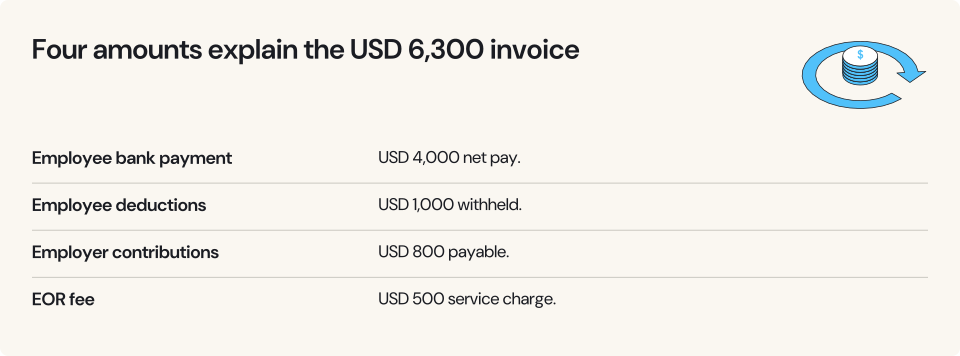
In this example, USD 5,000 in gross pay less USD 1,000 in employee deductions gives the employee USD 4,000. Match that payment to the bank record. Reconcile the USD 1,000 withheld and USD 800 in employer contributions to the remittance records. Add the USD 500 EOR fee and the four amounts account for the USD 6,300 invoice. If treasury already advanced USD 6,300, match it to the invoice. Record any later correction in its own period.
Give every exception a resolution record
Open a record for the employee with the amount in question, the payment due date, the person handling it and any temporary payment arrangement. Attach the correction and what you told the employee. Before closing it, check that the payment went through and that the payslip, invoice and filings reflect the correction.
When an extra payroll run is needed
An off-cycle run is any payment processed outside the standard calendar. Examples to plan for include:
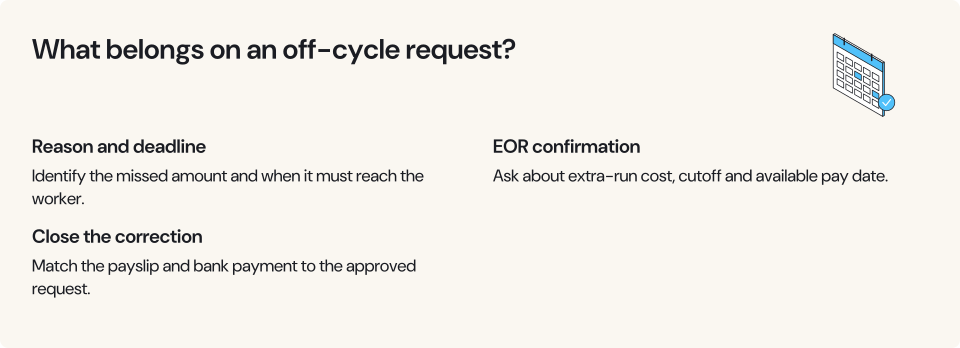
Deel’s published price is $29 for each employee affected by an On-Demand Payroll request, subject to the product’s availability and funding conditions. Deel says initiation is within the next business day after the invoice is paid; this is not a guaranteed bank-arrival time (provider terms checked 15 October 2026). If you use another provider, ask for its off-cycle price.
Agree the calendar and extra-run terms. Record the price and unit, billing trigger, included events and approval or waiver process before requesting a run. A disclosed then-current-rate clause still needs an accessible price before approval. Plan scheduled extras such as 13th-month pay in Brazil or the Philippines and annual bonuses in advance, and negotiate inclusion where useful. The EOR pricing-sheet guide has the full question set.
Your monthly EOR payroll checklist
Put these eight recurring actions in your calendar.
If payroll goes wrong, start with the approved inputs and follow the payment through the calculation, bank record and statutory submissions. That gives you and the EOR a way to locate the error before deciding who needs to fix it.
EOR payroll FAQs
What happens if we miss the payroll cutoff?
Why am I invoiced before my employee is paid?
What exchange rate does my EOR apply, and when?
When does my employee receive their salary?
Use the agreed country payroll calendar to confirm the contractual payday, applicable statutory deadline and pay frequency. Check how weekends and public holidays affect the payment date. Ask the EOR to confirm the first payday in writing before the hire starts.
Who pays the fine if a statutory filing is late?
The relevant employer or filing party may receive the authority’s penalty notice. Which costs the client must reimburse depends on the law, the cause of the error and the EOR agreement. Review the approved inputs, funding, processing record and contractual indemnities before assigning responsibility, and correct any effect on employee records or payment promptly.
Is a 13th-month payment an off-cycle run?
A scheduled statutory extra may be included in the base service or processed in a separately defined run. Before signing, confirm the included events, any separate-run trigger, fee unit and waiver process. Plan the payment early enough to meet the applicable wage deadline, and negotiate inclusion where useful.
Can we combine EOR payroll and our own-entity payroll in one report?
Yes, if your reporting service supports both employment types, or you combine their exports. Deel, for example, includes EOR and direct-payroll employees in its Global Gross-to-Net report, but its Global Payroll funding flow remains separate from EOR payments. Confirm which countries, employees and fields your reports cover.
Match employee IDs, employing entities, cost centres and pay periods, and keep local-currency amounts alongside the reporting currency. Reconcile salary, employer contributions, benefits and provider fees to payroll files and invoices; show deposits and advance funding separately from employment costs. A combined report does not change the employer: your own entity still employs its direct staff, while EOR staff remain employed under the EOR arrangement. Check who approves payroll, funds each payment and corrects errors for each service.
Sources and policy check dates
The sources behind this guide, grouped by topic. Dates show when we last checked a page. Prices and terms change, so confirm them in your quote.
Payslips and pay rules
7 sourcesUnited Kingdom · legislation.gov.uk
Employment Rights Act 1996, section 8: right to an itemised pay statement
Germany · gesetze-im-internet.de
Gewerbeordnung §108: Abrechnung des Arbeitsentgelts
The German payslip rule.
Germany · Federal Labour Court (BAG)
Electronic payslips and employee access, 28 January 2025
Checked 15 Oct 2026
Brazil · Planalto
Consolidação das Leis do Trabalho, Article 477
Final settlement within 10 days of termination.
Brazil · Planalto
The statutory 13th salary.
Philippines · Official Gazette
Statutory 13th-month pay.
Philippines · Department of Labor and Employment (DOLE)
Filing deadlines and late penalties
10 sourcesUnited Kingdom · GOV.UK
Running payroll: reporting to HMRC
Sending an FPS after paydayCorrecting an FPS or EPS
The FPS is due on or before payday. The pages on late and corrected submissions are used in the payroll example, checked 3 Oct 2026.
United Kingdom · GOV.UK
United Kingdom · GOV.UK
Late PAYE and National Insurance payments
Repeated-payment penalties, interest and longer-delay charges.
United Kingdom · GOV.UK
Penalty bands and exceptions.
Germany · gesetze-im-internet.de
Einkommensteuergesetz §41a: Lohnsteuer-Anmeldung
The applicable reporting period and the tenth-day deadline.
Germany · AOK
Germany · gesetze-im-internet.de
Sozialgesetzbuch IV §24: surcharge on late social contributions
1% per started month.
Germany · gesetze-im-internet.de
Abgabenordnung (AO) §152: late-filing surcharge
Declaration-specific rules and a €25,000 ceiling. Checked 15 Oct 2026
France · Service-Public.fr
Déclaration sociale nominative (DSN) deadlines and penalties
France · URSSAF
DSN deadlines, including 50+ employers paying the following month
Checked 15 Oct 2026
Exchange-rate benchmarks
2 sourcesEuropean Union · European Central Bank
LSEG
WM/Reuters 4pm London closing spot benchmark
Reference rate for USD pairs.
Provider payroll calendars and invoicing
5 sourcesBorderless AI
No published FX rate schedule behind the no-markup claim.
Deel
Payroll cut-off datesFlexible payroll announcementEOR invoices FAQLate payment feesOff-cycle paymentsAccount funding methodsReport typesPayroll Managed FAQ
Cutoff: the 20th in most countries; flexible payroll’s first stage moved 46 countries to it. Invoices issued on the 23rd, due in 5 calendar days; late fees after that. Off-cycle: $29 per affected employee. Direct debit in five currencies; bank transfers 1 to 3 business days domestic, 3 to 7 international (checked Sep 2026). Gross-to-Net reports cover EOR and direct payroll; Global Payroll is funded separately.
Oyster
EOR invoicing processWhy a deposit is requiredPricing
EOR invoicing uses a one-month refundable deposit and the month-end FX rate. The deposit is normally about one month of the new hire’s total cost of services (checked Sep 2026). A conversion fee applies only when paying outside the contract currency.
Remote
Payroll cutoffEOR invoice processNew hire’s first salary
Cutoff is the 11th of the month at 23:59 UTC (16th in some countries). EOR billing uses pre-funding and reconciliation invoices. A new hire’s prorated first salary is paid off-cycle by the 10th of the next month where available (checked Sep 2026).
Teamed
Zero-FX commitment: zero markup in any currency pairing.
Our research
1 sourceThe Best EOR
How we rate EOR providers.
If you spot a changed price or a conflicting source, send it through the contact page and we’ll review it.
This guide is for general information only and does not provide legal, tax, accounting, or financial advice. For advice about your business, consult a qualified professional familiar with the rules where you hire. Read our research methodology to learn how we assess sources.