TheBestEOR

Best Employer of Record in Kenya

Written by Martynas PupkeviciusFact-checked by Michael Ennis
Picture of Martynas Pupkevicius
Martynas Pupkevicius

EOR Advisor and Remote Work Editor

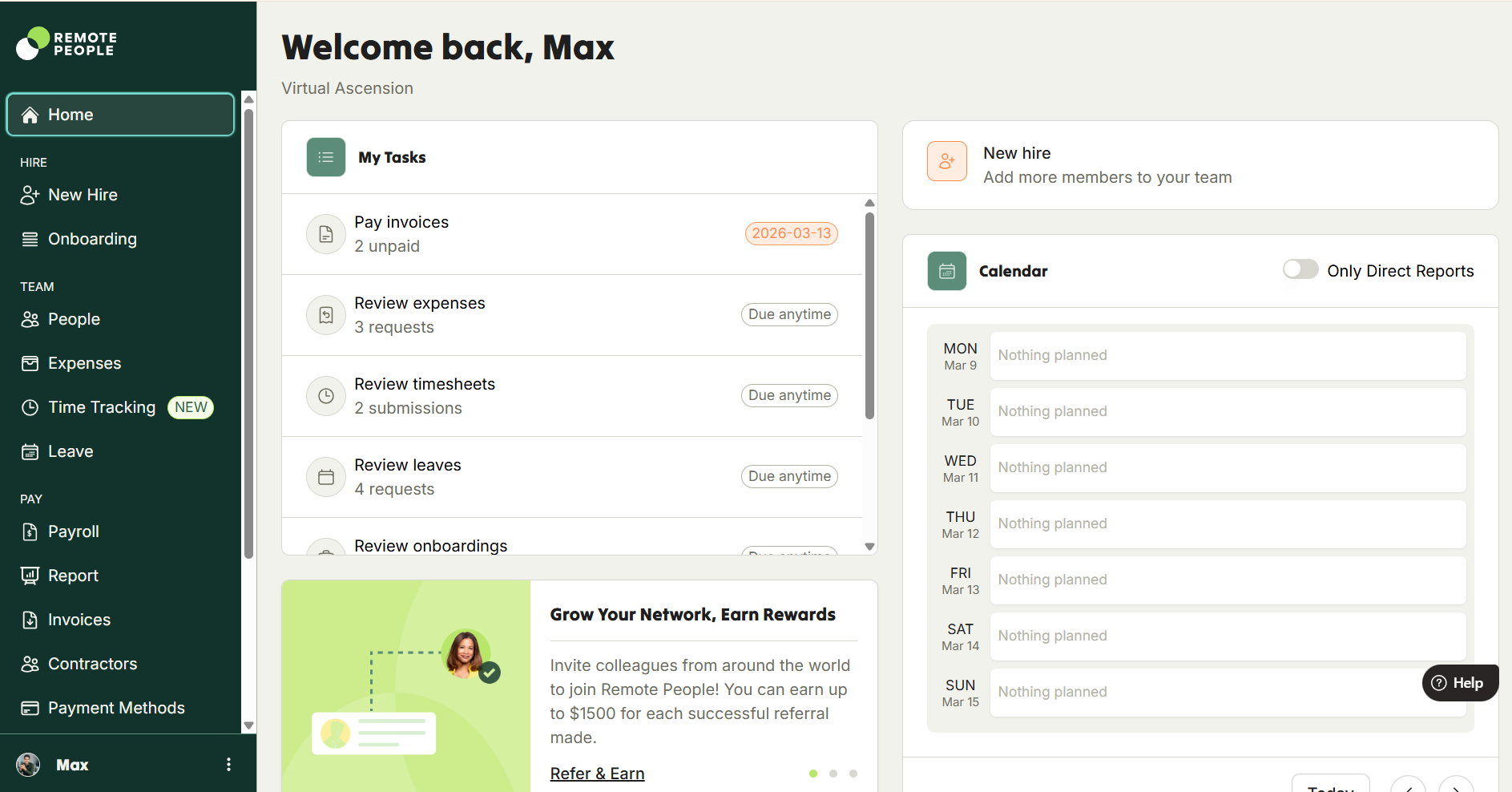
Our top employer of record in Kenya for 2026 is RemotePeople, from USD 499 per employee a month, ahead of Deel and Rippling.

We tested all 10 providers with paid client accounts, real quotes and a live hire run through payroll. Kenyan employers contribute to the National Social Security Fund pension and pay the housing levy, each calculated against a different earnings limit.

Flag of Kenya

Hiring in Kenya at a glance

Currency
KES
Kenyan shilling
Pay cycle
Monthly
Casual workers are generally paid daily
Working hours
52 hours
Over 6 days, sector and night limits differ
Annual leave
21 days
Working days after each 12 months of service
Extra pay
Per contract
Or union agreement, on top of normal salary
Employer costs
Social security
Plus the housing levy, with its own earnings limit
Before you hire:
Ask the EOR which sector wage order applies and how it calculates pension and the housing levy.

Country hiring overview · Kenya

Hiring in Kenya, at a glance.

Compare the local employer and the payroll funding plan.

For a Kenyan hire, I’d ask for the legal employer and payroll registration evidence. Compare the salary and contribution calculations, employee support and funding dates, with the provider fee shown separately from the employment budget.

Choose a hiring solution

Need a local employer?

Compare an EOR arrangement for your role before opening your own entity.

Already have a local employer?

Compare payroll and HR support against adding an EOR.

EOR service fee

Fees vary by provider.

Your quote should state the currency, fee per employee, minimum charge and billing commitment.

Onboarding

Paperwork affects the start date.

The contract, right-to-work checks, registrations and payroll deadlines all affect when employment can begin.

Employment costs

Include pension and levies.

The employment budget includes NSSF pension contributions, housing and training levies, and agreed benefits. The provider should show the calculation for each amount.

Annual leave

Leave starts after 12 months.

The Employment Act generally provides at least 21 working days of annual leave once an employee completes 12 consecutive months of service.

Check before choosing

Confirm PAYE and contribution handling, employee deductions, KES salary, invoice currency and the payroll funding deadline.

What your quote should include

Employment costs and service fees

1
Gross salary and agreed pay schedule
2
NSSF, housing/training levies and relevant benefits
3
EOR fee: currency, per-employee billing, minimums and commitment
4
Setup, foreign exchange, extras and exit costs

Deposits and payroll funding

1
Amount and payment deadline
2
Whether funds are refundable or credited to payroll
3
Release conditions and refund timing
Show these separately from recurring expenses.

Key takeaways for hiring in Kenya

NSSF employer contributions are capped

Under the NSSF schedule published for February 2026 onward, the maximum employer contribution is KES6,480 per month. A senior salary does not attract 6% on every shilling. Keep NSSF separate from the uncapped housing levy and use the payroll-period schedule when reconciling a quote.

Health deductions come out of employee pay

SHIF comes out of employee gross pay at 2.75%, subject to its minimum. Housing and NSSF have employer shares as well as employee deductions. An EOR invoice should distinguish money withheld from salary from money added to the employer’s budget.

The NITA training levy needs its own line

NITA is KES 50 per employee per month, paid by the employer. It is not another 1.5% contribution and should not reduce the employee’s salary. Keeping it separate makes an apparently small total-cost discrepancy easier to resolve.

Redundancy requires a process before the final payment

The statutory requirements cover notification, selection and payments. Give the legal employer the proposed business reason and affected roles early enough to manage the procedure before announcing a final departure date.

Quick verdict

What is the best EOR in Kenya?

1
Editorial pick
RemotePeople logo

4.9/5

RemotePeople

Hiring in new markets with local HR support

Starting fee
$499

per employee / month

Countries
150+
where you can hire

EOR Select from $199 for eligible hires.

Deposit
1 month

of gross salary

Deposit refund
Within 5 days

of the final payment

Why consider it

Recruitment and EOR services through one provider.

Dedicated account manager in both EOR plans.

Check the fit

Recruitment is separately priced.

Before signing: Confirm quote currency, billing commitment, deposits, funding deadlines and refund terms. EOR Select eligibility depends on the hiring country and employee salary.

Both EOR plans list local contracts, payroll and tax administration, and statutory benefits administration. Salary, employer contributions and benefit costs are separate.

Visit RemotePeople ↗

2
Deel logo

4.7/5

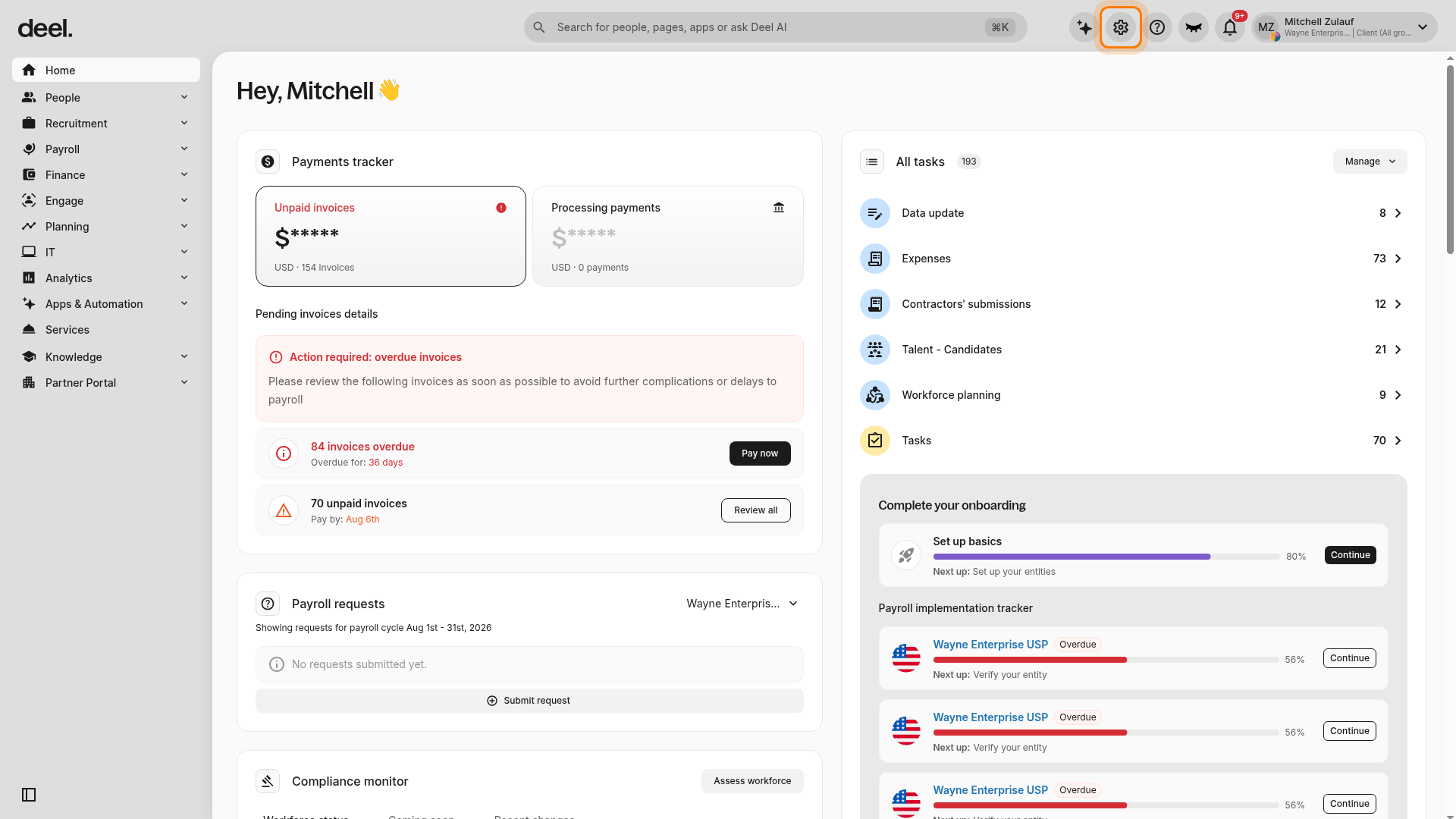
Deel

Paying employees and contractors on one platform

Starting fee
$599

per employee / month

Countries
130+
where you can hire

Plus a mandatory Employer Liability Cost.

Deposit
1–1.5 months

of gross salary

Deposit refund
Within 60 days

of offboarding

Why consider it

EOR, contractor management and payroll for your own entities.

Month-to-month EOR service pricing available.

Check the fit

Ask for the country-specific Employer Liability Cost in your quote; it is mandatory.

Before signing: Confirm the Employer Liability Cost amount, benefit costs and any additional products. Monthly service terms do not remove employment notice, severance or other exit obligations.

The EOR pricing page lists 130+ countries. Broader platform coverage figures may include other services.

Visit Deel ↗

3
Rippling logo

4.5/5

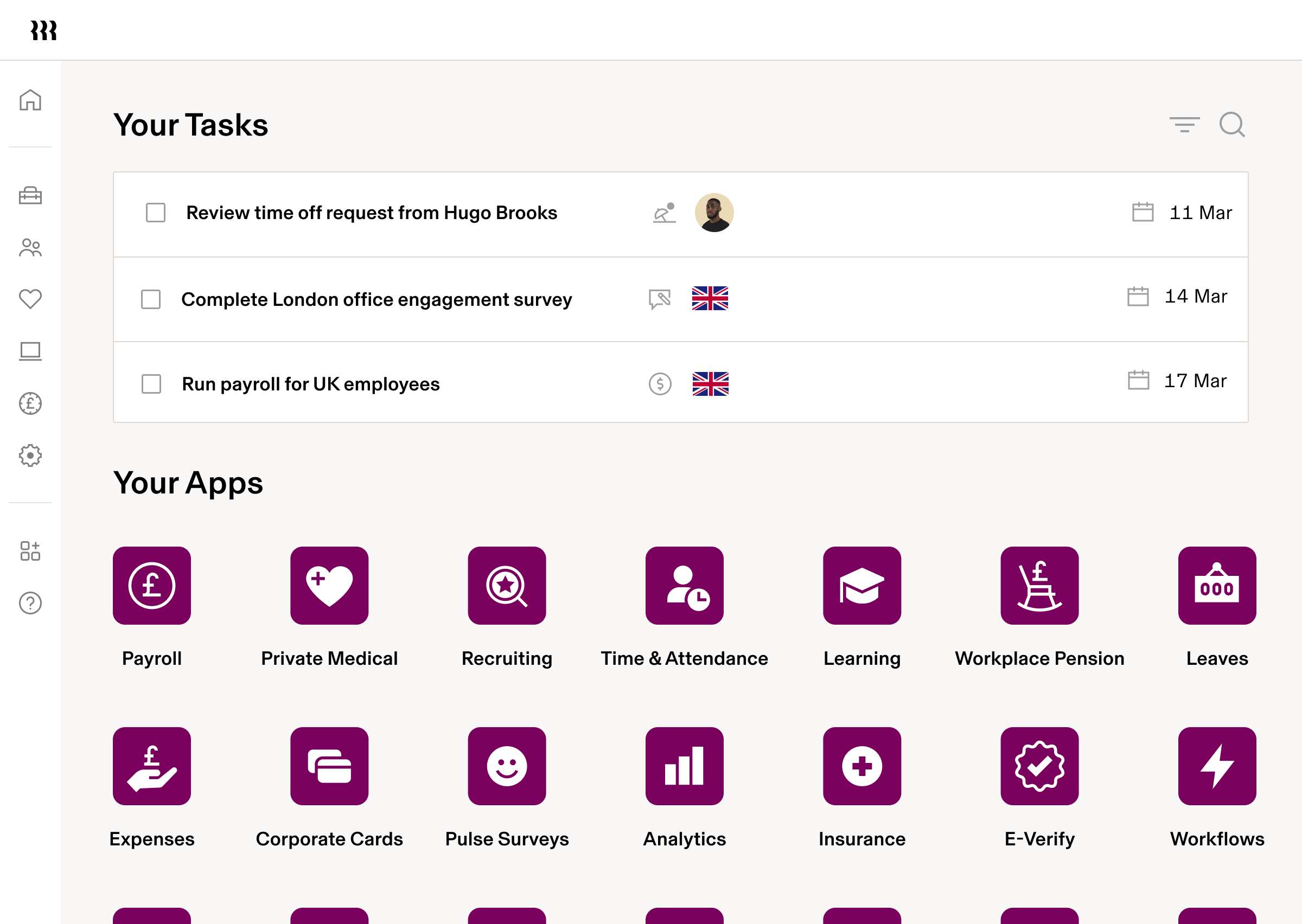
Rippling

Setting up payroll, laptops and app access for new hires

Starting fee
$499

per employee / month

Countries
115
where you can hire

Plus the Rippling Platform, from $8 per employee / month.

Deposit
Per quote

based on gross salary

Deposit refund
Per contract

set in your agreement

Why consider it

EOR, payroll, HR records and benefits administration in one platform.

Shared workflows and reporting for domestic and international teams.

Check the fit

Ask for an itemised quote showing the required platform and each HR or IT module.

A paid Rippling Platform subscription is required on top of the EOR fee, from $8 per employee per month plus a monthly base fee. Rippling EOR starts at $499 per employee per month. Other HR and IT products are priced separately.

Rippling’s EOR page lists 115 countries. Confirm your hiring country and legal employer.

Visit Rippling ↗

No provider pays for a position on this page; some outbound links pay a referral fee. See the funding model and methodology.

Entity, deposit, permits

All 10 EOR providers for Kenya, side by side

Allow extra time for a new work permit.

Prices are 2026 list fees per employee per month. Estimated onboarding times are for Kenyan-citizen hires; a foreign hire adds roughly two to four months of Class D work-permit processing on top of any row below.

Kenya’s payroll rulebook moved three times between 2023 and 2025: NSSF tiers began phasing in, the Affordable Housing Levy arrived, and SHIF replaced NHIF. The comparison below considers the complete service quote, payroll-funding terms and evidence of support for the changing rules. For the order across all markets, see the ranking of the best employer of record services worldwide. For a wider shortlist, browse EOR providers for Kenya.

Provider

Best For

Starting feeDepositOnboarding
1 RemotePeople logo RemotePeople 4.9/5 Rating Hiring in new markets with local HR support Starting fee: $499 USD / monthDeposit: 1 monthOnboarding: 3–8 days

My take

I’d compare RemotePeople’s two plans against your eligibility and budget.

Both include employment contracts, payroll and tax administration, statutory benefits administration, a dedicated account manager and ongoing employment support.

EOR Global starts at USD 499 per employee per month. EOR Select starts at USD 199 for eligible countries and employee salary ranges. Salary, employer contributions and benefits are separate; the proposal sets the applicable plan, billing commitment, deposit and payroll funding terms.

When this provider fits

RemotePeople and RemoFirst are worth comparing for a straightforward Kenyan hire when cost is a priority. Confirm which RemotePeople plan the salary qualifies for, then compare the same salary, benefits and support scope. Funding currency, exchange-rate charges and deposit release terms can change the cash required even where the advertised service fees look similar.

Deposit

1 month

Entity model

Own entities in core markets

First year, one hire

$5,988 in service fees

Reviewed by Martynas PupkeviciusFact-checked by Michael Ennis

Starting fee

$499

EOR Global. EOR Select starts at $199 where the country and employee salary qualify.

Against the 10 starting fees

$199 lowest$699 highest
2 Deel logo Deel 4.7/5 Rating Paying employees and contractors on one platform Starting fee: $599 USD / monthDeposit: 1–1.5 monthsOnboarding: 2–5 days

My take

The cash I’d set aside for Deel includes its refundable deposit, normally 1–1.5 months of gross salary. Higher requirements can apply, depending on the location and contract.

Deel’s global EOR service starts at USD 599 per employee per month, with month-to-month pricing available. Mandatory Employer Liability Cost is charged separately and varies by country. Salary, employer contributions, benefits and any additional services sit outside the starting service fee.

When this provider fits

I’d compare Deel and G-P when their wider international service scope fits your organisation. Ask for an itemised contribution calculation and the reporting available to your finance team, including proof of the agreed remittances.

Deposit

1–1.5 months

Entity model

Own entities and partners

First year, one hire

$7,188 in service fees

Reviewed by Martynas PupkeviciusFact-checked by Michael Ennis

Starting fee

$599

Month-to-month billing. Mandatory Employer Liability Cost is charged separately.

Against the 10 starting fees

$199 lowest$699 highest
3 Rippling logo Rippling 4.5/5 Rating Setting up payroll, laptops and app access for new hires Starting fee: $499 USD / monthDeposit: Per quoteOnboarding: 5–10 days

My take

I’d look at Rippling when you want EOR employees to share HR records and workforce reporting with the rest of the organisation.

App access and device management are separate products, so I’d keep those costs distinct in the comparison.

Rippling EOR starts at USD 499 per employee per month, plus the required Rippling Platform from USD 8 per employee per month plus a monthly base fee. Billing commitment and optional HR or IT modules are quote-specific.

Deposit

Per quote

Entity model

Own entities and local partners

First year, one hire

$5,988 in EOR fees

Reviewed by Martynas PupkeviciusFact-checked by Michael Ennis

Starting fee

$499

Plus the required Rippling Platform, from $8 per employee per month and a monthly base fee. Confirm the billing terms and selected products.

Against the 10 starting fees

$199 lowest$699 highest
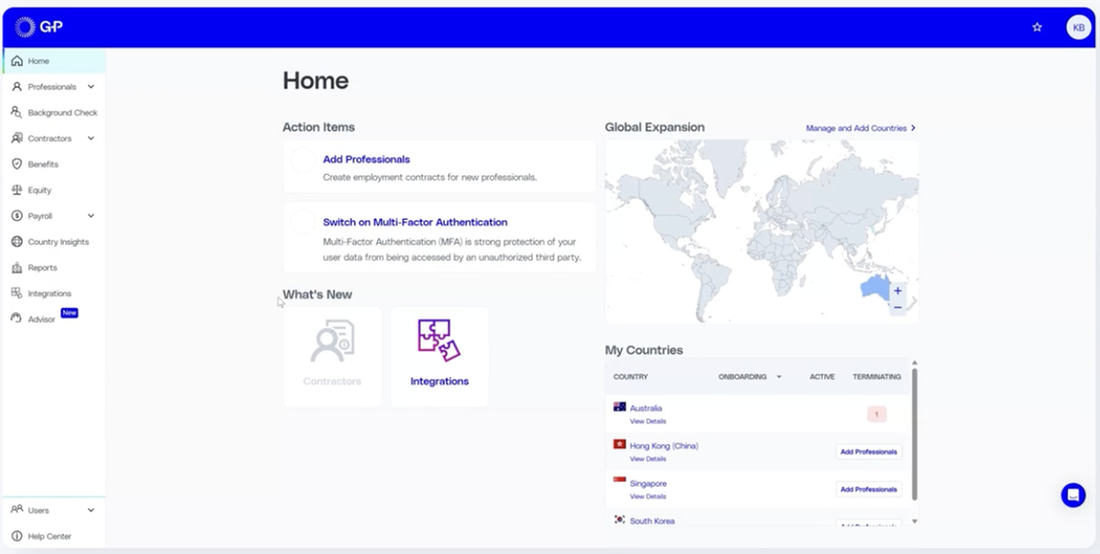
4 G-P logo G-P 4.2/5 Rating Hiring abroad while keeping your existing HR system Starting fee: $599 USD / monthDeposit: 1–2.5 monthsOnboarding: 2–5 days

My take

G-P would make my shortlist if you also need visa support, background checks or equity payroll management.

These are optional services alongside its employment service, with their own eligibility and charges.

G-P’s global EOR fee starts at USD 599 per employee per month, with a tailored country proposal. There is no minimum duration for an EOR hire; the client’s billing, cancellation and employee exit terms remain separate contract terms.

Deposit

1–2.5 months

Entity model

100+ own entities, plus partners

First year, one hire

$7,188 in service fees

Reviewed by Martynas PupkeviciusFact-checked by Michael Ennis

Starting fee

$599

Confirm the included services and billing terms in your country quote.

Against the 10 starting fees

$199 lowest$699 highest
5 Oyster logo Oyster 4.5/5 Rating Using one onboarding process for hires across countries Starting fee: $699 USD / monthDeposit: ~1 monthOnboarding: 7–14 days

My take

For Kenya, I’d check Oyster’s onboarding workflow before assuming it is automated.

Its virtual hiring assistant is available, but automated Team Member onboarding, automated agreements and electronic signature are unavailable in its automated Global Hiring workflow.

Oyster’s month-to-month EOR rate is USD 699 per employee per month. Annual seats are quoted separately. Standard annual billing is prepaid and non-refundable; quarterly or semiannual payment is available at a higher seat price. A seat can be reused for a replacement hire. Salary, employer costs, deposits and optional services are additional.

Deposit

~1 month

Entity model

Own entities and vetted partners

First year, one hire

$8,388 in service fees

Reviewed by Martynas PupkeviciusFact-checked by Michael Ennis

Starting fee

$699

Monthly billing. Annual seats are quoted separately, prepaid and non-refundable.

Against the 10 starting fees

$199 lowest$699 highest
6 Pebl logo Pebl 4.2/5 Rating Hiring people who need visa or relocation support Kenya work permits · Confirm which employer will support this hire’s Class D permit. Starting fee: $399 USD / monthDeposit: Per quoteOnboarding: 7–12 days

My take

I’d check Pebl’s Kenyan entity restriction against your expansion plans before comparing its fee.

At onboarding in Kenya, its EOR terms require that neither the client nor its affiliates is locally incorporated, owns or controls a local entity, or plans to establish, acquire or reorganise as one. Later changes must be reported promptly in writing to Pebl, which will work with the client to resolve the resulting issues.

Pebl lists an EOR fee of $399 per employee per month, but the general price does not specify the dollar currency or billing commitment. The country proposal determines availability, any offer period and renewal terms; salary, employer costs and additional services are separate.

When this provider fits

Pebl is worth evaluating for a foreign candidate only after its proposal explains the particular employment and permit arrangement. Separate preparation of the application from the government’s decision and from the payroll start date. For a Kenyan citizen, weigh the employment service and benefits directly; immigration assistance is less useful as a reason to choose a more expensive package.

Deposit

Per quote

Entity model

Affiliates and local partners

First year, one hire

$4,788 in service fees

Reviewed by Martynas PupkeviciusFact-checked by Michael Ennis

Starting fee

$399

Confirm the country price and billing commitment.

Against the 10 starting fees

$199 lowest$699 highest
7 Papaya Global logo Papaya Global 4.1/5 Rating Comparing payroll costs across countries in one report Starting fee: $499 USD / monthDeposit: 1–2 monthsOnboarding: 7–12 days

My take

Papaya’s support arrangement is one reason I’d include it in a payroll shortlist: an account manager coordinates payroll, legal, finance and benefits specialists.

Employees can also raise tickets through its worker app or WhatsApp.

Papaya’s EOR service starts at USD 499 per employee per month. The country quote must identify the billing commitment and any additional services. Salary and employer costs are separate.

Deposit

1–2 months

Entity model

Partner model; confirm employer

First year, one hire

$5,988 in service fees

Reviewed by Martynas PupkeviciusFact-checked by Michael Ennis

Starting fee

$499

The country quote sets the billing terms. Payroll-only processing is priced separately.

Against the 10 starting fees

$199 lowest$699 highest
8 Multiplier logo Multiplier 4.1/5 Rating Managing payroll, leave and expenses in one place Starting fee: $459 USD / monthDeposit: 1+ monthsOnboarding: 7–12 days

My take

With Multiplier, I’d choose the plan before comparing fees. Core starts at $499 per employee per month on monthly contracts, or $459 per employee per month billed annually.

The dollar currency is not specified. Country variations and compliance add-ons affect the quote. Growth adds integrations, custom reports and open API access. Implementation fees may apply, although the FAQ says setup is free; I’d have the quote resolve that charge.

Deposit

1+ months

Entity model

Own entities and partners

First year, one hire

$5,508 in service fees

Reviewed by Martynas PupkeviciusFact-checked by Michael Ennis

Starting fee

$459

Core plan billed annually, or $499 per month on monthly billing. Confirm the dollar currency.

Against the 10 starting fees

$199 lowest$699 highest
9 Borderless AI logo Borderless AI 4.0/5 Rating Getting 24/7 help with overseas payroll and HR Starting fee: $579 USD / monthDeposit: 1.5–3 monthsOnboarding: 7–12 days

My take

Before shortlisting Borderless AI, I’d budget for the refundable deposit due before onboarding.

Its standard calculation is 1.5 months of gross salary plus employer costs, benefits and platform fees for ACH or three months for wire and other methods, with country variations. Balances unpaid for 15 days, or more than two late payments during the term, can raise the deposit to six months. Refunds follow account closure and settlement of outstanding balances.

Borderless AI’s standard fee is USD 579 per employee per month. Eligible companies headquartered outside Canada can pay USD 399 on fees billed through 31 December 2026; USD 579 applies from 1 January 2027, including promotional customers. Some countries and employment types are priced separately. Salary and employer costs are additional.

Deposit

1.5–3 months

Entity model

Own entities

First year, one hire

$6,948 in service fees

Reviewed by Martynas PupkeviciusFact-checked by Michael Ennis

Starting fee

$579

Eligible companies headquartered outside Canada can pay $399 on fees billed through 31 December 2026.

Against the 10 starting fees

$199 lowest$699 highest
10 RemoFirst logo RemoFirst ⚠ Trustpilot warning 0.5/5 Rating Making a first overseas hire on a tight budget Starting fee: $199 USD / monthDeposit: About 1 monthOnboarding: 5–10 days

My take

We moved RemoFirst to last place on 8 November 2026: Trustpilot has suspended its rating for a breach of its guidelines and removed fake reviews.

RemoFirst says it works exclusively with vetted in-country partners. Here, that means a local partner company, not RemoFirst, would normally employ your hire, and payroll changes, questions and exits pass through both companies, which can slow answers. US$199 is RemoFirst’s starting fee and varies by country, so get this country’s quote before you compare. I’d separate RemoFirst’s contractor offer from its EOR price when reviewing a mixed workforce. The free contractor tier covers administration, including contract management and identity checks. Contractor payments cost USD 25 per contractor in months when a payment is processed; payment-provider and transfer fees may also apply.

RemoFirst’s global EOR fee starts at USD 199 per employee per month, with no minimum contract term or employee count. The country fee, deposit, payroll funding and add-ons depend on the proposal. Salary and employer costs are additional.

Deposit

About 1 month

Entity model

Partners, not own entities

First year, one hire

$2,388 in service fees

Reviewed by Martynas PupkeviciusFact-checked by Michael Ennis

Starting fee

$199

RemoFirst advertises no minimum contract term or employee count. Confirm any country-specific charges.

Against the 10 starting fees
$199 lowest$699 highest

“Says owned” identifies a provider ownership claim. A deposit commits cash before payroll; its currency, conversion rules and refund timing affect the amount eventually returned.

Pricing note (26 September 2026). Confirm billing terms, deposits, the employing entity, immigration fees and start dates; recalculate the budget using your quote.

Which top pick · Kenya

Request a quote for the proposed salary and service plan, then enter its recurring charges in USD in the EOR cost calculator.

Regional alternatives (researched, unranked): Africa-focused firms also provide EOR and payroll outsourcing in Kenya, among them Africa HR Solutions and Workforce Africa, and Nairobi has a deep bench of local payroll bureaus that already hold KRA, NSSF and SHIF employer registrations. None are in the ranking above because they are regional rather than global. If Kenya is your only market and you want a Nairobi phone number that answers, a regional specialist is worth a quote alongside the ten.

Get your EOR discount

Get up to 30% off eligible EOR service fees. Your quote confirms the discount and terms.

Employment framework

Employment and payroll in Kenya

Separate payday, payroll funding and tax deadlines.

The Kenyan employer’s payroll responsibilities should be documented separately from your instructions about the work. Keep the employee’s payday, your funding date and tax-remittance deadlines distinct.

Employment terms and responsibilities

Identify the Kenyan employer and agree the employment terms and payroll record. Document what happens when pay, hours or the role changes, including who approves the change and updates payroll.

PAYE and payroll evidence

PAYE deadline

KRA states that the return and payment of deductions are due by the ninth of the following month. This is separate from the employee’s payday and the date you fund the provider.

Official guidance: KRA PAYE returns and payment.

Payroll reconciliation

Request KES gross and net pay, employee deductions, each employer contribution and the EOR fee as separate amounts.

Registration and payment records

Obtain evidence of the first registrations and remittances.

Employer cost

Statutory employer contributions in Kenya

Budget for pension, housing and training levies.

Three employer lines: a tiered NSSF pension match, the 1.5% Affordable Housing Levy, and a flat NITA training levy. Because the NSSF contribution caps at an upper earnings limit, the employer load lands near 6% of gross on a modest salary and drifts lower as pay rises. The employee carries more lines than the employer does here.

Fig. 2 · Where the ~6% goes on a modest salary · the NSSF cap means the pension share shrinks as pay rises

Contribution Employer rate Basis / cap Collector
Contribution
NSSF pension
Employee pays a matching 6%
Employer rate
6%
Basis / cap
Pensionable earnings, tiered, capped at an upper earnings limit that rises in phases
Collector
NSSF
Contribution
Affordable Housing Levy
Employee pays a matching 1.5%
Employer rate
1.5%
Basis / cap
Gross monthly pay, no cap
Collector
KRA
Contribution
NITA training levy
Employer only
Employer rate
KES 50/mo
Basis / cap
Flat, per employee
Collector
NITA (via unified return)
Contribution
SHIF (health)
Employee-side deduction; replaced NHIF
Employer rate
0% (employee pays 2.75%)
Basis / cap
2.75% of gross pay, subject to a minimum contribution
Collector
Social Health Authority

Fig. 3 · Mandatory contributions touching a Kenyan payroll, 2026

Using the NSSF schedule published for February 2026 onward, the KES250,000 salary illustration has employer NSSF of KES6,480, housing levy of KES3,750 and NITA of KES50. These lines total KES10,280, or 4.112% of gross. Apply the payroll-period schedule and actual salary instead of a flat percentage for the whole team. The employee side is heavier: 6 percent NSSF within the tiers, 1.5 percent housing levy and 2.75 percent SHIF all come out of gross before PAYE, and the EOR withholds and remits each one. The EOR fee sits on top of all of this.

Read the invoice and payslip together

Using the NSSF schedule published for February 2026 onward, take an illustrative employee earning KES80,000 of gross and pensionable pay. Employer NSSF is KES4,800; the separate 1.5% employer Affordable Housing Levy is KES1,200; NITA adds KES50. Those employer lines total KES6,050, producing KES86,050 before the EOR fee and any other agreed benefits.

The employee also has KES 2,200 deducted for SHIF. NSSF, housing and SHIF together take KES 8,200 from gross before calculating PAYE and any other applicable deductions. If a proposal adds SHIF on top of gross and also subtracts it from the employee, have the provider explain the treatment before accepting the total.

Working time & leave

Working hours, overtime and statutory leave

Check the wage order for your employee’s sector.

Kenya’s leave floor is generous by regional standards, 21 working days, and the working-time rules live partly in sector wage orders rather than one statute. The figures below are the general position; the contract and any applicable wage order fill the gaps.

Hours and overtime

Common full-time week 40–45 hours
Statutory framework Sector wage orders + contract
Overtime premium Set by wage order / contract
Rest period 1 day per week
Public holidays/yr ~12–13 national

Fig. 4 · Hours and overtime · the Employment Act sets the floor; sector wage orders carry the detailed rules

The Employment Act guarantees at least one rest day in every seven and leaves detailed hours and overtime premiums to the Regulation of Wages orders that cover each sector, with a 40-to-45-hour week the professional norm. Kenya observes about a dozen national public holidays, including Madaraka Day, Mashujaa Day and Jamhuri Day, plus the movable Eid holidays. Office roles in Nairobi almost always run Monday to Friday on contractual hours.

Statutory leave

Annual leave
after 12 months, full pay
21 working days
Sick leave (paid)
per 12 months, after 2 months' service
7 days full + 7 days half pay
Maternity
full pay
3 months
Paternity
full pay
2 weeks
Market-norm annual 21–25 days

Fig. 5 · Statutory leave entitlements · the 21-day floor already matches the market norm, unlike most of the region

Statutory annual leave is 21 working days at full pay after a year of continuous service, a floor high enough that most employers simply adopt it, topping up to 24 or 25 for seniority. Sick leave runs seven days at full pay then seven at half pay in each twelve-month period once the employee has served two months, on a medical certificate. Maternity leave is three months on full pay with the job held open, and fathers get two weeks of paid paternity leave; both are Employment Act entitlements.

Ending employment

Probation, notice and severance in Kenya

The pay interval determines the statutory notice period.

Kenya keys notice to the pay interval, not tenure, and writes the redundancy formula into statute: 15 days’ pay per completed year of service. Every dismissal also needs a fair reason and a hearing first, because the Employment and Labour Relations Court reviews exits.

Situation Minimum notice Statutory severance
Situation
Probation (max 6 months, extendable to 12 with consent)
Minimum notice
7 days
Statutory severance
None
Situation
Daily-paid employee
Minimum notice
End of the day
Statutory severance
None outside redundancy
Situation
Monthly-paid employee
Minimum notice
28 days, in writing
Statutory severance
None outside redundancy
Situation
Redundancy (any employee)
Minimum notice
1 month to employee, union and labour officer
Statutory severance
15 days' pay per completed year of service

Fig. 6 · Notice and severance under the Employment Act 2007 · notice follows the pay interval; severance attaches to redundancy

Either side can pay salary in lieu of notice. Section 41 of the Employment Act requires the employer to explain the reason to the employee and hear their response, with a colleague or union representative present if the employee wants one, before dismissing for conduct or capability. Skip the hearing and an otherwise justified dismissal becomes procedurally unfair, and the Employment and Labour Relations Court can award compensation of up to twelve months’ gross pay. A redundancy adds its own checklist: a month’s written notice to the employee, any union and the local labour officer, selection criteria that can be defended, severance at 15 days per year, and payment for accrued leave. The EOR builds the documented case before any exit.

Redundancy of a 3-year employee on KES 250,000/month
15 days ≈ half a month's pay per year served

Redundancy notice

At least one month’s notice or pay in lieu
KES 250,000

Severance (statutory)

15 days × 3 years ≈ half a month × 3 = KES 125,000 × 3
KES 375,000

Accrued unused leave

Actual unused leave balance × applicable daily pay
Calculated from the employee’s leave record

Illustrative exit subtotal

Before unused leave and any negotiated additional payment
KES 625,000 + accrued leave

Fig. 7 · Redundancy cost, 3-year employee at KES 250,000/month · severance here is statute, not custom

Unlike Nigeria, where redundancy pay lives in the contract, Kenya writes the 15-days-per-year formula into section 40 of the Employment Act, so the middle line above is a legal floor rather than a benchmark. At roughly KES 130 to the dollar this indicative exit is about $5,500. The figure excludes any negotiated ex-gratia sum and assumes the redundancy procedure was followed; a procedural failure converts the exit into an unfair-termination claim where the ceiling is twelve months of pay, not half a month per year. The termination across jurisdictions guide compares the formulas market by market.

Plan a redundancy before choosing the last working day

Start with the business reason, the roles affected and the proposed selection criteria. Section 40 requires advance notification to the relevant employee or union and the labour officer, alongside an assessment of seniority, skill, ability and reliability. The correct recipients depend on union membership; a generic message to the worker does not complete the process.

Then ask for an exit schedule that separately identifies notice or pay in lieu, outstanding leave and severance. For redundancy, section 40 specifies at least one month’s notice or wages in lieu; the ordinary 28-day monthly-pay notice should not be substituted. Use an actual leave balance and a stated daily-pay calculation rather than copying the severance formula into the leave row. The commercial service-cancellation date belongs on the plan too, because stopping an EOR subscription does not itself complete the employment process.

Payroll & tax

Payroll cycle and income tax in Kenya

PAYE is filed through iTax by the ninth.

Monthly payroll, PAYE on iTax by the ninth, and shillings throughout. The EOR runs all of it and issues the itemised payslip the Act requires.

Income tax is withheld through PAYE and filed with the Kenya Revenue Authority on the iTax portal, due by the ninth of the month after payment. Every employee needs a KRA PIN, which the EOR confirms at onboarding, and the monthly return now carries the statutory deductions alongside the tax, so one late filing shows up in several places at once. Employees receive an annual P9 form from the employer for their own tax filing.

Annual chargeable income Rate
Annual chargeable income
First KES 288,000
Rate
10%
Annual chargeable income
Next KES 100,000 (to KES 388,000)
Rate
25%
Annual chargeable income
Next KES 5,612,000 (to KES 6,000,000)
Rate
30%
Annual chargeable income
Next KES 3,600,000 (to KES 9,600,000)
Rate
32.5%
Annual chargeable income
Above KES 9,600,000
Rate
35%

Fig. 8 · PAYE bands in force since the Finance Act 2023 · a personal relief of KES 2,400/month offsets the bill

Every resident employee gets a personal relief of KES 2,400 a month against the PAYE bill, and the employee’s NSSF, SHIF and housing-levy amounts are deductible or relieved against taxable income under rules the Finance Acts have adjusted more than once, so the payslip math is best left to software that stays current. The two top bands, 32.5 and 35 percent, only touch high salaries; a KES 250,000-a-month engineer tops out in the 30 percent band. Payroll runs monthly, usually paid in the last week of the month. There is no statutory 13th-month payment in Kenya and, unlike much of Latin America and parts of Africa, no strong custom of one either; bonuses are contractual or discretionary.

The currency is the Kenyan shilling (KES), trading near 130 to the US dollar in mid-2026. It has held steadier than most African currencies in recent years. The fee side still matters, because every provider on this page bills in dollars while the salary is paid in shillings, so your shilling cost of the fee moves with the rate even when the salary does not.

The employment contract

Contract requirements and fixed-term rules

Review fixed terms, probation and employee data.

The Employment Act 2007 requires a written contract for any employment of three months or more, stating the particulars: the parties, the job description, the date employment begins, the form and duration of the contract, the place of work, hours, remuneration and how it is calculated, and the leave and notice terms. Contracts are drafted in English or Kiswahili, and where the employee cannot read the language, the Act requires the terms to be explained.

Probation is capped at six months, extendable to twelve only with the employee’s consent, and carries a shortened seven-day notice. Kenyan law permits fixed-term contracts, which are common, and Kenya has no automatic conversion-to-permanent rule after repeated renewals, but the Employment and Labour Relations Court looks at substance, and a chain of fixed terms covering permanent work invites a claim that the employee acquired a legitimate expectation of renewal. The EOR uses a fixed term where the work is genuinely time-bound and an open-ended contract otherwise.

Kenya’s Data Protection Act 2019 applies to employee data, so payroll and HR records for your Kenyan hire must be handled with a legal basis for processing with the Office of the Data Protection Commissioner as regulator, and a serious EOR will speak fluently about where its payroll data sits. And because allowances form part of gross pay, anything you add for housing or transport feeds the housing levy and PAYE like ordinary salary; there is no exempt allowance channel worth engineering around.

Division of responsibility

What the EOR handles, and what stays with you

Who accounts for PAYE and remits payroll deductions?

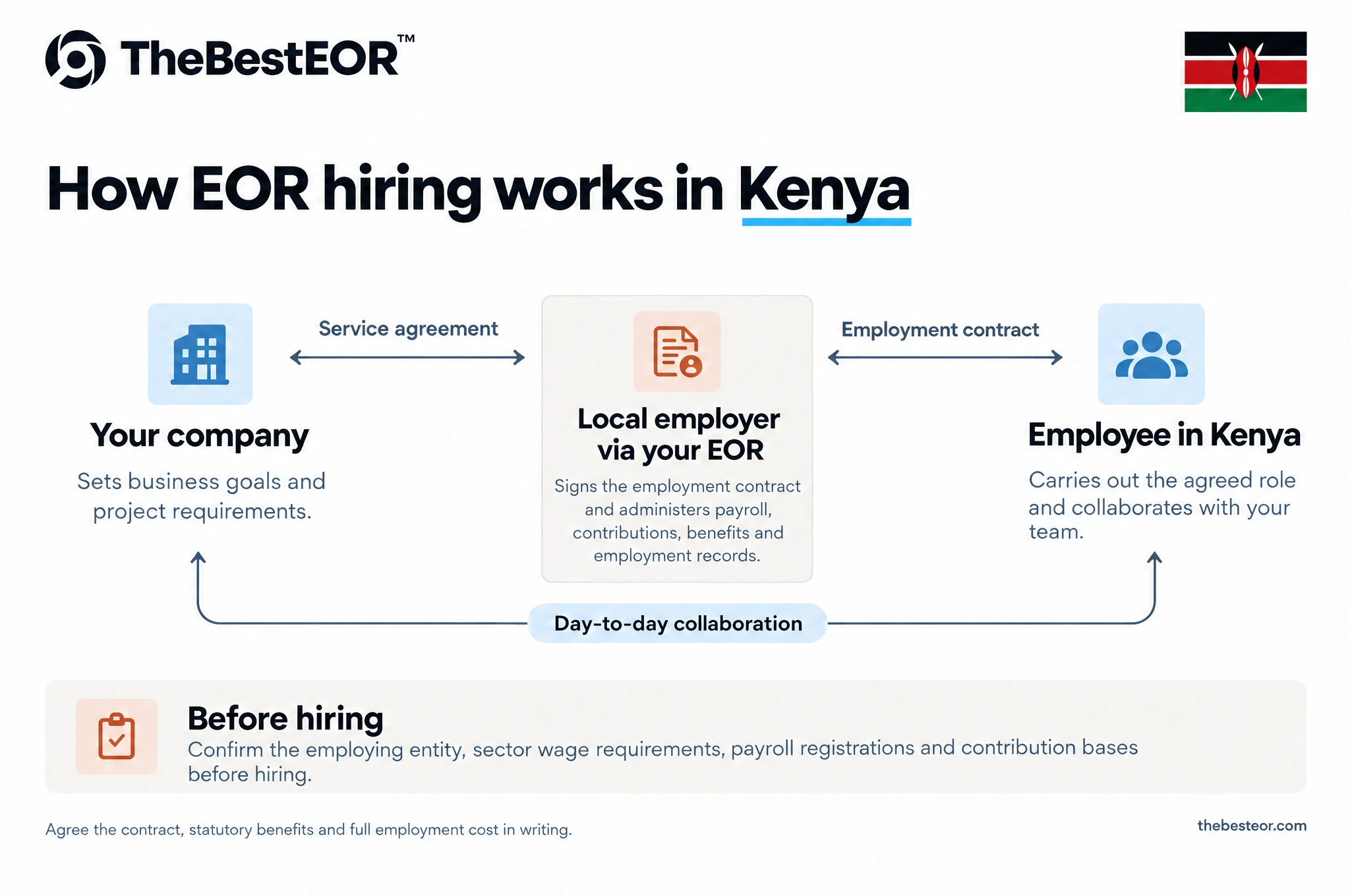
Employer of record in Kenya diagram showing the service agreement, employment contract, and day-to-day collaboration between your company and the employee.
Employer of record in Kenya: how your company, the local employer and the employee work together. Select the image to enlarge.

The EOR handles

1
PAYE withholding and the iTax filing by the ninth of the following month
2
NSSF tiered contributions, employer and employee shares
3
The Affordable Housing Levy, both halves, and the SHIF deduction
4
The NITA training levy and the itemised payslip
5
The written contract, in English or Kiswahili as required
6
Statutory leave administration: 21 days annual, sick, maternity, paternity
7
Compliant offboarding: the section 41 hearing, notice and any section 40 redundancy package

You keep

1
The work itself: what your hire builds, for whom, on what deadline
2
The pay package: base, any bonus, and any allowances, remembering they are levied and taxed like salary
3
Performance management, in writing: if an exit is ever challenged at the ELRC, that record is what the EOR will ask you for
4
Laptops and tooling (Rippling device management is a separate paid product)
5
Your IP terms: get the assignment language into the partner’s employment contract before signature

Engage a Nairobi developer as an independent contractor on fixed hours under your direction and a Kenyan court can call the relationship employment, with back PAYE, unremitted NSSF, SHIF and housing levy, and penalties attached to the finding. An employment arrangement that meets local requirements can change how the worker is engaged from then on, but it does not settle earlier classification liabilities. The misclassification guide covers the control tests courts apply.

Work permits

Class D work permits for foreign hires

Can the employer show why the role cannot be filled locally?

A foreign national needs a Class D work permit before taking Kenyan employment, applied for by the employing entity, which must show the role could not be filled locally.

Step What it is Who holds it Timing
Step
Class D work permit
What it is
Permit for a foreign national employed by a specific Kenyan employer
Who holds it
The employing (partner) entity applies; the hire holds it
Timing
Roughly 2–4 months, sometimes longer
Step
Local-labour test
What it is
Justification that no qualified Kenyan was available for the role
Who holds it
The employer, in the application
Timing
Part of the case file
Step
Special Pass
What it is
Short-term authorisation sometimes used for brief assignments while a permit is pending
Who holds it
The individual, via the immigration portal
Timing
Weeks; short validity
Step
Dependants' passes
What it is
Residence status for accompanying family
Who holds it
Each dependant, sponsored alongside
Timing
Alongside the permit

Fig. 9 · The Class D work permit · the Class D case is employer-led, so the sponsoring entity does the work

Applications run online through the immigration services portal, with government fees in the hundreds of thousands of shillings per year of validity; the exact schedule changes, so confirm current fees when the case opens. Approval commonly takes two to four months and can run longer, and permits are issued for one to two years and renewed. Kenya has also been courting remote workers with a digital-nomad permit announced in 2024, but that route covers foreign employees of foreign companies, not someone taking Kenyan employment, so it does not substitute for a Class D.

Not every partner will run a Class D case, so confirm sponsorship capacity before you commit to a foreign hire. Pebl’s in-house immigration team earns it a look from buyers planning to relocate staff into Nairobi; for a Kenyan-citizen hire, none of this applies.

Salary benchmarks

Indicative salary ranges

Compare monthly gross pay in Kenyan shillings.

Monthly gross in shillings with a USD equivalent at roughly KES 130 to the dollar. Ranges are representative 2026 market figures drawn from public salary aggregators; use the midpoint as a starting offer, not a ceiling. Nairobi pays the premium; other counties pay less.

Check current pay data for the role and location before you make an offer.

Role Gross KES/month USD/month (approx)
Role
Software engineer
Gross KES/month
KES 150,000–400,000
USD/month (approx)
$1,154–3,077
Role
Senior software engineer
Gross KES/month
KES 350,000–800,000
USD/month (approx)
$2,692–6,154
Role
Product manager
Gross KES/month
KES 250,000–600,000
USD/month (approx)
$1,923–4,615
Role
Accountant
Gross KES/month
KES 80,000–250,000
USD/month (approx)
$615–1,923
Role
Customer support
Gross KES/month
KES 50,000–150,000
USD/month (approx)
$385–1,154
Role
Sales manager
Gross KES/month
KES 200,000–500,000
USD/month (approx)
$1,538–3,846
Role
HR manager
Gross KES/month
KES 150,000–400,000
USD/month (approx)
$1,154–3,077
Role
UX / product designer
Gross KES/month
KES 120,000–350,000
USD/month (approx)
$923–2,692

Fig. 10 · Monthly gross salary benchmarks, 2026 · converted at roughly KES 130 to the dollar

Nairobi anchors the market, with Mombasa and Kisumu noticeably cheaper for the same title. English is an official language and the workday overlaps European hours, which helps Kenyan hires slot easily into EU-based teams.

Fully-loaded cost

What a Kenyan engineer really costs per month

Start with an engineer on KES 250,000 gross a month.

The example converts the EOR fee at about KES 130 to the dollar. For a different salary, estimate employer payroll costs in Kenya.

Software engineer, Nairobi
Gross base: KES 250,000/month
Gross salary KES 250,000

NSSF employer

Published February 2026 schedule: 6% up to KES108,000
KES 6,480

Affordable Housing Levy

1.5% of full gross, no cap
KES 3,750

NITA levy

Flat per employee
KES 50

EOR fee, cheapest

RemoFirst from $199 ≈ KES 25,870
⚠ Trustpilot warning: rating suspended for a breach of its guidelines; fake reviews removed
KES 25,870

Illustrative monthly total

Annual KES3,433,800 at the displayed assumptions
KES 286,150

Fig. 11 · Fully-loaded monthly cost at KES 250,000 gross, illustrative service fee · the statutory lines add about 4% at this salary

Under the published February 2026 NSSF schedule, the displayed employer lines total KES10,280, or 4.112% of this salary. For illustration only, at KES 130 per USD, a hypothetical USD 399 monthly service fee gives KES 312,150/month and a hypothetical USD 699 fee gives KES 351,150/month, before deposits and other unmodelled charges. These are budget scenarios, not Pebl or Oyster country quotes. Confirm the provider’s currency, commitment, benefits and full service scope before comparing totals.

EOR vs your own entity

EOR or your own Kenyan entity: compare costs

Allow for recurring tax, pension and training filings.

Incorporating in Kenya is cheap and online; operating an employer compliantly across KRA, NSSF, SHA and NITA is the real overhead.

Factor EOR Your own Kenyan entity
Factor
Setup cost
EOR
None
Your own Kenyan entity
Incorporation via the Business Registration Service, then employer registrations with KRA, NSSF, SHA and NITA
Factor
Time to first hire
EOR
2–14 days (by provider)
Your own Kenyan entity
4–8 weeks (registration, bank account, payroll setup)
Factor
Per-employee cost
EOR
$199–699/employee/mo fee + statutory
Your own Kenyan entity
Statutory only (~6% planning rate), plus shared overhead
Factor
Ongoing admin
EOR
Provider runs payroll & all filings
Your own Kenyan entity
In-house payroll, monthly iTax return, NSSF/SHIF/levy remittances, annual returns
Factor
Compliance liability
EOR
On the EOR partner entity
Your own Kenyan entity
On you and your directors

Fig. 12 · Illustrative EOR-versus-entity comparison; the crossover depends on the fee plan, local operating costs and hiring duration.

Take the $199 floor: a year of it is roughly KES 310,000 per employee beyond what the statutory lines would cost you directly. Kenyan incorporation itself is inexpensive and handled online through the eCitizen system, but operating an employer is a standing commitment: the monthly iTax cycle, the NSSF and SHIF remittances, the housing levy, NITA, the Data Protection Act obligations, and the accounting and audit routine behind them all. The EOR fee buys out that fixed overhead.

Annualise the selected service fee for the hires you expect to keep, then compare it with the Kenyan company setup, payroll, PAYE and contribution administration. Count setup costs over the same hiring horizon and include payroll, benefits, transition and exit charges on both sides. A higher service-fee plan moves the financial crossover earlier; lower recurring entity overhead or a longer hiring horizon can do the same. Short hiring duration, setup costs and the need for local administration can move it later. The legal suitability of each arrangement remains a separate question.

FAQ

EOR in Kenya: common questions

Class D permits, iTax deadlines, NSSF tiers and the shilling.\

 
What is the best EOR in Kenya?

RemotePeople is our top pick for Kenya in 2026 (4.9/5), followed by Deel (4.7/5) and Rippling (4.5/5). We opened paid accounts with all 10 providers on this page, priced real hires and ran payroll.

RemotePeople offers recruitment and EOR through one provider, with a dedicated account manager on both EOR plans. RemotePeople’s EOR Global plan starts at USD 499 per employee per month, and EOR Select at USD 199 where the hire qualifies. Deel starts at USD 599 plus a mandatory Employer Liability Cost; Rippling starts at USD 499 plus its required platform subscription.

How does an employer of record work in Kenya?

An employer of record in Kenya becomes the worker’s legal employer through a local employing entity, while your company directs the day-to-day work. The EOR withholds PAYE and files on iTax by the ninth of the following month, pays NSSF tiered contributions, the Affordable Housing Levy and the SHIF deduction, pays the NITA training levy and issues the written contract in English or Kiswahili.

How fast can an EOR onboard an employee in Kenya?

Estimated onboarding times for Kenya range from 2 to 14 days across the providers we tested. By provider: Deel 2–5 days, G-P 2–5 days, RemotePeople 3–8 days, Rippling 5–10 days and Oyster 7–14 days.

For a Kenyan-citizen hire, two to fourteen business days from signed contract to first payroll depending on the provider: Deel and G-P run two to five days, most of the field five to twelve, and Oyster quotes up to fourteen. Most providers in the top ten run Kenya through a vetted local partner entity that registers the hire for PAYE, NSSF, SHIF and the housing levy (Multiplier and G-P say they use their own entities). A foreign hire who needs a Class D work permit adds roughly two to four months for the immigration steps.
 
How much does an EOR cost in Kenya per month?

Published EOR service fees for Kenya run from USD 199 to USD 699 per employee per month across the 10 providers we tested.

On top of the fee you pay the employee’s gross salary plus the employer statutory lines: the tiered NSSF pension contribution, capped at the upper earnings limit, the 1.5 percent Affordable Housing Levy on gross pay, and the small monthly NITA training levy. On a typical professional salary the employer load works out near 6 percent of gross.

What employer contributions are mandatory in Kenya?

Three lines. The employer matches the employee’s tiered NSSF pension contribution at 6 percent of pensionable earnings up to an upper earnings limit that rises in phases under the NSSF Act 2013. It pays the Affordable Housing Levy at 1.5 percent of gross monthly pay, matched by a 1.5 percent employee deduction. And it remits the NITA industrial training levy of 50 shillings per employee per month. The employer also withholds employee-side deductions: PAYE income tax, the employee NSSF share, the employee housing levy and the SHIF health contribution of 2.75 percent of gross pay, which replaced NHIF.

Can an EOR sponsor a work permit in Kenya?

Yes, through the local entity that employs. A foreign hire needs a Class D work permit issued by the Directorate of Immigration Services, applied for by the employing entity, which must show the role could not be filled locally. Budget roughly two to four months for approval, sometimes longer.

How much notice and severance apply when terminating in Kenya?

Notice for a monthly-paid employee is 28 days in writing, or pay in lieu, under the Employment Act 2007; during probation it drops to seven days.  Severance pay applies on redundancy at 15 days’ pay for each completed year of service, and a redundancy also requires a month’s notice to the employee, the union where one exists, and the local labour officer. Any dismissal needs a fair reason and a hearing first, because the Employment and Labour Relations Court can award compensation of up to 12 months’ pay for unfair termination.

What currency and payroll cycle does Kenya use?

The Kenyan shilling (KES). Payroll runs monthly, and PAYE withheld from salaries is due to the Kenya Revenue Authority through iTax by the ninth of the following month, with the NSSF, housing levy and SHIF remittances running on a similar early-month schedule. The shilling traded near KES 130 to the US dollar in mid-2026 and has been far steadier than most African currencies in recent years, which makes Kenyan payroll budgeting more predictable than the regional norm.

Can I convert a Kenyan contractor to an EOR employee?

A conversion may be possible if the provider accepts the role and confirms the proposed employment is legal and compliant in Kenya. Plan the transition explicitly: end or amend the contractor engagement, agree an employment start date and gross salary, document the employment terms, and set up payroll and benefits. Compare the contractor’s former invoice with total employment cost rather than treating it as the new gross salary.

Review the earlier working relationship separately. A new EOR contract does not settle any earlier liabilities. Ask local counsel to assess that history if the worker already operated as an employee in practice.

Do I need a Kenyan entity to hire one person?

Annualise the selected service fee for the hires you expect to keep, then compare it with the Kenyan company setup, payroll, PAYE and contribution administration. Count setup costs over the same hiring horizon and include payroll, benefits, transition and exit charges on both sides. A higher service-fee plan moves the financial crossover earlier; lower recurring entity overhead or a longer hiring horizon can do the same. Short hiring duration, setup costs and the need for local administration can move it later. The legal suitability of each arrangement remains a separate question.

Sources and as-of dates

Article references

Statutory figures are as of August 2026, each traced to the statute it lives in.

Hiring facts Checked 2 Oct 2026

Hiring facts

Checked 2 October 2026
Eligibility, local and collective rules apply. EOR fees extra.

Employment Act 2007 6 sources

The Employment Act requires written contracts and particulars for employment lasting three months or more. Minimum leave includes 21 working days after 12 months’ service, three months’ maternity leave and two weeks’ paternity leave at full pay. After two months’ service, statutory sick leave is seven days at full pay plus seven at half pay, subject to certification and notification. Monthly-paid employees generally receive 28 days’ notice, unless longer notice applies. Probation is capped at six months, extendable by agreement for up to six more. Redundancy requires the section 40 procedure and at least 15 days’ severance pay per completed year. Sections 41 and 45 address hearings and fair termination.

NSSF Act 2013 3 sources

The NSSF Act sets employer and employee pension contributions at 6% each of pensionable earnings, with Tier I and Tier II contributions and phased lower and upper earnings limits. Use NSSF’s Year 4 (2026) employer notice for the applicable payroll limits; earlier annual limits should not be carried forward automatically. Approved contracting-out arrangements can apply to Tier II.

Affordable Housing Act 2024 1 source

The Affordable Housing Levy is 1.5% of gross monthly salary from the employee plus a matching 1.5% employer contribution, collected by the Kenya Revenue Authority. KRA’s notice states that employers must remit both amounts by the ninth working day after the end of the relevant month.

Social Health Insurance Act 2023 2 sources

For salaried contributors, SHIF contributions are 2.75% of gross monthly salary, with a minimum of KES 300 per month and no upper contribution limit. Employers calculate the employee deduction and remit it to the Social Health Authority. SHA’s premium guidance distinguishes this salaried deduction from the assessment of non-salaried households.

Industrial Training Act 3 sources

The NITA training levy is KES 50 per employee per month and is paid by the employer, rather than deducted from employees. KRA’s simplified PAYE return includes a NITA calculation based on employee numbers. Payment uses the agency-revenue obligation for NITA, separately from the income-tax obligation used for PAYE.

Income Tax Act / Finance Act 2023 2 sources

KRA’s individual income-tax schedule has marginal rates of 10%, 25%, 30%, 32.5% and 35% on taxable income, effective from 1 July 2023. Resident individuals receive personal relief of KES 2,400 per month. Employers file PAYE returns through iTax and remit PAYE by the ninth day of the following month; the highest rate does not apply to all gross pay.

Kenya Citizenship and Immigration Act 2011 2 sources

Class D covers approved employment with a specific employer where the applicant’s skills or qualifications are not available in Kenya and the employment benefits Kenya. The application requires employer support, evidence of competitive local recruitment and Kenyan understudy details. The Directorate’s published fees are KES 20,000 non-refundable processing plus KES 500,000 per year for issuance; East African Community member-state nationals are listed as gratis. Approval and processing time depend on the application.

Data Protection Act 2019 2 sources

The Data Protection Act 2019 establishes duties for controllers and processors handling personal data, including employee records, under the Office of the Data Protection Commissioner. Relevant principles include processing data legally and transparently, limited collection and retention, accuracy, data-subject rights and safeguards for transfers outside Kenya.

Salary benchmarks 2 sources

Nairobi salary estimates should be matched to the role, seniority, pay period and whether the figure is base salary or total compensation. Levels.fyi provides a Nairobi software-engineer dataset. USD conversions at KES 130 per dollar are rounded illustrations: CBK reported KES 129.40 per dollar on 30 July 2026, and actual payroll conversion rates and fees vary.

Provider fees, entity routing and estimated onboarding times 10 sources

Provider fees, entity descriptions and onboarding estimates are commercial provider-published information. They can change and should be confirmed in a country-specific written quote, including the employing entity and any conditions affecting the start date. The linked reviews and the methodology explain the comparison.

Further sources (October 2026) 6 sources

NSSF Year 4 contribution notice, effective February 2026 — Published Year 4 schedule effective February 2026: KES9,000 lower and KES108,000 upper earnings limits, with a KES6,480 maximum on each side. Examples use this schedule; apply any subsequent payroll-period instruction where relevant. Accessed 19 October 2026.

KRA Affordable Housing Levy collection notice — 1.5% employee deduction and separate 1.5% employer contribution. Accessed 19 October 2026.

NITA levy guidance — KES 50 per employee per month; employer cost, not salary deduction. Accessed 19 October 2026.

Social Health Authority premium rates — Employee deduction 2.75% gross, minimum KES 300, no upper cap; employer remits. Accessed 19 October 2026.

Employment Act 2007, section 40; Kenya Law statutory extract — Redundancy notice, leave and minimum 15 days per completed year. Accessed 19 October 2026.

Kenya Law: Woodsome Ochwo Mwanika v A To Z Transporters Limited [2021] KEELRC 1140 — Court quotation of section 40 and separation of notifications, selection and statutory dues. Accessed 19 October 2026.

Obtain a dated quote showing the current contribution limits and provider fees. Use the directory to compare EOR providers for Kenya, or see the country guides for another market. The EOR cost calculator totals the recurring USD amounts from each proposal.

This guide is for general information only and does not provide legal, tax, accounting, or financial advice. For advice about your business, consult a qualified professional familiar with the rules where you hire. The research methodology explains how TheBestEOR assesses sources.