TheBestEOR

Best Employer of Record in Indonesia

Written by Martynas PupkeviciusFact-checked by Michael Ennis
Picture of Martynas Pupkevicius
Martynas Pupkevicius

EOR Advisor and Remote Work Editor

Our top employer of record in Indonesia for 2026 is RemotePeople, from USD 499 per employee a month, ahead of Multiplier and Deel.

We tested all 10 providers with paid client accounts, real quotes and a live hire run through payroll. Indonesian employers pay a religious holiday allowance of 1 month’s pay after 1 year and contribute to BPJS national health and employment insurance.

Flag of Indonesia

Hiring in Indonesia at a glance

Currency
IDR
Indonesian rupiah
Pay cycle
Monthly
Daily or weekly cycles can also be agreed
Working hours
40 hours
Weekly, over 5 or 6 days
Annual leave
12 days
Paid working days after 1 continuous year
Extra pay
THR allowance
1 month’s pay after 1 year, pro rata if shorter
Employer costs
BPJS insurance
Covers healthcare, retirement and work injuries
Before you hire:
Confirm if the contract is fixed term or permanent and budget for the religious holiday allowance.

Country hiring overview · Indonesia

Hiring in Indonesia, at a glance.

Compare contract scope, benefit accruals and work rights.

For an Indonesian hire, I’d ask for the employing entity and proposed contract type. Compare the payroll and benefit scope, including THR treatment, and resolve any foreign-worker requirements separately from the provider’s onboarding estimate.

Choose a hiring solution

Need a local employer?

Compare an EOR arrangement for your role before opening your own entity.

Already have a local employer?

Compare payroll and HR support against adding an EOR.

EOR service fee

Fees vary by provider.

Your quote should state the currency, fee per employee, minimum charge and billing commitment.

Onboarding

Paperwork affects the start date.

The contract, right-to-work checks, registrations and payroll deadlines all affect when employment can begin.

Employment costs

Include THR in the budget.

The quote should show BPJS insurance and the THR religious-holiday allowance separately. Ask which other employment payments need to be set aside for the proposed contract.

Annual leave

Leave starts after 12 months.

The general entitlement is at least 12 working days after 12 months of continuous service. The employment contract may provide a larger allowance.

Check before choosing

Confirm the contract structure, BPJS enrolment, THR calculation, role eligibility and any foreign-worker approvals before agreeing dates.

What your quote should include

Employment costs and service fees

1
Gross salary and agreed pay schedule
2
BPJS, THR and applicable employment accruals
3
EOR fee: currency, per-employee billing, minimums and commitment
4
Setup, foreign exchange, extras and exit costs

Deposits and payroll funding

1
Amount and payment deadline
2
Whether funds are refundable or credited to payroll
3
Release conditions and refund timing
Show these separately from recurring expenses.

Key takeaways for hiring in Indonesia

THR timing follows the holiday

An eligible employee with at least one month but less than twelve months of continuous service receives proportional THR. The payment is due in full before the religious-holiday deadline. A monthly reserve helps budgeting, but the first holiday can still require a distinct payroll funding payment.

Renewing a PKWT can trigger a payment now

For a covered Indonesian fixed-term employee, compensation is due at the original term’s end before an extension starts; the extension has its own later calculation. Ask for both dates in the cash forecast.

THR and fixed-term compensation are different liabilities

Both can look like a proportion of one month’s pay, but their legal triggers are different. THR relates to the religious holiday, while PKWT compensation relates to the contract term. A quote should identify each separately so one provision is not mistaken for funding both.

Use the severance table with the current court ruling

The Constitutional Court requires the statutory severance scale to be read as a minimum. The actual termination ground and dispute process still matter. Treat the worked example as one specific scenario.

Quick verdict

What is the best EOR in Indonesia?

I’d ask who signs the contract and sponsors the hire.

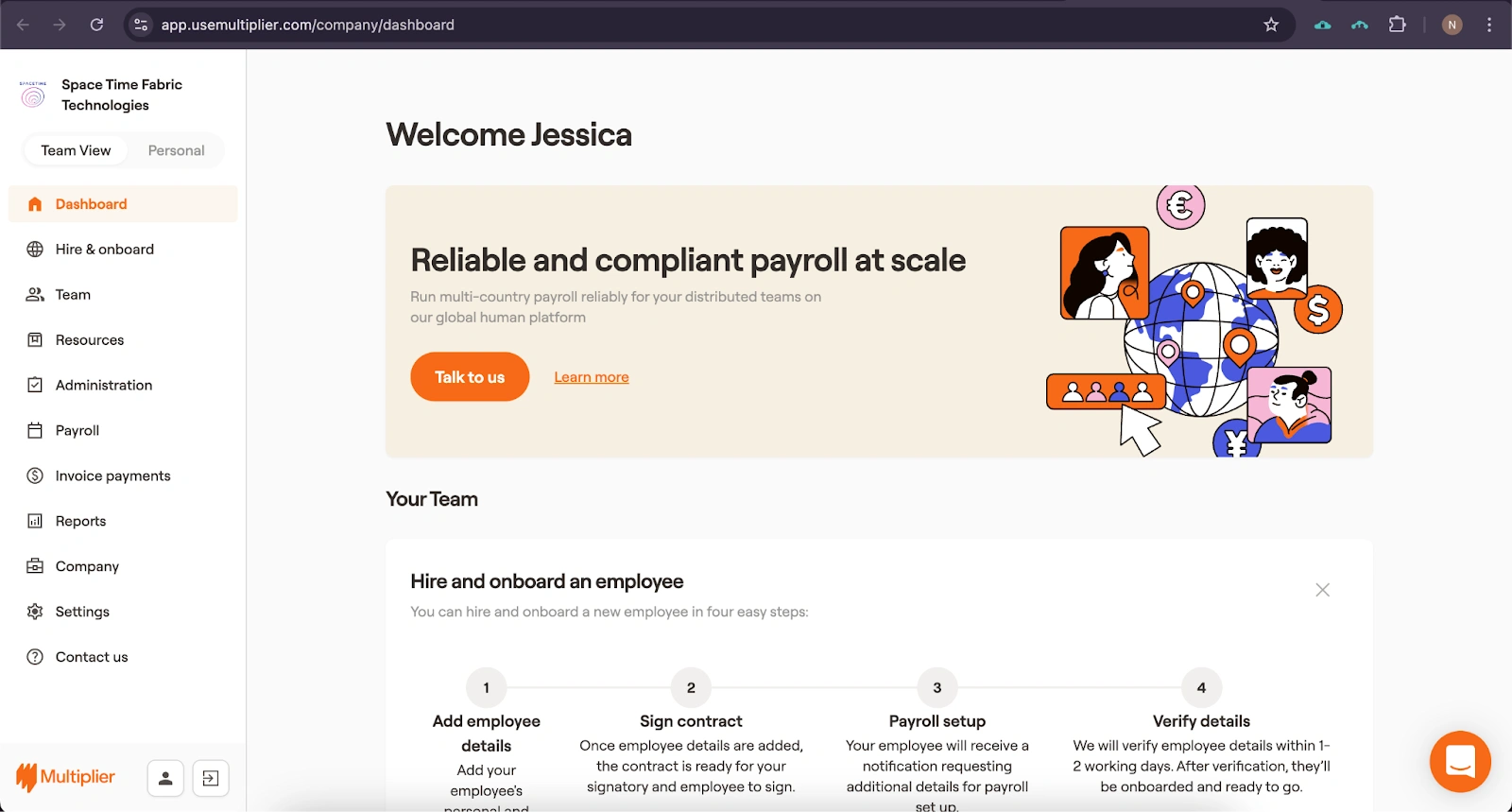
Many global EOR brands put an Indonesian hire on somebody else’s company. These three carry the contract, the BPJS lines and the RPTKA sponsorship with the fewest intermediaries.

1
Multiplier logo

4.1/5

Multiplier

Managing payroll, leave and expenses in one place

Starting fee
$459

per employee / month

Countries
150+
where you can hire

Billed annually. $499 billed monthly.

Deposit
1+ months

of gross salary plus contributions

Deposit refund
Within 60 days

of the last working day

Why consider it

A set monthly payroll calendar, with salaries paid at month-end.

SOC 2 Type II audited every year and ISO 27001:2022 certified.

Check the fit

Integrations and API access need the Growth plan.

Before signing: An implementation fee can apply on some plans, so get setup confirmed as free in your quote. Confirm the employing entity for each country in your contract.

At $459 a month billed annually, the first year for one hire is $5,508 in service fees. Salary, employer costs and the refundable deposit come on top.

Visit Multiplier ↗

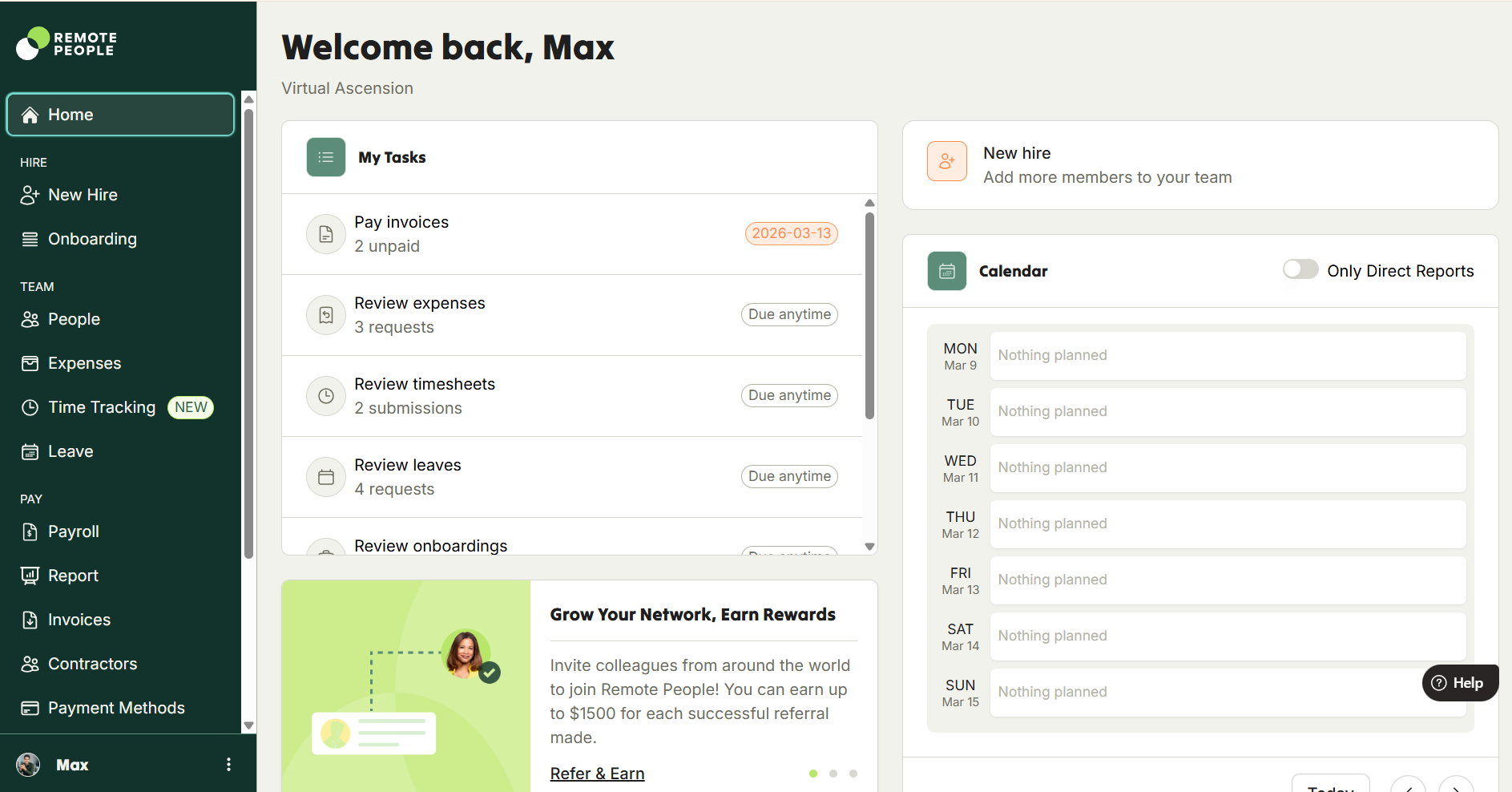
2
Editorial pick
RemotePeople logo

4.9/5

RemotePeople

Hiring in new markets with local HR support

Starting fee
$499

per employee / month

Countries
150+
where you can hire

EOR Select from $199 for eligible hires.

Deposit
1 month

of gross salary

Deposit refund
Within 5 days

of the final payment

Why consider it

Recruitment and EOR services through one provider.

Dedicated account manager in both EOR plans.

Check the fit

Recruitment is separately priced.

Before signing: Confirm quote currency, billing commitment, deposits, funding deadlines and refund terms. EOR Select eligibility depends on the hiring country and employee salary.

Both EOR plans list local contracts, payroll and tax administration, and statutory benefits administration. Salary, employer contributions and benefit costs are separate.

Visit RemotePeople ↗

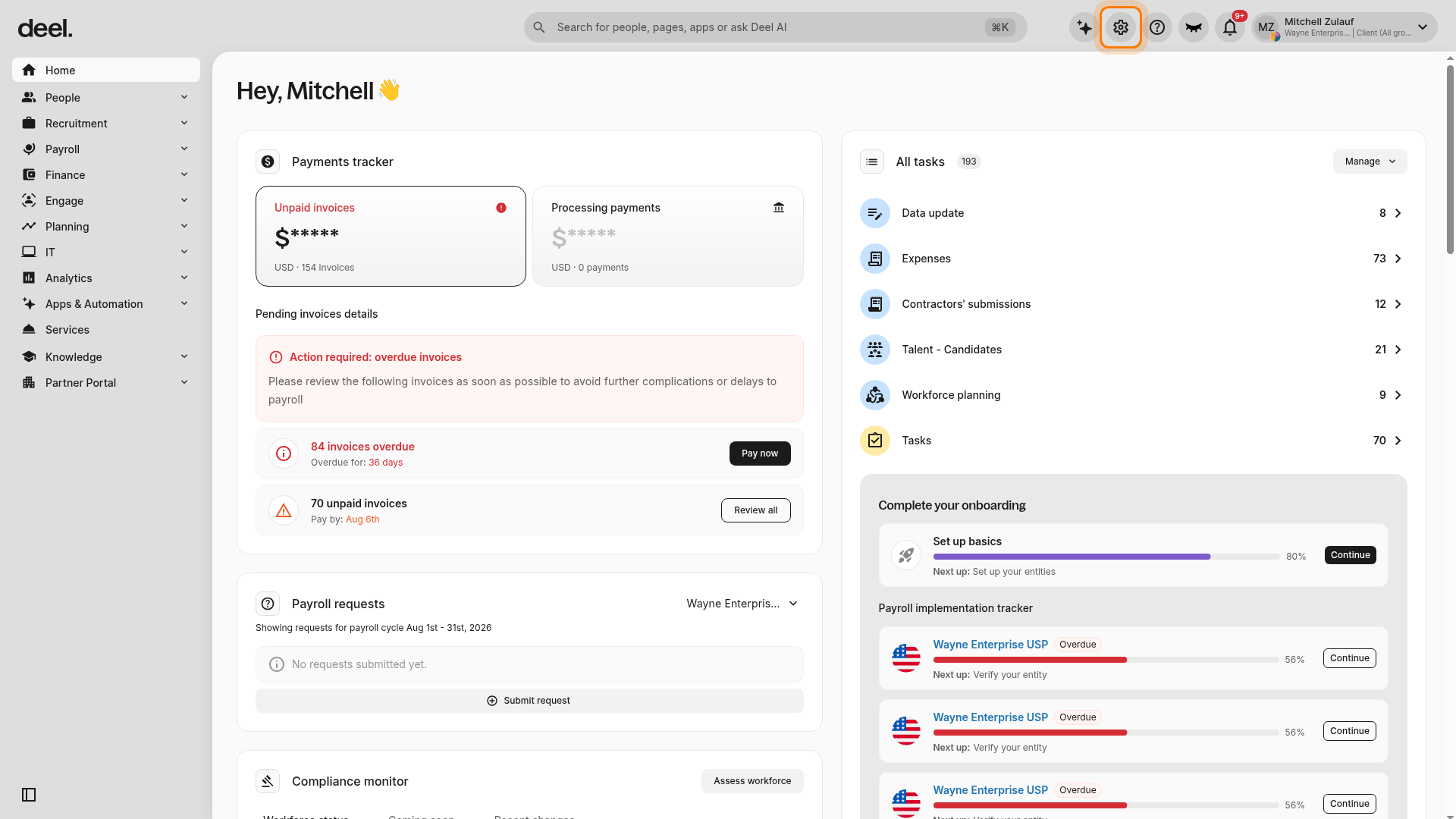
3
Deel logo

4.7/5

Deel

Paying employees and contractors on one platform

Starting fee
$599

per employee / month

Countries
130+
where you can hire

Plus a mandatory Employer Liability Cost.

Deposit
1–1.5 months

of gross salary

Deposit refund
Within 60 days

of offboarding

Why consider it

EOR, contractor management and payroll for your own entities.

Month-to-month EOR service pricing available.

Check the fit

Ask for the country-specific Employer Liability Cost in your quote.

Before signing: Confirm the Employer Liability Cost amount, benefit costs and any additional products. Monthly service terms do not remove employment notice, severance or other exit obligations.

The EOR pricing page lists 130+ countries. Broader platform coverage figures may include other services.

Visit Deel ↗

No provider pays for a position on this page; some outbound links pay a referral fee. See the funding model and methodology.

Provider comparison

All 10 EOR providers for Indonesia, side by side

Compare the June 2026 monthly fees per employee.

These figures are published list prices.

The same ten providers are compared side by side in the global EOR ranking. For a wider shortlist, browse EOR providers for Indonesia.

Provider

Best For

Starting feeDepositOnboarding
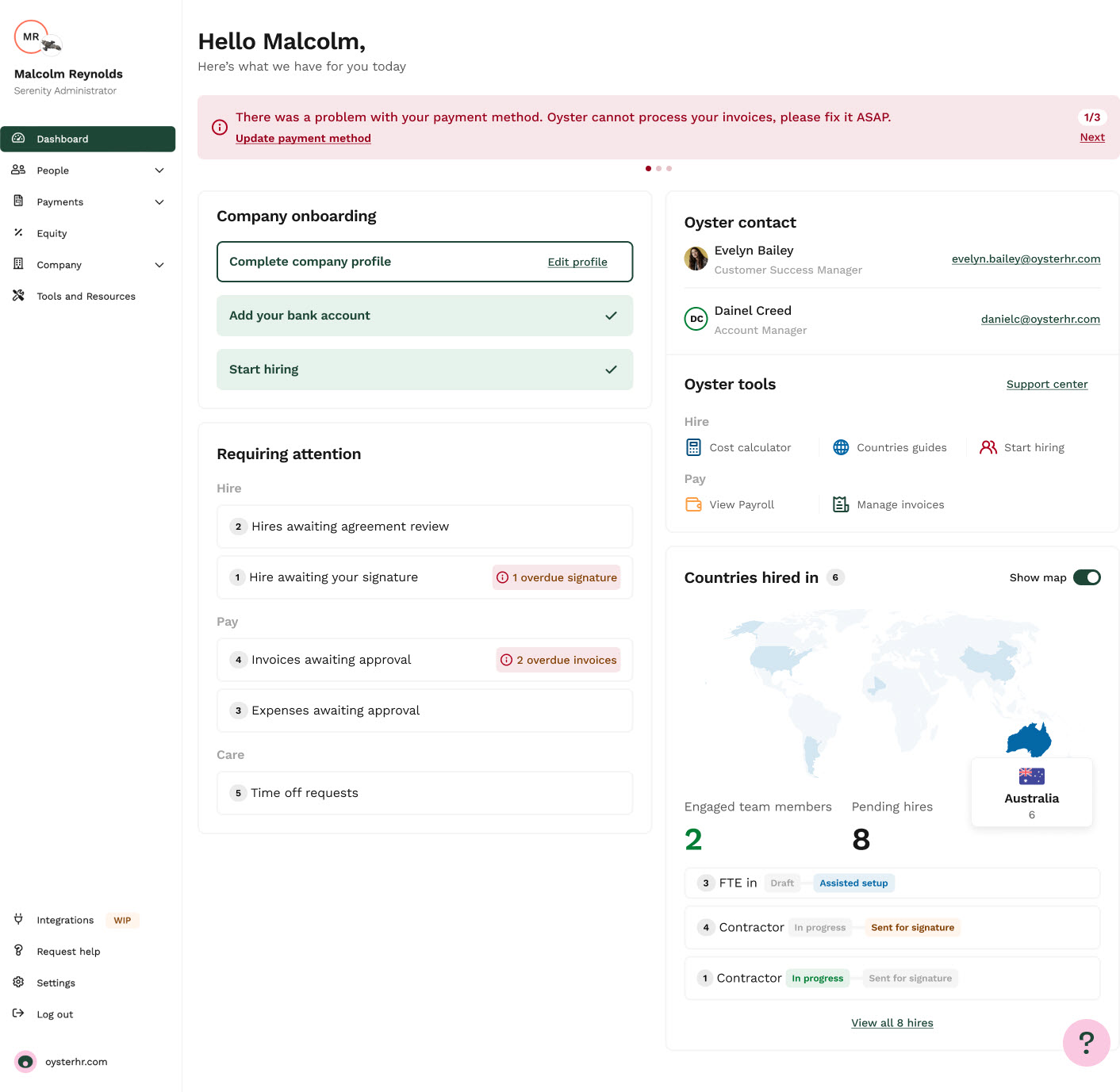
1 Multiplier logo Multiplier 4.1/5 Rating Managing payroll, leave and expenses in one place Starting fee: $459 USD / monthDeposit: 1+ monthsOnboarding: 48–72 hours

My take

I’d start with Multiplier Core if you need employment administration, payroll, leave and standard workforce reporting.

Core starts at $499 per employee per month on monthly billing or $459 per month billed annually. For integrations, custom reports and open APIs, I’d compare the Growth plan. The quote needs to identify the dollar currency and chosen plan.

Country variations and mandatory add-ons affect the total. Implementation fees may apply, although the FAQ says setup is free; the quote must resolve that charge. Salary, employer costs and benefit premiums are additional.

When this provider fits

Multiplier can be considered when Indonesia is part of an APAC hiring programme.

Deposit

1+ months

Entity model

Own entities and partners

First year, one hire

$5,508 in service fees

Reviewed by Martynas PupkeviciusFact-checked by Michael Ennis

Starting fee

$459

Core plan billed annually, or $499 per month on monthly billing. Confirm the dollar currency.

Against the 10 starting fees

$199 lowest$699 highest
2 RemotePeople logo RemotePeople 4.9/5 Rating Hiring in new markets with local HR support Starting fee: $499 USD / monthDeposit: 1 monthOnboarding: 5–8 days

My take

RemotePeople’s dedicated account manager is a reason I’d consider it when you want a named contact.

The EOR service includes local employment contracts, payroll and tax administration, and statutory-benefits administration. Recruitment is priced separately from the EOR fee.

EOR Global starts at USD 499 per employee per month. EOR Select starts at USD 199 for eligible countries and employee salary ranges. Salary, employer contributions, benefit costs and agreed extras are additional. The country quote determines eligibility, the final fee, billing commitment and payroll funding.

Deposit

1 month

Entity model

Own entities in core markets

First year, one hire

$5,988 in service fees

Reviewed by Martynas PupkeviciusFact-checked by Michael Ennis

Starting fee

$499

EOR Global. EOR Select starts at $199 where the country and employee salary qualify.

Against the 10 starting fees

$199 lowest$699 highest
3 Deel logo Deel 4.7/5 Rating Paying employees and contractors on one platform Starting fee: $599 USD / monthDeposit: 1–1.5 monthsOnboarding: 2–5 days

My take

Deel makes my shortlist when you want EOR payroll and benefits administration alongside separate contractor and HR products.

EOR starts at USD 599 per employee per month, with month-to-month billing available. I’d budget beyond that fee: mandatory Employer Liability Cost is an additional charge based on gross salary, with rates varying by country. Salary, statutory employer costs and benefit premiums are also separate.

Contractor management starts at USD 49 per active contract per month. It is a separate service from EOR employment; currency conversion, payment-method charges and any required deposit also affect the amount funded.

When this provider fits

For an Indonesian national, I’d compare Deel and Pebl on the employment service, benefits and complete fee. For a foreign candidate, first establish the permitted role and the application support offered for that individual.

Deposit

1–1.5 months

Entity model

Owned entity Jakarta entity

First year, one hire

$7,188 in service fees

Reviewed by Martynas PupkeviciusFact-checked by Michael Ennis

Starting fee

$599

Month-to-month billing. Mandatory Employer Liability Cost is charged separately.

Against the 10 starting fees

$199 lowest$699 highest
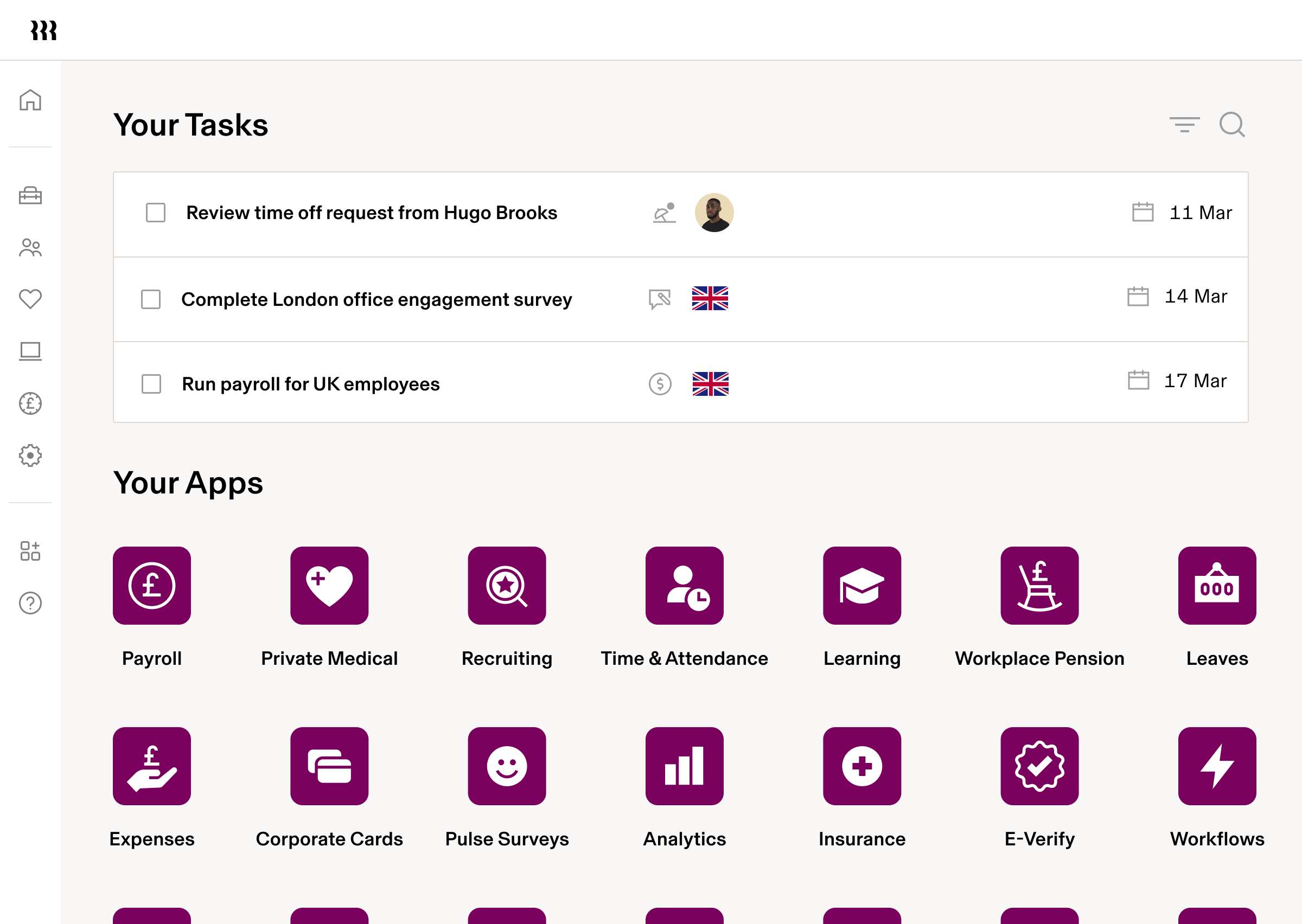
4 Rippling logo Rippling 4.5/5 Rating Setting up payroll, laptops and app access for new hires Starting fee: $499 USD / monthDeposit: Per quoteOnboarding: 7–12 days

My take

I’d consider Rippling when shared employee data across HR, IT and finance would help your workflows and reporting.

It connects EOR employment with those products, but device management and app access are separate products within the wider system.

Rippling EOR starts at USD 499 per employee per month, and the required Rippling Platform adds from USD 8 per employee per month plus a monthly base fee. The quote needs to show any selected HR, IT or finance products and the billing commitment. Salary, employer costs, benefits, deposits and payroll funding are additional to the software and service fees.

Deposit

Per quote

Entity model

Own entities and local partners

First year, one hire

$5,988 in EOR fees

Reviewed by Martynas PupkeviciusFact-checked by Michael Ennis

Starting fee

$499

Plus the required Rippling Platform, from $8 per employee per month and a monthly base fee. Confirm the billing terms and selected products.

Against the 10 starting fees

$199 lowest$699 highest
5 Oyster logo Oyster 4.5/5 Rating Using one onboarding process for hires across countries Starting fee: $699 USD / monthDeposit: ~1 monthOnboarding: 10–14 days

My take

I’d look at Oyster for payroll, expense and time-off administration, reporting, and onboarding and offboarding support.

Benefits packages are optional add-ons. At USD 699 per employee per month on monthly billing, I’d compare the included support carefully against the other quotes.

Annual seats are priced by headcount and location and are non-refundable, but can be reused for replacement hires. Annual prepayment gives the lowest fee; higher-priced quarterly or semiannual payment options are available. Salary, employer costs and benefit premiums are additional, and a refundable deposit is required. Optional People Partner project work costs USD 300 per hour.

Deposit

~1 month

Entity model

Own entities and vetted partners

First year, one hire

$8,388 in service fees

Reviewed by Martynas PupkeviciusFact-checked by Michael Ennis

Starting fee

$699

Monthly billing. Annual seats are quoted separately, prepaid and non-refundable.

Against the 10 starting fees

$199 lowest$699 highest
6 Pebl logo Pebl 4.2/5 Rating Hiring people who need visa or relocation support Starting fee: $399 USD / monthDeposit: Per quoteOnboarding: 7–10 days

My take

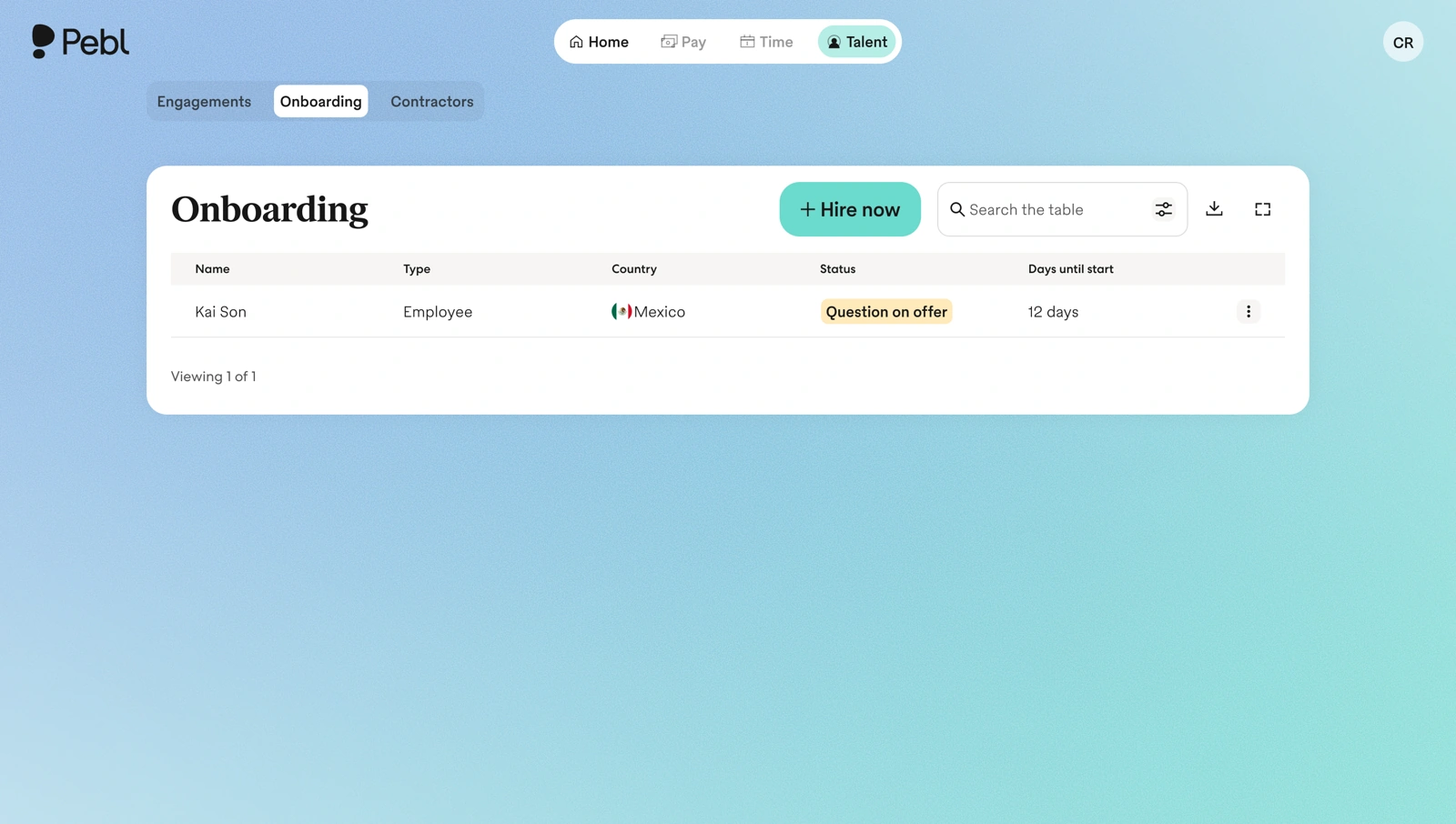
If you’re considering Pebl as a temporary step before opening an Indonesian company, I’d check its entity restriction first.

At onboarding, for an employee working in Indonesia, its terms require that neither the client nor its affiliates is incorporated there, owns or controls a local entity, or plans to become, acquire or establish one. Later changes to these circumstances must be reported promptly to Pebl in writing.

Pebl, formerly Velocity Global, combines hiring, payroll, employee changes, reporting and offboarding in one platform. EOR starts at $399 per employee per month; the country quote must identify the dollar currency and billing commitment. Salary, employer costs, benefits and additional services are separate.

A deposit is required before onboarding. Its amount can change with salary, seniority or payment history, and it is returned after the final invoice and outstanding balances are paid. Early exit can make the remaining committed-term service fees payable, subject to the agreement’s termination exceptions. Any discounted offer needs an end date and renewal price.

Deposit

Per quote

Entity model

Affiliates and local partners

First year, one hire

$4,788 in service fees

Reviewed by Martynas PupkeviciusFact-checked by Michael Ennis

Starting fee

$399

Confirm the country price and billing commitment.

Against the 10 starting fees

$199 lowest$699 highest
7 G-P logo G-P 4.2/5 Rating Hiring abroad while keeping your existing HR system Starting fee: $599 USD / monthDeposit: 1–2.5 monthsOnboarding: 3–7 days

My take

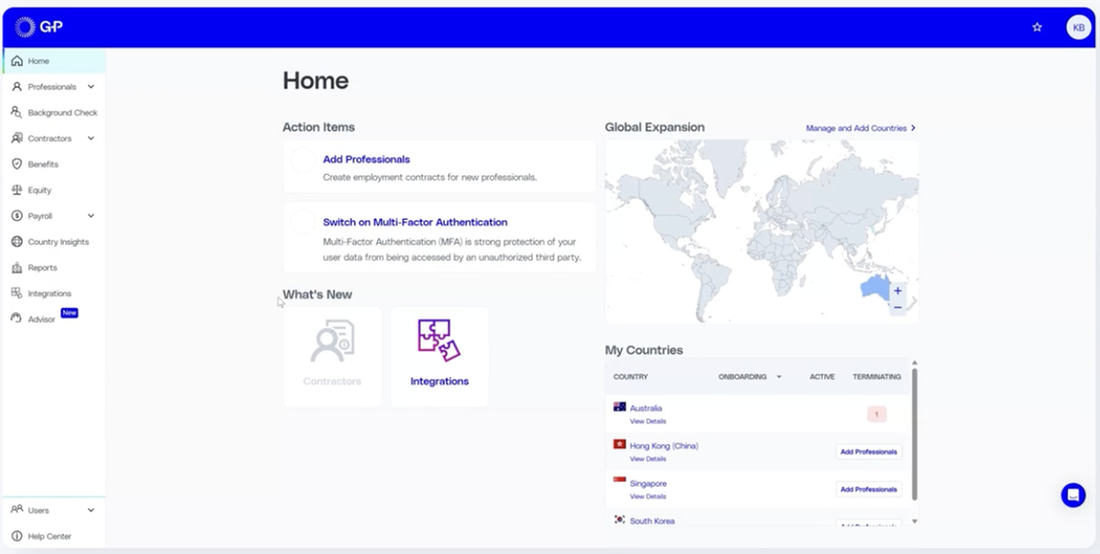
G-P would be on my shortlist when benefits, reporting and custom API integrations matter alongside EOR employment administration.

EOR starts at USD 599 per employee per month, with volume discounts by quote. I’d keep salary, employer costs, benefit premiums and additional services separate in the budget.

There is no minimum contract length for EOR hires. The proposal still sets the commercial billing and cancellation terms, along with the cost of any integration or implementation work.

Deposit

1–2.5 months

Entity model

Owned entity

First year, one hire

$7,188 in service fees

Reviewed by Martynas PupkeviciusFact-checked by Michael Ennis

Starting fee

$599

Confirm the included services and billing terms in your country quote.

Against the 10 starting fees

$199 lowest$699 highest
8 Papaya Global logo Papaya Global 4.1/5 Rating Comparing payroll costs across countries in one report Starting fee: $499 USD / monthDeposit: 1–2 monthsOnboarding: 7–10 days

My take

Papaya interests me when payroll and payments need to work together across EOR employees and your own entities.

It brings those employees, own-entity payroll and workforce payments into one platform, with consolidated reporting and payroll approval tools. That connection is what I’d focus on in the evaluation.

Papaya’s EOR service starts at USD 499 per employee per month. The country quote must identify the billing commitment and any additional services. Salary and employer costs are separate.

When this provider fits

Papaya is easier to justify when Indonesian payroll must be reconciled with several employers or countries. RemoFirst is worth comparing when a standalone employment service is the immediate need. Request a shared cash forecast covering salary, THR, any applicable fixed-term compensation and funding deadlines.

Deposit

1–2 months

Entity model

In-country partner + payroll engine

First year, one hire

$5,988 in service fees

Reviewed by Martynas PupkeviciusFact-checked by Michael Ennis

Starting fee

$499

The country quote sets the billing terms. Payroll-only processing is priced separately.

Against the 10 starting fees

$199 lowest$699 highest
9 Borderless AI logo Borderless AI 4.0/5 Rating Getting 24/7 help with overseas payroll and HR Starting fee: $579 USD / monthDeposit: 1.5–3 monthsOnboarding: 7–12 days

My take

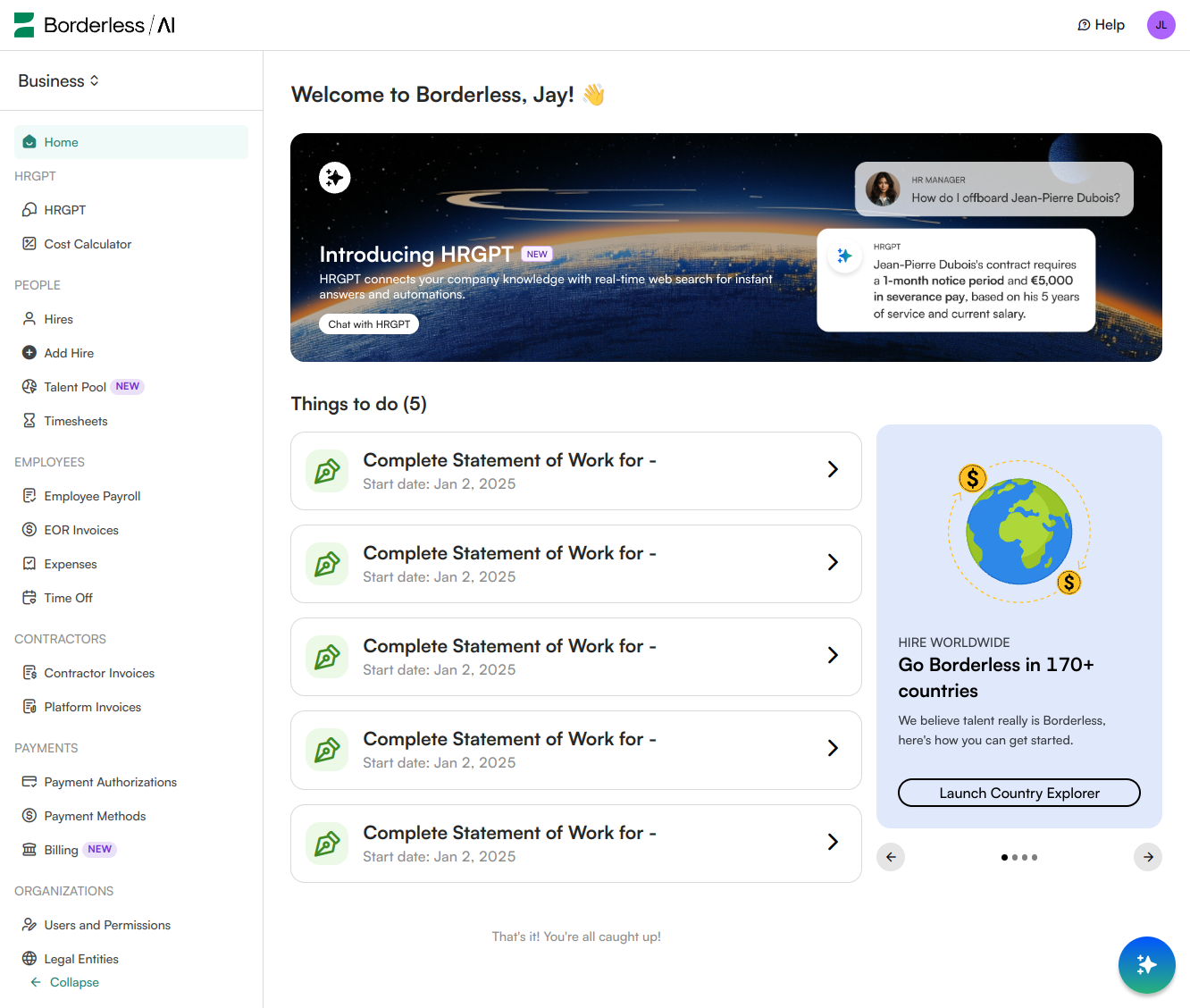
I’d compare Borderless AI using both its current offer and the fee after it ends.

The standard EOR fee is USD 579 per employee per month. Eligible companies headquartered outside Canada may qualify for USD 399 on fees billed through 31 December 2026. USD 579 applies from 1 January 2027, including promotional customers; country and employment-type exceptions apply. Salary, employer costs and benefits are additional.

A refundable deposit is required before the employee starts. The schedule is 1.5 months of gross salary plus employer costs, benefits and platform fees with ACH or three months by wire and other methods, with country variations. The base includes salary, employer contributions, benefits and platform fees. Late-payment issues can raise it to six months. Deposits are released after the relevant obligations are settled.

Deposit

1.5–3 months

Entity model

Own entities

First year, one hire

$6,948 in service fees

Reviewed by Martynas PupkeviciusFact-checked by Michael Ennis

Starting fee

$579

Eligible companies headquartered outside Canada can pay $399 on fees billed through 31 December 2026.

Against the 10 starting fees

$199 lowest$699 highest
10 RemoFirst logo RemoFirst ⚠ Trustpilot warning 0.5/5 Rating Making a first overseas hire on a tight budget Starting fee: $199 USD / monthDeposit: About 1 monthOnboarding: 7–12 days

My take

We moved RemoFirst to last place on 8 November 2026: Trustpilot has suspended its rating for a breach of its guidelines and removed fake reviews.

RemoFirst says it works exclusively with vetted in-country partners. Here, that means a local partner company, not RemoFirst, would normally employ your hire, and payroll changes, questions and exits pass through both companies, which can slow answers. US$199 is RemoFirst’s starting fee and varies by country, so get this country’s quote before you compare. RemoFirst’s lack of a minimum contract term or headcount makes it worth considering for a small team. I’d compare its dedicated customer success manager and EOR employment service from USD 199 per employee per month against the support you need. The fee can vary with country requirements. Salary, employer costs, benefits, deposits and optional services are separate.

Contractor management is free for onboarding, identity checks, contract storage and expenses. Contractor payments cost USD 25 per contractor in months when a payment is processed; payment-provider and transfer fees may also apply. These contractor services are separate from EOR employment.

Deposit

About 1 month

Entity model

Partners, not own entities

First year, one hire

$2,388 in service fees

Reviewed by Martynas PupkeviciusFact-checked by Michael Ennis

Starting fee

$199

RemoFirst advertises no minimum contract term or employee count. Confirm any country-specific charges.

Against the 10 starting fees
$199 lowest$699 highest

Entity ownership is as each provider states it.

Comparison as of 6 October 2026. Confirm the employing entity, immigration scope, start date and first-payroll cutoff.

Which top pick · Indonesia

The Indonesia decision usually comes down to your hire’s passport first, then price, then speed. Ask for a written quote covering the salary, benefits and services you need. Enter its recurring costs in USD in the EOR cost calculator to compare proposals.

Local Indonesian alternatives (researched, unranked): a few Indonesia-focused firms also provide EOR or local payroll outsourcing, including Cekindo (part of InCorp) and Emerhub on the market-entry side and Talenta by Mekari for domestic payroll software. None of the three is ranked: Cekindo and Emerhub are market-entry consultancies first, and Talenta is payroll software rather than an employer. If you will only ever hire in Indonesia, though, one of them may be all you need.

Get your EOR discount

Get up to 30% off eligible EOR service fees. Your quote confirms the discount and terms.

Employment framework

Employment and payroll in Indonesia

Include the THR holiday allowance in the payroll plan.

The Indonesian contract may be permanent PKWTT or fixed-term PKWT. Payroll connects BPJS insurance, PPh 21 tax and the THR holiday allowance; foreign-worker approvals require a separate plan.

PKWTT or PKWT employment contract

The EOR’s Indonesian entity becomes the legal employer on a PKWTT permanent contract or PKWT fixed-term contract. The framework is Manpower Law No. 13 of 2003, as amended by the Job Creation Law No. 6 of 2023 and implementing regulation PP 35/2021.

The employing entity holds the contract and administers BPJS, THR and monthly filings to the Directorate General of Taxes (DJP).

You direct the work and approve applicable timesheets or expenses. Before choosing a provider: request the legal employer’s name and registration details.

BPJS, PPh 21 and THR

BPJS Ketenagakerjaan

The EOR registers the employee for employment social security covering JHT old-age, JKK work-accident, JKM death and JP pension benefits.

BPJS Kesehatan

The EOR registers the employee for national health insurance.

DJP tax registration

The EOR arranges the employee’s NPWP tax record with the Directorate General of Taxes.

Tax deductions and remittance

Payroll deducts employee BPJS shares and PPh 21 income tax, then remits employer BPJS contributions. PPh 21 is due by the fifteenth of the following month, with the SPT Masa filing by the twentieth. BPJS contributions are remitted monthly.

Religious-holiday allowance

The THR religious-holiday allowance is paid annually, no later than seven days before the holiday.

Foreign-worker approval responsibilities

A foreign worker’s immigration arrangement depends on the sponsoring employer. Confirm the required RPTKA (Rencana Penggunaan Tenaga Kerja Asing), the foreign-manpower utilisation plan, and which entity handles the Ministry of Manpower application.

Confirm whether the USD 100 per worker per month DKP-TKA development levy applies, and who arranges the worker’s KITAS limited-stay permit. Check eligibility and any exceptions for the actual hire.

Schedule approvals and first payroll separately

1

Prepare the contract and employee records

Agree the rupiah salary and proposed start date. The EOR prepares the local contract, collects identity and bank details, and arranges the BPJS and tax registrations.

2

Confirm foreign-hire milestones where needed

For a foreign hire, obtain separate dates for the RPTKA and KITAS steps, contract signing and first payroll.

3

Start salary, contribution and THR payments

Once employment starts, the EOR makes monthly salary, contribution and tax payments, with THR before the relevant religious holiday.

Employer cost

Statutory employer contributions in Indonesia

Add the THR allowance to the payroll budget.

All figures are for 2026. The combined employer load is about 10 to 11 percent of gross, before the EOR fee and before the one month of THR.

Fig. 2 · Where the ~10–11% goes: employer contributions as a share of gross, within the 2026 ceilings

Contribution Employer rate Cap / basis Body
Contribution
JHT (old-age savings)
Employee also pays 2%
Employer rate
3.7%
Cap / basis
On full wages (no ceiling)
Body
BPJS Ketenagakerjaan
Contribution
JKK (work-accident)
Rate set by industry risk class
Employer rate
0.24%–1.74%
Cap / basis
On full wages, by risk band
Body
BPJS Ketenagakerjaan
Contribution
JKM (death benefit)
Employer rate
0.3%
Cap / basis
On full wages
Body
BPJS Ketenagakerjaan
Contribution
JP (pension)
Employee also pays 1%
Employer rate
2%
Cap / basis
Wage ceiling Rp11,086,300 (from Mar 2026)
Body
BPJS Ketenagakerjaan
Contribution
BPJS Kesehatan (health)
Employee also pays 1%
Employer rate
4%
Cap / basis
Wage ceiling Rp12,000,000
Body
BPJS Kesehatan
Contribution
THR (religious allowance)
Mandatory 13th-month, once a year
Employer rate
1 month/yr
Cap / basis
Full month after 12 months' service, pro-rated below
Body
Employer (per Permenaker 6/2016)

Fig. 3 · Mandatory employer contributions in Indonesia, 2026 rates and monthly ceilings

For a Rp10,000,000 salary in a low-risk industry and below both caps, JHT 3.7% = Rp370,000, JKK 0.54% = Rp54,000, JKM 0.3% = Rp30,000, JP 2% = Rp200,000, BPJS Kesehatan 4% = Rp400,000, a total of about Rp1,054,000, or roughly 10.5 percent on top of gross. Above the Rp11,086,300 JP ceiling and the Rp12,000,000 health ceiling the percentage drops, because those two lines stop rising. Spread the one month of THR across twelve and the annual employer load is closer to 18 to 19 percent of gross. The EOR fee sits on top of all of this.

Working time & leave

Working hours, overtime and statutory leave

Annual leave starts after one year of service.

Manpower Law Article 77 sets a 40-hour week; PP 35/2021 sets the overtime multipliers. Annual leave is 12 days after a year of service, and Indonesia gazettes one of the longest public-holiday calendars in the region.

Hours and overtime

Standard week 40 hours
OT, first hour (weekday) 1.5× hourly
OT, later hours (weekday) 2.0×
Rest day / holiday OT 2–4×
OT cap 4h/day, 18h/week
Public holidays/yr ~17 national

Fig. 4 · Hours and overtime under Manpower Law Article 77 and PP 35/2021 · ordinary overtime capped at 4 hours a day and 18 a week; weekly rest-day and official-holiday overtime are excluded from that cap

A five-day or six-day week is allowed so long as it stays within 40 hours. Overtime must be agreed in writing. The four-hour daily and eighteen-hour weekly cap excludes overtime on weekly rest days and official holidays under Article 26(2); those hours still require their applicable payment and working-time treatment. On a rest day or public holiday the multiplier rises to 2x for the early hours and up to 4x for the last hours worked. Indonesia gazetted 17 national public holidays for 2026, and the government sets additional joint-leave (cuti bersama) days on top each year.

Statutory leave

Annual leave
after 12 months' service
12 days
Maternity
extendable under Law 4/2024
3 months
Paternity 2 (+3) days
Miscarriage 1.5 months
Long sick leave
paid on a declining scale
up to 12 months

Fig. 5 · Statutory leave entitlements · annual leave vests after twelve continuous months of service

The 12 days of annual leave vest after twelve continuous months and generally must be used within six months or they lapse, subject to company policy. The Mother and Child Welfare Law (Law 4/2024) keeps maternity leave at three months and allows an extension of up to three further months on medical grounds, and gives fathers two days of paternity leave, extendable by three more by agreement. Extended illness is paid on a sliding scale: 100 percent for the first four months, 75 percent for the next four, 50 percent for the next four, then 25 percent until termination.

Ending employment

Probation, notice and severance in Indonesia

The reason for dismissal affects the severance amount.

Severance under the Omnibus Law and PP 35/2021 has three stacked components, and the multiplier depends on the reason for termination. There is no at-will employment, so the EOR documents the basis and follows the bipartite process.

Years of service Pesangon (severance, 1x basis) UPMK (service appreciation)
Years of service
Under 1 year
Pesangon (severance, 1x basis)
1 month
UPMK (service appreciation)
–
Years of service
1 to under 4 years
Pesangon (severance, 1x basis)
2–4 months
UPMK (service appreciation)
– (UPMK from 3 yrs: 2 months)
Years of service
4 to under 8 years
Pesangon (severance, 1x basis)
5–8 months
UPMK (service appreciation)
2–3 months
Years of service
8 years or more
Pesangon (severance, 1x basis)
9 months (capped)
UPMK (service appreciation)
3–10 months by tenure

Fig. 6 · Pesangon and UPMK by years of service, at the 1x basis · the multiplier depends on the reason for termination

Pesangon rises one month per year of service to a 9-month cap at eight years. UPMK (uang penghargaan masa kerja) starts at 2 months once the employee passes three years and steps up to 10 months at 24 years. On top of those two, UPH (uang penggantian hak, compensation of rights) covers payment for unused annual leave, repatriation costs where they apply, and anything the contract or company regulations stipulate; the pre-2021 rule that added 15 percent of pesangon plus UPMK for housing and medical was abolished by the Omnibus Law and PP 35/2021. The multiplier on pesangon depends on the reason: a resignation pays separation pay only, a redundancy to prevent losses pays pesangon at 1x, and some grounds pay 1.75x or 2x. Probation is allowed only on a PKWTT permanent contract and is capped at three months; a PKWT fixed-term contract cannot carry a probation period.

The Constitutional Court’s 2024 ruling requires the statutory severance scale to be read as a minimum. Apply the scale alongside the actual termination ground and the current interpretation of its multiplier; do not assume an older sub-one multiplier applies without that assessment.

Redundancy of a 3-year employee on Rp15,000,000/month Efficiency to prevent losses, pesangon at 1x

Pesangon (severance)

3 yrs → 4 months × 1x × Rp15,000,000
Rp60,000,000

UPMK (service appreciation)

3 to under 6 yrs = 2 months × Rp15,000,000
Rp30,000,000

UPH (compensation of rights)

Unused leave: assume 6 days outstanding × Rp15,000,000 / 21. The old 15% housing/medical top-up no longer applies under PP 35/2021
Rp4,286,000

Indicative exit cost

Before any negotiated settlement
Rp94,286,000

Fig. 7 · Redundancy of a 3-year employee on Rp15,000,000/month · pesangon at 1x, before any negotiated ex-gratia sum

At pesangon 1x the package is about Rp94.3 million, a little over six months of salary, and a termination on grounds that carry a 1.75x or 2x pesangon multiplier costs proportionally more. The total excludes any negotiated ex-gratia sum, which is common because a termination without one of the statutory grounds can be challenged at the Industrial Relations Court (PHI). Whether six months of exit cost is high depends on your comparison set: the guide to termination across jurisdictions supplies one.

Payroll & tax

Payroll cycle and income tax in Indonesia

When will the annual THR payment fall due?

Monthly payroll, monthly tax withholding, rupiah throughout, plus the one mandatory extra payment a year. The EOR files PPh 21 by the fifteenth of the following month, the SPT Masa return by the twentieth, and every BPJS line alongside.

Income tax is withheld through PPh Pasal 21, a pay-as-you-earn system run by the Directorate General of Taxes (DJP). Since January 2024 employers compute the monthly withholding for January through November using the TER (Tarif Efektif Rata-rata, average effective rate) applied to gross monthly income, then perform the full progressive calculation in December. Resident rates are progressive from 5 percent to a top band of 35 percent; non-residents are taxed at a flat 20 percent on Indonesian-source income. The EOR computes PPh 21 each month, remits it by the fifteenth of the following month, and files the SPT Masa return by the twentieth.

Payroll runs monthly and most Indonesian employers pay at month-end. The currency is the Indonesian rupiah (IDR, Rp); it has traded between about Rp16,675 and Rp18,175 to the US dollar in 2026, around Rp17,950 in June; conversions here use Rp17,000, close to the 2026 average. The one mandatory extra payment is THR, the religious-holiday allowance, equal to a full month of salary for an employee with twelve or more months of service and pro-rated below that; it must reach the employee no later than seven days before the relevant religious holiday, and late payment carries a 5 percent fine plus the original amount. There is no separate statutory 14th-month payment, though some employers add a discretionary year-end bonus on top of THR.

A national EOR applies the correct provincial minimum; a single fixed figure does not exist. BPJS contributions are calculated on capped wage bases (Rp12,000,000 for health, Rp11,086,300 for pension from March 2026), so on higher salaries the employer percentage falls as the salary clears those ceilings.

The employment contract

Contract requirements and THR norms

Include a Bahasa Indonesia version of the contract.

The employment contract must be in Bahasa Indonesia, or bilingual with a Bahasa Indonesia version, under Law 24/2009 on the national language; a contract drafted only in English with a foreign party can be challenged, so the EOR supplies the Indonesian version. The contract states the parties, the job and place of work, wages and how they are paid, working hours, the term, and the rights and obligations of both sides. A permanent role uses a PKWTT (open-ended) contract, which is the default and allows a probation period of up to three months.

A fixed-term role uses a PKWT, now capped at five years in total (including renewals) under PP 35/2021, and it carries a compensation payment (uang kompensasi) at the end, pro-rated to the length of the contract for covered employees. The PP 35/2021 compensation rule excludes foreign workers, and micro and small businesses have a separate agreed-payment provision. A PKWT may not include a probation period, and using a PKWT for work that is genuinely permanent risks the worker being deemed a permanent PKWTT employee by operation of law, which brings full severance exposure.

Keep PKWT compensation separate when a contract is renewed

Consider an ordinary covered Indonesian employee on a six-month PKWT with an applicable compensation wage of Rp10,000,000. The proportional compensation is 6 ÷ 12 × Rp10,000,000 = Rp5,000,000. If the contract is extended, that first payment is due when the original term ends; a further compensation calculation follows the extension. The example assumes the ordinary rules, not the separate micro/small-business agreement provision.

This payment is distinct from THR. Keep both provisions visible in the quote and distinguish amounts reserved by the provider from amounts actually paid to the employee. PP 35/2021 excludes foreign workers employed under PKWT from this particular statutory compensation provision.

The contract must meet the legal requirements for a fixed term, and it cannot include probation. Obtain a separate assessment before ending the agreed term early.

THR is mandatory, not customary. Under Minister of Manpower Regulation No. 6 of 2016 every employer must pay the religious-holiday allowance once a year: a full month of wages for an employee with twelve months of service or more, and a pro-rated amount for one to twelve months. It is paid before the employee’s religious holiday (Idul Fitri for Muslim employees, Christmas for Christian employees, and so on), and the deadline is seven days before. The EOR pays it through payroll and applies PPh 21 to it. Allowances such as transport or meals, where fixed, also count toward the wage base for BPJS, so the EOR factors them into the contribution calculation.

What to fund for the first religious holiday

Suppose an eligible employee has four complete months of continuous service at the relevant religious holiday and the applicable monthly THR wage is Rp16,000,000. The proportional calculation is 4 ÷ 12 × Rp16,000,000, or approximately Rp5,333,333. The calculation follows the published 2026 rule; the wage base and service period must match the employee.

The payment must reach the employee in full by the statutory deadline, no later than seven days before the holiday. Spreading a provision across invoices does not permit the employer to pay THR in instalments.

Have the proposal identify the holiday, eligibility date, wage base, accumulated provision and any funding shortfall. More generous contractual or established THR terms can increase the amount, so carry those into the forecast rather than budgeting only the statutory illustration.

Division of responsibility

What the EOR handles, and what stays with you

The legal employer answers a labour inspection.

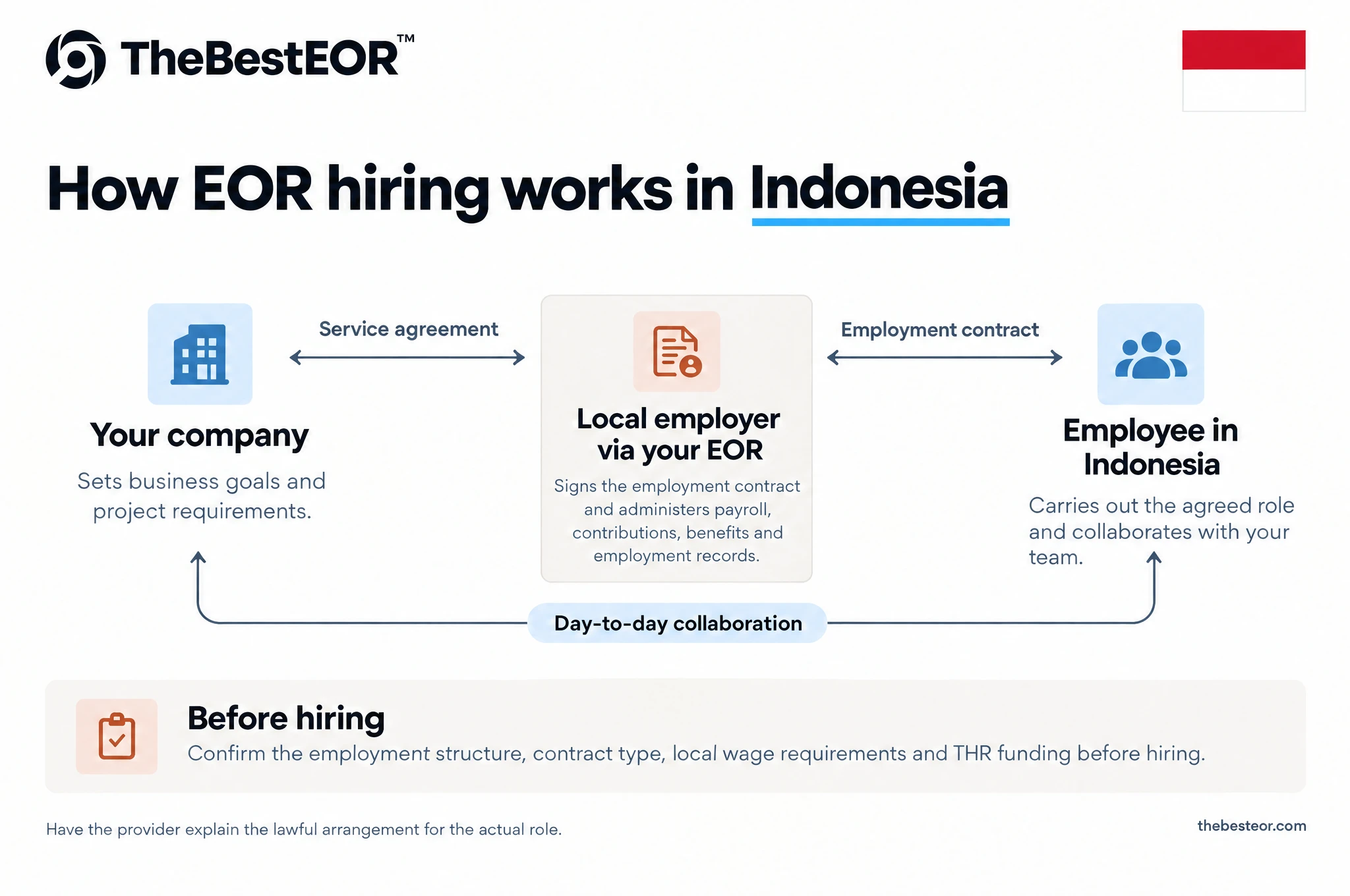
Employer of record in Indonesia diagram showing the service agreement, employment contract, and day-to-day collaboration between your company and the employee.
Employer of record in Indonesia: how your company, the local employer and the employee work together. Select the image to enlarge.

The EOR handles

1
Legal employer status on its Indonesian entity, with the statutory liability that follows it
2
BPJS Ketenagakerjaan and BPJS Kesehatan registration and monthly remittance
3
PPh 21 income-tax withholding (TER monthly, progressive year-end)
4
The mandatory THR payment before each religious holiday
5
The local PKWT or PKWTT contract in Bahasa Indonesia
6
Statutory leave administration and the payslip
7
Compliant offboarding, the bipartite process and the documented termination case

You keep

1
The work itself: what gets built, by when, to what standard
2
Pay decisions: salary, bonus, and the fixed allowances that feed the BPJS wage base
3
Hiring and firing decisions (the EOR runs the bipartite process you initiate)
4
Performance management, and the written record a PHI challenge would test
5
Laptops and tooling, bought and shipped by you unless you add the EOR’s device service
6
The commercial relationship with the provider, and your IP terms (check they survive the Bahasa Indonesia version of the contract)

Engage an Indonesian worker as an independent contractor while they work fixed hours under your direction and the authorities can declare them an employee, with unpaid BPJS, back THR, back PPh 21 and penalties attached. An employment arrangement that meets local requirements can change how the worker is engaged from then on. It does not settle earlier classification liabilities, and the staffing model and any immigration route require their own assessment. The misclassification guide covers the tests Indonesian authorities apply.

Work permits

RPTKA, KITAS and the foreign-worker levy

Check the role’s eligibility and the monthly levy.

Step / item What it is Cost / duration Who issues it
Step / item
RPTKA
What it is
Foreign-manpower utilisation plan; approves the position
Cost / duration
Tied to assignment length
Who issues it
Ministry of Manpower (via OSS)
Step / item
DKP-TKA levy
What it is
Skills-development fund, prepaid per worker
Cost / duration
USD 100/worker/month
Who issues it
Ministry of Manpower
Step / item
KITAS (ITAS)
What it is
Limited-stay permit allowing residence and work
Cost / duration
Usually 6–24 months, renewable
Who issues it
Directorate General of Immigration
Step / item
Notification
What it is
Confirms the worker may start (replaces old IMTA)
Cost / duration
Issued after RPTKA + levy
Who issues it
Ministry of Manpower

Fig. 8 · RPTKA, KITAS and the DKP-TKA levy · rates and steps in force in 2026, with the issuing agencies named

The work permit is employer-sponsored, so the EOR’s Indonesian entity must hold the RPTKA approval to sponsor a foreign hire. The employer files the RPTKA through the OSS system, pays the DKP-TKA levy of USD 100 per worker per month (payable in rupiah at the prevailing rate) into the skills-development fund, and the worker then receives the notification and a KITAS, issued digitally as an e-ITAS since Indonesia moved to eVisa processing in 2025. The levy is set by PP 34/2021 and has not moved. Indonesia reserves many positions for citizens, and in sectors the Ministry of Manpower restricts it expects local workers hired alongside each foreign one; certain roles (such as HR director) are closed to foreigners entirely. Processing typically runs one to two weeks once the documents are in order.

For an Indonesian-national hire none of this applies, so compare the complete country quote, employing entity and support scope.

Salary benchmarks

Indicative salary ranges

The ranges show monthly gross salaries in rupiah.

Monthly gross in rupiah with a USD equivalent at roughly Rp17,000 to the dollar, close to the rupiah’s 2026 average. Ranges are 2026 market data from the Michael Page Indonesia Salary Guide, SalaryExpert and Multiplier; use the midpoint as a starting offer, not a ceiling.

Check current pay data for the role and location before you make an offer.

Role Gross IDR/month USD/month (approx)
Role
Software engineer
Gross IDR/month
Rp12,000,000–25,000,000
USD/month (approx)
$706–1,471
Role
Senior software engineer
Gross IDR/month
Rp25,000,000–45,000,000
USD/month (approx)
$1,471–2,647
Role
Product manager
Gross IDR/month
Rp15,000,000–33,000,000
USD/month (approx)
$882–1,941
Role
Accountant
Gross IDR/month
Rp8,000,000–18,000,000
USD/month (approx)
$471–1,059
Role
Customer support
Gross IDR/month
Rp5,000,000–10,000,000
USD/month (approx)
$294–588
Role
Sales manager
Gross IDR/month
Rp20,000,000–40,000,000
USD/month (approx)
$1,176–2,353
Role
HR manager
Gross IDR/month
Rp20,000,000–38,000,000
USD/month (approx)
$1,176–2,235
Role
Designer
Gross IDR/month
Rp9,000,000–20,000,000
USD/month (approx)
$529–1,176

Fig. 9 · What roles cost in Indonesia, 2026 · monthly gross in rupiah, USD at roughly Rp17,000 to the dollar; use the midpoint as a starting offer, not a ceiling

Salaries cluster in Jakarta and the surrounding Jabodetabek area; Bandung, Surabaya and Yogyakarta run roughly 15 to 30 percent below the capital for the same role. Gross figures here exclude the mandatory THR, which adds one extra month of pay a year, so a Rp16,000,000 engineer costs about Rp208,000,000 a year in base salary plus THR before BPJS and the EOR fee.

Fully-loaded cost

What an Indonesian engineer costs per month

The Rp16 million example spreads THR across the year.

The table assumes a USD 199 monthly fee and shows the effect of substituting the Multiplier or Oyster fee. For a different salary, estimate employer payroll costs in Indonesia.

Software engineer, Jakarta Gross base: Rp16,000,000/month
Gross salary Rp16,000,000

JHT employer (3.7%)

No wage ceiling
Rp592,000

JKK (0.54%, low risk)

Industry risk band
Rp86,400

JKM (0.3%)

 
Rp48,000

JP employer (2%)

Capped at Rp11,086,300 of wages
Rp221,726

BPJS Kesehatan (4%)

One month of salary spread monthly
Rp480,000

THR provision (1/12)

One month of salary spread monthly
Rp1,333,333

EOR fee illustration

RemoFirst $199 ≈ Rp3,383,000
⚠ Trustpilot warning: rating suspended for a breach of its guidelines; fake reviews removed
Rp3,383,000

Monthly total, cheapest fee

Annual ≈ Rp265,733,000 (about $15,631)
Rp22,144,459

Fig. 10 · Fully-loaded monthly cost for an illustrative Jakarta software-engineer salary · THR spread across twelve months, illustrative USD 199 monthly service fee in the table

Statutory employer cost is about Rp1,428,000, roughly 8.9 percent on top of gross at this salary because the JP and health lines are capped; add the THR provision and the all-in statutory load is closer to 17.3 percent. At the illustration’s exchange rate, these hypothetical USD monthly service fees change the modelled total: an illustrative USD 499 fee (≈ Rp8,483,000) lands at Rp27,244,459/month (≈ Rp326,933,000/year), and a USD 699 service fee (≈ Rp11,883,000) lands at Rp30,644,459/month (≈ Rp367,733,000/year). In Indonesia the biggest lever on total cost is the fee rather than the statutory load.

EOR vs your own entity

EOR or your own PT PMA: compare costs

Compare EOR fees with local accounting and setup costs.

Annualise the selected service fee for the hires you expect to keep, then compare it with the PT PMA setup, local accounting, payroll and contribution administration. Count setup costs over the same hiring horizon and include payroll, benefits, transition and exit charges on both sides. A higher service-fee plan moves the financial crossover earlier; lower recurring entity overhead or a longer hiring horizon can do the same. Short hiring duration, setup costs and the need for local administration can move it later.

Factor EOR Your own PT PMA
Factor
Setup cost
EOR
None
Your own PT PMA
~USD 3,000–8,000 + Rp10bn paid-up capital expectation
Factor
Time to first hire
EOR
3–15 days
Your own PT PMA
2–4 months (OSS, NIB, BPJS, tax registration)
Factor
Per-employee cost
EOR
$199–699/employee/mo fee + statutory
Your own PT PMA
Statutory only, plus shared overhead
Factor
Ongoing admin
EOR
Provider runs payroll & filings
Your own PT PMA
Local director, monthly tax & BPJS, annual reporting
Factor
Compliance liability
EOR
On the EOR
Your own PT PMA
On you and your directors

Fig. 11 · Illustrative EOR-versus-entity comparison; the crossover depends on the fee plan, local operating costs and hiring duration.

Run the EOR at an illustrative USD 199 monthly service fee and the fee line comes to about Rp40,600,000 a year per employee: that is the service-fee component only, before other EOR charges or entity administration costs. Compare complete quotes for EOR service and PT PMA setup, director, filing and reporting obligations over the same hiring period, including the timing of capital and payroll funding.

Annualise the selected service fee for the hires you expect to keep, then compare it with the PT PMA setup, local accounting, payroll and contribution administration.

FAQ

EOR in Indonesia: common questions

What is the best EOR in Indonesia?

RemotePeople is our top pick for Indonesia in 2026 (4.9/5), followed by Multiplier (4.1/5) and Deel (4.7/5). We opened paid accounts with all 10 providers on this page, priced real hires and ran payroll.

RemotePeople offers recruitment and EOR through one provider, with a dedicated account manager on both EOR plans. Its EOR Global plan starts at USD 499 per employee per month, and EOR Select at USD 199 where the hire qualifies. Multiplier Core starts at $499 per employee per month on monthly billing, or $459 billed annually; Deel starts at USD 599 plus a mandatory Employer Liability Cost.

How does an employer of record work in Indonesia?

An employer of record in Indonesia becomes the worker’s legal employer through a local employing entity, while your company directs the day-to-day work. The EOR registers the employee with BPJS Ketenagakerjaan and BPJS Kesehatan and pays both monthly, withholds PPh 21 income tax, pays the mandatory THR before each religious holiday and issues the PKWT or PKWTT contract in Bahasa Indonesia.

How fast can an EOR onboard an employee in Indonesia?

Estimated onboarding times for Indonesia range from 2 to 14 days across the providers we tested that give an estimate. By provider: Deel 2–5 days, G-P 3–7 days, RemotePeople 5–8 days, Pebl 7–10 days and Oyster 10–14 days.

Plan the start date around the checks and employment contract, then agree when any required BPJS registration and the first payroll will be completed. The onboarding schedule should identify missing documents, the payroll cut-off, the funding deadline and the employee’s first pay date. A headline onboarding estimate is useful only if it states which milestones it covers.

How much does an EOR cost in Indonesia per month?

Published service fees for Indonesia run from USD 199 to USD 699 per employee per month across the 10 providers we tested: RemoFirst from USD 199; RemotePeople Global from USD 499, or Select from USD 199 only where country and salary qualify; Deel from USD 599 plus mandatory Employer Liability Cost; G-P from USD 599; Oyster USD 699 on monthly billing, with annual seats quoted separately. Multiplier Core advertises $499 monthly or $459 per month billed annually; Pebl advertises $399, with currency and commitment to confirm. Rippling starts at USD 499 plus its required platform from USD 8 per employee, and Papaya Global at USD 499. Borderless AI is USD 579 standard, with an eligible USD 399 promotion on fees billed through 31 December 2026. All amounts are per employee/month; salary and employment costs are separate. 

On top of the fee you pay the employee’s gross salary plus roughly 10 to 11 percent in employer BPJS Ketenagakerjaan and BPJS Kesehatan contributions, plus one month of THR each year.

What employer contributions are mandatory in Indonesia?

BPJS Ketenagakerjaan: JHT old-age 3.7 percent, JKK work-accident 0.24 to 1.74 percent by industry risk, JKM death 0.3 percent, and JP pension 2 percent capped at a Rp11,086,300 wage from March 2026. Plus BPJS Kesehatan health at 4 percent capped at Rp12,000,000 of wages. The combined employer load is about 10 to 11 percent of gross, before the mandatory THR.

Is THR mandatory in Indonesia?

Yes. Tunjangan Hari Raya, the religious-holiday allowance, is a mandatory 13th-month payment under Minister of Manpower Regulation No. 6 of 2016. An employee with twelve months of service or more receives one full month of salary; one to twelve months is pro-rated. It must be paid no later than seven days before the religious holiday, and late payment carries a 5 percent fine.

Can an EOR sponsor a work permit in Indonesia?

The employer files an RPTKA manpower plan, pays the DKP-TKA development levy of USD 100 per foreign worker per month, and the worker holds a KITAS limited-stay permit.

What is the minimum wage in Indonesia in 2026?

There is no national figure; minimum wage is set by province (UMP) and sometimes by city or regency (UMK). Jakarta’s UMP for 2026 is Rp5,729,876 per month, up 6.17 percent on 2025. Other provinces set their own, generally lower, rates, so the floor depends on where the employee works. An EOR applies the correct provincial minimum for the work location.

How is severance calculated when terminating in Indonesia?

Under the Omnibus Law and PP 35/2021, severance has three parts: pesangon (1 to 9 months of wage by tenure), UPMK service-appreciation pay (2 to 10 months from three years of service), and UPH compensation of rights, which since PP 35/2021 covers unused leave and contract-stipulated items rather than the abolished 15 percent housing-and-medical top-up. A redundancy to prevent losses pays pesangon at 1x. A three-year employee on Rp15,000,000 receiving redundancy gets about Rp90,000,000 plus accrued leave.

What currency and payroll cycle does Indonesia use?

The Indonesian rupiah (IDR, Rp). Payroll runs monthly and salaries are typically paid at month-end. BPJS Ketenagakerjaan and BPJS Kesehatan contributions and PPh 21 income-tax withholding are remitted monthly, with PPh 21 due by the fifteenth of the following month. The rupiah has traded between about Rp16,675 and Rp18,175 to the US dollar in 2026, around Rp17,950 in June; conversions here use Rp17,000, close to the 2026 average. THR is the one extra payment each year, due before the religious holiday.

Can I convert an Indonesian contractor to an EOR employee?

Review the earlier contractor arrangement before conversion: a contractor who works fixed hours under your direction can be deemed an employee, exposing you to back BPJS, unpaid THR and PPh 21 plus penalties. An EOR issues a compliant PKWT or PKWTT contract, enrols the worker in BPJS Ketenagakerjaan and Kesehatan, and runs PPh 21 withholding, usually within one to two weeks. The conversion steps and the tests are in the contractor misclassification guide.

Do I need a PT PMA to hire one person in Indonesia?

No. Incorporating a PT PMA costs roughly USD 3,000 to 8,000 plus a Rp10 billion paid-up capital expectation and ongoing reporting. The math usually favours an EOR until you reach about six to ten employees in Indonesia.

What is the difference between a PKWT and a PKWTT contract?

A PKWT is a fixed-term contract for time-bound work, now capped at five years total under PP 35/2021, and it carries an end-of-contract compensation payment for covered employees. The PP 35/2021 compensation rule excludes foreign workers; micro and small businesses have a separate agreed-payment provision. A PKWTT is a permanent, open-ended contract that allows a probation period of up to three months. An EOR issues the right type for the role; using a PKWT for genuinely permanent work risks the worker being deemed permanent.

Sources and as-of dates

Article references

Half of these figures are time-bound: the JP ceiling moved in March 2026, Jakarta’s UMP is a 2026-only figure, and THR follows the religious calendar rather than the fiscal one. Statutory figures trace to the statute or collecting body named on each line. Rates as of June 2026.

Hiring facts Checked 2 Oct 2026

Hiring facts

Checked 2 October 2026
Eligibility, local and collective rules apply. EOR fees extra.

Manpower Law No. 13 of 2003 4 sources

Manpower Law No. 13 of 2003, as amended by Law No. 6 of 2023, together with PP 35/2021 and Constitutional Court decision 168/PUU-XXI/2023: working time, leave, contracts and termination rights. The standard working week is 40 hours, subject to sector-specific exceptions.

PP 35/2021 4 sources

PP 35/2021 sets out a tenure-based severance scale of 1–9 months’ wages, service recognition pay (UPMK) of 2–10 months for qualifying service of at least three years, and compensation for unused unexpired leave, return travel and rights specified in employment agreements, company rules or collective agreements. Its UPH list does not include a standard 15% housing/medical addition. PKWT compensation is covered by Articles 15–17. The five-year contract limit includes extensions under the Constitutional Court’s 2024 ruling, which also requires the statutory severance scale to be read as a minimum; termination multipliers need to be assessed in that context.

BPJS Ketenagakerjaan 2 sources

Standard salaried-worker contributions: JHT employer 3.7% and employee 2%; JKK 0.24–1.74% according to occupational risk; JKM employer 0.3%; JP employer 2% and employee 1%. A BPJS Jakarta Ceger circular dated 25 February 2026 states a JP contribution wage ceiling of Rp11,086,300 per month from 1 March 2026; the linked copy is hosted by a third-party compliance portal. Sector-specific contribution relief may affect the amount payable.

BPJS Kesehatan 1 source

For salaried employees in the PPU category, the statutory health-insurance contribution is 5% of the monthly wage base: 4% paid by the employer and 1% by the employee. The contribution wage ceiling is Rp12,000,000 per month under Articles 30 and 32 of the health-insurance rules as amended by Presidential Regulation 64/2020.

THR 3 sources

Minister of Manpower Regulation 6/2016 and the 2026 THR circular: employees with at least one month of continuous service qualify; those with 12 months or more receive one month’s wages, while service of one to under 12 months is paid proportionally. THR is due no later than seven days before the employee’s religious holiday and must be paid in full. Late payment attracts a 5% fine without removing the obligation to pay the THR; more generous contractual or established entitlements remain applicable.

Minimum wage 2 sources

Minimum pay depends on the applicable provincial (UMP), regency/city (UMK) and, where relevant, sectoral minimum. Jakarta’s 2026 UMP is Rp5,729,876 per month, an increase of 6.17% from 2025, according to the provincial government’s announcement.

Work permits 3 sources

Where required, employers apply for RPTKA approval through the Ministry of Manpower’s TKA Online system. The DKPTKA levy is generally US$100 per position, per worker, per month, with statutory exemptions. RPTKA approval supports the immigration process for the appropriate work visa and limited stay permit (ITAS/KITAS); it does not replace those immigration permissions.

Income tax (PPh 21) 4 sources

Resident individual income tax uses progressive annual taxable-income rates of 5–35%. Employment income for non-residents is generally subject to PPh 26 withholding at 20%, subject to an applicable tax treaty. Monthly TER withholding has applied since January 2024 for covered employees, with reconciliation in the final tax period. Under the current general monthly timetable, PPh 21/26 is remitted by the 15th of the following month and the monthly return is filed by the 20th, subject to applicable deadline extensions.

Maternity and paternity 2 sources

Law 4/2024, Articles 4–6, gives working mothers at least three months’ maternity leave, with up to three additional months for specified maternal or child health conditions supported by a doctor’s certificate. Pay is full for the first three months and the fourth month, and 75% for the fifth and sixth months where the extension applies. A husband is entitled to two days to accompany his wife at childbirth; up to three further days may be granted, or as agreed, with additional time for the serious circumstances specified in the law.

Salary benchmarks 2 sources

NodeFlair provides Indonesia software-engineer monthly base pay, separately from total compensation. Rp17,000 per USD is an illustrative conversion, not a dated Bank Indonesia rate.

Provider pricing, entity model and onboarding 10 sources

Further sources, October 2026 3 sources

Kemnaker — Government Regulation 35/2021 — Articles 12, 15–17: PKWT probation prohibition, compensation timing, proportional calculation and foreign-worker exclusion; Article 26 overtime cap scope. Accessed 19 October 2026.

State Secretariat — 2026 THR circular explanation — At least one month continuous service, full/pro-rata calculation, seven-day deadline, full payment and better established terms. Accessed 19 October 2026.

Constitutional Court — decision 168/PUU-XXI/2023 — Operative ruling on five-year PKWT duration and the minimum severance scale; disputed termination process. Accessed 19 October 2026.

To expand your shortlist, browse EOR providers for Indonesia. Once you have proposals, enter the recurring amounts in USD in the EOR cost calculator. The country guides cover other hiring markets.

This guide is for general information only and does not provide legal, tax, accounting, or financial advice. For advice about your business, consult a qualified professional familiar with the rules where you hire. The research methodology explains how TheBestEOR assesses sources.