


Guide overview
PEO or EOR, at a glance.
Start with who can legally employ your worker.
For the US PEO model covered here, your company remains an employer and shares specified duties with the PEO. An EOR is the named local employer for the worker under the proposed arrangement. Start with where the person works, whether you have a ready employer there, and which payroll, benefits and HR tasks you need.
Hiring location
Country first
Review the arrangement available for the country and role.
Existing employer
Check your setup
Establish whether you already have an eligible local employer.
Service scope
Read the agreement
Compare payroll, HR, benefits and the duties you retain.
Budget
Compare full costs
Use the same employment package and service scope.
Check before acting
Confirm eligibility and responsibilities before choosing a service label.
What to record in the worksheet
Scope
Service / responsibility · PEO quote · EOR quote
Evidence and follow-up
Employer named · Included / excluded · Cost basis · Evidence
Which service should you compare?
Start with the employer and the services you need.
| Your situation | Services to assess | Evidence to obtain |
|---|---|---|
Your situation
US entity employing US staff
|
Services to assess
PEO versus separate payroll, HR and benefits support
|
Evidence to obtain
Scope, benefits quotes, remaining duties and any CPEO certification.
|
Your situation
Employee abroad, no ready local employer
|
Services to assess
EOR and other locally permitted hiring options
|
Evidence to obtain
Employing entity, country and role eligibility, required licences.
|
Your situation
Local entity is ready to employ
|
Services to assess
Payroll and HR support; an eligible PEO where available
|
Evidence to obtain
Employer registrations and the work each supplier actually performs.
|
Your situation
US team plus international hires
|
Services to assess
Domestic support plus country-specific employment arrangements
|
Evidence to obtain
Who handles each country, consolidated reporting and escalation ownership.
|
Your situation
Independent project work
|
Services to assess
Contractor services only after classification review
|
Evidence to obtain
Facts supporting independence under the applicable local rules.
|
Your situation
Only need better benefits
|
Services to assess
Benefits broker or PEO comparison
|
Evidence to obtain
Equivalent coverage, premiums, administration fees and participation conditions.
|
CPEO certification concerns specified US federal employment-tax consequences.
Your US business remains an employer, supported by co-employment services.
The provider is the named employer under an eligible arrangement.
Read the actual duties, country eligibility and signed terms. A service label does not remove every client responsibility.
Compare the actual employment and service agreements. Certification, benefits access and tax treatment need separate checks.
1. What an EOR is
An employer of record (EOR) hires the employee through a locally permitted arrangement. That can be useful where your company has no entity ready to employ someone. Depending on the agreement, the EOR may issue the employment contract, register the hire, run payroll in local currency, pay employer taxes and statutory contributions, and administer benefits.
The employee can report to your manager, join team meetings and use your tools while the EOR is their legal employer. If you later move the employee to your own entity, find out which documents you need, how service and rights will carry over and whether local rules require consent or consultation.
Your team normally decides whom to hire, directs the work and sets compensation. To see who bears the cost of a claim, read the indemnities and exclusions alongside local law. Your company’s own conduct can affect its liability.
Selected public EOR fees fall between USD 199 and USD 699 per employee/month in the examples maintained in our cost guide. They are starting service fees. Pricing is usually flat per employee, with statutory costs passed through separately, but watch for FX markups and setup fees that the advertised price leaves out.
2. What a PEO is
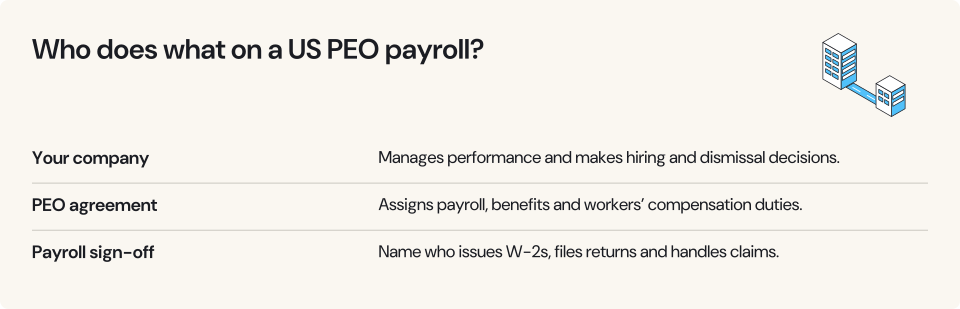
With a US professional employer organization (PEO), your company remains an employer. You direct the work and make hiring and dismissal decisions. The co-employment agreement assigns duties such as payroll, benefits and workers’ compensation to the PEO. For federal employment taxes, the rules for a certified PEO depend on the contract, who paid the wages and whether the employee qualifies as a worksite employee. The customer can retain tax liability in some cases.
Health insurance is the main draw. KFF’s 2025 Employer Health Benefits Survey puts average annual premiums at $9,325 for single coverage and $26,993 for family coverage. A PEO may offer access to group coverage, but rates, networks, eligibility and participation conditions depend on the plan and team. The PEO also handles 401(k) administration, workers’ comp through its master policy and multi-state payroll, so compare the quoted administration fee and actual benefits package with separate payroll, HR and insurance support.
Your managers still handle performance and business decisions. Check who will issue Forms W-2, make payroll filings and handle workers’ compensation claims. Where the PEO takes on those tasks, the agreement should also say which HR and compliance duties stay with your company.
Selected published US PEO administration-fee examples range from USD 79 to USD 124 per employee per month, with benefits premiums passed through on top. Justworks lists PEO Basic at $79 and PEO Plus (with medical, dental and vision administration) at $124, and RemotePeople’s US PEO starts at $99 (checked September 2026). For any other provider, obtain a current written PEO quote. Compare the actual payroll, tax and benefits migration milestones; team size and the existing setup affect readiness.
If you already employ a US team through your own entity, our PEO brokerage service can help you compare US PEO providers against your payroll and benefits needs.
3. Who employs the worker and directs the work?
The two are easy to confuse because Deel and Rippling sell both under the same brand.
4. PEO vs EOR: key differences
| Factor | EOR | PEO |
|---|---|---|
Factor
Geographic scope
|
EOR
Countries and roles where the proposed model is permitted
|
PEO
This comparison covers a US PEO serving eligible US employers and staff.
|
Factor
Legal employer
|
EOR
The EOR
|
PEO
You (co-employed with the PEO)
|
Factor
Need a local entity?
|
EOR
No
|
PEO
Yes
|
Factor
Onboarding prerequisites and timing
|
EOR
Country-, role- and document-dependent; confirm first payroll separately
|
PEO
Depends on payroll migration, benefits enrollment and the quoted product milestones; confirm the first payroll separately.
|
Factor
Selected published administration-fee examples
|
EOR
Selected published examples: USD 199–699 per employee/month; confirm plan, commitment and country.
|
PEO
Justworks Basic USD 79 / Plus USD 124 per employee/month, checked 15 October 2026; benefit premiums and eligibility are separate.
|
Factor
Compliance liability
|
EOR
Allocated by local law and the agreement; client duties and costs can remain
|
PEO
Shared with the PEO
|
Factor
Benefits sourcing
|
EOR
EOR's local plans (statutory + supplemental)
|
PEO
PEO master group health plan (US)
|
Factor
Best for
|
EOR
Employment abroad where the proposed model is legal and compliant for the role; compare other available routes.
|
PEO
US companies outsourcing HR for US staff
|
Factor
Evidence to check
|
EOR
SOC 2 report, ISO 27001 certificate, required local licences and data-protection terms
|
PEO
IRS CPEO certification where held; verify scope and status
|
Fig. 1 · EOR vs PEO across nine decision factors · cost row reflects September 2026 published rates
Compare equivalent services in the quotes
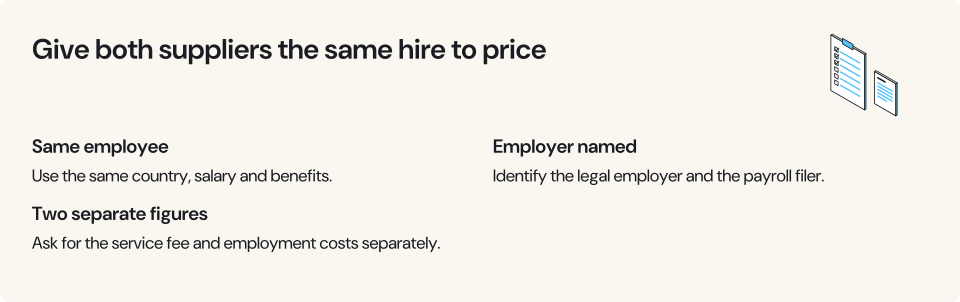
Give both suppliers the same hire to price. Ask each to name the employer and spell out who registers the employee, files payroll returns and administers benefits. Which HR tasks and liabilities stay with you? Once the quotes cover the same work, compare the fees. If you need an EOR, the comparison of EOR services for international hiring can help you build a shortlist.
| The working record | Fields to complete |
|---|---|
The working record
Scope
|
Fields to complete
Service / responsibility · PEO quote · EOR quote
|
The working record
Evidence and follow-up
|
Fields to complete
Employer named · Included / excluded · Cost basis · Evidence
|
5. Which service fits your employer setup?
- Q1. Are you hiring someone in a country where you don't have a legal entity?
- YES → Assess an eligible EOR arrangement alongside other hiring options the country permits.
- NO → Continue to Q2
- Q2. Do you have a US entity and want to outsource HR, benefits and payroll for your US employees?
- YES → Compare a PEO with separate payroll, HR and benefits support, using equivalent scope and costs.
- NO → You probably don’t need either yet. If you’re unsure, ask us about your hiring situation.
6. Include entity costs when comparing hiring options
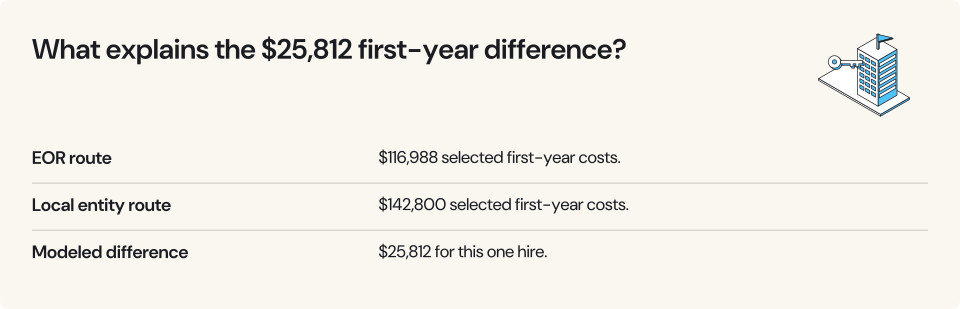
Suppose you hire a senior software engineer in Germany on a $90,000 base salary. The employee is paid in euros. The figures below are shown in dollars and use assumed costs to compare the first year through an EOR with the first year running a local entity.
Via EOR
Via local entity + payroll provider
The selected first-year costs come to $116,988 through the EOR and $142,800 through the entity, a difference of $25,812 on these assumptions. Before using that figure, price equivalent benefits and add any costs the example leaves out. Keep share capital in the cash forecast and out of the expense total.
The headcount at which an entity costs less depends on the country and the team. The country-by-country break-even comparison lets you weigh quoted EOR charges against entity overhead, differences in the employment package, cash requirements and the cost of moving employees.
Use current quotes for the employees you plan to hire when you fill in the EOR and entity cost model.
7. Common misconceptions
“Global PEO”: check the actual legal model. An international offer with that label may use a different structure from US co-employment. Ask who is the employer, which country rules apply and which payroll, benefits and employment duties each party accepts.
“An EOR is just a payroll provider.” A payroll provider calculates and administers pay without necessarily becoming the employer. An EOR is the named legal employer and supplies the agreed employment services.
“You can use a contractor instead.” Sometimes. Direction over hours, tools and work, or dependence on one client, can be relevant risk indicators. Assess the full relationship under the applicable local tests and exceptions before choosing the route.
A “global PEO” label needs a contract check
Suppose a supplier offers a “global PEO,” but its country proposal names a separate local company to sign the employment contract. Before you approve the quote, ask whether your business will be a co-employer and which agreement spells out who runs payroll and handles an exit.
8. When you need both a PEO and an EOR
You can use a PEO for employees on your US entity’s payroll and an EOR where you have no local employer. The two arrangements have separate invoices. On the US side, check which services the PEO handles, including multistate payroll, Affordable Care Act reporting, workers’ compensation, 401(k) administration and state unemployment claims.
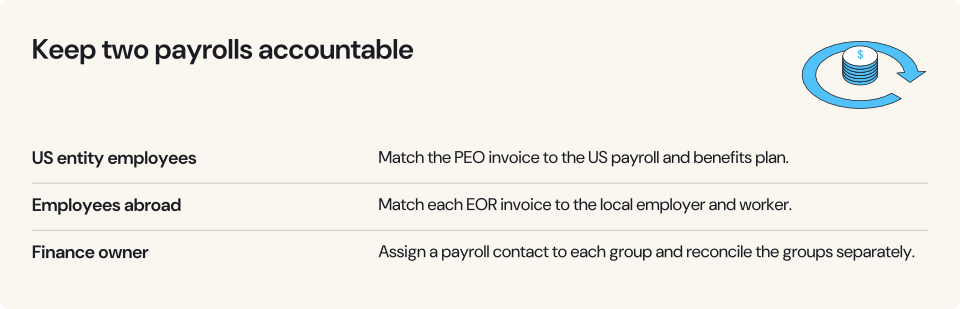
Payroll may have to reconcile records from two systems. Benefits also need a country-by-country comparison with the US health plan. If employees receive equity, budget time to check how vesting and tax treatment differ.
Assign responsibility across a mixed team
For each group of employees, record the local employer and the contact who handles payroll. Give HR a named person to call when there’s a gap in a benefit or employee record. Finance can then reconcile the PEO and EOR invoices separately and send each question to the team that can resolve it.
9. Frequently asked questions
Can I use the same vendor for EOR and PEO?
Yes, Deel and Rippling sell both. Compare the actual products, employing arrangements and current country quotes. Check the IRS’s published CPEO list and ask for the certification notice before you sign.
Is a “global PEO” a real category?
“Global PEO” is used inconsistently. Some suppliers use it for an EOR arrangement; others offer different local services. For any international proposal, identify the legal employer, whether co-employment applies, the local eligibility rules and which agreement covers payroll, benefits, liability and exit.
Does an EOR avoid permanent-establishment risk?
An EOR does not by itself prevent permanent establishment. Assess your company’s local activities under the applicable domestic rules and tax treaty, separately from the employment arrangement. Certain activities can still create PE risk, such as having an employee close deals on your behalf, holding inventory or operating a fixed place of business.
Can I switch from an EOR to my own entity later?
Yes, but the decision and timing depend on your actual costs, country requirements and employer readiness. A 20–30 employee planning scenario is not a universal break-even rule. When you plan the move from an EOR to your own entity, obtain a timeline for entity registration, employer readiness, the local transfer process, payroll testing and any tax consequences for the actual team.
Do PEOs offer health insurance?
In the United States, yes. A PEO’s main selling point is its master health plan, which may offer useful coverage and purchasing options. Compare actual premiums, benefits, networks, participation rules and administration fees. Across borders, service labels and employing arrangements vary. Identify the actual employer, local eligibility and benefits arrangements, then compare current premiums and service fees for that product.
10. Sources
The sources behind this guide, grouped by topic. Dates show when we last checked a page. Prices and terms change, so confirm them in your quote.
PEO and EOR legal framework
7 sourcesInternational · ILO
Private Employment Agencies Convention, Articles 1 and 12
Used in the EOR and PEO comparison. Checked 3 Oct 2026
International · OECD
Permanent establishment definitions. The update on remote work is used in the EOR and PEO comparison, checked 3 Oct 2026.
United States · Department of Labor (DOL)
United States · IRS
United States · IRS
CPEO customers: what you need to know
Distinguishes worksite and non-worksite federal-tax treatment. For federal employment taxes, the rules for a certified PEO depend on the contract and who paid the wages. Checked 15 Oct 2026
United States · IRS
ACA employer shared responsibility provisions
The ACA reporting a PEO runs for US teams.
European Union · EUR-Lex
Regulation (EU) 2016/679, the GDPR
The data-protection regime in the comparison table.
Entity costs and contractor reclassification
9 sourcesGermany · gesetze-im-internet.de
The EUR 25,000 minimum share capital for a German GmbH.
Germany · Federal Health Ministry (BMG)
Health and care insurance contributions
Statutory contribution components, coverage and calculation bases.
Germany · gesetze-im-internet.de
Tax-adviser fee schedule (StBVV)
The statutory per-employee payroll-bureau fee range.
Germany · gesetze-im-internet.de
Four-year back-contribution window when Germany reclassifies a contractor.
France · URSSAF
Enforcement background. Check the applicable procedure date and current law rather than relying on its older surcharge figures.
France · Service Public
Current concealed-work sanctions
Gives 35% and 50% contribution surcharges with conditions, possible reductions and repeat-offence rules. Government guidance verified 3 Jul 2026. Checked 15 Oct 2026
Spain · BOE
The employment presumption behind contractor reclassification.
Brazil · Planalto
The employment test behind contractor reclassification in Brazil.
United Kingdom · GOV.UK
Off-payroll working rules (IR35)
The UK contractor status test.
Standards and benefits research
3 sourcesUnited States · AICPA
What a SOC 2 Type II report attests.
International · ISO
ISO/IEC 27001 information security standard
The second EOR-side certification in section 4.
United States · KFF
2025 Employer Health Benefits Survey
Average employer-plan premiums.
Provider pricing and products
6 sourcesDeel
One vendor selling EOR and PEO side by side.
Justworks
PEO Basic $79 and PEO Plus $124 per employee per month in administration fees (checked Sep 2026). Benefit coverage and premiums need a comparable quote (cross-checked 15 Oct 2026).
Oyster
Published EOR pricing, used as a selected starting-fee example. The customer terms are used in the EOR and PEO comparison, checked 3 Oct 2026.
RemoFirst
Published EOR pricing, used as a selected starting-fee example; country pricing varies.
RemotePeople
Distinguish US PEO from EOR Global and Select. Global starts at $499 per employee per month; Select starts at $199 in selected countries and qualifying salary ranges (EOR cards checked 16 Oct 2026).
Rippling
The other dual EOR and PEO vendor named in section 3.
Our research
1 sourceThe Best EOR
How we rate EOR providers.
If you spot a changed price or a conflicting source, send it through the contact page and we’ll review it.
This guide is for general information only and does not provide legal, tax, accounting, or financial advice. For advice about your business, consult a qualified professional familiar with the rules where you hire. Read our research methodology to learn how we assess sources.