TheBestEOR

Best Employer of Record in Ukraine

Written by Martynas PupkeviciusFact-checked by Michael Ennis
Picture of Martynas Pupkevicius
Martynas Pupkevicius

EOR Advisor and Remote Work Editor

Our top employer of record in Ukraine for 2026 is RemotePeople, from USD 499 per employee a month, ahead of Deel and Rippling.

We tested all 10 providers with paid client accounts, real quotes and a live hire run through payroll. Ukrainian employers usually pay a 22% social insurance contribution on top of salary, and salary must be paid in at least 2 payments a month.

Flag of Ukraine

Hiring in Ukraine at a glance

Currency
UAH
Ukrainian hryvnia
Pay cycle
2 per month
At least 2, no more than 16 days apart
Working hours
40 hours
Up to 60 in some critical roles under martial law
Annual leave
24 days
Calendar days, martial law allows some deferral
Extra pay
Per contract
Ask which bonuses and allowances are guaranteed
Employer costs
22%
Social insurance, salary limits and reduced rates apply
Before you hire:
Confirm the employee’s work location and whether wartime rules on hours or leave apply to the role.

Country hiring overview · Ukraine

Hiring in Ukraine at a glance

Compare payroll continuity and the current employment rules.

For Ukraine, I want the proposal to name the legal employer and explain the practical payroll and employee-support arrangements. I’d ask how current martial-law rules affect the contract and leave. A move from a FOP contractor arrangement also needs a separate handover review.

Choose a hiring solution

Need a local employer?

Compare an EOR arrangement for your role before opening your own entity.

Already have a local employer?

Compare payroll and HR support against adding an EOR.

EOR service fee

Fees vary by provider.

Your quote should state the currency, fee per employee, minimum charge and billing commitment.

Onboarding

Paperwork affects the start date.

The contract, right-to-work checks, registrations and payroll deadlines all affect when employment can begin.

Employment costs

Show contributions separately.

Ask the provider to show applicable employer contributions and benefits separately from salary. The payroll calculation should explain each amount included in the employment budget.

Annual leave

Wartime rules can affect leave.

Martial-law provisions may affect the granting and use of annual leave. Ask the provider to explain how the current rules apply to the employee’s leave.

Check before choosing

Confirm current martial-law provisions, payroll funding/continuity plans, leave administration and any FOP-to-employment handover.

What your quote should include

Employment costs and service fees

1
Gross salary and agreed pay schedule
2
Applicable employer contributions, payroll and benefits
3
EOR fee: currency, per-employee billing, minimums and commitment
4
Setup, foreign exchange, extras and exit costs

Deposits and payroll funding

1
Amount and payment deadline
2
Whether funds are refundable or credited to payroll
3
Release conditions and refund timing
Show these separately from recurring expenses.

Key takeaways for hiring in Ukraine

Agree the net-pay result

Agree gross pay and expected net pay before converting a contractor. Under ordinary employment rates, 18% income tax and 5% military levy reduce the amount received.

Apply the USC ceiling

For 2026, the ordinary monthly USC base is capped at UAH 172,940; the standard 22% employer contribution is not unlimited on high salaries.

Write down remote-work terms

Write down equipment, expense reimbursement and communication arrangements for remote work, including a period when the employee can disconnect.

Assess disruption carefully

A wartime disruption does not automatically justify suspending employment. The statutory test concerns inability to provide and perform work because of armed aggression.

Track suspension days

Unilateral suspension is generally limited to 90 calendar days in total during martial law; further continuation requires the parties’ agreement under the current rules.

Quick verdict

What is the best EOR in Ukraine?

My top three: RemotePeople, Deel and Rippling.

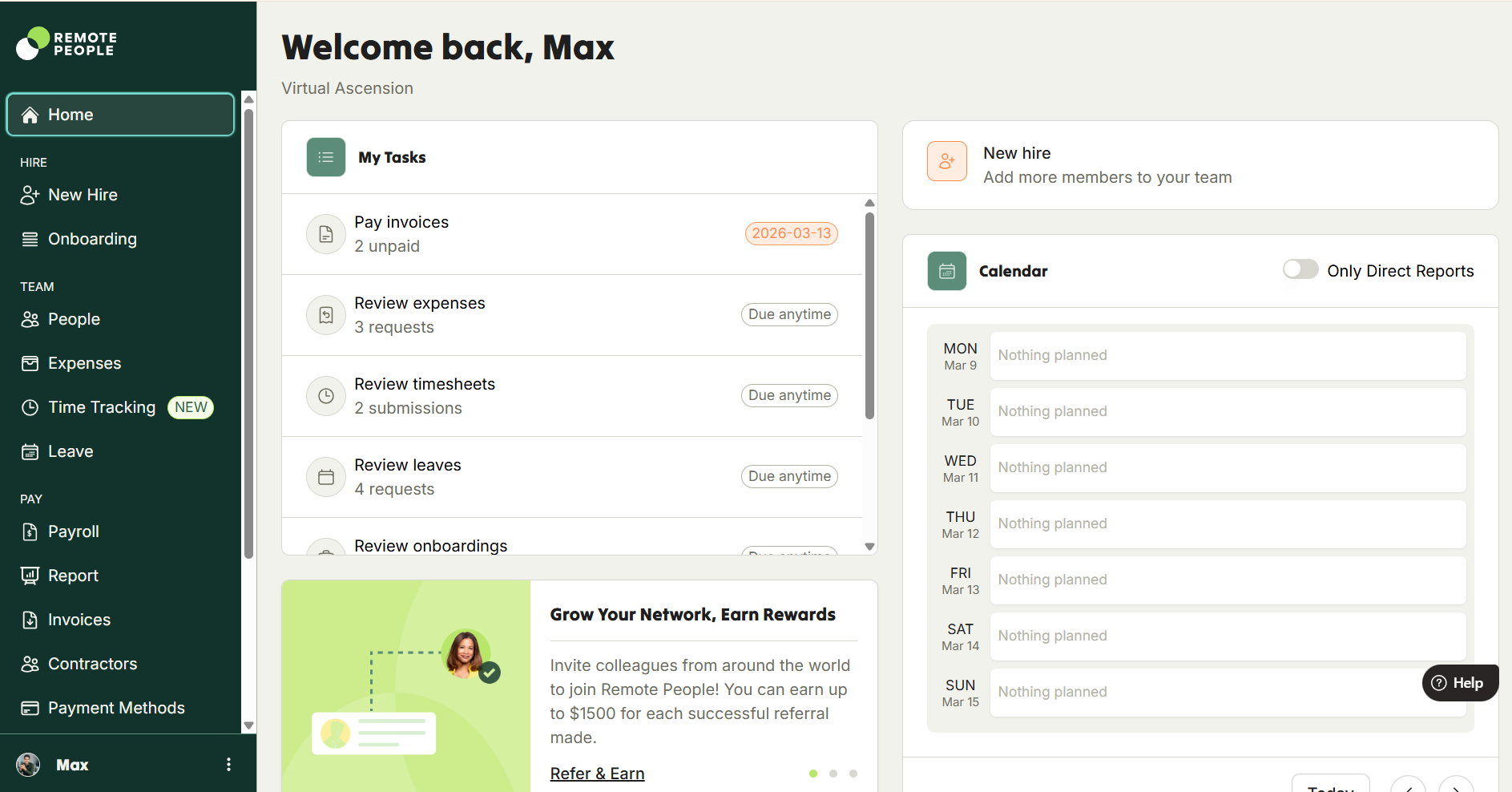
For a hire in Ukraine, I’d shortlist RemotePeople first. It offers recruitment and EOR through one provider, with a dedicated account manager on both EOR plans. Its EOR Global plan starts at USD 499 per employee per month, or USD 199 on EOR Select where the hire qualifies. Deel, from USD 599 plus a mandatory Employer Liability Cost, fits when Ukraine is one part of a wider employee and contractor programme. Rippling, from USD 499 plus its required platform, fits a team that already runs HR or IT on Rippling.

Ukraine rewards providers that stayed operational after February 2022 and kept salaries landing on time. All three below run hryvnia payroll today. Compare their proposed employer, service scope and complete country fee rather than assuming the advertised amounts cover equivalent terms.

1
Editorial pick
RemotePeople logo

4.9/5

RemotePeople

Hiring in new markets with local HR support

Starting fee
$499

per employee / month

Countries
150+
where you can hire

EOR Select from $199 for eligible hires.

Deposit
1 month

of gross salary

Deposit refund
Within 5 days

of the final payment

Why consider it

Recruitment and EOR services through one provider.

Dedicated account manager in both EOR plans.

Check the fit

Recruitment is separately priced. Confirm its fee and payment schedule.

Before signing: Confirm quote currency, billing commitment, deposits, funding deadlines and refund terms. EOR Select eligibility depends on the hiring country and employee salary.

Both EOR plans list local contracts, payroll and tax administration, and statutory benefits administration. Salary, employer contributions and benefit costs are separate.

Visit RemotePeople ↗

2
Deel logo

4.7/5

Deel

Paying employees and contractors on one platform

Starting fee
$599

per employee / month

Countries
130+
where you can hire

Plus a mandatory Employer Liability Cost.

Deposit
1–1.5 months

of gross salary

Deposit refund
Within 60 days

of offboarding

Why consider it

EOR, contractor management and payroll for your own entities.

Month-to-month EOR service pricing available.

Check the fit

Ask for the country-specific Employer Liability Cost in your quote.

Before signing: Confirm the Employer Liability Cost amount, benefit costs and any additional products. Monthly service terms do not remove employment notice, severance or other exit obligations.

The EOR pricing page lists 130+ countries. Broader platform coverage figures may include other services.

Visit Deel ↗

3
Rippling logo

4.5/5

Rippling

Setting up payroll, laptops and app access for new hires

Starting fee
$499

per employee / month

Countries
115
where you can hire

Plus the Rippling Platform, from $8 per employee / month.

Deposit
Per quote

based on gross salary

Deposit refund
Per contract

set in your agreement

Why consider it

EOR, payroll, HR records and benefits administration in one platform.

Shared workflows and reporting for domestic and international teams.

Check the fit

Ask for an itemised quote showing the required platform and each HR or IT module.

A paid Rippling Platform subscription is required on top of the EOR fee, from $8 per employee per month plus a monthly base fee. Rippling EOR starts at $499 per employee per month. Other HR and IT products are priced separately.

Rippling’s EOR page lists 115 countries. Confirm your hiring country and legal employer.

Visit Rippling ↗

No provider pays for a position on this page; some outbound links pay a referral fee. See the funding model and methodology.

Fee, entity and speed, side by side

All 10 EOR providers for Ukraine, side by side

Compare fees, the signing employer and first payday.

The statutory employer load is the same 22 percent USC whoever you pick, so the ten differ on the fee, whose company signs the employment contract, and how quickly first payroll lands. Fees are August 2026 list prices per employee per month.

Three things weigh on this order: the fee, whose entity signs the employment contract, and how each provider has actually operated in Ukraine since February 2022. Every plaque links its full review. The same ten providers are compared side by side in the global EOR ranking. For a wider shortlist, browse EOR providers for Ukraine.

Provider

Best For

Starting feeDepositOnboarding
1 RemotePeople logo RemotePeople 4.9/5 Rating Hiring in new markets with local HR support Starting fee: $499 USD / monthDeposit: 1 monthOnboarding: 2–5 days

My take

I’d compare RemotePeople’s two plans on eligibility and cost, since both include employment contracts, payroll and tax administration, statutory benefits administration, a dedicated account manager and ongoing employment support.

EOR Global starts at USD 499 per employee per month. EOR Select starts at USD 199 for eligible countries and employee salary ranges. Salary, employer contributions and benefits are separate; the proposal sets the applicable plan, billing commitment, deposit and payroll funding terms.

Fit check for RemotePeople, Deel and RemoFirst

For a contractor-to-employee move, I’d ask for a side-by-side transition statement showing gross salary, employee deductions, employer USC, benefits and the first two pay dates. A convenient platform transfer is useful, but the employee should understand the pay change before signing.

Deposit

1 month

Entity model

Own entities in core markets

First year, one hire

$5,988 in service fees

Reviewed by Martynas PupkeviciusFact-checked by Michael Ennis

Starting fee

$499

EOR Global. EOR Select starts at $199 where the country and employee salary qualify.

Against the 10 starting fees

$199 lowest$699 highest
2 Deel logo Deel 4.7/5 Rating Paying employees and contractors on one platform Starting fee: $599 USD / monthDeposit: 1–1.5 monthsOnboarding: 2–5 days

My take

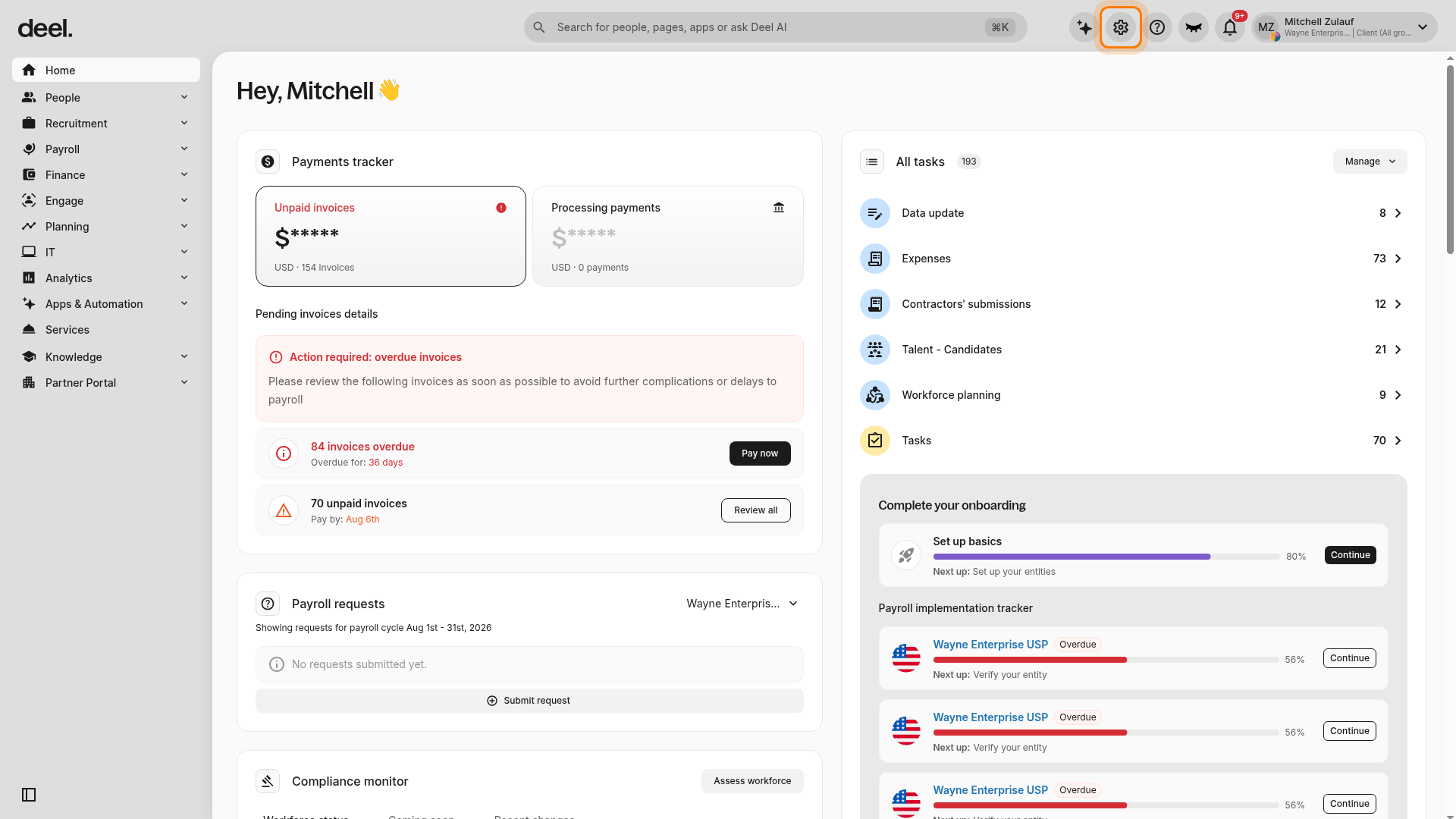
I’d consider Deel if you’re moving an existing contractor into employment: it can start the EOR transition from that contractor record.

The change requires a new quote, review and employee onboarding, including a contractor release agreement. Employee and contractor administration have separate service fees.

Deel’s global EOR service starts at USD 599 per employee per month, with month-to-month pricing available. Mandatory Employer Liability Cost is charged separately and varies by country. Salary, employer contributions, benefits and any additional services sit outside the starting service fee.

Deposit

1–1.5 months

Entity model

Owned network; Ukraine model unpublished

First year, one hire

$7,188 in service fees

Reviewed by Martynas PupkeviciusFact-checked by Michael Ennis

Starting fee

$599

Month-to-month billing. Mandatory Employer Liability Cost is charged separately.

Against the 10 starting fees

$199 lowest$699 highest
3 Rippling logo Rippling 4.5/5 Rating Setting up payroll, laptops and app access for new hires Starting fee: $499 USD / monthDeposit: Per quoteOnboarding: 3–5 days

My take

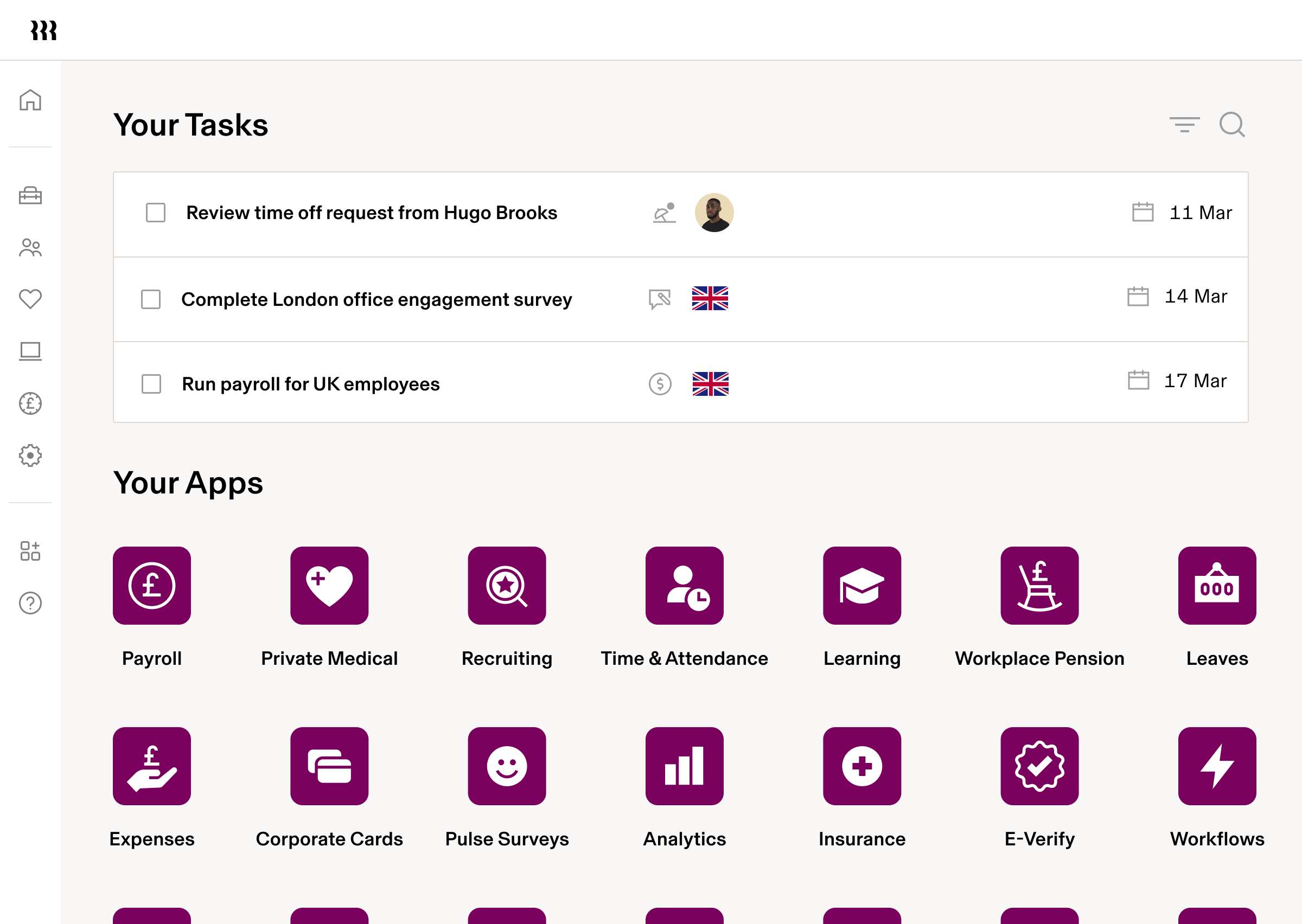
Rippling interests me when you want EOR employees to share HR records and workforce reporting with the rest of the organisation.

App access and device management are separate products.

Rippling EOR starts at USD 499 per employee per month, plus the required Rippling Platform from USD 8 per employee per month plus a monthly base fee. Billing commitment and optional HR or IT modules are quote-specific.

Fit check for Rippling, Papaya Global, Multiplier and Borderless AI

For Ukraine, I’d make the demo about a disrupted payroll cycle: who approves a change, how the employee is contacted and how the two scheduled payments are funded. Ask for the documented contingency process and the named escalation contact.

Deposit

Per quote

Entity model

Own entities and local partners

First year, one hire

$5,988 in EOR fees

Reviewed by Martynas PupkeviciusFact-checked by Michael Ennis

Starting fee

$499

Plus the required Rippling Platform, from $8 per employee per month and a monthly base fee. Confirm the billing terms and selected products.

Against the 10 starting fees

$199 lowest$699 highest
4 Oyster logo Oyster 4.5/5 Rating Using one onboarding process for hires across countries Starting fee: $699 USD / monthDeposit: ~1 monthOnboarding: 5–7 days

My take

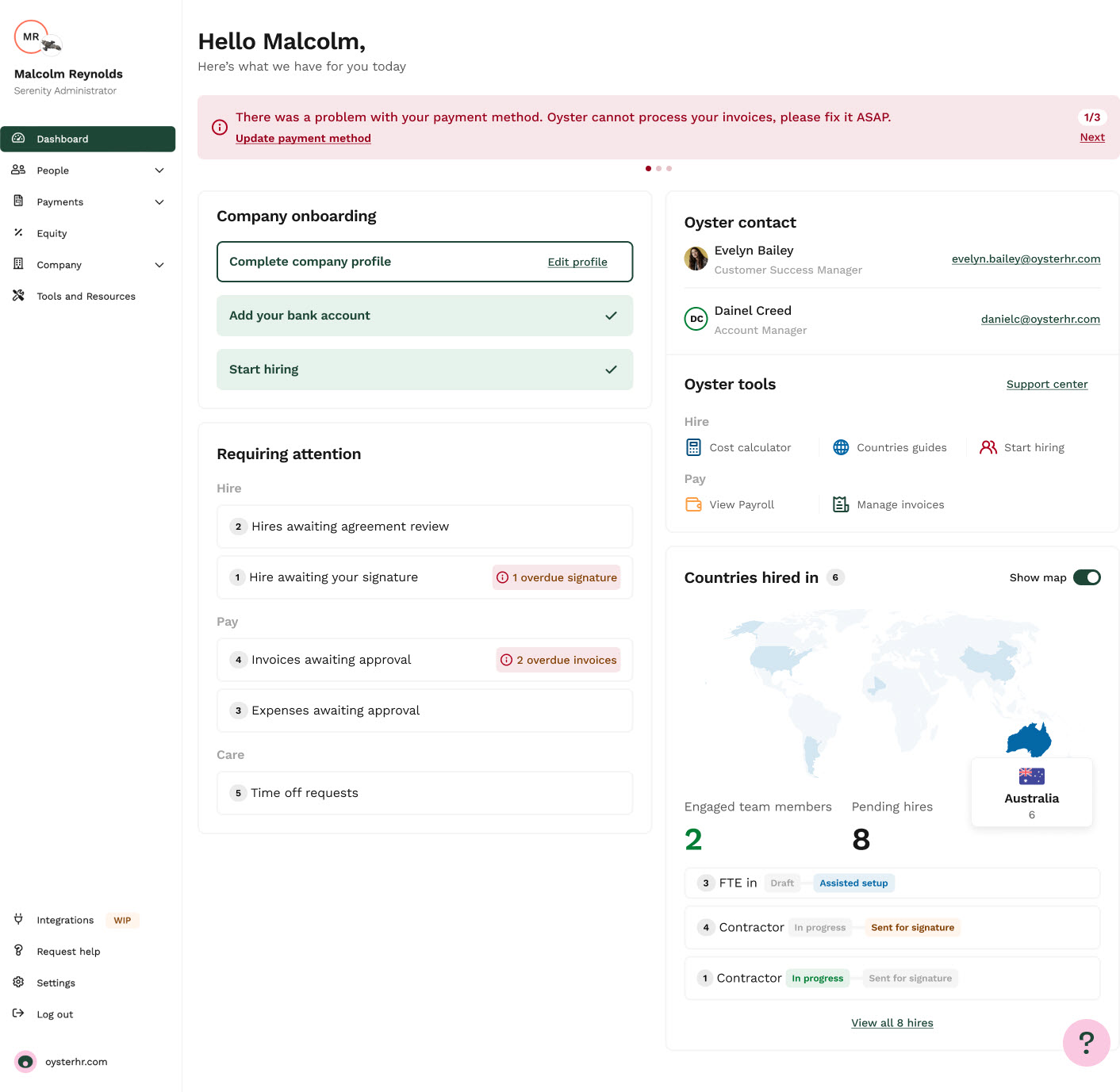
I’d use Oyster’s hiring-cost calculator as a starting point, then add the separately priced benefits and HR advice you need. People Partner advice costs USD 300 per hour.

Oyster’s month-to-month EOR rate is USD 699 per employee per month. Annual seats are quoted separately. Standard annual billing is prepaid and non-refundable; quarterly or semiannual payment is available at a higher seat price. A seat can be reused for a replacement hire. Salary, employer costs, deposits and optional services are additional.

Fit check for Oyster, Pebl and G-P

I’d want the proposal to identify where the employee will work and what support applies there. Agree the medical cover, equipment expenses and any relocation service, and ask how a move changes the employer, payroll and employment terms.

Deposit

~1 month

Entity model

Own entities and vetted partners

First year, one hire

$8,388 in service fees

Reviewed by Martynas PupkeviciusFact-checked by Michael Ennis

Starting fee

$699

Monthly billing. Annual seats are quoted separately, prepaid and non-refundable.

Against the 10 starting fees

$199 lowest$699 highest
5 Pebl logo Pebl 4.2/5 Rating Hiring people who need visa or relocation support Starting fee: $399 USD / monthDeposit: Per quoteOnboarding: 2–5 days

My take

Pebl’s EOR terms prohibit assigning workers to areas experiencing war, armed conflict, active hostilities or civil unrest that presents a material risk to personal safety.

For Ukraine, I’d establish the worker’s actual location and whether Pebl can serve it before going further.

Pebl lists an EOR fee of $399 per employee per month, but the general price does not specify the dollar currency or billing commitment. The country proposal determines availability, any offer period and renewal terms; salary, employer costs and additional services are separate.

Deposit

Per quote

Entity model

Affiliates and local partners

First year, one hire

$4,788 in service fees

Reviewed by Martynas PupkeviciusFact-checked by Michael Ennis

Starting fee

$399

Confirm the country price and billing commitment.

Against the 10 starting fees

$199 lowest$699 highest
6 G-P logo G-P 4.2/5 Rating Hiring abroad while keeping your existing HR system Starting fee: $599 USD / monthDeposit: 1–2.5 monthsOnboarding: 5–10 days

My take

I’d consider G-P when you need to assess optional visa support, background checks or equity payroll management alongside employment.

Additional services have their own eligibility and charges.

G-P’s global EOR fee starts at USD 599 per employee per month, with a tailored country proposal. There is no minimum duration for an EOR hire; the client’s billing, cancellation and employee exit terms remain separate contract terms.

Deposit

1–2.5 months

Entity model

100+ own entities, plus partners

First year, one hire

$7,188 in service fees

Reviewed by Martynas PupkeviciusFact-checked by Michael Ennis

Starting fee

$599

Confirm the included services and billing terms in your country quote.

Against the 10 starting fees

$199 lowest$699 highest
7 Papaya Global logo Papaya Global 4.1/5 Rating Comparing payroll costs across countries in one report Starting fee: $499 USD / monthDeposit: 1–2 monthsOnboarding: 4–6 days

My take

I’d distinguish Papaya’s payroll processing for workers employed by your own Ukrainian company from its EOR employment service.

These services have different employment responsibilities and prices. Its account manager coordinates payroll, legal, finance and benefits specialists.

Papaya’s EOR service starts at USD 499 per employee per month. The country quote must identify the billing commitment and any additional services. Salary and employer costs are separate.

Deposit

1–2 months

Entity model

Partner + payroll engine

First year, one hire

$5,988 in service fees

Reviewed by Martynas PupkeviciusFact-checked by Michael Ennis

Starting fee

$499

The country quote sets the billing terms. Payroll-only processing is priced separately.

Against the 10 starting fees

$199 lowest$699 highest
8 Multiplier logo Multiplier 4.1/5 Rating Managing payroll, leave and expenses in one place Starting fee: $459 USD / monthDeposit: 1+ monthsOnboarding: 7–10 days

My take

With Multiplier, I’d compare the commitment as well as the fee: Core starts at $499 per employee per month on monthly contracts, or $459 per employee per month billed annually.

The dollar currency is not specified. Country variations and compliance add-ons affect the quote. Growth adds integrations, custom reports and open API access. Implementation fees may apply, although the FAQ says setup is free; the quote must resolve that charge.

Deposit

1+ months

Entity model

Own entities and partners

First year, one hire

$5,508 in service fees

Reviewed by Martynas PupkeviciusFact-checked by Michael Ennis

Starting fee

$459

Core plan billed annually, or $499 per month on monthly billing. Confirm the dollar currency.

Against the 10 starting fees

$199 lowest$699 highest
9 Borderless AI logo Borderless AI 4.0/5 Rating Getting 24/7 help with overseas payroll and HR Starting fee: $579 USD / monthDeposit: 1.5–3 monthsOnboarding: 7–10 days

My take

With Borderless AI, I’d budget for the refundable deposit due before onboarding.

Borderless AI’s standard calculation is 1.5 months of gross salary plus employer costs, benefits and platform fees for ACH or three months for wire and other methods, with country variations. Balances unpaid for 15 days, or more than two late payments during the term, can raise the deposit to six months. Refunds follow account closure and settlement of outstanding balances.

Borderless AI’s standard fee is USD 579 per employee per month. Eligible companies headquartered outside Canada can pay USD 399 on fees billed through 31 December 2026; USD 579 applies from 1 January 2027, including promotional customers. Some countries and employment types are priced separately. Salary and employer costs are additional.

Deposit

1.5–3 months

Entity model

Own entities

First year, one hire

$6,948 in service fees

Reviewed by Martynas PupkeviciusFact-checked by Michael Ennis

Starting fee

$579

Eligible companies headquartered outside Canada can pay $399 on fees billed through 31 December 2026.

Against the 10 starting fees

$199 lowest$699 highest
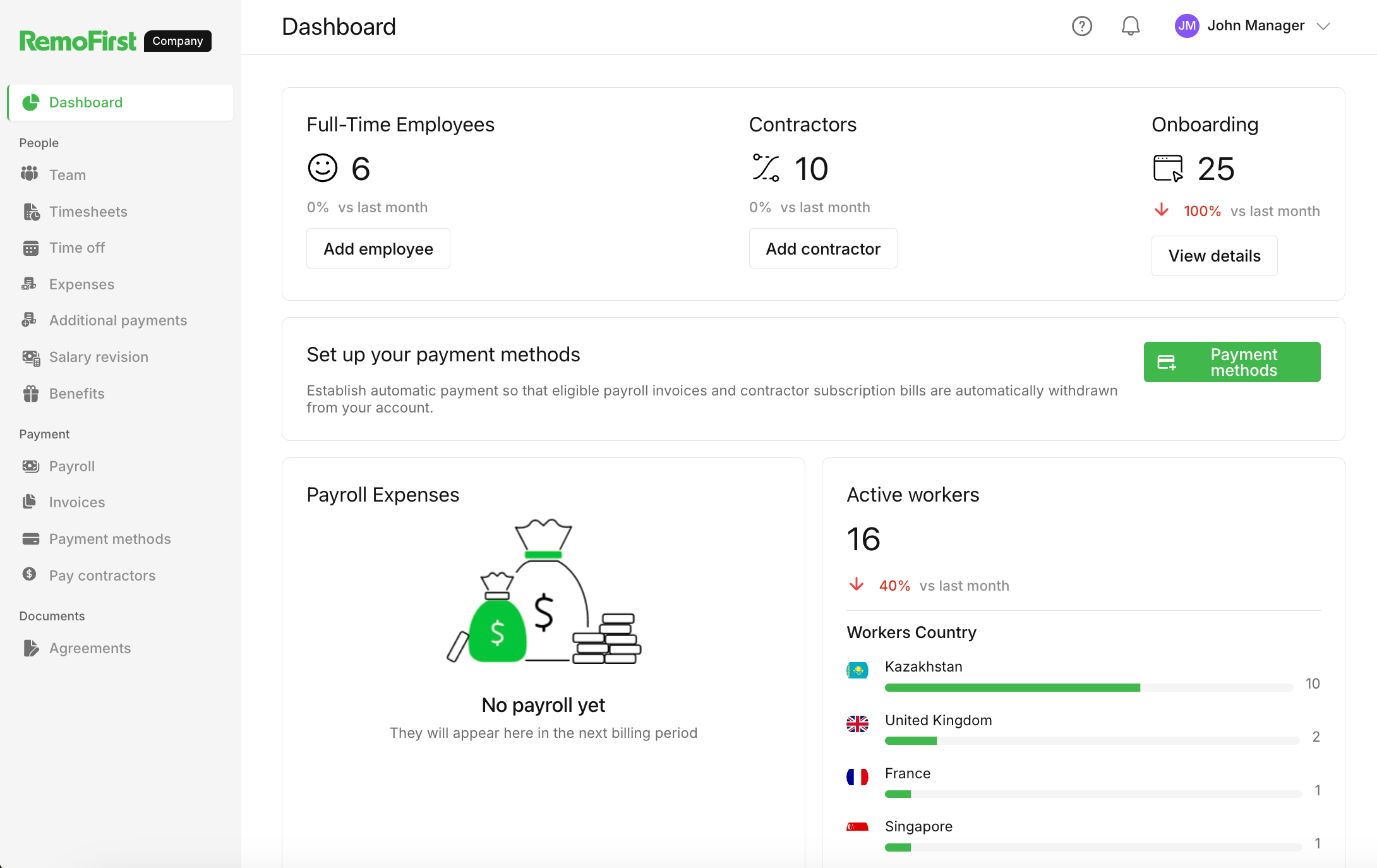
10 RemoFirst logo RemoFirst ⚠ Trustpilot warning 0.5/5 Rating Making a first overseas hire on a tight budget Starting fee: $199 USD / monthDeposit: About 1 monthOnboarding: 5–9 days

My take

We moved RemoFirst to last place on 8 November 2026: Trustpilot has suspended its rating for a breach of its guidelines and removed fake reviews.

RemoFirst says it works exclusively with vetted in-country partners. Here, that means a local partner company, not RemoFirst, would normally employ your hire, and payroll changes, questions and exits pass through both companies, which can slow answers. US$199 is RemoFirst’s starting fee and varies by country, so get this country’s quote before you compare. I separate RemoFirst’s contractor pricing from its EOR offer. Its free contractor tier covers administration, including contract management and identity checks. Contractor payments cost USD 25 per contractor in months when a payment is processed; payment-provider and transfer fees may also apply.

RemoFirst’s global EOR fee starts at USD 199 per employee per month, with no minimum contract term or employee count. The country fee, deposit, payroll funding and add-ons depend on the proposal. Salary and employer costs are additional.

Deposit

About 1 month

Entity model

Partners, not own entities

First year, one hire

$2,388 in service fees

Reviewed by Martynas PupkeviciusFact-checked by Michael Ennis

Starting fee

$199

RemoFirst advertises no minimum contract term or employee count. Confirm any country-specific charges.

Against the 10 starting fees
$199 lowest$699 highest

Entity ownership is as each provider states it.

Confirm the employing entity, immigration scope, start date and first-payroll cutoff.

Which top pick · Ukraine

Start from the services your Ukrainian team needs. For an FOP contractor moving onto employment, Deel offers conversion inside its platform; compare RemotePeople’s proposed transition process and named manager under its applicable Global or Select plan. Oyster offers benefits packages for employers competing on the employee offer. Request an itemised quote for the hire. The EOR cost calculator lets you compare the recurring amounts in USD.

Local Ukrainian alternatives (unranked): a few Ukraine-focused firms offer employment or R&D-team services alongside the global platforms. Alcor builds and legally employs tech teams for foreign product companies, and Newxel runs dedicated development teams in Kyiv. A Ukraine-only plan with no other markets may find a local operator sufficient; ask the same entity and continuity questions you would ask a global provider.
Get your EOR discount

Get up to 30% off eligible EOR service fees. Your quote confirms the discount and terms.

Employment framework

Employment and payroll in Ukraine

Employees are paid at least twice a month.

A Ukrainian employment arrangement uses a Labour Code contract and at least twice-monthly pay. FOP contracting and Diia City engagements have different structures, while wartime requirements can affect the employee’s plans.

Account for wartime employment and travel constraints

Since February 2022, legislation under martial law has adjusted parts of labour law. Some employees, particularly men of mobilization age, face travel restrictions.

Ask the provider what remote-work and relocation support it offers, and discuss the employee’s circumstances before making plans.

Employment contract and responsibilities

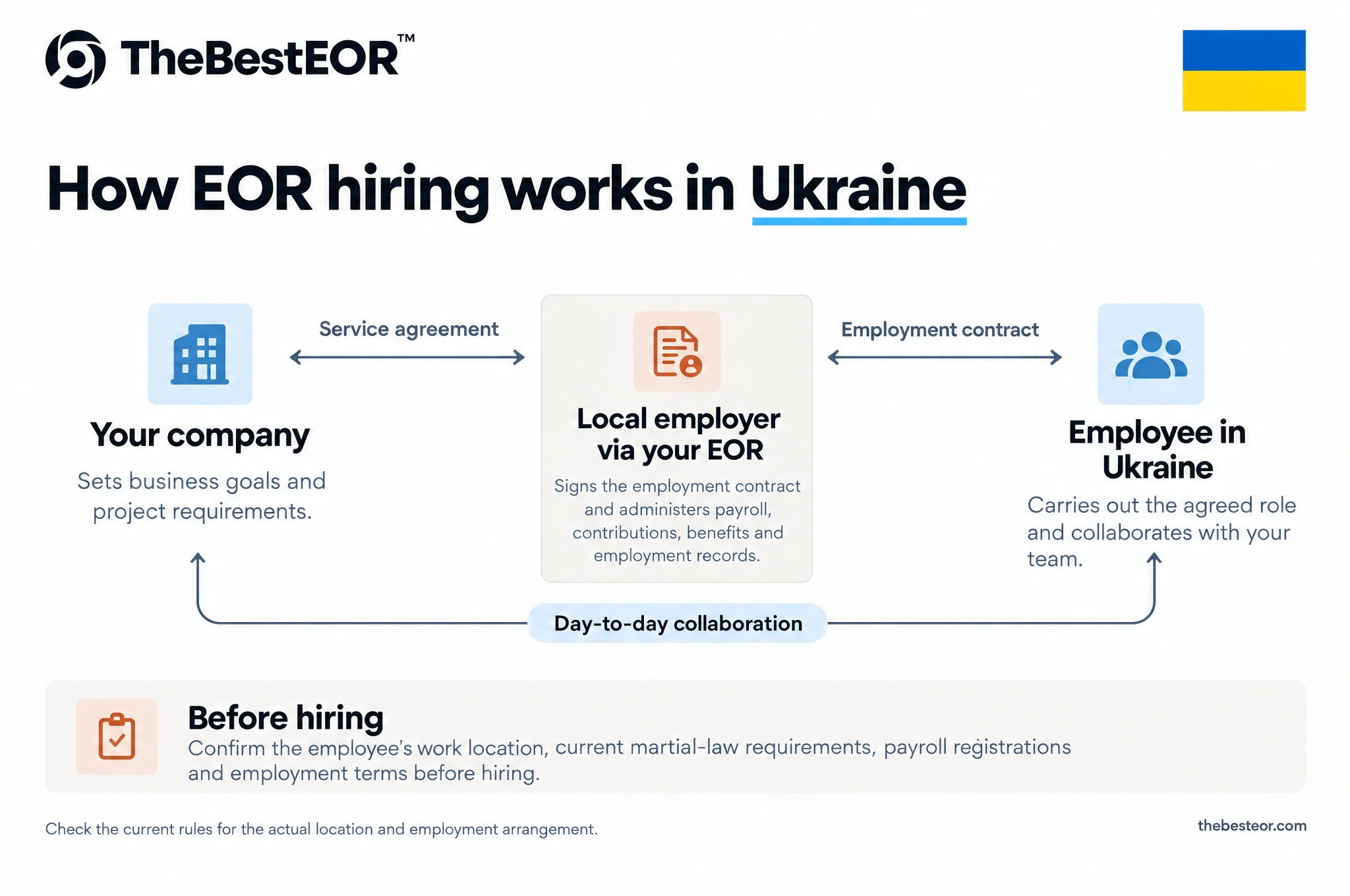
The EOR’s Ukrainian entity, typically a limited liability company (TOV), signs an employment contract under Ukraine’s Labour Code, the KZoT. You direct the work; the EOR handles the contract, tax registrations and employer payroll obligations.

FOP contracting and Diia City

Under a FOP arrangement, the worker registers as a private entrepreneur, pays a low single tax under the simplified system and invoices a client. This is permitted when the relationship is genuinely independent and can be disguised employment when it is not. Confirm the structure and responsibilities before converting an existing engagement to an EOR employment contract.

Diia City is a special legal and tax regime for technology companies. Its residents can engage specialists on gig contracts with preferential personal-tax treatment. If those benefits matter, ask the provider to identify the proposed resident entity and explain whether the specific engagement qualifies. A general EOR employment service should not be assumed to include Diia City treatment.

Twice-monthly pay and deductions

Pay frequency

Wages must be paid at least twice a month, with no more than 16 calendar days between payments. The EOR runs an advance and a settlement rather than one month-end payroll.

Contributions and net pay

Each cycle, the EOR pays the 22 percent unified social contribution on top of gross pay, up to the statutory contribution-base cap. It withholds 18 percent income tax and the military levy, then pays net salary in hryvnia to a Ukrainian account.

Employer cost

Statutory employer contributions in Ukraine

Start with the unified social contribution.

Ukraine consolidated its employer-side social charges into one line years ago: the unified social contribution, and nothing else.

Contribution Employer rate Cap / basis Fund
Contribution
Unified social contribution (USC / ESV)
Covers pension, unemployment and social insurance in one charge
Employer rate
22%
Cap / basis
For ordinary payroll in 2026, the maximum monthly base is UAH 172,940, equal to 20× the UAH 8,647 minimum wage; special categories and regimes require their own treatment.
Fund
Consolidated social funds via the tax service
Contribution
USC, employees with disabilities
Reduced statutory rate on those employees' wages
Employer rate
8.41%
Cap / basis
Same capped base
Fund
Same

Fig. 2 · Mandatory employer contributions in Ukraine · one consolidated 22% line on a capped base

For a UAH 110,000 salary, assuming the base sits under the cap: USC at 22 percent is UAH 24,200, and that is the entire statutory employer bill. There is no separate employer pension, unemployment, accident or health line; the single contribution funds them all, remitted with each payroll through the tax service. Because the contribution base is capped at a multiple of the minimum wage, the effective employer rate falls below 22 percent on high salaries once gross crosses the ceiling; the cap moves with the minimum wage, so confirm the current ceiling with your provider at quote time. The employee side, withheld by the EOR rather than paid by you, is 18 percent income tax plus the military levy. The EOR fee sits on top of all of this.

Working time & leave

Working hours, overtime and statutory leave

Count leave in calendar days.

A 40-hour week, overtime at double pay with an annual cap, and leave measured in calendar days rather than working days, a convention that trips up foreign employers doing the arithmetic.

Hours and overtime

Standard week 40 hours
Overtime premium +100% (double pay)
Annual overtime cap Ordinary 120-hour rule suspended during martial law
Probation (specialists) Up to 3 months

Fig. 3 · Hours and overtime in Ukraine · The ordinary 120-hour annual overtime limit is disapplied while the relevant martial-law provisions operate; overtime-pay requirements remain relevant.

Overtime is normally paid at double the normal rate. The ordinary 120-hour annual limit is disapplied under the relevant martial-law provisions. While martial law is in force, wartime labour legislation adjusts some working-time norms, including the treatment of public holidays as non-working days, so holiday scheduling in practice follows employer policy; the EOR applies whatever rules are current at the time.

Statutory leave

Annual leave
calendar days, minimum
24 days
Employer sick pay
first 5 days
Employer-paid
Sick benefit after day 5 State social insurance
Maternity
70 before + 56 after birth
126 calendar days

Fig. 4 · Statutory leave in Ukraine · 24 calendar days of annual leave; the first 5 sick days are on the employer

Annual leave is a minimum of 24 calendar days, not working days, so a two-week break consumes 14 days of the entitlement. Sick leave is employer-funded for the first five days, then paid as a state social-insurance benefit. Maternity leave is 126 calendar days, normally 70 before and 56 after the birth, funded by social insurance rather than the employer.

Ending employment

Probation, notice and severance in Ukraine

Redundancy has its own advance notice requirement.

Ukraine is not an at-will jurisdiction: an employer-initiated dismissal needs a ground the Labour Code names, and redundancy comes with two months of advance notice.

Scenario Notice Severance
Scenario
Redundancy / staff reduction
Notice
2 months, written, in advance
Severance
At least 1 month's average pay
Scenario
Employee resignation
Notice
2 weeks' written notice
Severance
None
Scenario
During probation
Notice
Short statutory notice
Severance
None

Fig. 5 · Notice and severance by scenario · redundancy carries two months’ notice and at least one month’s average pay

An employer cannot simply give notice without a reason: dismissal must rest on a ground the Labour Code recognises, such as redundancy, documented poor performance or misconduct, and a dismissal without a valid ground can be challenged in court with reinstatement and back pay on the table. Redundancy requires two months’ written warning and a statutory severance payment of at least one month’s average earnings; unused annual leave is always paid out on exit, whatever the ground. Probation for specialists can run up to three months, with a lighter exit during it. Wartime legislation has adjusted some procedures at the margins, and an EOR applies the rules in force at the time, but the planning assumption for a permanent Ukrainian employee should be a documented ground, two months of runway for a redundancy, and a final settlement that includes the leave balance.

Redundancy of a 3-year employee on UAH 60,000/month Statutory minimums, notice period worked
Notice period
2 months' warning, salary continues while worked = UAH 60,000 × 2
UAH 120,000
Statutory severance
Minimum 1 month's average earnings
UAH 60,000
Accrued unused leave
Assume 8 calendar days outstanding at the average daily rate
≈ UAH 16,200
Indicative exit cost
Before any negotiated settlement
≈ UAH 196,200

Fig. 6 · Redundancy of a 3-year employee on UAH 60,000/month · statutory minimums, before any negotiated terms

The notice line is salary for time worked rather than an extra payment, but it is real runway you commit to on the day you give warning, so it belongs in the exit budget. Severance is shown at the statutory minimum of one month; collective agreements or the contract can set more. Compare the same redundancy across markets in the termination across jurisdictions guide.

Payroll & tax

Payroll cycle and income tax in Ukraine

Model income tax and the military levy on each payslip.

Hryvnia payroll on a twice-monthly clock, a flat income tax with a wartime levy beside it, and a simplified regime next door that explains why so many workers arrived here as contractors.

Employment income is taxed at a flat 18 percent, withheld by the employer, plus the military levy, a separate wartime charge on personal income that was raised from 1.5 to 5 percent from December 2024. Both come out of the employee’s gross each payroll; neither is an employer cost. The EOR calculates, withholds and files all of it, and the employee receives net pay in hryvnia to a Ukrainian bank account.

The payroll calendar is stricter than most of Europe: the Labour Code requires payment at least twice a month, with an interval of no more than 16 calendar days, so a compliant Ukrainian payroll pays an advance around mid-month and settles the balance at the end. Salaries for residents are paid in hryvnia; offers in Ukrainian tech are commonly discussed in US dollars, and the contract then fixes the amount in UAH, so decide with the candidate how exchange-rate movement is handled at review time. Roughly UAH 41.5 bought one dollar in mid-2026.

The tax rules around employment explain the country’s contractor economy. A qualifying third-group FOP generally pays either 5% of revenue or 3% plus VAT, as well as a separate 1% military levy under the applicable rules, against 18-plus-levy on employment income, which is why so much of the sector structured itself around FOP invoices, and why the arrangement draws scrutiny when it hides what is really a job. Diia City sits between the two: resident tech companies get a preferential personal-tax package for their specialists on employment or gig contracts, at rates set by the regime rather than the general scale. A general-purpose EOR runs the standard employment numbers above.

The employment contract

Contract requirements, FOP conversion and bonus norms

How does employment differ from an FOP contract?

Ukrainian employment is documented in writing, in Ukrainian, with the essentials fixed: the parties, the role, the start date, the pay, the working time and the place of work, which since 2022 is very often “remote” as a recognised statutory mode of work. Remote work is well established in Ukrainian law, with the employee’s location flexible by agreement, and that legal maturity is an advantage of hiring here: a distributed arrangement does not need creative drafting. The EOR supplies the compliant contract, usually bilingual, and registers the hire with the tax authorities before the start date.

The form of engagement is the decision that carries the risk. Labour Code employment brings the full protective package: 24 calendar days of leave, sick pay, notice and severance, USC and withholding through payroll. The FOP invoice brings none of it and a much lighter tax bill, an option for genuinely independent work, indefensible for a person embedded in your team. The gig contract exists only inside Diia City, available to resident companies, blending contractor-style flexibility with employment-style protections. An EOR hire takes the first form: when a long-running FOP relationship has drifted into de facto employment, the conversion to an EOR contract is the clean fix, and it also gives the worker an employment payroll record and the associated employee protections. FOPs can also accrue insurance service through qualifying USC payments, so review the worker’s existing contribution record.

No 13th-month salary is required by Ukrainian law, and no statutory annual bonus exists. Performance bonuses and year-end payments are common in tech and are purely contractual; if you offer one, state in the contract whether it is guaranteed or discretionary, and the EOR pays it through payroll with USC, income tax and the military levy applied like any other wage. The competitive levers in a Ukrainian offer are usually the base salary, private medical insurance and equipment budget rather than a mandated bonus structure.

Agree the net-pay change before converting an FOP contractor

Do not turn the contractor’s invoice amount into gross salary without discussing the result. For an ordinary employee, 18% personal income tax and a 5% military levy are withheld from gross pay. A hypothetical UAH 100,000 gross salary therefore leaves UAH 77,000 before other individual deductions. Standard employer USC adds UAH 22,000 at that salary, producing UAH 122,000 of salary and USC before the EOR fee and agreed benefits.

If the intended employee take-home amount is UAH 100,000, the same simple assumptions require gross salary of approximately UAH 129,870 and employer USC of approximately UAH 28,571. The combined amount is about UAH 158,441 before service fees. This is an ordinary-rate illustration below the 2026 USC cap. Agree the salary, tax assumptions and transition date together so the new employment arrangement does not arrive as an unexpected pay cut.

Division of responsibility

What the EOR handles, and what stays with you

The EOR files payroll. You direct the team’s work.

The provider carries the filings and the employment law; you keep the work, the pay decision and the duty of care a wartime team needs.

Employer of record in Ukraine diagram showing the service agreement, employment contract, and day-to-day collaboration between your company and the employee.
Employer of record in Ukraine: how your company, the local employer and the employee work together. Select the image to enlarge.

The EOR handles

1
Being the employer in law: the employment contract sits on its Ukrainian entity
2
Semi-monthly payroll and the 22% USC remittance
3
Withholding the 18% income tax and the military levy
4
The written Ukrainian employment contract and tax registration
5
Administering the 24 calendar days of leave and sick-pay rules
6
Applying wartime labour rules as they currently stand
7
Compliant offboarding: ground, notice, severance, leave payout

You keep

1
What the person actually works on, day to day
2
The pay decision, and how a dollar-discussed offer is fixed in hryvnia
3
Who gets hired, promoted, and whose employment you end
4
Performance management and the documentation behind it
5
Equipment, power-outage and connectivity support, and any relocation help you choose to fund
6
Your contract with the provider, including IP assignment wording

The EOR makes the employment compliant; it does not decide how your team weathers air-raid disruptions, blackouts or a colleague’s mobilization. The companies that keep strong Ukrainian teams treat backup power, flexible hours and salary continuity as management decisions they own, with the EOR as the payroll instrument underneath.

Give disruption planning a clear employment process

The continuity plan should say who contacts the employee, how work is reassigned and how the employer records a disruption. Remote-work terms can cover equipment, reimbursed costs, communication and a protected period of disconnection. If work can continue safely through an agreed arrangement, a disruption should not be treated as an automatic reason to stop the employment contract.

Statutory suspension is a separate measure for circumstances in which armed aggression prevents both the employer from providing work and the employee from performing it. Current guidance limits suspension initiated by one party to 90 calendar days in total during martial law; repeating the order does not restart the clock. Beyond that, the parties must agree to continuation within the statutory framework or the employment obligations resume. Ask the EOR to explain which option the legislation permits, the pay consequences and the review date for the actual circumstances.

Work authorization

Work authorization in Ukraine (2026)

Check authorization for any hire from abroad.

Almost every Ukrainian EOR hire is a Ukrainian citizen, which makes the permit question mostly a formality.

Case Authorization needed Who handles it Notes
Case
Ukrainian national in Ukraine
Authorization needed
None
Who handles it
Nothing to file
Notes
The standard EOR case; hire can start within days
Case
Foreign national working in Ukraine
Authorization needed
Employer-sponsored work permit
Who handles it
The legal employer applies via the State Employment Service
Notes
Permit is tied to the employing entity; rare under martial law
Case
Ukrainian national now living abroad
Authorization needed
Depends on the country of residence
Who handles it
EOR employs them in that country instead
Notes
Often the cleaner route: employment where the person actually lives

Fig. 7 · Work authorization cases for a Ukraine hire · the common case needs nothing

Work permits for foreign nationals are employer-sponsored and attach to the employing entity, so where one is genuinely needed, the EOR’s Ukrainian company must be the applicant; in practice, bringing foreign staff into Ukraine is an unusual request in 2026 and worth an explicit conversation with the provider before you promise anyone anything. The more common authorization question runs the other way: a Ukrainian employee now living in Warsaw or Berlin under EU temporary-protection arrangements is usually best employed in that country, by the same or another EOR, under that country’s rules. Within Ukraine, martial law restricts travel for some employees, particularly men of mobilization age, so international team offsites and cross-border role designs need to be planned around the people.

Salary benchmarks

Indicative salary ranges

Compare monthly gross pay in hryvnia.

Monthly gross in hryvnia with a USD equivalent at roughly UAH 41.5 to the dollar. Ukrainian tech offers are commonly discussed in dollars first, so the right-hand column is often the number the candidate is thinking in.

Check current pay data for the role and location before you make an offer.

Role Gross UAH/month USD/month (approx)
Role
Software engineer
Gross UAH/month
UAH 85,000–145,000
USD/month (approx)
$2,050–3,495
Role
Senior software engineer
Gross UAH/month
UAH 145,000–230,000
USD/month (approx)
$3,495–5,540
Role
Product manager
Gross UAH/month
UAH 100,000–190,000
USD/month (approx)
$2,410–4,580
Role
Accountant
Gross UAH/month
UAH 30,000–60,000
USD/month (approx)
$725–1,445
Role
Customer support
Gross UAH/month
UAH 25,000–45,000
USD/month (approx)
$600–1,085
Role
Sales manager
Gross UAH/month
UAH 45,000–95,000
USD/month (approx)
$1,085–2,290
Role
HR manager
Gross UAH/month
UAH 40,000–80,000
USD/month (approx)
$965–1,930
Role
Designer
Gross UAH/month
UAH 60,000–120,000
USD/month (approx)
$1,445–2,890

Fig. 8 · Salary benchmarks in Ukraine, 2026 · monthly gross at roughly UAH 41.5 to the dollar

Ranges are indicative 2026 market levels drawn from Ukrainian tech-market salary surveys and job-board data (DOU and Djinni are the sector’s reference sources); treat the midpoints as a starting offer, not a ceiling, and expect senior engineering to price against European remote offers rather than local ones. Talent concentrates in Kyiv and Lviv but hiring is effectively nationwide and remote-first.

Fully-loaded cost

What a Ukrainian engineer costs per month

Budget around a UAH 110,000 gross monthly salary.

Software engineer, remote (Kyiv-based) Gross base: UAH 110,000/month
Gross salary UAH 110,000
Unified social contribution (22%)
Assuming the base sits under the statutory cap
UAH 24,200
EOR fee, cheapest
RemoFirst from $199 ≈ UAH 8,260
⚠ Trustpilot warning: rating suspended for a breach of its guidelines; fake reviews removed
UAH 8,260
Monthly total, cheapest fee
Annual ≈ UAH 1,709,520 (about $41,200)
UAH 142,460

Fig. 9 · Fully-loaded monthly cost of a UAH 110,000 engineer · illustrative USD 199 service fee shown; a premium fee moves the total

The statutory employer add is a single UAH 24,200 line, a 22 percent markup that is modest by European standards: the same engineer’s employer load would run about 45 percent in France and about 30 percent in Spain. Deel at its published starting fee of $599 (≈ UAH 24,860) lands at UAH 159,060/month, and Oyster at $699 (≈ UAH 29,010) at UAH 163,210/month. With statutory cost identical everywhere, the fee gap is up to UAH 20,750 a month per employee.
EOR vs your own entity

EOR or your own TOV: compare costs

Price running a Ukrainian company from abroad.

Factor EOR Your own TOV
Factor
Setup cost
EOR
None
Your own TOV
Registration, bank account, accounting setup before the first hire
Factor
Time to first hire
EOR
2–10 days
Your own TOV
Weeks in practice: banking and tax onboarding, not the registry, set the pace
Factor
Per-employee cost
EOR
$199–699/employee/mo fee + 22% USC
Your own TOV
22% USC only, plus shared overhead
Factor
Ongoing admin
EOR
Provider runs payroll & filings
Your own TOV
Local accountant, semi-monthly payroll, USC and withholding filings, currency-control rules
Factor
Compliance liability
EOR
On the EOR
Your own TOV
On you and your directors

Fig. 10 · EOR against your own TOV · a per-employee fee versus fixed overhead you operate from abroad

FAQ

EOR in Ukraine: common questions

How does the military levy affect take-home pay?

Which EOR should I use to hire in Ukraine?

RemotePeople is our top pick for Ukraine in 2026 (4.9/5), followed by Deel (4.7/5) and Rippling (4.5/5). We opened paid accounts with all 10 providers on this page, priced real hires and ran payroll.

RemotePeople offers recruitment and EOR through one provider, with a dedicated account manager on both EOR plans. RemotePeople’s EOR Global plan starts at USD 499 per employee per month, and EOR Select at USD 199 where the hire qualifies. Deel starts at USD 599 plus a mandatory Employer Liability Cost; Rippling starts at USD 499 plus its required platform subscription.

Start with the Ukraine provider comparison, then confirm the provider can support the employee’s current work location and name the Ukrainian legal employer. Request payroll-funding and banking deadlines, a plan for disruptions and a named employee-support contact. Compare gross and net pay calculations, employer costs, leave and exit terms alongside the service fee.

If moving from a FOP arrangement, review the handover separately and confirm the new employment terms. If the person works outside Ukraine, ask the provider to assess that location before choosing.

How does an employer of record work in Ukraine?

An employer of record in Ukraine becomes the worker’s legal employer through a local employing entity, while your company directs the day-to-day work. The EOR signs the employment contract on its Ukrainian entity, runs semi-monthly payroll, pays the 22% unified social contribution (USC), withholds the 18% income tax and the military levy, and applies the wartime labour rules as they currently stand.

How fast can an EOR onboard an employee in Ukraine?

Estimated onboarding times for Ukraine range from 2 to 10 days across the providers we tested. By provider: RemotePeople 2–5 days, Deel 2–5 days, Pebl 2–5 days, Rippling 3–5 days and G-P 5–10 days.

Bank onboarding and the employee’s hryvnia account details can affect first payroll. Confirm the proposed employer’s contracting, registration, KYC and banking requirements and agree the first-payroll cutoff. A foreign hire may require additional immigration approvals.

How much does an EOR cost in Ukraine per month?

Published service fees for Ukraine run from USD 199 to USD 699 per employee per month across the 10 providers we tested: RemoFirst from USD 199; RemotePeople Global from USD 499, or Select from USD 199 only where country and salary qualify; Deel from USD 599 plus mandatory Employer Liability Cost; G-P from USD 599; Oyster USD 699 on monthly billing, with annual seats quoted separately. Multiplier Core advertises $499 monthly or $459 per month billed annually; Pebl advertises $399, with currency and commitment to confirm. Rippling starts at USD 499 plus its required platform from USD 8 per employee, and Papaya Global at USD 499. Borderless AI is USD 579 standard, with an eligible USD 399 promotion on fees billed through 31 December 2026. All amounts are per employee/month; salary and employment costs are separate. 

On top of the fee you pay the employee’s gross salary plus the 22 percent unified social contribution, which is charged on a capped base, so the employer load on high salaries works out below 22 percent of gross.

What employer contributions are mandatory in Ukraine?

One: the unified social contribution (USC, or ESV in Ukrainian), paid by the employer at 22 percent of gross salary up to the ordinary 2026 monthly maximum base of UAH 172,940 (20 times the UAH 8,647 minimum wage), with special categories and regimes assessed separately. A reduced 8.41 percent rate applies to the wages of employees with disabilities. There is no separate employer-side pension, unemployment or accident line; the single contribution funds all of them.

Can I still hire in Ukraine during martial law?

Yes. EOR providers have run Ukrainian payroll continuously through the full-scale war, and the banking, tax and employment systems are functioning. Martial law changes planning: some employees, particularly men of mobilization age, face travel restrictions, and a role can be interrupted. Ask providers what remote-work, relocation and salary-continuity support they offer, and build cover into how you staff the team.

Can I convert a Ukrainian FOP contractor to an EOR employee?

Yes, where employment is the appropriate arrangement. Agree the employment terms and start date, and review the FOP contract, outstanding invoices and handover separately. Ukraine’s State Labour Service distinguishes independent services from employment by how the work is actually organised.

The EOR should explain the employer contributions and employee payroll deductions under the new arrangement. Starting employment does not automatically resolve possible obligations from earlier work; have that period reviewed separately.

What is Diia City and does it apply to EOR hires?

Diia City is Ukraine’s special legal and tax regime for technology companies. Companies that register as residents can engage specialists on gig contracts, a flexible contract form with employment-style protections, and their specialists get preferential personal-tax treatment. The benefits attach to the resident company, so a hire through a general-purpose EOR is standard employment under the Labour Code, not a Diia City engagement; if the regime matters to your plans, ask the provider whether it operates a resident entity.

What currency and payroll cycle does Ukraine use?

The Ukrainian hryvnia (UAH). The Labour Code requires wages to be paid at least twice a month, with no more than 16 calendar days between payments, so the EOR runs an advance mid-month and a settlement at month-end. Employees resident in Ukraine are paid in hryvnia through a Ukrainian bank account; roughly UAH 41.5 bought one US dollar in mid-2026.

Is the 13th-month salary mandatory in Ukraine?

No. Ukrainian law mandates neither a 13th-month salary nor any annual bonus. Performance and year-end bonuses are common in the tech sector and are set by contract or policy; if you offer one, the EOR runs it through payroll with USC, income tax and the military levy applied like any other wage. The statutory obligations are simply the 24 calendar days of paid annual leave and the semi-monthly payroll itself.

Sources and as-of dates

Article references

Ukrainian employment runs on the Labour Code with wartime legislation layered on top, which moves more often than a peacetime statute book. Figures are those in force in August 2026, and your provider applies whatever is current on payday.

Hiring facts Checked 2 Oct 2026

Labour Code of Ukraine (KZoT) 7 sources

The ordinary Labour Code framework covers a 40-hour week, double-rate overtime pay, wages paid at least twice monthly no more than 16 calendar days apart, statutory dismissal grounds, two-month redundancy notice and ordinarily two weeks’ resignation notice. Probation is generally up to three months, with statutory exceptions, including one month for workers and a possible six months with union agreement. During martial law, the ordinary 120-hour annual overtime cap does not apply, and eligible critical-infrastructure working weeks may be extended to 60 hours. Apply the relevant wartime exceptions before relying on the ordinary rules.

Unified social contribution (USC / ESV) 2 sources

The standard employer USC/ESV rate is 22% of the contribution base; the eligible rate on wages of employees with disabilities is 8.41%. For 2026, the ordinary maximum monthly base is UAH 172,940, or 20 times the UAH 8,647 minimum wage. Eligibility and special regimes, including Diia City, require separate checks.

Law on Leave 4 sources

Basic annual leave is at least 24 calendar days. Ordinary maternity leave totals 126 calendar days (70 before and 56 after birth), with longer entitlement for specified cases; insured maternity benefits are funded from the first day. For ordinary illness, the employer funds the first five days and the Pension Fund funds eligible benefits from day six. Occupational injury and family-care benefits follow different rules. Wartime rules can affect when annual leave is granted.

Personal income tax and military levy 2 sources

Ordinary employment income is generally subject to 18% PIT and a 5% military levy, withheld by the employer. The levy increase took effect on 1 December 2024 under Law No. 4015-IX of 10 October 2024, with transitional rules for earlier payroll periods and exceptions for specified categories. Special regimes, including eligible Diia City income, differ.

Simplified tax system (FOP) 2 sources

Eligible third-group FOPs generally pay single tax at 5% of income without VAT, or 3% plus VAT. In 2026 an additional 1% military levy and applicable USC obligations must also be considered. Tax registration does not make someone an independent contractor: the actual working relationship determines whether employment rules apply.

Diia City 2 sources

Diia City is a special legal and tax regime for qualifying resident technology companies, including gig contracts and preferential taxation for eligible specialist income. Residence and the relevant statutory conditions must be satisfied; registration alone does not make every payment eligible for preferential treatment.

Martial-law labour legislation 2 sources

Law No. 2136-IX provides the wartime labour framework, including changes to working time, holiday treatment, annual-leave administration and some procedures while martial law is in force. Apply the current provision to the employee’s circumstances. International travel requires a separate assessment under border-crossing rules; labour-law exceptions do not themselves authorize departure.

Severance 2 sources

For redundancy under Article 40(1) of the Labour Code, statutory severance is at least one month’s average earnings. Accrued unused annual leave is compensated on termination; other unused leave is compensated only where the law provides.

Salary benchmarks 2 sources

Indicative benchmarks draw on DOU’s summer 2026 survey and Djinni’s Q1 2026 hiring data. DOU reports net salaries in US dollars; Djinni’s cited figures are candidate salary expectations. Treat the role-specific ranges and the UAH 41.5-per-USD mid-2026 conversion assumption as planning estimates.

Provider pricing, entity model and onboarding 10 sources

October 2026 sources Checked 19 Oct 2026

State Tax Service — ordinary employment taxation in 2026 — 18% PIT and 5% military levy on ordinary employee salary. Checked 19 October 2026.

State Tax Service — 2026 social standards and USC — 22% USC and ordinary 2026 maximum base UAH 172,940. Checked 19 October 2026.

State Labour Service — remote-work employer guidance — Equipment, expenses, communication and disconnection terms. Checked 19 October 2026.

State Labour Service — suspension after 90 days — Unilateral aggregate 90-day rule and agreement to continue; guidance of 8 July 2026. Checked 19 October 2026.

Pension Fund — FOP insurance service — Qualifying FOP USC payments accrue insurance service. Checked 19 October 2026.

State Labour Service — meaning of employment suspension — Inability to provide/perform work due to armed aggression; suspension is not termination. Checked 19 October 2026.

The country guides cover other markets. For this hire, browse EOR providers for Ukraine and use the EOR cost calculator to compare the recurring amounts in your proposals in USD.

This guide is for general information only and does not provide legal, tax, accounting, or financial advice. For advice about your business, consult a qualified professional familiar with the rules where you hire. The research methodology explains how TheBestEOR assesses sources.