

Guide overview
What should you confirm before switching EOR providers?
Agree the transfer route and readiness before giving notice.
Check whether the current service can be fixed, compare equivalent replacement terms and confirm how local law allows the employees to move to the new provider. Set the cutover only after payroll, contracts, benefits, records and IP are ready. The 90-day sequence is an example to adjust.
Exit agreement
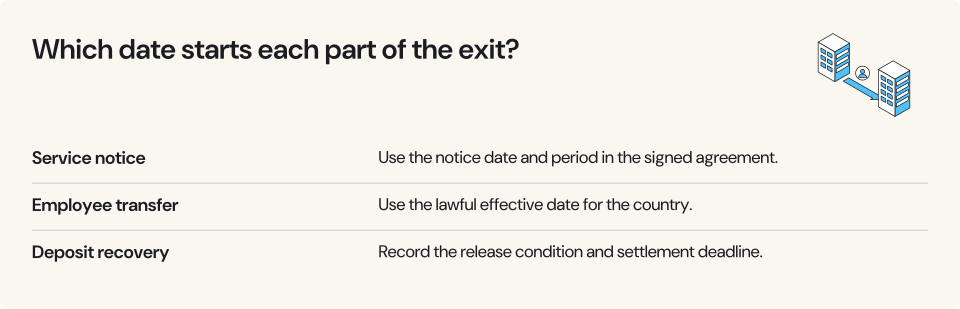
Read notice and fees
Check notice terms, overlapping fees and deposit returns.
Employment continuity
Confirm the transfer route
Review local continuity rules before requesting new contracts.
Payroll handover
Reconcile before cutover
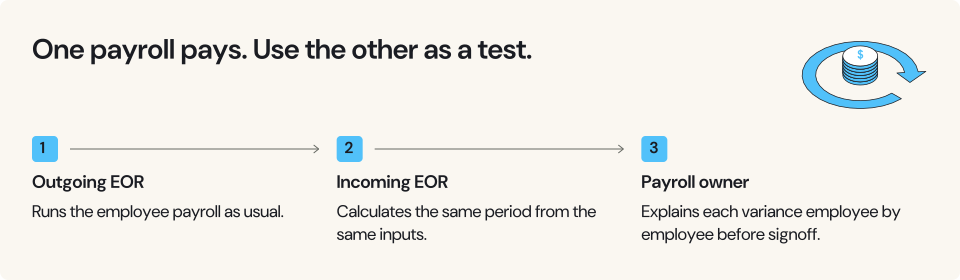
Agree which provider pays and how the other payroll is tested.
Employee experience
Protect the handover
Coordinate benefits, communications and the confirmed transfer date.
Check before acting
Both providers should agree the country-specific transfer and payment plan.
What to record in the worksheet
Scope
Handover item · Outgoing provider · Incoming provider
Evidence and follow-up
Employee / cohort · Owner · Dependency / date · Evidence · Acceptance status
A handover record both EORs should agree
Give both EORs the same approved record for each employee. It should show how that person will transfer and which provider has authority to release wages for each pay period.
| Item | Record before the provider handover | Acceptance check |
|---|---|---|
Item
Employment route and dates
|
Record before the provider handover
Applicable transfer rule, last/first employer dates and required documents.
|
Acceptance check
Local process complete without an unintended gap.
|
Item
Pay and payroll data
|
Record before the provider handover
Recurring pay, year-to-date data, tax identifiers and approved one-offs.
|
Acceptance check
Shadow payroll differences explained and signed off.
|
Item
Leave and service
|
Record before the provider handover
Original service date, balances and statutory/contractual treatment.
|
Acceptance check
Employee statement agrees with the new provider's record.
|
Item
Benefits and permits
|
Record before the provider handover
Coverage end/start dates, waiting periods and work authorization.
|
Acceptance check
No uncovered interval or unauthorized employment.
|
Item
Records and IP
|
Record before the provider handover
Payslips, employment records, data transfers that meet applicable privacy requirements and required IP documents.
|
Acceptance check
Access and assignments verified before the old account closes.
|
Item
Money and closure
|
Record before the provider handover
Fees, deposits, final liabilities and refund conditions.
|
Acceptance check
Each real payment, filing and refund has a named owner.
|
The incoming EOR can test the figures without sending wages a second time. Put any implementation or overlap fees in the order form. If the new EOR needs a deposit while the outgoing provider still holds yours, allow for the cash you’ll need on both dates.
Give both providers the same agreed payroll inputs.
The current provider releases the authorized wages.
The replacement produces a shadow calculation.
Resolve differences before the live cutover.
Agree exactly which provider releases each real payment.
Record who approved each material payroll difference and which provider may release each payment.
Compare the reason to switch and the full transition cost
Before you give notice, check whether the current EOR can fix the problem. If you need a replacement, use the EOR provider comparison to draw up a shortlist. Choose a payroll handover date only when you know how employees can transfer, what the outgoing agreement requires and when the new provider will be ready.

In a hypothetical quote, dropping the monthly service fee from $599 to $199 would cut fees by $4,800 a year for one employee. That comparison assumes equivalent service. Check the country coverage, billing commitment and other charges before counting a saving. You might also switch because support has deteriorated or the EOR has changed the local partner that employs your team. Allow for the cost of the handover and the risk of a payroll interruption.
For a 10-person team in Germany on a €72,000 average salary, use these illustrative expense and cash-planning categories:
Two things can offset these costs. RemotePeople markets an EOR-switch incentive. Before including a credit in the budget, confirm eligibility, which charges it covers, its cap, claim deadline and payment conditions in the actual offer. At the assumed rates, ten seats also save $4,000 a month in service fees. Estimate the payback from the written exit terms and your full migration budget, using the EOR cost calculator.
Check the exit agreement before timing notice
Terms are as of June 2026 unless a cell gives a later check date.
Our provider ratings show the order in which we recommend providers overall. They are not scores for an individual fee, contract term, certification or country.
★★★★★4.5
Pricing & terms
Client notice
30 days, published
Exit fee
$0 in standard terms
Deposit & return timing
About 1 month of the hire’s total cost (salary, employer costs and fees), sometimes more. Published terms return the unused balance within 60 days after all amounts owing are received or confirmed paid, whichever is later, subject to offsets and controlling documents (checked 15 October 2026).
Our rating
4.5/5
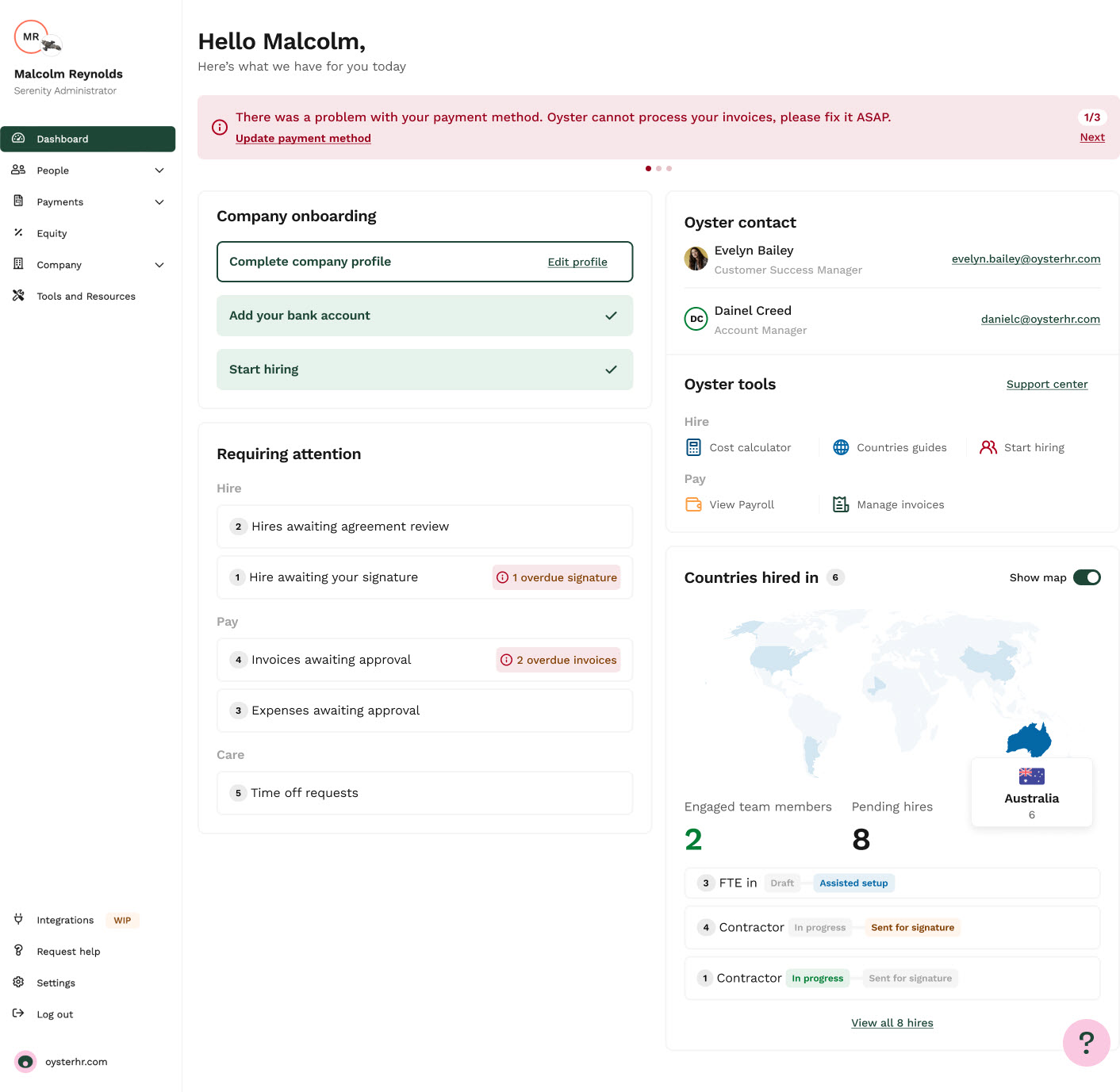
Oyster dashboard
Enlarge screenshot
![]()
Reviewed by Martynas Pupkevicius · Fact-checked by Lucia Aparicio
Opens oysterhr.com

★★★★★4.1
Pricing & terms
Client notice
60 days for pay-as-you-go quotations; fixed-term order forms cannot be ended for convenience (general terms, checked 30 September 2026)
Exit fee
Obtain a written exit quote
Deposit & return timing
Confirm the actual deposit basis, amount, accruals and return conditions in the applicable terms
Our rating
4.1/5
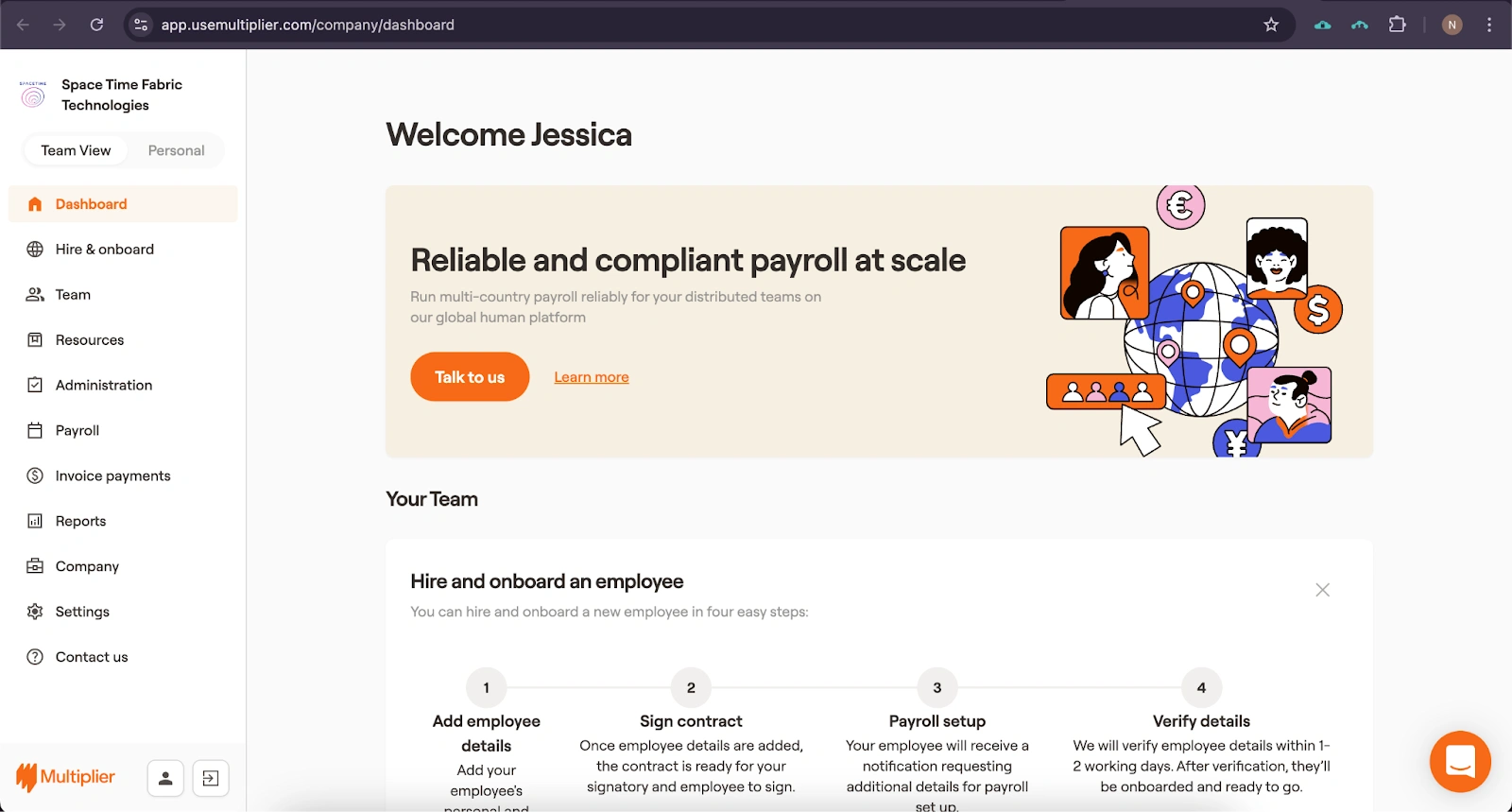
Multiplier dashboard
Enlarge screenshot
![]()
Reviewed by Martynas Pupkevicius · Fact-checked by Lucia Aparicio
Opens usemultiplier.com
★★★★★4.7
Pricing & terms
Client notice
Not published
Exit fee
Not published
Deposit & return timing
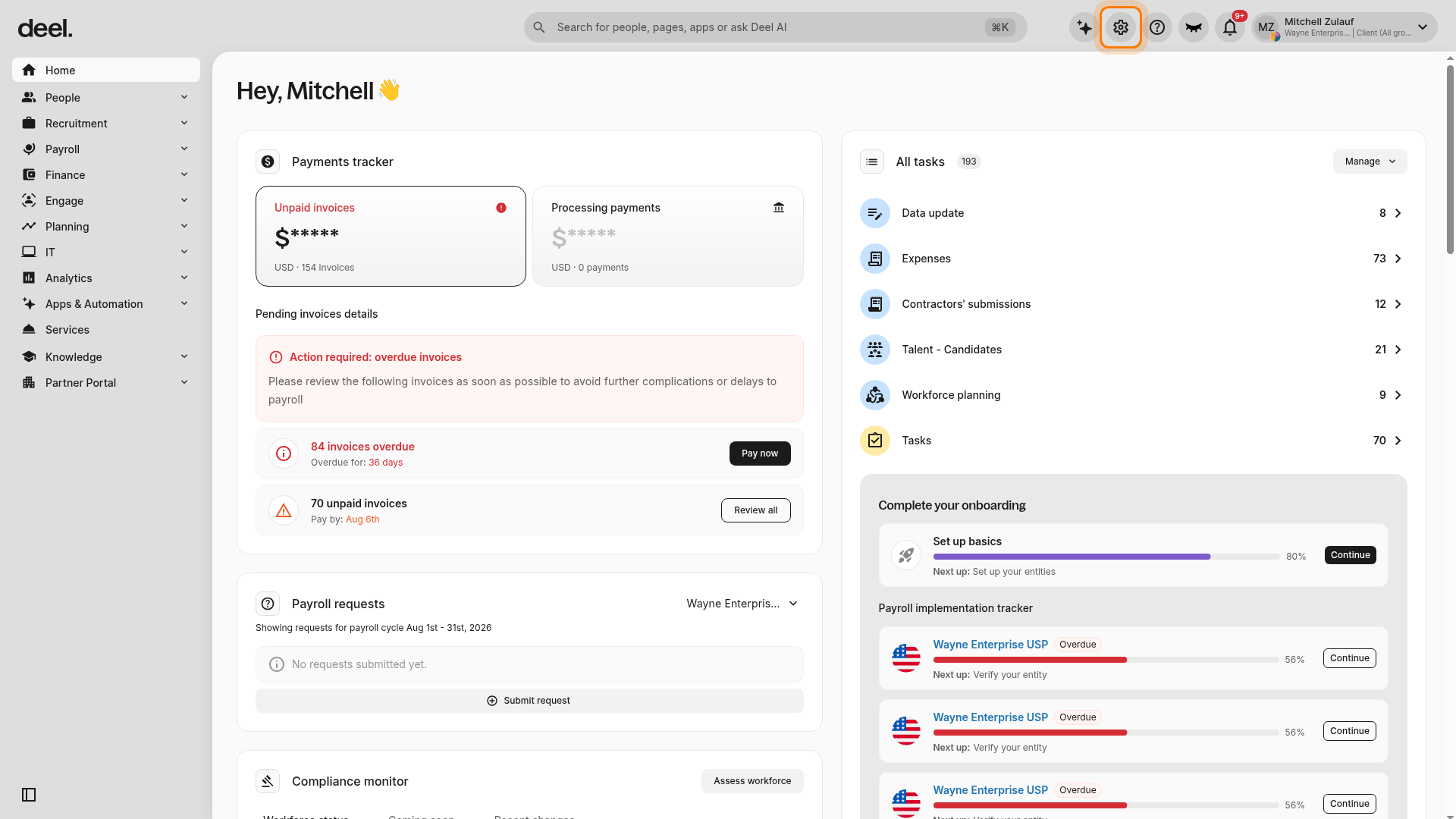
1–1.5x total monthly charges, refunded within 60 days after termination is completed and all invoices are paid, per Deel’s help center (checked 30 September 2026)
Our rating
4.7/5
Deel dashboard
Enlarge screenshot
![]()
Reviewed by Martynas Pupkevicius · Fact-checked by Lucia Aparicio
Opens deel.com

★★★★★4.9
Pricing & terms
Client notice
Use the applicable agreement
Exit fee
Use the applicable agreement; Switch program covers up to 12 months of the old provider’s exit fees
Deposit & return timing
Confirm the quoted Global or Select deposit amount, deductions and return deadline (pricing and eligibility checked 16 October 2026).
Our rating
4.9/5
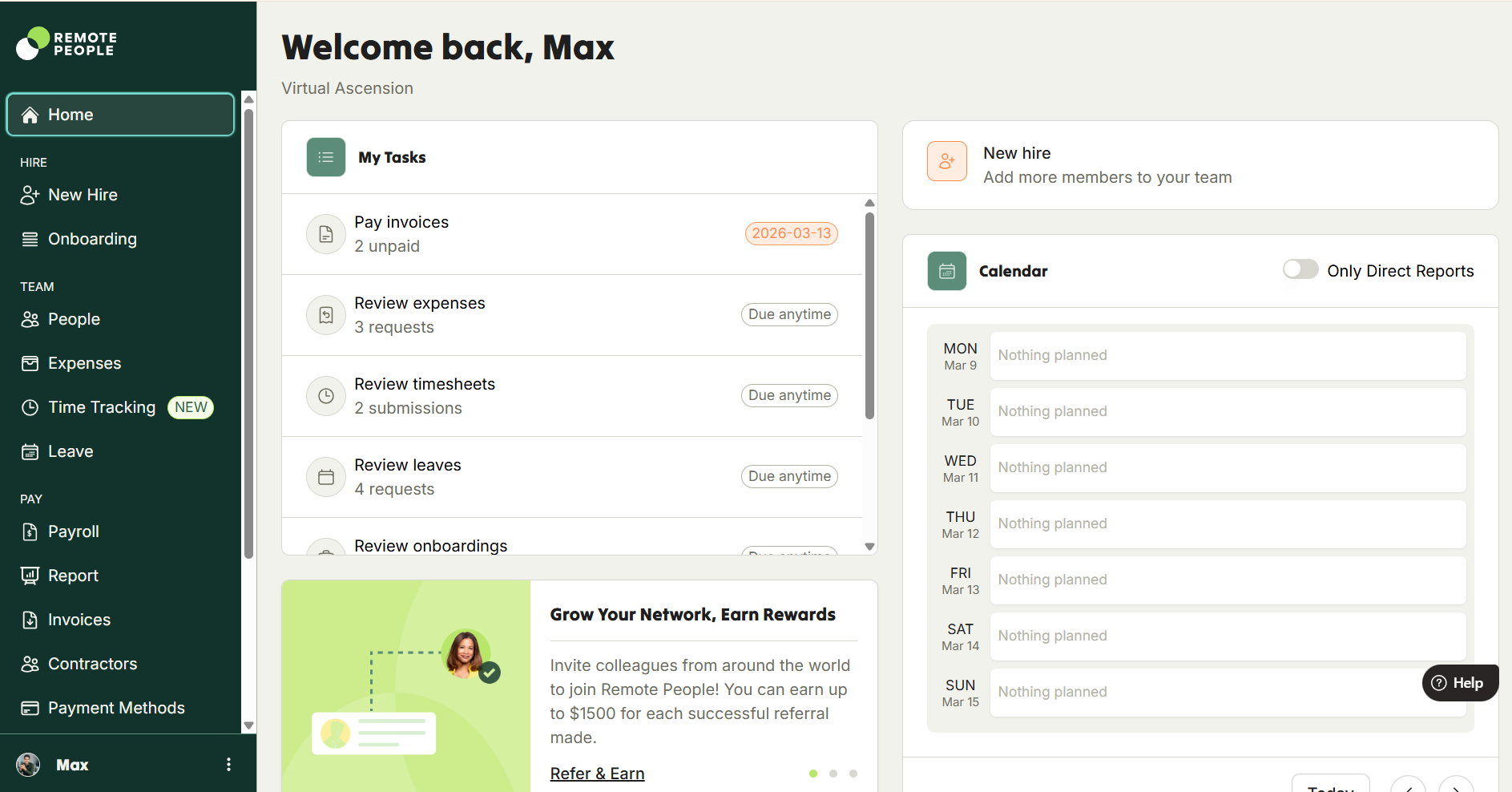
RemotePeople dashboard
Enlarge screenshot
![]()
Reviewed by Martynas Pupkevicius · Fact-checked by Lucia Aparicio
Opens remotepeople.com

★★★★★4.5
Pricing & terms
Client notice
Not published
Exit fee
Not published
Deposit & return timing
Confirm the actual deposit basis, amount and refund conditions in the agreement
Our rating
4.5/5
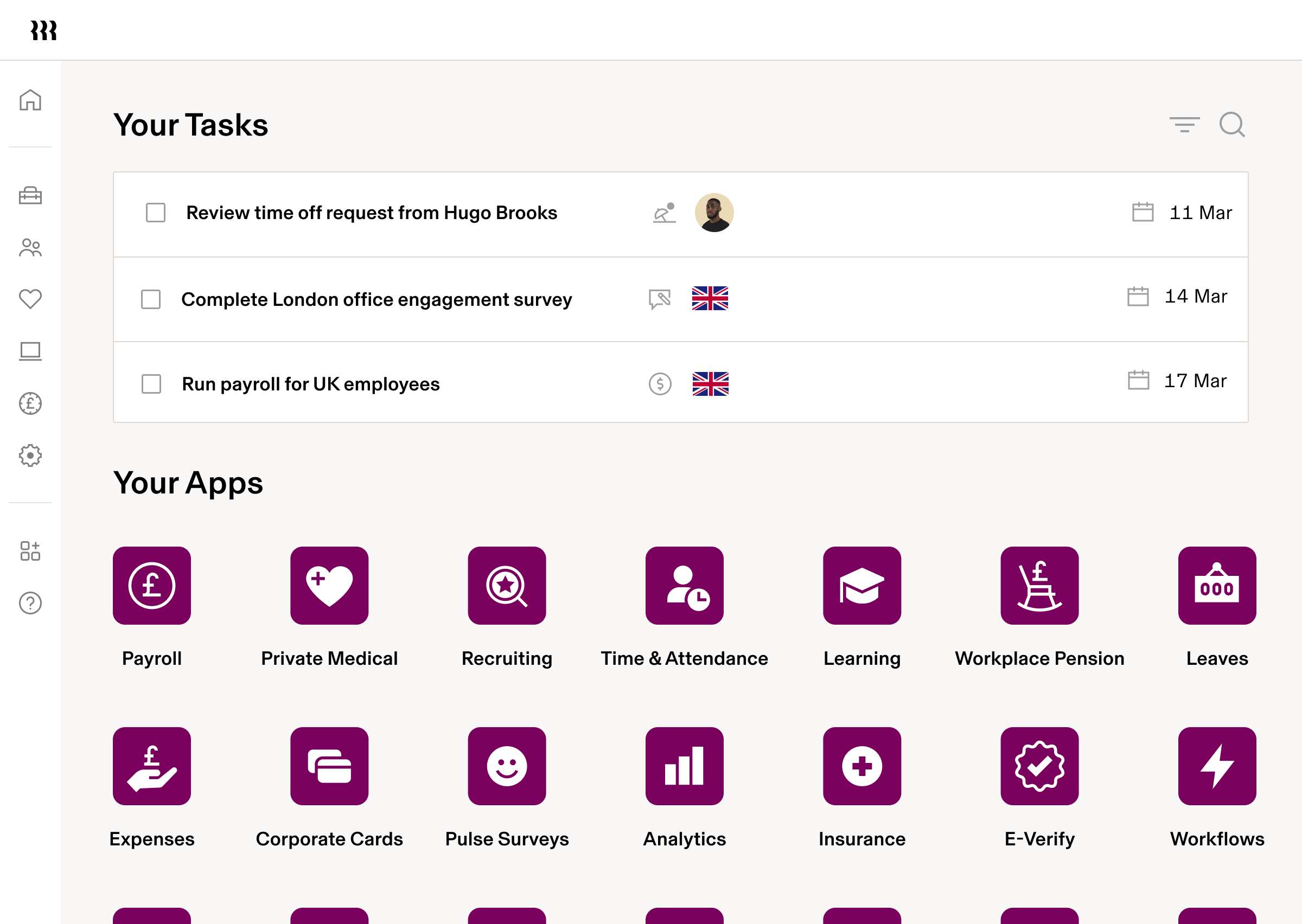
Rippling dashboard
Enlarge screenshot
![]()
Reviewed by Martynas Pupkevicius · Fact-checked by Lucia Aparicio
Opens rippling.com

★★★★★4.2
Pricing & terms
Client notice
Not published
Exit fee
Not published
Deposit & return timing
Confirm the actual deposit basis, amount and refund conditions in the agreement
Our rating
4.2/5
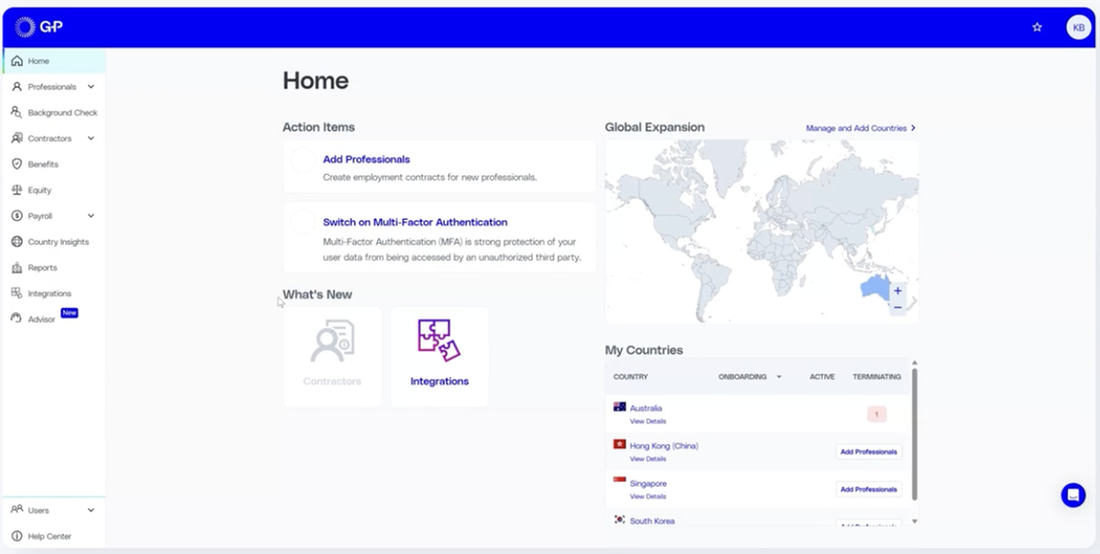
G-P dashboard
Enlarge screenshot
![]()
Reviewed by Martynas Pupkevicius · Fact-checked by Lucia Aparicio
Opens globalization-partners.com

★★★★★4.2
Pricing & terms
Client notice
Not published
Exit fee
No offboarding service fee under the published policy (checked 24 September 2026); employment liabilities are separate
Deposit & return timing
Not disclosed
Our rating
4.2/5
Pebl onboarding
Enlarge screenshot
![]()
Reviewed by Martynas Pupkevicius · Fact-checked by Lucia Aparicio
Opens hellopebl.com
Fig. 1 · Published exit terms across seven EOR providers · June 2026
In week 1, record your signed MSA, order form and applicable service terms: notice, exit charges, deposit return and renewal. Oyster’s cited standard terms set 30 days’ service notice and a deposit-return period measured from settlement of the required final amounts. They also permit transition-cost deductions; actual service and employment costs may continue beyond the notice period. Its annual-seat guidance states that seats are non-refundable. Confirm which terms apply to your order before modelling the exit.
Build one schedule for each country. Put the contractual notice deadline alongside the steps employees need to take, the benefits dates and the payroll deadlines. A date that works for one group may be too early for another.
- Q1. Have you confirmed the applicable transfer, consultation and employee-consent requirements?
- YES → Continue to Q2.
- NO → Confirm the process with both EORs and local advisers before committing to an exit date, without assuming either resignation and rehire or an automatic transfer.
- Q2. Are the required employee arrangements complete, or covered by an agreed plan that meets local requirements and sets clear dates?
- YES → Continue to Q3.
- NO → Resolve any outstanding consultation, documentation or consent requirements, and agree how affected employees stay employed and paid meanwhile.
- Q3. Have both providers confirmed notice periods, the last service date and the proposed transfer date in writing?
- YES → Continue to Q4.
- NO → Check the current agreement and get the dates in writing. Do not assume 30 days: a longer notice period may require earlier notice, an agreed extension or a later transfer.
- Q4. Is the transfer plan ready to maintain pay, benefits and access to employee records?
- YES → Give notice on the agreed date, get it acknowledged, and confirm which employer handles each payroll payment and filing.
- NO → Close the gaps first. If that needs more time, agree an extension with the current EOR so employees stay employed and paid.
Confirm how employees can transfer under local law
A new EOR is a new legal employer. Depending on the arrangement and local law, the move may fall under an automatic-transfer rule or need an agreed termination and new contract. Confirm the route in each country before asking anyone to resign or sign a new contract.
UK TUPE can apply to a qualifying business transfer or service-provision change, including some changes of service provider, whatever the size of the business. Where it applies, employment transfers with continuity and existing rights protected. Check applicability and the information and consultation duties before choosing the documents or giving notice.
Germany’s §613a BGB and the EU Acquired Rights Directive may also apply where a business or identifiable economic entity transfers. A change of provider alone does not settle that. Without an automatic transfer, have local advisers confirm the consent, documents and any termination payments needed. A tripartite agreement and new contract may be appropriate but should not replace statutory transfer rights.
If an employee objects or declines a new contract, resolve the consequences under the applicable legal route, which may differ by country. Record how their employment, pay, benefits and service will be treated.
In Germany, §99 BetrVG requires companies (Unternehmen) that normally have more than 20 voting-eligible employees to inform their works council and get its consent before each hire. The one-week objection period depends on proper notification; check that the required information is complete. Confirm which duties apply to the new EOR’s German entity and, where the arrangement falls under the AÜG, to a works council at your own German operation. Plan the actual consultation and consent steps with local advisers, allowing time to resolve an objection rather than assuming one calendar week clears the transfer.
Employee tenure and continuity by country
Tenure affects notice, severance, leave and dismissal rights, so do not assume a change of EOR resets it. Establish whether local law preserves continuity, then record any extra contractual credit. The rules differ by country:
Check probation and service rights before the move. A provider change does not automatically create a valid new probation period. Where a new contract is needed, ask local advisers whether local law allows a new probation period and whether it fits this worker, and document any agreement to omit it.
Explain the changes and follow consultation duties
Establish the information and consultation duties for the transfer route first, including any employee-representative process, then explain the move before sending employment documents. Local duties may bring the checklist dates forward or change their order.
Cover these points in a written announcement:
Brief managers a day before the announcement, so none of them learns about their team’s new employer from a company-wide email. In works-council countries, tell the council before the all-hands, following the confirmed legal transfer and consultation sequence.
Give employees a written change outline
Employees need to know who employs them today, who is expected to employ them next, why the change is happening and what they need to do. Give them the proposed dates and explain what will happen to pay, length of service and benefits under the local transfer route. Identify anything still open. Name a payroll contact and someone they can turn to if a question goes unanswered, then follow up when you have the answer.
Test payroll before the first live run
During weeks 9–13 of the example checklist, both providers use the same inputs for one full payroll cycle. The outgoing EOR pays employees as usual. Compare the incoming EOR’s calculation employee by employee before authorizing it to release any money. Include the countries and payments that could produce a different result, such as a bonus or 13th-month pay. If a material difference remains unexplained, allow time for another test.
Secure the IP chain before the handover
Check how title passes for each type of IP and jurisdiction. Ending the EOR agreement does not undo an assignment already validly completed. Review existing title, licences or conditions, work in progress, future work and any surviving assistance obligations with counsel.
Before cutover, confirm ownership of completed work and identify any missing assignments or required invention procedures. Obtain confirmatory documents where the actual chain needs them, and ensure the new arrangements cover work from the transfer date. Agree continuing assistance obligations before the old service agreement ends.
US-style “employee hereby assigns all inventions” boilerplate fails in several major jurisdictions, so check the new chain country by country. Germany’s ArbnErfG gives employees statutory invention rights and compensation claims no contract can remove. France separates inventions de mission from inventions the employer must pay for. The new EOR’s local contracts need country-specific IP language, and your new MSA must pass everything through to you. IP assignment across jurisdictions covers 12 jurisdictions and five clauses to include in each.
Check benefits, pensions and leave continuity
Confirm how each statutory health, pension and unemployment registration continues or changes under the actual transfer route. Obtain the employer registration dates and evidence needed for uninterrupted cover and correct contributions.
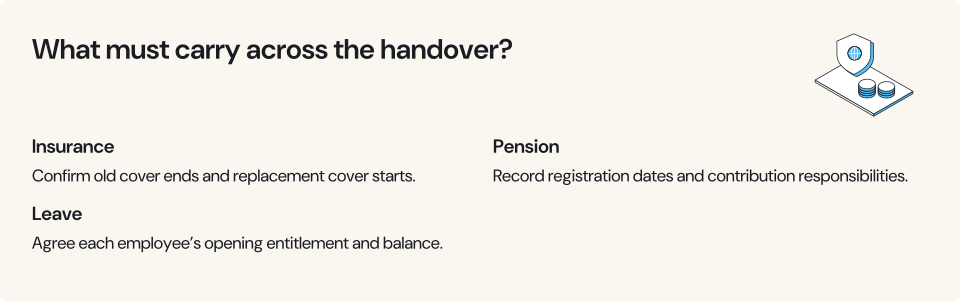
Check supplemental-benefit continuity separately. Confirm who holds each policy, when cover ends and whether continuation, replacement or portability arrangements apply:
An adjustable 90-day EOR switch checklist
Set the dates around the confirmed transfer route, consultation and consent requirements, provider notice periods and payroll calendar. Where employment transfers automatically, use the required transfer documents, preserve existing rights and skip resignation-and-rehire steps.
| Week | Days | What gets done |
|---|---|---|
Week
1
|
Days
1–7
|
What gets done
Pull the incumbent MSA and note the notice period, exit fees, deposit-return terms, renewal date and any non-refundable annual seats.
|
Week
2
|
Days
8–14
|
What gets done
Shortlist and price the new EOR. Get exit-side terms in writing before you sign anything: notice, fees, continuity letters, migration support.
|
Week
3
|
Days
15–21
|
What gets done
Confirm the legal transfer route and the new MSA. Build the employee map: country, salary, benefits, visa status, original start date, probation status and IP-sensitive roles.
|
Week
4
|
Days
22–28
|
What gets done
Prepare the documents required by the confirmed transfer route. Record preserved rights and any contractual service credit. Review probation, representative consultation and visa requirements locally.
|
Week
5
|
Days
29–35
|
What gets done
Follow the required information and consultation sequence for each country. Brief managers and employees at the appropriate stage (see employee communications), and start sooner if local duties require it.
|
Week
6
|
Days
36–42
|
What gets done
Issue the required transfer documents or new contracts and obtain any necessary consent. Complete right-to-work checks and benefits arrangements; confirm coverage dates.
|
Week
7
|
Days
43–49
|
What gets done
Resolve outstanding documentation or employee objections under the applicable legal route. Confirm pension arrangements and how local law requires you to handle unused leave.
|
Week
8
|
Days
50–56
|
What gets done
Complete the exit-term and pre-notice readiness checks. Give written notice on the agreed contractual date, which may fall earlier or later than this example. Confirm the last service date and deposit-return process in writing.
|
Week
9
|
Days
57–63
|
What gets done
Payroll data handover to the new EOR: YTD gross-to-net, tax IDs and classes, contribution categories, deductions, allowances, accruals.
|
Week
10
|
Days
64–70
|
What gets done
Start the parallel run: the old EOR pays live while the new EOR shadow-calculates the same period.
|
Week
11
|
Days
71–77
|
What gets done
Reconcile gross-to-net for each employee, explain every variance and sign off in writing.
|
Week
12
|
Days
78–84
|
What gets done
Complete any IP confirmations or assignments identified by the country-specific chain-of-title review. Run the final incumbent payroll: expenses, 13th-month proration, vacation payout or transfer.
|
Week
13
|
Days
85–90
|
What gets done
On the agreed transfer date, implement the confirmed legal route without an unintended employment or pay gap. Do not terminate employment that transfers automatically. Run the first live payroll with the new EOR and track the deposit-return date.
|
Fig. 2 · The 90-day switch checklist, 13 weeks in order · assumes a 30-day notice period
For migration support, see the EOR Switch service.
Plan backwards from a realistic handover date
Enter the agreed transfer date and first payday in the workbook. Work backwards from them through country transfer requirements, consultation or consent, signed terms, benefits enrollment, payroll testing and funding. Check the outgoing provider’s notice deadline against those dates. Replace the workbook’s example intervals with the time each step actually needs.
The handover worksheet
For each task, record which employees it affects, who owns it, what has to happen first and what evidence will let you sign it off. Some work continues after the first payroll. Assign someone to resolve outstanding employee records, benefits claims and pay adjustments, and to track the outgoing deposit until it’s recovered.
| The working record | Fields to complete |
|---|---|
The working record
Scope
|
Fields to complete
Handover item · Outgoing provider · Incoming provider
|
The working record
Evidence and follow-up
|
Fields to complete
Employee / cohort · Owner · Dependency / date · Evidence · Acceptance status
|
Switching EOR provider FAQs
Do employees have to sign new contracts when we switch EOR providers?
It depends on the transfer rules. A qualifying TUPE or other statutory transfer can move employment on existing terms without resignation and rehire. Elsewhere, local law and the arrangement decide whether you need new contracts, consent and termination documents. Confirm the route before you issue any paperwork.
Can an employee refuse to move to the new EOR?
Yes, but the consequences depend on local law and on whether employment transfers automatically. Check objection rights and consultation duties before you respond, do not treat refusal as automatic resignation or dismissal, and agree next steps that respect each affected worker’s rights.
Do we pay both EOR providers during the parallel payroll month?
When do we get our security deposit back?
Does switching EOR providers reset probation and severance tenure?
No, not automatically. A qualifying TUPE transfer preserves UK statutory continuity even between unrelated employers, and other local transfer rules may preserve service too. Otherwise, agree any contractual credit for prior service, check which statutory rights continue, and review probation clauses rather than assume a fresh probation period is valid.
Can we switch EOR providers in less than 90 days?
Sources and contract check dates
The sources behind this guide, grouped by topic. Dates show when we last checked a page. Prices and terms change, so confirm them in your quote.
Employee transfer and continuity law
10 sourcesEuropean Union · EUR-Lex
Council Directive 2001/23/EC, the Acquired Rights Directive
Applies only when a business or unit transfers.
United Kingdom · legislation.gov.uk
TUPE Regulations 2006, SI 2006/246
The service-provision-change rules that can catch outsourcing swaps.
United Kingdom · GOV.UK
Business transfers, takeovers and TUPE
Transfers of employment contracts
TUPE can apply to a qualifying business transfer or service-provision change, including some changes of service provider, whatever the size of the business. The contracts page is used in the provider handover example, checked 3 Oct 2026.
United Kingdom · legislation.gov.uk
Employment Rights Act 1996, Part XIV: continuity of employment
United Kingdom · GOV.UK
Other statutory continuity rules may apply besides a qualifying TUPE transfer.
United Kingdom · Acas
Royal Assent 18 December 2025. A 6-month unfair-dismissal qualifying period applies from 1 January 2027.
United Kingdom · Hill Dickinson
Employment Rights Act 2025 tracker: key changes and implementation dates
The unfair-dismissal qualifying period is cut to six months from 1 January 2027.
Germany · gesetze-im-internet.de
AÜG, the German employee-leasing act
Check applicability to the actual arrangement.
Netherlands · Wetten.nl
Dutch Civil Code, article 7:673
Service with successive employers that are each other’s successor for the work performed counts toward the transitievergoeding. Checked Sep 2026
Notice, severance and consultation law
6 sourcesGermany · gesetze-im-internet.de
Germany · gesetze-im-internet.de
§1a KSchG, the German dismissal protection act
Statutory severance formula.
Germany · gesetze-im-internet.de
France · Légifrance
Statutory severance and notice.
Netherlands · Rijksoverheid
Transitievergoeding, the Dutch statutory transition payment
Accrues from day one of service.
Brazil · Planalto
40% penalty on the FGTS balance at without-cause dismissal.
IP, pension and payroll rules
5 sourcesGermany · gesetze-im-internet.de
ArbnErfG, the German Employee Inventions Act
Statutory invention rights and compensation.
France · Légifrance
Code de la propriété intellectuelle, article L611-7
Inventions de mission and employee-invention remuneration.
Germany · gesetze-im-internet.de
§1a BetrAVG: occupational pension law
The German bAV framework.
United Kingdom · The Pensions Regulator
A new employer may postpone enrolment by up to 3 months.
United Kingdom · HMRC
Fix problems with running payroll: you made a mistake in your FPS or EPS
Used in the provider handover example. Checked 3 Oct 2026
Provider exit terms, deposits and pricing
5 sourcesDeel
EOR pricingTransferring existing employeesDeposit refundsDeposit calculations
Published EOR pricing gives the $599 per-employee reference rate. Deposits are refunded within 60 days after termination is completed and all invoices are paid; the standard deposit is 1 to 1.5 times all monthly charges (deposit pages checked Sep 2026).
Multiplier
The pricing page gives the list price. It was the source of the June 2026 exit-fee position in the exit-terms table, which it no longer showed in Sep 2026. General Terms effective 1 June 2026: 60 days’ written notice to end a pay-as-you-go EOR quotation, and no termination of fixed-term order forms for convenience (checked Sep 2026).
Oyster
Home pageCustomer termsWhy a deposit is requiredEOR Annual
No-exit-fee position: “no extra fees when someone leaves your team”. Terms: 30-day service notice; the deposit is released after receipt or confirmation of all relevant sums, whichever is later, subject to deductions; use the terms that apply to the order. The deposit is about one month of the hire’s total cost of services, sometimes more. Annual seats are non-refundable. Home and help pages checked Sep 2026.
Pebl
The published policy lists no setup or offboarding service fees. Checked 24 Sep 2026
RemotePeople
EOR pricingSwitch EOR provider offer
Global from USD 499 per employee per month; Select from USD 199 in selected countries and qualifying employee salary ranges. Confirm quote currency, rate, commitment and deposit terms (pricing checked 1 Nov 2026). The example’s $199 replacement fee is a hypothetical input, not a country quote. Switch offer: confirm current eligibility, covered charges, cap and claim conditions; the example assumes no credit.
If you spot a changed price or a conflicting source, send it through the contact page and we’ll review it.
This guide is for general information only and does not provide legal, tax, accounting, or financial advice. For advice about your business, consult a qualified professional familiar with the rules where you hire. Read our research methodology to learn how we assess sources.