TheBestEOR

Best Employer of Record in Japan

Written by Martynas PupkeviciusFact-checked by Michael Ennis
Picture of Martynas Pupkevicius
Martynas Pupkevicius

EOR Advisor and Remote Work Editor

Our top employer of record in Japan for 2026 is RemotePeople, from USD 499 per employee a month, ahead of Deel and Rippling.

We tested all 10 providers with paid client accounts, real quotes and a live hire run through payroll. Japan limits normal hours to 8 a day and 40 a week, and overtime requires the appropriate agreement and additional pay.

Flag of Japan

Hiring in Japan at a glance

Currency
JPY
Japanese yen
Pay cycle
Monthly
At least monthly, on a fixed date agreed ahead
Working hours
8 h a day
40 hours a week, overtime needs an agreement
Annual leave
10 days
After 6 months with 80% attendance, rising to 20
Extra pay
Per contract
Check summer and winter bonuses and what is guaranteed
Employer costs
Pension, health
Plus unemployment and work injury insurance
Before you hire:
Provide written terms and confirm if an overtime agreement must be filed before extra hours begin.

Country hiring overview · Japan

Hiring in Japan, at a glance.

Compare the contract, payroll calendar and employee support.

For a Japanese hire, I’d establish who signs the contract and handles payroll, insurance and employee administration. Compare the actual work schedule, salary terms and benefit scope, then confirm any work-authorisation steps before using the proposed start date.

Choose a hiring solution

Need a local employer?

Compare an EOR arrangement for your role before opening your own entity.

Already have a local employer?

Compare payroll and HR support against adding an EOR.

EOR service fee

Fees vary by provider.

Your quote should state the currency, fee per employee, minimum charge and billing commitment.

Onboarding

Paperwork affects the start date.

The contract, right-to-work checks, registrations and payroll deadlines all affect when employment can begin.

Employment costs

Include pension and insurance.

Pension, health insurance and labour insurance contributions add to the employment budget. The quote should show each employer contribution and the cost of agreed benefits.

Annual leave

Leave increases with service.

The standard full-time allowance is 10–20 working days, depending on service. It begins after 6 months, provided the employee has attended at least 80% of working days.

Check before choosing

Confirm insurance eligibility, payroll and tax handling, working-time arrangements, paid-leave administration and any visa scope.

What your quote should include

Employment costs and service fees

1
Gross salary and agreed pay schedule
2
Pension, health and labour insurance plus benefits
3
EOR fee: currency, per-employee billing, minimums and commitment
4
Setup, foreign exchange, extras and exit costs

Deposits and payroll funding

1
Amount and payment deadline
2
Whether funds are refundable or credited to payroll
3
Release conditions and refund timing
Show these separately from recurring expenses.

Key takeaways for hiring in Japan

Price the bonus payroll separately

Pension and health apply different bonus ceilings: the pension ceiling aggregates bonuses paid in the same month, while the health ceiling runs across the insurance year. Include bonus payment dates as well as amounts in the proposal.

The five-day leave deadline follows the grant date

For an employee granted at least ten statutory leave days, the employer must ensure five are taken within the following year. Employee-requested or planned leave already taken counts. The EOR needs the leave record, while your manager needs to make the time away workable.

Use the insurer’s branch, not only the home address

The Tokyo contribution example uses a particular insurer and branch. Kyokai Kenpo warns that the insured branch can differ from the employee’s prefecture of residence. Confirm the actual insurance arrangement before carrying Tokyo’s rate into another employee’s quote or assuming a relocation changes it automatically.

Age can change the insurance budget

The 2026 Tokyo notice adds long-term-care contributions for insured people aged 40–64. An under-40 quotation should therefore state its age assumption and the relevant contribution period. When comparing annual budgets, ask how a birthday affecting coverage is reflected in the payroll forecast.

Quick verdict

What is the best EOR in Japan?

My top three: Deel, RemotePeople and Rippling.

1
Deel logo

4.7/5

Deel

Paying employees and contractors on one platform

Starting fee
$599

per employee / month

Countries
130+
where you can hire

Plus a mandatory Employer Liability Cost.

Deposit
1–1.5 months

of gross salary

Deposit refund
Within 60 days

of offboarding

Why consider it

EOR, contractor management and payroll for your own entities.

Month-to-month EOR service pricing available.

Check the fit

Ask for the country-specific Employer Liability Cost in your quote; it is mandatory.

Before signing: Confirm the Employer Liability Cost amount, benefit costs and any additional products. Monthly service terms do not remove employment notice, severance or other exit obligations.

The EOR pricing page lists 130+ countries. Broader platform coverage figures may include other services.

Visit Deel ↗

2
Editorial pick
RemotePeople logo

4.9/5

RemotePeople

Hiring in new markets with local HR support

Starting fee
$499

per employee / month

Countries
150+
where you can hire

EOR Select from $199 for eligible hires.

Deposit
1 month

of gross salary

Deposit refund
Within 5 days

of the final payment

Why consider it

Recruitment and EOR services through one provider.

Dedicated account manager in both EOR plans.

Check the fit

Recruitment is separately priced.

Before signing: Confirm quote currency, billing commitment, deposits, funding deadlines and refund terms.

Both EOR plans list local contracts, payroll and tax administration, and statutory benefits administration. Salary, employer contributions and benefit costs are separate.

Visit RemotePeople ↗

3
Rippling logo

4.5/5

Rippling

Setting up payroll, laptops and app access for new hires

Starting fee
$499

per employee / month

Countries
115
where you can hire

Plus the Rippling Platform, from $8 per employee / month.

Deposit
Per quote

based on gross salary

Deposit refund
Per contract

set in your agreement

Why consider it

EOR, payroll, HR records and benefits administration in one platform.

Shared workflows and reporting for domestic and international teams.

Check the fit

Ask for an itemised quote showing the required platform and each HR or IT module.

A paid Rippling Platform subscription is required on top of the EOR fee, from $8 per employee per month plus a monthly base fee. Rippling EOR starts at $499 per employee per month. Other HR and IT products are priced separately.

Rippling’s EOR page lists 115 countries. Confirm your hiring country and legal employer.

Visit Rippling ↗

No provider pays for a position on this page; some outbound links pay a referral fee. See the funding model and methodology.

Ask for the legal employer’s name and registration details.

All 10 EOR providers for Japan, side by side

Allow time for a new Certificate of Eligibility.

Fees are advertised starting service fees in USD per employee per month, not total employment costs or Japan quotes. Rippling, G-P, Oyster, Papaya and Multiplier pricing was checked on 24 September 2026. Estimated onboarding times exclude the one-to-three-month immigration wait on a fresh Certificate of Eligibility.

See how they compare globally in the ranking of the best EOR providers overall. For a wider shortlist, browse EOR providers for Japan.

Provider

Best For

Starting feeDepositOnboarding
1 Deel logo Deel 4.7/5 Rating Paying employees and contractors on one platform Starting fee: $599 USD / monthDeposit: 1–1.5 monthsOnboarding: 2–5 days

My take

Deel makes my shortlist when you want EOR payroll and benefits administration alongside separate contractor and HR products.

EOR starts at USD 599 per employee per month, with month-to-month billing available. I’d budget beyond that fee: mandatory Employer Liability Cost is an additional charge based on gross salary, with rates varying by country. Salary, statutory employer costs and benefit premiums are also separate.

Contractor management starts at USD 49 per active contract per month. It is a separate service from EOR employment; currency conversion, payment-method charges and any required deposit also affect the amount funded.

When this provider fits

Deel is worth considering when its wider payroll and employment tools fit your existing international team. For Japan, the useful test is the written country scope: the legal employment arrangement, insurer, bonus payroll and responsibility for leave records.

Deposit

1–1.5 months

Entity model

Owned entity

First year, one hire

$7,188 in service fees

Reviewed by Martynas PupkeviciusFact-checked by Michael Ennis

Starting fee

$599

Month-to-month billing. Mandatory Employer Liability Cost is charged separately.

Against the 10 starting fees

$199 lowest$699 highest
2 RemotePeople logo RemotePeople 4.9/5 Rating Hiring in new markets with local HR support Starting fee: $499 USD / monthDeposit: 1 monthOnboarding: 3–7 days

My take

I’d consider RemotePeople if a dedicated account manager is part of the support you want.

The service includes local employment contracts, payroll and tax administration, and statutory-benefits administration. I’d price recruitment separately, as it is a separate service.

EOR Global starts at USD 499 per employee per month. EOR Select starts at USD 199 for eligible countries and employee salary ranges. Salary, employer contributions, benefit costs and agreed extras are additional. The country quote determines eligibility, the final fee, billing commitment and payroll funding.

Deposit

1 month

Entity model

Own entities in core markets

First year, one hire

$5,988 in service fees

Reviewed by Martynas PupkeviciusFact-checked by Michael Ennis

Starting fee

$499

EOR Global. EOR Select starts at $199 where the country and employee salary qualify.

Against the 10 starting fees

$199 lowest$699 highest
3 Rippling logo Rippling 4.5/5 Rating Setting up payroll, laptops and app access for new hires Starting fee: $499 USD / monthDeposit: Per quoteOnboarding: 2–5 days

My take

I’d consider Rippling when shared employee data across HR, IT and finance would help your workflows and reporting.

It connects EOR employment with those products, but device management and app access are separate products within the wider system.

Rippling EOR starts at USD 499 per employee per month, and the required Rippling Platform adds from USD 8 per employee per month plus a monthly base fee. The quote needs to show any selected HR, IT or finance products and the billing commitment. Salary, employer costs, benefits, deposits and payroll funding are additional to the software and service fees.

When this provider fits

Rippling is most relevant when the Japanese employee will join HR and IT processes you already use. Papaya is most relevant when finance needs Japanese salary and bonus runs reported alongside other countries.

Deposit

Per quote

Entity model

Own entities and local partners

First year, one hire

$5,988 in EOR fees

Reviewed by Martynas PupkeviciusFact-checked by Michael Ennis

Starting fee

$499

Plus the required Rippling Platform, from $8 per employee per month and a monthly base fee. Confirm the billing terms and selected products.

Against the 10 starting fees

$199 lowest$699 highest
4 G-P logo G-P 4.2/5 Rating Hiring abroad while keeping your existing HR system Starting fee: $599 USD / monthDeposit: 1–2.5 monthsOnboarding: 5–10 days

My take

G-P would be on my shortlist when benefits, reporting and custom API integrations matter alongside EOR employment administration.

EOR starts at USD 599 per employee per month, with volume discounts by quote. I’d keep salary, employer costs, benefit premiums and additional services separate in the budget.

There is no minimum contract length for EOR hires. The proposal still sets the commercial billing and cancellation terms, along with the cost of any integration or implementation work.

Deposit

1–2.5 months

Entity model

100+ own entities, plus partners

First year, one hire

$7,188 in service fees

Reviewed by Martynas PupkeviciusFact-checked by Michael Ennis

Starting fee

$599

Confirm the included services and billing terms in your country quote.

Against the 10 starting fees

$199 lowest$699 highest
5 Pebl logo Pebl 4.2/5 Rating Hiring people who need visa or relocation support Starting fee: $399 USD / monthDeposit: Per quoteOnboarding: 7–10 days

My take

I’d look at Pebl, formerly Velocity Global, when you want hiring, payroll, employee changes, reporting and offboarding in one platform.

EOR starts at $399 per employee per month. Before using that figure in a budget, I’d have the country quote identify the dollar currency and billing commitment. Salary, employer costs, benefits and additional services are separate.

A deposit is required before onboarding. Its amount can change with salary, seniority or payment history, and it is returned after the final invoice and outstanding balances are paid. Early exit can make the remaining committed-term service fees payable, subject to the agreement’s termination exceptions. Any discounted offer needs an end date and renewal price.

When this provider fits

For a hire needing residence-status assistance, I’d compare Pebl and Borderless AI on the specific application service offered, the responsible Japanese employer and the documents required. For a worker who already holds suitable permission, concentrate on the employment and payroll package.

Deposit

Per quote

Entity model

Affiliates and local partners

First year, one hire

$4,788 in service fees

Reviewed by Martynas PupkeviciusFact-checked by Michael Ennis

Starting fee

$399

Confirm the country price and billing commitment.

Against the 10 starting fees

$199 lowest$699 highest
6 Oyster logo Oyster 4.5/5 Rating Using one onboarding process for hires across countries Starting fee: $699 USD / monthDeposit: ~1 monthOnboarding: 7–14 days

My take

I’d look at Oyster for payroll, expense and time-off administration, reporting, and onboarding and offboarding support.

Benefits packages are optional add-ons. At USD 699 per employee per month on monthly billing, I’d compare the included support carefully against the other quotes.

Annual seats are priced by headcount and location and are non-refundable, but can be reused for replacement hires. Annual prepayment gives the lowest fee; higher-priced quarterly or semiannual payment options are available. Salary, employer costs and benefit premiums are additional, and a refundable deposit is required. Optional People Partner project work costs USD 300 per hour.

Deposit

~1 month

Entity model

Own entities and vetted partners

First year, one hire

$8,388 in service fees

Reviewed by Martynas PupkeviciusFact-checked by Michael Ennis

Starting fee

$699

Monthly billing. Annual seats are quoted separately, prepaid and non-refundable.

Against the 10 starting fees

$199 lowest$699 highest
7 Papaya Global logo Papaya Global 4.1/5 Rating Comparing payroll costs across countries in one report Starting fee: $499 USD / monthDeposit: 1–2 monthsOnboarding: 7–10 days

My take

Papaya interests me when payroll and payments need to work together across EOR employees and your own entities.

It brings those employees, own-entity payroll and workforce payments into one platform, with consolidated reporting and payroll approval tools. That connection is what I’d focus on in the evaluation.

Papaya’s EOR service starts at USD 499 per employee per month. The country quote must identify the billing commitment and any additional services. Salary and employer costs are separate.

Deposit

1–2 months

Entity model

Partner model; confirm employer

First year, one hire

$5,988 in service fees

Reviewed by Martynas PupkeviciusFact-checked by Michael Ennis

Starting fee

$499

The country quote sets the billing terms. Payroll-only processing is priced separately.

Against the 10 starting fees

$199 lowest$699 highest
8 Multiplier logo Multiplier 4.1/5 Rating Managing payroll, leave and expenses in one place Starting fee: $459 USD / monthDeposit: 1+ monthsOnboarding: 5–10 days

My take

I’d start with Multiplier Core if you need employment administration, payroll, leave and standard workforce reporting.

Core starts at $499 per employee per month on monthly billing or $459 per month billed annually. For integrations, custom reports and open APIs, I’d compare the Growth plan. The quote needs to identify the dollar currency and chosen plan.

Country variations and mandatory add-ons affect the total. Implementation fees may apply, although the FAQ says setup is free; the quote must resolve that charge. Salary, employer costs and benefit premiums are additional.

Deposit

1+ months

Entity model

Own entities and partners

First year, one hire

$5,508 in service fees

Reviewed by Martynas PupkeviciusFact-checked by Michael Ennis

Starting fee

$459

Core plan billed annually, or $499 per month on monthly billing. Confirm the dollar currency.

Against the 10 starting fees

$199 lowest$699 highest
9 Borderless AI logo Borderless AI 4.0/5 Rating Getting 24/7 help with overseas payroll and HR Starting fee: $579 USD / monthDeposit: 1.5–3 monthsOnboarding: 7–12 days

My take

I’d compare Borderless AI using both its current offer and the fee after it ends.

The standard EOR fee is USD 579 per employee per month. Eligible companies headquartered outside Canada may qualify for USD 399 on fees billed through 31 December 2026. USD 579 applies from 1 January 2027, including promotional customers; country and employment-type exceptions apply. Salary, employer costs and benefits are additional.

A refundable deposit is required before the employee starts. The schedule is 1.5 months of gross salary plus employer costs, benefits and platform fees with ACH or three months by wire and other methods, with country variations. The base includes salary, employer contributions, benefits and platform fees. Late-payment issues can raise it to six months. Deposits are released after the relevant obligations are settled.

Deposit

1.5–3 months

Entity model

Own entities

First year, one hire

$6,948 in service fees

Reviewed by Martynas PupkeviciusFact-checked by Michael Ennis

Starting fee

$579

Eligible companies headquartered outside Canada can pay $399 on fees billed through 31 December 2026.

Against the 10 starting fees

$199 lowest$699 highest
10 RemoFirst logo RemoFirst ⚠ Trustpilot warning 0.5/5 Rating Making a first overseas hire on a tight budget Starting fee: $199 USD / monthDeposit: About 1 monthOnboarding: 5–9 days

My take

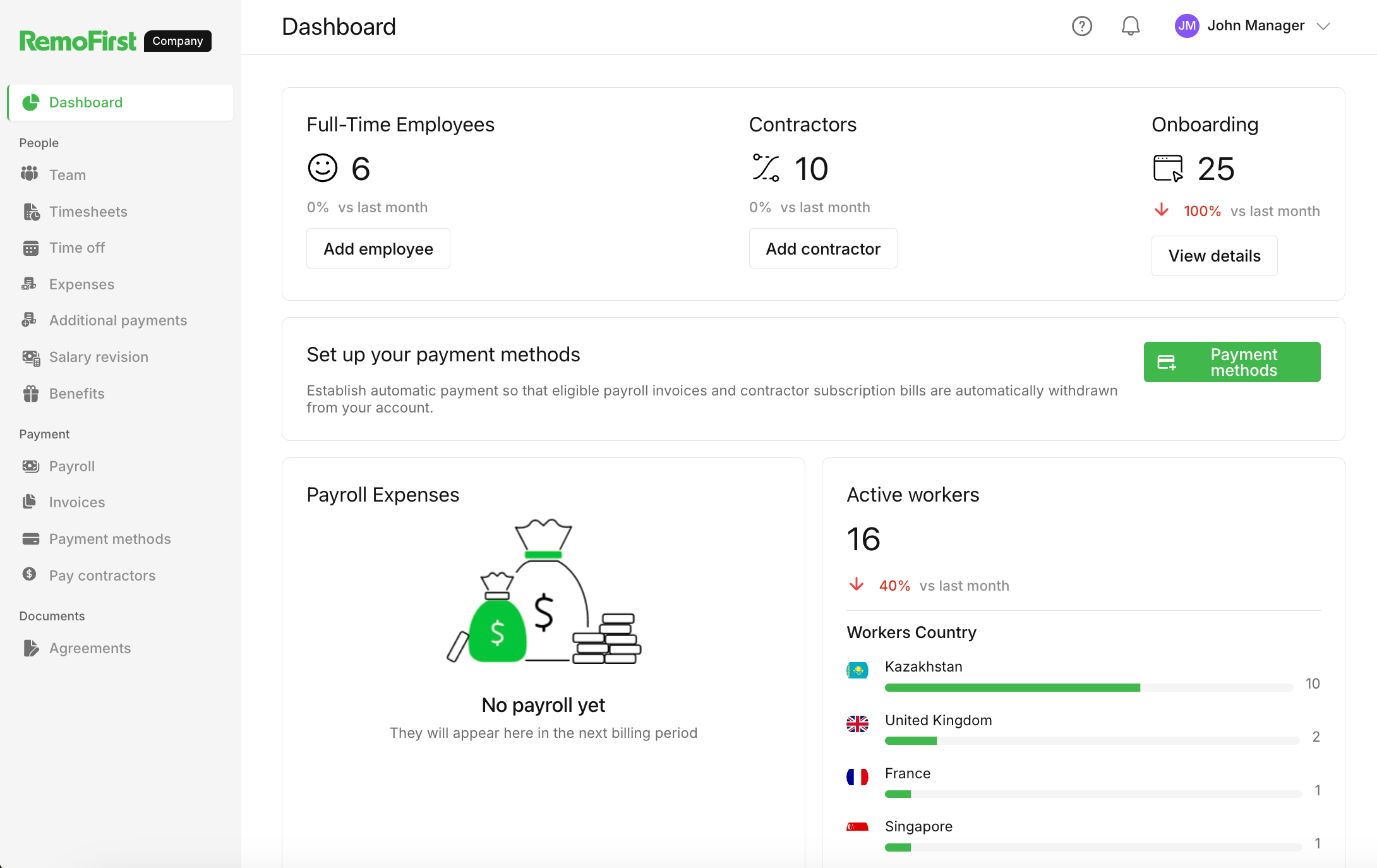
We moved RemoFirst to last place on 8 November 2026: Trustpilot has suspended its rating for a breach of its guidelines and removed fake reviews.

RemoFirst says it works exclusively with vetted in-country partners. Here, that means a local partner company, not RemoFirst, would normally employ your hire, and payroll changes, questions and exits pass through both companies, which can slow answers. US$199 is RemoFirst’s starting fee and varies by country, so get this country’s quote before you compare. RemoFirst’s lack of a minimum contract term or headcount makes it worth considering for a small team. I’d compare its dedicated customer success manager and EOR employment service from USD 199 per employee per month against the support you need. The fee can vary with country requirements. Salary, employer costs, benefits, deposits and optional services are separate.

Contractor management is free for onboarding, identity checks, contract storage and expenses. Contractor payments cost USD 25 per contractor in months when a payment is processed; payment-provider and transfer fees may also apply. These contractor services are separate from EOR employment.

Deposit

About 1 month

Entity model

Partners, not own entities

First year, one hire

$2,388 in service fees

Reviewed by Martynas PupkeviciusFact-checked by Michael Ennis

Starting fee

$199

RemoFirst advertises no minimum contract term or employee count. Confirm any country-specific charges.

Against the 10 starting fees
$199 lowest$699 highest

Entity ownership is as each provider states it.

Which top pick · Japan

For a hire who needs immigration support, the quote should identify the provider’s sponsorship role and any additional fees. Ask for a written quote covering the salary, benefits and services you need. Enter its recurring costs in USD in the EOR cost calculator to compare proposals.

Local Japanese alternatives (unranked): several Japan-based firms also provide EOR or local payroll and labor outsourcing, including long-running bilingual providers such as HTM (Outsourcing in Tokyo) and accounting-led firms that run shakai hoken (social insurance) and payroll for foreign companies. They employ in Japan alone and publish no multi-country compliance program, so they sit outside the ranking. A Japan-only employer with bilingual in-house HR may find one sufficient.

Get your EOR discount

Get up to 30% off eligible EOR service fees. Your quote confirms the discount and terms.

Employment framework

Employment and payroll in Japan

Check whether the work counts as worker dispatch.

Japanese payroll combines social and labour insurance with tax withholding. Check the operating model as well as residence status: an EOR label does not settle the worker-dispatch question.

Check whether worker-dispatch rules apply

Confirm the proposed employment model and any required licence. Japan’s Ministry of Health, Labour and Welfare states that a business conducting worker dispatch must obtain permission.

Japanese employment contract

The EOR’s Japanese entity becomes the legal employer under a contract governed by the Labor Standards Act (Rodo Kijun Ho) and Labor Contract Act (Rodo Keiyaku Ho). You direct the day-to-day work; the EOR administers the employment relationship and filings with the pension office, Hello Work and tax office.

Applicable insurance and payroll deadlines

Social insurance

Health Insurance (kenko hoken) and Employees’ Pension Insurance (kosei nenkin) through the Japan Pension Service, with Long-Term Care Insurance according to the worker’s age and circumstances.

Labour insurance

Employment Insurance (koyo hoken) through Hello Work and Workers’ Accident Compensation Insurance (rosai hoken) through the Labor Standards Inspection Office.

Tax and insurance remittance

Payroll deducts the employee’s social-insurance share and gensen choshu income tax. Withheld tax is remitted by the tenth of the following month, and social-insurance premiums by the end of the following month.

Residence status and permitted work

For a foreign hire, confirm that the person’s residence status permits the proposed role and employment arrangement. Engineer/Specialist in Humanities/International Services is a route used for office and technical roles.

Where a new application is required, the EOR’s Japanese entity handles the Certificate of Eligibility (zairyu shikaku nintei shomeisho) with the Immigration Services Agency, followed by the consular visa process. Confirm the provider’s eligibility and responsibilities for the particular hire.

Agree the start date after checking the route

1

Agree salary and prepare employment records

Agree salary and the proposed start date. For a foreign hire, check the salary against what a Japanese national earns in the role. The EOR prepares the employment contract and rules-of-employment reference, collects the candidate’s details and arranges insurance records.

2

Confirm the immigration milestones

Where required, obtain separate dates for the Certificate of Eligibility, consular visa and residence-card steps. Confirm the actual schedule before fixing the start date.

3

Begin payroll on the agreed date

Once payroll starts, the EOR pays salary on the agreed date and handles tax and insurance remittances. You approve relevant timesheets or expenses and manage the work.

Employer cost

Statutory employer contributions in Japan

The example uses Tokyo’s April 2026 insurance rates.

Rates as of 2026, using Tokyo health-insurance figures from the April 2026 schedule. The combined employer load is about 15 to 16 percent of gross, before the EOR fee.

Fig. 2 · Where the ~15–16% goes: employer contributions as a share of gross, within the 2026 ceilings

Contribution Employer rate Cap / basis Agency
Contribution
Employees' Pension (kosei nenkin)
Employee also pays 9.15%
Employer rate
9.15%
Cap / basis
Standard monthly remuneration capped at ¥650,000
Agency
Japan Pension Service
Contribution
Health Insurance (kenko hoken)
Tokyo 9.85% total, split in half
Employer rate
4.925%
Cap / basis
Standard monthly remuneration capped at ¥1.39M
Agency
Japan Health Insurance Assn (Kyokai Kenpo)
Contribution
Long-Term Care (kaigo hoken)
Only employees aged 40–64
Employer rate
~0.81% (half of 1.62%)
Cap / basis
Same base as health insurance
Agency
Japan Health Insurance Assn
Contribution
Employment Insurance (koyo hoken)
Employee also pays 0.5%
Employer rate
0.85% (from Apr 2026)
Cap / basis
On total gross wages
Agency
Hello Work / MHLW
Contribution
Accident Insurance (rosai hoken)
Employer pays 100%, rate by industry
Employer rate
0.25%–8.8% (0.3% clerical)
Cap / basis
On total gross wages
Agency
Labor Standards Inspection Office
Contribution
Child & Childcare Support levy
New from April 2026; 0.23% total, split in half
Employer rate
~0.115%
Cap / basis
Health-insurance standard remuneration, capped at ¥1.39M
Agency
Collected with health insurance (Kyokai Kenpo)
Contribution
Child Allowance Contribution (kodomo-kosodate kyoshutsukin)
Employer-only
Employer rate
0.36%
Cap / basis
Pension standard remuneration, capped at ¥650,000
Agency
Japan Pension Service

Fig. 3 · Mandatory employer contributions in Japan, 2026 rates and monthly ceilings

JETRO’s reference table puts the total employer burden at about 15.8 percent for an employee under 40 and 16.7 percent including Long-Term Care for an employee aged 40 or over, before the variable accident rate, with premiums there stated as of December 2023; the 2026 Tokyo health rate of 9.85 percent and the new April 2026 Child and Childcare Support contribution adjust the components slightly. Health-insurance rates depend on the actual insurer and insured branch. Confirm the branch and payroll-period rate in the proposal; the EOR fee is additional.

Working time & leave

Working hours, overtime and statutory leave

Track how many paid leave days employees take.

The Labor Standards Act caps the standard week at 40 hours and sets the overtime premiums; the annual-leave system carries a mandatory five-day take rule that trips up foreign employers used to use-it-or-lose-it policies.

Hours and overtime

Standard week 40 hours / 8 a day
Overtime premium +25%
Over 60 hrs/month +50%
Late night (22:00–05:00) +25%
Statutory holiday work +35%
Public holidays/yr 16 (17 in 2026)

Fig. 4 · Hours and overtime premiums under the Labor Standards Act · overtime requires a filed Article 36 agreement, capped at generally 360 hours a year

Overtime requires a labor-management agreement filed with the authorities (the Article 36 or “saburoku” agreement), which the EOR puts in place. The annual overtime cap is generally 360 hours, with limited exceptions. Japan gazettes 16 national holidays; 2026 has 17 because a weekday falls between two September holidays. Public holidays are not separately paid leave; they are non-working days.

Statutory leave

Annual leave
from 6 months, by tenure
10 → 20 days
Mandatory take 5 days/yr
Maternity 6 + 8 weeks
Childcare leave up to age 1–2
Sick leave no statutory paid

Fig. 5 · Statutory leave entitlements · annual leave runs 10 to 20 days by tenure, and at least 5 must actually be taken each year

Paid annual leave starts at 10 days after six months of service with 80 percent attendance, rising one to two days a year to a cap of 20 days at six years and six months. Since April 2019, any employee granted 10 or more days must actually take at least 5, and the employer is liable for ensuring it, with a fine of up to ¥300,000 per worker for non-compliance. Unused leave carries over for up to two years, then expires. There is no statutory paid sick leave; employees use annual leave or claim health-insurance injury-and-sickness allowance.

Track the five days against each employee’s leave year

For an employee whose qualifying leave is granted on 1 October, track the five-day requirement over the following year from that grant date, not automatically from January to December. If the employee has already taken three qualifying days at their own request, two further days are needed to reach five; the employer does not need to designate five additional days. Planned annual leave can also count.

Agree how the EOR receives approved leave and how your manager is alerted before the deadline. Where the employer must designate dates, it should hear the employee’s preferences and respect them.

Use one shared record for the grant date, qualifying days taken and the remaining requirement. This is particularly useful when your company’s global leave year differs from the Japanese grant cycle or the employee joins part-way through it.

Ending employment

Probation, notice and dismissal in Japan

Dismissal needs objectively reasonable grounds.

Notice is short at 30 days, but dismissal is legally hard: without objectively reasonable grounds a court can rule it void. There is no statutory severance, so most exits are settled by mutual agreement.

Step Rule Practical note
Step
Notice
Rule
30 days, or 30 days' pay in lieu
Practical note
Same for all tenures; can mix part-notice + part-pay
Step
Statutory severance
Rule
None
Practical note
Retirement-allowance schemes are contractual, not mandated
Step
Just cause
Rule
Required for unilateral dismissal
Practical note
No objective grounds = void, reinstatement + back pay
Step
Probation
Rule
Typically 3–6 months
Practical note
Still cannot dismiss arbitrarily; slightly lower bar

Fig. 6 · Notice, severance and dismissal rules in Japan · notice is 30 days, but a dismissal without objectively reasonable grounds is void

Japan has no at-will employment. Under the Labor Contract Act, a dismissal that lacks objectively reasonable grounds and is not socially acceptable is an abuse of the right to dismiss and is void, so a wrongly dismissed employee can win reinstatement and back wages at court or labor tribunal. The 30-day notice or pay-in-lieu under the Labor Standards Act is the easy part; the hard part is justifying the dismissal at all. Because of that, the overwhelming majority of separations in Japan are handled as a mutually agreed resignation (taishoku) with a negotiated settlement, which the EOR documents and processes. The EOR builds the documented performance case before any exit and runs the settlement compliantly.

Mutual-separation cost, 3-year employee on ¥500,000/month Monthly salary = ¥500,000
Notice (or pay in lieu)
30 days = one month's salary if not worked
¥500,000
Settlement (typical)
Mutual-separation packages often run 2–6 months; 3 months shown
¥1,500,000
Accrued unused leave
Assume 8 days outstanding × ¥500,000 / 21.7 working days
¥184,000
Indicative exit cost
Before employer social insurance on the above
¥2,184,000

Fig. 7 · Mutual-separation cost for a 3-year employee on ¥500,000/month · a market benchmark, not a legal entitlement; there is no statutory formula

The settlement size depends on the strength of the dismissal case, tenure and seniority. A weak case pushes the package up because the alternative is a tribunal that can order reinstatement. The figure excludes any contractual retirement allowance, which larger Japanese employers often run. The guide to termination across jurisdictions sets Japan’s settle-by-agreement exit against markets that write severance formulas into statute.

Payroll & tax

Payroll cycle and income tax in Japan

Plan for year-end tax and seasonal bonuses.

Income tax is withheld through gensen choshu, Japan’s pay-as-you-earn system run by the National Tax Agency. Resident employees are taxed on seven progressive national bands from 5 to 45 percent, plus a reconstruction surtax on the income-tax amount (2.1% in 2026; the national tax authority describes changes from 2027) and a local inhabitant tax of about 10 percent levied on the prior year’s income and collected through payroll from June to May. Non-residents, a status Japanese law ties to domicile and length of residence rather than a simple day count, are generally taxed at a flat 20.42 percent on Japan-source employment income. The EOR computes the withholding each month and remits it by the tenth of the following month.

Payroll runs monthly, most commonly paid on the 25th of the same month or at month end, and the Labor Standards Act requires wages to be paid at least once a month on a fixed date. The currency is the Japanese yen (JPY), roughly ¥150 to one US dollar in 2026. In December the EOR runs the year-end adjustment (nenmatsu chosei), reconciling each employee’s annual tax against what was withheld and settling the difference in the December pay, and issues the withholding record (gensen choshu hyo) that the employee needs.

There is no statutory 13th-month salary, but twice-yearly bonuses are a deep custom: a summer bonus paid around June or July and a winter bonus around December, together commonly worth four to six months of salary at large established employers and a smaller multiple at startups. Candidates expect them, so the basis goes into the contract as guaranteed or performance-linked. Social insurance and tax apply to each bonus like ordinary wages, but the pension bonus base has a JPY1.5 million aggregate ceiling per calendar month and the health-insurance bonus base a JPY5.73 million accumulated ceiling for the April-to-March year, and the EOR processes the bonus runs alongside the monthly cycle.

Bonus payments do not use the monthly-salary cap

Suppose a covered employee receives a hypothetical JPY 2,000,000 bonus in one month. The pension bonus base is capped at JPY 1,500,000, giving an ordinary employer pension share of JPY 137,250 at 9.15%. The monthly-salary pension ceiling is not the ceiling for that bonus. If two bonuses are paid in the same month, their amounts are aggregated before applying the pension bonus ceiling.

Health insurance uses a different rule: the standard bonus ceiling is JPY 5,730,000 accumulated over the April-to-March year. The insurance premium on the actual payment therefore depends on bonuses already paid in that period.

Request separate salary and bonus payroll calculations, including the proposed payment months and insurance arrangement. The illustration covers pension only.

The employment contract

Contract requirements and bonus norms

Set out any bonus in the employment terms.

The employment contract is normally written in Japanese, or bilingual, and the Labor Standards Act requires the employer to give the worker written notice of key conditions: wages, the wage-payment date, working hours, the workplace and duties, leave, and the rules on termination. An employer with 10 or more employees at a workplace must also draw up and file Rules of Employment (shugyo kisoku) with the Labor Standards Inspection Office; an EOR maintains a compliant rulebook so your hire is covered from day one. Wages must be paid in full, directly to the employee, in cash or by bank transfer with consent.

Fixed-term contracts are permitted, capped at three years for most roles and five for specialists or workers aged 60 and over, but Japanese law converts them: under the Labor Contract Act, once an employee has been on renewed fixed terms for more than five years total, they can convert the contract to open-ended on request. There is also a doctrine that protects employees against non-renewal where renewal was effectively expected.

There is no statutory 13th-month salary, but the summer and winter bonuses described above are customary across most of the established private sector and many candidates treat them as part of expected pay. If you offer them, write the basis into the contract as either guaranteed or performance-linked so the obligation is unambiguous; the EOR pays them through payroll and applies social insurance and tax. Commuting allowance (tsukin teate) is another near-universal Japanese norm, usually reimbursing the monthly train pass and partly tax-exempt up to a cap, and the EOR administers it alongside salary.

Division of responsibility

What the EOR handles, and what stays with you

Clarify who owes social insurance on the arrangement.

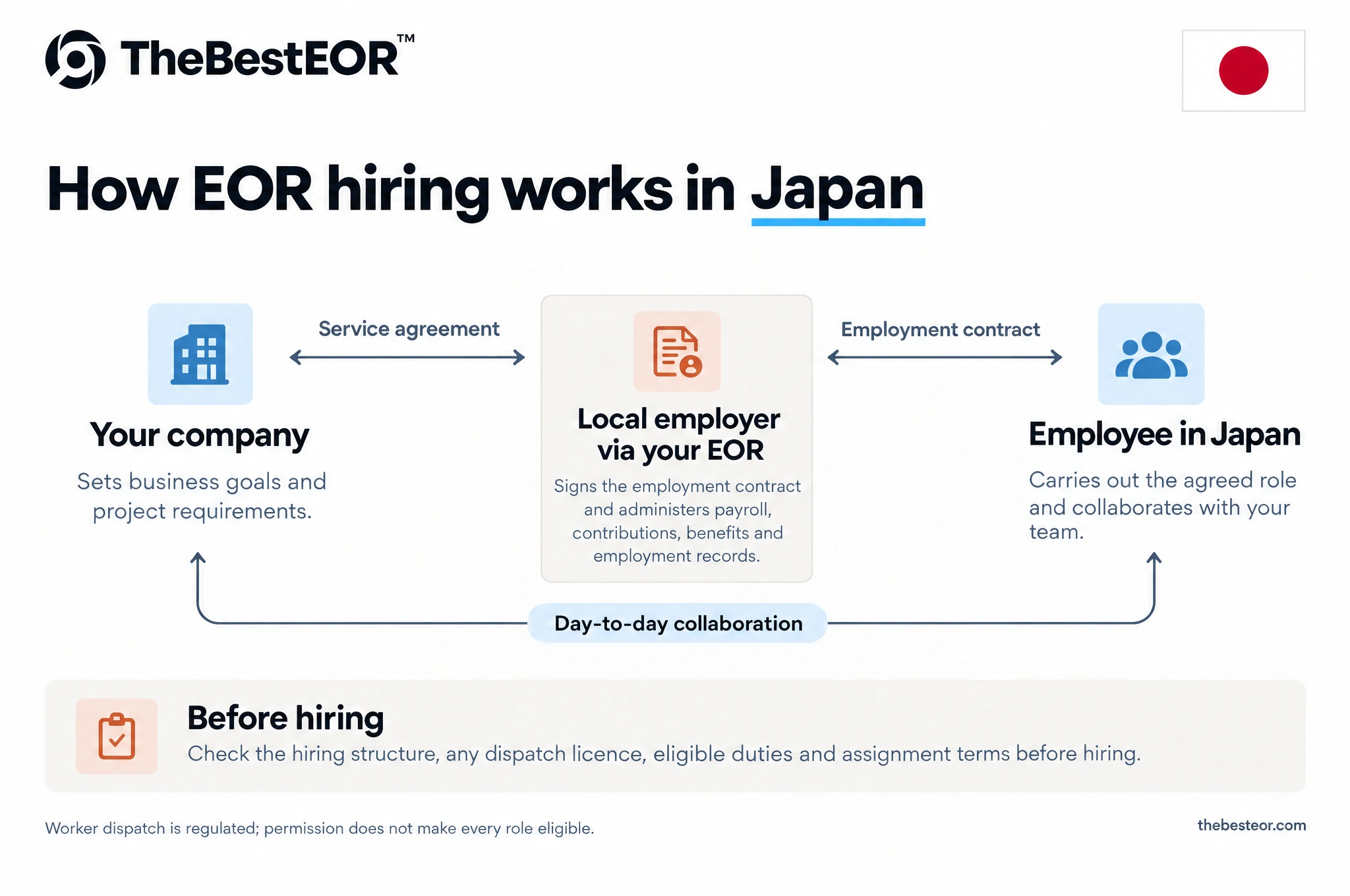
Employer of record in Japan diagram showing the service agreement, employment contract, and day-to-day collaboration between your company and the employee.
Employer of record in Japan: how your company, the local employer and the employee work together. Select the image to enlarge.

The EOR handles

1
Being the employer Japanese law holds to account, on its own Japanese entity
2
Your hire’s kenko hoken card and kosei nenkin record: enrolment with the Japan Pension Service, premiums settled by the end of the following month
3
Registrations at Hello Work and the Labor Standards Inspection Office, plus the Article 36 agreement required for statutory overtime
4
Monthly gensen choshu withholding, the December nenmatsu chosei, and the gensen choshu hyo the employee takes away
5
The Japanese employment contract and the Rules of Employment behind it
6
The leave ledger, with dates designated if the mandatory five days risk going untaken
7
The 30-day notice and a documented, settled exit when employment ends

You keep

1
What the hire works on each day, and who they answer to
2
The offer itself: base salary, the summer and winter bonus basis, the commuting allowance
3
Who you hire, and when to end it
4
Performance reviews, and the evidence that makes a separation defensible
5
The hire’s laptop and tools (device provisioning is an add-on at some providers)
6
The client relationship, and the IP terms you need the employment contract to carry

The split’s main purpose is shutting down deemed employment. Engage a Japanese worker on a gyomu itaku (services) contract while setting their hours and directing their work, and the authorities or a court can deem them an employee, exposing you to unpaid social insurance, back income tax and labor-law claims. An employment arrangement that meets local requirements can change how the worker is engaged from then on. It does not settle earlier classification liabilities, and the staffing model and any immigration route require their own assessment. The misclassification guide covers the tests Japanese authorities apply.

Work visas

Work status, the Certificate of Eligibility and salary rules

Check who can sponsor the relevant residence status.

The status of residence types that matter for hiring, the salary rule that governs them, and whether an EOR can sponsor, which depends on the provider type. All as of 2026.

Status of residence Who it is for Salary rule Max duration
Status of residence
Engineer / Specialist in Humanities / International Services
Who it is for
Office and technical roles: IT, engineering, marketing, finance, translation
Salary rule
Equal to a Japanese national in the same role; no fixed floor
Max duration
1, 3 or 5 years, renewable
Status of residence

Highly Skilled Professional (HSP)

Who it is for
High earners scoring on a points system
Salary rule
Points include income; ¥3M+ to score, fast-track PR
Max duration
5 years (HSP i) or indefinite (HSP ii)
Status of residence
Intra-company Transferee
Who it is for
Staff moved from an overseas group company
Salary rule
Equal to a Japanese national in the same role
Max duration
1, 3 or 5 years
Status of residence
Business Manager
Who it is for
Founders and executives running a Japanese entity
Salary rule
Capital and office substance tests apply
Max duration
1, 3 or 5 years

Fig. 8 · Statuses of residence for hiring, salary rules and durations · as of 2026 · pay must at least equal a Japanese national’s in the same role

The status is employer-sponsored, so the EOR’s Japanese entity files the Certificate of Eligibility with the Immigration Services Agency before the worker applies for the visa at a consulate. The Engineer/Specialist in Humanities route requires a relevant bachelor’s degree, a Japanese vocational qualification, or about ten years of relevant experience (three years suffices for some International Services fields such as translation), and the work must match the field of study. There is no published minimum salary, but the offered pay must be at least equal to what a Japanese national would earn in the same role, and immigration scrutinises low offers. Processing of the Certificate of Eligibility typically runs one to three months, which is the part outside the EOR’s control.

Borderless AI lists no standalone visa product, so a Certificate of Eligibility hire is a gap there.

Salary benchmarks

Indicative salary ranges

The yen figures lean toward Tokyo and exclude bonuses.

Monthly gross in yen with a USD equivalent at roughly ¥150 to the dollar. Ranges are 2026 market data from ERI SalaryExpert and TokyoDev, Tokyo-weighted; use the midpoint as a starting offer, not a ceiling, and add the summer and winter bonuses on top.

Check current pay data for the role and location before you make an offer.

Role Gross JPY/month USD/month (approx)
Role
Software engineer
Gross JPY/month
¥470,000–920,000
USD/month (approx)
$3,130–6,130
Role
Senior software engineer
Gross JPY/month
¥750,000–1,400,000
USD/month (approx)
$5,000–9,330
Role
Product manager
Gross JPY/month
¥580,000–1,000,000
USD/month (approx)
$3,870–6,670
Role
Accountant
Gross JPY/month
¥440,000–740,000
USD/month (approx)
$2,930–4,930
Role
Customer support
Gross JPY/month
¥300,000–480,000
USD/month (approx)
$2,000–3,200
Role
Sales manager
Gross JPY/month
¥600,000–1,100,000
USD/month (approx)
$4,000–7,330
Role
HR manager
Gross JPY/month
¥600,000–1,050,000
USD/month (approx)
$4,000–7,000
Role
Designer
Gross JPY/month
¥450,000–820,000
USD/month (approx)
$3,000–5,470

Fig. 9 · Monthly gross salary benchmarks by role, 2026 · ERI SalaryExpert and TokyoDev data, Tokyo-weighted; summer and winter bonuses come on top

Salaries concentrate in Tokyo and the surrounding Kanto region; Osaka, Nagoya and Fukuoka run roughly 10 to 20 percent below the capital for the same role. These are monthly gross figures before the summer and winter bonuses, which at established employers add the equivalent of four to six months over the year, so annual total cash is materially above twelve times the monthly figure.

Fully-loaded cost

What a Japanese engineer really costs per month

The example uses ¥620,000 in monthly gross pay.

For a different salary, estimate employer payroll costs in Japan.

Software engineer, Tokyo (under 40) Gross base: ¥620,000/month
Gross salary ¥620,000
Employees' Pension (9.15%)
Capped at ¥650,000 standard remuneration
¥56,730
Health insurance (4.925%)
Tokyo, employer half of 9.85%
¥30,535
Employment insurance (0.85%)
On total gross wages, FY2026 rate from April 2026
¥5,270
Accident insurance (0.3%)
Clerical/IT rate, employer pays 100%
¥1,860
Child & Childcare Support levy (~0.115%)
Employer half of 0.23%, from April 2026, via health insurer
¥713
Child Allowance Contribution (0.36%)
Employer-only, on the pension base
¥2,232
EOR fee illustration
RemoFirst $199 ≈ ¥29,850
⚠ Trustpilot warning: rating suspended for a breach of its guidelines; fake reviews removed
¥29,850
Monthly total, cheapest fee
Annual ≈ ¥8,966,280 (about $59,800), before bonuses
¥747,190

Fig. 10 · Fully-loaded monthly cost, illustrative Tokyo software-engineer salary, age under 40 · statutory load about 15.7% on gross; summer and winter bonuses excluded

Statutory employer cost is about ¥97,340, roughly 15.7 percent on top of gross (an employee aged 40 or over adds Long-Term Care of about ¥5,022, the employer half of 1.62 percent, lifting it near 16.5 percent). At the illustration’s exchange rate, these hypothetical USD monthly service fees change the modelled total: a USD 599 service fee (≈ ¥89,850) lands at ¥807,190/month, and a USD 699 service fee (≈ ¥104,850) lands at ¥822,190/month. None of these totals include the summer and winter bonuses, which at four to six months add ¥2.5M to ¥3.7M a year on a ¥620,000 base, so annual cash cost runs well above twelve monthly totals. The bonus norm, not the fee, is the biggest swing on Japanese total cost, which is why you should price the full-year package rather than the monthly line.

The employee’s remuneration grade, insurer and other scheme bases determine the actual payroll amount.

EOR vs your own entity

EOR or your own KK: compare costs

Compare incorporation and running costs over time.

Incorporating a kabushiki kaisha adds setup and recurring administration in Japan. Compare current entity quotes with the complete EOR proposal over the same hiring period.

Factor EOR Your own KK
Factor
Setup cost
EOR
None
Your own KK
~¥400,000–1,000,000 all-in (registration tax, notary, legal)
Factor
Time to first hire
EOR
3–14 days (visa adds 1–3 months)
Your own KK
4–8 weeks (notary, Legal Affairs Bureau, bank, social-insurance registration)
Factor
Per-employee cost
EOR
$199–699/employee/mo fee + statutory
Your own KK
Statutory only, plus shared overhead
Factor
Ongoing admin
EOR
Provider runs payroll, social insurance & tax
Your own KK
Tax accountant, labor consultant (sharoshi), your own payroll
Factor
Compliance liability
EOR
On the EOR
Your own KK
On you and your resident representative director

Fig. 11 · Illustrative EOR-versus-entity comparison; the crossover depends on the fee plan, local operating costs and hiring duration.

Annualising an illustrative $199 monthly starting service fee gives about ¥358,000 using the example’s exchange rate. A KK’s incorporation is a one-off, but mandatory ongoing accounting, a labor and social-insurance consultant (sharoshi), and in-house payroll add roughly ¥1,000,000 to ¥2,500,000 a year in fixed overhead regardless of headcount, plus a resident representative you must appoint and the compliance liability your directors carry. Those figures are illustrative assumptions. Compare complete country quotes, setup, administration and exit costs before deciding whether a KK saves money.

For the working, see the EOR vs entity break-even guide. The break-even depends on complete current quotes, including setup, administration, funding, benefits, FX and exit costs. Many teams follow this sequence: first hires on the EOR, a KK once headcount justifies the sharoshi and accounting overhead, then staff transferred across .

FAQ

EOR in Japan: common questions

What is the best EOR in Japan?

RemotePeople is our top pick for Japan in 2026 (4.9/5), followed by Deel (4.7/5) and Rippling (4.5/5). We opened paid accounts with all 10 providers on this page, priced real hires and ran payroll.

RemotePeople offers recruitment and EOR through one provider, with a dedicated account manager on both EOR plans. Its EOR Global plan starts at USD 499 per employee per month, and EOR Select at USD 199 where the hire qualifies. Deel starts at USD 599 plus a mandatory Employer Liability Cost; Rippling starts at USD 499 plus its required platform subscription.

How does an employer of record work in Japan?

An employer of record in Japan becomes the worker’s legal employer through a local employing entity, while your company directs the day-to-day work. The EOR enrols the employee in health insurance (kenko hoken) and the employees’ pension (kosei nenkin), registers with Hello Work and the Labor Standards Inspection Office, files the Article 36 agreement needed for overtime and runs monthly gensen choshu withholding and the December nenmatsu chosei adjustment.

How fast can an EOR onboard an employee in Japan?

Estimated onboarding times for Japan range from 2 to 14 days across the providers we tested. By provider: Deel 2–5 days, Rippling 2–5 days, RemotePeople 3–7 days, G-P 5–10 days and Oyster 7–14 days.

Ask the provider to separate contract preparation, right-to-work checks, payroll and social-insurance setup, and the first salary payment. For a candidate joining from abroad, assess the residence-status application separately. For someone already in Japan, check that their present status permits the proposed work before promising a start date.

How much does an EOR cost in Japan per month?
Published service fees for Japan run from USD 199 to USD 699 per employee per month across the 10 providers we tested: RemoFirst from USD 199; RemotePeople Global from USD 499, or Select from USD 199 only where country and salary qualify; Deel from USD 599 plus mandatory Employer Liability Cost; G-P from USD 599; Oyster USD 699 on monthly billing, with annual seats quoted separately. Multiplier Core advertises $499 monthly or $459 per month billed annually; Pebl advertises $399, with currency and commitment to confirm. Rippling starts at USD 499 plus its required platform from USD 8 per employee, and Papaya Global at USD 499. Borderless AI is USD 579 standard, with an eligible USD 399 promotion on fees billed through 31 December 2026. All amounts are per employee/month; salary and employment costs are separate. See Provider service fees. On top of the fee you pay the employee’s gross salary plus roughly 15 to 16 percent in employer health insurance, pension, employment insurance and accident insurance contributions.
What employer contributions are mandatory in Japan?
Employees’ Pension Insurance at 9.15 percent, Health Insurance at about 4.9 percent (Tokyo, employer half of 9.85 percent), Long-Term Care Insurance of about 0.81 percent for employees aged 40 to 64, Employment Insurance at 0.85 percent from April 2026, Workers’ Accident Compensation Insurance from 0.25 percent for clerical work, and an employer-only Child Allowance Contribution of 0.36 percent on the pension base. From April 2026 the Child and Childcare Support levy, 0.23 percent split in half and collected with health insurance, adds about 0.12 percent on the employer side. The combined employer load is roughly 15 to 16 percent of gross.
Can an EOR sponsor a work visa in Japan?

Japan’s residence status must permit the actual proposed work. The Immigration Services Agency provides a certificate of authorised employment to help confirm which activities an existing status permits; holding a residence card is not enough to assume that every job is allowed.

For a new application, ask the provider to name the proposed employing organisation, the relevant status and its role in the application. Request a written assessment of the role and the candidate’s qualifications.

What is the minimum wage in Japan in 2026?
Japan sets the minimum wage by prefecture as an hourly rate, revised every October. Tokyo’s minimum is ¥1,280 per hour from 1 October 2026. Other prefectures have their own rates and effective dates; use the applicable prefectural notice. There is no single national monthly figure; the EOR applies the prefectural rate for the employee’s work location.
How much notice and severance applies when terminating in Japan?

The Labor Standards Act requires at least 30 days’ notice, or 30 days’ wages paid in lieu, for any dismissal. There is no statutory severance payment. The harder constraint is that a dismissal must have objectively reasonable grounds and be socially acceptable, or a court can rule it void and order reinstatement with back pay. Most exits in Japan are settled by mutual agreement with a negotiated package rather than a unilateral dismissal.

What currency and payroll cycle does Japan use?
The Japanese yen (JPY). Payroll runs monthly, usually paid on the 25th of the same month or the end of the month, and the Labor Standards Act requires wages to be paid at least once a month on a fixed date. Withheld income tax is remitted to the tax office by the 10th of the following month; social insurance premiums are due to the pension office by the end of the following month. About 150 yen equals one US dollar in 2026.
Are summer and winter bonuses mandatory in Japan?
No. Japan has no statutory 13th-month salary, but twice-yearly bonuses are a deep custom: a summer bonus paid around June or July and a winter bonus around December, together commonly worth four to six months of salary at large employers. Candidates expect them, so the EOR writes the bonus basis into the contract as either guaranteed or performance-linked, and applies social insurance and tax to each payment like ordinary wages.
Can I convert a Japanese contractor to an EOR employee?
Yes. An EOR can employ the worker going forward. Under the earlier gyomu itaku arrangement, a contractor who works set hours under your direction can be deemed an employee, leaving you liable for unpaid social insurance, back income tax and labor-law claims. An EOR issues a compliant employment contract, enrols the worker in health insurance and pension, and runs gensen choshu withholding, usually within one to two weeks for someone already work-authorised.
Do I need a KK or branch to hire one person in Japan?

No. An EOR employs the worker on its Japanese entity, so you hire without registering your own kabushiki kaisha or godo kaisha. Setting up a KK costs roughly 400,000 to 1,000,000 yen all-in and takes four to eight weeks including notarisation and a bank account, plus ongoing accounting and a resident representative.

Annualise the selected service fee for the hires you expect to keep, then compare it with the KK or GK setup, accounting, payroll, insurance and labour administration. Count setup costs over the same hiring horizon and include payroll, benefits, transition and exit charges on both sides. A higher service-fee plan moves the financial crossover earlier; lower recurring entity overhead or a longer hiring horizon can do the same. Short hiring duration, setup costs and the need for local administration can move it later.

How does the mandatory 5-day paid leave rule work in Japan?
Since April 2019, any employee granted 10 or more days of annual paid leave must actually take at least 5 of those days within the year, and the employer is legally responsible for ensuring it happens, designating dates if the employee does not. Non-compliance can draw a fine of up to 300,000 yen per affected worker. The EOR tracks each employee’s leave ledger and prompts the five-day minimum so you stay compliant.

Sources and as-of dates

Article references

Japan re-prices itself on a fixed calendar: health-insurance rates each April, prefectural minimum wages each October, labor-insurance rates each fiscal year.

Hiring facts Checked 2 Oct 2026

Hiring facts

Checked 2 October 2026
Eligibility, local and collective rules apply. EOR fees extra.

Labor Standards Act (Rodo Kijun Ho) 2 sources

and Labor Contract Act (Rodo Keiyaku Ho): the general limits are 8 hours per day and 40 hours per week, subject to statutory exceptions; statutory overtime attracts premium pay. Dismissal normally requires 30 days’ notice or pay for the shortfall, subject to exceptions. Paid annual leave depends on service, attendance and working pattern. A dismissal without objectively reasonable grounds that is not socially acceptable is invalid as an abuse of rights. MHLW guidance covers the relevant Labor Standards Act provisions and Labor Contract Act Article 16.

Annual paid leave and the mandatory five-day take rule 1 source

Since 1 April 2019, employers must ensure that workers granted at least 10 days of statutory annual paid leave take at least five days within one year of the grant date. Leave already taken at the worker’s request or through planned leave counts toward the five days. Breach of this duty can attract a fine of up to ¥300,000. MHLW.

Employees' Pension Insurance (kosei nenkin) 2 sources

18.30% total, normally shared equally by employer and employee (9.15% each). The standard monthly remuneration ceiling is ¥650,000 as of 2 October 2026; bonuses have a separate contribution base. Japan Pension Service.

Health Insurance (kenko hoken) 1 source

Kyokai Kenpo’s Tokyo health-insurance rate is 9.85% total for March 2026 contributions, payable in April, with a normal employer share of 4.925%. Long-term-care insurance adds 1.62% total for insured people aged 40–64, also normally split equally. Rates and arrangements depend on the insurer and branch.

Employment Insurance (koyo hoken) 3 sources

and Workers’ Accident Compensation Insurance (rosai hoken): for general businesses, employment-insurance rates are 0.85% employer and 0.5% employee from 1 April 2026 to 31 March 2027; some industries have higher rates. Base accident-insurance rates range from 0.25% to 8.8% by business classification; the “other businesses” category is 0.3%. A clerical job title alone does not determine the employer’s accident-insurance classification. MHLW.

Child and Childcare Support levy 3 sources

Kyokai Kenpo’s new child and childcare support contribution is 0.23% total for April 2026 contributions, payable in May, normally split equally between employer and employee and collected alongside health insurance. The separate Child Allowance Contribution (kodomo-kosodate kyoshutsukin) remains employer-only at 0.36% for FY2026 on the applicable pension contribution base. Kyokai Kenpo / Japan Pension Service.

Total employer burden reference 1 source

JETRO’s “Setting Up Business in Japan” Table 4-9 gives historical employer totals of 15.76% and 16.67% where long-term-care insurance applies, using premiums dated December 2023. These totals already include the table’s 0.3% accident-insurance assumption. They are not current 2026 payroll rates; insurer, age, industry and contribution ceilings affect an actual calculation.

Income tax (gensen choshu) 3 sources

Japan’s ordinary national income-tax bands range from 5% to 45% on taxable income. For 2026, the reconstruction surtax is generally 2.1% of the base income-tax amount. NTA’s current guidance flags a change from 2027, so the 2.1% rate may not continue unchanged through 2037. Japan-source employment income paid to a non-resident without a permanent establishment is generally subject to 20.42% withholding, with treaty relief and other exceptions. Tokyo’s ordinary inhabitant-income-tax component totals 10% (4% metropolitan and 6% municipal), with separate fixed charges.

Work status and Certificate of Eligibility 2 sources

Engineer/Specialist in Humanities/International Services is one relevant status of residence; the permitted work and the applicant’s qualifications must fit the selected status. For this status, remuneration must be at least equivalent to what a Japanese national would receive for comparable work. A Certificate of Eligibility forms part of the usual overseas work-visa application process. MHLW / JASSO; the Immigration Services Agency provides the application requirements.

Minimum wage 1 source

Hourly minimum wages are set by prefecture and change on different effective dates. As of 2 October 2026, the official MHLW table lists Tokyo at ¥1,280 per hour from 1 October 2026, replacing ¥1,226. Check the effective prefectural rate and any applicable industry minimum; a national weighted average is not the rate payable in every prefecture.

Entity setup 1 source

KK setup costs and timing depend on the scope of work and the company’s circumstances. JETRO’s model case separates company registration and related professional filings from paid-in capital, visas, office costs and other startup expenses. The linked official model does not substantiate the ¥400,000–1,000,000 “all-in” range or the 4–8-week timetable, including a bank account; obtain an itemised quote and a case-specific timetable.

Salary benchmarks 2 sources

TokyoDev’s published 2025 survey provides context for international software developers in Japan. Its 2026 survey was still marked open when checked on 2 October 2026. Any conversion at ¥150 = USD 1 is an illustrative exchange-rate assumption.

Provider pricing checked 24 September 2026 10 sources

October 2026 sources 4 sources

Japan Pension Service — pension premiums and remuneration — 18.3% total normally shared equally; standard remuneration grades and pension bases. Accessed 19 October 2026.

Japan Pension Service — bonus reporting, updated 6 October 2026 — Pension bonus ceiling of JPY1.5m per month, same-month aggregation; health bonus ceiling annual JPY5.73m; bonus definition and payment reporting. Accessed 19 October 2026.

MHLW — five-day annual-leave duty — Five days within one year of grant for employees receiving at least ten statutory days, with worker-requested and planned leave counting; consult employee on designated dates. Accessed 19 October 2026.

Kyokai Kenpo Tokyo — 2026 premium notice — Tokyo health 9.85% total for March contributions, normally split equally; care 1.62% for ages 40–64; new support levy timing; insurer branch can differ from residence. Accessed 19 October 2026.

The country guides cover other markets. For this hire, browse EOR providers for Japan and use the EOR cost calculator to compare the recurring amounts in your proposals in USD.

This guide is for general information only and does not provide legal, tax, accounting, or financial advice. For advice about your business, consult a qualified professional familiar with the rules where you hire. The research methodology explains how TheBestEOR assesses sources.