


Guide overview
Worker misclassification, at a glance.
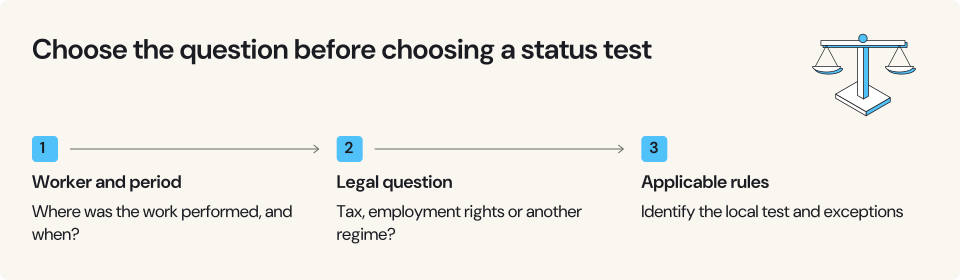
Review the whole relationship under each applicable test.
Full-time, open-ended work for one client under its direction can be a warning sign, but status depends on the applicable legal tests and the whole relationship. Review employment rights, tax and social-security treatment separately for each country. Prioritise workers with the strongest factual warning signs or largest potential exposure, obtain a local status assessment and decide both the future working arrangement and any correction of past treatment.
Working practices
Document warning signs
Record direction, dependence and how work actually happens.
Employment rights
Review the local test
Obtain a country-specific assessment of worker status.
Tax and contributions
Assess separately
Check tax and social-security treatment alongside employment status.
Next steps
Address future and past
Decide the future arrangement and any correction of prior treatment.
Check before acting
Prioritise relationships with the strongest factual warning signs or largest potential exposure, then obtain a local assessment.
What to record in the worksheet
Scope
Worker / record ID · Country and period · Contracting entities
Evidence and follow-up
Role and working practices · Tests / advice needed · Evidence · Concern and next action · Owner / review date
Start with how the person works. Who directs the tasks? What decisions can the contractor make about doing the work? Compare the answers with the applicable employment, tax and social-security tests in the country table. Each test answers a different question. Record the facts before deciding how to handle future work or correct earlier treatment.
1. The working practices that warrant a status review
If someone has worked for one client for a long time, takes close direction and does work central to that business, there’s reason to review their status locally. The comparison of employment and contracting gives you five questions to ask about the arrangement before you apply the country’s test.
Six of the ten, including the US and Germany, changed their rules or enforcement between 2024 and 2026. Australia wrote a new employee definition into statute (August 2024), and the Netherlands restarted tax audits (January 2025, with penalties from 2026). Poland let labor inspectors reclassify contracts by administrative decision (July 2026), while Brazil’s STF suspended cases concerning self-employed and company-based contracting in April 2025. In June 2026, it allowed first-instance and regional labour proceedings to continue, with suspension returning after the regional judgment under that decision.
| Country | The test | Selected regime and period to verify | Example |
|---|---|---|---|
Country
US
|
The test
Economic realities (DOL), IRS common law, ABC in CA/NJ/MA
|
Selected regime and period to verify
IRS 3 yrs; unlimited if no filings
|
Example
Uber, $100M, New Jersey, Sep 2022
|
Country
UK
|
The test
IR35 / off-payroll working rules
|
Selected regime and period to verify
4–6 yrs; 20 if deliberate
|
Example
DWP, £87.9M, 2021
|
Country
Netherlands
|
The test
DBA, nine-factor Deliveroo test
|
Selected regime and period to verify
Normally no earlier than 1 January 2025 under the tax policy; exceptions can permit earlier assessment
|
Example
Deliveroo riders reclassified, Mar 2023
|
Country
Germany
|
The test
Scheinselbständigkeit (§7 SGB IV)
|
Selected regime and period to verify
4 yrs; 30 if intentional
|
Example
Obtain a year-by-year calculation using covered wages, contribution ceilings, recovery limits and late charges
|
Country
France
|
The test
Requalification; travail dissimulé
|
Selected regime and period to verify
5 yrs (URSSAF)
|
Example
Deliveroo, €375k criminal fine, Apr 2022
|
Country
Spain
|
The test
Riders Law presumption (RDL 9/2021)
|
Selected regime and period to verify
4 yrs (contributions)
|
Example
Glovo, €205M+ in fines, 2022–2024
|
Country
Poland
|
The test
Labour Code art. 22 §1; PIP decisions from Jul 2026
|
Selected regime and period to verify
Assess earlier ZUS and tax periods separately; no automatic five-year outcome
|
Example
Reform signed Apr 2, 2026; in force Jul 8, 2026
|
Country
Brazil
|
The test
CLT status analysis and STF Theme 1389; check the actual claim and current order
|
Selected regime and period to verify
5 yrs, up to 2 yrs after exit
|
Example
First-instance/regional suspension lifted June 2026; check the actual proceeding
|
Country
Canada
|
The test
Dependent contractor; CRA total relationship
|
Selected regime and period to verify
CPP and EI reassessed, both shares
|
Example
Canac Kitchens, 26 months' notice, 2016
|
Country
Australia
|
The test
FW Act s 15AA, whole of relationship
|
Selected regime and period to verify
Super: effectively unlimited
|
Example
Foodora, A$3M and market exit, 2018
|
Fig. 1 · Misclassification tests, selected reassessment or claim periods and historical examples; verify the relevant regime in 10 countries · reflects 2024–2026 rule and enforcement changes
How to use the country sections
Start with the relevant country section, then identify the governing question and date.
2. United States: the economic-realities, IRS and ABC tests
For a US engagement, identify the federal wage, federal tax and state rules that apply, including any exceptions. A finding for federal tax purposes can leave the wage-law question open.
Federal wage law uses the Department of Labor’s economic-realities test: is the worker in business for themselves, or economically dependent on you? The 2024 rule (effective March 11, 2024) weighs six factors, including permanence, control and how integral the work is. WHD’s 1 May 2025 enforcement guidance changed the analysis used in its investigations but did not repeal the codified rule. DOL announced a replacement proposal on 26 February 2026, published in the Federal Register on 27 February. The eCFR text displayed as current through 9 October 2026 still contains the 2024 six-factor analysis. Agency enforcement policy, the codified text and the test applied in a particular court proceeding are separate checks.
Federal tax uses the IRS common-law test: behavioral control, financial control and the relationship of the parties. Either side can ask the IRS to rule on a specific worker with Form SS-8. Where IRC §3509 relief applies, reduced federal withholding and employee-FICA rates depend on whether required information returns were filed; the employer FICA share is not reduced. Wage bases and eligibility matter. Use the IRS Publication 15 calculation for the relevant year.
State law can add separate tests and liabilities. California, New Jersey and Massachusetts use versions of the ABC test: a worker is an employee unless (A) free from your control, (B) doing work outside your usual course of business and (C) running an independently established trade. For example, a software company engaging a developer to build its core product may need to examine whether the work is outside its usual course of business. Identify the applicable statute, exemptions and all parts of the governing test. California codified the test in AB5 (in force January 1, 2020), and willful misclassification there costs $5,000 to $15,000 per violation, rising to $25,000 for a pattern. In September 2022 New Jersey’s unemployment-insurance audit of Uber, covering 297,866 drivers, ended in a $100 million assessment. New York’s attorney general settled with Uber and Lyft for $328 million in November 2023, and FedEx Ground paid $228 million in 2015 after 2,300 California drivers were reclassified.
3. United Kingdom: IR35 and the status determination duty
IR35 (the intermediaries legislation of 2000) asks whether a contractor would be an employee without the limited company in the middle, using the case-law factors of control, personal service and mutuality of obligation. Since April 6, 2021, covered medium and large private-sector clients must take reasonable care in deciding status and send a reasoned status determination statement to the worker and the party they contract with. The deemed employer normally operates PAYE, but liability can remain with or move to the client where the statutory duties are not met; identify the actual supply chain to see who bears it. The small-client exception applies outside the public sector. A client wholly overseas with no UK connection also has different treatment: the worker’s intermediary generally decides whether the rules apply. Inside IR35, the work is taxed through PAYE, with employer National Insurance at 15% (the rate since April 2025).
HMRC’s free CEST tool gives a status answer HMRC will stand behind if your inputs are accurate, but tribunals are not bound by it, and even government departments get the call wrong. The Department for Work and Pensions paid HMRC £87.9 million in 2021, and the Home Office took a £33.5 million bill labeled “careless” that year. The Ministry of Justice disclosed £72.1 million in 2022, including a £15 million carelessness penalty. HMRC itself lost its £4.9 million case against Gary Lineker at tribunal in March 2023 and dropped its appeal in 2024. The look-back is typically 4 to 6 years, or up to 20 for deliberate behavior.
4. Netherlands and Germany: DBA and Scheinselbständigkeit
Netherlands: DBA enforcement resumed in 2025
The DBA enforcement moratorium ended on January 1, 2025. From that date, the tax authority (Belastingdienst) could impose payroll-tax corrections and additional assessments directly when it found false self-employment; 2025 was not a blanket exemption from assessment. Culpability penalties can apply in 2026; default penalties are not imposed in 2026 under the authority’s published policy. Under the published enforcement policy, the authority normally does not assess earlier than January 1, 2025. Exceptions include malicious conduct or failure to comply with earlier directions.
The Supreme Court’s Deliveroo ruling of 24 March 2023 considers the whole relationship, including how work is embedded in the organization, personal performance, who sets pay, duration and business risk. Do not substitute a proposed or future pay-threshold presumption for the law applicable to the review period. The current tax-enforcement policy and the employment-law status test answer different questions.
Germany: Scheinselbständigkeit and the status determination
Germany has a statutory procedure for requesting a status determination. The test is whether the worker is self-employed or in dependent employment (§7 SGB IV): bound by instructions, integrated into your organization and without entrepreneurial risk. Two authorities enforce it: the pension insurer (Deutsche Rentenversicherung, DRV), which audits every employer’s contractor spend on a four-year cycle, and the customs financial police (FKS), which handle criminal cases. You can ask the DRV’s Clearingstelle for a free, binding status determination (Statusfeststellungsverfahren) even before an engagement starts, and it takes about three months.
A finding of Scheinselbständigkeit (false self-employment) makes you liable for both halves of social contributions, using the relevant years’ contribution bases, ceilings and worker coverage, for up to 4 years back (30 years if intent is proven), plus late fees of 1% per month. A missed employee-share deduction can normally be recovered only from the next three wage or salary payments; §28g SGB IV contains exceptions, including where the employer was not at fault, and intentional cases are a criminal offense under §266a StGB. Do not estimate four years of liability by multiplying every contractor fee by 40%; calculate the covered wages and each year’s capped contribution amounts, then assess late charges separately. After the Federal Social Court’s Herrenberg ruling (June 28, 2022) reclassified a freelance music-school teacher, auditors swept the education sector. Under §127 SGB IV as amended from April 23, 2026, qualifying teaching engagements can have employment-based social-insurance liability deferred until January 1, 2028 where both parties originally assumed self-employment and the teacher agrees. The transition also addresses insurance as a self-employed teacher.
5. France and Spain: status tests and potential criminal liability
France: requalification and travail dissimulé
French courts requalify a contractor as an employee when they find a lien de subordination: you give orders, supervise the work and can sanction the worker. The Cour de cassation applied that test to an Uber driver on March 4, 2020. Requalification brings back pay, paid leave, notice and severance for the worker, subject to the applicable entitlement rules. Concealed-work criminal liability is a separate question.
Where concealed work is established, the contribution assessment can use the extended five-year period. For procedures started from 1 June 2026, the LFSS 2026 amendment sets the contribution surcharge at 35%, or 50% for aggravated cases under that version. Current government guidance, checked 15 October 2026, confirms those rates. Assess the applicable procedure date, later amendments, reductions, repeat-offence rules and any cancellation of contribution relief for the case. Criminal courts can add fines of up to €45,000 and three years’ imprisonment for individuals and up to €225,000 for the company, with higher maximums when several workers are involved. In April 2022 Deliveroo France received a €375,000 corporate fine (the legal maximum) for concealed work involving its 2015–2017 couriers, and two former managers received suspended prison sentences.
Spain: the Riders Law presumption
Spain’s Workers’ Statute has long presumed employment where work happens inside someone else’s organization and direction (article 8). The Riders Law (Royal Decree-Law 9/2021, in force August 12, 2021) strengthened that presumption for digital delivery platforms, which must prove that a rider is not an employee, and required algorithm transparency for works councils. A 2022 Penal Code reform made it a crime, punishable by six months to six years in prison, to impose false self-employment on workers or to keep it in place against an administrative order or sanction.
Glovo challenged these rules and lost. Its Labor Inspectorate fines passed €205 million by 2024, and in July 2024 a Barcelona investigating court opened a criminal investigation of CEO Oscar Pierre for offenses against workers’ rights. That December he testified as a formal suspect, and Glovo said it would move its riders to employment, budgeting €100 million in 2025 to employ 15,000 of them. Other businesses should check the TRADE threshold: receiving at least 75% of income from one client is only one condition for economically dependent self-employed (TRADE) status under Law 20/2007. Check the remaining Article 11 conditions and whether the actual relationship is employment before using that route. Contribution debts reach back four years.
6. Poland: the PIP status-review procedure
Polish B2B contracting is not an exemption from employment law. Labour Code article 22 looks at the real relationship, including supervised paid work at a place and time set by the employer. The label, invoice or tax treatment does not decide whether those conditions exist. Review the actual duties and independence of Polish developers and other contractors individually.
The Act published as DU 2026/473 took principal effect on 8 July 2026. PIP guidance describes factual review, a route to a district-inspector decision or court proceedings, and distinct appeal and enforceability rules. A decision’s employment effect and any earlier tax or social-contribution exposure must be assessed separately.
The reform raises the applicable Labour Code court-fine range to PLN 2,000–60,000. Inspector-issued fines follow a separate procedure and limits. Check the alleged offense, transition rules and voluntary-correction conditions before using either amount.
7. Brazil: pejotização and STF proceedings
Pejotização means hiring a person through their own legal entity (a “PJ”) to do an employee’s job. Labor courts have always tested it against CLT article 3, under which personal service, habituality, subordination and pay mean employment. A reclassified PJ is owed the full employment package retroactively: 13th-month salary, vacation plus the constitutional one-third premium, the applicable FGTS deposits and employer social-security contributions. The 40% FGTS termination payment applies to dismissal without just cause under Article 18(1) of Law 8.036/1990. Calculate contribution rates and bases for the employer’s actual regime and review period. Claims reach five years back and can be filed up to two years after the relationship ends.
STF Theme 1389 concerns PJ and self-employed contracting, jurisdiction and the burden of proof. The STF’s 18 June 2026 announcement lifted the suspension for first-instance and regional labour courts. That procedural step is not a final ruling on the merits of every PJ arrangement. Identify the actual claim, court and current order before deciding how it affects a worker or pending proceeding; do not treat company formation as proof of independent status.
8. Canada and Australia: how the common-law tests changed
Canada: the dependent contractor category
Canada has common-law decisions recognising a dependent-contractor category between employee and independent contractor. Economic dependence and exclusivity must be assessed in context under the applicable provincial law; a 90% income figure is not a universal statutory threshold. The Ontario Court of Appeal recognized the category in 2009, and dependent contractors are owed reasonable notice at common law on the same scale as employees. The Court of Appeal applied this in Keenan v. Canac Kitchens (2016 ONCA 79), upholding about C$125,000 in lieu of 26 months’ notice for a couple with 32 and 25 years of service whom Canac had let go without notice.
For tax, the CRA applies the total-relationship test from the Supreme Court’s Sagaz decision (2001): control, ownership of tools, chance of profit and risk of loss. A CRA assessment can include the employer and employee shares of CPP and EI, applicable penalties and interest. Failure-to-deduct penalties are generally 10%; specified repeated failures in a calendar year involving knowing conduct or gross negligence can attract 20%. Separately, assess any common-law notice claim when a dependent-contractor relationship ends; its value is case-specific.
Australia: the 2024 statutory definition
In 2022 the High Court ruled that the written contract decides status, and Parliament reversed that with the Closing Loopholes reforms. Since August 26, 2024, section 15AA of the Fair Work Act defines employment by the “real substance, practical reality and true nature” of the relationship across the whole engagement, rather than by the signed document. A contractor earning above the high-income threshold (A$175,000 at launch, A$190,100 from July 1, 2026) can opt out of section 15AA by written notice under the Australian rules. Tax and superannuation obligations are assessed separately.
The same reforms tightened the sham-contracting rules. Since February 27, 2024, the defense requires a reasonable belief that the worker was a contractor, a higher bar than the old absence-of-recklessness standard. Civil penalties for a contravention committed from July 1, 2026 reach A$546,000 for a company, or three times any related underpayment if that is higher. For a company with fewer than 15 employees, the maximum is A$109,200. Superannuation is the easiest liability to miss. The ATO’s superannuation guarantee charge has no general time limit, so underpaid super on a misclassified contractor can be assessed across the whole engagement. The Foodora case predates the reforms. After the Fair Work Ombudsman sued Foodora for sham contracting in June 2018, the company left Australia within months. In November 2018 the Fair Work Commission ruled that rider Josh Klooger had been an employee, and parent Delivery Hero funded an A$3 million part-payment to underpaid riders.
9. How to review contractor status and record the next action
Use this for an initial review of your contractor list. Escalate uncertain or high-exposure relationships for local advice.
Review status before ending a contractor relationship. An exit may bring a dispute about leave, notice, severance or contributions into view. Check the facts and local route before making termination promises. The termination guide explains the separate procedure and cost questions.
For the conversion steps, including how to set the salary and keep the person, see converting contractors to employees.
What to document in a contractor status review
Use these questions to get the worker’s and the manager’s accounts of the same job. The weight each answer carries depends on the local test.
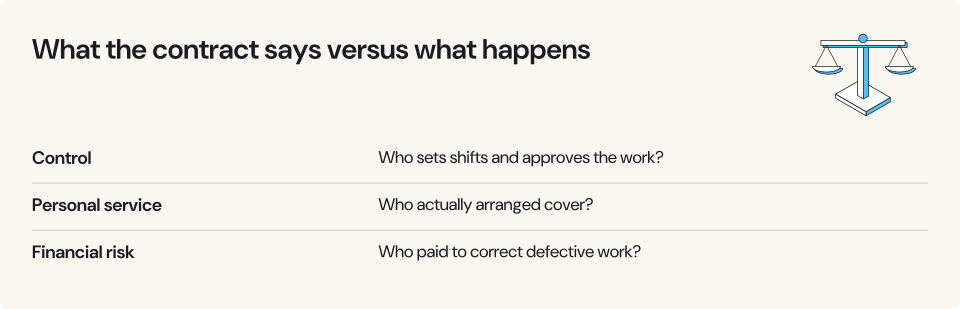
| Review area | Evidence to collect | Question to resolve |
|---|---|---|
Review area
Control
|
Evidence to collect
Instructions, schedules, supervision and approval requirements.
|
Question to resolve
Who decides how the work is performed in practice?
|
Review area
Independent business
|
Evidence to collect
Other clients, marketing, investment and business records.
|
Question to resolve
Is the person operating a business on their own account?
|
Review area
Financial risk
|
Evidence to collect
Pricing, expenses, correction of defective work and payment terms.
|
Question to resolve
Can business decisions produce a profit or loss?
|
Review area
Personal service
|
Evidence to collect
Substitution terms and what happens when cover is needed.
|
Question to resolve
Is a substitute genuinely permitted and practical?
|
Review area
Integration and duration
|
Evidence to collect
Actual duties, organization chart and engagement history.
|
Question to resolve
How does the role fit the business and the local test?
|
Review area
Applicable regimes
|
Evidence to collect
Work location, contracting parties and tax/employment coverage.
|
Question to resolve
Which separate status tests and exemptions must be checked?
|
Write down the local conclusion and the facts behind it. If the facts suggest the worker was already an employee, get advice on the current arrangement and the earlier period before relying on a new contract to settle either question.
Use evidence of how the arrangement works in practice.
Employment, tax and social-insurance rules can differ.
Apply each relevant test; do not use a universal point score.
Address both the future arrangement and potential past issues.
Reassess when duties or working practices change.
A contract title, invoice, fixed end date or worker preference does not decide status.
List your contractors before assessing the risks
Keep one record for each worker and review period. Identify the countries and contracting parties, then document who directs the work, whether the worker can send a substitute and how independently they run their business. If accounts differ, record the disagreement. Name the reviewer for each employment-rights, tax or social-security question.
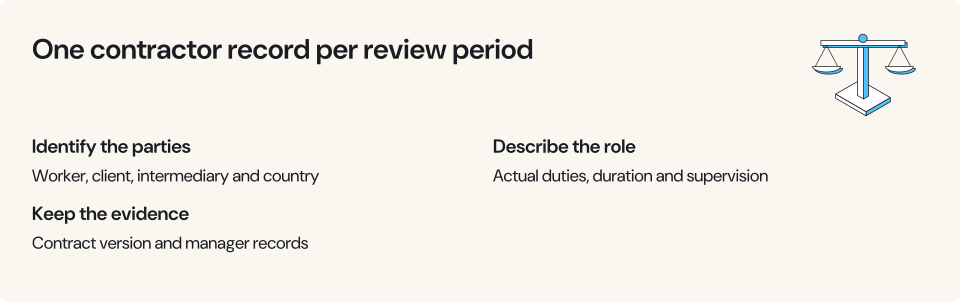
Use the employee misclassification calculator to work through one engagement and identify facts and missing evidence for the local review.
| The working record | Fields to complete |
|---|---|
The working record
Scope
|
Fields to complete
Worker / record ID · Country and period · Contracting entities
|
The working record
Evidence and follow-up
|
Fields to complete
Role and working practices · Tests / advice needed · Evidence · Concern and next action · Owner / review date
|
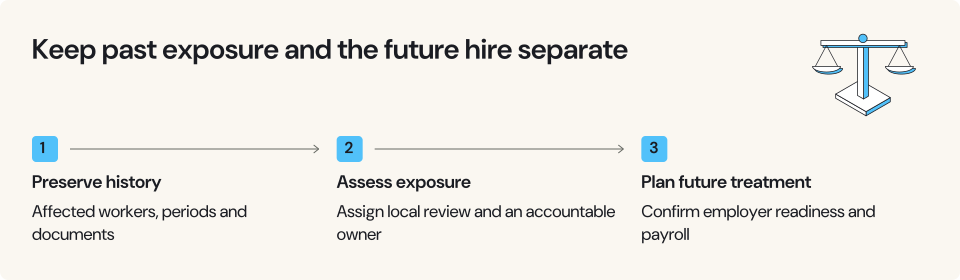
Assign the next action after finding a concern
Preserve the documents and identify the workers and dates affected. Get local advice on status and on what may be owed. Give someone responsibility for the earlier period. If employment is the right route for future work, coordinate the offer, payroll and the employer’s readiness to take the person on.
10. Frequently asked questions
How do I assess contractor misclassification risk by country?
There is no universal country ranking that determines your exposure. Prioritise actual working practices, worker numbers, engagement length, potential liabilities and the evidence available. Enforcement changes in a country are one reason to review affected arrangements, but apply the relevant employment, tax and social-security tests to each worker.
Can a contractor's home country come after us if we have no entity there?
What triggers a misclassification audit or investigation?
What penalties do I face if a contractor is reclassified?
A finding can create back-contribution and employment-entitlement liabilities. Penalties and interest depend on the regime, conduct, period and actual assessment. Back social contributions usually cover both halves: in Germany, calculate covered wages using each relevant year’s bases and ceilings. Entitlements include holiday pay, severance, overtime and, in Brazil, the 13th salary and FGTS deposits.
For established concealed work in France, the LFSS 2026 amendment sets contribution surcharges at 35% or 50% in aggravated cases for procedures begun from 1 June 2026. Other examples include Dutch culpability penalties where the relevant conditions are met, and up to $25,000 per violation in California. Officers can also face criminal liability in France, Spain and Germany.
Can I convert a misclassified contractor without paying for the past?
Conversion does not erase historical exposure. For eligible US applicants, VCSP calculates a payment as 10% of the prior-year liability at the applicable reduced section 3509(a) rates, subject to its conditions and application timing. That relief concerns specified federal employment taxes. Review wage, benefit, state-law and other-country liabilities separately with advisers; the conversion guide explains how to keep past treatment and future employment on separate tracks.
11. Sources
The sources behind this guide, grouped by topic. Dates show when we last checked a page.
US and UK law and enforcement
16 sourcesUnited States · IRS
Independent contractor (self-employed) or employee?
Common-law factors, Form SS-8 and the Voluntary Classification Settlement Program (VCSP). The VCSP FAQ is used in the classification assessment, checked 3 Oct 2026.
United States · Cornell Law School LII
Conditional federal employment-tax rates; the employer FICA share remains due.
United States · Cornell Law School LII
The 3-year IRS assessment limit, unlimited where no return was filed.
United States · Department of Labor (DOL)
Employee or Independent Contractor Classification rulemaking
Covers the 2024 rule, FAB 2025-1 and the 2026 proposal to rescind the 2024 rule (2026 page checked Sep 2026).
United States · DOL
Used in the classification assessment. Checked 3 Oct 2026
United States · DOL
Field Assistance Bulletin (FAB) 2025-1
WHD enforcement analysis changed from 1 May 2025; this is distinct from repealing the codified 2024 text. Checked 15 Oct 2026
United States · eCFR
The codified text still uses the 2024 totality-of-the-circumstances, six-factor analysis; the source citation is 89 FR 1741, 10 January 2024. Checked 15 Oct 2026
United States · California LWDA
ABC test, AB5 and Labor Code 226.8.
United States · California DIR
Used in the classification assessment. Checked 3 Oct 2026
United States · New Jersey Department of Labor
Uber pays $100M in driver misclassification case
Published 13 Sep 2022.
United States · New York Attorney General
$328 million settlements with Uber and Lyft
Published 2 Nov 2023.
United Kingdom · HMRC
Understanding off-payroll working (IR35)
Off-payroll working for clients
Includes the CEST tool. The guidance for clients is used in the classification assessment, checked 3 Oct 2026.
United Kingdom · Gov.uk
Changes to Class 1 National Insurance contributions
Employer rate of 15% from April 2025.
United Kingdom · Department for Work and Pensions (DWP)
Annual Report and Accounts 2020-21
Source for the £87.9M IR35 settlement with HMRC.
United Kingdom · BAILII
Gary Lineker Media v HMRC [2023] UKFTT 340 (TC)
The £4.9M IR35 case HMRC lost.
United Kingdom · HMRC
Compliance Handbook CH53000: assessment time limits
Limits of 4, 6 and 20 years.
Continental European law and enforcement
23 sourcesNetherlands · Business.gov.nl
Wet DBA enforcement and the Deliveroo criteria.
Netherlands · Belastingdienst
The 2026 audit regime; back-assessments reach to 1 January 2025.
Netherlands · officielebekendmakingen.nl
Kamerstuk 36783 nr. 6: nota van wijziging
Received 10 March 2026. The VBAR clarification was dropped and the hourly-rate presumption kept. Checked Sep 2026
Netherlands · officielebekendmakingen.nl
Staatsblad 2026, 158: Act of 18 June 2026
Commencement decree (Staatsblad 2026, 207)
Article 7:610aa BW: the hourly-rate presumption of employment, with an indexed rate. The commencement decree puts the presumption in force from 31 December 2026. Checked Sep 2026
Germany · Deutsche Rentenversicherung (DRV)
The status determination procedure (Statusfeststellungsverfahren)
The statutory procedure for requesting a status determination.
Germany · gesetze-im-internet.de
The German dependent-employment definition.
Germany · gesetze-im-internet.de
A 4-year contribution look-back, or 30 years where intentional.
Germany · gesetze-im-internet.de
Criminal liability for withheld social contributions.
Germany · Deutsche Rentenversicherung (DRV)
The Herrenberg ruling and the §127 SGB IV transitional rule for teachers
The §127 SGB IV version effective 23 April 2026 was rechecked 15 Oct 2026.
France · Service Public
Current government guidance on concealed-work sanctions
Confirms the contribution surcharge of 35%, or 50% for aggravated cases, set by the LFSS 2026 amendment for procedures started from 1 June 2026. Assess the applicable procedure date and later amendments. Checked 15 Oct 2026
France · URSSAF
Travail dissimulé penalties and surcharges.
France · Légifrance
Code du travail, article L8224-1
Criminal penalties for travail dissimulé.
France · Code du travail numérique
Higher penalties for concealed work involving several people. Checked Sep 2026
France · Cour de cassation
Arrêt n°19-13.316 of 4 March 2020
Uber driver requalified (lien de subordination).
Spain · EU-OSHA
Spain’s Riders Law, new regulation on digital platform work (RDL 9/2021)
Spain · BOE
Código Penal, consolidated text
Article 311 sets six months to six years in prison (checked Sep 2026). Ley Orgánica 14/2022 is the article 311 reform on imposed false self-employment.
Spain · BOE
Ley 20/2007, Estatuto del trabajo autónomo
The 75% income threshold for TRADE status.
Spain · BOE
Ley General de la Seguridad Social
The 4-year prescription on contribution debts.
Poland · National Labour Inspectorate (PIP)
Poland · National Labour Inspectorate (PIP)
New inspection powers and procedure
Covers individual factual review, the district-inspector decision or court route, decision-date effect, and appeal and enforceability. Court fines for the cited Labour Code offenses are PLN 2,000 to 60,000; inspector fines are a different procedure. Notes a 12-month voluntary-conversion concession. Checked 15 Oct 2026
Poland · PIP Gdańsk
New inspectorate powers from 8 July 2026
Covers appeal to the labor court. Checked Sep 2026
Poland · ISAP (Polish Sejm)
Article 22 §1 substance rule and article 281 fines.
Poland · ELI
Dziennik Ustaw 2026, item 473: the PIP reform act
In force 8 July 2026; appeals go to the labor court. Checked Sep 2026
Brazil, Canada and Australia law and courts
14 sourcesBrazil · Planalto
Article 3 employment test and reclassification entitlements.
Brazil · Supreme Federal Court (STF)
2018 outsourcing ruling (ADPF 324 and RE 958.252)
Official news release.
Brazil · STF
Pejotização case status.
Brazil · STF
Lifting the first-instance and TRT suspension
The official announcement of 18 June 2026 allowed first-instance and regional labour proceedings to continue. Checked 15 Oct 2026
Brazil · TRT-6
Pejotização cases resume in first and second instance after the STF lifts the suspension
Published 3 July 2026. Checked Sep 2026
Canada · CanLII
McKee v. Reid’s Heritage Homes Ltd., 2009 ONCA 916
Recognition of the dependent contractor category.
Canada · CanLII
Keenan v. Canac Kitchens Ltd., 2016 ONCA 79
A dependent contractor case with 26 months’ notice.
Canada · Canada Revenue Agency (CRA)
Total-relationship test, CPP and EI rulings. The Employers’ Guide sets out failure-to-deduct penalties (rechecked 15 Oct 2026).
Australia · Fair Work Ombudsman
Independent contractor changes
Covers s 15AA, the opt-out and sham contracting.
Australia · Fair Work Commission (FWC)
Contractor high-income threshold
A$190,100 from 1 July 2026.
Australia · FWC
Klooger v Foodora Australia [2018] FWC 6836
Rider found to be an employee.
Australia · Federal Register of Legislation
Sham-contracting maximum penalties under s 539 item 11A and s 546. Checked Sep 2026
Australia · ASIC
Commonwealth penalty unit of A$364 from 1 July 2026. Checked Sep 2026
Australia · ATO
No general time limit on SGC assessments.
Legal commentary and news
8 sourcesUnited States · Reuters
FedEx Ground settles California driver misclassification claims for $228 million
Published in 2015.
Netherlands · De Zaak
Schijnzelfstandigheid enforcement in 2026
The €38 per hour presumption was kept after the VBAR bill was split.
France · Le Monde
Deliveroo France fined €375,000 for travail dissimulé
Published 19 April 2022.
Spain · France 24
Glovo moves its Spanish riders to employment
Reported in Dec 2024, after more than €205M in fines.
Spain · Infobae
Barcelona court opens criminal investigation of Glovo over workers’ rights
Published July 2024.
Poland · TGC Corporate Lawyers
New powers of the Polish labour inspectorate from 2026
Reform timeline; decisions are not retroactive.
Poland · EY Poland
PIP powers to reclassify civil-law contracts
ZUS exposure and shared datasets. The Taxówka reports the reclassification powers in force, decisions not retroactive and risk-based audit plans (checked Sep 2026).
Brazil · Folha de S.Paulo
STF crisis delays the pejotização ruling
Published 15 September 2026, with Theme 1389 still pending. Checked Sep 2026
Our research
1 sourceThe Best EOR
How we rate EOR providers.
If you spot an outdated or conflicting source, send it through the contact page and we’ll review it.
This guide is for general information only and does not provide legal, tax, accounting, or financial advice. For advice about your business, consult a qualified professional familiar with the rules where you hire. Read our research methodology to learn how we assess sources.