


Guide overview
Do you need an EOR, at a glance?
Check which other hiring options local rules allow.
You may not need an EOR if local rules allow another arrangement that fits the work and is ready to use. That could be direct employment through your existing entity, suitable payroll and HR support, or a genuine independent-contractor arrangement. Decide the working relationship and local requirements first; then compare the complete costs of the options that fit.
Contracting
Check independence
Review the actual relationship under the applicable local rules.
Local entity
Check readiness
Confirm registration and the ability to employ directly.
Existing employer
Compare support
Assess payroll and HR services against adding an EOR.
Potential saving
Deduct alternative costs
Compare the complete costs and responsibilities of each route.
Check before acting
A short project or local preference for B2B contracting does not decide worker status. First confirm whether the work qualifies as independent contracting.
What to record in the worksheet
Scope
Arrangement · Legal employer / contracting party · Working-practice evidence
Evidence and follow-up
Registration / payroll evidence · Full annual cost · Advice and source date · Open condition · Owner
Start with the profile closest to your situation
Find the situation closest to yours, then check the facts for the role and country where the person will work.
Keep the readiness evidence in one record
Use one row for each arrangement you are considering. Name the employer or contracting party, who will run payroll or invoicing, the documents supporting the route and the condition that must be resolved before work begins. Record the advice date so a future reviewer can see what was checked.
| The working record | Fields to complete |
|---|---|
The working record
Scope
|
Fields to complete
Arrangement · Legal employer / contracting party · Working-practice evidence
|
The working record
Evidence and follow-up
|
Fields to complete
Registration / payroll evidence · Full annual cost · Advice and source date · Open condition · Owner
|
1. Compare hiring options before fees
First establish which arrangements local rules allow for the work. Then compare their complete costs and responsibilities. The fee-only examples in section 7 show why a lower administration charge does not guarantee a lower total employment cost.
An EOR takes on the legal employer’s responsibilities under local law and the agreement, while a contractor payment platform, payroll service or PEO plays a different role. Treat any refundable deposit as cash required rather than as a service fee, and check its return terms. For direct-employment planning, see the entity cost comparison. If an EOR remains a suitable option after those checks, our EOR service comparison can help you identify providers to approach.
Match the arrangement to the evidence
Gather this evidence before comparing prices.
| Situation | Option to assess | What must be established |
|---|---|---|
Situation
Independent project work
|
Option to assess
Contractor agreement and payment process
|
What must be established
The actual working relationship meets the relevant local classification rules.
|
Situation
Local entity already exists
|
Option to assess
Direct employment with payroll and HR support
|
What must be established
Employer registrations, benefits, insurance and payroll are ready for this hire.
|
Situation
US employer wants HR and benefits support
|
Option to assess
PEO or separate payroll, HR and benefits services
|
What must be established
Eligibility, service scope, benefits costs and remaining employer responsibilities.
|
Situation
Short overseas assignment
|
Option to assess
Assignment, local employment or genuine services arrangement
|
What must be established
Immigration, tax, employment and social-security requirements for the actual travel and work.
|
Situation
Polish candidate prefers B2B
|
Option to assess
B2B only after local assessment
|
What must be established
Working practices and tax eligibility support the proposed arrangement; preference alone is insufficient.
|
Situation
Employment needed but no ready local employer
|
Option to assess
EOR or another permitted way to employ the person
|
What must be established
The country, role and proposed provider model are permitted and suitable.
|
If a classification assessment is unresolved, keep the decision open.
Consider contracting, subject to the applicable local tests.
Get a local assessment before comparing hiring options.
Consider direct employment and verify operational readiness.
Assess whether an EOR arrangement is eligible for this role and country.
Start with the work and local requirements. Compare fees only among the routes that fit.
2. Profile 1: you work with genuine independent contractors
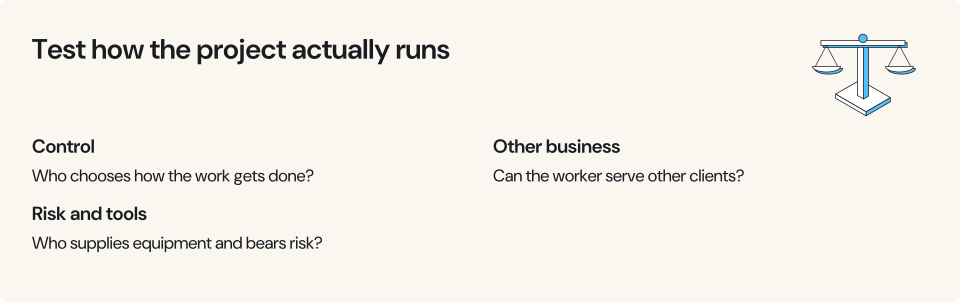
Look at how the work will actually run. Who sets the schedule, supplies equipment and bears the risk if the project costs more than expected? Can the person work for other clients? Local classification rules determine how much weight those facts carry. A fixed deliverable or an invoice tells you only part of the story.
Use our employee misclassification calculator to organise the facts of one engagement before choosing a payment or employment route.
If a country-specific assessment supports genuine independent-contractor status, consider a contractor agreement and a suitable payment process.
In June 2026, RemoFirst listed contractor payments at $25 per contractor per month, Oyster and RemotePeople at $29, and Deel at $49. Check current prices and inclusions.
The independence test is tightening in some markets. The Netherlands resumed normal enforcement of false self-employment from 1 January 2025. The tax authority can impose corrections and back assessments, normally no earlier than that date, with exceptions including malicious conduct and ignored directions. Culpability fines can apply from 2026, while default fines are not imposed in 2026. Check the authority's current guidance for the facts of the engagement. If you direct the person's daily work, read EOR vs contractor before choosing the cheaper option.
First establish whether the work qualifies as independent contracting. A provider may offer misclassification insurance, a contractor-of-record service or contractual protection. For a genuinely independent engagement, check which responsibilities it accepts and what its coverage, exclusions and indemnities mean for a claim. If the work requires employment, compare ways to employ the person under local rules.
3. Profile 2: you already have an entity in that country
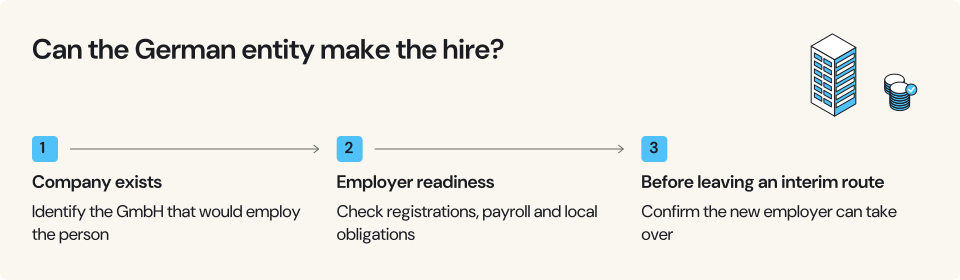
A German GmbH may be able to employ a Berlin hire directly. After incorporation, check whether the company has the registrations and payroll arrangements it needs to employ that particular person.
If your entity is registered and able to employ this person, compare payroll and HR support for employing them directly. Historical examples for Germany are €12–€25 per employee per month from payroll bureaus at 2025 market rates. The tax-adviser fee schedule (StBVV), as updated in July 2025, sets €6–€30 per employee per payroll period. In June 2026, RemotePeople listed Global Payroll from $25 per employee per month. Confirm current quotes, scope and applicable fee rules.
If employer registrations or other requirements are incomplete, check whether local rules allow an interim arrangement and agree the responsibilities, conditions and timing for any transition. Before you end the interim arrangement, confirm that registrations and other obligations are complete.
4. Profile 3: you need payroll, HR and benefits for US staff
Where your US company can employ its own staff, decide which work you want help with. You can buy payroll, HR or benefits support separately or consider a PEO if the business and team are eligible. Ask what the agreement leaves with your company as an employer.
Compare PEO services if your US company and employees are eligible. In September 2026, Justworks listed PEO Basic at $79 per employee per month and PEO Plus at $124, and RemotePeople listed its US PEO from $99. Get current proposals and check benefits availability, premiums, inclusions and other charges.
If the provider claims certified PEO status, check its IRS listing and what the certification covers. The PEO and EOR comparison explains how the employment and payroll responsibilities differ.
5. Profile 4: you need someone for a short project
Three months can still be employment. Before treating a short project as an independent contract, check the work itself and the rules where it will take place.
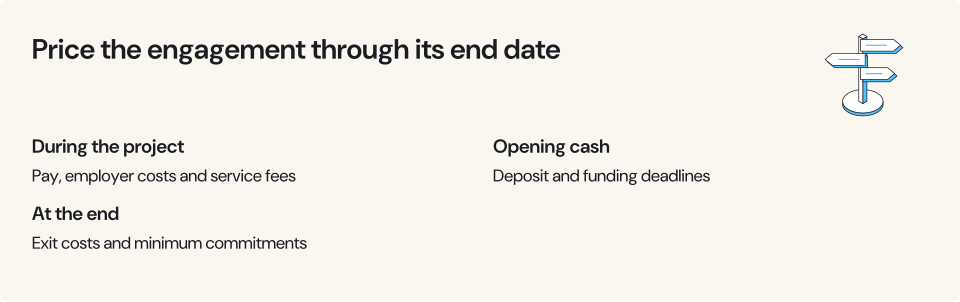
Ask the provider to price the whole engagement through its end date, including salary, employer costs, service charges, deposits, exit costs and any minimum commitment.
For a short project, assess these options:
If the project is a trial for an ongoing role, assess the relationship you expect from the start. If the facts change later, the contractor-to-employee guide covers the offer, first payroll and any obligations from the contractor period.
6. Profile 5: a Polish candidate asks for a B2B contract
A candidate operating a registered sole proprietorship (JDG) may ask to invoice you for services and handle their own applicable tax and social contributions. Assess the actual work under Polish classification rules and review the candidate’s own tax eligibility before comparing fees.
If a Polish candidate prefers to invoice, ask why, then review the working arrangements and the person’s tax eligibility. Their preference and business registration are relevant background. If you’re comparing EOR providers for a Polish hire, price the employment offer alongside the contractor invoice and spell out the contributions, benefits and duties each would cover.
Poland: review the actual work and current procedure. PIP’s guidance describes administrative procedures from 8 July 2026, including appeal and enforceability conditions. Obtain Polish advice on any earlier period, tax or ZUS exposure, available voluntary-correction relief and the applicable deadlines. Lump-sum tax eligibility depends on the services and statutory conditions, including relevant work for a current or former employer; it is not a guaranteed treatment for every developer.
Where the role needs employment, compare direct employment, an eligible EOR arrangement and other options the country allows.
7. Illustrative service fees for eligible routes
The table compares service fees. Only use the contractor or B2B rows if the actual relationship qualifies under local rules. To compare the budget for a hire, add taxes, benefits, employment costs and any transition work that the fee leaves out.
| Scenario to assess | Arrangement to assess | Illustrative fee | Illustrative EOR service fee | Service-fee difference |
|---|---|---|---|---|
Scenario to assess
Genuine contractor status supported by local assessment
|
Arrangement to assess
Contractor payment platform (RemoFirst, Oyster, RemotePeople, Deel)
|
Illustrative fee
$25–$49/contractor/mo
|
Illustrative EOR service fee
$7,188/yr
|
Service-fee difference
$6,600–$6,888/yr
|
Scenario to assess
Local entity registered and able to employ
|
Arrangement to assess
Direct employment with payroll support
|
Illustrative fee
€12–€25/employee/mo (German bureau example); $25/employee/mo global payroll example
|
Illustrative EOR service fee
$7,188/yr
|
Service-fee difference
$6,888/yr using the $25 monthly example
|
Scenario to assess
US employer and staff eligible for the PEO service
|
Arrangement to assess
PEO services (Justworks, RemotePeople US PEO); compare with other payroll and HR support
|
Illustrative fee
$79–$124/employee/mo
|
Illustrative EOR service fee
$7,188/yr
|
Service-fee difference
$5,700–$6,240/yr
|
Scenario to assess
Three-month project; genuine contractor status supported
|
Arrangement to assess
Contractor agreement and payment process only if the actual relationship meets local requirements
|
Illustrative fee
$75–$147 for three months at $25–$49/contractor/mo
|
Illustrative EOR service fee
$1,797 for three months; any deposit is separate cash required
|
Service-fee difference
$1,650–$1,722 over three months
|
Scenario to assess
Polish B2B arrangement supported by local classification assessment
|
Arrangement to assess
B2B contract and payment process only if properly classified; market custom does not create eligibility
|
Illustrative fee
$300–$588/yr
|
Illustrative EOR service fee
$7,188/yr
|
Service-fee difference
$6,600–$6,888/yr; excludes tax and contributions
|
Fig. 1 · The five buyer profiles priced against a $599 EOR · List rates as of June 2026 (PEO row: September 2026)
The gap is smaller with a cheaper EOR. At illustrative rates of $199 a month for an EOR and $29 for a contractor platform, the annual fee difference is $2,040 per person.
Compare one alternative on a complete cost basis
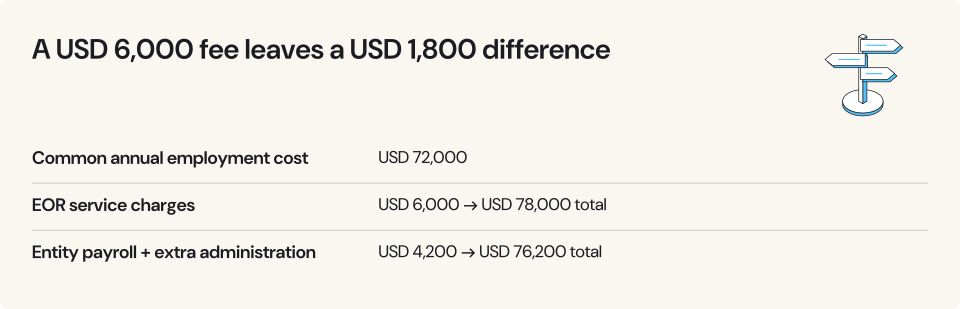
Suppose a role carries USD 60,000 in annual salary, USD 9,000 in employer costs and USD 3,000 in benefits under either route. An EOR fee of USD 6,000 brings the total to USD 78,000. Employing the person through your existing entity costs USD 76,200 if you spend USD 1,800 on payroll and USD 2,400 on additional administration. That leaves a difference of USD 1,800 in this example. Check employer readiness and add any registration, advice, insurance, setup or exit costs before using the figure.
8. Check which hiring arrangement fits
Work through the questions below in order, starting with the working relationship and the rules where the person will work.
- Q1. Have you assessed the worker’s status under the rules in the country where they will work?
- YES → Continue to Q2.
- NO OR UNSURE → Get a country-specific classification assessment before choosing a contractor or employment arrangement.
- Q2. Does that assessment support a genuine independent-contractor relationship?
- YES → A contractor agreement and a suitable payment process may fit. Document the assessment, and review it if the relationship changes.
- NO → Continue to Q3 to assess an employment arrangement.
- Q3. Does your company have a local entity that is registered and able to employ this person?
- YES → Assess direct employment through that entity, with payroll and HR support as needed. A PEO may also be an option for eligible US employers.
- NO → Continue to Q4.
- Q4. Have you confirmed that EOR employment is permitted and suitable for this role and country?
- YES → Compare providers for that country, including the legal employer, local restrictions, employment costs, service fees and exit terms.
- NO OR UNSURE → Confirm the available hiring options with qualified local advisers before work starts. You may need a different arrangement or your own employing entity.
The expensive mistake is calling someone a contractor (profile 1 or 5) while directing their work the way an employer does. Reclassification can lead to back contributions, back income tax and penalties, depending on the jurisdiction and facts. In the Netherlands, assess the actual enforcement period and conduct. The tax authority’s 2026 policy permits culpability penalties while retaining the stated concession for default penalties; it sets no fixed surcharge for every case. In Poland, inspectors can reclassify a contract as employment by administrative decision from July 2026. The country-by-country tests are in contractor misclassification.
9. Frequently asked questions
Is a contractor always cheaper than an EOR?
Contractor-platform fees can be lower, but they pay for a different service and do not show that the role qualifies as independent contracting. At illustrative fees of $25–$49 a month against $599 for an EOR, the annual fee difference is $6,600–$6,888. Assess the working relationship under local rules before comparing full costs and responsibilities, using the questions in EOR vs contractor.
Do I need an EOR in a country where I already have a legal entity?
You may not, if your local entity is registered, able to employ the person and able to meet the applicable obligations. Consider direct employment with payroll and HR support as needed. Incorporation alone does not confirm employer readiness, so check registrations, payroll, benefits and other local requirements. If you need an interim arrangement, confirm that it is legal and compliant for the role and agree a transition plan before the hire starts.
Can I hire Polish developers on B2B contracts instead of using an EOR?
Possibly, if the actual working relationship meets the applicable Polish rules. The prevalence of B2B in tech, the developer’s preference for invoicing, a business registration and a payment platform do not make someone a contractor. Assess the work arrangements and the person’s tax eligibility before comparing costs, and choose a locally permitted employment arrangement if the role requires it.
What does an EOR cost for a 3-month project?
At an illustrative $599 a month, three months of EOR fees total $1,797. Salary, employer costs, any deposit, setup or offboarding charges, and contractual notice or minimum commitments come on top. Request a proposal covering the full engagement and exit. Assess the working relationship under local rules first.
When do I need an EOR?
An EOR may be suitable when the role needs employment, your company has no local entity registered and able to employ the person, and EOR employment is permitted for that role and country. There is no universal three-month threshold, because a short engagement can still require employment and a longer engagement is not automatically employment. Before signing, confirm the local requirements and the provider’s responsibilities, and compare the locally permitted options on total cost, service and your plans for the market.
10. Sources
The sources behind this guide, grouped by topic. Dates show when we last checked a page. Prices and terms change, so confirm them in your quote.
Employment and tax law by country
12 sourcesUnited States · IRS
Independent contractor vs employee
Used in the hiring options comparison. Checked 3 Oct 2026
United States · IRS
United States · IRS
CPEO customers: what you need to know
Used in the hiring options comparison. Checked 3 Oct 2026
United Kingdom · GOV.UK
Used in the hiring options comparison. Checked 3 Oct 2026
Netherlands · Business.gov.nl
Wet DBA false self-employment enforcement from 1 January 2025.
Netherlands · Belastingdienst
Enforcement of employment relationships
Used in the hiring options comparison. Checked 3 Oct 2026
Germany · gesetze-im-internet.de
Tax-adviser fee schedule (StBVV)
Fees for payroll processing, July 2025 update.
International · OECD
Model Tax Convention, Article 15
The 183-day rule.
Poland · National Labour Inspectorate (PIP)
Current inspection and employment-relationship guidance
8 July 2026 powersContract-character interpretation
The guidance on the 8 July 2026 powers and the contract-character interpretation were cross-checked 15 Oct 2026.
Poland · National Labour Inspectorate (PIP)
Used in the hiring options comparison. Checked 3 Oct 2026
Poland · Biznes.gov.pl
Poland · Social Insurance Institution (ZUS)
Polish market data and legal commentary
3 sourcesPoland · EY
Taxówka bulletin of 8 July 2026
The PIP’s expanded powers in force from 8 July 2026. Checked Sep 2026
Poland · Wozniak Legal
Secondary commentary. Verify current procedure and appeal conditions against primary guidance.
Poland · No Fluff Jobs
Contract-type data 2024 to 2025.
Provider pricing
8 sourcesBorderless AI
$579 per employee per month.
Deel
$599 per employee per month for EOR and $49 for contractor management.
Justworks
PEO Basic $79 and Plus $124 per employee per month. Checked Sep 2026
Multiplier
Core $459 annually or $499 monthly. Checked 26 Sep 2026
Oyster
$699 monthly, a $29 contractor tier with a 30-day trial, a deposit requirement and Oyster Shell aggregate protection up to $500,000. The invoicing process includes the deposit invoice (checked Sep 2026).
Pebl
Formerly Velocity Global. $399 per employee per month.
RemoFirst
EOR from $199 per employee per month. Contractor payments at $25 per contractor per month in June 2026, with free contracts, identity checks and expenses.
RemotePeople
EOR Global from $499 per employee per month; EOR Select from $199 in selected countries and qualifying salary ranges (checked 16 Oct 2026; confirm quote currency and terms). Earlier comparison prices: contractor payments from $29, Contractor of Record from $199, Global Payroll from $25, US PEO from $99.
Our research
1 sourceThe Best EOR
If you spot a changed price or a conflicting source, send it through the contact page and we’ll review it.
This guide is for general information only and does not provide legal, tax, accounting, or financial advice. For advice about your business, consult a qualified professional familiar with the rules where you hire. Read our research methodology to learn how we assess sources.