


Guide overview
How do you convert a contractor to employment?
Review status, agree the offer and confirm when the person can legally start as an employee.
Assess the actual relationship and any required correction of past treatment. Compare the person’s net pay, total rewards and employer cost, then complete the employment contract, work-permission, payroll and benefit checks. The Dutch salary calculation and 90-day sequence are illustrative; actual dates follow the local process and readiness.
Worker status
Review the relationship
Assess current practices and any correction of past treatment.
Compensation
Compare total rewards
Build a country-specific offer with net-pay and employer-cost estimates.
Employment route
Confirm the employer
Confirm which employment arrangement local law permits and which documents it requires.
Start plan
Set actual dates
Work around local procedures, work permission and payroll readiness.
Check before acting
Complete the local status review and compensation proposal before making the conversion offer.
What to record in the worksheet
Scope
Task · Worker and country · Current position
Evidence and follow-up
Proposed arrangement · Evidence / advice date · Owner · Action / deadline · Acceptance status
Six inputs to approve before making the conversion offer
Start with the person’s annual invoices and the costs they pay out of that income. Get a dated payroll calculation for the proposed salary. Showing both on an annual basis leaves room to explain paid leave, pension and insurance alongside take-home pay.
| Input | Evidence needed | Decision it supports |
|---|---|---|
Input
Status and history
|
Evidence needed
Actual working practices and local advice on current and past treatment.
|
Decision it supports
What must change now and which liabilities need separate handling.
|
Input
Contractor baseline
|
Evidence needed
Annual invoices, business expenses and the worker's chosen benefit costs.
|
Decision it supports
A transparent starting point without treating invoiced revenue as take-home pay.
|
Input
Employee compensation
|
Evidence needed
Gross-to-net simulation with tax assumptions, benefits and leave.
|
Decision it supports
A realistic offer and explanation of any net-pay difference.
|
Input
Employer budget
|
Evidence needed
Salary, employer charges, benefits, fees, FX and one-time costs.
|
Decision it supports
Full cost approval rather than a service-fee comparison.
|
Input
Rights and onboarding
|
Evidence needed
Required service treatment, contracts, work authorization and enrollment dates.
|
Decision it supports
Whether the proposed start date is achievable.
|
Input
Checks before the employment change
|
Evidence needed
Final invoice period, first salary period and historical remediation plan.
|
Decision it supports
No double payment, pay gap or assumption that the past is erased.
|
Matching estimated take-home pay gives you one salary to discuss. Compare it with market pay, local pay requirements and the benefits in the offer. If you’re considering the US Voluntary Classification Settlement Program, check eligibility and its application timetable before setting the conversion dates.
Apply the relevant classification tests and review the history.
Price and agree the employment terms.
Separately assess any past tax, contribution or employment issues.
Prepare the documents and enrolments, then confirm when employment can legally start.
Check pay and deductions against the agreed terms.
The employment contract sets the terms from the start of employment. Ask separately whether your company owes taxes, contributions or employee entitlements for any part of the contractor period.
When to review contractor-to-employee conversion
Review the person’s actual working relationship under local employment, tax and social-security tests. If employment treatment is required, agree how to employ the person under local law going forward and handle earlier periods separately. Approve the compensation package and payroll readiness before fixing a start date; a conversion plan does not create a legal grace period.
The employee misclassification calculator can help record current working practices and missing evidence for that review.
Trigger 1: the relationship fails the test. The EOR vs contractor guide uses five common questions as an initial screen: control, integration, substitution, business risk and permanence. Prioritize a prompt local review when someone works mainly for you, follows your direction and is integrated into your core work. Twelve months is not a universal threshold for employment status. Assess the relationship from its actual start under the tests covered by the country-by-country misclassification guide.
Trigger 2: a relevant enforcement or legal change. Check the exact rule and effective date for the person’s relationship. The Dutch authority resumed enforcement against false self-employment in 2025; its published 2026 policy distinguishes culpability penalties from default penalties, with separate conditions for back-assessments. Poland’s PIP reform, principally effective July 8, 2026, changes the inspection and employment-status decision procedure. Individual facts, decision effects and appeal rules matter; no blanket rule turns every B2B contract into employment. For Spain, Germany and other countries, review the current local test and the actual audit or dispute scope. Use the misclassification guide for the jurisdiction-specific questions.
Trigger 3: an event will expose the history. Acquisition or funding diligence, a planned exit, or opening an entity can prompt a contractor-classification review. Review the relevant engagements, prior liabilities and legal options for ending the engagement before making a conversion or termination plan.
Trigger 4: the contractor asks. Common reasons are mortgage applications, parental leave and pension worries. Confirm what the person wants, then compare the employment package, provider costs and any earlier liabilities before agreeing the change.
- Q1. Does the contractor match the red-flag profile: 12+ months, effectively full time, one client, your direction, core-business work?
- YES → Obtain a local status assessment promptly, then agree on employment or corrective steps that meet local requirements and review the history.
- NO → continue to Q2
- Q2. Do they fail one or two of the five questions (no end date, no other clients, you set their hours)?
- YES → Review the local test and actual practices promptly. Changing the documents does not make the worker independent.
- NO → Record the assessment under the applicable local tests and review again when the facts change.
Compare the contractor rate with salary and total rewards
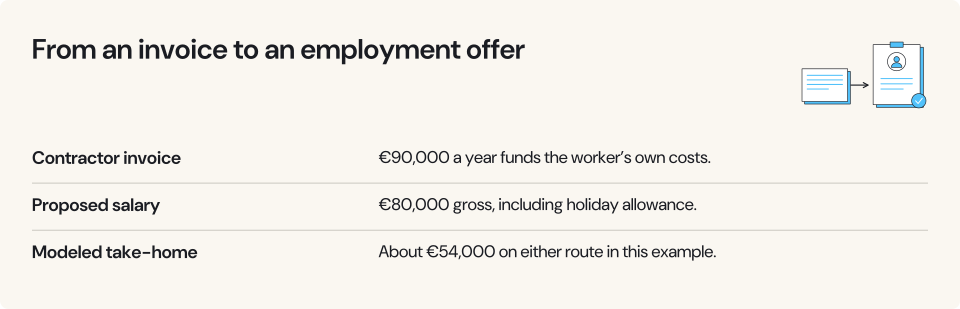
The contractor’s invoice covered taxes, pension, insurance and the time they took off without pay. Before proposing the same figure as a gross salary, show what the person would receive through payroll and which costs they would still have to cover themselves.
The method has four steps:
This example reverses the senior Dutch developer case from the EOR vs contractor cost table, using hypothetical rounded assumptions for a single filer without the 30% ruling. The 22% employer rate is a historical planning assumption (see the cost-estimate guide ). The model assumes an illustrative rate of USD 1 = EUR 0.89, set on 15 October 2026. Annual EOR fees are rounded to the nearest EUR 100, and the USD 49 monthly contractor fee is shown as about EUR 525 per year. Totals use the displayed rounded inputs.
| Line item | Before: contractor | After: EOR employee |
|---|---|---|
Line item
Annual invoice or gross salary
|
Before: contractor
€90,000 invoiced (about €64/hour, 1,400 billable hours)
|
After: EOR employee
€80,000 gross (includes the 8% holiday allowance)
|
Line item
Their take-home
|
Before: contractor
~€54,000, after ~€24,000 tax and Zvw, €8,000 pension, €2,500 disability cover, €1,500 equipment
|
After: EOR employee
~€54,000
|
Line item
Employer contributions
|
Before: contractor
None
|
After: EOR employee
€17,600 (22%)
|
Line item
Platform / EOR fee
|
Before: contractor
~€525/year contractor management
|
After: EOR employee
~€6,400/year at the assumed USD 599/employee/month fee (Deel); ~€2,100 at a hypothetical USD 199/employee/month fee. The lower input is not a country quote; confirm actual eligibility and pricing.
|
Line item
Your total cost
|
Before: contractor
~€90,500
|
After: EOR employee
~€104,000 at $599 · ~€99,700 at $199
|
Line item
Reclassification exposure
|
Before: contractor
Prior-period classification exposure depends on actual status, dates and applicable local rules
|
After: EOR employee
Prospective employment; prior classification liabilities still need review
|
Fig. 1 · Contractor invoice vs EOR employee, six cost lines for a senior Dutch developer · illustrative assumptions
For the same Dutch developer, the offer looks different depending on which figure you try to match.
In some markets the parity gap narrows each year. The Dutch self-employed deduction fell from €2,470 in 2025 to €1,200 in 2026 and is due to drop to €900 in 2027, which shrinks the contractor’s tax advantage and moves the parity gross closer to the invoice. Do not apply a single employer percentage to every hire in France, Brazil or another country. Use the actual salary, contribution bases and caps, worker coverage, employer profile, benefits and service terms; separate employer charges from the provider fee. Price the individual offer with the global payroll calculator before you promise anyone a number.
Compare the individual’s annual package
Use the workbook to put the contractor’s invoices and business costs beside the estimated employee payslip. Replace the sample tax and payroll figures with dated calculations for this person. Then discuss how regular pay, leave and benefits would change the package, and check the resulting employer cost.
| The working record | Fields to complete |
|---|---|
The working record
Scope
|
Fields to complete
Task · Worker and country · Current position
|
The working record
Evidence and follow-up
|
Fields to complete
Proposed arrangement · Evidence / advice date · Owner · Action / deadline · Acceptance status
|
Explain the proposed employment package
Give the worker the written offer and the pay comparison so they can see where the figures come from. Agree time for them to review it, allowing for any process local rules require. The EOR’s payroll team can explain its calculation. Give the worker room to seek independent advice on their personal tax position.
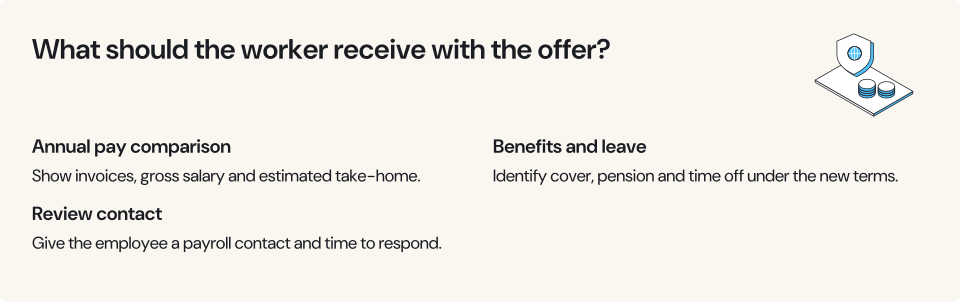
If the worker asks why €80,000 is less than the €90,000 they invoiced, show both take-home estimates. They’re equal in this illustration. Talk through who pays for leave, sick pay, pension and severance, including any contributions the employee would pay. A request for €90,000 gross is a salary negotiation. Bring market pay and the worker’s priorities into that discussion.
Tell the person which duties, manager, tools and team arrangements will carry over. Their status during the contractor period still depends on the facts and the applicable local tests.
Keep a written offer and question record
Write down the employer’s name, hours and duties, salary currency, pay dates and estimated deductions. Include the start date, contract steps, leave and when each benefit begins and what it costs. Mark estimates as estimates. Give the worker a named contact for questions about expenses, flexibility or prior service, and respond in writing before asking them to decide.
Prior service and historical classification liabilities
Neither tenure nor back-liability has a single global answer; France and Brazil are two examples.
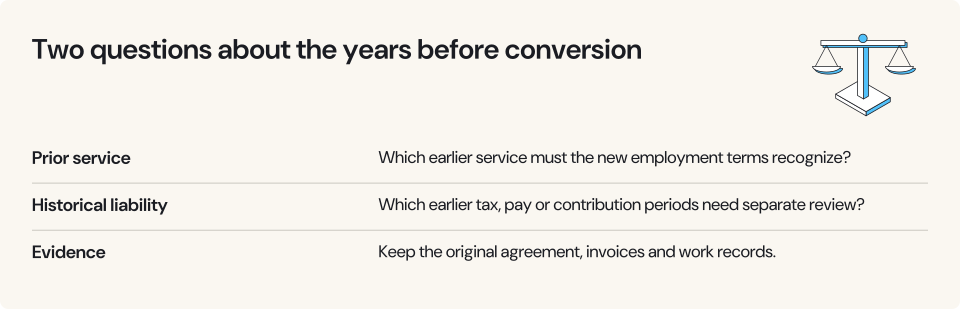
France: prior seniority carries over. When a French court requalifies a contractor relationship as employment, seniority runs from the first day of the relationship, and notice and statutory severance scale with it. A converted four-year contractor may therefore carry four years of tenure whether or not your contract mentions it. In its April 29, 2025 decision, the Cour de cassation rejected the trial period where the prior self-employed work had already allowed the employer to assess the person’s skills. Check how that reasoning applies to the actual prior work and proposed terms.
Brazil: employment is recognized from day one. When a labor court recognizes employment during a PJ engagement, the recognized period and applicable rights follow the facts and decision. Potential items include 13th-month salary, vacation plus the constitutional one-third premium, FGTS and employer contributions. A dismissal-related FGTS penalty depends on the actual termination route. Have counsel distinguish the applicable employment-claim periods from tax and contribution rules rather than apply one five-year/two-year summary to every liability. Check the current Supreme Court Theme 1389 docket and its procedural effects with Brazilian counsel; the linked commentary dates from September 2026.
Questions to resolve locally:
Record signature and effective dates accurately. Budget two to four hours of local counsel time per country for the conversion agreement.
An illustrative 30–60–90-day conversion plan
The 30-, 60- and 90-day stages are planning examples. Allow longer for permits, payroll setup or a settlement process. If you seek relief under the US Voluntary Classification Settlement Program, the IRS says to apply at least 120 days before the proposed change. Price the package before making the offer, and have the employment documents signed before you switch payroll.
Days 1–30: decide and price
Days 31–60: offer and sign
Days 61–90: cut over and close
Check the dependencies in week one. Confirm existing right to work, whether the proposed employer can sponsor the required permit, and the case-specific timetable. Agree compensation using the individual payroll calculation and confirm benefit enrollment dates.
Review future employment and past arrangements separately
The future-employment stream covers the offer, employer readiness, contract, payroll, benefits and start. The historical stream preserves working-practice evidence and follows local advice on status, tax, contributions, tenure and any correction. Track dependencies between them.
Compare EOR conversion processes and provider fees
If a contractor already uses a provider’s contractor-management product, some records may be reusable. Employment still needs a status review, local contract, work-authorisation checks, payroll and benefits setup and any further information the EOR requires. Ask for a country- and person-specific readiness schedule; a contract-drafting estimate is only one stage. For help choosing a provider for the conversion, use our EOR matching service.
Deel publishes contractor management from US$ 49 per contractor per month and EOR from US$ 599 per employee per month. Its public pricing FAQ offers month-to-month terms without a required long-term commitment; confirm the actual country quote and selected services. An existing account may reduce vendor-onboarding work.
RemotePeople lists contractor management from US$ 29 per contractor per month, Contractor of Record from US$ 199 per contractor per month and, on the current EOR cards, Global from $499 and Select from $199 per employee/month. Select requires a selected country and qualifying employee salary range. CoR is only an option for a relationship that meets the applicable legal tests for independent contracting; confirm actual indemnity scope, limits and exclusions. Confirm the currency, rate, Global or Select commitment, headcount, deposit and extra charges in the country quote. Pricing cards checked 16 October 2026.
If the contractor is paid by bank transfer or through a marketplace, collect the existing records and identify the remaining EOR information requirements. Multiplier’s published EOR Core starts at US$ 459 per employee per month on an annual contract or US$ 499 on a monthly contract. Confirm its current contractor-management charges and compare equivalent scope.
At ten conversions, the gap between a $599 and a $199 EOR fee is $48,000 a year. Contractor-of-record indemnities carry liability caps, so read them before you rely on one. Check the quote against the add-ons in the hidden-fees guide.
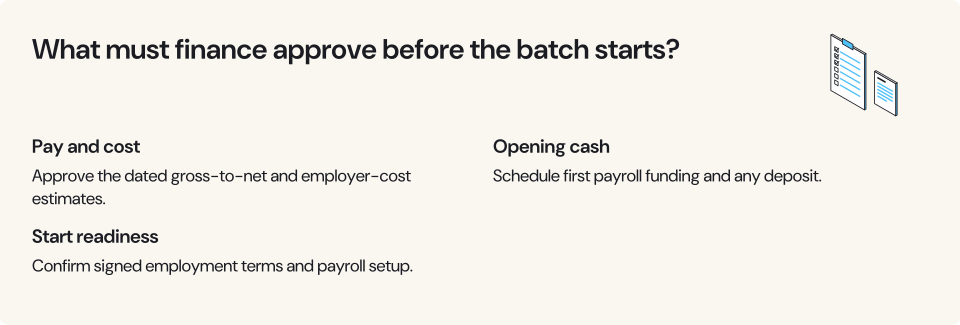
The finance signoff checklist
Have finance sign every line before the batch starts.
Contractor-to-employee conversion FAQs
Will the contractor take home less money as an employee?
A person-specific payroll simulation can estimate the effect, but it depends on tax status, deductions, benefits and the agreed salary. The Dutch figures above are hypothetical. Compare annual net pay and total rewards with the worker before promising parity.
Is converting an admission that the old arrangement was illegal?
Changing to employment leaves the legal status of the earlier contractor relationship to be assessed. Assess the historical facts and any correction, disclosure or settlement duties with local advisers, and document them accurately. US VCSP relief has specific eligibility conditions and covers federal employment taxes; it does not automatically settle wage, benefit or state-law claims.
Does time served as a contractor count toward notice and severance?
Potentially. Reclassification, statutory continuity rules and the legal transfer route may require earlier service to count, and the effect differs by country and entitlement. Contractual credit can add protection but cannot replace mandatory rights. Ask local advisers to assess the historical relationship and specify the service date used for notice, leave, severance and other rights.
What if the contractor refuses to convert?
A worker’s preference alone does not determine classification. If they decline employment, obtain advice on an independent arrangement that fits the local test or how to end the engagement in line with local law. Do not use an unchanged contractor arrangement where employment treatment is required; review any historical liabilities separately.
Can we convert a contractor who lacks work authorization where they live?
Sources and policy check dates
The sources behind this guide, grouped by topic. Dates show when we last checked a page. Prices and terms change, so confirm them in your quote.
Classification law and enforcement
10 sourcesUnited States · IRS
Voluntary Classification Settlement Program (VCSP)
Terms and eligibility. The FAQ is used in the contractor conversion example, checked 3 Oct 2026.
United States · IRS
Independent contractor (self-employed) or employee?
Used in the contractor conversion example. Checked 3 Oct 2026
France · Légifrance
Cour de cassation, chambre sociale, April 29, 2025, n° 23-22.389
Full text of the trial-period ruling.
Brazil · Supreme Federal Court (STF)
Pejotização case status.
Netherlands · Business.gov.nl
Wet DBA enforcement from 2025.
Germany · Deutsche Rentenversicherung
The formal status-determination route; confirm the actual process and timing.
Germany · Deutsche Rentenversicherung
The four-year Betriebsprüfung cycle under §28p SGB IV.
Poland · eli.gov.pl
Published April 7, 2026, with principal commencement July 8, 2026 and specified earlier provisions. Checked 15 Oct 2026
Poland · National Labour Inspectorate (PIP)
Individual employment-status procedure
Decision effects and appeal distinctions. Checked 15 Oct 2026
Australia · Fair Work Ombudsman
The sham-contracting reasonable-belief defence and penalties.
Employment costs, benefits and visas
9 sourcesFrance · Service-Public.fr
France · URSSAF
A landing page; it does not support a universal French employer percentage.
Brazil · Planalto
Federal Constitution, article 7
13th-month salary, vacation plus one third, FGTS, and the five-year and two-year claim limits.
Brazil · Receita Federal
A landing page; it does not support a universal Brazilian employer percentage.
Netherlands · Business.gov.nl
Continued payment during illness
Dutch employers pay at least 70% of wages for up to 104 weeks. The guidance explains the payment period, amount and contract-specific conditions. Checked 15 Oct 2026
Netherlands · Business.gov.nl
Mandatory pension arrangements
Distinguishes state, compulsory supplementary and voluntary pension arrangements. Checked 15 Oct 2026
Netherlands · Business.gov.nl
Paying holiday allowance to your staff
The statutory 8% Dutch holiday allowance.
Netherlands · Ondernemersplein
Reduced to €1,200 in 2026.
Germany · Make it in Germany (Federal Government portal)
EU Blue Card and German work-visa requirements
For non-EU hires.
Legal commentary and news
7 sourcesFrance · L&E Global
No trial period after prior self-employed work for the same company
Commentary on the Cour de cassation ruling of April 29, 2025.
Netherlands · PwC Netherlands
Enforcement against false self-employment from 2026
Fines in 2026 only for intent or gross negligence; corrections in principle back to January 1, 2025.
Poland · TGC Corporate Lawyers
New powers of the National Labour Inspectorate from July 2026
Commentary; check scope against the primary act and the inspectorate’s explanation.
Poland · EY Poland
Dated reform commentary; individual facts, decision effects and appeals need the primary rules.
Spain · Reuters
Glovo CEO appears in court over alleged workers’ rights violations
Barcelona, January 2025.
Spain · Crónica Global
Dated September 22, 2026. Historical news background, not an employment-status test.
Brazil · Contábeis
Dated September 16, 2026. Historical background; consult the official docket for current status.
Provider conversion processes and pricing
3 sourcesDeel
Contractor transition guidePricingImmigration services
EOR USD 599 per employee per month and contractor management USD 49 per contractor per month; the FAQ offers month-to-month without a required long-term commitment (pricing checked 15 Oct 2026). For immigration services, confirm country availability, fees and the actual work-permission route.
Multiplier
EOR Core from $459 per employee per month on annual contracts and $499 on monthly contracts. Checked Sep 2026
RemotePeople
Global from $499 per employee per month; Select from $199 in selected countries and qualifying employee salary ranges (checked 16 Oct 2026). Confirm quote currency, rate, commitment and deposit terms. Contractor management from US$ 29 and Contractor of Record from US$ 199 come from earlier comparison checks.
Our research
1 sourceThe Best EOR
How we rate EOR providers.
If you spot a changed price or a conflicting source, send it through the contact page and we’ll review it.
This guide is for general information only and does not provide legal, tax, accounting, or financial advice. For advice about your business, consult a qualified professional familiar with the rules where you hire. Read our research methodology to learn how we assess sources.