



Guide overview

EOR contract terms, at a glance.

Test the agreement against your countries and actual exposure.

The client–EOR service agreement, order form and country schedules should explain responsibilities, reimbursement, remedies and the cost of leaving. Read them alongside the employee’s local employment agreement without conflating the documents. Review the nine clauses against actual exposure; the numeric targets are negotiating positions. Confirm recoverability, caps, IP/data duties, notice, deposits and transition assistance in the controlling documents.

Liability

Read caps and exclusions

Compare the proposed allocation of risk with exposure and insurance.

Employee work

Trace the IP rights

Confirm the transfer route in the controlling documents.

Data

Confirm the roles

Review data responsibilities and the required terms.

Leaving

Agree the handover

Check notice, deposits, fees and transition assistance.

Check before acting

The example positions are negotiation starting points. Confirm the terms in the controlling documents before committing.

What to record in the worksheet

Scope

Clause / issue · Original wording / reference · Requested change

Evidence and follow-up

Supplier response · Cost / operational consequence · Owner · Accepted wording · Controlling document / status

Start with the client service agreement, order form and country schedule. Read them alongside the local employment contract. Those documents tell you who owes each duty, which employment costs your company must reimburse and what you could recover if the provider fails. Use the matrix to put a specific request to the provider, then have counsel check the agreed wording for the employee and jurisdiction.

1. Liability cap

What it does. The liability cap sets the most you can recover from the EOR if it fails you. Read the actual definition of covered loss, fee base, lookback period, aggregate limit and exclusions. An agreement may limit direct losses or exclude consequential loss.
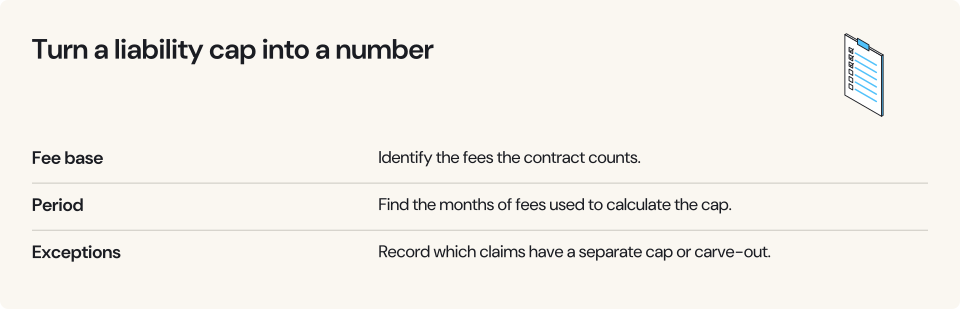
A liability cap has a defined base, period and exceptions. The resulting amount must be compared with the loss scenario.
Price the cap against a failure your payroll team could actually face before asking for a change.

Example position. One opening position is a cap based on fees paid in the preceding 12 months. Choose the amount after estimating exposure and reviewing exclusions. A hypothetical 10-seat team at USD 599 per employee per month pays USD 71,880 a year. That would be the cap if the agreement uses the preceding 12 months of those fees as its basis. Actual recovery also depends on covered losses, exclusions, aggregation and carve-outs. A single wrongful-termination award in France or a back-contributions order in Brazil can exceed that. Estimate your figure with the EOR cost calculator.

Push for a 12-month cap with carve-outs, so that indemnification obligations, breach of confidentiality, data breaches, gross negligence and willful misconduct sit outside it. For data-protection claims, a separate super-cap of two to three times fees is an example to assess against the potential loss.

Watch for a cap of 3–6 months of fees, an unclear fee base, per-claim limit or aggregate maximum, or a cap with no carve-outs. Without carve-outs, the section 2 indemnities fall under a cap that can be smaller than a single employee’s severance.

The negotiation table

Adapt the requested terms and escalation points to your exposure, bargaining position and the available providers.

Clause Example position Push for Escalate or review if
Clause
Liability cap
Example position
Direct damages, capped at 12 months of fees
Push for
Carve-outs for indemnities, data breach, gross negligence; 2–3x super-cap for data claims
Escalate or review if
Cap under 6 months of fees, or no carve-outs
Clause
Indemnification
Example position
Mutual; EOR covers employer-side compliance claims
Push for
Defense costs, fines and back contributions included; indemnity sits outside the cap
Escalate or review if
One-way indemnity in the vendor's favor
Clause
Termination notice
Example position
30–60 days’ written notice (Oyster publishes 30; check your own agreement)
Push for
30 days any reason; immediate for cause; no anniversary lock
Escalate or review if
90+ days, or exit only at renewal
Clause
IP transfer
Example position
Documented transfer route for each country and IP right
Push for
Warranty covering every local employment contract, plus further assurances
Escalate or review if
“Agrees to assign,” or no employment-contract warranty
Clause
Data processing
Example position
Role-specific data terms, transfer basis and prompt incident notice
Push for
Prompt notice without undue delay, agreed hosting and retention and deletion rules that meet local requirements
Escalate or review if
DPA “on request,” or no agreed breach-notification process
Clause
Sub-processor
Example position
Published list, 30 days’ notice, objection right
Push for
Named employing entity per country in the order form
Escalate or review if
Changes posted to a webpage you must poll
Clause
Audit
Example position
Appropriate security assurance plus separate employment and remittance evidence
Push for
Report in 30 days, bridge letters, proof of statutory remittances per country
Escalate or review if
No contractual right to any report
Clause
Exit assistance
Example position
No exit fee (Oyster’s published terms); records and continuity letters
Push for
Specified deliverables, a 30-day completion deadline and a cap on transition costs
Escalate or review if
Uncapped deductions, or an exit fee that first appears on the final invoice
Clause
Fees on renewal
Example position
Uplift at renewal; Oyster caps annual-seat renewals at 5% but can change fees on 30 days’ notice
Push for
CPI or 5% cap, 60-day renewal notice, right to drop to monthly
Escalate or review if
Silent auto-renew at “then-current list price”

Fig. 1 · Nine EOR contract clauses: example positions, requested protections and escalation points

Read the base and period inside the liability cap

Suppose a draft says, “Liability is limited to fees paid in the preceding three months.” Which fees count, and does that definition exclude payroll funding? Ask when the three months are measured and whether the cap applies to each claim or to all claims together. Check the exclusions and which document takes precedence with counsel.

2. Indemnification

What it does. The indemnity (“defend, indemnify, and hold harmless”) decides who defends and pays when a third party, such as an employee, a tax office or a labor court, brings a claim. It is why you use an EOR, but paying an EOR fee does not transfer every employment liability, so the contract should specify which claims and costs each party bears.
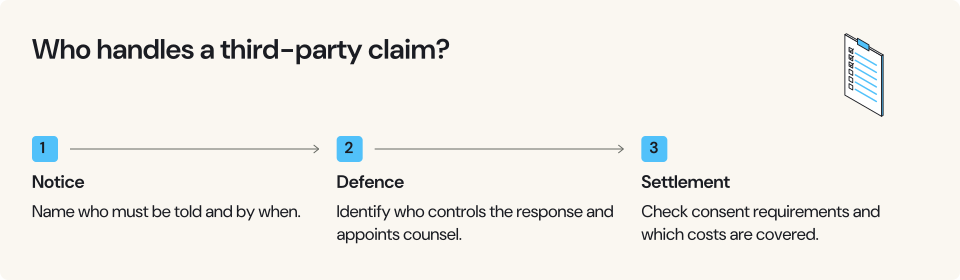
A usable indemnity assigns notice, defence, settlement authority and covered losses for the specified claim.
Read the indemnity beside the liability cap to establish how much protection the agreement actually provides.

Example position. Indemnities run in both directions. The EOR covers claims arising from its role as legal employer: payroll errors, missed statutory contributions and misclassification built into its own model. You cover claims arising from your own conduct: dismissal instructions you gave, IP claims against your product and discrimination or harassment by your managers. Vendors also price contractor misclassification protection separately. Oyster Shell is an optional USD 49 per contractor per month add-on to its standard USD 29 monthly contractor product fee. Its published overview describes reimbursement of certain claims or losses up to USD 50,000 per claim and USD 500,000 in aggregate per customer, subject to eligibility, terms and exclusions.

Push for an indemnity addressing defense costs and the actual employment exposures outside the general cap or under an agreed higher cap. Any transfer of fines or penalties, insurance response or recovery requires jurisdiction-specific review of enforceability, fault, causation, exclusions and the final wording.

Watch for a one-way indemnity that protects only the vendor, or an EOR indemnity inside the 12-month fee cap. A third-party employment claim can exceed that cap, and the drafting decides whether you pay the difference.

3. Termination notice

What it does. This clause sets how long you keep paying after you decide to leave. It is separate from the employee’s notice entitlement, which depends on local law, the contract and any collective agreement; the master services agreement (MSA) does not remove mandatory employee rights.

Example position. For illustration, compare the cost of 30 and 60 days’ written notice with your transition needs. Oyster publishes one example: its standard terms give either party 30 days’ written notice. For Pebl EOR worker offboarding, the October 2026 terms require at least 90 days’ written notice, starting on the first day of the calendar month after Pebl receives it. Service fees continue during that period. Separate Order Form termination terms depend on the service model and remain subject to the worker-offboarding obligations. Check the applicable Order Form and country employment requirements before setting a final date.

Negotiate clauses before you sign

Push for 30 days’ notice for convenience, immediate termination for cause (insolvency, material breach, missed payroll) and no requirement to time notice to a renewal anniversary. If you take an annual-seat discount, ask for pro-rata refunds. Oyster’s annual seats are non-refundable mid-term, so keep markets with unpredictable headcount on monthly terms.

Watch for notice of 90 days or more, or termination allowed only at the renewal date. With the second, if you decide to leave in month one of a 12-month term, you pay until the term ends.

4. IP transfer

What it does. Because the local employer may acquire rights under law or contract, check the full transfer route for each type of IP. The route may involve statutory vesting, an invention-claiming procedure, a permitted direct assignment or onward assignments through the EOR and any partner. If either link is missing, the EOR can be the first owner of code your company paid for. Freshfields has flagged this gap in its analysis of EOR arrangements, and acquirers test the chain in due diligence.

Example position. Use locally effective assignment language and complete any statutory procedures; obtain moral-rights consents or waivers only where local law allows them. National law complicates the chain. Under Germany’s Employee Inventions Act, invention rights pass to the employer through a claiming procedure (an invention is deemed claimed four months after the employee reports it), and in an EOR arrangement that employer is the EOR.

Push for a warranty that the EOR’s employment contract in each of your countries contains assignment and invention clauses. Also ask for the right to review that template and for a further-assurances clause obliging the EOR to sign confirmation documents during a financing or sale. The 12-jurisdiction IP guide covers the per-country statutes.

Watch for “agrees to assign” (which only promises a future transfer), IP language in the MSA with no warranty about the underlying employment contracts, and IP-perfection assistance billed at unquoted hourly rates.

5. Data processing

What it does. The data processing agreement (DPA) governs your employees’ personal data: salaries, bank details, health and tax records. GDPR Article 28 requires a written DPA whenever a processor handles personal data on your behalf. It must cover instructions, confidentiality, security measures, breach notification and the deletion or return of data at the end of the engagement.

Review the roles first. Use Article 28 terms for processing on your behalf and appropriate arrangements for independent or joint controllers. Assess each restricted transfer; SCCs are one possible mechanism, and UK transfers require a UK-compatible basis where relevant. Agree prompt incident communications without diluting the processor’s duty to notify its controller without undue delay. Verify any hosting or assurance commitments against the service and entities in your agreement.

Push for notice without undue delay, with an agreed outer deadline that does not postpone any earlier duty; for example, a 24–48-hour contractual maximum, a named hosting region and a fixed deletion-and-return window at exit. Document retention requirements and the return or deletion process by data category. Do not assume every employment record must be transferred to the client or deleted immediately.

Watch for a DPA that is “available on request” instead of signed with the contract, breach notice “as required by applicable law” with no hour count, and silence on what happens to data when you leave.

6. Sub-processors and local partners

What it does. The sub-processor list identifies companies a processor engages to process personal data on its behalf. Separately identify any local partner firm that employs your hire and assess its role for each activity; being the employer does not automatically make it a sub-processor. Record who handles onboarding, payroll accuracy and support in the service agreement.

Example position. Request a current sub-processor list, the applicable authorization process and advance notice that gives a practical opportunity to object. Check the applicable SCC set, module and authorization option. Under the controller-processor clauses’ general-authorization option, objection prevents engagement of the new sub-processor; other roles and terms need their own analysis. Deel says it owns entities in 130+ countries, while Oyster does not publish its split between owned and partner entities.

Push for the order form to name the employing entity in each of your countries before you sign. Also ask for 30 days’ notice of changes and an objection right that lets you exit that country’s services without penalty if the objection cannot be resolved. The RFP checklist puts this question to every vendor.

Watch for blanket pre-authorization with changes “posted to our website,” which leaves you checking a webpage, and for any vendor that refuses to name the in-country employer before you sign.

7. Audit rights

What it does. The audit clause gives you the right to check that the EOR does what it claims: that contributions reach the tax office, that security controls exist and that the partner entity in the Philippines is solvent and licensed.

Example position. Request suitable information-security assurance and proportionate audit rights. Review the report or certificate’s entity, scope, period and exceptions. Separately require relevant employment licences, partner responsibility and payroll-remittance evidence, which SOC 2 or ISO 27001 does not cover.

Push for a contractual right to the reports within 30 days of a request, bridge letters for gaps between report periods and audit rights that reach the partner arrangements in your countries. Also ask for per-country filing confirmations, on request, proving that statutory contributions were paid. They catch the failure that hurts employees most: an EOR that collects your invoice but never remits the contributions.

Watch for certifications named in marketing with no contractual right to read the report behind them, and for an audit right that applies only “where required by a regulator.”

8. Exit assistance

What it does. The exit clause (“Upon termination, Provider shall…”) sets out what the EOR owes you when you leave: records handed over, continuity letters issued and cooperation with the successor employer so your employees keep unbroken service history.
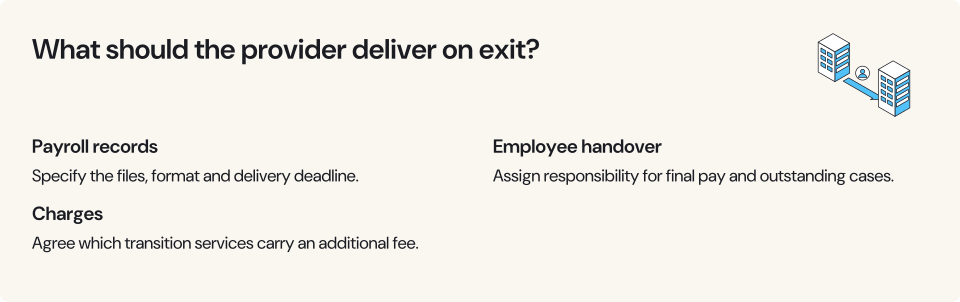
Exit assistance needs named records, delivery dates, accountable owners and known service charges.
Put the deliverables in the contract while the provider still has an obligation to supply them.

Example position. Under its published standard terms, Oyster charges no exit fee and returns the deposit, about one month of the hire’s gross salary plus employer costs and fees, within 60 days after all amounts are received or confirmed paid, whichever is later, subject to the applicable documents, offsets and settlement conditions. Those terms do not cap the “transition costs” it can deduct from the deposit. Pebl states on its pricing page that it charges no setup or offboarding service fees (checked 24 September 2026). Confirm notice, severance and other employment liabilities, and any other contractual exit terms, separately. Ask for any continuity-administration charge in the written quote.

Push for a zero exit fee in writing, a list of deliverables (payroll history, employment contracts, leave balances, tax filings) with a 30-day delivery deadline, and continuity letters for every employee. Use the order form to cap any transition costs deducted from your deposit.

Watch for exit assistance “at our then-current professional services rates” with no rate card, undefined deliverables and uncapped deductions from your deposit. The 90-day switching guide covers the full transition process. For help coordinating the move, see our paid EOR switching service.

9. Fees on renewal

What it does. The renewal clause sets your price at the contract anniversary and whether the contract renews automatically. One negotiating position is a cap of CPI or 5%, whichever is lower.
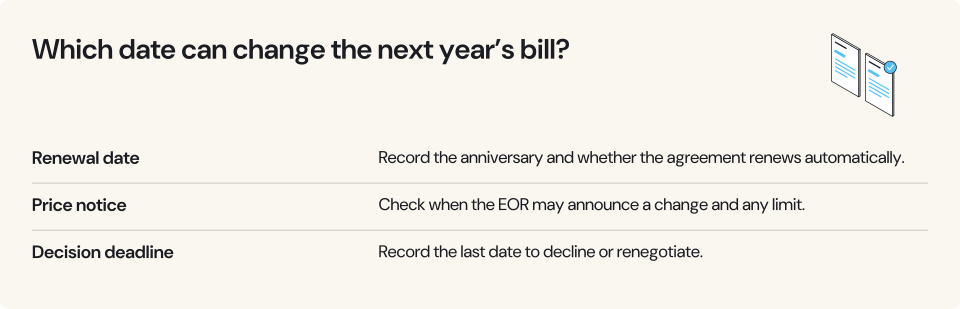
A renewal calendar separates the anniversary, fee-change notice and deadline to act.
Put both notice dates on the buyer’s calendar so finance can assess the new fee in time.

Example position. Check the renewal price, notice and commitment in the actual EOR documents. Oyster publishes an annual-plan example: its help center guarantees that the per-seat price of an annual EOR plan will not rise by more than 5% at renewal. Its standard terms still let it change subscription fees on 30 days’ notice, and its pricing page lists $699 per employee per month and mentions annual discounts without giving a figure or volume tiers.

Push for a cap of CPI or 3–5% in the contract, written notice of the new price 60 days before the anniversary, the right to switch from annual to monthly terms at renewal, and volume discounts that carry into the renewal term.

Watch for silent auto-renewal for a further 12 months with an uncapped price increase, a non-renewal window that closes 90 days before the anniversary, and renewal “at our then-current list price.” With any of these, missing the deadline in month 10 costs you a year of unbudgeted fees.


With an hour to review the draft, start with the exit terms. They tell you what you’d have to pay and do if you later move the employees elsewhere. Resolve those questions before you sign.

1
1. Exit: termination notice, exit fee, continuity letters (clauses 3, 8)
2
2. Money: liability cap, renewal uplift, deposit deductions (clauses 1, 8, 9)
3
3. Risk: indemnities and their carve-outs (clause 2)
4
4. Assets: the IP chain, the DPA, the sub-processor list (clauses 4, 5, 6)
5
5. Verification: audit rights and remittance evidence (clause 7)

RULE  Write anything promised on a sales call but missing from the contract into the order form before you sign.

Benchmark against published terms. Oyster’s published standard terms are one comparison example: 30 days’ notice, no exit fee and a deposit of about one month of the hire’s gross salary plus employer costs and fees, returned subject to the actual settlement trigger: within 60 days after all amounts are received or confirmed paid, whichever is later, and applicable offsets. Compare these positions with your actual transition needs, exposure and price. Ask for the reason and cost of a different term before deciding which requirements are mandatory for your procurement.

Keep the negotiation decision with the final wording

Keep the original clause beside the revision you requested. Record the supplier’s answer, the financial or operational consequence and who reviewed it. If the provider agrees by email, leave the item open until the signed documents contain the agreed wording. Identify which document controls if the service agreement, order form and country schedule conflict.

The working record Fields to complete
The working record
Scope
Fields to complete
Clause / issue · Original wording / reference · Requested change
The working record
Evidence and follow-up
Fields to complete
Supplier response · Cost / operational consequence · Owner · Accepted wording · Controlling document / status

Six failures to test against the contract

Ask the vendor to point to the clause that answers each scenario. Record the remedy, any exclusion and the person who can act.

Scenario Contract question Evidence to keep
Scenario
Payroll is late or short
Contract question
Who must fix it, by when, and who pays correction costs?
Evidence to keep
Service levels, escalation route and relevant liability provisions.
Scenario
A partner fails locally
Contract question
Does your counterparty remain responsible, and for which losses?
Evidence to keep
Partner obligation, indemnity and any guarantee.
Scenario
A data incident occurs
Contract question
Who notifies whom, in which role, and how quickly?
Evidence to keep
Role-specific data terms and incident contacts.
Scenario
IP is challenged during a sale
Contract question
Who supplies title records and missing signatures?
Evidence to keep
Local terms, onward transfer and further-assistance clause.
Scenario
You need to change EOR
Contract question
What notice, records, employee process and costs apply?
Evidence to keep
Country exit schedule and service-fee/employee-cost split.
Scenario
Renewal prices increase
Contract question
When must the vendor notify you, and when can you decline?
Evidence to keep
Renewal rate mechanism and calendar of notice deadlines.

Have the reviewer reconcile the MSA, order form and country schedules, including which document prevails.

Contract checks after an incident
Define the incident

Describe the failure and the affected obligations.

Identify the responsible party

Read the MSA, order form and country schedule together.

Confirm the required action

Check timing, escalation and any cure process.

Test loss and limits

Read recoverable losses, caps and exclusions together.

Check the practical remedy

Ask what can actually be recovered or enforced under the agreed terms.

Put an amount beside a failure scenario

Suppose you pay USD 500 a month in service fees for each of four employees. That’s USD 2,000 a month. If the cap counts only three months of those fees, it comes to USD 6,000. A documented loss of USD 12,000 would exceed that figure by USD 6,000. The USD 24,000 you send each month for payroll adds nothing to a cap that excludes payroll funding. What you could actually recover still depends on the wording, exclusions, causation and local enforceability.

Frequently asked questions

Are EOR contract terms negotiable?
Some terms may be negotiable before you sign, including renewal pricing, deposits and exit assistance. Pebl’s published policy says it has no setup or offboarding service fees (checked 24 September 2026). Get each concession you agree in writing.
How should I assess the liability cap in an EOR agreement?
Check which losses the cap covers, which fees count, the period used, whether the limit is per claim or aggregate, and any exclusions or carve-outs. Compare the resulting amount with your actual exposure. Use the article’s twelve-month fee example to understand the calculation, then apply the cap and exclusions in your proposed contract.
Who owns the IP that an EOR employee creates?
The answer depends on the country, type of IP and documents. Document the route for each country and right: statutory vesting or claiming, a direct assignment where local law allows it, or onward assignments through the EOR and any partner. Complete all required assignments, consents and statutory procedures using locally effective wording. Investors and acquirers check this chain in due diligence. The 12-jurisdiction IP guide covers the per-country statutes.
What does it cost to leave an EOR?
Leaving costs the fees you pay through the notice period in your agreement (30 days under Oyster’s published terms), any offboarding service fee (Oyster and Pebl publish none) and any quoted continuity-administration charge. Employee notice, severance and other employment liabilities are separate from provider service fees and need checking too. Check whether your annual seat commitment permits any refund or credit. For a hypothetical non-refundable 12-month seat, leaving after seven months leaves five months of committed fees.
Is an EOR a data controller or a data processor?
Assess the role for each activity. An EOR can act as a controller for its own purposes and as a processor where it acts on your behalf. Article 28 terms apply to the latter relationship. Separately assess restricted transfers and agree an incident process that preserves the applicable notification duties.

Sources

The sources behind this guide, grouped by topic. Dates show when we last checked a page. Prices and terms change, so confirm them in your quote.

Data protection law and regulators

5 sources
  1. European Union · gdpr-info.eu

    Regulation (EU) 2016/679 (GDPR), Article 28: Processor

  2. European Union · EUR-Lex

    General Data Protection Regulation (GDPR), Articles 28 and 33

    Used in the contract review. Checked 3 Oct 2026

  3. European Union · EDPB

    Guidelines 07/2020 on controller and processor roles

    Used in the contract review. Checked 3 Oct 2026

  4. European Union · European Commission

    Standard contractual clauses (SCC)

    Questions and answers

    Covers sub-processor change notice and objection mechanics.

  5. United Kingdom · Information Commissioner’s Office (ICO)

    Contracts between controllers and processors

IP and reclassification law

6 sources
  1. Freshfields

    Employers of record, part 2: intellectual property

  2. Germany · gesetze-im-internet.de

    Employee Inventions Act (Arbeitnehmererfindungsgesetz)

    Covers the invention-claiming mechanism.

  3. Germany · DPMA

    Employee Inventions Act, sections 5 to 9 and 22

    Used in the contract review. Checked 3 Oct 2026

  4. Germany · gesetze-im-internet.de

    Social Code Book IV, section 25

    Back contributions are recoverable for four years, thirty if intentional.

  5. France · Légifrance

    Code du travail, article L8224-1

    Sets criminal penalties for concealed employment.

  6. Brazil · Planalto

    Consolidation of Labor Laws (CLT)

    Covers employer obligations on reclassification.

Security standards and attestation

2 sources
  1. AICPA & CIMA

    System and Organization Controls (SOC) suite

    Covers SOC 2 Type II attestation reports and bridge-letter practice.

  2. International · ISO

    ISO/IEC 27001, information security management systems

Provider pricing and terms

3 sources
  1. Deel

    PricingEmployer of Record pageSecurity and compliance

    Flat $599 per employee per month. Owned entities and payroll engine in 130+ countries (checked Sep 2026). The security page lists SOC 2 Type II, ISO 27001, ISO 27701 and EU in-region hosting.

  2. Oyster

    PricingStandard termsEOR AnnualWhy a deposit is requiredOyster Shell overview

    USD 699 per EOR employee per month. Terms cover termination notice, deposit floor, transition costs and fee changes. Annual seats are non-refundable, per-seat increases capped at 5% at renewal; deposit about one month of the hire’s total cost of services (both Sep 2026). Shell: optional USD 49 monthly add-on to the separate USD 29 contractor product, with eligibility and reimbursement limits (15 Oct 2026).

  3. Pebl

    PricingEOR terms of service

    For EOR worker offboarding, the Oct 2026 terms require at least 90 days’ written notice, starting on the first day of the calendar month after Pebl receives it.

Our research

3 sources
  1. The Best EOR

    Deel review

    Evidence status and terms to confirm.

  2. The Best EOR

    Oyster review

    Published standard terms, deposit and exit mechanics (Jun 2026).

  3. The Best EOR

    Methodology and rubric

    How we assess Switching & Exit.

If you spot a changed price or a conflicting source, send it through the contact page and we’ll review it.

This guide is for general information only and does not provide legal, tax, accounting, or financial advice. For advice about your business, consult a qualified professional familiar with the rules where you hire. Read our research methodology to learn how we assess sources.