


Guide overview
When can your entity take over from an EOR?
Confirm the legal route, employer setup and payroll readiness first.
An EOR-to-entity migration combines formation, tax and employer registrations, payroll, benefits and the local legal requirements for transferring employees. Compare one-time expenses, recurring costs and cash requirements separately. Keep the EOR notice and transfer date conditional on readiness; the six-month Germany plan is an example.
Business case
Use country-specific costs
Compare the proposed entity with the current EOR arrangement.
Employment transfer
Confirm how employees can transfer under local law
Review employee documents, continuity and local procedures.
Operational readiness
Clear the start requirements
Confirm registrations, benefits and the contractual notice timetable.
Parallel payroll
Explain every variance
Reconcile results and approve legitimate employer-specific differences.
Check before acting
Confirm the transfer route and readiness before committing to a date.
What to record in the worksheet
Scope
Task or required check · Country and employee group · What must happen first
Evidence and follow-up
Owner · Target date · Evidence · Variance / correction · Signoff status
Evidence needed before the entity takes over employment
For each unresolved item, name the person who will close it. If a target date slips, check which employee rights and payment deadlines still apply.
| Gate | Evidence needed | If it is not ready |
|---|---|---|
Gate
Transfer route
|
Evidence needed
Local advice on automatic transfer, consent and consultation.
|
If it is not ready
Do not issue resignation-and-rehire documents by default.
|
Gate
Employer readiness
|
Evidence needed
Entity, required registrations, bank access and payroll configuration.
|
If it is not ready
Agree a new handover date with the EOR that meets local transfer requirements.
|
Gate
Employee terms
|
Evidence needed
Required documents and a comparison of pay, rights and service treatment.
|
If it is not ready
Resolve differences through the applicable process.
|
Gate
Benefits and permits
|
Evidence needed
Confirmed coverage dates, pension arrangements and right-to-work position.
|
If it is not ready
Close the gap before the new employment arrangement begins.
|
Gate
Payroll test
|
Evidence needed
Parallel calculation with every material variance explained and approved.
|
If it is not ready
Correct the setup and repeat the affected checks.
|
Gate
Handover and closure
|
Evidence needed
Named payer and filer for each period, records export and final invoices.
|
If it is not ready
Retain an owner until the first live cycle and closeout are verified.
|
Where employment transfers by law, follow that route and preserve the rights it carries. Where consent and new contracts are needed, obtain the required agreements without using them to waive statutory rights.
Confirm the applicable route and any information or consultation duties.
Complete registrations, banking and payroll setup.
Check continuity, documentation and any required consent.
Confirm coverage, permissions and transition arrangements.
Correct errors; document and approve every material variance between test calculations.
Resolve gaps before cutover; then check the first live payroll.
Complete statutory information and consultation at the required time, and agree any delay with the outgoing EOR before notice or employment end dates create a gap.
Decide whether the entity case justifies a migration
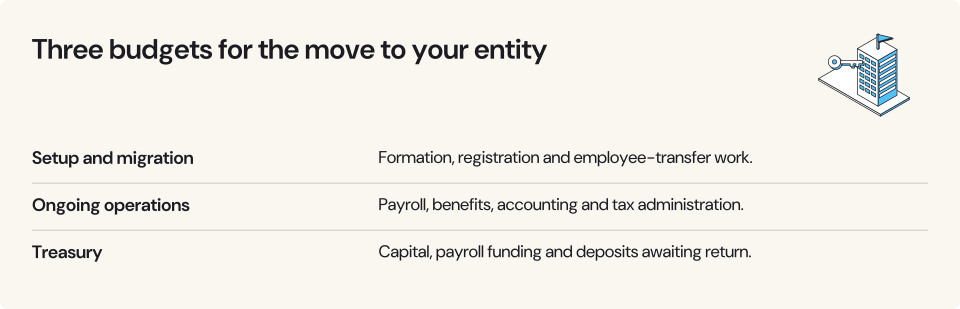
Give setup and migration their own budget. In a second budget, put the costs you’ll keep paying once the entity is running, including payroll, benefits, accounting and tax administration. Then draw up a cash forecast for paid-in capital, payroll funding and deposits you’re waiting to recover. Record the country, employee profile, currency, quote or source date, and owner beside each figure. This keeps capital and refundable cash out of the service-expense total.
Consider reviewing the entity option at 20–30 FTEs in one country. On cost alone, our break-even analysis shows an entity breaking even at around 9 employees on a German cost base with a $599 monthly fee. Up to about 15 employees the savings stay thin: about $7,400 a year at 10 employees and $28,820 at 15, while the model assumes a $20,000–$40,000 migration project. At the model’s hypothetical USD 199 fee, the EOR service fee is below the assumed marginal entity cost at the evaluated headcounts. RemotePeople currently lists Global from $499 and Select from $199 per employee/month; Select requires a selected country and qualifying employee salary range. A country-specific RemoFirst quote may also differ from its starting fee. Confirm each quote’s currency, eligibility and terms before using it in the model. Re-price fixed and variable costs before extrapolating beyond those points. Check the numbers against your actual fee, and price your own team with the EOR cost calculator.
Three other triggers force or speed up the move:
A legal time limit is approaching. In Germany, the clearest example, where the actual arrangement falls under the AÜG (Arbeitnehmerüberlassungsgesetz), licensing and assignment-limit rules apply, including the standard 18-month assignment limit. Check the applicable assignment limit, including any permitted collective-agreement variation and earlier assignments that count toward it. Resolve the arrangement before the applicable limit expires.
A permanent establishment may already exist. A salesperson who has habitually closed deals in the country can create a taxable presence there, whoever employs them, and a new entity may be one part of the future operating plan. Our PE risk guide lists the triggers, and the tax section below covers earlier years.
The business needs direct control. Licensed activities (financial services, defense, some government contracts), direct IP ownership and custom benefits design may justify reviewing an entity before the cost case alone does.
Consider the expected market commitment alongside mandatory employment limits and the costs of setup and closure: unwinding a GmbH includes a statutory waiting year for creditors before assets are paid out, so obtain a separate legal and tax closure timetable rather than treating formation as easily reversible. The migration scenario assumes a 4–6 month, $20,000–$40,000 migration project on top of entity setup. These are planning inputs; obtain country-specific costs and dates.
A six-month Germany migration example
This example follows a German GmbH with a foreign parent. Its formation, banking and registration dates depend on the structure and the providers involved. If you’re setting up a UK Ltd or a Singapore Pte Ltd, work out the deadlines for that entity before putting dates in the checklist.
| Month | Task | Required result at month end |
|---|---|---|
Month
1
|
Task
PE review, EOR contract review, entity formation, bank account opened
|
Required result at month end
Notarized formation done; capital deposit underway
|
Month
2
|
Task
Tax, payroll and VAT registrations; benefits inventory
|
Required result at month end
Tax questionnaire filed; employer numbers requested
|
Month
3
|
Task
Payroll provider selected; benefits broker quotes; intercompany agreement drafted
|
Required result at month end
Provider contract signed with go-live date in writing
|
Month
4
|
Task
Documents required by the confirmed transfer route; employee communication; payroll configuration
|
Required result at month end
Every employee has seen terms side by side
|
Month
5
|
Task
Parallel payroll run; documents for the confirmed transfer route signed; EOR notice timed to the agreement
|
Required result at month end
Parallel run reconciled; each variance explained and approved
|
Month
6
|
Task
Transfer on the date local rules allow, run the first payroll and complete EOR offboarding
|
Required result at month end
First payslips and statutory filings correct
|
Fig. 1 · Six-month migration timeline with month-end checks · Germany GmbH base case
Month 1: reviews and entity formation
Do both reviews before filing: the PE review establishes what your people have done in the country, and the EOR contract shows the notice period, any offboarding fee and any clause on transfers to your own entity. The example assumes about $15,000 of formation work with cross-border legal support and a 4–12-week banking allowance for a non-resident parent. Start the banking work early and confirm the required account and capital-payment sequence with counsel. A standard cash GmbH’s minimum paid-in capital before registration is €12,500 under the statutory conditions; this is company capital, not a formation fee.
For help comparing incorporation providers, see our entity setup support before you commission the formation.
Month 2: registrations
Identify the trigger for each registration; they do not all begin solely on commercial-register entry (see the registration table). In Germany the registrations are the tax questionnaire to the Finanzamt via ELSTER, the trade office, a Betriebsnummer from the Federal Employment Agency, the Berufsgenossenschaft (accident insurance) and VAT. In parallel, start the benefits inventory that prevents benefit gaps by listing every benefit line in the EOR contracts and the last three months of payslips.
Month 3: payroll provider and benefits build
Shortlist two or three local payroll providers and compare prices: the linked break-even model uses illustrative Germany and UK inputs. Keep the currencies and country profiles separate: €15–€25 per payslip per month for Germany and £5–£10 for the UK are example assumptions to replace with quotes. Ask each for its lead time to a first live run and whether it handles per-employee statutory registrations, and put the go-live date in the contract. Meanwhile, have a local broker quote matching cover for the benefits inventory, and have counsel draft the intercompany services agreement and transfer-pricing policy.
Month 4: contracts and communication
Use the documents required by the confirmed local transfer route. Where new contracts are appropriate, prepare the required language version, compare all terms, preserve mandatory service rights and document any additional agreed credit. Have counsel check whether any proposed trial period is permitted given the prior work and route. Give each employee the documents required for the confirmed transfer route, a side-by-side comparison of the terms and a one-on-one discussion. Identify any information and consultation duties at the outset and complete them by the legally required stage; do not wait until month 4 if the applicable route requires earlier action. Also request continuity-of-service letters from the EOR. Meanwhile, the payroll provider loads employee master data, tax classes and social insurance numbers.
Month 5: parallel run, signatures, notice
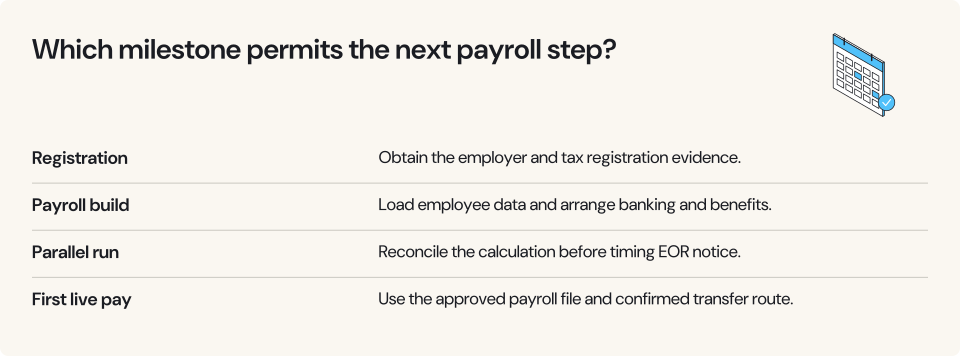
Run the EOR’s latest completed payroll through your own system. For each person, compare gross pay, deductions and net pay. A change in employer contributions or benefits may be legitimate. A missing tax class, a wrong contribution group or an unmapped allowance needs correcting. Rerun the payroll until every difference is explained and approved. Only then give notice in line with the service agreement and local rules on the transfer date. Check that the payroll calendar and transfer route allow the outgoing employer’s last day to lead directly into the entity’s first, with the required documents and benefits effective on the agreed date.
Month 6: transfer and first live payroll
The entity takes over on the agreed date permitted by local transfer rules, after the required employment documents, work permission, benefits, registrations and payroll readiness are confirmed. Complete registrations by their actual deadlines, including any immediate-reporting requirement for the applicable sector. Pay wages on the contractual date and German social contributions by their statutory due date, the third-to-last banking day of the month. Then close out the EOR: final invoices, data export, archived payslips and a continuity letter for each employee. In week two, audit accrued-leave carry-over, pension redirection and social contributions for any double or missing months.
Track the tasks and what each one depends on
Put the country’s legal, tax and payroll deadlines on the same calendar as benefits enrollment and employee communication. Give each task an owner and attach evidence when it’s ready. If a registration or funding step is still open, check which later tasks depend on it before confirming the handover date.
| The working record | Fields to complete |
|---|---|
The working record
Scope
|
Fields to complete
Task or required check · Country and employee group · What must happen first
|
The working record
Evidence and follow-up
|
Fields to complete
Owner · Target date · Evidence · Variance / correction · Signoff status
|
Accept a shadow run by explaining each variance
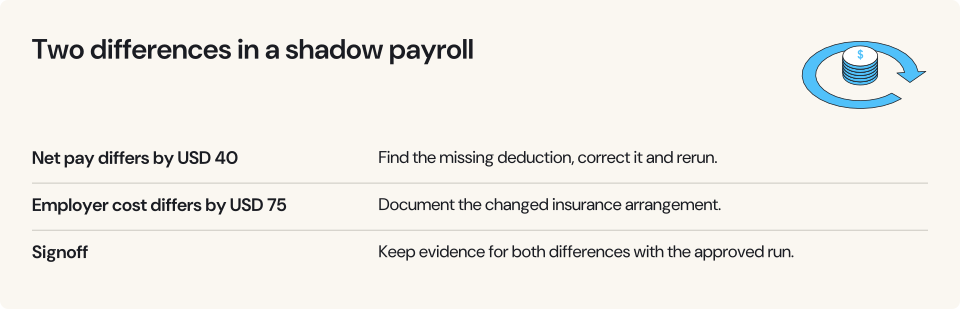
In this fictional test, net pay is off by USD 40. Payroll finds an omitted deduction, corrects it and tests again. The USD 75 difference in employer cost comes from a documented change to the insurance arrangement. Finance and the local reviewer can sign off that difference once they accept the explanation. Keep a bank-file mismatch open until the corrected file passes a test. For each difference, keep the expected and actual amounts, the reason, the owner and the evidence used to close it.
Tax, registration and intercompany planning
Your entity becomes responsible for its own tax, payroll and reporting obligations. Review these four areas of work with the country advisers and budget them separately.
Consideration 1: permanent establishment timing
A sales lead who has habitually concluded deals from Munich since 2023 may have created prior dependent-agent PE exposure; assess the actual activities and applicable treaty rather than assuming formation starts the tax clock. German AO §169 generally provides a four-year tax-assessment period, extended in specified cases including ten years for tax evasion; commencement and suspension rules also matter. Review the history before filing, using the PE risk guide and tax counsel.
Where prior German exposure is identified, obtain criminal-tax advice before any disclosure. Relief under AO §371 depends on the required completeness and statutory scope, exclusion events and timely payment where required. Filing before an investigation opens is not enough by itself.
Consideration 2: payroll and tax registrations
Confirm which new-entity registrations and employer records are needed and their actual prerequisites. The bank-account allowance is a planning input, not a statutory deadline.
| Registration | Country | Deadline or typical wait |
|---|---|---|
Registration
Betriebsnummer (Federal Employment Agency)
|
Country
Germany
|
Deadline or typical wait
Online application; usually issued same day
|
Registration
Tax questionnaire to the Finanzamt (via ELSTER)
|
Country
Germany
|
Deadline or typical wait
Due within 1 month of formation; tax number takes 2–8 weeks
|
Registration
Berufsgenossenschaft (accident insurance)
|
Country
Germany
|
Deadline or typical wait
Notify the competent accident-insurance body within one week after the enterprise begins (§192 SGB VII); a qualifying timely trade notification can satisfy the duty
|
Registration
Bank account for paid-in capital
|
Country
Germany
|
Deadline or typical wait
4–12 weeks for a non-resident parent
|
Registration
PAYE employer registration (HMRC)
|
Country
UK
|
Deadline or typical wait
Before the first payday; reference takes up to 15 working days; cannot register more than 2 months ahead
|
Registration
VAT registration (HMRC)
|
Country
UK
|
Deadline or typical wait
For UK-established businesses: general £90,000 taxable-turnover threshold (since 1 April 2024), subject to applicable tests; non-established businesses and voluntary registration need separate review.
|
Fig. 2 · Six payroll and tax registrations across Germany and the UK · statutory deadlines checked June 2026
Not every application must wait for the same tax number or bank account. Track each dependency, owner and deadline separately and replace the illustrative month 2 dates with the agreed country sequence.
Consideration 3: transfer pricing between parent and entity
Your entity is a separate taxpayer, so assess the actual intercompany activities and applicable transfer-pricing obligations. Where a services arrangement is appropriate, document the pricing method, agreement and invoicing process; cost-plus is not mandatory for every subsidiary. The elective OECD simplified approach for qualifying low value-adding intra-group services uses a 5% markup on the relevant cost pool, excluding pass-through costs, without a benchmarking study for that markup. Eligibility depends on supportive, non-core activities that do not involve the excluded intangibles or substantial risks. Applicable local adoption or thresholds and the required documentation must also be checked; this is not an automatic German safe harbour. Core engineering or revenue-generating sales activity should not be assumed to qualify. Determine an appropriate supported method for activities outside the approach rather than applying 5% automatically. The model’s $5,000 annual documentation-upkeep allowance is an assumption to replace with a scoped quote; assess tax on the actual taxable profit separately. In this example, the intercompany invoice funds payroll: agree the monthly invoicing and cash-transfer schedule before month 6, while the EOR still invoices you for payroll.
Consideration 4: corporate income tax and VAT
The entity takes responsibility for its corporate tax filings and tax on taxable profit. For 2026 Germany, the calculation includes 15% corporation tax plus a solidarity surcharge of 5.5% of that tax, plus municipal trade tax: roughly 30% combined, depending on the municipality. Prepayments are assessed once the Finanzamt processes the questionnaire. For VAT, identify the actual supplies, customer status, place-of-supply rules and any reverse-charge treatment, including for invoices to the parent. Assess mandatory or voluntary VAT registration and input-tax recovery for the actual supplies and local costs before deciding whether registration is appropriate. Missed deadlines bring surcharges and a poor record with an authority that will assess you for years.
Choose the legal employee-transfer route
First determine the legal transfer route in each country. Employment may transfer automatically where a statutory test is met; otherwise an agreed termination and new employment may be needed. Do not request resignations before that analysis. Where local law permits agreed termination and new employment and that approach fits the facts, a tripartite agreement between you, the EOR and the employee may document that route. Confirm the required consent, continuity and treatment of accrued rights. Whether an agreed move triggers a termination payment depends on local law and the actual route. Crediting prior service does not by itself remove a statutory payment.
Four points decide whether the paperwork holds up:
New contracts: match or better. Identify which terms and rights the actual transfer route preserves by law, then compare salary, notice, leave and benefits line by line. Resolve any proposed change through the required process. Do not assume a new probation period is available for someone already doing the job; obtain a local assessment of the prior service and contract route.
Establish which service rights continue by law, then document any additional contractual credit. Credit prior service explicitly for notice periods, severance calculation and leave accrual, and collect a continuity-of-service letter from the EOR for each employee. Assess the applicable notice, leave and severance route; Germany’s conditional section 1a offer route sets no universal settlement amount.
TUPE-like rules where they apply. The UK, Germany and other jurisdictions have statutory transfer rules that can apply if their factual tests are met. TUPE 2006 covers a “service provision change”, which includes bringing activities in-house from a contractor. If the EOR-employed team is an organised grouping whose principal purpose is serving you and the work continues, employees can transfer automatically on their existing terms with full continuity. The outgoing employer must then supply employee liability information at least 28 days ahead, and a dismissal whose sole or principal reason is the transfer is generally automatically unfair unless an economic, technical or organisational reason entails workforce changes. That exception does not remove other requirements for a fair dismissal. The test is fact-specific, so get a TUPE analysis before drafting. If TUPE applies, the statutory transfer replaces the tripartite structure. The EU Acquired Rights Directive and national implementing rules address qualifying transfers of undertakings. Germany’s §613a BGB can preserve employment rights when its business-transfer test is met. Obtain country-specific advice on whether a provider change or move in-house meets that test before choosing documents.
Works councils and consultation duties. Check the applicable representation thresholds and the transfer’s information and consultation duties separately. In Germany, the ordinary works-council threshold is five permanent employees with voting rights, including three eligible to stand. France generally requires a CSE after at least 11 employees have been maintained for 12 consecutive months; check any existing representation and transfer rules. A Dutch works council is normally required from 50 employees, while smaller workplaces may have staff-representation duties. Identify the correct establishment, headcount and timing before issuing transfer documents.
Avoid transferring before payroll is ready
In the typical failure, the EOR notice goes out in month 4 on the assumption that payroll will be live in month 5. The tax number or bank account is still pending when the notice expires, so the team starts month 6 employed by an entity that cannot run a compliant payroll. Wiring net pay by hand in an emergency is not payroll, because it produces no payslips, wage-tax remittance or social-insurance filings. In Germany, late social-insurance contributions then accrue a surcharge of 1% of the overdue amount per started month (§24 SGB IV).
Make the transfer date depend on readiness. Confirm registrations, payroll setup, benefits and the local legal procedure for the transfer. Correct payroll errors and document and approve every material variance. Then align the EOR notice with the confirmed contract and local procedure. A first-of-month date can simplify reconciliation where those requirements allow it.
Compare benefits before promising continuity
Ask the broker to quote for the benefits employees have today. Compare premiums, waiting periods, eligibility and coverage, then look for items that are easy to miss in a new contract, such as meal vouchers, a transport allowance, extra pension contributions or private health cover. Show each employee the value of the two packages side by side. Resolve gaps before the transfer, when there’s still time to change the offer.
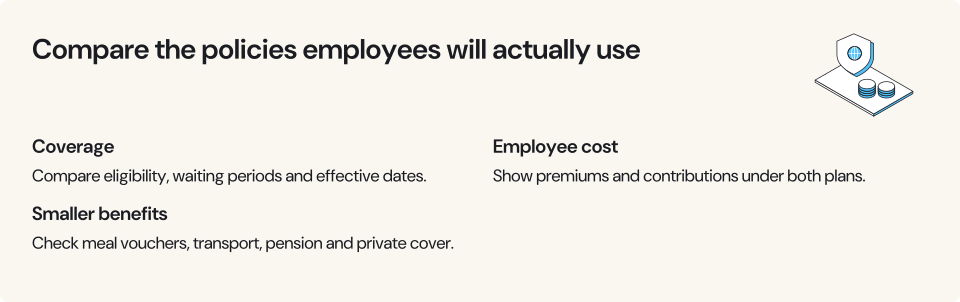
Prevent this with an inventory and a written commitment. Compare the month-3 broker quotes with the month-2 inventory and price the gap accurately. If small-group cover costs more, add the difference to the business case you took to the CFO rather than cutting employees’ compensation. Record benefit continuity and any agreed improvements in the appropriate transfer documents.
Before the broker sees your inventory, check it against our guide to EOR benefits, which separates statutory employer obligations from supplementary options to investigate by country.
The notice and transfer readiness checklist
Run this in month 5, before the EOR notice goes out. If a question remains open, revise the plan to meet the applicable legal requirements. Agree any delay with the current EOR and check assignment limits, notice and employee rights before extending the arrangement.
- Q1. Has payroll tested a full cycle, corrected errors and documented and approved every material variance for each person?
- YES → continue to Q2
- NO → Hold the notice, fix the errors and rerun while the EOR keeps running payroll.
- Q2. Are benefits signed, effective on the transfer date, and matched or bettered line by line?
- YES → continue to Q3
- NO → Close the gaps or fund the difference (see the benefits comparison).
- Q3. Are the documents and any consent required by the confirmed transfer route complete, with service rights and consultation addressed?
- YES → continue to Q4
- NO → Resolve outstanding documents or objections under the applicable legal route and agree any necessary extension with the EOR.
- Q4. Does the proposed transfer date meet the confirmed notice period, legal transfer procedure and payroll readiness requirements?
- YES → Send notice on the confirmed contractual timetable and transfer on the agreed date once local requirements are met.
- NO → Resolve the timing conflict before giving notice.
Approve notice only after reviewing readiness
Before you give notice, get the legal, payroll, HR and finance leads to sign off their parts of the handover. Keep the agreed transfer route, employer registrations, signed terms, payroll and funding checks, benefits dates and employee communications together. If anything remains open, record the owner and decide whether notice or the transfer itself must wait.
EOR-to-entity migration FAQs
Does TUPE apply when I move people from an EOR to my own UK entity?
Do employees keep their tenure when they move from the EOR to my entity?
Can the tax office assess the years before my entity existed?
Should everyone move to the new entity on the same date?
How much does an EOR-to-entity transition cost?
Price the move for your actual headcount and transfer route. Ask for country quotes covering formation, registrations, counsel, employment documents, payroll setup, benefits and transition support. Budget separately for overlap fees and staff time, and show cash deposits on the funding calendar. The figures in the six-month scenario are planning assumptions.
Sources and model assumptions
The sources behind this guide, grouped by topic. Dates show when we last checked a page. Prices and terms change, so confirm them in your quote.
Employee transfer and works council law
10 sourcesEuropean Union · EUR-Lex
United Kingdom · legislation.gov.uk
Transfer of Undertakings (Protection of Employment) Regulations 2006 (SI 2006/246)
Includes service provision changes.
United Kingdom · GOV.UK
Business transfers, takeovers and TUPE
Transfers of employment contracts
Used in the entity transfer example. Checked 3 Oct 2026
Germany · gesetze-im-internet.de
§613a BGB (German Civil Code): rights and duties on business transfer
The juris.de version is used in the entity transfer example, checked 3 Oct 2026.
Germany · gesetze-im-internet.de
Arbeitnehmerüberlassungsgesetz (AÜG)
The German labor-leasing act, with an 18-month assignment cap. Section 1 is used in the entity transfer example, checked 3 Oct 2026.
Germany · gesetze-im-internet.de
§1a KSchG (German Dismissal Protection Act)
A conditional statutory offer route, not a universal settlement amount.
Germany · gesetze-im-internet.de
Betriebsverfassungsgesetz (German Works Constitution Act)
Works council elections from 5 permanent employees.
France · Légifrance
Code du travail, Article L2311-2
CSE mandatory from 11 employees.
France · Service Public
CSE headcount and 12-consecutive-month condition
Checked 15 Oct 2026
Netherlands · Business.gov.nl
Works councils and staff representation
Checked 15 Oct 2026
Registration and social contributions
6 sourcesGermany · gesetze-im-internet.de
GmbHG (German Limited Liability Companies Act)
Minimum capital deposit (§7) and liquidation waiting year (§73).
Germany · Bundesagentur für Arbeit
Employer number.
Germany · gesetze-im-internet.de
§24 SGB IV (German Social Code)
1% late-payment surcharge per started month on social contributions.
Germany · AOK
2026 due dates for social insurance contributions
Third-to-last banking day of the month.
United Kingdom · HMRC (GOV.UK)
United Kingdom · HMRC (GOV.UK)
The £90,000 threshold.
Corporate tax and transfer pricing
5 sourcesInternational · OECD
Transfer Pricing Guidelines (2022), Chapter VII: low value-adding intra-group services
Paragraphs 7.45 to 7.49, 7.61 and 7.63 to 7.64 cover the qualifying simplified approach, the 5% cost pool and local implementation and documentation (PDF checked 15 Oct 2026).
International · OECD
Model Tax Convention, Article 5
Dependent-agent permanent establishment.
Germany · gesetze-im-internet.de
Abgabenordnung (German Fiscal Code)
§169: assessment periods§371: voluntary disclosure
§169 covers assessment periods and statutory scope. §371 covers voluntary-disclosure completeness, exclusions and payment conditions (checked 15 Oct 2026).
Germany · gesetze-im-internet.de
Solidaritätszuschlaggesetz 1995 (SolZG) §3
The solidarity surcharge is assessed on the corporation tax, at the 5.5% rate set in §4. Checked Sep 2026
Germany · Bundesministerium der Finanzen (BMF)
General background, not the exact authority for a particular PE conclusion.
Provider pricing
2 sourcesRemoFirst
Published EOR pricing from $199 per employee per month.
RemotePeople
Global from $499 per employee per month; Select from $199 in selected countries and qualifying employee salary ranges. Confirm quote currency, rate, commitment and deposit terms. Checked 16 Oct 2026
Our research
2 sourcesThe Best EOR
How we rate EOR providers.
The Best EOR
EOR vs entity setup break-even model
Crossover at about 9 employees on a $599 fee on a German cost base, with savings of about $7,400 a year at 10 employees and $28,820 at 15. Checked Sep 2026
If you spot a changed price or a conflicting source, send it through the contact page and we’ll review it.
This guide is for general information only and does not provide legal, tax, accounting, or financial advice. For advice about your business, consult a qualified professional familiar with the rules where you hire. Read our research methodology to learn how we assess sources.