


Guide overview
Permanent establishment, at a glance.
Assess company activity as a separate corporate-tax question.
An employer of record may handle local employment administration, but permanent establishment is a separate corporate-tax question. Assess the enterprise’s actual activities under domestic law and the applicable treaty: the place available to it, the work performed, the working pattern, commercial reasons for the location and authority over contracts all matter. Engineering, support or back-office titles do not establish an exemption.
Place of business
Record the facts
Identify the place available to the enterprise and how it is used.
Activities
Describe the actual work
Record the working pattern and commercial reasons for the location.
Contract authority
Check the role
Document authority and the worker’s involvement in contracts.
Applicable rules
Review law and treaty
Give counsel the relevant facts and supporting documents.
Check before acting
Review the actual enterprise activity.
What to record in the worksheet
Scope
Fact / activity · Country and dates · Entity / person
Evidence and follow-up
Actual practice and evidence · Authority / premises / duration · Advice requested · Reviewer · Change trigger
An employer of record can run local payroll. Whether your company has a permanent establishment (PE) depends on what the employee actually does, the domestic rules and the applicable tax treaty. Someone who negotiates contracts raises a different question from someone who makes a workplace available to the business. Management decisions can matter too. Check any time threshold against the treaty before relying on a count of 183 days.
1. What a permanent establishment is: OECD definition and types
Article 5(1) of the OECD Model Tax Convention defines a permanent establishment as “a fixed place of business through which the business of an enterprise is wholly or partly carried on.” Most of the world’s 3,000+ bilateral tax treaties copy or adapt this wording. A country that finds you have a PE on its territory can tax the profits attributable to it under Article 7, and you file corporate returns there as if you ran a branch.
The OECD Model covers fixed-place, construction and dependent-agent PE. Some treaties also contain service-PE or other project-duration provisions. A fixed-place PE under Article 5(1) can be a place of management, branch, office, factory or workshop, as listed in 5(2). A construction PE under 5(3) is a building site or installation project lasting more than 12 months. A dependent-agent PE under 5(5) arises from a person in the country who habitually concludes contracts on your behalf. Article 5(4) excludes “preparatory or auxiliary” activities such as storage, display, purchasing and collecting information.
After its BEPS project, the OECD tightened the definition in a 2017 update to the Model, which Articles 12 to 14 of the Multilateral Instrument (MLI) bring into existing treaties. The agent test now also covers anyone who “habitually plays the principal role leading to the conclusion of contracts that are routinely concluded without material modification by the enterprise.” The update also made the 5(4) exemptions conditional, added an anti-fragmentation rule against splitting one operation into several “auxiliary” pieces, and blocked the splitting of construction contracts.
Spain and India opted into the dependent-agent expansion (MLI Article 12), while Germany and the Netherlands reserved against it. Which version of Article 5 applies to you therefore depends on the specific treaty rather than the model text.
Facts to collect before a PE review
Give your adviser the operating facts.
| Area | Record these facts | Why they matter |
|---|---|---|
Area
Workplace
|
Record these facts
Where work happens, regularity, available space and who requires the arrangement.
|
Why they matter
A fixed-place analysis turns on the actual use of a location.
|
Area
Commercial reason
|
Record these facts
Why the person works from this country and which customers or activities benefit.
|
Why they matter
Remote-work facts can affect the home-office assessment.
|
Area
Contracts
|
Record these facts
Who negotiates, approves, changes and concludes contracts.
|
Why they matter
Signing authority alone may not capture an agency test.
|
Area
Management
|
Record these facts
Where substantive decisions are made and who makes them.
|
Why they matter
Management presence can raise PE or residence questions.
|
Area
Duration and projects
|
Record these facts
All relevant visits, recurring activity and connected project work.
|
Why they matter
Treaties can apply different fixed-place, project or service tests.
|
Area
Existing registrations
|
Record these facts
Employer, branch, tax and other registrations already held.
|
Why they matter
Payroll registration and corporate tax presence are separate questions.
|
Revisit the review when activities or working arrangements change.
Start with the applicable domestic law and treaty provisions.
Review the facts of where and how work is carried out.
Review negotiation, authority and the actual sales process.
Check where substantive management decisions are made.
Check activity and duration rules where applicable.
The applicable treaty, domestic law, actual activities and relevant duration rules determine the result.
2. The 6 triggers of permanent establishment risk
Trigger 1: a fixed place of business at your disposal
An office, leased desk, warehouse or workshop can qualify whether or not you own it. The test is power of disposal: whether your business can use the space regularly for its work. A home office can qualify when the company requires the arrangement or benefits from it. The OECD’s 2025 Commentary update adds a 50 percent working-time reference point for home offices and asks whether there is a commercial reason for the person to work in that country. It is still a facts-and-circumstances test rather than a safe harbor.
Trigger 2: habitual authority to conclude contracts
A single person in the country who regularly signs customer or supplier contracts in your name creates the classic dependent-agent PE under Article 5(5), even if you have no office there. Cases turn on the word “habitually”: the frequency and nature of contracting must be assessed under the applicable treaty and business facts; there is no universal one-contract or quarterly safe threshold.
Trigger 3: senior management presence
A founder, CEO or country head who makes company-level decisions from home can create a PE without any office, because “a place of management” heads the Article 5(2) list. The Danish CEO ruling in section 3 is the clearest recent example. In the worst case, a board based in the country can shift the company’s entire tax residence there under place-of-effective-management rules, a bigger problem than a PE.
Trigger 4: revenue-generating sales roles
Under a treaty that incorporates the expanded principal-role test, a salesperson may create a dependent-agent PE without signing authority if they play the principal role leading to contracts routinely concluded without material modification. Lead generation and marketing have historically counted as preparatory or auxiliary, and Denmark’s SKM2025.23.SR confirms that direct customer contact alone does not create a PE. But that exemption is now conditional, and it protects less the closer the role comes to pricing and terms.
Trigger 5: duration and recurrence
The OECD Commentary treats roughly six months as the point where a fixed place usually stops being temporary, but shorter presences can still count and repeated ones add up. India’s Supreme Court has found PEs for a three-day event under the company’s exclusive control and for years of rotating visits by Hyatt employees, none of whom crossed the treaty’s day threshold (section 4). Track each country’s cumulative presence across all trips, as these courts did.
Trigger 6: construction and installation projects
A building site, assembly or installation project becomes a PE after 12 months under the OECD Model and after 6 months under the UN Model, which many treaties with developing countries follow. Where the applicable treaty is modified by MLI Article 14, connected activities may have to be aggregated under its contract-splitting rule; check the parties’ reservations and the provision’s conditions. Sending field engineers to a customer site for a year counts toward the threshold whether or not anyone sells anything.
3. The home-office rulings: Spain and Denmark
Spain, binding ruling V0066-22 (18 January 2022). A UK company’s employee was stranded in Spain by the March 2020 lockdown. After restrictions lifted, he asked to keep working from his Spanish home, the company refused, and he resigned in February 2021. The Spanish Directorate-General for Taxes (DGT) found no PE because his use of the home was “discontinuous and incidental” and the company had no power of disposal over it. Relevant facts in that specific ruling included: it did not require the arrangement, paid nothing toward the home office and gained nothing from his being in Spain.
Denmark, SKM2024.432.SR (2 September 2024). A Swedish company’s CEO worked about 40 percent of the time from his home in Denmark, for personal reasons. The company had no Danish customers and no commercial interest in Denmark. The Tax Council found a PE anyway, holding that employing a senior decision-maker who works from Denmark is itself a company interest in the arrangement.
Denmark, SKM2025.23.SR (17 January 2025). By contrast, a foreign company’s product consultant marketed and demonstrated its products on ferries sailing to and from Denmark and did administrative work from his Danish home one day a month. The Tax Council accepted that the ferries and his home office were fixed places of business but found the work preparatory or auxiliary, so there was no PE despite direct customer contact.
4. India: court rulings on short and rotating presence
These Indian rulings illustrate why actual control, activity and the applicable treaty matter. Losing there is expensive: foreign companies pay a 35 percent base rate (cut from 40 percent by the Finance (No. 2) Act 2024, effective April 2024) plus surcharge and a 4 percent cess.
Formula One World Championship v. CIT (Supreme Court, 24 April 2017). The F1 rights holder had exclusive access to and operational control of the Buddh International Circuit during a three-day race weekend each year. The Court held that this made the circuit a fixed-place PE, because for a business whose activity is inherently short, three days of full control was “permanent” enough.
Hyatt International Southwest Asia v. ADIT (Supreme Court, 24 July 2025). A UAE Hyatt entity provided strategic oversight to Indian hotels under long-term agreements, through rotating employee visits. It had no office or desk, and no individual employee exceeded the treaty’s stay threshold. The Court found a fixed-place PE under Article 5(1) of the India-UAE treaty, because continuous, coordinated engagement and operational control over the hotels’ core activities satisfied the disposal test.
For India, assess the actual activities, presence and applicable treaty provisions, including any aggregation rule that applies.
5. What taxes and costs can a permanent establishment create?
A PE finding rarely costs only one year’s tax, because the assessment reaches back over prior years, adds penalties and interest, and leaves you with branch-level compliance from then on.
| Cost line | Typical range | Reference points |
|---|---|---|
Cost line
Back corporate tax
|
Typical range
Local CIT rate on profits attributed to the PE, per year found
|
Reference points
Denmark 22%, Spain 25%, Germany ~30% combined, India 35% + surcharge + 4% cess for foreign companies
|
Cost line
Reassessment window
|
Typical range
Depends on the tax year, notice date, threshold and applicable law
|
Reference points
Use each jurisdiction’s actual limitation rules. India: distinguish current 2025 Act §§279–286 from legacy periods under the 1961 Act and §536 transition rules.
|
Cost line
Penalties
|
Typical range
Jurisdiction- and conduct-specific; not one global percentage
|
Reference points
India: conditional 50% under-reporting / 200% misreporting rules in current §439; earlier periods may retain §270A. Establish the tax base, exclusions and applicable period.
|
Cost line
Late-payment interest
|
Typical range
Statutory rate, accruing from each original due date
|
Reference points
Check the local rate, starting date and simple or compound calculation; do not assume one method worldwide
|
Cost line
Profit attribution fight
|
Typical range
Advisory and audit-defense fees
|
Reference points
A transfer-pricing style study to establish what profit was “attributable” to the PE under Article 7
|
Cost line
Ongoing compliance
|
Typical range
Annual, once registered
|
Reference points
Local books, corporate filings, possible VAT/GST registration, audit exposure: the running cost of an entity you never chose to open
|
Fig. 1 · Six cost lines of a triggered permanent establishment · cost categories and dated examples; India current/legacy mapping checked 15 October 2026
Beyond corporate tax, a PE finding usually raises payroll withholding, VAT and director-duty questions for the same period. For the cost of opening an entity on purpose, see the EOR vs entity break-even calculation.
6. What an EOR handles and what still needs tax review
An employer of record’s local entity becomes the legal employer: it registers the employment, issues a compliant contract, runs payroll, withholds income tax and pays employer contributions. Selected published starting fees in our EOR cost comparison range from USD 199 to USD 699 per employee per month, with different plans, billing commitments and country conditions. Salary, employer contributions, benefit premiums and any extra charges are separate; model the country-specific quote in the EOR cost calculator.
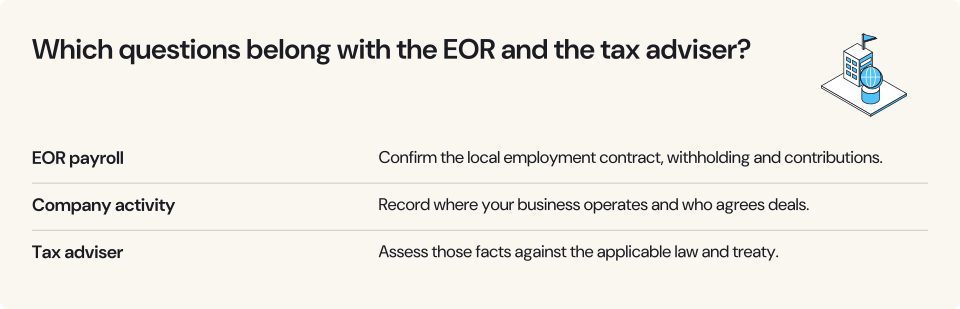
Keep employment administration and corporate tax presence separate when evaluating the arrangement. An EOR does not automatically exclude the employee’s home from the fixed-place analysis. Assess its actual use and the relevant treaty, including any applicable guidance on working time and commercial reasons. An employment arrangement that meets local rules can address worker-status concerns.
7. What an EOR cannot fix: dependent-agent PE
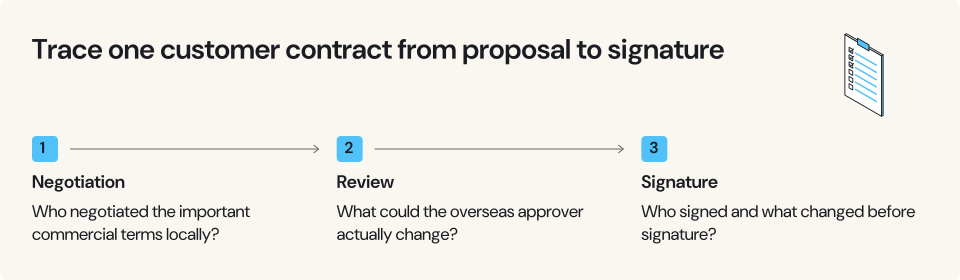
Article 5(5) applies to “a person acting in a Contracting State on behalf of an enterprise,” whether or not that person is its employee. The OECD Commentary and national courts look at whose business the person advances. An account executive in Madrid who negotiates your pricing, works your pipeline and closes your deals is acting on behalf of your company. Moving her employment contract to an EOR changes her payslip but not how she sells. The client company’s dependent-agent question remains: assess those activities under the treaty actually applicable to the Spanish arrangement.
Vendor marketing that promises “zero PE risk” through an EOR is wrong. Read any indemnity’s written scope, exclusions, causation requirements and limits. Check whether it covers the client’s activities, a provider error, defence costs or assessed tax; do not infer coverage from the provider’s reputation.
For the same reason, an EOR does not remove the other triggers: a leased office or company-paid workspace (fixed place), a CEO or statutory director running the company from the country (place of management, as in the Danish ruling), or a 14-month installation project at a customer site (construction PE).
8. PE risk by role: from engineer to founder
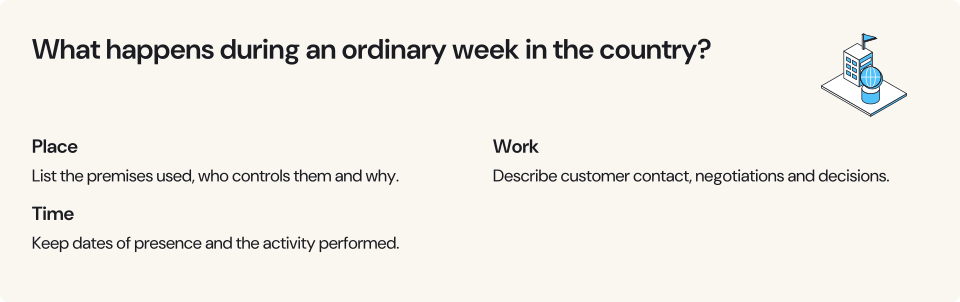
Give your tax adviser a description of the employee’s actual week. Where do they work, what does the company use that space for, and why does the business need them there? Explain what the company sells, who negotiates the contracts and who can approve them. That gives the adviser facts to test against local law and the applicable treaty.
| Role | Facts to examine | Question for the treaty review |
|---|---|---|
Role
Engineer, designer or QA
|
Facts to examine
Core product work, work location and regularity
|
Question for the treaty review
Is this a core business activity carried on through a place available to the enterprise?
|
Role
Customer support
|
Facts to examine
Delivery duties, renewals and customer commitments
|
Question for the treaty review
How do the actual activities fit the business, and does the person negotiate or conclude contracts?
|
Role
Finance, HR or back office
|
Facts to examine
Scope and importance of local functions
|
Question for the treaty review
Are the activities genuinely preparatory or auxiliary for this enterprise under the applicable treaty?
|
Role
Marketing or product manager
|
Facts to examine
Local commercial activity, demonstrations and pilots
|
Question for the treaty review
What work is performed locally, why is it located there and what authority does the person exercise?
|
Role
Account executive
|
Facts to examine
Negotiation, habitual contract activity and actual approvals
|
Question for the treaty review
Does the applicable dependent-agent provision cover how contracts are obtained or concluded?
|
Role
Country manager or sales VP
|
Facts to examine
Contract authority and management decisions
|
Question for the treaty review
Do the actual management and commercial functions create a fixed-place or dependent-agent issue?
|
Role
Founder or C-suite
|
Facts to examine
Strategic decisions, working pattern and place of management
|
Question for the treaty review
Is there a PE or a separate corporate-residence issue under the relevant rules?
|
Fig. 2 · Seven role groups and factual questions for a PE review · apply domestic law and the relevant treaty
The same title can conceal different activities
Take two fictional account managers. One answers customer queries using centrally approved scripts and has no authority to negotiate. The other regularly negotiates material terms and brings deals to signature. For each person, trace how a contract is agreed, where the work takes place and how long the arrangement lasts before applying the domestic rules and treaty.
9. Four questions to prepare a permanent establishment review
Use these four questions while you can still change the proposed role, before the offer goes out.
- Q1. Will this hire negotiate terms or close revenue contracts with customers in their country?
- YES → Country/treaty review required, including actual authority and activities, even with an EOR; obtain a local tax assessment.
- NO → continue to Q2
- Q2. Is the hire a director or executive who will make company-level decisions from there?
- YES → Review PE and corporate residence using where decisions are actually made. Keep the operating evidence.
- NO → continue to Q3
- Q3. Will the company pay for, lease or publicly list any address in that country (including the home office)?
- YES → Review the space's actual use with a tax adviser. Changing who pays for it does not by itself resolve fixed-place PE.
- NO → continue to Q4
- Q4. Does service, project or installation work require a duration or aggregation review under the applicable treaty?
- YES → Review the actual service/project/construction provision, duration and aggregation rules before committing; not every treaty has the same threshold.
- NO → Check other applicable treaty tests.
If a PE may exist, assess the position before choosing a remedy. Ask a qualified local adviser about the historical activities, registration and reporting duties, and available correction routes. Compare a prospective entity with EOR use under the actual cost and operating assumptions; there is no universal headcount crossover. The migration guide covers the planning steps.
Prepare the adviser briefing and worksheet
Send the adviser the countries, entities and people involved, the relevant dates and a description of the premises. Attach contracts and show how decisions are made in practice, including who talks to customers and who approves the terms. Ask which domestic rules and treaty provisions apply and which facts the adviser still needs.
| The working record | Fields to complete |
|---|---|
The working record
Scope
|
Fields to complete
Fact / activity · Country and dates · Entity / person
|
The working record
Evidence and follow-up
|
Fields to complete
Actual practice and evidence · Authority / premises / duration · Advice requested · Reviewer · Change trigger
|
Reopen the review when facts change
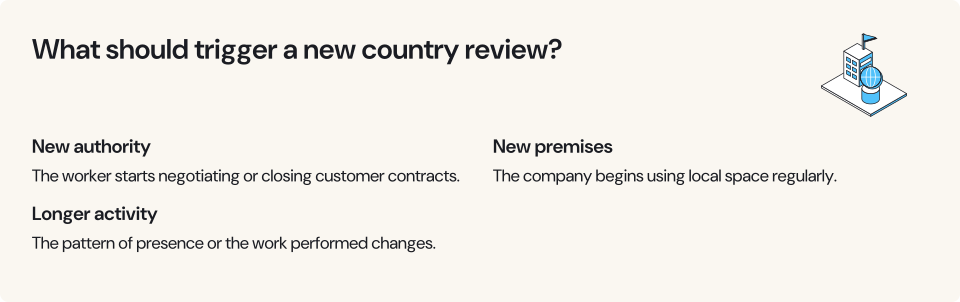
Assign someone to reopen the assessment if the employee starts negotiating contracts, moves into management or takes on new local revenue work. A new country or regular workplace, a longer or recurring stay, or a change to the entity or contract structure also warrants a review. Keep the earlier advice and tell the adviser exactly what changed.
10. Frequently asked questions
Does an employer of record eliminate permanent establishment risk?
Can a single remote employee create a permanent establishment?
Yes. One person’s activities can create a PE if the applicable domestic-law and treaty tests are met. In Danish ruling SKM2024.432.SR, the authority found a PE on the particular facts of a CEO working partly from a Danish home. Review the person’s actual duties, management and contract authority, working pattern and place available to the enterprise.
How many days can an employee work in a country before PE risk starts?
Is an employee's home office automatically a permanent establishment?
No. Relevant facts include whether the company requires the arrangement, pays for it or has a commercial reason for the person’s location. Assess those alongside the actual activities, working pattern, availability of the place and all other circumstances under domestic law and the applicable treaty. The Spanish V0066-22 ruling concerned its own facts and is not a universal safe harbour.
What taxes and costs can a permanent establishment create?
11. Sources
The sources behind this guide, grouped by topic. Dates show when we last checked a page.
Tax treaties and model conventions
8 sourcesInternational · OECD
Model Tax Convention on Income and on Capital, Article 5 and Commentary
Covers the 2017 condensed version and the 2025 Commentary update. The topic page lists the 2025 full Model, published 30 Sep 2026; historical 2017 and update references can coexist (checked 15 Oct 2026).
International · OECD
The 2025 Update to the Model Tax Convention
Used in the tax presence example. Checked 3 Oct 2026
International · OECD
Home and away: cross-border remote work
Used in the tax presence example. Checked 3 Oct 2026
International · KPMG
Navigating permanent establishment risk in a remote work era: the OECD’s 2025 Commentary
Dated Apr 2026.
International · OECD
BEPS Multilateral Instrument (MLI)
Articles 12 to 14: the principal-role agent test, conditional exemptions, anti-fragmentation and contract splitting. The India position document covers Articles 12 to 14.
Netherlands · Loyens & Loeff
Overview of MLI choices made by the Netherlands and neighbours
Covers the Dutch reservation against Article 12.
International · United Nations
UN Model Double Taxation Convention 2021
Article 5(3) sets the six-month construction PE threshold.
International · United Nations
UN Primer on Double Tax Treaties
Over 3,000 bilateral income tax treaties are in effect, most based largely on the UN and OECD Models. Checked Sep 2026
Rulings and court cases
5 sourcesSpain · Osborne Clarke
Spanish Directorate-General for Taxes binding ruling V0066-22
Ruling dated 18 Jan 2022.
Denmark · Kromann Reumert
Danish Tax Council binding ruling SKM2024.432.SR
Ruling dated 2 Sep 2024.
Denmark · Danish Tax Agency
Danish Tax Council binding ruling SKM2025.23.SR
Official text: decided 17 Dec 2024 and published 17 Jan 2025; covers the consultant’s work on ferries and one administrative day a month at home (checked Sep 2026). Azets’ summary is dated 19 Mar 2025.
India · IndiaCorpLaw
Formula One World Championship v. CIT, Supreme Court of India
Judgment dated 24 Apr 2017.
India · SCC Online
Hyatt International Southwest Asia v. ADIT, Supreme Court of India
Judgment dated 24 Jul 2025.
Tax rates, penalties and reassessment
6 sourcesSpain · Boletín Oficial del Estado (BOE)
Ley 58/2003 General Tributaria, consolidated text
Spain’s General Tax Law: article 66 sets the four-year limitation window and article 191 the penalty bands.
India · Income Tax Department
Income-tax Act 1961 statutes portal
Section 270A penalty rates and the section 149 reassessment window.
India · Income Tax Department
Income-tax Act 2025, amended by Finance Act 2026
Sections 17, 282, 392, 439 and 536 checked. Section 439 retains conditional 50% and 200% penalty rules; section 282 measures notice periods from the tax-year end; section 392 covers salary withholding and conditional eligible-startup treatment. Checked 15 Oct 2026
India · Central Board of Direct Taxes (CBDT)
Tax year 2026-27 onward uses the Income-tax Act 2025 reassessment provisions in sections 279 to 286. Earlier income periods and their penalty proceedings can remain under the Income-tax Act 1961 via section 536; the old section 149 reference can still apply. Checked 15 Oct 2026
India · UNCTAD
India cuts the corporate income tax rate for foreign companies to 35%
Under the Finance (No. 2) Act 2024.
International · PwC Worldwide Tax Summaries
Corporate income tax rates quick chart
Denmark 22%, Spain 25% and Germany about 30% combined.
PE turns on treaty wording and individual rulings.
If you spot an outdated or conflicting source, send it through the contact page and we’ll review it.
This guide is for general information only and does not provide legal, tax, accounting, or financial advice. For advice about your business, consult a qualified professional familiar with the rules where you hire. Read our research methodology to learn how we assess sources.