


Guide overview
IP for EOR employees, at a glance.
Trace the rights from the worker to your company.
Employee IP ownership depends on the country and the right involved. Patent rights, copyright and inventor compensation can follow different rules, including statutory claiming or payment procedures. In Canada, hiring someone to invent and the wider employment circumstances can affect patent ownership, so use a written assignment. For an EOR hire, document the applicable route from the employee or local employer to your company before work starts.
Rights involved
Identify the work
Distinguish patent rights, copyright and other relevant rights.
Local ownership
Review the country
Check the employment circumstances and applicable ownership rules.
Required process
Record the evidence
Confirm claiming, assignment and compensation procedures as applicable.
EOR chain
Complete the route
Document the relevant route from the worker or employer to your company.
Check before acting
Confirm the rights and required documents before work starts. A general statement about employer ownership is insufficient.
What to record in the worksheet
Scope
Work / right · Country · Creator and legal employer
Evidence and follow-up
Local entitlement / restriction · Transfer document · Notice / compensation / registration · Client evidence · Reviewer
Start with the right you need. For an invention, find out who can claim it and which local reporting steps apply. For a work protected by copyright, establish its first owner and check moral rights separately. In both cases, your company needs to know how the relevant rights can pass to it when an EOR employs the creator.
1. Employee IP rules a US template can miss
A standard Silicon Valley invention-assignment agreement does three things: it assigns all inventions to the employer in the present tense, treats salary as full consideration, and labels copyrightable output “work made for hire.” Each rests on a US assumption that fails somewhere abroad.
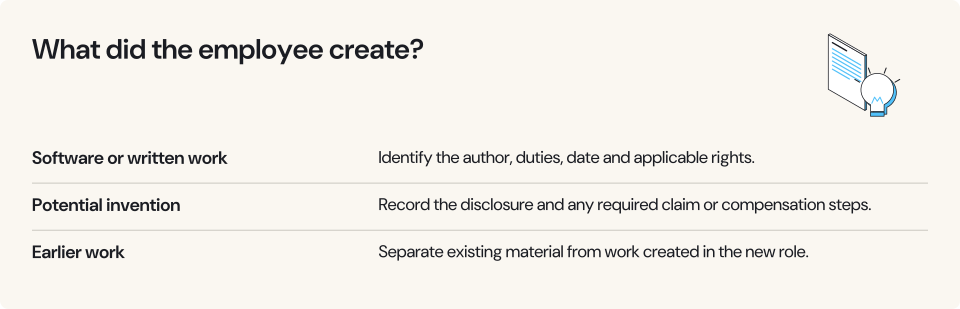
In Germany, France, and the Netherlands (by statute) and under the applicable China and Japan arrangements, inventor remuneration or reasonable-benefit rights require separate review. India does not transfer patent rights through employment without a written assignment, and Canada assesses the employment duties and circumstances, including whether the person was hired to invent. “Work made for hire” is a US Copyright Act definition.
If you hire through an employer of record (EOR), your IP is governed by the EOR’s local employment contract, so review its local IP terms before work starts. Gaps surface in due diligence, when an acquirer’s counsel asks for the chain of title and finds a missing German compensation file or an Indian copyright assignment subject to the five-year default because its duration was unstated, and fixing them then means chasing former employees for signatures. Section 7 and the 47-question EOR RFP checklist cover the checks to run on an EOR’s paperwork.
2. Employee IP rights and assignment checks in 12 jurisdictions
| Jurisdiction | Right and legal framework | Patent / invention ownership or claim to review | Separate copyright, compensation and formality checks |
|---|---|---|---|
Jurisdiction
Germany
|
Right and legal framework
ArbnErfG (Employee Inventions Act)
|
Patent / invention ownership or claim to review
Employer, via deemed claim 4 months after report
|
Separate copyright, compensation and formality checks
Compensation right cannot be waived in advance
|
Jurisdiction
France
|
Right and legal framework
IP Code Art. L611-7
|
Patent / invention ownership or claim to review
Employer (mission inventions)
|
Separate copyright, compensation and formality checks
Mandatory supplementary pay; blanket assignment of future works is void
|
Jurisdiction
UK
|
Right and legal framework
Patents Act 1977 ss. 39–42
|
Patent / invention ownership or claim to review
Employer (normal duties)
|
Separate copyright, compensation and formality checks
“Outstanding benefit” claims; Shanks got £2M from Unilever
|
Jurisdiction
Netherlands
|
Right and legal framework
Patent Act 1995 Art. 12
|
Patent / invention ownership or claim to review
Employer (hired to invent)
|
Separate copyright, compensation and formality checks
Fair-compensation right; waiver clauses are void
|
Jurisdiction
Poland
|
Right and legal framework
Industrial Property Law Arts. 11, 22
|
Patent / invention ownership or claim to review
Employer
|
Separate copyright, compensation and formality checks
Statutory remuneration applies unless the contract says otherwise
|
Jurisdiction
Japan
|
Right and legal framework
Patent Act Art. 35
|
Patent / invention ownership or claim to review
Employee, unless work rules vest it in employer
|
Separate copyright, compensation and formality checks
Reasonable-benefit rights depend on Article 35 vesting, transfer or exclusive-licence conditions
|
Jurisdiction
China
|
Right and legal framework
Patent Law Arts. 6, 15
|
Patent / invention ownership or claim to review
Employer
|
Separate copyright, compensation and formality checks
An agreement or rules adopted under the required legal procedure. Otherwise, statutory defaults apply to the grant reward and reasonable remuneration.
|
Jurisdiction
India
|
Right and legal framework
Patents Act 1970; Copyright Act ss. 17–19
|
Patent / invention ownership or claim to review
Employee (patents), absent assignment
|
Separate copyright, compensation and formality checks
Patent assignment is separate from copyright. Copyright §19 defaults: five years and India if duration/territory unstated.
|
Jurisdiction
Israel
|
Right and legal framework
Patents Law ss. 132–134
|
Patent / invention ownership or claim to review
Employer
|
Separate copyright, compensation and formality checks
A statutory committee sets pay unless the contract settles it
|
Jurisdiction
United States
|
Right and legal framework
Patent assignment/ownership rules; copyright separately under 17 USC §101
|
Patent / invention ownership or claim to review
Do not infer patent ownership from work-for-hire; inspect inventor title, assignment and applicable state-law limits
|
Separate copyright, compensation and formality checks
Copyright work-for-hire has its own employment/ |
Jurisdiction
Canada
|
Right and legal framework
Patent ownership under the actual employment/invention circumstances; Copyright Act separately
|
Patent / invention ownership or claim to review
Review duties, whether hired to invent, local rules and written assignment; no universal employer-patent default asserted
|
Separate copyright, compensation and formality checks
Copyright Act §13(3) is a conditional employment-copyright default; moral rights under §14.1 require separate treatment
|
Jurisdiction
Brazil
|
Right and legal framework
Law 9.279/96 Arts. 88–91
|
Patent / invention ownership or claim to review
Employer (R&D contracts)
|
Separate copyright, compensation and formality checks
Mixed inventions are co-owned 50/50 by default
|
Fig. 1 · Patent/invention ownership and separate copyright/formality checks across 12 jurisdictions
Check each kind of right separately
Use the jurisdiction sections for local detail. A single “all IP” clause can conceal different treatment of copyright, inventions and personal rights.
| Right / asset | Question for the local review |
|---|---|
Right / asset
Copyright
|
Question for the local review
Who first owns the work, and what transfer language and formalities apply?
|
Right / asset
Inventions / patents
|
Question for the local review
Are disclosure, employer claims, inventor compensation or registrations required?
|
Right / asset
Moral rights
|
Question for the local review
Which rights remain personal, and what consent or waiver is legally effective?
|
Right / asset
Pre-existing or third-party material
|
Question for the local review
What licence permits the company to use it?
|
3. Europe: Germany, France, UK, Netherlands, Poland
Germany
A blanket “all inventions are hereby assigned” clause is ineffective for patentable inventions, because the Employee Inventions Act (ArbnErfG) governs the transfer and its Section 22 voids any advance agreement that reduces the employee’s rights, including the right to compensation.
Follow the statutory process instead. The employee reports each service invention in text form under Section 5. The employer may claim it expressly; unless the employer releases it in text form within four months after receiving a due report, a claim is deemed under Section 6 (the rule since the 2009 amendment). Acquisition triggers reasonable compensation under Section 9. The calculation considers the invention’s economic value, the employee’s duties and position, and the employer’s contribution. Disputes go to the arbitration board at the German Patent and Trade Mark Office (DPMA). Name the reporting channel in the contract. Someone has to track the four-month deadline and keep the compensation file, so if an EOR is the employer, ask before the first hire which party does both.
France
Even when the employer owns an invention outright, French law (IP Code Art. L611-7) requires supplementary remuneration on top of salary. On the copyright side, a blanket assignment of future works is void under Art. L131-1.
An invention de mission, made under an inventive mission written into the job, belongs to the employer, which owes rémunération supplémentaire. Most collective bargaining agreements, including the 2022 Métallurgie agreement, set how that pay is calculated. The employer can claim an invention hors mission attribuable against a “juste prix,” and everything else stays with the employee. Where an inventive mission is genuinely part of the role, describe it accurately in the job documentation, state how the supplementary pay is set, and make copyright transfers list the rights, duration, and territory, as Art. L131-3 requires. The economic rights in software vest in the employer under Art. L113-9, with no extra pay owed. Moral rights never transfer in France, even with a waiver.
United Kingdom
Section 39 of the Patents Act 1977 already favors employers on ownership, but s. 40 lets the inventor claim a fair share if an invention proves to be of “outstanding benefit,” even decades later. Section 42 makes any contract term that diminishes the employee’s statutory rights unenforceable, so a contract cannot remove the s. 40 claim.
Define normal duties precisely, keep invention records, and treat s. 40 as a low-probability risk that arises when a single patent earns large sums. In Shanks v Unilever [2019] UKSC 45, the UK Supreme Court awarded Professor Ian Shanks £2 million as a fair share (5 percent, adjusted for the time value of money) of the roughly £24 million Unilever earned from his 1980s glucose-sensing patents.
Netherlands
Article 12(6) of the Dutch Patent Act 1995 gives the inventor a claim to fair compensation (billijke vergoeding) where salary does not cover the invention’s value, and Article 12(7) voids any contract term that removes that right.
Dutch courts treat the salary of staff hired for R&D as already including invention compensation and award extra money only in exceptional cases, so the contract should state that the role involves inventive work and that the salary reflects it. Any claim lapses three years after the patent is granted. For copyright, Article 7 of the Dutch Copyright Act vests employment works in the employer.
Poland
The employer acquires employment inventions by law (Industrial Property Law Art. 11(3)), but unless the contract says otherwise, Art. 22 gives the inventor a right to remuneration in “fair proportion” to the employer’s benefit, which Polish courts can increase if profits exceed the original estimate.
Unlike Germany, Poland lets you settle this by agreement, so state in the contract how invention remuneration is set or that salary covers it. For copyright, the employer acquires economic rights only on accepting the work and only within the contract’s purpose (Copyright Act Art. 12), so define that purpose broadly. Employee software vests in the employer by statute (Art. 74(3)). Polish creative employees often ask to split salary into base pay and a royalty for the copyright transfer, because personal income tax allows 50 percent deductible costs on the royalty portion, and your payroll provider, EOR included, has to support that split.
4. Asia and the Middle East: Japan, China, India, Israel
Japan
Under Patent Act Article 35, the right to a patent belongs to the employee from the start unless the employment contract or work regulations vest it in the employer in advance. Where Article 35 gives the employer rights through advance vesting, transfer or an exclusive licence, check the inventor’s reasonable-benefit entitlement and the required procedure.
Check that the work rules (shugyo kisoku) of whoever employs your hire in Japan contain a vesting provision and a benefit standard adopted after consultation, because an English side letter is no substitute. Since the 2015 amendment (effective 1 April 2016), such a provision gives the employer ownership from the moment of creation, and the “reasonable benefit” can be money, promotion, paid leave, or stock options. METI guidelines set the procedure for a valid benefit standard: disclose it, consult employees, and hear their opinions. The amendment responded to the Nakamura case, in which the Tokyo District Court ordered Nichia in January 2004 to pay ¥20 billion (about $180 million) to Shuji Nakamura, the blue-LED inventor, on his Article 35 claim. The case settled in January 2005 for about ¥840 million including interest, covering 191 patents.
China
The employer owns service inventions by law (Patent Law Art. 6), but Art. 15 makes inventor reward and remuneration mandatory. Without a written policy or agreement, statutory defaults apply, and they became more expensive in 2024.
Articles 92–94 of the revised Implementing Regulations distinguish an agreement or rules adopted under the required legal procedure from the statutory defaults. If no applicable agreement or rules specify the reward, Article 93 sets grant rewards of at least RMB 4,000 for an invention patent or RMB 1,500 for a utility model/design, within three months of grant. Article 94 addresses reasonable remuneration by reference to the law on promoting the transformation of scientific and technological achievements. An employee’s signature alone does not establish that the employer followed the required procedure. “Service invention” also covers inventions made mainly with the employer’s materials and technical resources. In an EOR setup, ask whose policy governs, the EOR entity’s or yours, and verify the applicable agreement or rules, how any rules were adopted and communicated, whether the terms are reasonable, and what the employer must pay.
India
The Patents Act 1970 has no employer-ownership rule, so without an express written assignment the invention stays with the employee. A copyright assignment that is silent on duration and territory is limited by statute to five years and to India (Copyright Act s. 19(5) and s. 19(6)).
Indian courts have refused to imply a patent assignment from employment alone (Bombay High Court, Darius Rutton Kavasmaneck v Gharda Chemicals, 2014), so the contract needs an express, present-tense assignment of patentable inventions with the consideration stated. Employee copyright vests in the employer under the “contract of service” rule in s. 17, but work by contractors or outside the employment scope needs a full s. 19 assignment that identifies the work, lists the rights, states the royalty or consideration, and spells out duration and territory so the five-year default never applies.
Israel
Service inventions vest in the employer (Patents Law s. 132), but unless an agreement settles the question, s. 134 gives the employee a right to compensation set by the statutory Compensation and Royalties Committee.
Israeli R&D contracts now routinely include an express service-invention clause covering the s. 131 notification duty, employer ownership, and an explicit waiver or settlement of s. 134 compensation, so check that your EOR’s Hebrew contract has the explicit version. Decisions since 2010 have settled most of the doubt about such waivers. The Supreme Court left the question open in Bayer v Plurality (2012), but in 2014 the Committee held that a former Iscar engineer’s general waiver of claims, signed when he left, covered his s. 134 compensation. In 2019 the Supreme Court rejected Dr. Ruth Levy’s petition against Teva, ruling that employees have no “vested right” to remuneration for service inventions.
5. The Americas: United States, Canada, Brazil
United States
Work-for-hire covers only copyright created by employees in the scope of employment (plus nine narrow commissioned categories), never patents. For patents, “agrees to assign” loses to “hereby assigns,” as the Federal Circuit held in Stanford v Roche (the Supreme Court affirmed in 2011 without reviewing that point). California and at least eight other states also void assignments of personal-time inventions.
Always use present-tense assignment language for patents, and respect the state carve-outs. California Labor Code §2870 protects inventions developed entirely on the employee’s own time without employer equipment, supplies, facilities, or trade secrets, unless they relate to the business or result from work for the employer, and §2872 requires written notice of that carve-out. Washington, Illinois, Minnesota, Delaware, Kansas, North Carolina, Utah, and New Jersey have similar statutes. Work-for-hire rarely covers contractor deliverables, so contractor agreements need their own express assignment.
Canada
The employer owns employment copyright (Copyright Act s. 13(3)), but moral rights cannot be assigned, and an assignment of copyright does not by itself waive them (s. 14.1), so without express waiver language your developer keeps the right to object to modifications of their work. For employee patent ownership, review the contract and the applicable common-law principles.
Put an express written moral-rights waiver in every Canadian employment and contractor agreement. Unlike French law, Canadian law allows one. Then add an express invention assignment rather than relying on the hired-to-invent presumption, which turns on multi-factor case law (the Federal Court’s Comstock v Electec, 1991, is the usual reference) and is best not tested in court.
Brazil
If the object of the employment contract is not research or inventive activity, an invention made with any company resources is co-owned 50/50 by employee and employer by default (Law 9.279/96 Art. 91), and the employee is owed fair remuneration for the employer’s exclusive exploitation.
Describe the employee’s actual duties accurately. Where the real role meets Art. 88’s research or inventive-activity conditions, review the resulting ownership route; do not add an inventive mission merely to obtain ownership. The co-ownership rule in Art. 91 gives way to an express contract term, so include one for mixed inventions. An employer that takes exclusive exploitation of a co-owned invention must start exploiting it within one year of the patent grant, or ownership passes to the employee under Art. 91 §3. Moral rights cannot be transferred, as in France. Employee-developed software belongs to the employer under Law 9.609/98 Art. 4.
6. Five issues to resolve under the local IP rules
The wording has to be localized, but every employment contract, yours or an EOR’s, should contain these five components.
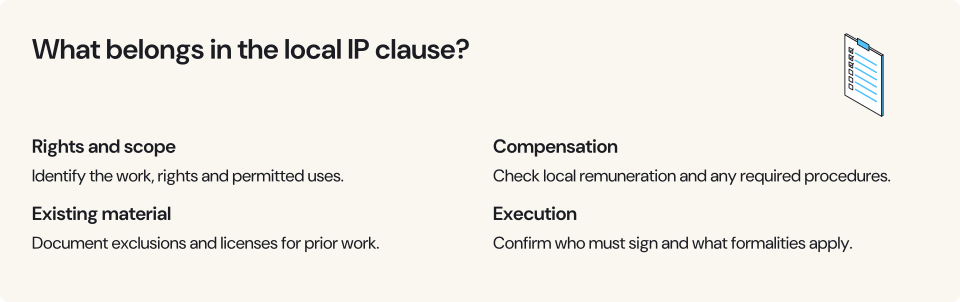
In due diligence, records matter more than clauses. Germany’s compensation file, Japan’s consultation procedure and China’s applicable agreement or reward-and-remuneration rules adopted under the required legal procedure need their supporting records. Keep evidence of the required reporting, adoption, communication and payments.
7. How IP assignment works when you hire through an EOR
For each country and type of right, find out who owns it first. Local law may vest it in the legal employer, require a claim or assignment, or allow a direct transfer to the client. If the EOR acquires the right, identify the document that then transfers it to your company. Include any local partner that acquires or transfers rights along the way.
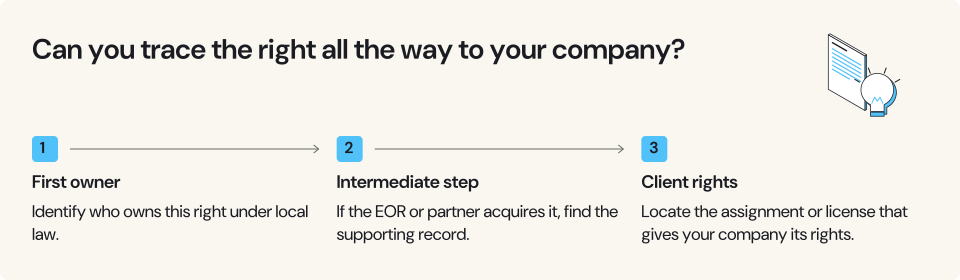
Before you sign, and before the first hire in any new country, work through these questions:
- Q1. Has the EOR shown you the IP clause from its local-language employment contract for this country?
- NO → Ask for it, and treat a wait of more than a week as a warning sign.
- YES → Continue to Q2
- Q2. Does your service agreement assign everything the EOR entity acquires onward to you, in present tense, with a further-assurances duty?
- NO → When you review the EOR agreement, ask for an assignment clause before you sign.
- YES → Continue to Q3
- Q3. Is it agreed in writing who runs the statutory procedures (German invention reports, Japanese work rules, Chinese reward policy) and who pays any inventor compensation?
- NO → Get it in writing, because inventor compensation costs money and someone owes it.
- YES → Continue to Q4
- Q4. Do the exit terms include a confirmatory IP assignment when you leave?
- NO → Add a confirmatory assignment to the exit terms and include it in your provider handover checklist.
- YES → IP evidence review complete.
In the EOR’s local contracts, also check for the ArbnErfG acknowledgment and reporting channel in Germany, the vesting provision and consulted benefit standard in Japan’s work rules, the applicable agreement in China or reward-and-remuneration rules adopted under the required legal procedure, the moral-rights waiver in Canada, and the §2872 notice in California offer letters.
Map the chain of title
Pick one asset and follow it from the creator to your company. Beside each step, record the legal basis and signed document, its effective date, the rights it covers and any excluded material or formalities. Include every partner or group entity in the chain. If one transfer is missing, ask for the document or local procedure that would complete it.
Download an IP evidence register
Give each asset or right a row. Keep the signed agreement with the local review, evidence of any required notice or compensation, and the record of any onward transfer to your company. Flag any gap before you rely on ownership.
| The working record | Fields to complete |
|---|---|
The working record
Scope
|
Fields to complete
Work / right · Country · Creator and legal employer
|
The working record
Evidence and follow-up
|
Fields to complete
Local entitlement / restriction · Transfer document · Notice / compensation / registration · Client evidence · Reviewer
|
Build an IP evidence file for each hire
A signed clause is only one part of the file. Track each type of work and every party through which title must pass.
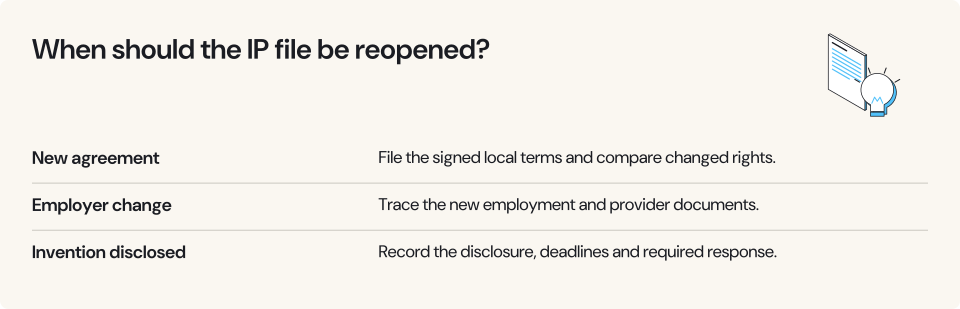
| File item | What it establishes | Keep current when |
|---|---|---|
File item
Role and work location
|
What it establishes
Which duties and jurisdictions the IP review covered.
|
Keep current when
The role, work country or engagement type changes.
|
File item
Local employment IP terms
|
What it establishes
Applicable ownership, assignment and statutory carve-outs.
|
Keep current when
A new contract or local-law update changes the terms.
|
File item
Onward transfer documents
|
What it establishes
How rights acquired by the employer or partner reach the client.
|
Keep current when
The employing entity, provider or contractual chain changes.
|
File item
Invention reports and decisions
|
What it establishes
Who reported the invention, when it was received and the claim or release decision.
|
Keep current when
A potentially patentable invention is disclosed.
|
File item
Compensation and moral-rights records
|
What it establishes
Required remuneration steps and locally valid consents or waivers.
|
Keep current when
Rights are claimed, exploited or additional payments become due.
|
File item
Exit confirmation and archive
|
What it establishes
Outstanding signatures, further assistance and accessible records.
|
Keep current when
The employee leaves or you switch EORs.
|
Review the checklist with local IP counsel. For example, a service invention in Germany brings statutory reporting and claim procedures into the review alongside the employment contract.
Distinguish copyright, inventions and moral rights.
Determine who owns each right and which transfers are permitted.
Complete any reporting, claiming, assignment, consent and inventor-compensation steps required locally.
Retain signed agreements, work records and transfer evidence.
The transfer route varies by jurisdiction, type of right and agreement.
8. Frequently asked questions
Does the EOR legally own my team's IP at any point?
Can a German employee claim extra pay for an invention made at work?
Is “work made for hire” valid outside the US?
Do these rules apply to contractors hired through a contractor-of-record?
Who pays statutory inventor compensation, me or the EOR?
9. Sources
The sources behind this guide, grouped by topic. Dates show when we last checked a page.
Employee IP law in Europe
9 sourcesGermany · German Patent and Trade Mark Office (DPMA)
Germany · German Patent and Trade Mark Office (DPMA)
Arbitration Board for employee invention disputes
Procedure and jurisdiction.
France · Légifrance
France · Légifrance
Convention collective nationale de la métallurgie of 7 February 2022
Cited for the invention remuneration method.
United Kingdom · legislation.gov.uk
Employee inventions. Compensation and unenforceable terms follow in Sections 40 to 42.
United Kingdom · Supreme Court
Netherlands · Business.gov.nl
Dutch Patent Act 1995, Article 12
Employee inventions and fair compensation.
Netherlands · Overheid.nl
Rijksoctrooiwet 1995 (Dutch Patent Act), consolidated statutory text
Includes Article 12.
Poland · ISAP (Polish Sejm)
Industrial Property Law of 30 June 2000, Articles 11 and 22
Employment inventions and inventor remuneration.
Employee IP law in Asia
6 sourcesJapan · Japanese Law Translation
Includes the 2015 amendment and the METI guideline reference.
China · National People’s Congress (NPC)
Law on Promoting the Transformation of Scientific and Technological Achievements, Article 45
Inventor remuneration of at least 50 percent of net transfer or licensing income, or at least 5 percent of operating profit. Checked Sep 2026
China · CNIPA
Patent Law implementing regulations, Articles 92 to 94
Where neither an agreement nor rules adopted under the required procedure set the payment, the default grant rewards are RMB 4,000 for an invention and RMB 1,500 for a utility model or design, within three months. Article 94 refers reasonable remuneration to the law on promoting the transformation of scientific and technological achievements. Checked 15 Oct 2026
India · India Code
Copyright Act 1957, Section 19
Mode of assignment.
India · Copyright Office
Section 19(5) supplies a five-year duration where the copyright assignment period is unstated; §19(6) addresses the territorial default. Checked 15 Oct 2026
India · Indian Kanoon
Darius Rutton Kavasmaneck v Gharda Chemicals, Bombay High Court 2014
No patent assignment implied from employment.
Employee IP law in the Americas
8 sourcesUnited States · Justia
Board of Trustees of Stanford University v Roche, 563 U.S. 776 (2011)
Affirmed the Federal Circuit, whose “hereby assigns” versus “agrees to assign” ruling the Court did not review.
United States · USPTO
MPEP 301: ownership and assignability
Patent ownership and written assignment are distinct from copyright work-for-hire. Checked 15 Oct 2026
United States · Copyright Office
Work-made-for-hire rules concern copyright, subject to employee or commissioned-work conditions. Checked 15 Oct 2026
United States · California Legislative Information
United States · Nevada Legislature
Unless a written agreement says otherwise, the employer owns work-related employee inventions; there is no personal-time carve-out like California’s. Checked Sep 2026
Canada · Justice Laws
Moral rights: no assignment, waiver only. Section 13(3) is an employment copyright default, subject to its conditions and agreement exceptions (checked 15 Oct 2026).
Canada · Justice Laws
Used in the intellectual property example. Checked 3 Oct 2026
Brazil · WIPO Lex
Law No. 9.279 of 14 May 1996 (Industrial Property Law), Articles 88 to 93
Commentary and news
5 sourcesChina · National Law Review
Revised Implementing Regulations of the Chinese Patent Law
Effective 20 Jan 2024.
Japan · Nichia Corporation
Settlement announcement in the Nakamura “reasonable remuneration” case, January 2005
Israel · Reinhold Cohn Group
The Bayer v Plurality decision and Israel Patents Law Section 134
Israel · Globes
C’tee dismisses patent claim against Iscar, 15 May 2014
The Compensation and Royalties Committee upheld a former engineer’s general waiver of claims. Checked Sep 2026
Israel · Herzog Fox & Neeman
No “vested right” to remuneration. Checked Sep 2026
If you spot an outdated or conflicting source, send it through the contact page and we’ll review it.
This guide is for general information only and does not provide legal, tax, accounting, or financial advice. For advice about your business, consult a qualified professional familiar with the rules where you hire. Read our research methodology to learn how we assess sources.