


Guide overview
How do you put an EOR raise or promotion into effect?
Approve the change, document it and confirm the payment route.
Cost the change, identify the required agreement or payroll instruction, and send the EOR the new terms and effective date. Complete the applicable consent and documentation steps in time, then verify payroll and any arrears. The legal effective date and provider processing cutoff are separate.
Employee change
Agree the terms
Record the raise or promotion and any required consent.
Legal effective date
Confirm the entitlement
Check local amendment and notice requirements.
Payment date
Plan the payroll
Give the provider complete instructions and resolve cutoff issues.
Related costs
Check the agreement
Review effects on service charges, deposits and any equity grant.
Check before acting
Keep the effective date and payment date separate. A payroll cutoff does not permit an unlawful delay.
What to record in the worksheet
Scope
Employee / country · Current terms · Requested change
Evidence and follow-up
Entitlement effective date · Payment date / cutoff · Document required · Approval / funding · Exception owner and status
Six checkpoints for a raise or promotion
Before telling the employee what will change, get the EOR to confirm these six items on the same request.
| Checkpoint | Write down | Why it matters |
|---|---|---|
Checkpoint
Scope of change
|
Write down
Salary, title, hours, allowances and any equity award.
|
Why it matters
Related changes can require different approvals or documents.
|
Checkpoint
Total employer cost
|
Write down
Gross increase plus incremental contributions, benefits and contractual charges.
|
Why it matters
Ceilings and fee terms can make a flat percentage misleading.
|
Checkpoint
Legal documentation
|
Write down
Required agreement, notice, signatures and filing obligations.
|
Why it matters
A platform request alone may not change the contract.
|
Checkpoint
Effective date
|
Write down
When the new entitlement legally starts.
|
Why it matters
This can differ from the processing date.
|
Checkpoint
Payment plan
|
Write down
First payslip, any arrears, off-cycle route and funding deadline.
|
Why it matters
A cutoff does not cancel an amount already due.
|
Checkpoint
Verification
|
Write down
Approved document, payroll preview and final payslip match.
|
Why it matters
Close the request only when both terms and pay agree.
|
For an equity refresh, involve the payroll and reporting owner before grant whenever the instrument or country requires it. Tax or reporting can arise before a cash settlement.
Approve the change, complete required documentation or consent, and establish the effective date.
Submit inputs, confirm when payment is due, and arrange any required arrears or off-cycle payment.
Check the payslip and any changes to employer costs, benefits, service fees or deposits.
Put the employment-document deadline and the payroll deadline on the same calendar. If you miss one, ask the EOR how to meet the employee’s entitlement under the applicable rules, including whether an extra payroll run is needed.
Which agreement a raise or promotion changes
Every EOR arrangement involves two contracts. Your service agreement with the EOR sets pricing, payment terms, liability and data processing. You sign it once (see EOR contracts: the 9 clauses to review), and pay changes may also affect a country schedule, deposit or fee calculation under its terms. Raises and promotions change the local employment contract between the EOR and your employee, which sets salary, job title, working hours and notice period.
Amendment, addendum or payroll instruction?
Three documentation routes are common, listed from most to least paperwork; confirm the instrument needed for each country and change:
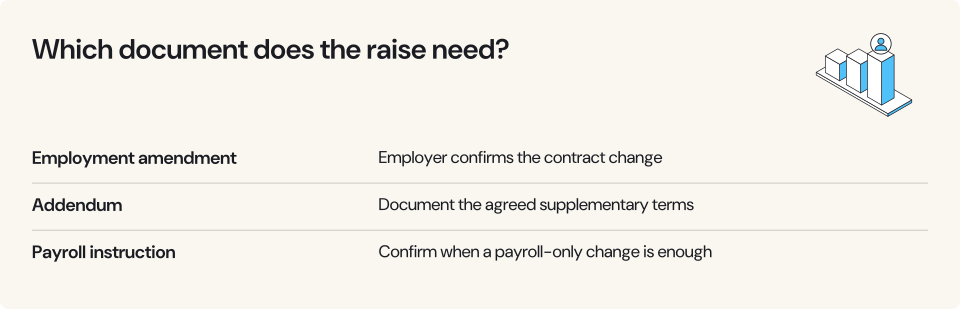
A contract amendment changes a term of the employment contract itself. The employee signs it, the EOR countersigns, and the new term replaces the old one. Remote requires an amendment for any salary or title change but auto-generates the amendment letter for a salary-only increase below +15% over 180 days, except in Germany, Portugal, Ukraine and Indonesia, where it says wet signatures are required or other complications exist. Since September 5, 2025, some Deel amendments, including gross salary and job title changes, no longer need additional review and can take effect immediately, depending on country regulations. Deel also accepts backdated effective dates, subject to compliance review.
An addendum is a supplementary document attached to the contract without rewriting its core terms, typically for a recurring car or remote-work allowance, a bespoke benefits arrangement or a retention bonus with conditions. Which of the two a change needs varies by country, so the EOR’s local counsel decides the form and you decide the substance.
A payroll instruction tells the provider what to process. For a payment already authorized by the contract or policy, an instruction may be sufficient, but confirm documentation, tax treatment and any approval duties. A new bonus entitlement, stipend or benefit change may need revised terms, employee consent or separate enrollment documentation.
Bundle title and salary changes. Put a promotion’s new title and salary in one amendment, with one effective date and one round of signatures. Two separate requests can add an extra review cycle and can put the title and the pay in different payroll months.
Match the change to its documentation and processing time
Confirm the required documentation, approval, effective date and payroll due date for the actual country and change.
| Change type | Instrument | Illustrative processing time |
|---|---|---|
Change type
Base salary raise
|
Instrument
Contract amendment (auto-generated at Remote for raises under +15%/180 days)
|
Illustrative processing time
1–2 weeks; submit by Remote's 5th-of-month amendment deadline
|
Change type
Job title change
|
Instrument
Contract amendment (title is an essential written term in Germany; filed with eSocial in Brazil)
|
Illustrative processing time
1–2 weeks; bundle with any salary change
|
Change type
Promotion (title + salary)
|
Instrument
One amendment covering both
|
Illustrative processing time
2–3 weeks including signatures
|
Change type
One-off bonus or commission
|
Instrument
Confirm existing terms; a payroll instruction may suffice
|
Illustrative processing time
Days; before the payroll cutoff (Remote 11th, Deel 20th)
|
Change type
Recurring allowance (car, remote stipend)
|
Instrument
Addendum or amendment, country-dependent
|
Illustrative processing time
3–4 weeks
|
Change type
Benefits tier upgrade
|
Instrument
Confirm plan eligibility, required consent, documents and enrollment window
|
Illustrative processing time
Next enrollment window, often 30 days
|
Change type
Equity refresh grant
|
Instrument
Grant agreement and any required local terms or disclosures
|
Illustrative processing time
Board cycle plus local tax, reporting and payroll review before grant
|
Change type
Working-hours change
|
Instrument
Contract amendment (essential term)
|
Illustrative processing time
2–4 weeks
|
Change type
Pay cut or demotion
|
Instrument
Amendment plus consent, heavily restricted by local law
|
Illustrative processing time
1–3 months, sometimes impossible (see local documentation rules)
|
Fig. 1 · Nine types of change mapped to instrument and lead time
A change to a written term may require an amendment, consent or notice; the formalities and lead time depend on local law and the provider, while a payment that leaves the contract unchanged still needs correct authorization, records, tax treatment and compliance with the contractual and statutory pay deadline. If in doubt, ask your EOR: “Does this change a term of the employment contract in this country?”
Local documentation rules: Germany, France and Brazil
Germany: document essential-term changes by their effective date. The Nachweisgesetz requires the employer to document essential terms, including pay composition and the job description; specified breaches can carry a fine up to EUR 2,000. Since January 1, 2025, qualifying essential-term documentation may be sent electronically in text form if it is accessible, saveable and printable and the employer requests evidence of receipt. Employees can still request written documentation, and the listed undeclared-work sectors are excluded. This documentation rule is separate from the form required for a fixed-term agreement: TzBfG §14(4) requires written form, while BGB §126a provides a qualified-electronic-signature mechanism where electronic form is legally available. Ordinary click-to-sign is not automatically sufficient. Confirm the clause and signing route with the EOR before signature. Remote excludes Germany from its automated salary-amendment flow; that is a provider process, not a rule that every EOR uses paper.
France: contractual pay changes need employee agreement. Salary is an essential contract term. Obtain the employee’s agreement and retain the appropriate written record rather than treating ordinary silence as acceptance. Article L1222-6 provides a separate procedure for changes proposed for economic reasons, with its own notice and response rules. Automatic legal or collective-agreement increases and changes to working conditions can follow different rules. Have the EOR identify the actual type of change and required document instead of assuming every change needs the same avenant.
Brazil: consent, no detriment and the applicable eSocial event. CLT Article 468 requires mutual consent and prohibits changes causing direct or indirect harm to the employee. Constitution Article 7(VI) prohibits salary reductions except through collective bargaining. Contract changes such as pay and role changes are reported through eSocial event S-2206. The general deadline is the 15th of the following month, or before the relevant monthly payroll events when the change affects their totals; special cases have different deadlines. Confirm the reporting owner and exact event timing with the EOR.
In all three countries, pay cuts range from hard to prohibited. If a role was leveled wrong and you need to correct pay downward, talk to the EOR’s local counsel before saying anything to the employee. Withdrawing a promised raise can create claims depending on the agreed terms, facts and applicable law.
Track the effective date and payroll deadline separately
The amendment deadline is the date by which the EOR needs the amendment request for that month’s payroll. At Remote it is the 5th: requests received later go into the following month’s payroll, and the signed amendment must be back before the payroll cutoff. If the provider names no separate amendment deadline, ask for it. Legal documentation may be due by the effective date, earlier than payroll’s operational cutoff.
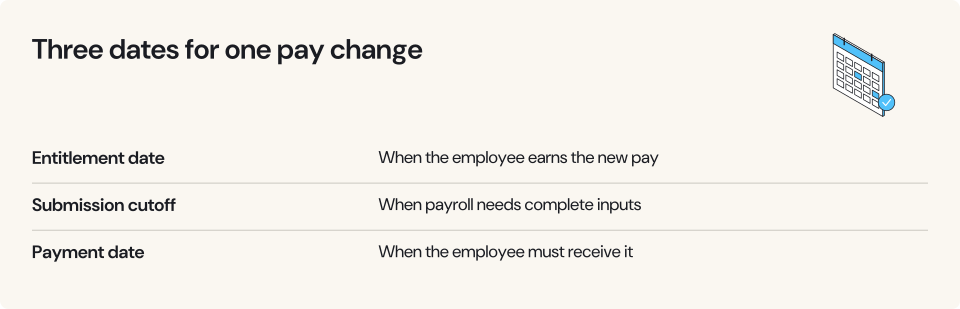
The payroll cutoff is when the month’s payroll inputs, including bonuses and expenses, freeze. Remote’s standard cutoff is the 11th at 23:59 UTC, with some countries on the 16th. Deel’s EOR cutoff is the 20th of the month in most countries, a change it first announced in 2023. For the full monthly cycle, see running payroll through an EOR.
Work back from the effective date. If the EOR needs to draft an amendment and collect signatures, ask whether two to three weeks is enough for this case. The legal documentation deadline still applies. A request on 25 June for a raise effective 1 July leaves little time for either signer.
Equity refreshes and scheme eligibility
An equity refresh usually has a separate plan and award documents. Before grant, the issuer needs to check who qualifies and obtain approvals. Ask the EOR which employment disclosures it needs and what information payroll will use for local tax and reporting.
Agree who will report the grant and any later vesting, exercise, settlement or sale that matters for this award under local rules. For each event, identify who reports, who withholds and who supplies the funds. Some duties may fall to the issuer or employee. Ask local counsel how the employment documents should refer to the award.
Assess the scheme’s issuer, actual employer or qualifying group, participant, instrument and tax conditions before selecting an award. Employment by an unrelated EOR can prevent an employee-employer or group condition from being met; EOR use alone is not a universal exclusion from every scheme. Germany’s §19a includes conditional group-company share rules as well as employer-company shares. Use the equity-for-EOR-employees guide to identify the relevant local questions, then obtain scheme-specific advice before promising tax treatment.
Retro pay when a change misses the operational cutoff
A missed operational cutoff does not remove an entitlement or authorize late payment. Ask the EOR to confirm when the employee becomes entitled to the new pay, any documentation still needed and a compliant payment route. If arrears are due, record the period and calculation separately and have payroll apply the relevant tax and social-contribution treatment; this is not uniform across countries.
If the ordinary run would miss an amount’s due date, ask for a compliant off-cycle or other payment solution. Remote supports off-cycle runs but warns that late submissions may not qualify, and several EORs charge a per-run fee. To avoid support tickets, tell the employee which payslip will first show the raise, make sure the retro line is labeled with the period it covers, and check the amount yourself: months paid at the old rate times the monthly difference.
Escalate exceptions with a payment plan
If the cutoff has passed, record the date the employee became entitled to the higher pay and ask payroll to confirm how to pay the difference and when it is due. If an amendment is outstanding, ask the legal employer and local reviewer which changes can take effect. Name the person who will fund the payment and tell the employee what to expect. Match payroll’s written confirmation to the payment and the updated records before closing the request.
A five-step raise and promotion example
Take a software engineer in Germany on EUR 90,000 who will become a Senior Software Engineer on 1 July. The promotion comes with a 12% raise.
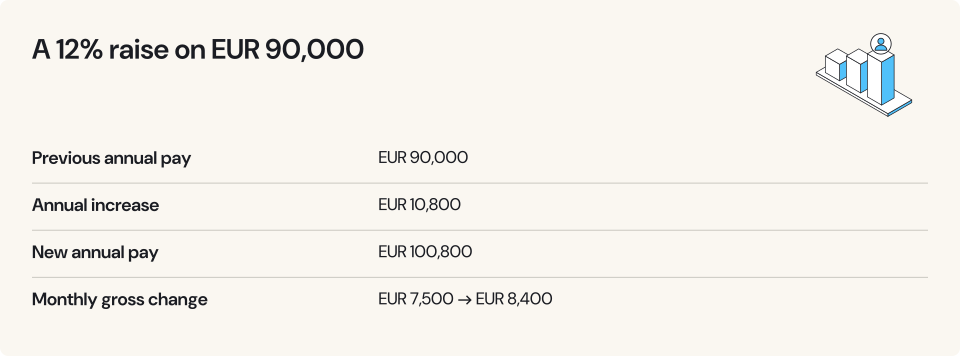
Step 1: Approve and cost it internally. The raise is EUR 10,800 gross per year (90,000 to 100,800, or EUR 7,500 to 8,400 per month). As a sensitivity assumption, a flat 22% employer-cost allowance would produce roughly EUR 13,200 of total incremental annual cost. Contributions use different rates and bases, and statutory ceilings matter: both salaries are above the 2026 health-insurance ceiling of EUR 69,750. Calculate the actual incremental contributions, levies and benefits for this employee instead of applying the allowance to the full raise. Work out the full cost in the global payroll calculator before the promotion conversation.
Step 2: Classify the change against the decision table. Title plus salary means one amendment covering both. Remote’s automated flow does not apply, even though 12% is under its +15%/180-day threshold, because the flow covers salary-only increases and excludes Germany. The Nachweisgesetz also requires the change to be documented by the effective date.
Step 3: Submit early, with the effective date attached. In the first week of June, submit the amendment request with only the new title, the new gross salary and the July 1 effective date. That leaves about four weeks for drafting and signatures before the July 1 documentation deadline, and the request is well ahead of Remote’s July 5 deadline.
Step 4: Complete signatures by July 1, then verify payroll. Once the employee and the EOR have signed, the platform shows the amendment as active. Then verify payroll processing before the provider’s cutoff, which for Germany is the 16th at Remote and the 20th at Deel. If documentation is still pending as July 1 approaches, escalate then and confirm which documents are needed and when the employee must be paid; do not wait for the payroll cutoff.
Step 5: Check the payslip and update your records. With the change processed on time, July gross pay should be EUR 8,400 and there should be no arrears line. Update the salary band and organization chart before announcing the promotion. If the employee also received an equity refresh, update the equity ledger.
Show the employer’s incremental cost
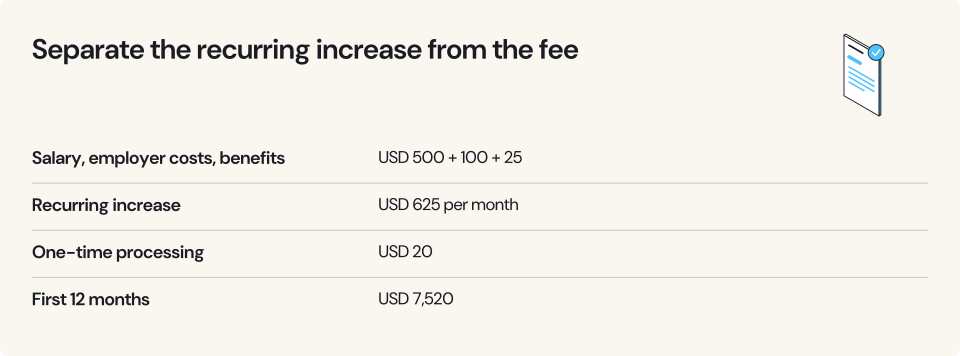
Suppose a USD 500 monthly raise adds USD 100 in employer costs and USD 25 in benefits each month. The recurring increase is USD 625, or USD 7,500 for twelve months. If the contract also charges USD 20 once to process the change, the first-year increase is USD 7,520. Enter your own figures in the workbook, including any proration, contribution caps, benefit changes and provider fees.
Download the compensation-change request and cost worksheet
Record the employee’s current and new pay or duties, the currency, legal employer and country. Give the entitlement date and the payroll payment date separate entries. Attach the required amendment and approvals, and mark any funding or local document still outstanding.
| The working record | Fields to complete |
|---|---|
The working record
Scope
|
Fields to complete
Employee / country · Current terms · Requested change
|
The working record
Evidence and follow-up
|
Fields to complete
Entitlement effective date · Payment date / cutoff · Document required · Approval / funding · Exception owner and status
|
EOR raise and promotion FAQs
Does a raise change my EOR fee?
Can we backdate a raise through an EOR?
Does the employee have to sign off on their own raise?
Does a title-only change need a contract amendment?
It can. The required documentation depends on the country, the change and the provider’s process. Remote treats any change to salary or job title as a contract amendment. Some countries require the job title or job description to be recorded in writing. Germany lists it in the Nachweisgesetz, and Brazil uses eSocial S-2206 for relevant changes. The deadline can be earlier than the following month’s 15th when the change affects payroll events. If the salary is changing too, put both in one amendment.
Can I cut pay or demote someone through an EOR?
Sources and policy check dates
The sources behind this guide, grouped by topic. Dates show when we last checked a page. Prices and terms change, so confirm them in your quote.
Employment law in Germany, France and Brazil
9 sourcesGermany · gesetze-im-internet.de
As amended by the Fourth Bureaucracy Relief Act, in force 1 Jan 2025. Section 3, on changes to particulars, is used in the pay change example, checked 3 Oct 2026.
Germany · Noerr
Employment-law changes under the Fourth Bureaucracy Relief Act
Covers text form for contract documentation from 1 Jan 2025 and the excluded sectors.
Germany · gesetze-im-internet.de
Kündigungsschutzgesetz (KSchG)
Sets the change-termination route (Änderungskündigung) for contract changes an employee does not accept.
Germany · gesetze-im-internet.de
BGB §126a: qualified electronic form
Subject to the applicable form rule.
France · Service-Public.fr
Modification of the employment contract
Under Code du travail Art. L1222-6.
Brazil · Planalto
Brazil · Planalto
Federal Constitution, Article 7(VI)
Salary reductions are barred except through collective bargaining.
Brazil · eSocial
eSocial MOS S-1.3 consolidated through July 2026: S-2206
Technical guidance landing page
Gives the S-2206 event and deadline conditions (checked 15 Oct 2026).
Contribution ceilings and equity tax rules
5 sourcesGermany · Federal Government
2026 social insurance contribution ceilings
Used in the cost example. Earnings above a ceiling are contribution-free.
Germany · Federal Ministry of Health (BMG)
Statutory health insurance contributions
The 2026 contribution ceiling is EUR 69,750 a year. Checked Sep 2026
Germany · gesetze-im-internet.de
Sets conditional employer and group-company share rules; it is not a universal EOR exclusion or instrument default. Checked 15 Oct 2026
United Kingdom · legislation.gov.uk
Sets scheme-specific employment and group conditions.
United States · IRS
Used in the pay change example. Checked 3 Oct 2026
Provider help centers and pricing
4 sourcesDeel
Requesting EOR contract changesPayroll cut-off dates2023 cutoff announcement
The payroll cut-off is the 20th of the month in most countries. The 2023 blog announcement extended EOR payroll cutoffs to the 20th in 46 countries.
RemoFirst
From $199 per employee per month. Checked Sep 2026
Remote
Amendment deadlinePayroll cutoffAutomated salary amendmentsOff-cycle payments
Amendment deadline: the 5th of the month. Payroll cutoff: the 11th at 23:59 UTC, or the 16th in some countries. Automated amendments cover salary-only raises under +15% over 180 days, except in Germany, Indonesia, Ukraine and Portugal. The off-cycle page covers what qualifies and why late submissions may not.
RemotePeople
Global from $499 per employee per month; Select from $199 in selected countries and qualifying employee salary ranges. Checked 16 Oct 2026
Our research
1 sourceThe Best EOR
How we rate EOR providers.
If you spot a changed price or a conflicting source, send it through the contact page and we’ll review it.
This guide is for general information only and does not provide legal, tax, accounting, or financial advice. For advice about your business, consult a qualified professional familiar with the rules where you hire. Read our research methodology to learn how we assess sources.