


Guide overview
Equity for EOR hires, at a glance.
Review eligibility, the award and payroll before you promise it.
An EOR employee may be able to receive an equity award, but the answer depends on the country, instrument, plan and individual. Check plan eligibility, securities rules, exchange controls and tax treatment before grant. Options, RSUs and cash-settled awards can trigger different obligations at grant, vesting, exercise, settlement or sale. Agree reporting and withholding responsibilities in advance. Moving to your own entity requires a fresh review of any tax-favoured scheme and existing awards.
Plan eligibility
Confirm the participant
Review plan definitions, the service relationship and required approvals.
Award structure
Compare the instruments
Assess options, RSUs and cash-settled alternatives separately.
Country review
Check local obligations
Review securities, exchange controls and instrument-specific tax events.
Payroll and reporting
Name the owners
Agree reporting, withholding and funding responsibilities before grant.
Check before acting
An entity move needs a fresh review of any tax-favoured scheme and existing award. Keep unresolved conditions in the offer record.
What to record in the worksheet
Scope
Award / employee · Country and employer · Plan eligibility
Evidence and follow-up
Event / date · Tax and reporting review · Withholding / recharge owner · Evidence · Approval status
What will the employee own, and when can they turn it into cash? For options, add the price the person would have to pay to exercise. For any award, identify the events that may trigger tax or reporting and who will fund payroll charges. Check that the plan permits the award before describing it in the offer.
1. How EOR employment affects equity-plan eligibility
Read the plan’s definition of an eligible participant against the actual employment arrangement. Your company receives the person’s services, but the EOR is their legal employer. If the plan restricts awards to employees of the issuer or its group, find out whether this person qualifies before proceeding.
Clear these checks before promising an award
Keep a separate record for each proposed award and country. Permission under the plan, permission to offer the award under securities law and eligibility for a tax concession each need their own answer.

| Decision | Evidence needed | Who should confirm |
|---|---|---|
Decision
Can this person receive the award?
|
Evidence needed
Plan definitions, service relationship and required approvals.
|
Who should confirm
Issuer’s equity counsel.
|
Decision
Do local rules allow the issuer to offer the award?
|
Evidence needed
Applicable securities exemption, disclosures and local offer rules.
|
Who should confirm
Issuer and local securities counsel.
|
Decision
When can tax arise?
|
Evidence needed
Grant, vesting, exercise, settlement and sale analysis for this instrument.
|
Who should confirm
Local tax adviser; do not use a generic country label.
|
Decision
Who reports and withholds?
|
Evidence needed
Event reporting, valuation, currency and funding instructions.
|
Who should confirm
Issuer finance team and the EOR’s payroll owner.
|
Decision
Can the employee fund it?
|
Evidence needed
Exercise price, potential withholding and realistic liquidity route.
|
Who should confirm
Issuer and employee, with clear award communications.
|
Decision
What happens at a move or exit?
|
Evidence needed
Leaver terms, service continuity, provider switch and any replacement award.
|
Who should confirm
Equity counsel before cancellation or regrant.
|
If you move to your own entity, review eligibility, timing and any amendment or replacement award.
Confirm who can participate under the actual scheme.
Check the award instrument, country and relevant taxable events.
Assign reporting, withholding and funding responsibilities.
Explain the award and its conditions before acceptance.
Complete required approvals and documents.
Suggested pre-grant review.
Plan eligibility. Most equity incentive plans limit participants to employees, directors and consultants of the company and its subsidiaries, and an EOR worker’s eligibility depends on the plan definitions and actual service relationship. An award to an ineligible person can be void, so confirm eligibility and any required approvals before choosing or amending a participant category.
US securities law. Private US companies grant equity under SEC Rule 701, which exempts compensatory offerings to employees, directors, general partners, officers and bona fide consultants and advisors of the issuer and its majority-owned subsidiaries. EOR staff are neither the issuer’s employees nor obviously consultants. The SEC’s 1999 Rule 701 adopting release expressly discusses de facto employment and qualifying consultants. Counsel should assess the facts, the plan and the exemption’s conditions for each EOR worker. Its November 24, 2020 proposal to extend Rule 701 and Form S-8 to “platform workers” was never adopted, so as of June 2026 no category explicitly covers EOR-employed staff.
Qualified-scheme eligibility. Check the employer and group conditions for each proposed tax-favored scheme: EMI in the UK, BSPCE in France, Section 102 in Israel, the Section 19a deferral in Germany and the ESS start-up concession in Australia. US incentive stock options (IRC Section 422) have issuer, parent or subsidiary employment conditions. An unrelated EOR arrangement does not satisfy those conditions. Assess non-qualified options, RSUs and other awards separately under the plan and applicable tax rules.
2. Four award structures to assess for EOR hires
Availability and tax treatment depend on the country, plan and individual circumstances.
| Structure | The worker gets | Tax moment | Offering rules and filings |
|---|---|---|---|
Structure
Direct equity (NSOs, options, shares)
|
The worker gets
Real options or shares under your plan
|
Tax moment
Instrument-specific: review grant, vesting, exercise and sale
|
Offering rules and filings
Check offering exemptions and required disclosures. Rule 701 is a US registration exemption; local filing requirements need separate review.
|
Structure
Phantom equity (VSOP, SARs)
|
The worker gets
A contractual cash promise that tracks share value
|
Tax moment
Usually employment income on payment; check earlier tax and social-charge triggers
|
Offering rules and filings
Check local regulatory and reporting rules
|
Structure
RSUs and eligible trustee arrangements
|
The worker gets
Rights to shares delivered at vest; a trustee can hold them until sale
|
Tax moment
Vest, settlement, sale or trustee release may matter; confirm the instrument and applicable track
|
Offering rules and filings
Review the underlying share offering and any required plan or trustee-regime filings.
|
Structure
Cash-based LTIP
|
The worker gets
A multi-year bonus tied to valuation or KPI targets
|
Tax moment
Usually employment income on payment; check earlier tax and social-charge triggers
|
Offering rules and filings
Review the actual instrument, local regulatory classification and reporting; do not assume no filing
|
Fig. 1 · Four equity and cash-linked structures to assess for EOR hires: instrument, tax timing, offering rules and filings
A direct grant can give the worker a stake in the company, subject to the instrument and its terms. Check who qualifies and when withholding is due. Options and restricted stock units can trigger tax at different points. A cash-settled plan avoids issuing shares, but still needs local employment, tax and regulatory review. Whether a trustee can hold shares depends on the country and scheme.
Track the award by event
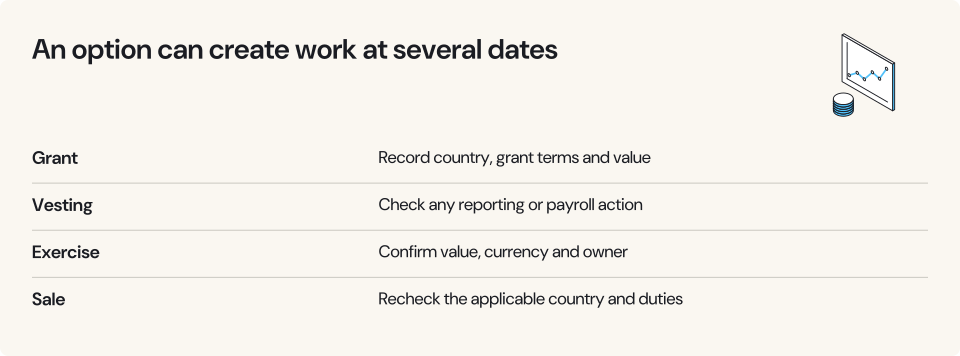
In this example, the company approves an option grant, the options vest, and the employee exercises them and later sells the shares. At each step, record the country, valuation and who has to report or withhold. Add a review if the employee relocates or their employment ends. A cash-settled award can follow a different sequence.
3. Tax rules in four countries: UK, Germany, India, Brazil
UK: verify EMI and other scheme eligibility. Qualifying EMI options can avoid Income Tax and National Insurance at exercise where the statutory conditions are met, including the grant-value and exercise rules. A grant discount or disqualifying event can change that treatment. A later share sale can create a capital gain; Business Asset Disposal Relief is conditional, with an 18% rate from 6 April 2026. But the option holder must be an employee of the issuing company or its qualifying subsidiary, working at least 25 hours a week or 75 percent of their working time for it (ITEPA 2003, Schedule 5; HMRC manual ETASSUM53020), so an unrelated EOR employment relationship does not satisfy the issuer-group condition. Check the actual employer, group and service facts. Unapproved options remain possible, but the exercise gain can be employment income. Applicable rates depend on the individual, tax year and UK nation; Scottish rates differ. If the shares are readily convertible to cash, National Insurance applies too, including employer NIC at 15 percent since April 6, 2025, which the EOR pays and recharges to you.
Germany: check the Section 19a employer/group conditions. Section 19a EStG defers tax on discounted employee shares so that employees are not taxed on shares they cannot yet sell. The Future Financing Act (Zukunftsfinanzierungsgesetz, in force January 1, 2024) made it more useful: the size tests are fewer than 1,000 employees and annual turnover no more than EUR 100 million or a balance-sheet total no more than EUR 86 million, met at transfer or in one of the preceding six calendar years. The employer must be no more than 20 years old. Group awards require the statutory group-wide size and age conditions, and employee consent is required. Tax can arise on transfer of the shares, after 15 years or at employment end; the statutory employer-liability election can defer the latter two triggers. The separate annual tax-free allowance rose from EUR 1,440 to EUR 2,000. The Annual Tax Act 2024 (December 2024) extended it to shares in the employer’s group companies. An unrelated EOR is not part of the issuer’s group merely because its employee works for you. Establish the actual employer/group and scheme conditions before assuming a deferral. Non-qualified options can create wage income at exercise; RSUs and other instruments need their own timing analysis. Compare cash-settled VSOPs with the proposed direct award.
India: separate the tax event from award eligibility. For current periods, Income-tax Act 2025 §17(1)(d) and §17(4)(h) address specified securities/sweat equity and exercise-date value less the amount paid; §392 covers salary withholding, with the 2026 valuation rules. Earlier periods can retain the Income-tax Act 1961 under the transition rules. Eligible-startup deferral, issuer/employee relationships, the instrument and the overseas-investment route require their own review.
Brazil: capital-gains treatment is now possible, with conditions. On September 11, 2024, the Superior Court of Justice (STJ) decided Theme 1226 (REsp 2,069,644): a standard stock option plan is mercantile rather than remuneration, so income tax falls at resale as a capital gain, not at exercise. To get that treatment, the employee must pay an exercise price and bear market risk, and labor courts can still reclassify free grants and guaranteed-value awards as remuneration, with social charges attached. A statutory framework (Bill 2,724/2022) passed the Senate in August 2023 and, as of September 2026, is still pending in the Chamber of Deputies. Compare the actual direct-option and cash-settled awards under their respective tax and employment conditions.
Go straight to the country review
Use the country table for the local questions, then return to plan eligibility and the award structure.
4. Country review points for options and alternatives
The table mainly covers non-qualified options. RSUs and other awards can have different events at grant, vesting, settlement and sale. Confirm the exact instrument and employee facts before using a row.
| Country | Direct-award eligibility and restrictions to review | Option tax point to review; RSUs may differ | Possible structures to investigate, subject to approval |
|---|---|---|---|
Country
United States
|
Direct-award eligibility and restrictions to review
Check IRC Section 422 issuer, parent or subsidiary employment conditions for ISOs; unrelated EOR employment alone does not satisfy them. Confirm Rule 701 coverage separately.
|
Option tax point to review; RSUs may differ
NSOs: spread generally employment income at exercise. RSUs: review vesting/settlement and payroll-tax timing
|
Possible structures to investigate, subject to approval
NSOs with valuation review; assess RSUs separately
|
Country
United Kingdom
|
Direct-award eligibility and restrictions to review
Check the actual issuer/group employment and scheme conditions for EMI or CSOP (ITEPA 2003, Schedules 4 and 5); do not infer eligibility from the EOR label. Assess unapproved awards separately.
|
Option tax point to review; RSUs may differ
Exercise: income tax, plus NICs if shares are readily convertible (employer NIC 15% since April 2025)
|
Possible structures to investigate, subject to approval
Unapproved options or phantom
|
Country
Germany
|
Direct-award eligibility and restrictions to review
Review the actual employer/group and share conditions for §19a; unrelated EOR employment alone does not create eligibility.
|
Option tax point to review; RSUs may differ
Exercise: spread is wage income
|
Possible structures to investigate, subject to approval
VSOP (virtual options): compare with available direct awards
|
Country
France
|
Direct-award eligibility and restrictions to review
For BSPCE or free shares (AGA), assess the specific issuer, recipient, employer/group and award conditions. EOR employment alone does not create eligibility.
|
Option tax point to review; RSUs may differ
Exercise gain taxed as salary-type income with social charges
|
Possible structures to investigate, subject to approval
Compare cash awards; review BSPCE eligibility after any entity move
|
Country
Netherlands
|
Direct-award eligibility and restrictions to review
Possible; confirm plan eligibility and Dutch tax timing
|
Option tax point to review; RSUs may differ
Exercise if the shares are tradable then; otherwise when they become tradable, unless the worker elects tax at exercise (election available since January 1, 2023)
|
Possible structures to investigate, subject to approval
Direct NSOs through EOR payroll
|
Country
Spain
|
Direct-award eligibility and restrictions to review
Yes, but the Startup Law's €50,000 exemption and 10-year deferral (Ley 28/2022) need startup employment
|
Option tax point to review; RSUs may differ
Exercise: employment income
|
Possible structures to investigate, subject to approval
Phantom
|
Country
Poland
|
Direct-award eligibility and restrictions to review
Yes, but deferral to sale (Art. 24(11) PIT Act) needs income from the issuer's group
|
Option tax point to review; RSUs may differ
Risk of tax at exercise, then 19% on sale; take local advice
|
Possible structures to investigate, subject to approval
Phantom or RSUs
|
Country
India
|
Direct-award eligibility and restrictions to review
Check current overseas-investment rules against the issuer, employee relationship and actual award; EOR employment alone does not create eligibility
|
Option tax point to review; RSUs may differ
Current 2025 Act §17 perquisite and §392 salary withholding; distinguish exercise/settlement and later sale, instrument and historical period
|
Possible structures to investigate, subject to approval
Compare a direct award with a cash-linked alternative only after tax, exchange-control and payroll review
|
Country
Singapore
|
Direct-award eligibility and restrictions to review
Possible; confirm local reporting and departure rules
|
Option tax point to review; RSUs may differ
Exercise: employment income; no capital gains tax; exit charge on unexercised awards when foreigners leave
|
Possible structures to investigate, subject to approval
Direct NSOs or RSUs
|
Country
Australia
|
Direct-award eligibility and restrictions to review
Yes, but the ESS start-up concession needs employer-group equity
|
Option tax point to review; RSUs may differ
Vest or exercise under Div 83A; deferral up to 15 years in qualifying schemes
|
Possible structures to investigate, subject to approval
Direct options with advice, or phantom
|
Country
Canada
|
Direct-award eligibility and restrictions to review
Yes, but the 50% option deduction likely fails without issuer employment
|
Option tax point to review; RSUs may differ
Exercise, fully taxable without the deduction
|
Possible structures to investigate, subject to approval
Cash-settled RSUs or phantom
|
Country
Brazil
|
Direct-award eligibility and restrictions to review
Yes. STJ Theme 1226 (Sept 2024) treats paid-for plans as mercantile
|
Option tax point to review; RSUs may differ
Sale: capital gains, if the worker pays a real strike and bears risk
|
Possible structures to investigate, subject to approval
Direct options with mercantile features, or phantom
|
Country
Mexico
|
Direct-award eligibility and restrictions to review
Confirm the actual plan, service relationship and local securities/tax conditions
|
Option tax point to review; RSUs may differ
Exercise: salary-type income; withholding needs a recharge to the EOR
|
Possible structures to investigate, subject to approval
Phantom or payroll bonus
|
Country
Israel
|
Direct-award eligibility and restrictions to review
Awkward: the Section 102 trustee track needs an Israeli employing company
|
Option tax point to review; RSUs may differ
Confirm the applicable Section 102 track, trustee and holding requirements, tax point and any employment-income component. Other awards need their own Section 3(i) or employment-tax analysis.
|
Possible structures to investigate, subject to approval
ITA pre-ruling or phantom; many wait for an entity
|
Fig. 2 · Direct-grant feasibility, tax moment, and common EOR structure across 14 countries
Use the table to sort your hiring list, then obtain country- and instrument-specific legal and tax review before granting. Singapore, the Netherlands and the US still require instrument-specific review. For the UK, Germany, France, Spain, Poland, Australia and Israel, check the particular scheme’s issuer, employer, group and award conditions before assuming a tax advantage is available. Compare the eligible awards and review any replacement grant separately if you convert to your own entity. For India, assess exchange-control requirements separately from tax and securities rules; their relative importance depends on the award and worker.
5. Phantom equity
Phantom equity (virtual options, VSOPs, stock appreciation rights) gives the worker contractual units, not shares. The units mirror your cap table, with a strike value, a vesting schedule and usually your real plan’s acceleration and leaver terms. On exit or another liquidity event, the company pays cash equal to the unit gain, which the EOR runs through payroll as a bonus.
Cash-settled awards avoid issuing shares, but local plan, securities, exchange-control and employment requirements still need review. Confirm that the EOR can process the proposed instrument and reporting in that country before grant. Agree documentation, valuation, funding and lead time.
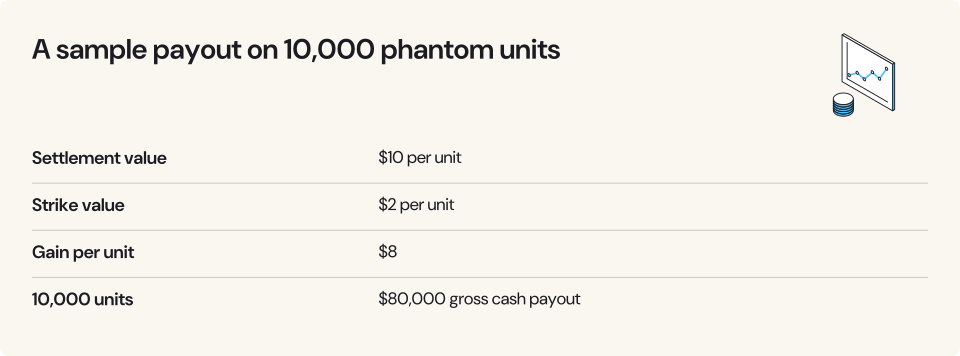
Suppose 10,000 phantom units settle at $10 each against a $2 strike. The $8 gain per unit gives a gross cash payout of $80,000. Before comparing it with a share grant, calculate the employee’s tax, any payroll withholding, employer charges and the EOR’s fee.
A phantom award is a contractual cash claim rather than share ownership. If the debtor fails, the claim’s ranking depends on the actual debtor, award/employment terms, jurisdiction and insolvency rules; employee remuneration can have different priorities from ordinary unsecured debt. Review any conversion clause for eligibility, consent, valuation and tax consequences.
6. RSUs and trustee structures
RSUs remove two things workers dislike about options: paying a strike price and choosing when to exercise. Employment-income timing can fall at vesting or settlement, with possible separate social-charge and later disposal consequences, and in a liquid company withholding can be covered by selling part of the delivered shares. Direct RSUs may suit a hire who should not have to fund an exercise price, provided eligibility, liquidity and tax timing work for that person. The eligibility questions in section 1 still apply, but payroll handles a fixed vesting schedule instead of exercises in random months.
An RSU that vests with no market for the shares can leave the worker owing cash tax on shares they cannot sell. Most private issuers avoid this dry-income problem with double-trigger vesting: units settle only after both time served and a liquidity event, but local tax rules decide whether delayed settlement also delays each tax or social-charge obligation.
Trustee structures place a third party between the worker and the shares. For Israel’s Section 102, confirm the chosen track, eligible employer–issuer relationship, filing, trustee and holding conditions before promising capital-gains treatment. The tax point and any employment-income component depend on the actual award and track. An unrelated EOR does not satisfy the employing-company conditions. Ask Israeli advisers whether the proposed arrangement needs an ITA ruling and whether Section 3(i) applies to each instrument without one. Elsewhere, trustee and nominee arrangements can simplify the shareholder register, but they are not automatically tax-neutral. UK employee benefit trusts have their own scheme, contribution and employee-tax rules.
7. Cash LTIPs: when to skip equity entirely
A cash long-term incentive plan is a multi-year bonus tied to company outcomes: a valuation multiple, revenue targets or a fixed schedule. One example is $30,000 paid in three tranches over 36 months, each conditional on continued engagement and a company KPI. It vests and helps retention like equity, but its employment, deferred-compensation, tax, exchange-control and approval requirements still need local review. Cash settlement alone does not make the cost deductible or remove every regulatory issue.
Compare that cash bonus with what the employee could receive under a share award. In this example, even a tenfold rise in the company’s value leaves the maximum bonus at $30,000. The service and performance conditions still apply. If the bonus is meant to bridge a move to your own entity, specify how long it lasts and what happens on transfer. Any replacement grant needs its own eligibility and tax review.
8. Choosing a structure per country
- Q1. Will you open your own entity in this country within ~24 months?
- YES → Compare interim awards only after local review. Before any entity move, assess scheme eligibility and the tax effects of retaining, amending or replacing the award.
- NO → continue to Q2
- Q2. Is the country suitable for direct grants in the section 4 table (US, UK unapproved, NL, SG, AU, BR)?
- YES → Assess NSOs and RSUs separately. Get written counsel sign-off on plan eligibility and Rule 701, and budget for the instrument’s specific tax, social-charge and reporting events.
- NO → continue to Q3
- Q3. Does the offer need equity upside to close (senior hire, competing against equity-heavy offers)?
- YES → Compare a cash-linked award only after checking the instrument, employee, country, tax, reporting, funding and payroll conditions. Assess any Israeli ruling route separately.
- NO → Cash LTIP on the same vesting dates: subject to local approval, employment and tax review; compare administration cost and employee outcomes.
Compare the instrument against the actual employee, country and issuer. A cash-settled alternative also needs eligibility, tax, regulatory and payroll review. Include valuation, funding, employer charges and administration in the cost of EOR hiring.
9. Withholding, recharges, and the EOR contract
Before grant, identify the events the issuer, EOR and employee each have to report and which ones require payroll withholding. A taxable event may occur before anyone receives cash.
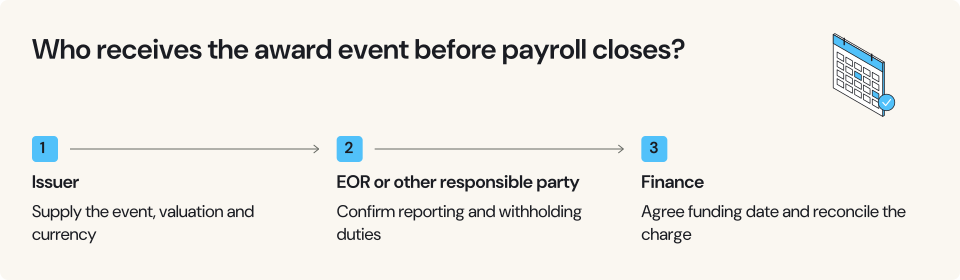
Event reporting. For this award and country, check which events require notice, from grant and vesting through exercise, settlement or sale. Name who will supply the valuation, in which currency and by what date. Set out who reports or withholds and how the agreement treats costs if notice arrives late.
A recharge agreement. Where the EOR handles withholding or employer charges, agree the funding deadline before the relevant payroll run, any permitted employee recovery and the invoice timing. A tax gross-up is a separate promise: record whether one is offered and who funds it. When choosing a provider, ask in your RFP whether it has processed equity events in your target countries and what it charges per event.
Contract clauses. Before the first grant, your EOR agreement should name who calculates taxable value, who files employer securities reports where they exist (the UK’s annual ERS return, Australia’s ESS statements), the per-event admin fee and what happens to awards if you switch providers. Have the plan, award and employment documents reviewed together for any effects of a provider switch. Align the documented parties and responsibilities with your IP assignment clauses, and see the 9 EOR contract clauses to negotiate.
Agree the parties and continuity before granting. Counsel should confirm who issues the award, who administers it and who has withholding duties. Review what a provider switch, employment transfer or insolvency would do to the rights. EOR administration and being a party to the award are separate decisions; the appropriate structure depends on the plan and local rules.
Record approval before promising the award
Record the issuer and the legal employer alongside the employee’s country. Keep the eligibility decision, advice, award terms and valuation with the offer, including any approval still outstanding. Use a row for each later event and name who will handle withholding or reimburse the EOR.
| The working record | Fields to complete |
|---|---|
The working record
Scope
|
Fields to complete
Award / employee · Country and employer · Plan eligibility
|
The working record
Evidence and follow-up
|
Fields to complete
Event / date · Tax and reporting review · Withholding / recharge owner · Evidence · Approval status
|
10. Frequently asked questions
Can you grant stock options to employees hired through an EOR?
Is phantom equity a security?
What happens to grants when you replace the EOR with your own entity?
Who withholds tax when an EOR employee exercises options?
Are RSUs better than options for EOR employees?
Can an EOR employee in Israel get Section 102 treatment?
11. Sources
The sources behind this guide, grouped by topic. Dates show when we last checked a page.
Securities law, plan eligibility and insolvency
6 sourcesUnited States · SEC
Employee benefit plans, Rule 701
Covers the compensatory offering exemption. The 1999 adopting release is used in the equity example, checked 3 Oct 2026.
United States · SEC
Proposed temporary rules for “platform workers” under Rule 701 and Form S-8
Proposed 24 Nov 2020 and not adopted.
United States · Cornell Law School (LII)
26 U.S. Code Section 422, incentive stock options
Its employee-of-issuer requirement limits EOR hires to NSOs.
Freshfields
Covers equity plan eligibility and IP for workers employed outside the issuer’s group.
United Kingdom · legislation.gov.uk
Insolvency Act 1986, section 107
Company liabilities are paid pari passu before any distribution to members. Checked Sep 2026
United Kingdom · Insolvency Service
Official Receivers guidance 43
Distinguishes preferential employee remuneration and holiday debts from other claims. Checked 15 Oct 2026
Tax rules in the UK, Germany, India and Brazil
15 sourcesUnited Kingdom · HMRC
ETASSUM53020: EMI working-time commitment
Under ITEPA 2003, Schedule 5.
United Kingdom · legislation.gov.uk
Income Tax (Earnings and Pensions) Act 2003, Schedule 4
Covers CSOP schemes and their employment requirement. Checked Sep 2026
United Kingdom · HMRC
Employee benefit trusts and scheme rules
Checked 15 Oct 2026
United Kingdom · HMRC
EBT contribution and employee-tax treatment
Checked 15 Oct 2026
United Kingdom · GOV.UK
Employment related securities: registering schemes and filing the annual ERS return
United Kingdom · GOV.UK
Business Asset Disposal Relief
The rate is 14% for 2025 to 2026, rising to 18% from 6 Apr 2026.
United Kingdom · GOV.UK
Rates and thresholds for employers 2025 to 2026
Employer National Insurance is 15% from 6 Apr 2025.
Germany · gesetze-im-internet.de
Income Tax Act (EStG), section 19a
As amended by the Zukunftsfinanzierungsgesetz (1 Jan 2024).
India · Income Tax Department
Covers salary perquisites, TDS and the Finance Act 2020 startup deferral.
India · Income Tax Department
Income-tax Act 2025, amended by Finance Act 2026
Sections 17, 282, 392, 439 and 536 checked. Section 439 retains conditional 50% and 200% penalty rules; section 282 measures notice periods from the tax-year end; section 392 covers salary withholding and conditional eligible-startup treatment. Checked 15 Oct 2026
India · Central Board of Direct Taxes (CBDT)
The 2026 page of the Income-tax Act 2025 identifies specified securities and sweat equity in §17(1)(d), and exercise-date fair market value less the amount paid in §17(4)(h). Checked 15 Oct 2026
India · Central Board of Direct Taxes (CBDT)
Tax year 2026-27 onward uses the Income-tax Act 2025 reassessment provisions in sections 279 to 286. Earlier income periods and their penalty proceedings can remain under the Income-tax Act 1961 via section 536; the old section 149 reference can still apply. Checked 15 Oct 2026
India · Income Tax Department
Income-tax Rules 2026 notification
Covers commencement on 1 Apr 2026 and exercise-date FMV valuation for 17(1)(d), including exchange-listed and merchant-banker routes. Checked 15 Oct 2026
Brazil · Superior Tribunal de Justiça (STJ)
Theme 1226 ruling on stock option plans
Decided 11 Sep 2024 (REsp 2,069,644): a standard plan is mercantile rather than remuneration, so income tax falls at resale as a capital gain, not at exercise. The employee must pay an exercise price and bear market risk to get that treatment.
Brazil · Senado Federal
PL 2724/2022, stock options legal framework bill
Approved in the Senate in Aug 2023 and sent to the Chamber of Deputies, where it is attached to PL 286/2015 and still pending. Checked Sep 2026
Tax rules in other countries
12 sourcesUnited States · IRS
Used in the equity example. Checked 3 Oct 2026
Canada · Canada Revenue Agency (CRA)
Covers the 110(1)(d) deduction and the $200,000 vesting limit (1 Jul 2021).
Mexico · Servicio de Administración Tributaria (SAT)
Covers ISR wage withholding through payroll.
France · Hogan Lovells
French Finance Act for 2025: BSPCE and management package reforms
Covers Article 163 bis G CGI.
France · URSSAF
Taux de cotisations, secteur privé
Employer social contribution schedules on cash pay in France.
Netherlands · officielebekendmakingen.nl
Staatsblad 2022, 539: act amending Wages Tax Act article 10a
From 1 Jan 2023, tax falls when the shares become tradable, or at exercise if they are already tradable or the employee elects it.
Netherlands · wetten.overheid.nl
Wages Tax Act 1964 (Wet op de loonbelasting 1964), article 10a
Tax at exercise if the shares are tradable, otherwise when they become tradable unless the employee elects in writing for tax at exercise. Checked Sep 2026
Poland · Podatki.gov.pl
Polish tax administration portal
Covers personal income tax rules for employee share income under Art. 24(11) of the PIT Act.
Spain · Agencia Tributaria
Tax measures in Law 28/2022 on emerging companies (Startup Law)
Israel · gov.il
The department behind Section 102 trustee-track plans and individual pre-rulings.
Singapore · IRAS
Gains from the exercise of stock options
Includes the deemed exercise rule.
Australia · Australian Taxation Office (ATO)
Cessation of employment was removed as a taxing point from 1 Jul 2022.
Our research
1 sourceThe Best EOR
How we rate EOR providers.
If you spot an outdated or conflicting source, send it through the contact page and we’ll review it.
This guide is for general information only and does not provide legal, tax, accounting, or financial advice. For advice about your business, consult a qualified professional familiar with the rules where you hire. Read our research methodology to learn how we assess sources.