


Guide overview
An EOR pilot, at a glance.
Test one hire and a complete payroll cycle before expanding.
An EOR pilot tests the service with a real paid hire before you expand. Agree the country requirements, pilot terms and acceptance criteria, then observe at least one complete payroll cycle. Thirty days can be a planning target, but payroll timing and unresolved issues may require a longer window.
Start requirements
Clear them first
Complete the employment contract, checks and agreed pilot terms.
Payroll
Reconcile the cycle
Compare pay, invoices and FX with the signed terms.
Support
Record the outcome
Document responses, resolutions and any unresolved problems.
Exit
Read the conditions
Check the notice terms and how the employee can stay employed or transfer.
Check before acting
Use a real evidence log and correct problems promptly. A low deposit does not make leaving cost-free.
What to record in the worksheet
Scope
Test / milestone · Country / employee · Payroll cycle / cutoff
Evidence and follow-up
Owner · Expected result · Observed evidence · Issue / action · Acceptance status
Keep an evidence log for the pilot
Agree on the tests before the employee starts. Keep the pilot open through at least one complete payroll cycle, even if payday or reconciliation falls after day 30.
| Test | Evidence to keep | What it does not prove |
|---|---|---|
Test
Contract readiness
|
Evidence to keep
Final local contract, open issues and written start clearance.
|
What it does not prove
That every future contract or country is correct.
|
Test
Payroll delivery
|
Evidence to keep
Approved inputs, payslip, funding record and employee confirmation of arrival.
|
What it does not prove
Long-term accuracy or a universal onboarding median.
|
Test
Invoice reconciliation
|
Evidence to keep
Signed quote matched to each invoice line and separate cash deposits.
|
What it does not prove
That a refundable deposit is a service expense.
|
Test
Currency conversion
|
Evidence to keep
Same amount, currency pair, fixing time, rate source and explicit fees.
|
What it does not prove
That the gap from an ECB reference equals a hidden markup.
|
Test
Support escalation
|
Evidence to keep
Ticket timestamps, substantive answer, owner and resolution.
|
What it does not prove
A guarantee of future service from one fast reply.
|
Test
Safe continuation or exit
|
Evidence to keep
Country transition review, employee communications and notice/settlement calculation.
|
What it does not prove
That cancelling the vendor contract automatically transfers employment.
|
Choose go, extend or pause using the agreed evidence and the employee’s needs. Correct payroll or legal issues promptly; check how employment can continue or transfer under local rules before issuing an exit instruction.
Collect the payslip, funding, payment and support evidence.
Remediate immediate problems and assess contractual options.
Base the next step on the evidence and agreed pilot criteria.
Before a provider change, check notice, transfer requirements, benefits and payment responsibility.
Payroll timing, notice and country transition requirements can extend a 30-day pilot.
1. What a pilot can test beyond an RFP
An RFP records what the provider promises. A pilot lets you see what happens on a real payday, when an invoice includes a charge you didn’t agree to, or when support gets a labor-law question wrong. One hire and one cycle can tell you about that experience. You’ll need other evidence for performance over time or in other countries. To build a shortlist first, compare EOR companies for the service you need.
You pay the salary either way, so budget the pilot’s service fee, review time, funding requirements and possible transition costs separately from salary. Track the evidence through one complete payroll cycle and confirm the applicable EOR fees.
2. The pilot hire and the order-form terms
Choose a real hire whose country, role, pay, benefits and support needs reflect the hiring program you have in mind. A pilot in Germany, France, the US or the UK needs to test that country’s requirements. Tell the employee what you’re testing. Their employment starts on the agreed date the employee is permitted to work once the contract and start requirements are clear. If the service falls short, work with the employee and both providers on how employment can continue or transfer under local rules.
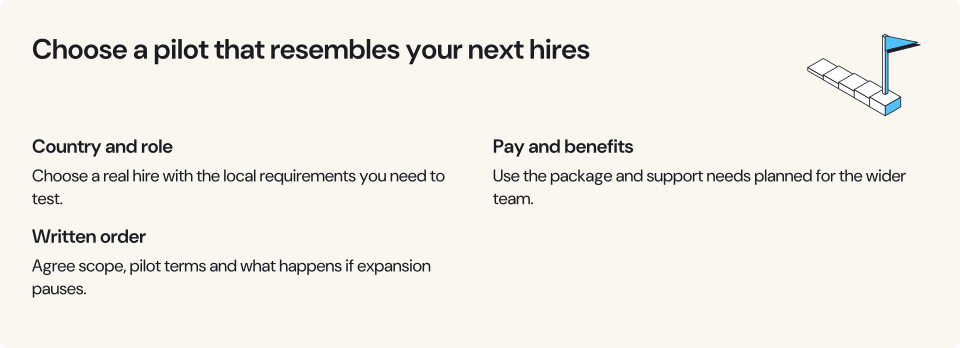
Before the start date, put six contract terms in the order form. These are negotiation requests; the signed terms and employment obligations determine exit cost:
The pre-pilot order form. 1) Month-to-month billing with no annual minimum. Confirm whether the provider offers it for your country and plan. 2) A client notice period of 30 days, written as a number. 3) No deposit, or a return date in days. 4) Offboarding service fees in writing. Pebl’s published policy says it charges no setup or offboarding service fees (checked 24 September 2026), but confirm notice, severance and other employment liabilities separately. 5) FX terms that name the rate source on every invoice and cap the margin, using an agreed benchmark, currency pair and fixing time. ECB rates are informational rather than executable transaction prices. 6) The full quote attached, listing every recurring and one-time line for the invoice audit in week 3.
Record which requested terms the vendor accepts and price any remaining exit exposure.
3. A sample pilot schedule
If you can, start the contract on the 1st of a month, so the first payroll is a full cycle rather than pro-rated and the pilot fits one billing period.
| Days | What happens | What you measure |
|---|---|---|
Days
Before start
|
What happens
Submit complete hire data, agree pilot terms and confirm when the employee can start work
|
What you measure
Clock starts on draft-contract turnaround
|
Days
Before start
|
What happens
Review and sign contracts; complete required checks and payroll/benefits readiness
|
What you measure
Test 1: both speed intervals, plus the clause check
|
Days
Early in the first cycle
|
What happens
Send the support question through the normal channel; submit one payroll change (a small one-time bonus or an expense)
|
What you measure
Test 3 timestamps; the change tests payroll accuracy
|
Days
By the agreed cutoff
|
What happens
Payroll cut-off passes; the invoice arrives
|
What you measure
Test 2a: invoice vs quote, line by line; FX reconciliation to the agreed rate and charges
|
Days
Contractual payday
|
What happens
Payday; the payslip arrives
|
What you measure
Test 2b: payslip audit; employee confirms net amount and date
|
Days
After the full cycle
|
What happens
Fill in the scorecard, check the four escalation triggers
|
What you measure
Go, extend the evidence window or pause expansion
|
Fig. 1 · Pilot sequence: pre-start clearance through a complete payroll cycle
Build the pilot around an actual payroll cycle
Work back from the country’s contractual payday. When must inputs be in, who approves them, and when must the funds clear? Add filing milestones to the calendar before choosing the onboarding date. If the 30-day window misses a normal payroll cycle, move the start or extend the pilot.
| The working record | Fields to complete |
|---|---|
The working record
Scope
|
Fields to complete
Test / milestone · Country / employee · Payroll cycle / cutoff
|
The working record
Evidence and follow-up
|
Fields to complete
Owner · Expected result · Observed evidence · Issue / action · Acceptance status
|
4. Test 1: contract and onboarding speed
Draft-contract turnaround. Time the gap between submitting complete hire data and receiving a locally compliant draft. Use the agreed country turnaround as the pass threshold; a missed deadline needs explanation and a revised date. A draft with missing required fields also needs correction before the start.
Offer to active. Time the gap from signed contract to the employee being live on the platform with payroll and benefits enrolled. Use a country-specific readiness deadline agreed before the pilot. Record missed milestones and their causes, and do not allow a start until the applicable requirements are cleared.
The clause check. A fast contract is no use if it is home-country boilerplate, so for a German hire, check four clauses against the statute before signature: the agreed probation and notice provisions, paid leave of at least 20 working days on a 5-day week (Bundesurlaubsgesetz minimum), notice terms reviewed under §622 BGB and any applicable collective provisions rather than “at will” language, and an IP-assignment clause written for German invention law. A contract that fails counts as escalation trigger 4 rather than a flag, because drafting a locally compliant contract is the vendor’s job.
Under BGB§622(3), the statutory two-week notice provision during agreed probation applies for no more than six months. That provision sets no universal probation cap. Ask the legal reviewer to assess the actual contract, any collective agreement, fixed-term proportionality and dismissal-protection questions separately.
5. Test 2: payroll accuracy, the payslip audit, and the FX check
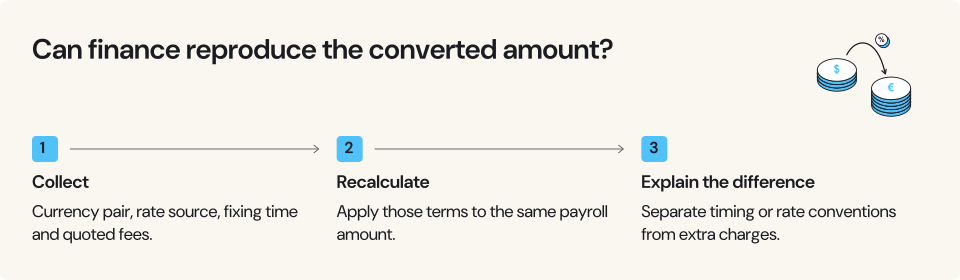
In weeks 3 and 4 of the sample schedule, match each invoice line to the quote. Use the employee’s actual pay profile, rates and ceilings to check the payslip. For a currency conversion, verify the pair, quotation direction, rate source, fixing time and any separate fee. You can use the EOR cost calculator to review the written offer before day 1 and return to those same quoted amounts when the invoice arrives.
Payday. Ask the employee to confirm the net salary arrived on the contractual payday and is correct to the cent. A late or short payment needs immediate correction and escalation. Pause expansion, investigate the cause and assess contractual remedies and the local rules for continuing or transferring employment.
The payslip audit. Recompute each employee-side deduction from its published rate. For Germany, the rates effective January 1, 2026 are: pension 9.3% of gross (18.6% split equally, up to the €8,450/month ceiling), unemployment insurance 1.3% (2.6% split, same ceiling), and health insurance at 7.3% plus half the fund’s supplemental rate, for which the published 2026 average is 2.9%; use the employee’s actual fund rate, up to the €5,812.50/month ceiling. Check long-term-care coverage and the employee’s applicable rate separately, including age, children and any Saxony-specific allocation. Check income tax against the official BMF calculator (bmf-steuerrechner.de). Check that the authorized payroll change submitted before the agreed cutoff appears with the applicable tax and contribution treatment. A variance the vendor explains in writing within 2 days is a flag, and an unexplained one is a fail.
The FX check. Reconcile the converted amount using the contract’s currency pair, rate source, fixing time and explicit fees. An ECB rate can be an indicative cross-check, but a difference can reflect timing or rate conventions as well as charges. Agree acceptable cost and disclosure thresholds before the pilot; the scorecard tests whether the invoice reconciles to the agreed method. For a hypothetical €6,000 conversion, each separately charged 1% adds €60. The FX markup guide explains the comparison.
6. Test 3: support accuracy and escalation
Use the normal support channel and ask about a real issue you’re authorized to raise, or tell support that the case is hypothetical. Never describe an invented medical problem as something that happened to the employee. Get the expected answer checked for the pilot country before scoring the response.
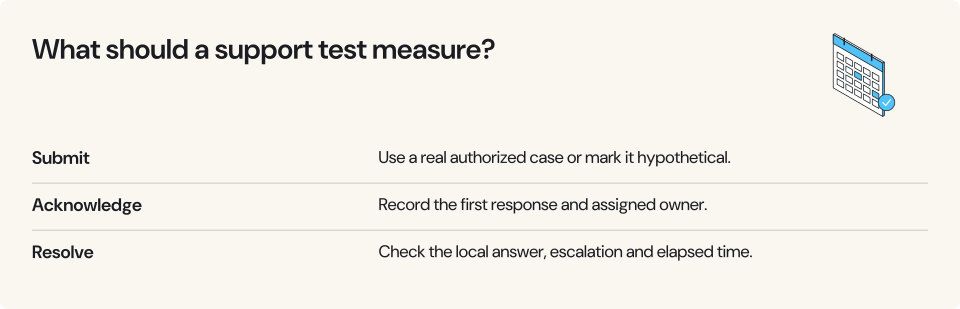
For example: “Hypothetical case: a Berlin employee in statutory health insurance has completed four uninterrupted weeks of employment and becomes unable to work through illness for eight weeks. What pay, sickness benefit and notification steps apply, and which facts could change the answer?” Under the German continued-pay rules, the qualifying employer obligation is generally up to six weeks; recurrence and other conditions matter. BMG explains the subsequent sickness-benefit calculation as 70% of regular gross up to the contribution ceiling, capped at 90% of the last net pay. For the same illness, the 78-week limit runs within a three-year period and includes continued-pay periods. Ask support to identify eligibility, earlier episodes, coverage, documents and the actual employer/health-fund responsibilities rather than merely repeat those numbers.
For a French pilot, a hypothetical leave-accrual question can ask support to distinguish jours ouvrables from jours ouvrés and explain how work and any absence affect the employee’s accrual. Verify the answer against the applicable law and contract for that case.
Speed. For the sample scorecard, a first human response within 4 business hours passes, more than 4 and up to 24 business hours is a flag, and beyond 24 business hours triggers review. Agree suitable business hours, channels and thresholds before the pilot.
Substance. Record whether the answer identifies the relevant rule, applies it to the stated facts, explains exceptions and gives a useful next action. The sample target is a substantive answer within 2 business days. Ask for the primary source and escalate a material wrong answer promptly.
Ask the employee about the first cycle
Ask the employee about their own experience. Did they know who employed them and whom to contact? Were the contract and pay clear before they accepted? Could they enroll in the agreed benefits, understand their payslip and reach someone about a correction? Check whether the money arrived on the agreed date. Record feedback with consent and note what you did about it. One person’s response can guide a correction without becoming a rating for the whole provider.
7. Four issues that pause expansion
Any one of these pauses expansion and triggers remediation and review. Decide whether to extend or exit using the severity, response and contractual rights, while protecting the employee.
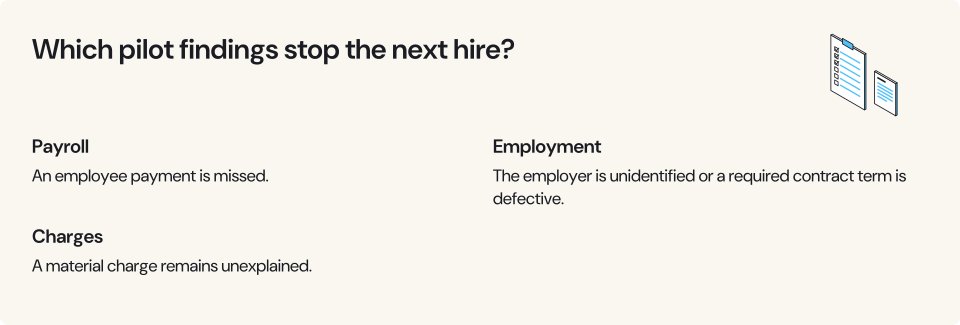
1. Failed payroll. A late or incorrect payment needs prompt correction and review. 2. Unagreed charges. Reconcile an invoice line absent from the written quote and record the agreed outcome. 3. Support failure. Review a missed buyer-agreed response or escalation commitment. 4. Material compliance issue. Resolve an incorrect legal answer, unidentified employer or required contract defect before expansion.
Do not soften the scores because the relationship is new. Record the issue, agreed remedy and evidence of correction.
8. Plan exit costs and employment continuity
Before you start, find out how much cash the EOR will hold and how much notice you’ll owe if you decide to stop. Use the agreement and order form that would apply to your hire. Where public terms leave an amount or deadline open, ask for it in writing.
Our provider ratings show the order in which we recommend providers overall. They are not scores for an individual fee, contract term, certification or country.
★★★★★4.7
Pricing & terms
Notice and exit notes
Confirm the applicable notice period and commitment in the signed agreement
Deposit
Help-center example:1–1.5 times total monthly charges; confirm the applicable country calculation in writing
Return timing
Within 60 days after termination is complete and invoices are paid; confirm settlement, deductions and refund setup
Our rating
4.7/5
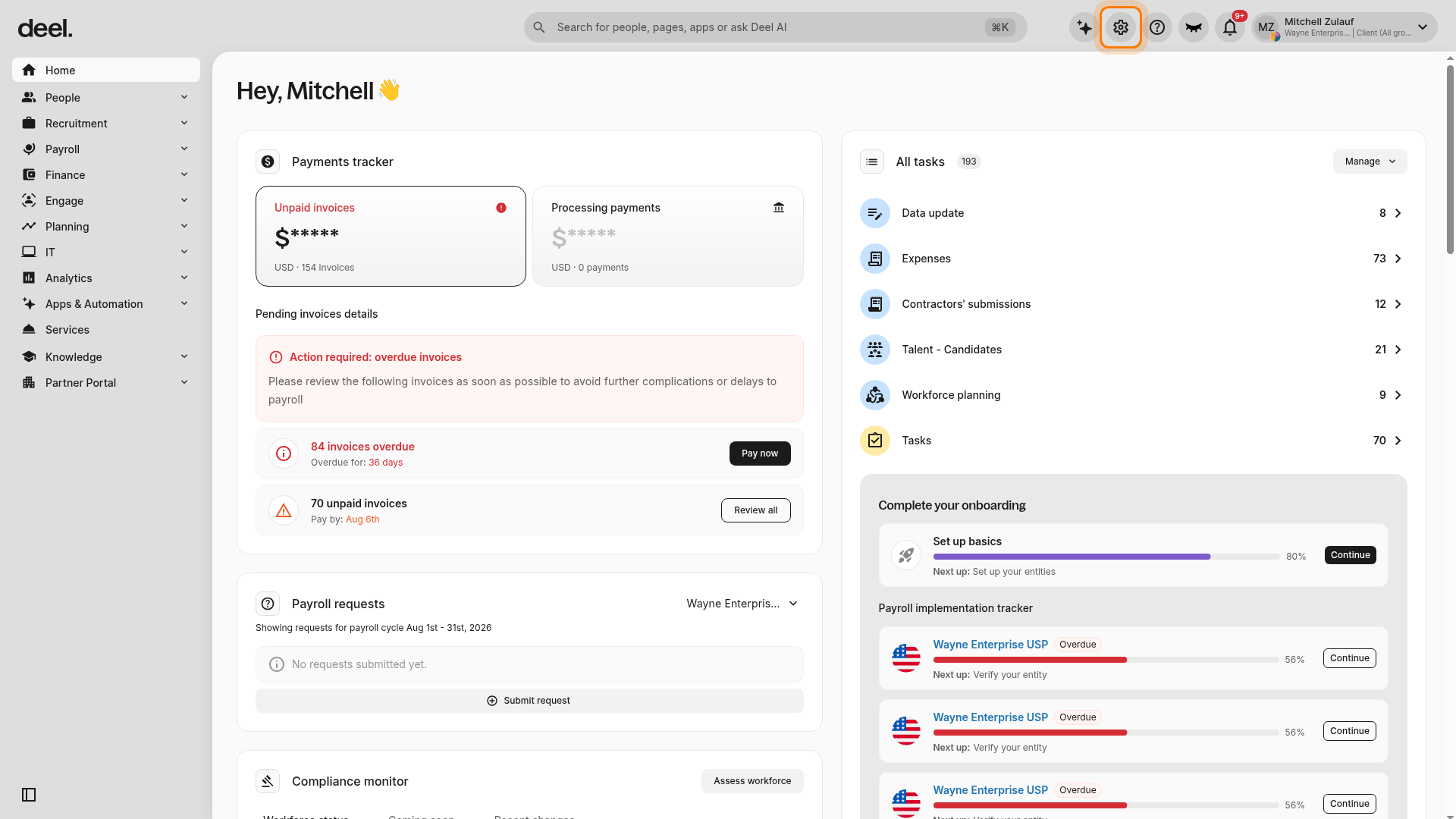
Deel dashboard
Enlarge screenshot
![]()
Reviewed by Martynas Pupkevicius · Fact-checked by Michael Ennis
Opens deel.com

★★★★★4.9
Pricing & terms
Notice and exit notes
Confirm Global or Select commitment, notice and exit terms in writing.
Deposit
Confirm the Global or Select deposit amount and calculation base in the country quote.
Return timing
Confirm deductions, settlement conditions and the return deadline in the applicable agreement.
Our rating
4.9/5
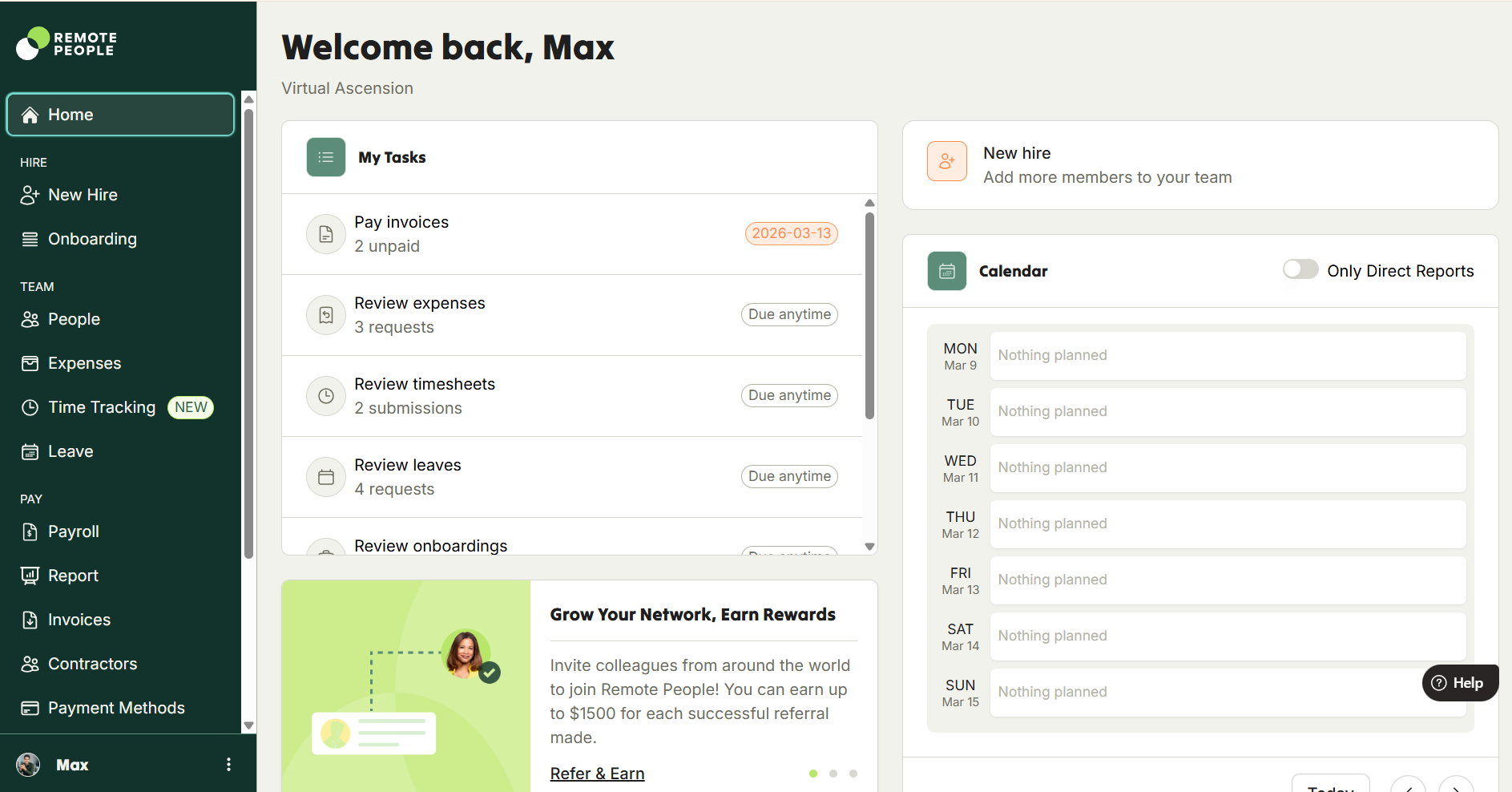
RemotePeople dashboard
Enlarge screenshot
![]()
Reviewed by Martynas Pupkevicius · Fact-checked by Michael Ennis
Opens remotepeople.com

★★★★★4.5
Pricing & terms
Notice and exit notes
Published standard service terms include 30-day notice; employment end and transition obligations may continue. Confirm applicable agreement and offboarding charges.
Deposit
≈1 month's Total Cost of Service
Return timing
Published terms: unused balance within 60 days after the later of receipt of all sums owing or confirmation that all sums have been paid. Check offsets and controlling documents.
Our rating
4.5/5
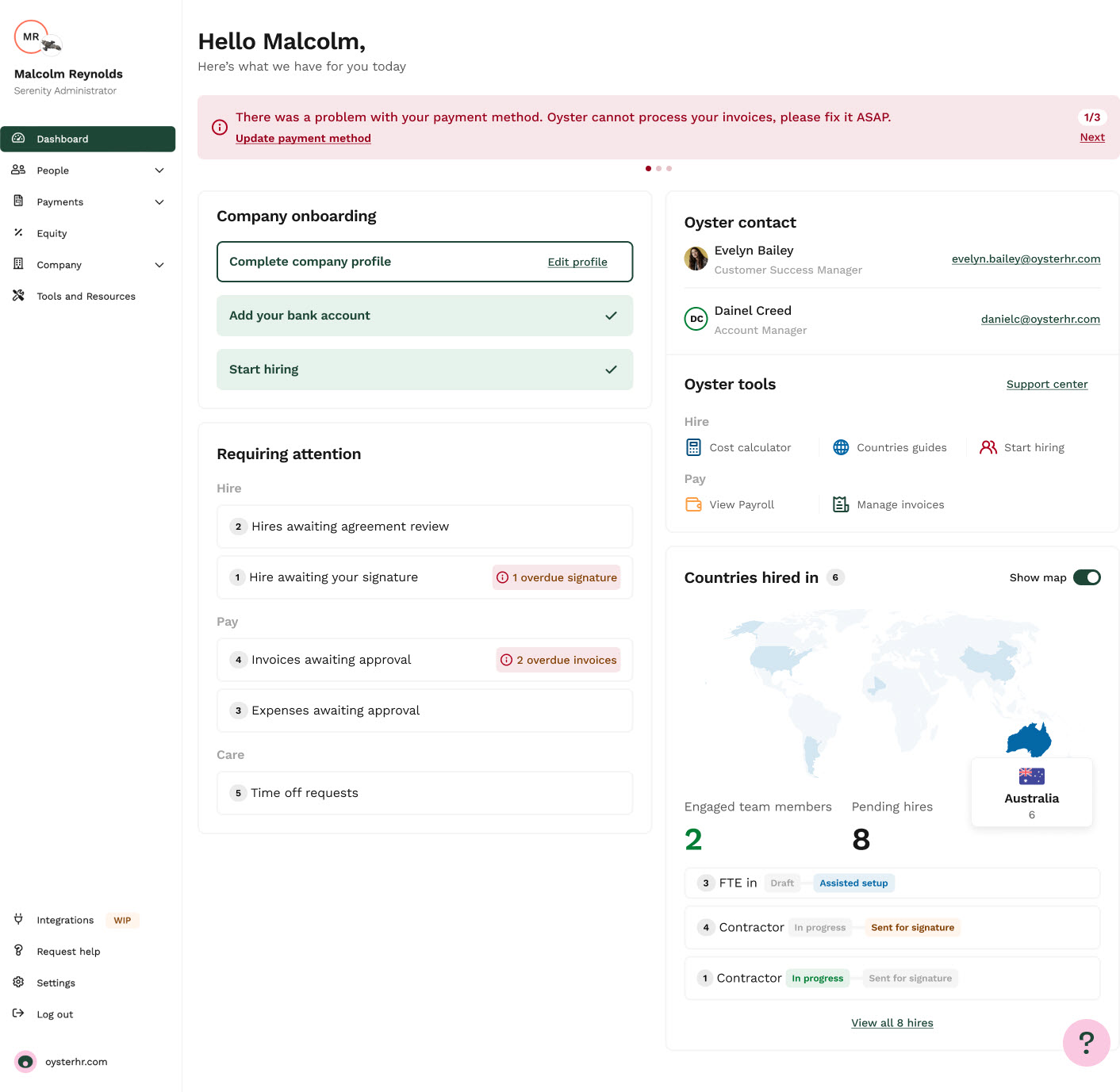
Oyster dashboard
Enlarge screenshot
![]()
Reviewed by Martynas Pupkevicius · Fact-checked by Michael Ennis
Opens oysterhr.com

★★★★★4.1
Pricing & terms
Notice and exit notes
Current General Terms (effective 1 June 2026): EOR quotations require 60 days’ written notice; fixed-term order forms have no convenience termination. Confirm the signed instrument and any overriding terms.
Deposit
Confirm the deposit amount and calculation base for this country in writing
Return timing
Confirm deposit deductions and return deadline in the applicable EOR terms and signed instrument; do not infer a pro-rata service-fee refund
Our rating
4.1/5
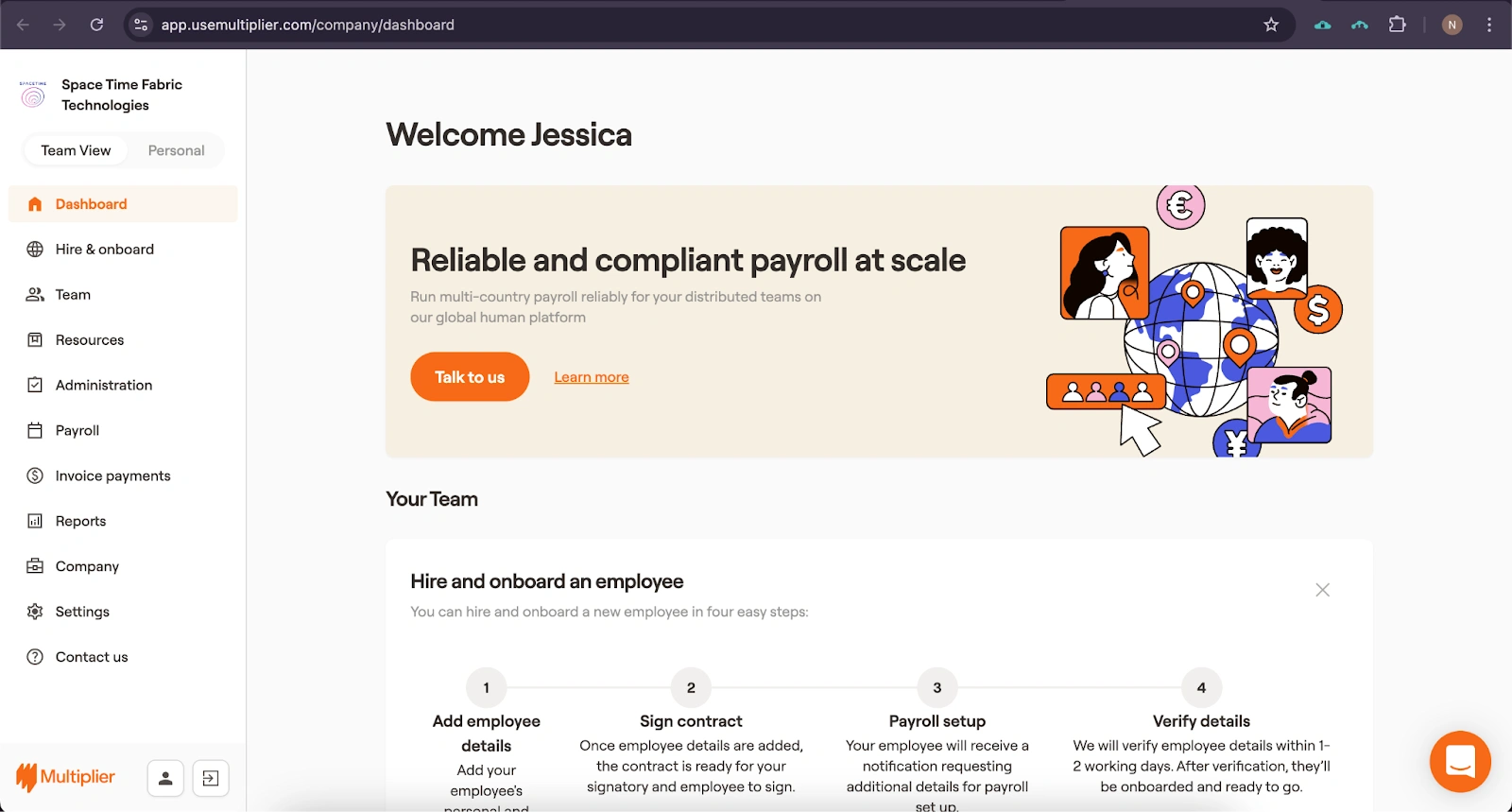
Multiplier dashboard
Enlarge screenshot
![]()
Reviewed by Martynas Pupkevicius · Fact-checked by Michael Ennis
Opens usemultiplier.com

★★★★★0.5
Pricing & terms
Notice and exit notes
⚠ Trustpilot warning: rating suspended for a breach of its guidelines; fake reviews removed (8 Nov 2026).
Confirm the applicable notice, commitment and employee-transition terms
Deposit
Confirm amount, currency and calculation base in the proposal
Return timing
Confirm deductions, settlement conditions and return deadline in writing
Our rating
0.5/5
RemoFirst dashboard
Enlarge screenshot
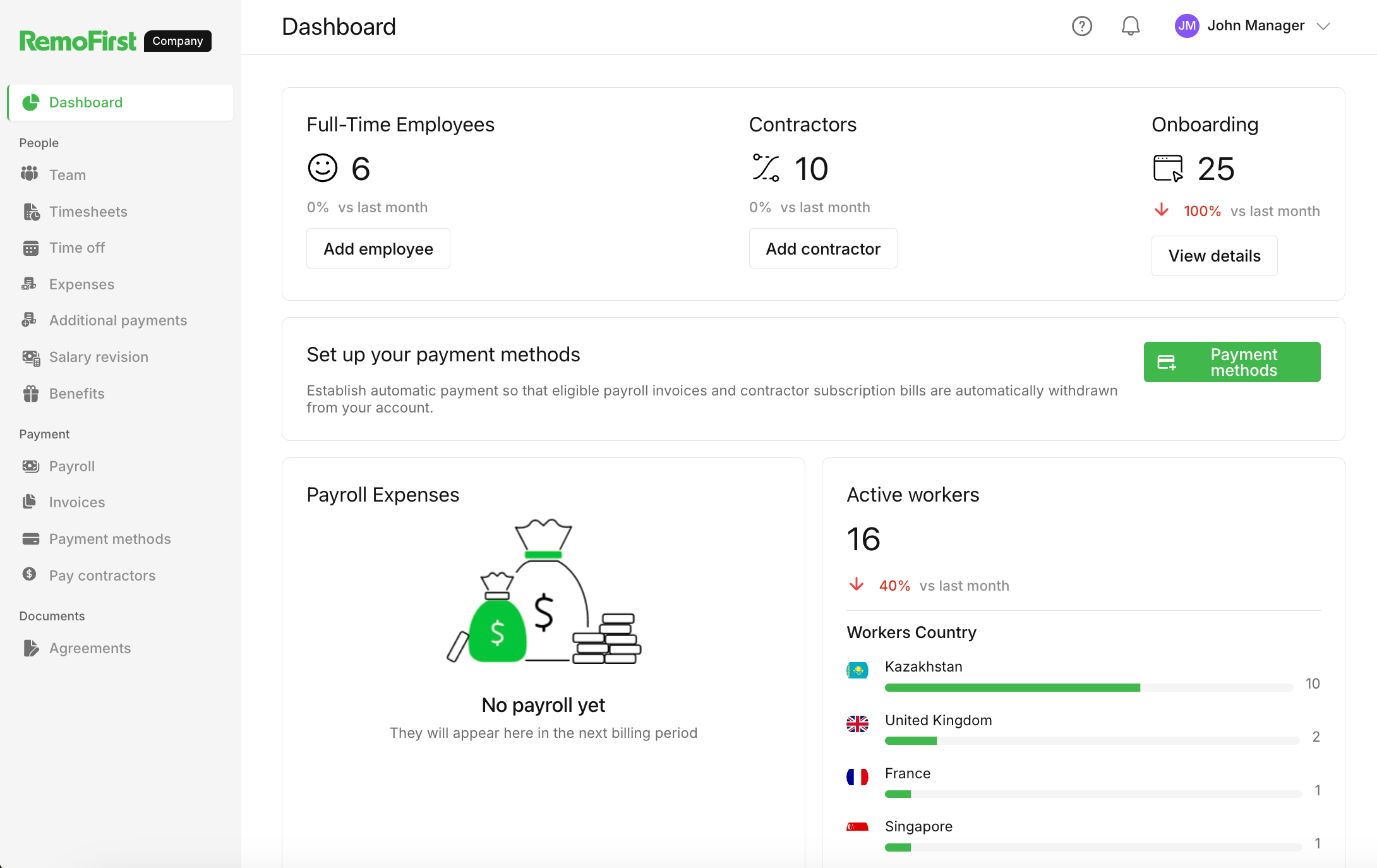
![]()
Reviewed by Martynas Pupkevicius · Fact-checked by Michael Ennis
Opens remofirst.com

★★★★★4.5
Pricing & terms
Notice and exit notes
Confirm notice, commitment and exit charges in the applicable agreement
Deposit
Confirm amount, currency and calculation base in the quote
Return timing
In the order form
Our rating
4.5/5
Rippling dashboard
Enlarge screenshot
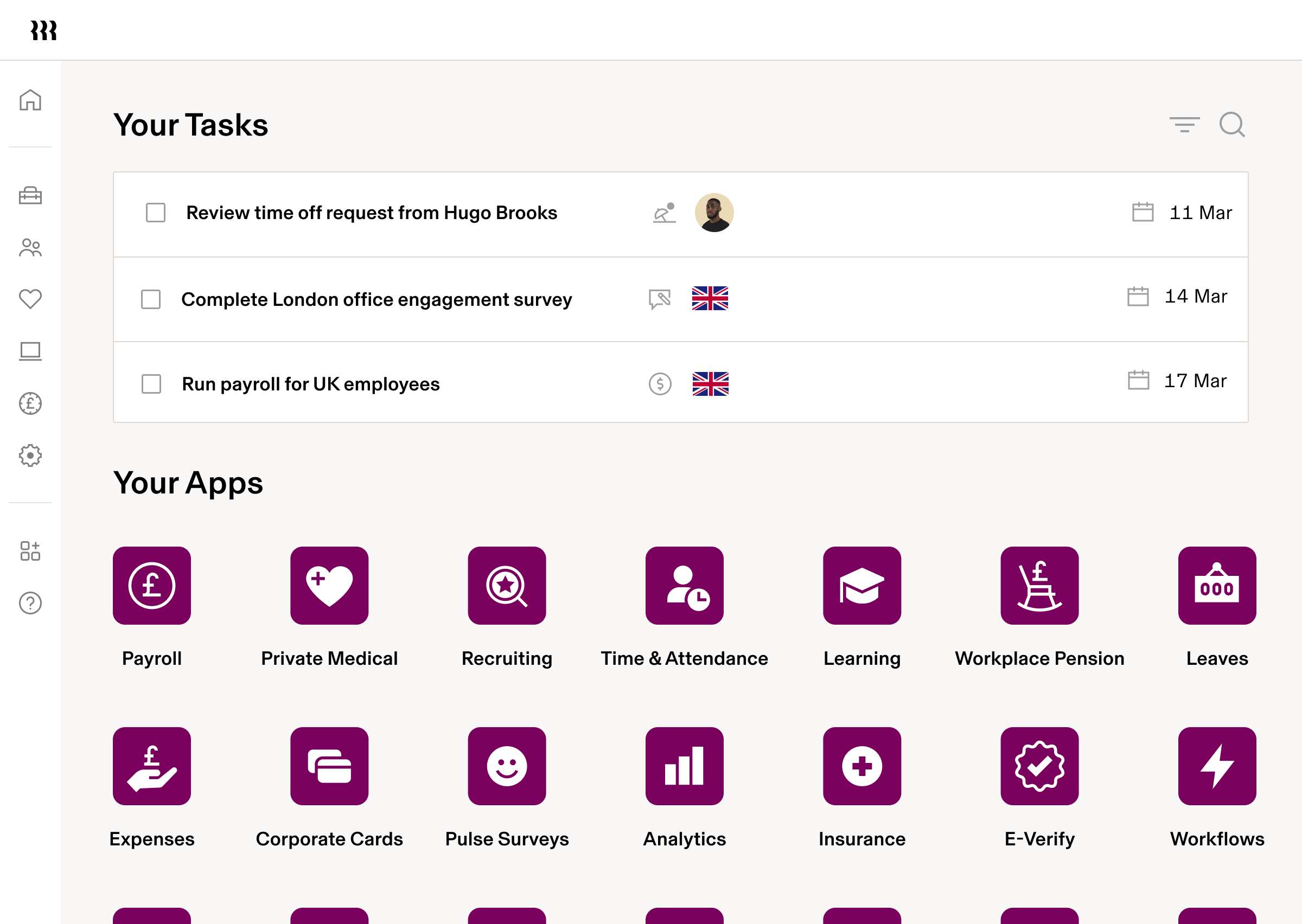
![]()
Reviewed by Martynas Pupkevicius · Fact-checked by Michael Ennis
Opens rippling.com

★★★★★4.2
Pricing & terms
Notice and exit notes
Confirm commitment, renewal and notice in the signed agreement
Deposit
Confirm amount, currency and calculation base in the quote
Return timing
Confirm settlement conditions and the deposit-return deadline
Our rating
4.2/5
G-P dashboard
Enlarge screenshot
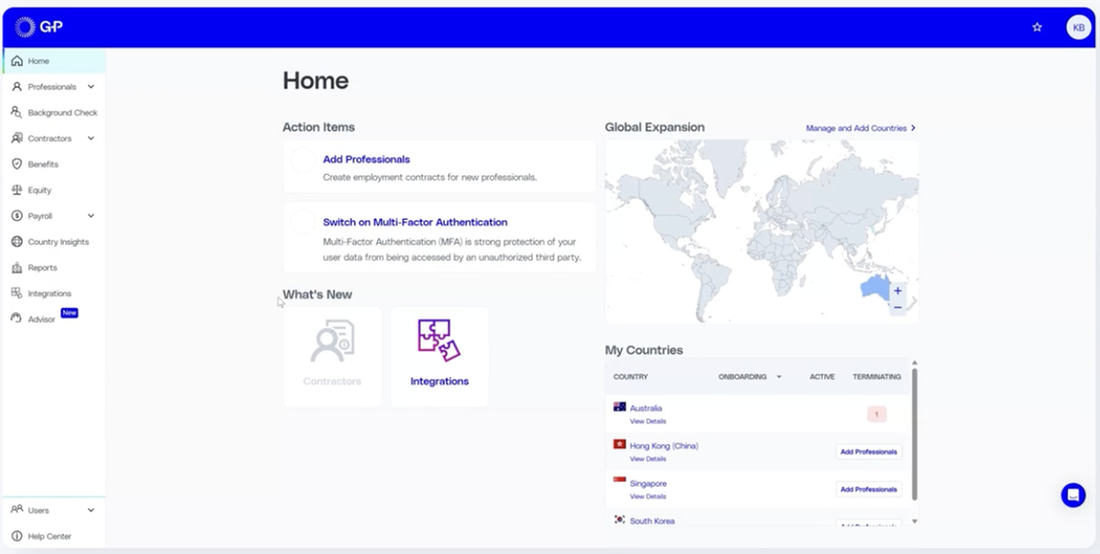
![]()
Reviewed by Martynas Pupkevicius · Fact-checked by Michael Ennis
Opens globalization-partners.com

★★★★★4.2
Pricing & terms
Notice and exit notes
No offboarding service fee under the published policy (checked 24 September 2026); confirm notice and employment liabilities separately
Deposit
Confirm any deposit or prefunding and its calculation base
Return timing
Confirm any deductions and return deadline
Our rating
4.2/5
Pebl onboarding
Enlarge screenshot
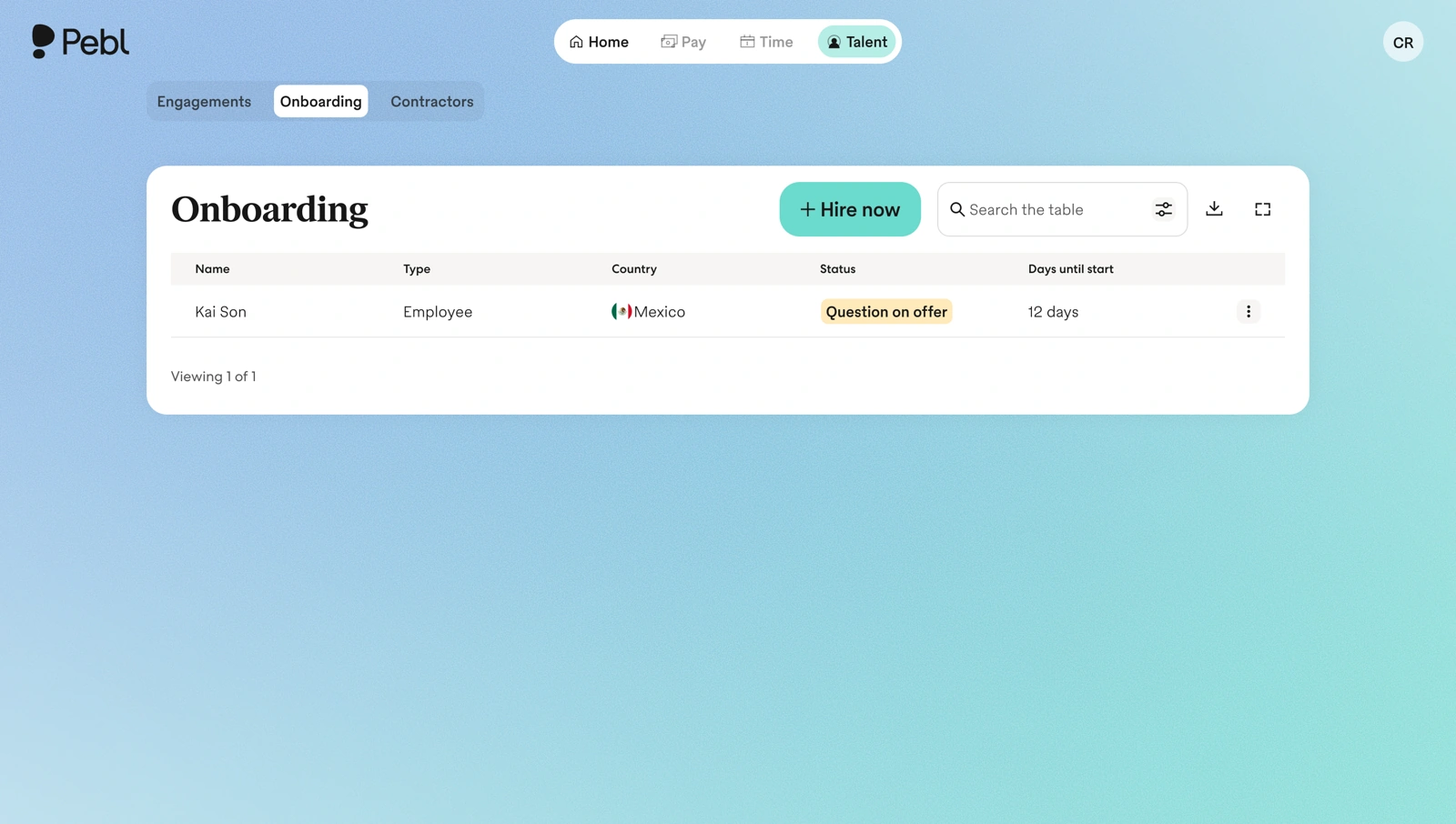
![]()
Reviewed by Martynas Pupkevicius · Fact-checked by Michael Ennis
Opens hellopebl.com
Fig. 2 · Deposit, return timing, and notice terms across eight providers · historical terms unless a row gives a later date
If the pilot fails, review the actual notice and employment-transition requirements before giving notice. A replacement employer may require employee agreement, new documentation and other local steps; agree the sequence before promising an uninterrupted transfer. Ask the outgoing vendor for an employment-continuity letter, and export everything before platform access ends, including the contract, payslips and payroll register. Agree which records can be shared, who may receive them, the format, access-end date and delivery timetable in writing. Pay the final invoice promptly, because Oyster’s published 60-day window for returning the unused balance starts after the later of receipt of all amounts owing or confirmation that all amounts have been paid. A no-deposit contract reduces cash tied up, but the final cost can include notice-period service fees, legal review, payroll and transition liabilities. For illustration, a deposit assumed to equal two months of a EUR 6,000 gross salary ties up EUR 12,000, separately from any annual fee commitment. The actual calculation may include employer costs and benefits; confirm the basis, deductions and return conditions. The switching guide covers moving the hire.
9. The go/no-go scorecard
Use this as a sample scorecard and agree country-specific thresholds before the pilot. Review it after a complete payroll cycle.
Agree the acceptance criteria and who owns each remedy before the hire starts. A missed payment, required contract defect, unknown employer or material unexplained charge pauses expansion until reviewed and resolved, even if the other metrics pass.
| Metric | Pass | Flag | Fail |
|---|---|---|---|
Metric
Draft contract turnaround
|
Pass
Agreed country-specific turnaround met
|
Flag
Deadline missed; documented reason and revised date agreed
|
Fail
Unexplained delay or required contract defect unresolved before start
|
Metric
Contract clause check
|
Pass
All clauses meet applicable local requirements
|
Flag
One fix, made same week
|
Fail
Boilerplate (trigger 4)
|
Metric
Offer to active
|
Pass
Agreed country readiness date met
|
Flag
Delay explained with an agreed revised date
|
Fail
Beyond that, unexplained
|
Metric
Payday
|
Pass
Exact amount, contractual date
|
Flag
n/a
|
Fail
Late or short (trigger 1)
|
Metric
Payslip math
|
Pass
Each line reconciles to the applicable employee profile, current rates and ceilings
|
Flag
Variance explained in writing ≤2 days
|
Fail
Unexplained variance (trigger 1)
|
Metric
Invoice vs quote
|
Pass
Line-for-line match
|
Flag
New line removed on request
|
Fail
New line defended (trigger 2)
|
Metric
FX vs agreed terms
|
Pass
Reconciles to agreed pair, timing, rate and fees
|
Flag
Documented variance under investigation
|
Fail
Unexplained charge or breach of agreed cap
|
Metric
Support first response
|
Pass
≤4 business hours
|
Flag
More than 4 and up to 24 business hours
|
Fail
>24 business hours (trigger 3)
|
Metric
Compliance answer
|
Pass
Statute named, stages correct, ≤2 days
|
Flag
Correct after one follow-up
|
Fail
Wrong or absent (trigger 4)
|
Fig. 3 · The go/no-go scorecard, nine metrics with pass, flag, and fail thresholds
- Rule 1. Any serious issue requiring remediation or transition review?
- YES → Pause expansion. Correct urgent issues, review the response and decide whether to continue or exit. If changing provider, confirm contractual notice and how employment will transfer under local law.
- NO → continue to Rule 2
- Rule 2. At least 7 of 9 passes and no more than 2 flags?
- YES → Go. Stay month-to-month, and trade flexibility for an annual discount only when headcount in the market is stable.
- NO → Extend 15 days. Re-run each flagged test once. A repeat flag on the same metric is a no-go.
Record what passed and what remains open
For each test, put the expected result next to the observed result and the dated evidence. Identify the employee affected and the person responsible for the next action. Mark whether the team saw a demonstration or verified a live payroll.
10. Frequently asked questions
What should I agree with the EOR before a pilot?
Do I pay the employee during the pilot?
What does a failed EOR pilot cost?
Which country should the pilot hire be in?
Can I pilot two EORs in parallel?
11. Sources
The sources behind this guide, grouped by topic. Dates show when we last checked a page. Prices and terms change, so confirm them in your quote.
Employment law and official guidance
9 sourcesGermany · Federal Ministry of Justice
Germany · Federal Ministry of Justice
Statutory notice periods and the six-month shortened-notice provision. Checked 15 Oct 2026
Germany · Federal Ministry of Justice
Employee Inventions Act (Arbeitnehmererfindungsgesetz)
IP assignment for employee inventions.
Germany · Federal Ministry of Justice
Continued Remuneration Act (Entgeltfortzahlungsgesetz)
Section 3 checked 15 Oct 2026.
Germany · Federal Ministry of Justice
Social Code Book V (SGB V) §47
Krankengeld at 70% of gross, capped at 90% of net. Section 48 checked 15 Oct 2026.
Germany · Federal Ministry of Health (BMG)
Sickness benefit (Krankengeld)
The 78-week limit includes continued pay. Checked Sep 2026 and again 15 Oct 2026.
France · Légifrance
Code du travail, Article L3141-3
Paid leave accrual of 2.5 working days per month.
United Kingdom · GOV.UK
Used in the payroll pilot. Checked 3 Oct 2026
European Union · EUR-Lex
General Data Protection Regulation (GDPR), Articles 28 and 33
Used in the payroll pilot. Checked 3 Oct 2026
Payroll, contributions and exchange rates
6 sourcesGermany · Federal Government
2026 contribution assessment ceilings (Beitragsbemessungsgrenzen)
Germany · Federal Ministry of Health (BMG)
2026 health-contribution guidance
Checked 15 Oct 2026
Germany · Federal Ministry of Finance (BMF)
Germany · PwC Worldwide Tax Summaries
European Union · European Central Bank (ECB)
Euro foreign exchange reference rates
Published each working day around 16:00 CET.
Wise
Currency conversion from 0.23% at the mid-market rate. Checked Sep 2026
Provider pricing and terms
6 sourcesDeel
Deposit-refund process and timing. Checked 7 Oct 2026
Multiplier
General Terms effective 1 Jun 2026, covering quotation notice and fixed-term commitments. Checked 7 Oct 2026
Oyster
Public termsPublished terms, section 5.4
Public terms published 27 Feb 2025. The deposit-return clause covers the unused balance and the payment or confirmation trigger; read it alongside any controlling MSA and order form. Section 5.4 of the published terms was checked on 3 Oct 2026; the applicable service agreement may override it. Checked 15 Oct 2026
Pebl
Its published policy says it charges no setup or offboarding service fees; confirm this in the order form. Checked 24 Sep 2026
RemoFirst
The public pricing FAQ does not establish the deposit amount for a particular customer; obtain the proposal.
RemotePeople
Global from USD 499 per employee per month; Select from USD 199 in selected countries and qualifying employee salary ranges. Checked 1 Nov 2026
Our research
2 sourcesThe Best EOR
The Best EOR
If you spot a changed price or a conflicting source, send it through the contact page and we’ll review it.
This guide is for general information only and does not provide legal, tax, accounting, or financial advice. For advice about your business, consult a qualified professional familiar with the rules where you hire. Read our research methodology to learn how we assess sources.