


Guide overview
EOR entity models, at a glance.
Trace the actual employer and service responsibilities.
A direct EOR uses a local employer within its group; an indirect EOR routes employment through a separate local partner. Providers can use a mix across countries, and either may outsource payroll. Compare the actual employer, agreements, licences, support and records access for your hire rather than judge the service by ownership alone.
Legal employer
Name the company
Identify the entity employing the worker in each country.
Operating model
Trace the relationship
Distinguish a group-owned entity from a separate partner employer.
Country service
Check the evidence
Compare licences, payroll support, liability terms and data handling.
Commercial terms
Include cost and exit
Review the full quote and cooperation required at a transition.
Check before acting
Compare the actual employing chain and agreement.
What to record in the worksheet
Scope
Country · Commercial supplier · Legal employer
Evidence and follow-up
Ownership / partner evidence · Payroll party · Contract and IP chain · Incident contact · Exit owner
Make one employer record per country
For each country, write down who sells you the service, who signs the employment contract and who runs payroll. Include the evidence of ownership or partnership, how IP rights reach your company, who handles an escalation and who will help at exit. Get written confirmation if the proposed employer changes before onboarding.
One supplier may use a group company in one country and a partner in another. Keep a separate record for each country so payroll can see who has authority to act there.
| The working record | Fields to complete |
|---|---|
The working record
Scope
|
Fields to complete
Country · Commercial supplier · Legal employer
|
The working record
Evidence and follow-up
|
Fields to complete
Ownership / partner evidence · Payroll party · Contract and IP chain · Incident contact · Exit owner
|
Compare the evidence behind each operating model
Give both providers the same questions. Trace who receives the request, who can make a decision and which other company they have to involve.
| Check | Owned-entity proposal | Partner-network proposal |
|---|---|---|
Check
Legal employer
|
Owned-entity proposal
Name the local subsidiary and verify its role.
|
Partner-network proposal
Name the local partner and verify its role.
|
Check
Authority to employ
|
Owned-entity proposal
Check licences and restrictions for that entity and activity.
|
Partner-network proposal
Run the same checks on the partner; platform coverage is not a licence.
|
Check
Contract recovery
|
Owned-entity proposal
Identify which group company owes each obligation and any guarantee.
|
Partner-network proposal
Identify who covers partner failures, with caps and exclusions.
|
Check
Payroll correction
|
Owned-entity proposal
Ask who can authorize and execute a correction locally.
|
Partner-network proposal
Ask who owns the ticket across the platform and partner.
|
Check
Data assurance
|
Owned-entity proposal
Match each entity and service to the report or certificate scope.
|
Partner-network proposal
Check both platform scope and separate partner evidence where needed.
|
Check
Exit readiness
|
Owned-entity proposal
Obtain the local records and transition process.
|
Partner-network proposal
Confirm the partner’s cooperation, records access and replacement plan.
|
Compare country evidence and the complete quote before judging value.
Client → EOR platform → group employing entity → employee.
Client → EOR platform → local partner employer → employee.
Confirm each counterparty, contract, payroll operator and escalation owner.
Illustrative operating models. The named legal entities and signed agreements determine obligations; group ownership does not itself create a parent guarantee.
1. Direct EOR: what an owned entity means
When you compare EOR providers for a hire in Spain, ask which company will sign the employment contract and whether the proposed arrangement is permitted for that work. The local employer is responsible for employer registrations, payroll filings and contributions. In an owned model, that company is in the same group as the supplier that signs your service agreement. The two contracts can still bind different legal entities.
Ownership changes the corporate relationship between the platform and local employer. Check which entity owes each indemnity, where employment records are processed and which entity holds any required licence. Germany, for example, treats an EOR arrangement as labor leasing under the AÜG. The legal employer must hold a leasing license from the Federal Employment Agency, and the default cap for assignments to the same client is 18 months. Earlier assignments count where breaks are no more than three months, and specified collective-agreement arrangements can change the cap. Exceeding the cap carries a fine of up to €30,000 and breaching equal-pay rules a fine of up to €500,000 (rules in force since the April 2017 reform and still enforced in 2026).
Whether a provider owns the employing entity varies by country. Deel advertises owned entities and payroll infrastructure in 130+ countries on its product page, checked 15 October 2026. That is a provider claim. Ask for the named employing entity and supporting evidence in each country you need.
Follow both employment chains
Read each chain from the client to the actual employer and employee. Confirm every named entity in the country documents.
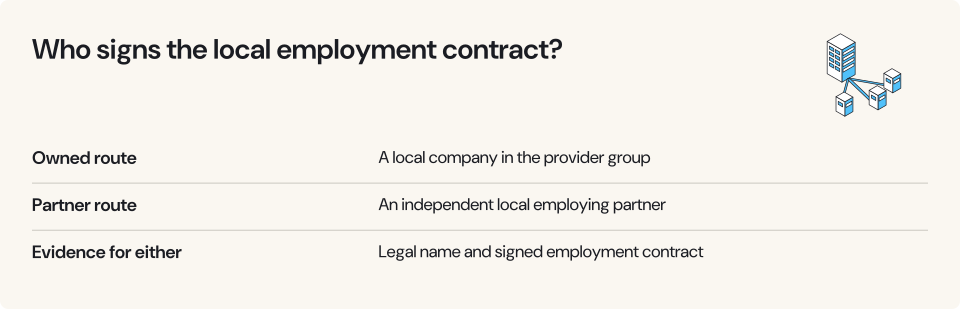
| Model | Commercial agreement | Employment agreement | Evidence to retain |
|---|---|---|---|
Model
Owned employer
|
Commercial agreement
Client → provider group contracting entity
|
Employment agreement
Group local employer → employee
|
Evidence to retain
Group relationship and both signed contracts
|
Model
Partner employer
|
Commercial agreement
Client → commercial supplier; supplier → local partner
|
Employment agreement
Partner legal employer → employee
|
Evidence to retain
Partner role, obligations and complete contract chain
|
2. Indirect EOR: how a partner chain (sub-EOR) works
A partner arrangement involves four parties. Your business signs a service agreement with the platform. The platform contracts with a local employer, sometimes called an in-country partner or sub-EOR. That employer signs the worker’s employment contract and is named on the payslip. If a problem arises, your own service agreement is with the platform.
Partner networks let providers offer coverage through established local employers. RemoFirst describes vetted in-country partner delivery in its pricing FAQ, checked 15 October 2026. Identify the actual employer, commercial counterparty and payroll operator for your country rather than infer the complete chain from that public description. Test the proposed partner’s service and country readiness.
Ask which partner terms apply to your hire. The local firm may have its own registration and identity checks, so get an onboarding schedule that names the person responsible for each step. Find out whether the supplier plans to change partners.
3. Liability: who pays when employment goes wrong
If a payroll filing or dismissal is challenged, start with two questions. Who has duties under local law, and which losses will the supplier cover under your agreement? A subsidiary is a separate company, even when the platform owns it. Check whether the indemnity covers that employer’s conduct. For a partner, ask what the platform must do about the partner’s actions and which records it can obtain. In both arrangements, read the caps, who must defend a claim and whether a parent company gives a guarantee.
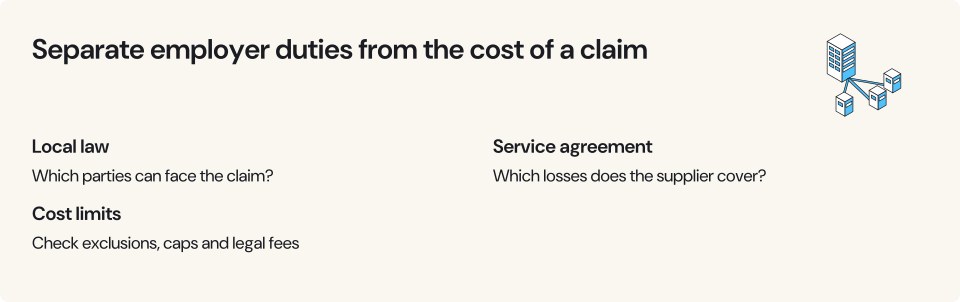
Germany (AÜG). The leasing license belongs to the legal employer, so in an owned-entity market you can check the EOR’s own license, but in a partner-routed market you rely on a local firm’s. If that firm is unlicensed, the employment can become yours retroactively, with back contributions and a fine of up to €30,000.
Mexico (REPSE). Confirm that the actual service and employment arrangement are permitted under the subcontracting rules. Where registration is required for the proposed specialized service, verify the named supplier and the registered activity in REPSE. Review the relevant liability chain before signing.
If a partner firm fails, its employees, including yours, have claims against a company in administration, and you need a new legal employer there quickly. Ask every vendor who carries employer liability if the partner fails, and keep unclear coverage as an unresolved approval condition until the relevant contractual obligations are identified.
4. Data: who holds your employee’s records
Map the legal employer, platform, client and any other data recipients for each processing activity. Their controller or processor roles follow what each party actually does. Group ownership does not ensure that records stay in one system or under one legal entity. Agree appropriate role-specific terms, arrangements that meet the applicable rules for data transfers and incident contacts; do not assume that every local employer is a sub-processor or that all parties have a 72-hour notification allowance.
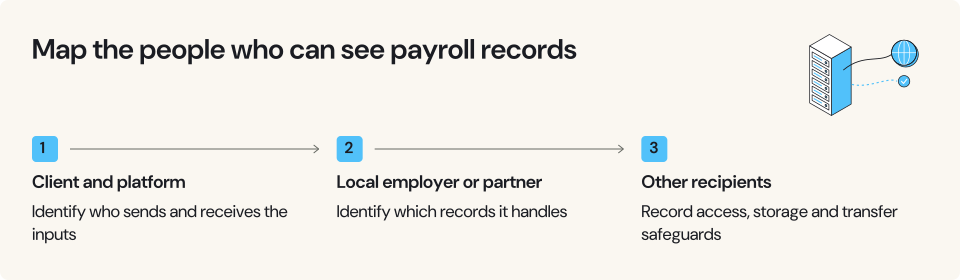
Additional recipients can add coordination work, so test how subject-access requests and incidents are handled. For assurance, inspect the scope of each SOC 2 report or ISO certificate. An owned entity may be outside scope, while a partner may have separate assurance or be addressed in the service organization’s report. Ask for evidence covering the actual service and recipients. Our guide to which certifications matter explains the review.
5. Payroll: one system or several
An owned employer may use group payroll systems or local ones. A partner may run payroll while the platform issues the consolidated invoice. Ask both providers for the employer’s registration requirements, a dated onboarding schedule for your country and evidence from comparable hires. Name who can correct payroll in each case.
Ask the support team to show what happens after you report a payroll error. Time the handoff to the person who can authorize a correction and compare the demonstration with recent evidence from similar customers. Include your own team’s time and the cost of putting errors right when you estimate the cost of a hire.
6. Provider claims and country evidence
For each of the six providers, distinguish what it says about its network from what it commits to for your country. Ask for the employing entity and the payroll operator by name.
Our provider ratings show the order in which we recommend providers overall. They are not scores for an individual fee, contract term, certification or country.
★★★★★4.7
Pricing & terms
Entity model
Provider reports owned entities and payroll infrastructure in 130+ countries
Evidence scope and next check
Product page checked 15 October 2026. Obtain the country employer, group relationship, licence where required and contracts.
Published starting-fee example (per employee/month)
From USD 599 per employee/month; month-to-month available. Mandatory Employer Liability Cost is additional; confirm country scope.
Our rating
4.7/5
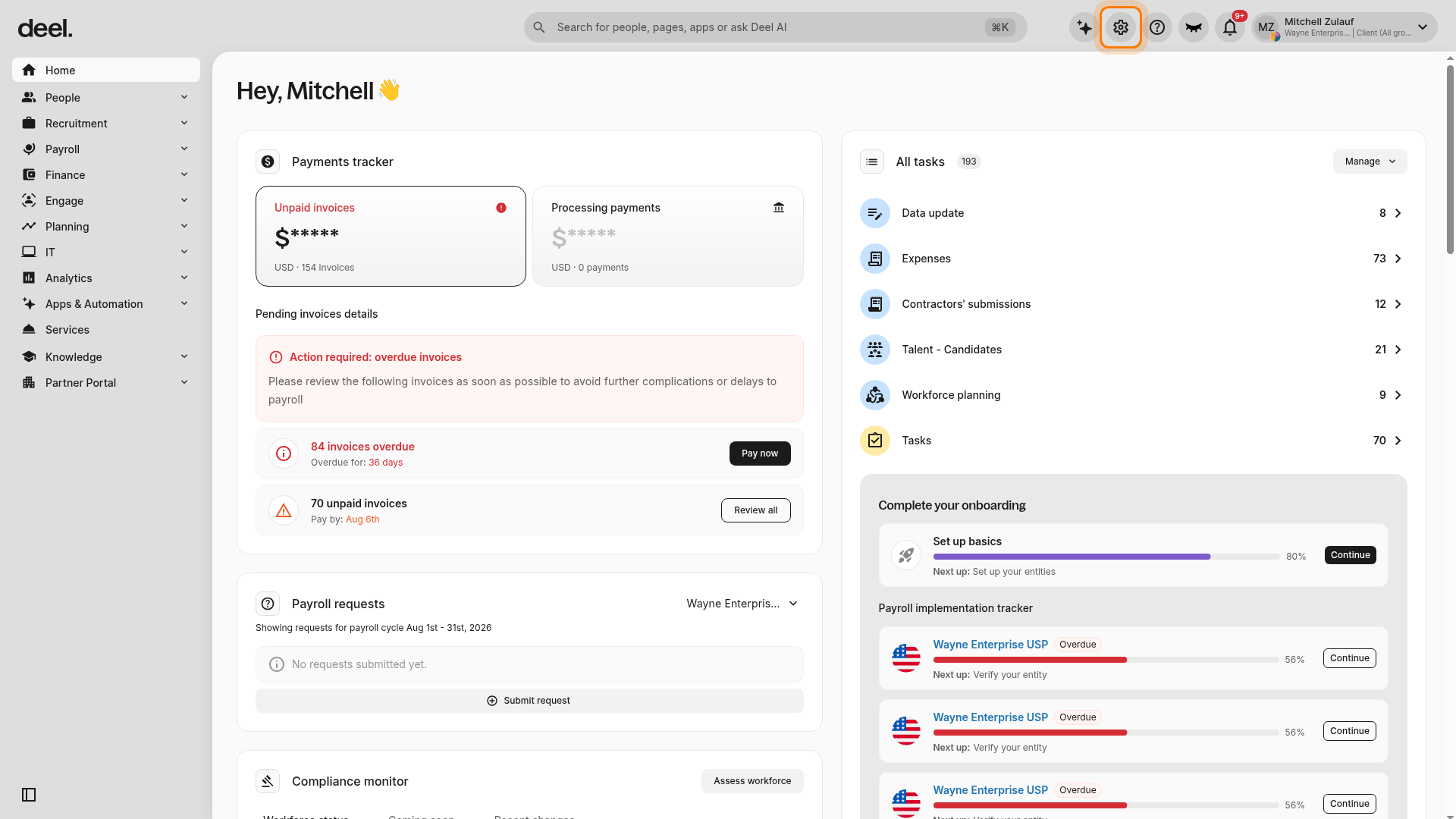
Deel dashboard
Enlarge screenshot
![]()
Reviewed by Martynas Pupkevicius · Fact-checked by Michael Ennis
Opens deel.com

★★★★★4.2
Pricing & terms
Entity model
Provider reports 100+ wholly owned entities; coverage in 180+ countries
Evidence scope and next check
G-P comparison updated 23 September 2026, checked 15 October 2026. Confirm the actual country employer and group relationship.
Published starting-fee example (per employee/month)
From USD 599 per employee/month; no minimum EOR hire duration advertised. Confirm commercial terms and country scope.
Our rating
4.2/5
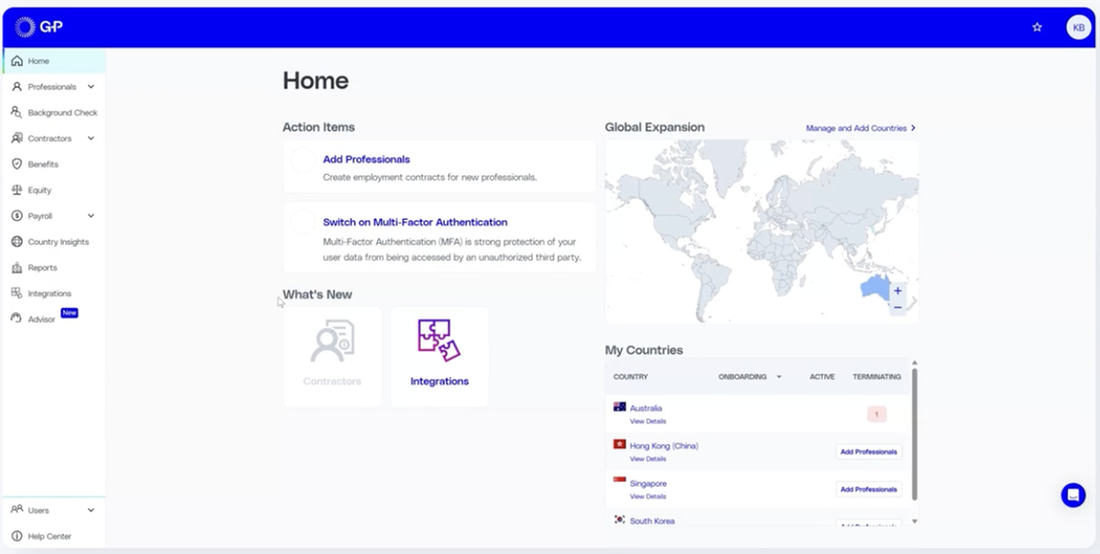
G-P dashboard
Enlarge screenshot
![]()
Reviewed by Martynas Pupkevicius · Fact-checked by Michael Ennis
Opens globalization-partners.com

★★★★★4.1
Pricing & terms
Entity model
Provider reports own-entity delivery rather than a partner network
Evidence scope and next check
FAQ checked 15 October 2026. Request the named company and relevant country documents.
Published starting-fee example (per employee/month)
Core $499 monthly or $459 per employee/month billed annually. Dollar currency unconfirmed; obtain implementation and mandatory add-on terms.
Our rating
4.1/5
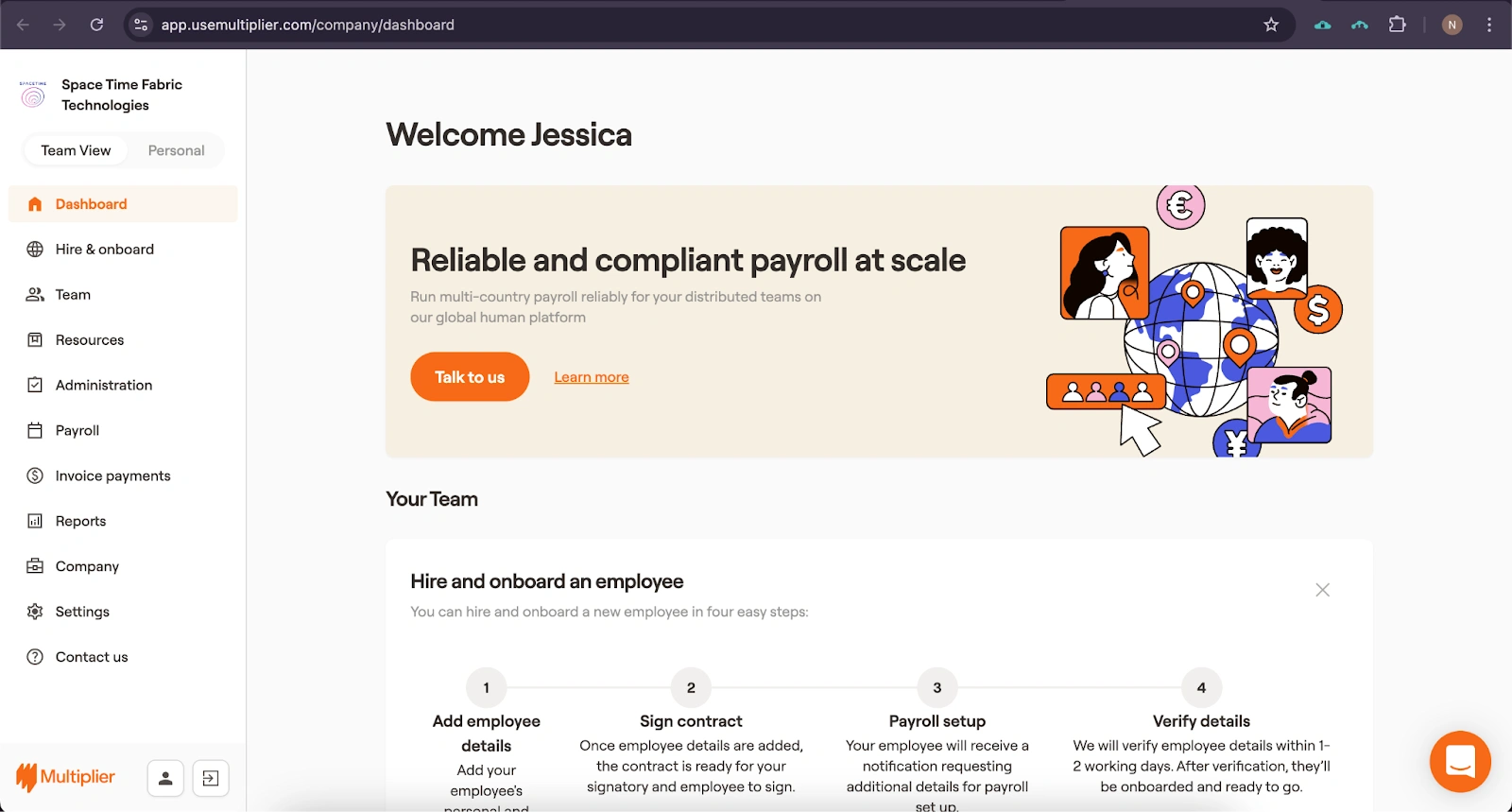
Multiplier dashboard
Enlarge screenshot
![]()
Reviewed by Martynas Pupkevicius · Fact-checked by Michael Ennis
Opens usemultiplier.com

★★★★★4.5
Pricing & terms
Entity model
Confirm direct or partner delivery for the actual market, including UK, Germany, France, India and Australia.
Evidence scope and next check
Oyster's current product page does not give the complete owned/partner split. Request the employer and delivery route in writing.
Published starting-fee example (per employee/month)
USD 699 on monthly billing; annual seats are priced by quote, prepaid and non-refundable, with seat reuse permitted.
Our rating
4.5/5
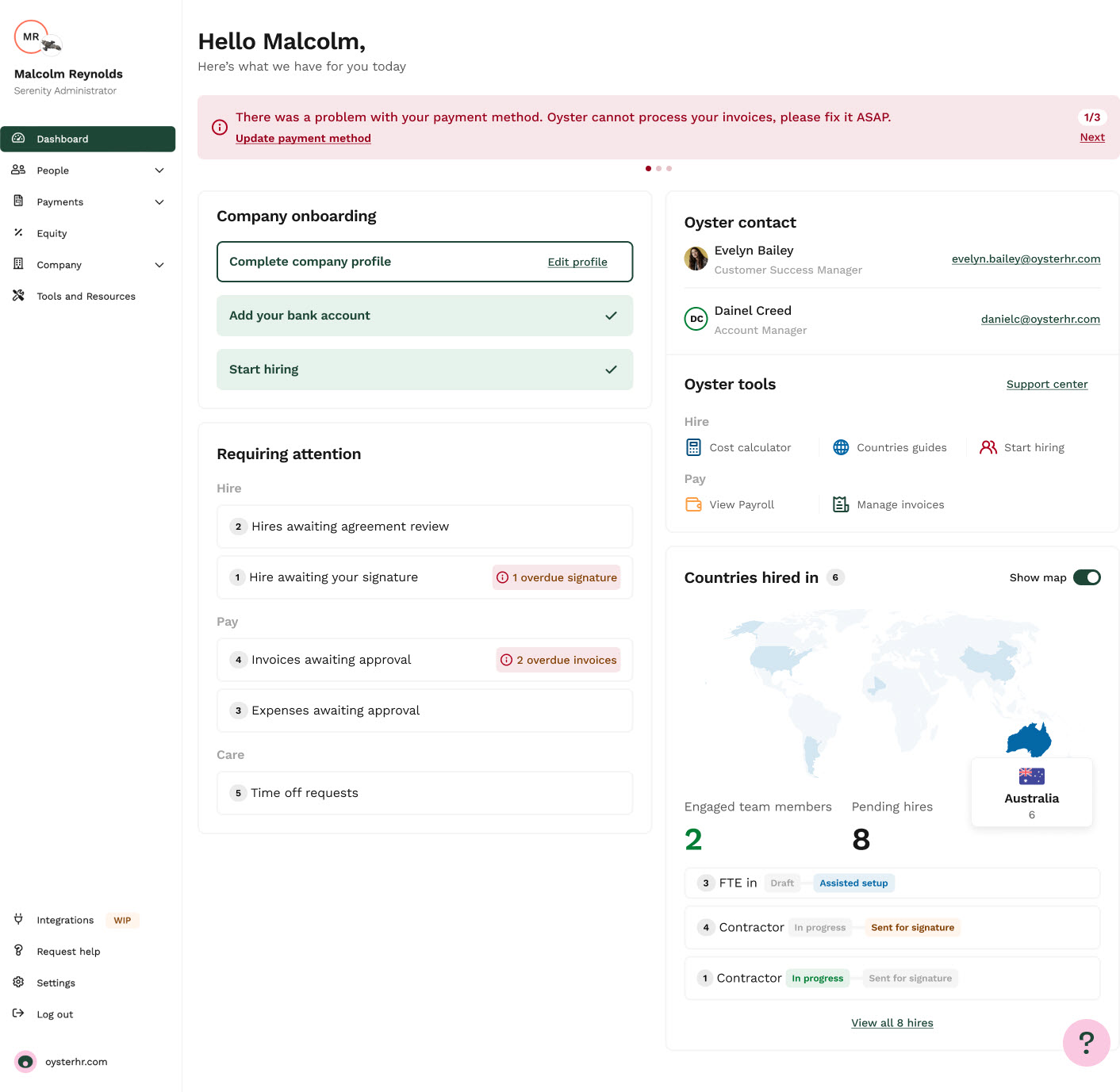
Oyster dashboard
Enlarge screenshot
![]()
Reviewed by Martynas Pupkevicius · Fact-checked by Michael Ennis
Opens oysterhr.com

★★★★★4.9
Pricing & terms
Entity model
Confirm the employing company, ownership or partner relationship and payroll operator for each country.
Evidence scope and next check
Use the applicable country agreement and entity evidence; a published coverage total does not name the legal employer.
Published starting-fee example (per employee/month)
Global from USD 499; Select from USD 199 in eligible countries and salary ranges, per employee/month. Confirm country offer and commitment.
Our rating
4.9/5
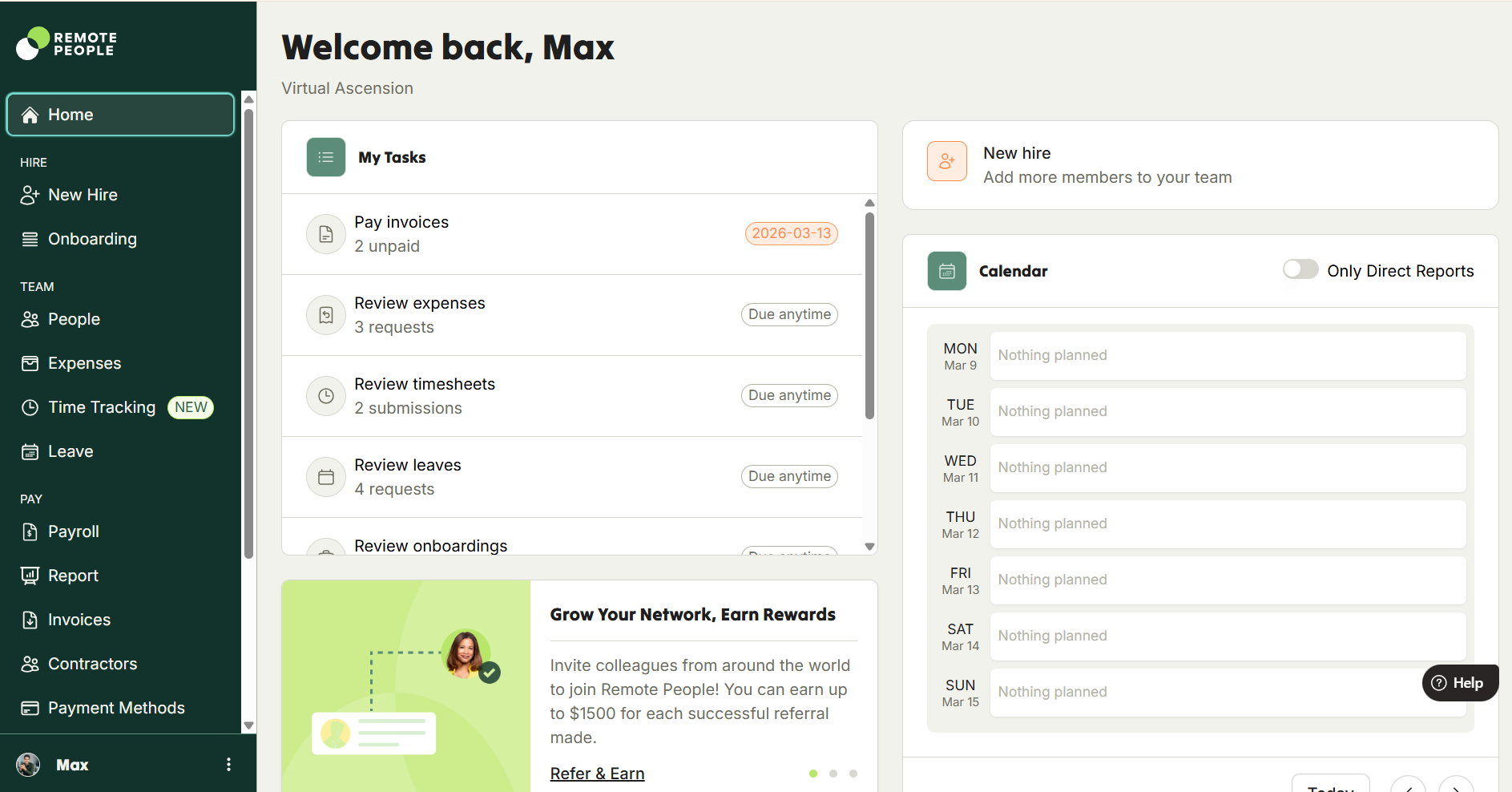
RemotePeople dashboard
Enlarge screenshot
![]()
Reviewed by Martynas Pupkevicius · Fact-checked by Michael Ennis
Opens remotepeople.com

★★★★★0.5
Pricing & terms
Entity model
⚠ Trustpilot warning: rating suspended for a breach of its guidelines; fake reviews removed (8 Nov 2026).
Provider FAQ describes vetted in-country partner delivery
Evidence scope and next check
RemoFirst pricing FAQ checked 15 October 2026. This is a provider description; confirm the named employer and full contract chain.
Published starting-fee example (per employee/month)
From USD 199 per employee/month; no annual contract or headcount minimum advertised. Country price varies.
Our rating
0.5/5
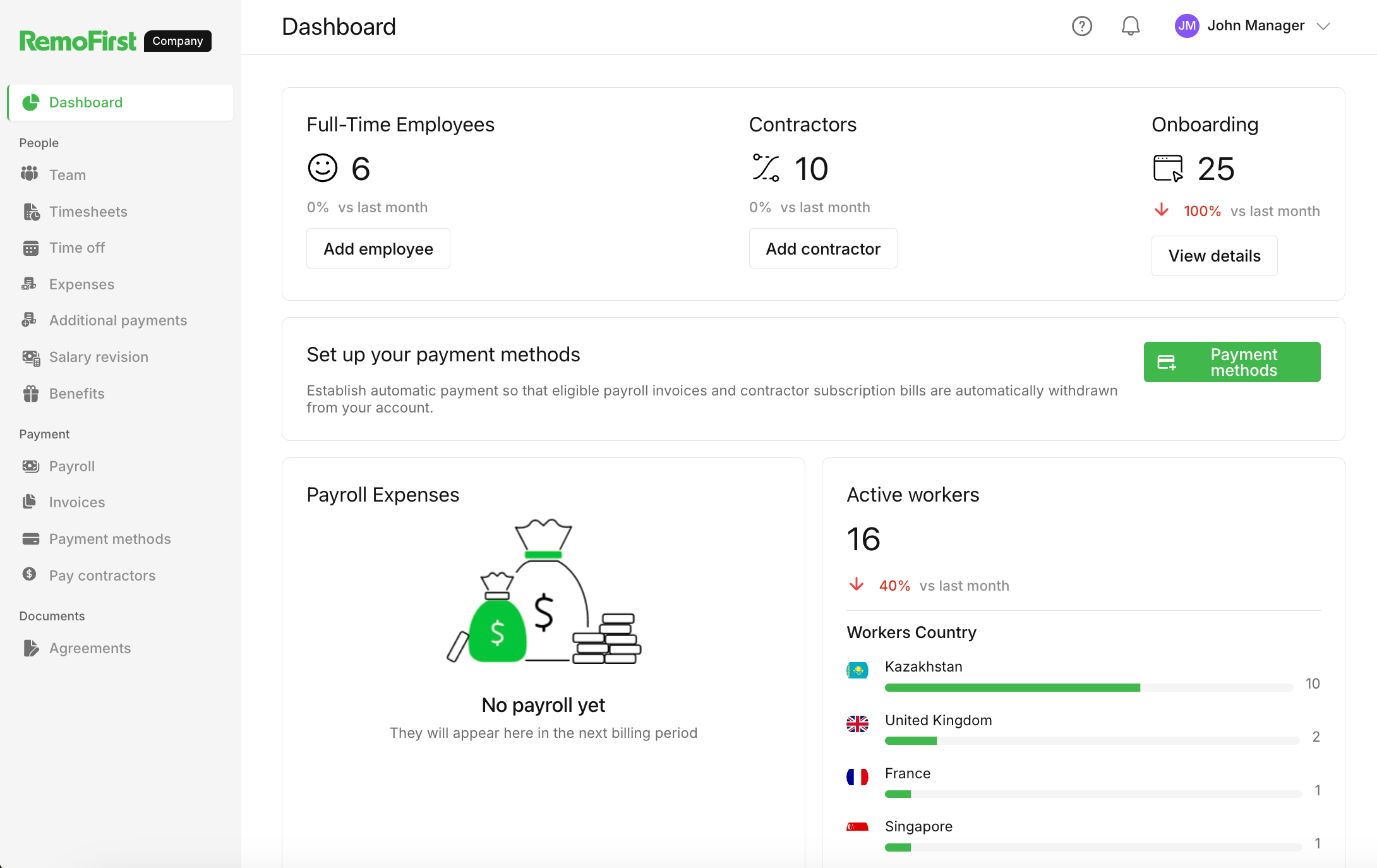
RemoFirst dashboard
Enlarge screenshot
![]()
Reviewed by Martynas Pupkevicius · Fact-checked by Michael Ennis
Opens remofirst.com
Fig. 1 · Six selected providers: public model statements and the country evidence to request. Starting fees and stated billing terms rechecked 1 November 2026; obtain a current country quote.
Delivery-model evidence retains its original check dates. Multiplier’s dollar currency requires confirmation; all fees exclude employment costs and separately quoted services.
The listed service fees are dated provider examples. Compare the actual country, plan, billing commitment, scope, employment costs and cash requirements. If both are on your shortlist, use our Deel vs G-P comparison to check their proposals.
The EOR cost guide covers plan and funding conditions. For a wider shortlist, compare employer of record providers and confirm the employing entity in each country.
7. Trade-offs: speed, liability, price, exit
| Factor | Owned entity | Partner-routed |
|---|---|---|
Factor
Onboarding speed
|
Owned entity
Obtain the country schedule, prerequisites and recent evidence
|
Partner-routed
Obtain the partner schedule, prerequisites and recent evidence
|
Factor
Legal employer
|
Owned entity
A subsidiary of the group you signed with
|
Partner-routed
A local firm; request the relevant responsibility and service terms
|
Factor
Liability chain
|
Owned entity
Check the contracting entities, indemnities and any parent guarantee
|
Partner-routed
Two steps; partner terms sit behind the platform’s; joint-liability regimes (Mexico) can reach you
|
Factor
Price
|
Owned entity
Obtain the actual country and plan quote; ownership alone does not set the fee
|
Partner-routed
Compare the service fee, employment costs, deposits and quoted FX spread
|
Factor
Employee data
|
Owned entity
Group ownership; verify each entity’s roles, systems and assurance scope
|
Partner-routed
Identify partner-held records, legal roles, transfer basis and relevant assurance
|
Factor
Payroll fixes
|
Owned entity
Named payroll owner and written escalation/resolution commitments
|
Partner-routed
Named platform and partner contacts; test escalation and resolution
|
Factor
Exit
|
Owned entity
Confirm records holders, transfer mechanism and local documentation
|
Partner-routed
Confirm the partner’s cooperation and records access alongside the procedure local law permits for the transfer and the employees’ rights.
|
Fig. 2 · Owned entity vs partner-routed across seven factors, from onboarding speed to exit
Before signing, ask who would hold the records if you handed payroll to another provider. In either model, an employee transfer may require new documents or other local formalities. Agree which employers and records holders must cooperate. The guide to switching EOR providers shows how to plan the handover.
Run the same failure through both models
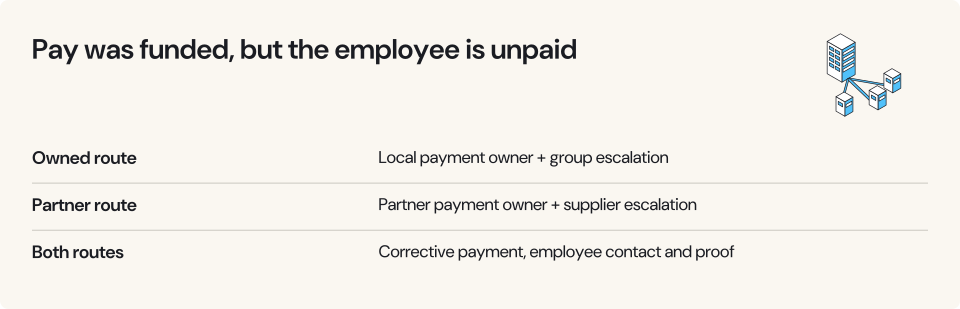
Suppose your team approved payroll and sent the money on time, but an employee hasn’t been paid. At an owned employer, who can release the payment and who in the group can escalate it? At a partner employer, ask what the platform must do to reach the person who controls the payment. In both cases, you need a correction plan, someone to update the employee and evidence that the money reached them.
8. Review every country requirement before choosing
Go through every country requirement, even if an early answer is missing. Record who will get the evidence and what they need to do next. Keep the question open until you have the answer in writing.
If an answer is missing, record the owner and next action while you continue through the remaining questions. Keep that requirement open until the relevant evidence resolves it.
- Q1. Have both providers documented the local employer, necessary licences and responsibility chain?
- YES → Compare each complete quote and the country evidence before shortlisting. Continue through the remaining requirements for each shortlisted provider.
- NO → continue to Q2
- Q2. Does the proposed service meet the support hours and payroll needs of your hiring region?
- YES → Verify the named team, support commitments and employing entity in each country. Continue to the liability, data and exit checks.
- NO → continue to Q3
- Q3. Have you verified liability, data handling and transition cooperation for the actual contracting entities?
- YES → Assess whether the evidenced service improvement justifies the quoted premium. Record the evidence and any unresolved approval conditions.
- NO → Keep unresolved requirements open before choosing either model. Verify entity status per country and run a 30-day pilot →
Whatever the model, get three things in writing before you sign: the legal name of the employing entity in each target country, the responsibilities and remedies if that employer or its payroll operator fails, and recent onboarding timings for the actual country team. For partner-routed delivery, include the partner’s obligations and onboarding evidence. Questions 7 to 13 of our 47-question RFP checklist cover entities and coverage.
9. Frequently asked questions
Is an EOR that uses a partner network legally risky?
How do I find out whether a provider owns its entity in my country?
Does a partner model cost less?
How can I check G‑P's owned-entity claim?
Does the entity model matter for a single hire?
What are the tradeoffs between an owned-entity EOR and a partner network?
An owned-entity model keeps the employing company within the provider’s group; a partner model adds an independent local employer. Compare who handles payroll corrections, how teams share employee records, how escalations work and who cooperates when you leave. An extra handoff can complicate an issue, but ownership alone does not establish better service, lower costs or compliance.
For each hiring country, request the named employer, written responsibilities, a complete quote and the exit process. Use the tradeoffs table to compare the same requirements across both models.
10. Sources
The sources behind this guide, grouped by topic. Dates show when we last checked a page. Prices and terms change, so confirm them in your quote.
Labor leasing and outsourcing law
5 sourcesGermany · gesetze-im-internet.de
Arbeitnehmerüberlassungsgesetz (AÜG)
Labor-leasing licensing and the 18-month assignment cap. Section 16 sets the fine tiers: up to €30,000 for unlicensed leasing and for exceeding the assignment cap, up to €500,000 for equal-pay breaches. Section 1 is used in the delivery model comparison, checked 3 Oct 2026.
Germany · Federal Employment Agency (BA)
Arbeitnehmerüberlassung guidance
The labor-leasing license the legal employer must hold.
Germany · German Customs (Zoll)
Consequences of illegal labor leasing
Employment is deemed to exist with the client, with fines up to €30,000 for using workers from an unlicensed lender. Checked Sep 2026
Germany · Haufe
The AÜG 18-month assignment cap and its reset rule
The cap comes from the April 2017 reform; a break of more than three months resets it.
Mexico · Ministry of Labor (STPS)
Specialized-services registration under the April 2021 Federal Labor Law reform.
Data protection law and regulators
3 sourcesEuropean Union · European Commission
Standard Contractual Clauses, Implementing Decision (EU) 2021/914
Dated Jun 2021.
European Union · EUR-Lex
GDPR, Regulation (EU) 2016/679
Article 28 processor obligations.
European Union · EDPB
Guidelines 07/2020 on controller and processor roles
Used in the delivery model comparison. Checked 3 Oct 2026
Standards and certification bodies
2 sourcesAICPA & CIMA
System and Organization Controls (SOC) suite
What a SOC 2 Type II report attests, and for whose systems.
International · ISO
ISO/IEC 27001:2022, information security management systems
Cited for certification scope.
Provider claims and pricing
6 sourcesDeel
Owned entity vs partnerEntity coverage postPricingEOR product page
The vendor’s own description of both delivery models. Entity-coverage claims: owned infrastructure and entities in over 100 countries, and owned entities and a payroll engine in 130+ countries (EOR page checked Sep 2026 and 15 Oct 2026). EOR list price $599 per employee per month (fee and billing basis rechecked 1 Nov 2026).
G‑P
EOR solutions pageCompany profileG‑P vs RemoFirst guide
EOR from $599 per employee per month and coverage in 180+ countries (checked Sep 2026); founded 2012. The G‑P vs RemoFirst guide claims 100+ wholly owned entities (checked Sep 2026; guide updated 23 Sep 2026 and rechecked 15 Oct 2026).
Multiplier
Core $459 per employee per month billed annually or $499 billed monthly (checked 26 Sep 2026; fee and billing basis rechecked 1 Nov 2026). Says it operates through its own legal entities in every country, not a partner network, with no third-party partner dependency in the employment chain (checked Sep 2026; FAQ rechecked 15 Oct 2026).
Oyster
$699 per employee per month on monthly billing, annual discounts and employment in 120+ countries (fee and billing basis rechecked 1 Nov 2026). EOR product page checked 15 Oct 2026.
RemoFirst
$199 per employee per month and 185+ countries (fee and billing basis rechecked 1 Nov 2026). Pricing FAQ checked 15 Oct 2026.
RemotePeople
Global from USD 499 per employee per month; Select from USD 199 in selected countries and qualifying employee salary ranges. Confirm quote currency, rate, commitment and deposit terms. Checked 1 Nov 2026
Our research
2 sourcesThe Best EOR
Review methodology and our ratings
Includes how we assess coverage and entity ownership.
The Best EOR
G‑P reviewMultiplier reviewOyster reviewRemoFirst reviewRemotePeople review
Our 2026 provider reviews, for further country and service context.
If you spot a changed price or a conflicting source, send it through the contact page and we’ll review it.
This guide is for general information only and does not provide legal, tax, accounting, or financial advice. For advice about your business, consult a qualified professional familiar with the rules where you hire. Read our research methodology to learn how we assess sources.