


Guide overview
What must be ready before an EOR employee starts?
Confirm the contract, work permission, payroll and equipment.
Agree the employing entity, signed terms, work permission, payroll route, benefits and working equipment before confirming the first working day. The illustrative 14-day plan has named owners and readiness checks; the actual start depends on the country, provider and hire.
Contract and permission
Clear before starting
Confirm the applicable contract and right-to-work requirements.
Employment setup
Check readiness
Agree registration, payroll and benefits requirements with the EOR.
Equipment
Confirm delivery
Order against the employee’s confirmed delivery date.
Payday
Plan a compliant route
Agree how contractual and statutory payment dates will be met.
Check before acting
Use a country-specific plan and start only after the EOR clears the applicable requirements.
What to record in the worksheet
Scope
Task or required check · Country and employee · Person responsible
Evidence and follow-up
Dependency · Due date / timezone · Evidence · Employee action · Readiness status
Complete these checks before setting the first working day
The applicable country rules and the written offer determine what must be completed before the start.
| Gate | Evidence needed | Owner to confirm |
|---|---|---|
Gate Work location and permission | Evidence needed Actual work country, immigration status and any required checks. | Owner to confirm EOR; employee supplies documents. |
Gate Employment terms | Evidence needed Correct employer, role, pay, date and required local documentation. | Owner to confirm EOR and employee; client checks commercial terms. |
Gate Registrations | Evidence needed Required registrations and their legal deadlines, with status recorded. | Owner to confirm EOR, including any local partner. |
Gate First pay | Evidence needed Contractual payday, onboarding cutoff and any off-cycle payment that meets local pay rules. | Owner to confirm EOR payroll and client finance. |
Gate Benefits | Evidence needed Statutory arrangements and confirmed start date for promised insured cover. | Owner to confirm EOR or insurer; client approves the package. |
Gate Tools and first-week work | Evidence needed Delivered equipment, tested access and a named manager. | Owner to confirm Client IT and hiring manager. |
An active login tells you the account is ready. Get the EOR’s written clearance for this employee and resolve any pay or coverage gap before confirming they can start work.
Employment documents and any work authorization are ready.
Payroll funding, payment timing and enrolment are confirmed.
Required tools and access are available.
The manager owns the first-day plan.
Set the date around the dependencies that apply to this hire.
Illustrative dependency map. Several tasks can run in parallel.
How to use the illustrative 14-day onboarding plan
Day one in this plan is the day the employee accepts the offer. We count calendar days, while a supplier may quote delivery in working days. Your team provides the offer details and equipment and sets up time with the manager. The EOR handles the contract, registrations, benefits and payroll. The employee supplies their documents and signs. Each task names the person the next one depends on.
Request the local onboarding schedule and a delivery date for the equipment before you set the start date. Benefits enrolment and first payroll also have deadlines, so start those conversations while the contract is being prepared.
This example assumes the EOR employs through its own entity and the hire already has permission to work where they live. If the EOR uses a local partner, ask which entity will employ the person and who needs to approve the start. If the hire needs a visa, get a separate timeline for that country and case.
The plan also assumes the EOR agreement is signed and you are onboarding your first hire. If you have not picked a provider yet, do that first. The EOR cost guide sets out the inputs for your hiring budget.
Day 1: send complete offer data to the EOR
Incomplete offer information can delay drafting; ask which missing items block the next step. Send one message with everything:
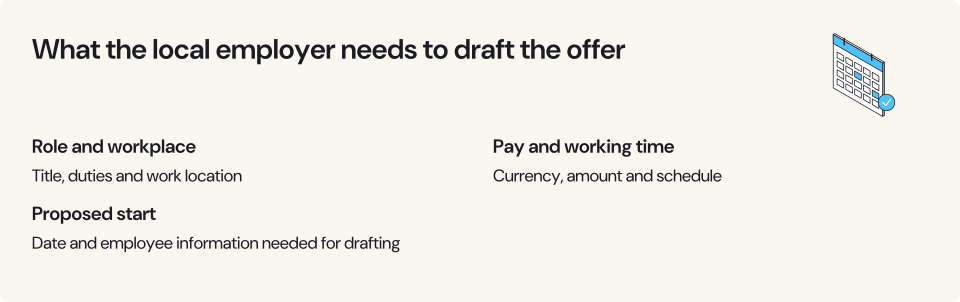
An Italian passport and an interview from Germany tell you little about where a candidate living in Spain will do the job. Ask where the person will usually work and whether any work will take place across borders. Have the EOR assess those facts for employment, tax and social security before it drafts the offer.
Set the start date with the payroll cutoff in mind. If the ordinary cutoff cannot be met, agree a payment route that still satisfies the contractual payday and local law before the hire starts.
Days 2–3: review the local employment contract
Review the country template’s mandatory provisions with the EOR, including working-time limits, minimum leave, notice floors and a 13th-month salary where the law or a collective agreement requires one. Do not agree terms below a mandatory floor. Ask the EOR to explain the applicable law, collective agreement and any permitted variation, then review the commercial terms:
Before you approve the first draft, read our guide to the nine EOR contract clauses and confirm any amendment charge.
Changes after signature are slow because an amended contract goes back through drafting and review. Deel’s help center quotes 3–5 business days per amendment request, and up to 10 for complex cases.
Days 4–5: employee review and right-to-work checks
Give the employee at least 48 hours with the contract. Meanwhile, the EOR platform collects their documents: passport or national ID, tax identification number, social-security number, bank details (IBAN in most of Europe), proof of address and professional certificates for regulated roles.
The right-to-work check must be complete before the start date. The EOR runs it as the legal employer, but get written confirmation. In the UK, since 13 February 2024, the civil penalty for employing someone without a valid check has been up to £45,000 per worker for a first breach and £60,000 for a repeat. A compliant check may establish a statutory excuse, subject to the Home Office rules and exceptions, including knowledge of illegal working.
Complete the right-to-work checks and documentation required before work begins, and record any registration deadlines that fall later. Do not assume that an unsigned document makes someone uninsured or prevents an employment relationship from arising. Avoid informal early work while requirements remain unresolved.
By this checkpoint, obtain both signatures and complete the employee’s onboarding documents.
Days 6–8: check equipment delivery and IT access
Order hardware after offer acceptance, working backward from a confirmed delivery date. International delivery can take ten working days or longer, depending on the route and customs. Allow for possible customs delays in Brazil or India.
| Route | How it works | Best when |
|---|---|---|
Route Deel IT (built on Hofy, acquired 2024) | How it works Device procurement and lifecycle support through Deel IT. Confirm availability for the destination, delivery commitment, customs/duties, device management and offboarding retrieval in the actual quote; do not treat a global marketing estimate as the hire’s delivery date. | Best when You use Deel as your EOR and want one system of record. |
Route Firstbase (part of AppDirect) | How it works AppDirect-owned procurement and device lifecycle platform, separate from your EOR. Confirm the destination, customs and duties, storage, repairs, device-management scope and retrieval terms. Ask for the quoted delivery commitment and its conditions rather than assuming a published aggregate delivery rate applies. | Best when You hire in more than one country or expect churn, and your EOR is not Deel. |
Route Local procurement | How it works Purchase locally or arrange a payroll stipend. Compare the full device, support, warranty and retrieval cost. Confirm local tax and expense-documentation treatment before choosing reimbursement or a cash stipend. | Best when One hire, one easy-shipping country, and you accept the retrieval risk. |
Fig. 1 · Three equipment routes for international hires, compared by fit
When you order the laptop, record who owns it and who will collect it when the employee leaves.
Days 7 and 8 cover IT setup, which you cannot hand to the EOR. The EOR is the legal employer, but your systems, data and access decisions stay with you. Before the first day:
By day 8 in this example, test the setup the employee needs for their first task. When the laptop arrives, they should be able to sign in and get to work without waiting for another access approval.
Days 9–11: benefits enrollment and payroll readiness
Provide the required information and confirm statutory enrolment and effective dates with the EOR. Registering the employee for social security, healthcare and state pension is the EOR’s legal duty and part of employment registration, so ask it to confirm the registration is complete. Two other items need your attention:
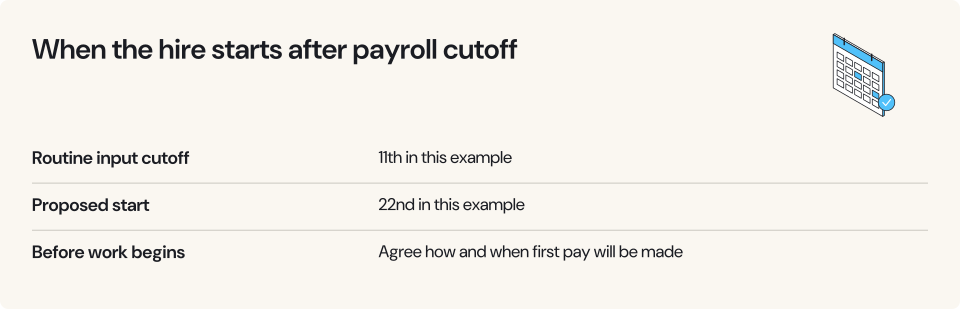
The payroll cutoff governs routine processing. Here are two examples, current as of June 2026:
Check that the EOR has put the hire on the country’s payroll and has the signing bonus, relocation allowance and first expenses before cutoff. For a start on the 22nd after an 11th-day cutoff, get the first pay date in writing before work starts. If the ordinary run would miss the deadline, agree an off-cycle payment or another way to meet the payday. Use the monthly EOR payroll calendar to track the handoff.
Days 12–14: final checks and the first working day
On day 12, ask the employee whether the laptop arrived. The day 8 tracking update can’t confirm that. Give them the week-one calendar, the name of their buddy and a first task they can finish that week.
The manager runs day 13, the first day, which covers four things:
On day 14, schedule a daily 15-minute check-in for the first week, then twice-weekly one-to-ones through probation. Book review dates, for example at the halfway and 80% points, early enough to meet the actual probation, notice and procedural deadlines. Also book a 20-minute payslip walkthrough for after the first payroll run and invite the EOR’s payroll contact. A German payslip has a dozen deduction lines that a US or UK manager cannot explain on the spot.
Give the employee a usable welcome pack
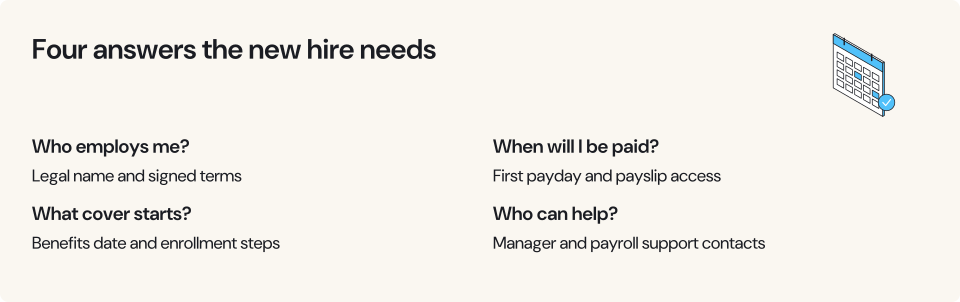
Put the legal employer’s name, signed terms, first payday and payslip instructions in the welcome pack. Tell the employee when benefits start, how to enrol or ask for leave, and how to get their equipment and sign in. Include the manager’s and payroll team’s contact details and where to escalate a problem. If anything is pending, name the person following up. Ask what else the employee needs for day one.
An illustrative 14-day international onboarding checklist
The table pastes into Sheets or Notion as 14 rows, one per day, each showing who is responsible.
| Day | Task | Owner |
|---|---|---|
Day D1 | Task Send the complete offer data pack: identity, role, money, terms, benefits tier, equipment needs. Confirm habitual work location, planned cross-border work and right-to-work status; obtain the EOR’s country clearance. | Owner You |
Day D2 | Task EOR drafts the local contract from the country template. | Owner EOR |
Day D3 | Task Review commercial terms: salary, title, start date, agreed probation terms that local law allows, IP assignment. | Owner You |
Day D4 | Task Employee reviews the contract and uploads ID, tax number, social security number, bank details. | Owner Employee |
Day D5 | Task Right-to-work check confirmed in writing; both parties sign; platform onboarding complete. | Owner EOR + Employee |
Day D6 | Task Check equipment delivery and setup against the confirmed start date. Place orders after offer acceptance; record ownership and the return route. | Owner You |
Day D7 | Task Create email and SSO accounts; enroll the device in MDM for zero-touch setup. | Owner You |
Day D8 | Task Request approval-gated access (repos, CRM, finance tools); verify shipment tracking. | Owner You |
Day D9 | Task Confirm supplemental benefits enrollment before the insurer's joiner deadline; check pension/auto-enrolment handling. | Owner You + EOR |
Day D10 | Task Get the country payroll calendar in writing; confirm the hire is registered in the current run. | Owner You + EOR |
Day D11 | Task Submit signing bonus, allowances, and first expenses before your country's published cutoff. | Owner You |
Day D12 | Task Final prep: laptop delivered, week-one calendar populated, buddy named, first task assigned. | Owner You |
Day D13 | Task First day: welcome call in their time zone, team intros booked, 30/60/90 document shared. | Owner You |
Day D14 | Task Set the meeting schedule: daily check-ins in week one, twice-weekly 1:1s, probation reviews scheduled, payslip walkthrough booked. | Owner You |
Fig. 2 · The 14-day onboarding checklist, one row per day with owner
Turn the checklist into an onboarding tracker
Set actual dates from the country process and payroll calendar. Each task needs an owner, dependency and evidence of completion. Record any document, work-authorization or payroll dependency that requires a different start date.
| The working record | Fields to complete |
|---|---|
The working record Scope | Fields to complete Task or required check · Country and employee · Person responsible |
The working record Evidence and follow-up | Fields to complete Dependency · Due date / timezone · Evidence · Employee action · Readiness status |
Probation, notice and review rules to confirm
Agree any permitted probation arrangement before employment begins, choose a period appropriate to the role and book reviews. Confirm when the relevant review and notice periods start. These reference points are current as of June 2026. Confirm the contract type, collective agreement, renewal rules and any protected status.
| Country | Selected contract or notice rule | Notice during probation |
|---|---|---|
Country Germany | Selected contract or notice rule For an agreed probation period, §622(3) allows the two-week-notice regime for at most six months; this is not a universal trial-duration cap | Notice during probation Two weeks under §622(3), subject to applicable contractual/collective rules. Confirm the valid form and delivery date before relying on that notice regime. |
Country Netherlands | Selected contract or notice rule 2 months (permanent contracts); none allowed on contracts of 6 months or less | Notice during probation Immediate, either side, but the reason must not be discriminatory. |
Country France | Selected contract or notice rule For an open-ended contract, initial periods are 2–4 months by category. A permitted renewal depends on the applicable sector agreement, contract and employee agreement; up to eight months for cadres with a valid renewal. | Notice during probation Staged “délai de prévenance”: 24 hours to 1 month depending on time served. |
Country Spain | Selected contract or notice rule Absent a governing collective agreement: normally six months for qualified technicians, two months for others; small-employer and short fixed-term rules differ (art. 14) | Notice during probation Immediate, either side. |
Country Brazil | Selected contract or notice rule 90 days total, typically structured 45 + 45 (CLT art. 445) | Notice during probation An employer’s premature ending may trigger half the remaining remuneration under CLT art. 479; check the early-termination clause and art. 481 before applying that result. |
Country United Kingdom | Selected contract or notice rule No general statutory probation cap; use the actual contract and applicable statutory rights rather than an assumed customary period | Notice during probation Check contractual and statutory notice separately. For ordinary unfair dismissal, Great Britain usually requires two years now, with a six-month period scheduled from 1 January 2027; Northern Ireland usually requires one year. Exceptions and other day-one protections remain. |
Fig. 3 · Selected probation and notice reference points for six countries. Contract type, collective agreement and individual rights can change the result; the Great Britain/Northern Ireland distinction and Germany notice scope were checked 15 October 2026.
A probation label does not remove applicable discrimination, wage, notice or procedural rights. Schedule reviews early enough to follow the actual local process, serve valid termination notice and meet the relevant deadline. If performance is borderline, add support and obtain country-specific advice before any renewal or extension; permitted routes differ.
If the working relationship looks more like a project engagement than employment, read EOR vs contractor, which covers when each is the right choice.
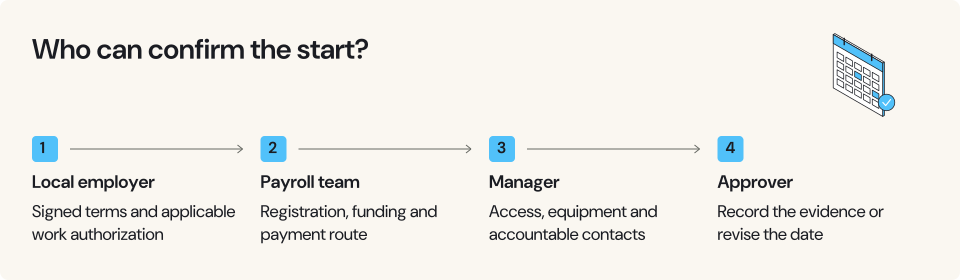
Record the first-day readiness decision
Before confirming the start, name the legal employer and check the signed terms, work permission where required, payroll funding, benefits start date and employee access. Keep the confirmation and approver for each item. If a required check is still open, name who will resolve it and agree a revised date.
EOR onboarding FAQs
Can my new hire start working before the contract is signed?
What happens if we miss the payroll cutoff?
Who owns the laptop if the employee leaves?
Can an EOR sponsor a work visa?
Is 14-day EOR onboarding realistic in every country?
Do I need to handle benefits myself with an EOR?
Sources and policy check dates
The sources behind this guide, grouped by topic. Dates show when we last checked a page. Prices and terms change, so confirm them in your quote.
Right to work, registration, pay and pensions
6 sourcesUnited Kingdom · Home Office
Code of practice on preventing illegal working
Civil penalties were raised to a maximum of £45,000 per worker for a first breach and £60,000 for a repeat, effective 13 Feb 2024.
Germany · Deutsche Rentenversicherung
Germany · German Customs (Zoll)
A new employment is reported with the first payroll, within six weeks at the latest. Immediate reporting at the start of work applies only in listed sectors such as construction and hospitality. Checked Sep 2026
Germany · gesetze-im-internet.de
Used in the onboarding example. Checked 3 Oct 2026
United Kingdom · The Pensions Regulator
Automatic enrolment postponement guidance
Postponement of up to 3 months. The notice deadline was checked 15 Oct 2026.
Brazil · Presidência da República
The statutory 13th salary.
Contract, probation and dismissal rules
13 sourcesUnited Kingdom · GOV.UK
Written statement of employment particulars
Used in the onboarding example. Checked 3 Oct 2026
European Union · EUR-Lex
Used in the onboarding example. Checked 3 Oct 2026
Germany · gesetze-im-internet.de
Two-week notice during agreed probation for at most six months; not a universal duration cap. Checked 15 Oct 2026
Netherlands · Overheid.nl
Civil Code, Book 7: art. 7:652
Probation is capped at 2 months on permanent contracts and not allowed on contracts of 6 months or less.
France · Code du travail numérique
2 to 4 months by category, with a staged délai de prévenance. The statutory provisions are French Labour Code art. L1221-19 to L1221-26.
Spain · Boletín Oficial del Estado (BOE)
Workers’ Statute, consolidated text
Article 14 sets the probation limits.
Brazil · Presidência da República
Arts. 445 and 479: the 90-day probation cap and the early-termination indemnity.
United Kingdom · Acas
Great Britain’s scheduled six-month ordinary unfair-dismissal qualifying period from 1 Jan 2027; not the Northern Ireland rule.
United Kingdom · GOV.UK
The Great Britain and Northern Ireland distinction. Checked 15 Oct 2026
United Kingdom · business.gov.uk
Government employer guide: unfair dismissal rights
Great Britain scope and the scheduled Jan 2027 change. Checked 15 Oct 2026
Germany · gesetze-im-internet.de
A post-contract non-compete requires compensation of at least half of final pay.
Germany · Federal Labour Court (BAG)
Press release on case 8 AZR 453/21, 25 August 2022
Quotes HGB §74(2): a post-contract non-compete requires compensation of at least half of final pay for each year it runs. Checked Sep 2026
Germany · gesetze-im-internet.de
Employer claiming of German service inventions. Checked 15 Oct 2026
Provider help centers and announcements
3 sourcesDeel
Payroll cut-off datesFlexible payroll announcementIntroducing Deel ITImmigration services
The payroll cut-off is the 20th of the month in most countries (checked Sep 2026); the EOR cutoff extension to the 20th rolled out in 2023. Deel IT is historical service background: confirm current destination and delivery scope. Immigration and visa sponsorship are offered in a subset of markets.
Firstbase
IT procurement servicesAppDirect acquisition
IT procurement and device lifecycle; confirm the actual destination and service quote. AppDirect’s Firstbase acquisition is dated 17 Dec 2024 (checked 15 Oct 2026).
Remote
Payroll cutoff on the 11th of the month at 23:59 UTC, or the 16th in some countries.
If you spot a changed price or a conflicting source, send it through the contact page and we’ll review it.
This guide is for general information only and does not provide legal, tax, accounting, or financial advice. For advice about your business, consult a qualified professional familiar with the rules where you hire. Read our research methodology to learn how we assess sources.